
Dress Manufacturer for Buying Managers
Commercial dress development built around assortment, target cost, sample approval, launch timing, bulk control, and repeat-order continuity.
Jinfeng Apparel supports established fashion brands and buying teams that need more than a sewing quotation. Dress programs are reviewed against range architecture, fabric direction, fit risk, target cost, quantity by style and color, private-label requirements, and the planned launch window before sampling begins.
- 10-30 style collection support through grouped sampling, revision tracking, factory allocation, SKU control, and staged approvals.
- 6 owned women’s fashion factories, 10+ long-term production partners, 18+ sewing lines, and 6+ flexible production lines.
- 2 sample rooms, 7+ senior pattern makers, 20+ sample machinists, 12+ merchandisers, and 15+ QC inspectors.
- MOQ starts from 200 pcs per style/color, subject to fabric, color, trim, construction, packaging, and scheduling requirements.
Production Facts Buying Teams Can Verify
Since 2008
6 Owned Factories
10+ Production Partners
100,000+ Monthly Capacity
2 Sample Rooms
15+ QC Inspectors
What Buying Teams Need From a Dress Supplier
Range Relevance
Target Cost
Launch Discipline
Stock Exposure
Supplier Reliability
Repeat Continuity
Is Jinfeng the Right Supplier Fit?
Best Fit For
Global and regional fashion brands, established ecommerce labels, retail groups, buying offices, sourcing companies, and apparel programs requiring custom dresses, skirts, jumpsuits, matching sets, private labels, seasonal collections, multi-style development, bulk production, and repeat-order support.
- Reference images, samples, sketches, tech packs, line sheets, or an established product brief are available.
- The program has a planned quantity by style and color, an intended launch period, and a defined sales channel.
- The team values pattern development, sample revision, PP approval, bulk consistency, private-label execution, and transparent project management.
Not Designed For
Jinfeng Apparel does not operate as a ready-stock wholesaler, one-piece fulfillment service, or an unstructured micro-order workshop.
The production model is built around professional sampling and planned bulk manufacturing, not immediate inventory resale or single-unit dispatch.
- No specification, no product direction, no sample budget, and no production plan.
- Orders divided into 1-50 pieces with no realistic path to standard production.
- Requests based only on the lowest possible unit price while ignoring fabric, fit, construction, QC, and delivery risk.
Buying Risks We Help Control
Margin Erosion
Sample Drift
Launch Delay
SKU Confusion
Return Exposure
Reorder Mismatch
How to Evaluate a Dress Manufacturer
A reliable vendor review should test commercial fit and manufacturing evidence together. The matrix below can be used during RFI, sample evaluation, factory audit, quotation comparison, and trial-order approval.
| Evaluation Area | What to Test | Evidence to Request |
|---|---|---|
| Product relevance | Relevant dress categories, fabrics, structures, and selling occasions | Recent category samples, anonymized case records, fabric and construction knowledge |
| Development | Pattern, fit, sampling, revision, and PP approval capability | Sample-room structure, pattern team, sample versions, revision records |
| Commercial costing | Transparent cost drivers and viable optimization routes | Fabric/trim breakdown, construction notes, quantity assumptions, packing scope |
| MOQ and allocation | Clear minimum by style/color and realistic line allocation | Quantity plan, fabric MOQ, trim MOQ, color split, factory assignment logic |
| Bulk quality | Material, cutting, sewing, measurement, finishing, and packing control | Inspection plan, tolerance rules, in-line records, final QC evidence |
| Delivery control | Milestone planning from approval to warehouse receiving | Critical path, material status, production status, QC window, shipment plan |
| Brand protection | NDA, unpublished design protection, label and file confidentiality | NDA process, image-use rules, restricted access to brand files |
| Repeatability | Ability to reproduce approved fit, materials, trims, and packing | Pattern archive, Golden sample, fabric reference, trim card, packing records |
Dress Categories Built for Commercial Assortments

Mini and Midi

Party and Occasion

Bodycon and Club

Corset and Structured

Satin and Slip

Mesh and Lace

Resort and Printed

Jumpsuits and Sets
Build a Balanced Dress Range
A successful assortment needs planned roles for volume, image, margin, seasonality, and repeatability. Jinfeng Apparel can organize development around five commercial dimensions so the range feels intentional rather than becoming a collection of unrelated references.
Length and Silhouette Architecture
A range can be mapped across mini, midi, maxi, and floor length, then balanced through bodycon, A-line, slip, corset, halter, backless, off-shoulder, ruched, pleated, and structured shapes. Length is not only a styling choice: it changes fabric consumption, lining, cutting efficiency, pressing, shipping volume, and target cost.
Core silhouettes should carry more color and size depth, while statement silhouettes can carry narrower quantity. Pattern blocks may also be reused selectively for new necklines, sleeves, fabric updates, or length extensions, reducing repeated development without forcing unrelated styles onto one base pattern.
Occasion and Price-Ladder Planning
A commercial assortment usually needs entry-price options, mid-tier fashion products, and visual hero pieces. Casual mini and midi dresses can support volume; satin, lace, mesh, sequin, or corset styles can create higher perceived value. The cost ladder should be planned before sampling so fabric and construction match the intended retail position.
Eventwear, wedding guest, party, graduation, resort, and day-to-night programs also follow different selling calendars. Material booking and sample priority should be tied to the event window rather than developed in the order references were received.
Color, Fabric, and SKU Control
Color extensions are most efficient when fabric availability, dye-lot risk, lining colors, trim colors, and MOQ are reviewed together. A style in four colors is not a single production decision; each color requires its own material readiness, quantity, and packing data. Satin, lace, mesh, and print programs often need tighter shade or motif control.
For 10-30 styles, Jinfeng Apparel groups the range by fabric family, structure, fit complexity, launch priority, and production destination. The line sheet should identify hero SKUs, expected depth, planned colors, size range, private-label format, and target launch date.
Repeat and Replenishment Potential
Core products should be selected with future replenishment in mind. A stable pattern, commercially available fabric, repeatable trim, clear size chart, and standard packing method make reorders easier to launch.
Seasonal materials, custom-dyed colors, limited lace, or special embellishments may require earlier rebooking.
Jinfeng Apparel keeps pattern versions, measurement files, fabric references, trim information, sewing notes, labels, packing requirements, and Golden sample records. Reorders still require reconfirmation of material availability, dye lot, cost, and schedule.
Protect Margin Without Weakening Product
Margin protection begins before bulk quotation. A commercially sound quote must reflect the complete product, not only sewing labor. Jinfeng Apparel reviews material, structure, development, production, quality, packing, and delivery variables to find cost reductions that preserve the intended look and wearability.
Cost Drivers That Matter
Fabric usually carries the greatest impact, followed by lining, trims, decoration, pattern complexity, sewing time, finishing, and quantity efficiency. Bias-cut satin, matched lace motifs, layered mesh, hand-applied decoration, corset support, heavy ruching, or complicated cut-outs require more control than a straightforward woven shape.
Quoted scope should also identify sample development, pattern work, cutting, pressing, QC, packing, wastage, testing, logistics responsibility, and reasonable factory margin. Hidden scope creates margin pressure later.
- Fabric composition, GSM, width, finish, color method, and supplier MOQ
- Lining coverage, zipper grade, bra cups, boning, hooks, sliders, lace trims, stones, beads, sequins, and labels
- Panel count, seam type, draping, ruching, pleating, binding, topstitching, embellishment placement, and pressing difficulty
- Color count, size ratio, total quantity by style/color, packing method, testing, and shipment terms
Optimization Routes
Cost optimization is most effective when it targets one controlled variable at a time. A matte stretch satin may replace a higher-cost satin while preserving drape; a lining zone can be redesigned without exposing the garment; decorative pieces can be standardized; a complex seam can be simplified while keeping the visible silhouette.
Color consolidation, improved marker planning, common trims across styles, balanced size ratios, stock-fabric alternatives, and split-shipment planning can also reduce cost or risk. Any change that affects hand feel, stretch, transparency, support, or fit must be resampled or re-approved.
- Preserve the visual feature driving retail value
- Remove cost from hidden construction before removing it from visible quality
- Compare alternatives using physical swatches or revised samples
- Record price, MOQ, lead-time, and fit impact before approval
Commercial Quote Inputs
Accurate pricing requires a reference image or tech pack, fabric direction, color plan, size range, quantity per style/color, label and packaging scope, testing needs, delivery term, and target timeline. A preliminary range can be discussed from incomplete information, but a firm production quote follows confirmed materials and construction.
For multi-style programs, quotation should be reviewed by product group so styles sharing fabric, trims, and construction are easier to compare. Large variances usually reveal a fabric, labor, or MOQ difference rather than arbitrary pricing.
- Provide target cost as a commercial boundary, not as a substitute for specifications
- Separate optional details from required brand standards
- Identify hero styles where product effect matters more than lowest unit cost
- Confirm whether freight, duty, testing, or special packaging sits inside or outside the manufacturing quote

Plan MOQ, Colors, Sizes, and Volume
Jinfeng Apparel starts from 200 pcs per style/color. Quantity is calculated by style and color, not by adding unrelated designs or colorways together. Fabric dyeing, custom prints, special lace, unique trims, branded packaging, and production scheduling can create separate minimums.
| Order Structure | Initial View | Commercial Notes |
|---|---|---|
| 1 style / 1 color / 200 pcs | Normally assessable | Standard starting structure when fabric and trims are commercially available |
| 1 style / 2 colors / 200 pcs each | Normally assessable | 400 pcs total; every color meets the style/color minimum |
| 1 style / 2 colors / 100 pcs each | Usually below standard | 200 pcs total does not mean each color reaches production minimum |
| 4 styles / 50 pcs each | Usually below standard | Different patterns and operations cannot be combined into one style minimum |
| 12 styles / 24,000 pcs total | Suitable for program review | Average 2,000 pcs per style; actual allocation still depends on color and SKU split |
| Custom print or custom dye | Separate review required | Material supplier MOQ, lab dips, strike-offs, lead time, and shade approval affect feasibility |
| Special lace or custom trim | Separate review required | Trim supplier quantity, color, tooling, and replenishment risk may increase minimum |
From Buying Brief to Approved Sample
Sampling should turn commercial direction into a controlled production standard. Jinfeng Apparel uses separate sample stages because photography, fit approval, salesman review, PP confirmation, and bulk replication do not serve the same purpose.
Project Intake and Priority
The starting pack should include a line sheet or style list, reference image or tech pack, target quantity by style/color, target fabric, size range, launch date, packaging scope, and style priority. For 10-30 styles, the collection is grouped by fabric family, structure, pattern complexity, trim set, and approval urgency.
Hero styles, photo-shoot pieces, materials with longer sourcing time, and high-risk structures normally receive earlier attention. A priority sequence is more reliable than asking every style to be completed at the same speed.
First, Fit, and Revised Samples
The first sample tests design translation, construction route, fabric direction, trim placement, and initial fit. A fit sample focuses on measurements, balance, bust-waist-hip proportion, neckline, armhole, back coverage, slit, hem, stretch, and movement. Revised samples carry recorded changes into a new pattern version.
Sample comments should use marked photos, measurement notes, and clear approval status. Conflicting comments from design, technical, buying, and merchandising teams should be consolidated before the next version is cut.
Photo and Salesman Samples
Photo-ready samples prioritize final visual effect, color, fabric, pressing, styling details, and camera performance. Salesman samples may support internal review, wholesale appointments, line presentations, or sales meetings. Neither should automatically replace PP approval if materials, labels, measurements, or construction remain different from bulk standard.
When a photo sample uses temporary fabric or trims for timing, the differences must be recorded so commercial teams do not assume the photographed sample is identical to the later production standard.
PP and Golden Sample Control
The PP sample should lock fabric, color, trims, measurements, construction, labels, hangtags, polybag, carton mark, and packing method before production.
Late changes can affect cost, material availability, pattern, line setup, quality, and delivery.
The Golden sample becomes the retained physical reference for production, QC, and repeat-order comparison. It should be linked to the approved pattern version, size chart, fabric reference, trim card, and packing instructions.
Control Fabric, Fit, and Construction
Fabric and pattern cannot be approved independently. Weight, stretch, recovery, drape, transparency, shine, shrinkage, wrinkle behavior, and surface sensitivity can change the silhouette, lining, measurements, labor route, cost, and bulk risk.
Satin Surface Control
Satin is evaluated for composition, weight, drape, shine, snag risk, wrinkle behavior, bias movement, shade, and lining need. Shine direction can create apparent color differences even within one approved dye lot, so cutting direction and bundle control matter.
Seam puckering, needle marks, pulled threads, zipper waves, pressing shine, and hem distortion are checked during sample construction. Bulk inspection should separate dye lots, protect the surface during handling, and compare color under suitable lighting.
- Approve physical swatch, color standard, and lining combination
- Confirm grain or shine direction before marker release
- Test needle, seam tension, pressing temperature, and handling method
- Inspect snagging, seam smoothness, shade, hem, and final pressing
Mesh and Lace Layering
Mesh and lace require clear coverage zones, stretch direction, motif placement, seam position, edge finish, and skin-contact decisions. A soft fashion mesh, power mesh, embroidered lace, and rigid lace cannot share one pattern or sewing method.
Lace placement affects fabric consumption and labor. Matching motifs across bust, waist, or center front may increase cost but can be visually essential.
Lining color and cut line should support the design without exposing unwanted seam allowances.
- Map transparent and covered zones on the pattern
- Confirm lace motif direction and matching standard
- Test stretch balance between shell, lining, elastic, and zipper
- Inspect tears, skipped stitches, exposed edges, alignment, and comfort
Stretch and Bodycon Fit
Bodycon fit depends on fabric stretch percentage, recovery, GSM, relaxation, cutting direction, pattern reduction, and grading. A fabric that stretches easily but recovers poorly can look acceptable during fitting and become loose after wear.
Measurements are reviewed around bust, waist, high hip, full hip, hem, length, armhole, and neckline. The garment must remain close without uncontrolled riding, twisting, seam strain, or transparency.
- Record stretch and recovery before pattern confirmation
- Relax fabric before cutting and control grain direction
- Review grade rules rather than scaling every point equally
- Measure in line and compare bulk garments with PP and Golden samples
Corset and Structured Support
Corset and bustier dresses require coordinated decisions on bra cups, boning, underwire, lining, interfacing, hook or zipper, anti-slip tape, seam placement, and neckline security. Support must be tested on the body, not judged only from a flat sample.
Construction is refined for comfort, symmetry, bust shape, waist shaping, back tension, and bulk repeatability. Boning length, cup position, wire coverage, seam allowance, and edge finishing are documented before line production.
- Verify support and comfort through fit testing
- Confirm cup shape, wire, boning, and lining material
- Check neckline security, zipper balance, and seam symmetry
- Use retained construction notes for bulk and repeat orders
Match Every Style to the Right Factory
A multi-factory network creates value only when product allocation is controlled. Jinfeng Apparel assigns styles according to fabric behavior, construction, order size, sample approval status, sewing skill, line availability, finishing needs, and delivery sequence.
Owned Factory Allocation
Six owned women’s fashion factories provide the core production base. Styles are not distributed randomly. Woven dresses, stretch garments, structured partywear, jumpsuits, sets, and detailed occasionwear are assigned according to proven line capability and current scheduling.
The approved PP sample, pattern version, size chart, fabric and trim files, workmanship notes, QC focus, labels, packing, and shipment instructions travel with the style allocation. Production responsibility remains visible to merchandising and QC teams.
Long-Term Partner Allocation
More than ten long-term satellite production partners extend category and capacity options. They are used as a planned part of the manufacturing system rather than described as short-term, anonymous outsourcing. Factory fit is reviewed before order placement.
When a partner factory is involved, product requirements, quality standards, in-line checks, final inspection, packing verification, and shipment status remain under coordinated project management.
Multi-Style Grouping
Ten to thirty styles are grouped by fabric family, construction similarity, trim set, fit risk, launch priority, and expected volume. Grouping reduces repeated setup, helps material control, and keeps review meetings focused on comparable products.
Styles sharing satin, power mesh, lace, jersey, or structured corset methods may be reviewed together, while high-risk or hero styles receive separate pilot attention. Different colors remain tracked as independent production and packing units.
Capacity Without Blind Promises
Jinfeng Apparel operates 18+ sewing lines and 6+ flexible production lines across the wider system, with regular monthly capacity above 100,000 pieces. Capacity figures do not mean every complex style can run at the same rate.
Sequins, lace matching, corset construction, special trims, custom-dyed fabrics, and detailed packing require longer preparation and slower line speed than simple dresses. A credible capacity plan links the style mix to actual line time.
Keep Seasonal Launches on Schedule
A delivery promise is useful only when the critical path is visible. Jinfeng Apparel builds project timing from confirmed product requirements, material readiness, sample stages, PP approval, line allocation, QC, packing, and shipment method.
Launch Date Back-Planning
The plan starts from the warehouse receiving date, retail floor date, ecommerce launch, photo shoot, wholesale appointment, or presale window. Sea freight, air freight, courier time, customs handling, warehouse booking, and internal distribution are considered before the factory completion date is set.
A seasonal collection should identify immovable dates, flexible dates, hero SKUs, and backup styles. Critical materials and high-risk constructions are brought forward, while lower-risk extensions can follow later.
- Launch or warehouse date
- Required photo or salesman sample date
- PP approval deadline
- Fabric and trim booking deadline
- Bulk completion and QC window
- Packing, documentation, and shipment date
Milestone Ownership
Merchandising tracks style files, material approval, sample versions, comments, PP status, bulk progress, QC feedback, packing confirmation, and shipment data.
Clear ownership prevents a collection from being delayed by unrecorded feedback or missing approvals.
For multi-style programs, status can be managed by style code and approval stage: material pending, first sample, fit review, revised sample,
PP pending, bulk cutting, sewing, finishing, final QC, packed, or shipped.
- One current specification set per style
- One recorded sample status per version
- One confirmed production standard before bulk
- One packing instruction set linked to SKU data
Schedule Risk Management
Common schedule risks include late fabric approval, custom dyeing, unavailable lace, special trim tooling, repeated fit changes, missing size charts, late label artwork, barcode changes, and revised carton instructions. Each change should be assessed for cost and timeline impact rather than absorbed silently.
Where commercially sensible, partial or split shipment can protect a key launch. The decision should consider SKU completeness, freight cost, warehouse receiving, and whether partial inventory creates an unbalanced range.
- Prioritize key styles instead of rushing every style equally
- Book approved stock fabrics before capacity is lost
- Do not cut bulk before required PP approval
- Protect a real QC and packing window before shipment

One Team Across Development and Production
Project Contact
Pattern Team
Sample Rooms
Merchandising
Quality Control
Packing and Logistics
Control Bulk Quality and Return Risk
Bulk quality has to protect fit, appearance, function, SKU accuracy, and warehouse readiness. Jinfeng Apparel links inspection points to the product risk identified during sampling rather than relying only on a final visual check.
Material and Cutting Control
Fabric review covers shade, dye lot, width, hand feel, defects, stretch, recovery, weight, transparency, print, shrinkage, and surface risk as relevant to the style. Satin shine direction, lace motifs, print direction, mesh stretch, and nap direction require marker and cutting instructions.
Fabric relaxation, pattern version, size ratio, marker, cutting accuracy, bundle identification, and panel pairing are checked before sewing. Errors at cutting cannot be corrected efficiently at final inspection.
- Separate dye lots and record fabric batches
- Confirm approved shell, lining, and trim combinations
- Use the current pattern and grade rule
- Identify style, color, size, and bundle clearly
In-Line Sewing Control
In-line checks focus on seam type, stitch balance, puckering, skipped stitches, gathering, zipper insertion, lining, boning, cups, straps, lace placement, decoration, symmetry, and measurements. High-risk operations are reviewed early enough for correction before the full lot reaches finishing.
A bodycon dress, satin slip, corset dress, sequin dress, and printed maxi need different in-line priorities. Inspection instructions therefore follow the approved product standard rather than a generic checklist alone.
- Compare workmanship with PP and Golden samples
- Measure critical points during line production
- Record recurring defects and corrective action
- Protect delicate surfaces from handling damage
Final Garment Inspection
Finished garments are checked for measurements, appearance, symmetry, shade, stains, pressing, loose threads, zipper function, buttons, hooks, trims, decoration security, lining exposure, comfort-related defects, and overall presentation. Tolerance follows the approved size chart and product type.
Where an agreed AQL or external inspection applies, the lot is prepared to the required sampling plan. Third-party inspection can be coordinated when requested and commercially arranged.
- Critical, major, and minor defect definitions should be agreed
- Size and color assortment must match packing data
- Repairs or rework should be rechecked
- Final acceptance remains tied to agreed standard and inspection scope
Packing and Warehouse Accuracy
Quality does not end with the garment. Woven labels, size labels, care labels, hangtags, barcodes, SKU stickers, polybags, carton quantities, size/color assortments, carton marks, and documents are checked against packing instructions.
Warehouse errors can be expensive even when sewing quality is good. Packing verification therefore needs the same revision control as the product specification.
- Confirm label and tag artwork before bulk printing
- Match barcode and SKU data to style/color/size
- Verify carton quantity and carton mark
- Protect satin, sequins, cups, boning, and structured garments during packing
Prepare Retail-Ready Private Label Delivery
Private-label execution converts an approved garment into a receiving-ready SKU. Jinfeng Apparel manages labels, hangtags, barcodes, polybags, cartons, and packing instructions as controlled production items with their own MOQ, lead time, cost, artwork, and quality risks.
Garment Branding

Brand presentation may include woven main labels, printed or heat-transfer labels, size labels, care and content labels, country-of-origin information, hangtags, spare buttons, and special brand trims. Label material and placement should support comfort, legal requirements, and the intended product finish.
Artwork, dimensions, color, folding method, attachment position, and content are confirmed before bulk production. Changes after label production can affect cost and schedule.
- Woven or printed main label
- Size and care/content label
- Hangtag and attachment method
- Country-of-origin and market information as required
SKU and Barcode Accuracy
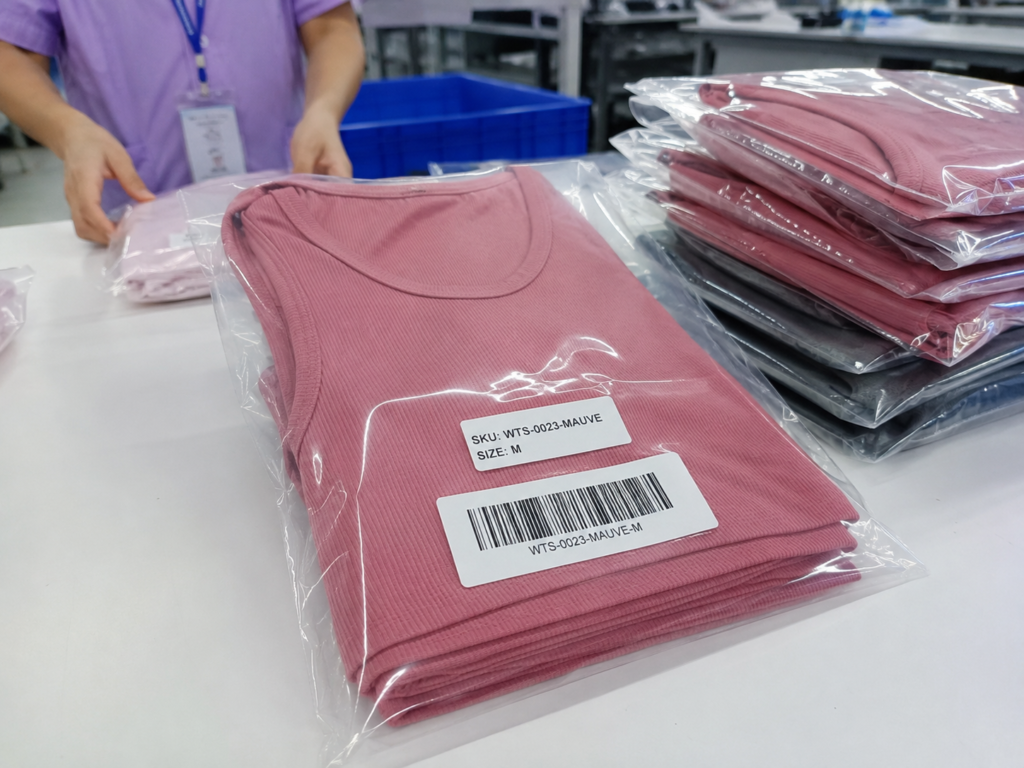
Barcode and SKU files must connect the correct style, color, size, retail data, and destination.
A visually correct dress with the wrong barcode can create warehouse rejection, relabeling cost, and launch delay.
Data is checked before printing and again during packing. Multi-color and multi-size programs need clear file naming and revision control to prevent one colorway receiving another SKU label.
- Style-color-size matrix
- Barcode or SKU sticker placement
- Retail price tag when required
- Warehouse or channel-specific label
Protective Packing

Packing method depends on garment construction and surface. Satin needs snag and wrinkle protection; sequins need abrasion control; corset cups and boning need shape protection; lace and mesh need tear prevention; sets need both pieces verified together.
Polybag thickness, warning text, tissue, folding board, hanger, silica gel, carton dimensions, and carton quantity are selected according to product and destination requirements.
- Folding and pressing standard
- Polybag, tissue, hanger, or protective inserts
- Assortment by color and size
- Carton strength, dimensions, quantity, and marks
Packing Approval

Packing should be reviewed before the full order is completed. A packing reference can confirm folding, labels, hangtags, barcodes, polybag, carton quantity, assortment, carton mark, and any warehouse-specific requirement.
Packing instructions are retained with the style records so repeat orders can reproduce the approved presentation, subject to reconfirmation of artwork and destination needs.
- Approve one complete packed unit
- Confirm master carton and assortment
- Check shipping mark and receiving labels
- Retain approved packing instruction and photos
Use a Supplier Qualification Checklist
A supplier should be qualified against the exact dress program, not against a generic company presentation. The following checklist can guide an RFI, factory visit, sample review, quotation comparison, trial order, or annual supplier assessment.
Company and Production Fit
Jinfeng Apparel can provide a structured overview of its Guangdong production system, 6 owned factories, 10+ long-term production partners, 18+ sewing lines, 6+ flexible lines, and the team roles supporting the program.
- Legal company details and operating location
- Owned factories versus partner factories
- Relevant dress categories and fabrics
- Line allocation and actual capacity for the proposed style mix
- Named responsibility for merchandising, production, QC, packing, and logistics
Development and Sample Evidence
Two sample rooms, 7+ senior pattern makers, and 20+ sample machinists support development from reference images, samples, sketches, tech packs, or line sheets.
- Sample-room structure and pattern resources
- Sample types and approval process
- Fit-comment and pattern-version control
- Complex fabric and construction experience
- PP and Golden sample management
Commercial and Delivery Evidence
A quotation should state assumptions clearly and be revised when fabric, trims, construction, quantity, packaging, testing, or delivery responsibility changes.
- MOQ by style/color and material minimums
- Cost assumptions and optimization routes
- Milestone plan linked to launch date
- Material booking and factory allocation
- Packing, shipment, and warehouse-receiving support
Quality and Brand Protection
Jinfeng Apparel protects tech packs, samples, patterns, trims, private-label details, unpublished designs, quantities, pricing information, and launch plans through NDA-based cooperation and controlled information use.
- Incoming, cutting, in-line, final, and packing checks
- Measurement tolerances and product-specific defects
- Third-party inspection support where required
- NDA and unpublished-design protection
- Repeat-order files and retained Golden sample
Compliance, NDA, and Design Protection
Project Compliance
Audit Cooperation
NDA Protection
Multi-Style Dress Programs in Real Production
The following anonymized program profiles reflect the scale and structure of established fashion-brand orders: 10-30 styles and approximately 20,000-80,000 total pieces per buying cycle. Names, original design files, pricing, barcodes, and unreleased product details remain confidential.

US Occasionwear Collection - 18 Styles / 42,600 Pieces
Program scope: 18 styles across satin midi dresses, mesh-lined party dresses, lace occasion styles, ruched bodycon dresses, and structured corset silhouettes. Total volume reached 42,600 pieces across 31 style-color combinations and a multi-size range.
Commercial challenge: the collection needed a visible price ladder while preserving a unified premium look. Satin shine, lace placement, corset support, lining coverage, and size grading created different cost and fit risks. Photo samples for hero styles were required before the full PP sequence.
Execution: styles were grouped into satin, mesh/lace, stretch, and structured families. Eight hero SKUs entered the first sample priority group; remaining styles followed after fabric and trim direction was stable. Pattern comments were tracked by version, PP approvals locked labels and packing, and production was allocated by construction family.
Control outcome: color and lining combinations were approved before bulk material release; in-line measurement focused on bust-waist-hip balance and dress length; satin handling and corset symmetry received separate QC focus. The order was prepared in planned shipment groups aligned with the brand’s launch sequence.

US Trend-Led Ecommerce Drop - 24 Styles / 68,400 Pieces
Program scope: 24 styles including mini bodycon dresses, cut-out mesh styles, corset minis, slip dresses, halter dresses, and coordinated sets. Total quantity reached 68,400 pieces across 46 style-color combinations, with key SKUs carrying deeper volume than experimental styles.
Commercial challenge: the brand needed strong visual impact, controlled target cost, photo-ready samples, and a fast-moving approval order without allowing 24 styles to become one unmanaged queue. Stretch recovery, mesh transparency, neckline security, and barcode accuracy were major return-risk areas.
Execution: the line sheet classified hero, core, extension, and experimental products. Sampling was divided into four priority groups based on launch date, material readiness, and fit complexity. Common trims and related fabrics were consolidated where the appearance allowed. PP and Golden sample records were connected to style-color-size and packing files.
Control outcome: bodycon styles used dedicated stretch and recovery checks; mesh coverage zones and lining colors were mapped on the pattern; SKU and barcode data were verified before packing. Production and packing status were tracked by style code, color, approval stage, and shipment batch.

Regional Retail Dress Program - 12 Styles / 27,600 Pieces
Program scope: 12 styles covering printed resort dresses, woven midi dresses, lightweight maxi dresses, wedding guest styles, and two jumpsuits. Total quantity reached 27,600 pieces across 22 style-color combinations for multiple retail doors and an ecommerce channel.
Commercial challenge: print direction, shrinkage, color story, size grading, carton assortment, and warehouse labels had to remain consistent across several destinations. The brand also needed a commercial mix of core printed dresses and higher-value occasion items.
Execution: strike-off or fabric print approval preceded bulk cutting; printed styles were grouped by fabric base and print method. Size ratios were allocated by store-channel plan.
Jumpsuit development received separate torso and crotch-length review. Packing instructions separated retail-door assortments from ecommerce single-SKU cartons.
Control outcome: fabric batches, print direction, lining, dress length, jumpsuit fit, barcode data, and carton marks received dedicated checks. The program moved through planned packing groups so the destination mix remained intact at warehouse receiving.
Frequently Asked Questions for Buying Managers

Send Your Buying Brief for Project Review
Send Jinfeng Apparel the current line sheet, reference images or tech packs, planned quantity by style and color, fabric direction, color plan, size range, label and packaging requirements, target cost, launch date, and delivery destination. Kelly will coordinate an initial review covering product fit, material direction, construction risk, MOQ, sample route, quotation inputs, production allocation, and the information still needed before formal development.
A useful first review does not require every detail to be finalized, but the product direction and commercial plan should be clear enough to assess. For a 10-30 style program, identify hero SKUs, photo-sample priorities, expected volume, critical materials, and immovable launch dates. Files can be shared under NDA when required.
- Reference image, original sample, sketch, tech pack, or line sheet
- Quantity per style/color and expected size range
- Fabric preference, target hand feel, stretch, transparency, or finish
- Private-label, barcode, polybag, carton, and warehouse requirements
- Target cost boundary, required delivery term, destination, and launch date
- Hero styles, sample priority, and any known fit or quality risks


