 Skip to content
What Is the Best Lining for Different Dress Fabrics and Structures?

Your trusted Women’s Apparel Manufacturer from China

A lining is easy to underestimate because customers rarely see much of it when a dress is worn correctly. Yet in development rooms and production lines, that hidden layer can decide whether a satin skirt glides or clings, whether a mesh bodycon dress stretches comfortably or feels undersized, and whether a lace style looks refined or strangely flat. The outer fabric creates the first impression, but the lining often determines whether that impression survives real movement, lighting, washing, pressing and repeated wear.
The best dress lining is the one that works with the shell fabric and the garment structure rather than simply matching its color. It should provide the required opacity, comfort and internal finish while remaining compatible with the shell’s weight, drape, stretch, recovery, surface friction and care method. Chiffon, satin, lace, mesh, jersey, sequins, bias-cut dresses and structured bodices therefore need different lining strategies.
A useful way to think about lining is to imagine a sample that looks perfect on a hanger but fails the moment someone walks across the fitting room. The skirt catches around the thighs, the lining climbs upward, the slit flashes an unexpected inner edge, or a pale shell suddenly becomes transparent under brighter light. None of those problems starts with the decorative design. They start with the relationship between layers. That relationship is what experienced dress developers evaluate before a lining is approved for production.
What Makes a Good Dress Lining?
A good dress lining solves the garment’s practical needs without changing the intended silhouette. It should offer enough coverage, comfort and durability for the wearing occasion while remaining compatible with the shell fabric’s weight, drape, stretch, recovery, breathability and care method. The right lining usually feels almost invisible because it supports the dress instead of competing with it.
What Does Dress Lining Do?
Dress lining does much more than cover seam allowances. In a sheer chiffon dress it may provide the opacity that makes the garment wearable; in a sequin mini dress it separates abrasive backing and cut sequin edges from the skin; in a fitted mesh style it can influence the actual bust-waist-hip fit because the inner layer participates in stretch. In occasionwear, lining also helps conceal cups, reinforcement, zipper construction and internal seams so the outside remains visually clean. The useful starting point is therefore not the fiber name but the function. Some dresses mainly need coverage, some need comfort, some need controlled movement, and others require several jobs at once. Problems often appear when a developer asks one lining to provide maximum opacity, maximum breathability, strong structure and unrestricted movement at the same time. Those goals can conflict, so the garment must establish the priority.
Which Properties Matter Most?
Fiber content alone is not enough to approve a lining. Two fabrics labeled 100% polyester can have completely different weights, yarn constructions, surface finishes, drape and static behavior. The practical comparison should include weight, thickness, surface friction, stretch direction, recovery, opacity, shrinkage and care compatibility. For fitted styles, compare shell and lining in the direction that wraps around the body rather than pulling them randomly by hand. For light-colored dresses, stack the actual production shades together because the perceived color can change once the shell becomes a translucent filter over the lining. For fluid skirts, hang the two materials vertically and watch whether the lining changes the size of the folds. These simple checks often reveal more about real garment performance than a specification sheet viewed in isolation, especially when the design depends on movement or controlled transparency.
Is One Lining Right for Every Dress?
No single lining is suitable for every dress, and the same shell fabric can require different inner constructions in different silhouettes. A lightweight satin used for a bias-cut slip dress needs low bulk and fluid movement, while satin used in a strapless corset dress may sit over cups, boning, tapes and a more controlled bodice structure. Mesh creates the same contrast: a resort overlay can intentionally stay transparent, an occasion dress may need carefully positioned body coverage, and a fitted mesh mini may require an inner layer that stretches and recovers with the shell. The most reliable decision formula is shell fabric plus silhouette plus coverage requirement plus structure plus wearing occasion. Reusing an approved lining from a previous style can save development time, but it should still be tested in the new construction before a production commitment is made.
How Much Lining Is Enough?
Full lining is not automatically the premium solution. It can improve coverage and internal finish, but it also adds weight, warmth, material consumption and sewing operations. A lace dress may only need opaque coverage through the torso while keeping sleeves and an upper yoke sheer. A mesh midi can use a shorter internal mini layer so the lower skirt remains transparent. A corset dress may require a fully finished bodice but a very light skirt lining, while a layered tulle dress can contain several decorative layers and only one true opacity layer. Experienced development teams map lining by body zone: bust for support and coverage, waist for seam comfort and stability, hip for opacity and movement, skirt for drape and slit behavior, and neckline or armhole for clean finishing. That approach makes the inner construction serve the design rather than forcing every style into the same template.
Which Lining Works Best for Each Dress Fabric?
Different shell fabrics create different lining priorities. Chiffon usually needs lightness and opacity, satin needs smoothness without visible bulk, lace and mesh depend heavily on color and transparency control, jersey requires compatible stretch, and sequins need skin protection. The best pairing preserves the quality that made the outer fabric desirable while solving the weaknesses that could affect wear or production.

What Lining Is Best for Chiffon and Satin?
Chiffon generally performs best with a lightweight, soft lining that gives enough coverage without suppressing the fabric’s floating movement. A fluid polyester or viscose-type lining can work well depending on care requirements, hand feel and price level, but the finished combination matters more than the generic material name. Satin presents a different challenge because smooth, reflective surfaces can show internal ridges, bulky seams and zipper reinforcement. Lightweight satin slip dresses usually benefit from smooth, low-bulk linings that can move independently without grabbing the shell. Heavier satin used for eveningwear can accept a slightly more substantial inner layer, particularly around structured bodices. With both fabrics, static should be checked after movement rather than while the sample hangs perfectly still. A combination that looks elegant on a mannequin can cling unexpectedly after walking, sitting or being handled in a dry fitting room.
How Should Lace, Mesh and Sequin Dresses Be Lined?
Lace lining is partly an engineering decision and partly a color decision because the lining becomes the visual background of the motif. Matching shades produce a denser, more unified appearance; nude bases can make motifs seem to float on the body; and deliberate contrast makes placement errors more visible as well as more dramatic. Mesh requires similar transparency control but adds the question of stretch. A stretch mesh bodycon style should be assessed while the shell is extended to wearing dimensions because both coverage and color can change when the openings enlarge. Sequin fabric shifts the priority toward skin protection. The backing, cut edges and thick seam allowances can irritate the underarm, neckline, waist and side seam, so a soft inner layer and clean edge treatment become critical. In all three cases, the lining should be judged on the body or a realistic form, not only as a flat fabric stack.
Outer Fabric | Typical Lining Priority | Practical Check | Common Failure |
Chiffon | Lightweight opacity and fluid drape | Hang shell and lining together | Heavy lining suppresses movement |
Satin | Smooth surface and low bulk | Check seams and zipper from outside | Internal ridges show through |
Lace | Background color and motif clarity | Compare 2-3 lining shades under lace | Lining changes visual tone |
Stretch Mesh | Opacity plus compatible extension | Check while stretched on body | Inner layer limits fit |
Sequin | Soft skin-contact barrier | Inspect underarm and side seams | Abrasive edges touch skin |
Jersey | Stretch and recovery | Compare extension in fit direction | Lining rides up or restricts movement |
Velvet | Low-friction inner surface | Walk and sit in sample | Layers catch against each other |
Tulle | Lightweight base coverage | Assess volume with all layers | Unnecessary stiffness builds bulk |
Which Lining Suits Jersey and Stretch Fabrics?
For jersey, stretch satin, power mesh and other fitted materials, mechanical behavior is usually more important than composition alone. If the shell can extend substantially around the hip but the lining reaches its limit much earlier, the wearer experiences the lining as the true size of the garment. That mismatch can create horizontal drag lines, restricted movement or upward migration of the inner layer. Stretch direction matters too. A lining that only stretches crosswise may work in a simple bodycon silhouette but become restrictive in a design that relies on vertical extension, deep ruching or aggressive cut-outs. Recovery should be checked after extension because a fabric that stretches easily but remains elongated can bag around the seat or waist. The practical test is simple: compare shell and lining in the exact orientation used for cutting, then evaluate the complete sample at bust, waist, high hip, full hip and thigh where relevant.
What About Crepe, Velvet, Organza and Tulle?
Crepe covers a wide family of fabrics, so the lining should follow the actual weight and drape rather than the word “crepe” on a fabric card. Lightweight crepe can behave like chiffon, while heavier crepe used for tailored occasion dresses can support a more stable lining. Velvet introduces pile, warmth and friction; a smooth lining helps the garment slide over the body and prevents the inside from feeling heavy. Organza is intentionally crisp, so a stiff inner layer can double the structure and create more volume than the designer intended. Tulle is often misunderstood because several layers can create volume without creating comfortable opacity. The base lining should normally sit closer to the body while decorative tulle remains free above it. Distinguishing lining, underlining, interlining, support fabric and decorative overlay prevents unnecessary layers and makes it easier to control both cost and silhouette.
Which Lining Fits Different Dress Structures?
Dress structure can matter as much as fabric type. Slip and bias-cut dresses need freedom of movement, bodycon styles need compatible extension and recovery, corset dresses require organized internal support, sheer dresses need intentional coverage, and evening dresses often combine several lining functions in one garment. Lining should therefore be developed alongside the pattern instead of being added after the shell is already finalized.
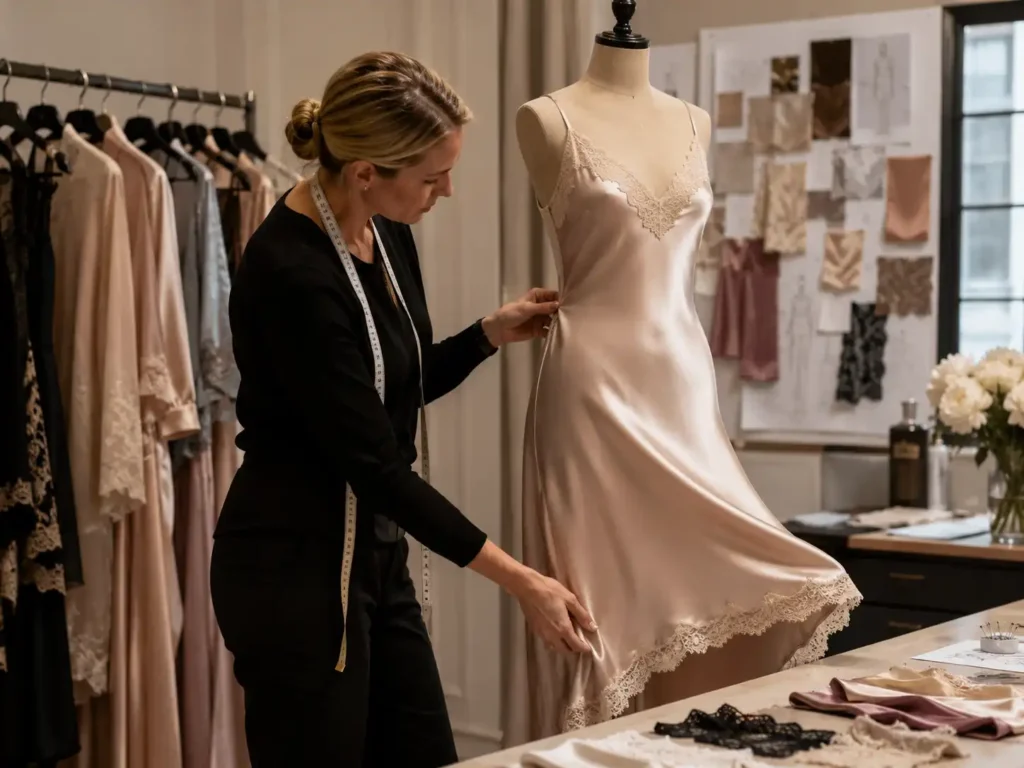
How Should Slip and Bias-Cut Dresses Be Lined?
Slip dresses expose internal mistakes because their surfaces are clean and their silhouettes are narrow. A thick side seam, stiff lining or poorly controlled dart can become visible through lightweight satin. Bias-cut dresses add another complication because woven shell fabric can lengthen and reshape as it hangs. If the lining settles differently, the relationship between the two hems may change after assembly. A good process allows the complete garment to hang before the final hem relationship is fixed, then checks whether the side seams remain vertical and whether the inner layer creates diagonal pulling. The lining should have enough ease to move but not so much that it wrinkles under the shell. During fitting, watch the dress while the wearer walks and turns rather than only standing still. In a successful slip or bias dress, the lining provides coverage and comfort but leaves the visual movement to the outer fabric.
What Lining Works for Bodycon and Corset Dresses?
Bodycon and corset dresses both fit close to the body, but their internal requirements are almost opposite. A bodycon lining generally needs to participate in movement, so insufficient stretch can become the hidden limit on fit even when the shell has plenty of extension. Corset dresses, by contrast, may contain bra cups, boning, underwire, waist tape, reinforcement and anti-slip components that deliberately control the shape. The skin-contact lining should feel smooth and cover rough structural elements without weakening the support system. One common error is using the same soft stretch lining logic in every fitted style; another is making every internal corset layer so rigid that the bodice becomes unnecessarily bulky. The stronger approach separates comfort from structure: flexible where movement is needed, stable where the pattern needs control, and clean enough that the wearer never feels hard edges through prolonged wear.
Do Sheer Dresses Need Full Lining?
Sheer dresses often look more considered when lining is placed strategically instead of automatically covering the entire garment. A lace occasion dress can keep sleeves and upper chest transparent while lining the torso; a mesh midi can use a shorter internal dress; a resort style might rely on bodysuit-type coverage; and a cut-out party dress may use small opaque zones only where necessary. The key is to examine what happens in motion. A lining edge that looks perfectly horizontal on a mannequin can become visually distracting when the wearer sits, raises an arm or walks through a slit. Check front, side and back views under realistic lighting, and pay particular attention to where lining edges cross strong lace motifs or printed mesh elements. Full lining is useful when the design needs complete opacity, but selective coverage can preserve the intended fashion effect while reducing unnecessary weight and bulk.
How Should Evening Dresses Be Lined?
Evening dresses frequently need more than one lining strategy because the bodice and skirt perform different jobs. A strapless or corseted top may require stable internal layers around cups and boning, while the floor-length skirt benefits from a lighter lining that keeps movement fluid. Slits create another technical point: the inner skirt must remain concealed when the wearer takes a long step, sits or turns. Heavily embellished styles also need protection at the underarm, waist and side seams, where sequin or bead backing can become uncomfortable. The longer the skirt, the more visible small length differences become, particularly after pressing or hanging. Formalwear therefore rewards a zone-based approach in which the bodice, hip, slit and lower skirt are evaluated separately before being connected into one complete lining system. The outside may look simple precisely because the inside has been planned carefully.
Dress Structure | Primary Lining Job | Useful Development Check | Typical Risk |
Slip Dress | Smooth coverage with low bulk | Check side seams and surface ridges | Lining telegraphs through satin |
Bias-Cut Dress | Move and settle with shell | Hang before final hemming | Uneven shell-to-lining length |
Bodycon Dress | Stretch and recover with body | Fit at bust, waist and hip | Inner layer becomes restrictive |
Corset Dress | Comfort around structured layers | Check cups, boning and waist | Bulk or hard internal edges |
Sheer Dress | Strategic opacity | View front, side and back in motion | Lining edges become visible |
Evening Dress | Support above, movement below | Walk, sit and test slit | Lining flashes or drags |
Layered Tulle Dress | Base coverage without extra volume | Review full layer stack | Excessive stiffness and weight |
How Do Stretch, Drape and Opacity Affect Lining?
Stretch determines how the dress moves with the body, drape controls how the layers fall, and opacity determines what remains visible through the shell. These properties interact. A highly opaque lining may be too heavy for a fluid skirt, while a very light lining may become transparent when stretched. The best result balances all three around the actual silhouette and wearing situation.
Does Lining Need the Same Stretch?
The lining does not need to match the shell stretch percentage exactly, but it should not prevent the garment from reaching its intended fit. A useful sample-room comparison starts with a 10 cm reference mark on both materials in the functional stretch direction. Extend each sample using consistent hand tension, record the new length, release it, and then see how closely it returns to the original mark. If a 10 cm section reaches 13 cm, the observed extension in that informal test is 30 percent. This is not a universal pass-or-fail standard, because power mesh may intentionally control more than fashion mesh and a loose jersey dress needs less extension than a tight mini. The value is comparability. Recording actual behavior is far more useful than notes such as “high stretch” or “good elastic,” especially when several materials are being considered for the same fitted silhouette.
How Does Lining Change Drape?
Drape is created by weight, stiffness, thickness, surface friction and the way layers are attached. A chiffon shell can form fine flowing folds by itself, then develop wider and heavier folds once a denser lining is added. A satin slip dress can behave differently when the lining catches against the shell, creating wrinkles that were absent during the initial fabric review. The most practical test is to compare three conditions: shell alone, lining alone, and both materials hanging together. Evaluate them vertically rather than only on a table, then move the pair gently to see whether the layers separate cleanly or drag against each other. This matters most in bias skirts, circular hems, ruffles, cowl necklines and lightweight maxi dresses where movement is part of the product’s visual appeal. If the combination changes the silhouette noticeably, the lining deserves another review before bulk material is committed.
How Much Opacity Is Needed?
Opacity should match the design rather than a universal idea of modesty. A white graduation dress, a nude-lined lace cocktail dress and a clubwear mesh mini may intentionally offer very different levels of coverage. What matters is predictable opacity under the conditions in which the garment will actually be worn and photographed. Check pale and sheer fabrics in normal indoor light, strong backlight and on-body conditions, and repeat the review while stretch fabrics are extended because mesh openings and jersey structures become more transparent under tension. Photography also matters. Studio lights and smartphone flash can reveal cups, underwear, seam allowances or labels that are barely noticeable in the fitting room. When the design intentionally uses transparency, the goal is not to eliminate it. The goal is to control which areas remain visible and to make sure the result is consistent across sizes and production batches.
Which Lining Color Works Best?
Under opaque fabric, lining color may have little effect on the outside. Under chiffon, lace, mesh, organza and pale satin, it becomes part of the final color appearance. Matching-color lining usually creates a more solid result, while nude lining can make lace and mesh motifs appear more open and dimensional. A white lining under ivory fabric may cool the surface, while a warm beige underneath can shift it toward cream or champagne. Color approval should therefore use stacked production-quality swatches rather than separate shade cards. For light-colored fitted dresses, the internal stack also includes cups, seam allowances, reinforcement tape and labels, all of which can show as blocks of different tone. When several nude options are being considered, compare them under the same shell, on the same light source, and at realistic wearing tension before choosing the final combination.
How Should Brands Test Lining Before Production?
Lining should be tested as part of the complete dress system before bulk approval. The most useful review combines swatch checks with a finished sample: compare stretch and recovery, observe drape, inspect transparency in several lighting conditions, check dimensional change after the intended care process, review color interaction, and evaluate movement. The approved construction should then become part of the production reference.

How Do You Test Drape and Transparency?
Start with the actual shell and proposed lining rather than unrelated substitute swatches once the style reaches final development. For drape, use a piece large enough to form natural folds and hang the layers together so gravity can reveal how they interact. Compare the combination with the shell alone, then move it gently to check whether static or friction makes the fabrics catch. Transparency should be reviewed flat, vertically, on a form and on a fit model when appropriate. For fitted styles, repeat the observation at realistic body extension because the appearance of stretch mesh and light jersey can change significantly under tension. Strong light and photography are useful practical screens for pale occasionwear. These are not laboratory optical tests; they are controlled development checks designed to reproduce real customer situations such as daylight, event lighting, studio photography and movement during wear.
How Do You Check Shrinkage and Color Compatibility?
Differential dimensional change is more important than looking at the shell and lining separately. Mark a known length on each material before the intended wash, steam or finishing process, then measure the same points afterward once the fabrics have settled. Shrinkage can be expressed as the original measurement minus the final measurement, divided by the original measurement and multiplied by 100. For example, a 50 cm test length that becomes 49.5 cm has changed by 1 percent. The key question is whether the two layers change differently enough to create pulling, puckering or an exposed inner hem. Color compatibility should be checked before and after the intended care process as well, particularly for ivory, white, champagne, blush, pale blue and nude combinations. Where a market or customer program requires formal colorfastness or dimensional-stability testing, those project-specific test methods should take priority over informal sample-room checks.
How Should a Lined Sample Be Approved?
Final approval should happen on the complete garment because a lining can pass every swatch review and still fail once pattern pieces, seams, zippers and body movement are introduced. During fitting, evaluate standing, walking, sitting and turning. Watch for the lining riding upward around the hip, flashing through a slit, becoming visible below the outer hem, pulling at the side seam or showing through light-colored shells. Record the approved lining reference, color, cutting direction, attachment method and length relationship so production does not depend on memory. For custom dress programs, a clear technical record also makes later repeat orders more predictable because the team can distinguish an intentional lining choice from a last-minute sample-room substitution. This is particularly important when a collection contains several similar styles that use different internal solutions despite sharing the same outer fabric family.
Approval Point | Practical Test or Record | Useful Numeric Reference | Warning Sign |
Stretch | Mark and extend a fixed section | 10 cm reference length | Lining reaches limit before shell |
Recovery | Re-measure after release | Return toward original 10 cm | Permanent elongation or bagging |
Dimensional Change | Measure before and after care | Example: 50 cm to 49.5 cm = 1% | Shell and lining change differently |
Transparency | Check relaxed and stretched | Multiple lighting conditions | Cups or underwear become visible |
Lining Length | Measure from defined garment point | Record by size, not verbal description | Inner hem appears below shell |
Color | Layer actual approved shades | Compare 2-3 candidate linings | Shell tone shifts unexpectedly |
Movement | Walk, sit and turn | Repeat same fitting actions | Ride-up, pulling or slit exposure |
Construction | Keep approved sample/BOM notes | Record attachment method | Bulk production uses a different solution |
What Should Be Recorded for Bulk?
Once the lined sample is approved, the important details should travel into production with the garment rather than remaining informal knowledge in the sample room. At minimum, the record should identify the lining fabric reference, approved shade, cutting orientation, relevant stretch direction, pattern pieces, attachment points and measurable length relationship to the shell. Partial lining needs especially clear instructions because phrases such as “line the body” can be interpreted differently by separate production teams. Multi-size programs also need the lining grade reviewed with the shell; an inner pattern that works in the base size can become restrictive if its grade does not follow the same fit logic. Keeping the approved garment or a sealed reference available during production gives operators and quality teams something physical to compare against. The more the lining influences fit, transparency or structure, the more precisely it should be documented.
What Lining Problems Occur in Production?
The most common lining problems are pulling, twisting, ride-up, uneven inner hems, visible lining edges, show-through and excessive bulk. These defects usually come from mismatched material behavior, inaccurate cutting, incorrect grain or stretch direction, poor attachment, inconsistent bulk fabric or dimensional change. The fastest solution is to identify which layer is causing the problem before changing the pattern or sewing method.
Why Does Lining Pull, Twist or Ride Up?
Pulling usually appears when the shell and lining no longer share movement correctly. The lining may be too small, cut with the wrong stretch direction, attached with insufficient ease or changed by steaming after cutting. Twisting often begins earlier than sewing; lightweight jersey, mesh and bias-cut woven fabrics can distort when spread under tension, so a small grain error may only become obvious after the finished dress hangs. Ride-up is particularly common in bodycon styles because friction, negative ease and insufficient extension can make the inner layer migrate toward the waist during walking. Before changing the pattern, compare the problem garment with the approved sample and inspect shell dimensions, lining dimensions, grain direction, stretch orientation, side-seam alignment and material batch behavior. A pattern alteration cannot correct a bulk lining fabric that performs differently from the material used during sample approval.
Why Does Lining Show Through or Add Bulk?
Show-through does not always mean the entire lining fabric is visible. Often the customer sees the construction underneath it: seam allowances under satin, a hard lining edge under mesh, a label under pale chiffon or a cup that is several shades lighter than the surrounding inner fabric. Bulk behaves in the same localized way. The center-back zipper, waist seam, corset panel intersections, gathered seams, armholes and skirt-to-bodice joins can contain several thin layers that become thick once stacked. The correct response is therefore not automatically to replace the lining with something lighter. Reducing seam allowance, redistributing reinforcement, changing the joining method or moving an internal edge may produce a cleaner result without sacrificing coverage. Experienced sample teams inspect the complete cross-section of the garment because a visible ridge is usually created by the total layer stack, not one material in isolation.
What Should QC Inspect?
Lining quality control should be style-specific. A loose woven occasion dress may mainly need checks for color, inner hem length, seam flatness and transparency, while a bodycon style also needs stretch direction, recovery and ride-up reviewed. Sequin dresses require attention to skin-contact zones, and corset dresses need inspection around cups, boning ends and internal edges. The garment should be compared with the approved reference in a natural hanging condition rather than immediately after aggressive pressing, which can temporarily hide twisting or pulling. Useful checkpoints include correct material and shade, consistent cutting direction, no lining below the outer hem, no trapped fabric in zippers, controlled slit construction, acceptable transparency, clean internal seams and no abrasive edges. Representative finished measurements are especially important in stretch styles because an inner-layer fit problem can remain invisible while the garment is hanging on a rail.
How Do You Trace Repeated Lining Defects?
Repeated defects are best traced backward through material, cutting, sewing and finishing rather than repaired garment by garment. If one piece twists, workmanship or handling may be responsible; if an entire bundle twists in the same direction, cutting orientation deserves attention; if several bundles from one roll behave differently, material consistency becomes the stronger suspect. The same logic applies to ride-up, visible inner hems and opacity variation. First compare the defect with the approved sample, then identify what changed: fabric lot, cutting direction, pattern version, seam method, pressing condition or lining length. This approach prevents symptom repair from becoming the production strategy. The costly problems are rarely spectacular. They are small differences repeated across hundreds of garments, where a few millimeters of exposed lining, a slightly tighter inner hip or a recurring zipper ridge can turn a technically acceptable order into a visibly inconsistent collection.
The most successful lining decisions rarely attract attention from the customer, and that is precisely the point. The dress moves naturally, the shell keeps its intended color and drape, the wearer remains comfortable, and the inner construction stays out of sight. Achieving that result requires lining to be considered at the same time as the outer fabric, pattern and wearing occasion rather than added after the major design choices have been fixed. For brands developing custom dresses, sharing the intended shell fabric, reference sample or tech pack, opacity requirement, fit direction and wearing scenario gives a manufacturer such as Jinfeng Apparel enough context to discuss lining as part of the whole garment instead of treating it as a last-minute accessory. That approach usually produces a cleaner sample, clearer approval standard and fewer surprises when the style moves into bulk production.
Share This Article :

Jerry Lee
Categories

Latest blogs
Table of Contents
Here, developing your OEM/ODM private label clothing collection is no longer a challenge—it’s an excellent opportunity to bring your creative vision to life.

