 Skip to content
Custom Denim Dresses for Fashion Brands
Develop denim dress collections with a women’s fashion manufacturer that understands fit, fabric behavior, sampling, and repeat production. Jinfeng helps brands turn tech packs, reference samples, and seasonal concepts into custom denim dresses ready for bulk production, private labeling, and international delivery.
- Founded in 2008 with nearly 30 years of apparel experience
- 4 factories support women’s fashion and casual product lines
- 2 sample rooms, 7 pattern makers, 20 sample makers
- 18 production lines with 100,000 pcs monthly capacity
- 5-7 day sampling for regular denim dress styles
- 20-30 day bulk production for planned apparel orders
Built for Fashion Brands Developing Denim Dress Collections
Fashion Brands Developing Denim Dress Collections
A denim dress needs to look strong on both the body and the rack. Structure, comfort, movement, wash effect, and styling all need to work together across different sizes and production runs.
Jinfeng supports custom denim dress development for styles such as denim mini dresses, shirt dresses, corset dresses, bodycon silhouettes, washed midi dresses, and utility-inspired collections. Our women’s fashion background allows us to focus on fit, silhouette, and overall product presentation instead of treating denim dresses like basic denim items.
From sampling to bulk production, fabric selection, wash planning, and construction details are reviewed around the intended style direction and customer positioning.
Built for Brands Planning Repeat Production
Many successful denim dress styles move beyond first-season launches into replenishment orders, color updates, and larger seasonal programs. Production stability becomes critical once a style starts selling consistently.
Jinfeng operates with 18 production lines and around 300,000 pieces of monthly capacity across coordinated manufacturing resources. This supports brands developing repeatable denim dress programs with more stable measurements, wash consistency, workmanship control, and delivery planning.
For established fashion brands, reliable repeat production often matters more than chasing the lowest unit cost. Consistent fit, appearance, and shipment quality protect customer experience and reduce return pressure across retail and e-commerce channels.

Women’s Fashion Experience Beyond Basic Denim Production
Many denim suppliers specialize in jeans, jackets, and workwear categories. Denim dresses require a different development approach because body fit, silhouette balance, neckline comfort, waist shaping, and movement all affect the final wearing experience.
Jinfeng’s women’s apparel experience includes dresses, fitted silhouettes, occasionwear, fashion sets, and trend-led collections. This allows denim dress development to start from body fit and styling direction first, with fabric weight, stretch level, wash effect, seam structure, and hardware placement matched to the intended silhouette afterward.
The result is a denim dress that works not only in flat product photos, but also in fit sessions, campaign styling, retail presentation, and repeat production.
What Usually Matters Most in Denim Dress Production
A strong denim dress supplier should do more than sew garments. Most fashion brands focus on fit consistency, fabric behavior, wash control, production stability, communication efficiency, and repeat order reliability before moving into long-term cooperation. The points below reflect common development and production concerns during denim dress manufacturing.
| Brand Focus | Why It Matters | What Often Goes Wrong | How Jinfeng Handles It |
|---|---|---|---|
| Understanding the Product Direction | Denim dresses combine women’s fit, wash effect, silhouette, and denim structure | The factory treats the style like basic denim or a standard woven dress | We review silhouette, fabric weight, stretch, wash direction, and construction before development starts |
| Cleaner Sample Development | Samples should match the intended fit, styling direction, and product positioning | Too many revisions delay launch timing and increase development cost | 2 sample rooms, 7 pattern makers, and 20 sample makers support organized sample development |
| Fabric Matching the Intended Silhouette | Denim weight, stretch, and recovery directly affect comfort and shape | Fabric feels too stiff, too heavy, or unable to hold the intended fit | Fabric sourcing and pattern adjustments are reviewed together before sampling |
| Women’s Fit and Body Balance | Denim dresses need balanced bust, waist, hip, neckline, and hem proportions | The garment looks correct flat but fits poorly during wear | Our women’s apparel background supports fit balance and silhouette control |
| Wash Consistency and Surface Appearance | Wash effect changes shade, softness, shrinkage, and garment character | Bulk pieces show uneven shade or unstable wash appearance | Wash standards are reviewed during development and confirmed through approved samples |
| Stable Bulk Measurements | Successful styles need repeatable sizing across production runs | Bulk sizing becomes inconsistent after washing or sewing | Pattern review, seam tension checks, and measurement control are organized before cutting |
| Production Capacity for Scaling | Denim dress programs often move into repeat orders and seasonal expansion | The supplier can sample but struggles with larger production volume | 18 production lines and around 300,000 pcs monthly capacity support ongoing production planning |
| Clear Daily Communication | Overseas development requires fast and practical communication | Delayed feedback causes approval mistakes and repeated corrections | Our teams support email, video calls, WhatsApp, WeChat, and voice communication |
| Flexible Order Planning | Different brands need different production quantities at different stages | The supplier only accepts large MOQ production | We support small test runs, mid-size programs, and larger seasonal production |
| Long-Term Repeat Production | Strong-selling styles usually need repeat runs and future updates | Repeat orders change in fit, color, fabric, or workmanship | Coordinated production management helps keep repeat orders more stable |
Denim Dress Styles Developed for Different Fashion Collections

Denim Shirt Dress

Denim Mini Dress

Denim Midi Dress

Denim Maxi Dress

A-Line Denim Dress

Bodycon Denim Dress

Corset Denim Dress

Button-Front Denim Dress

Sleeveless Denim Dress

Belted Utility Denim Dress

Denim Overall Dress

Washed Vintage Denim Dress
Denim Fabric Options for Custom Dress Development

Cotton Rigid Denim

Cotton Stretch Denim

Lightweight Summer Denim

Tencel Blend Denim
Tencel blend denim creates softer drape and a smoother hand feel for midi, maxi, shirt, and premium casual dresses. At 180-300 GSM, it needs careful review for shrinkage, torque, hem balance, and post-wash appearance.

Recycled Cotton Denim

Black Denim

Colored Denim

Denim-Look Cotton Twill
Washing Techniques for Denim Dress Production

Stone Wash

Enzyme Wash

Acid Wash

Light Wash

Dark Indigo Wash

Vintage Wash

Sanding / Grinding

Whisker / Local Fading

Hardware Application
Construction Control for Denim Dress Production
Denim dress production requires careful control of pattern, fabric direction, seam tension, lining, reinforcement, closures, and finishing. These details affect how the garment fits, moves, washes, photographs, and performs during repeat production.
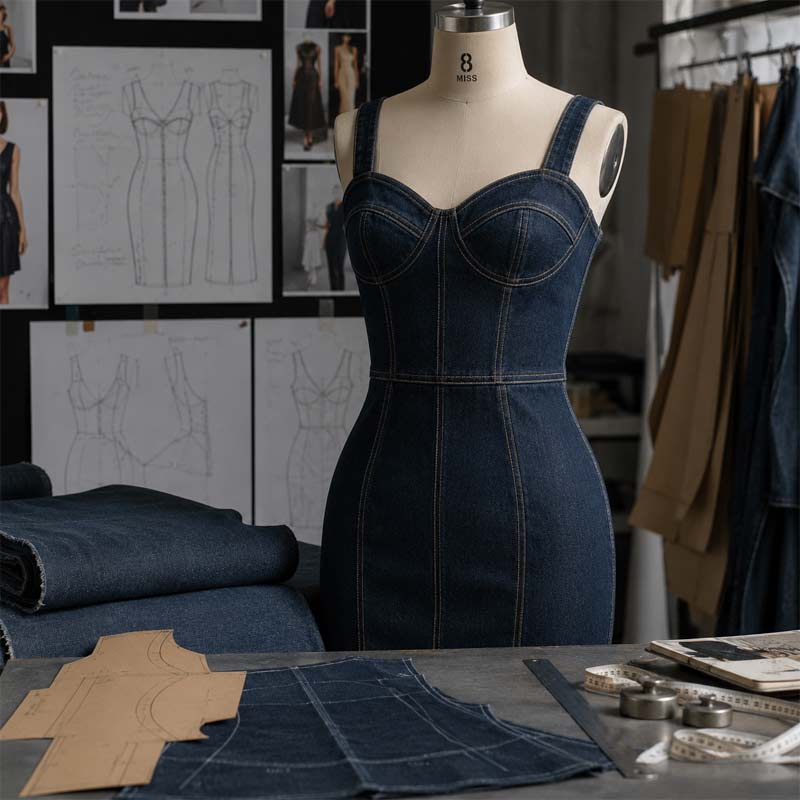
Pattern Engineering for Denim Dress Fit

Stretch Direction Control

Seam Tension Management

Lining Compatibility

Cut-Out Reinforcement

Ruching Control

Closure Construction

Pressing and Finishing
Different Ways to Start a Denim Dress Project
Send Us Your Tech Pack
Brands with established product development systems usually already have measurement charts, construction details, fabric direction, trims, labels, and packing requirements prepared before sampling starts.
Once the tech pack is received, Jinfeng reviews:
- Fabric weight and stretch suitability
- Wash feasibility and shrinkage risk
- Construction details and seam structure
- Hardware placement and closure methods
- Pattern complexity and production difficulty
For denim dresses, small technical adjustments can strongly affect fit, comfort, appearance, and repeat production consistency. Reviewing these details early helps keep sampling cleaner and more aligned with the intended product direction.
This workflow works well for brands with internal design, merchandising, and technical development teams that already follow structured production standards.
Start From Reference Samples or Images
Some collections begin with visual direction instead of complete technical files. In these cases, Jinfeng can develop denim dresses from reference garments, market images, fit comments, styling direction, and target customer positioning.
Development usually focuses on:
- Silhouette balance and body proportion
- Fabric behavior and wash direction
- Construction feasibility and seam structure
- Fit comfort and movement
- Converting design concepts into production-ready garments
This workflow is common for fashion brands launching frequent new drops or trend-led collections. Regular denim dress samples usually take around 7-12 days, while more complex constructions may require around 7-10 days depending on fabric sourcing, wash effects, trims, and structure.
Plan a Full Denim Dress Collection
Some brands develop denim dresses as a complete seasonal story instead of isolated styles. A collection approach allows silhouettes, washes, fabrics, and styling directions to work together across different customer groups and selling channels.
Collection planning may include:
- Mini, midi, maxi, and shirt dress combinations
- Shared wash direction and fabric sourcing
- Commercial core styles and fashion-forward pieces
- Seasonal color and hardware coordination
- Collection balance for retail and campaign presentation
Starting from fabric and wash direction first often helps keep the collection more visually connected during development and production. More commercial styles can support volume, while structured or trend-led pieces help strengthen campaign visuals and collection identity.
Denim Dress Sample Development Process
Step 1: Tech Pack, Design Image, or Reference Review
Before sampling starts, our team reviews the tech pack, design images, reference garments, measurement charts, fabric direction, trims, labels, and expected order quantity.
During review, we check:
- Fabric weight and stretch compatibility
- Wash effect feasibility
- Hardware and closure construction
- Silhouette balance and fit direction
- Production difficulty and possible risk areas
For denim dresses, small adjustments in fabric, structure, or wash planning can strongly affect the final fit and appearance later during production.
Step 2: Fabric and Trim Matching
Once the design direction is confirmed, fabric and trim selection moves forward together with the garment structure and intended silhouette.
Our team reviews:
- Denim weight and hand feel
- Stretch ratio and recovery
- Shrinkage expectation after washing
- Buttons, zippers, rivets, and topstitch thread
- Label, packaging, and trim coordination
For fitted styles, fabric recovery and wash behavior receive additional attention because they directly affect body fit and post-wash stability.
Step 3: Pattern Making and First Sample
After materials are confirmed, pattern development and first sampling begin. Jinfeng supports custom women’s apparel development with 2 sample rooms, 7 pattern makers, and 20 sample makers.Regular denim dress samples usually take around 7-12 days, while more complex constructions may require around 12-15 days depending on wash effects, trims, structure, and fabric sourcing.
During sample development, we review:
- Bust, waist, and hip balance
- Neckline and armhole shape
- Hem sweep and garment length
- Seam placement and closure position
- Post-wash measurement behavior
Step 4: Fit Review and Sample Correction
After the first sample is completed, fit comments, fabric feedback, wash appearance, measurements, trims, and workmanship details are reviewed before the next revision or approval stage.
Typical adjustments may involve:
- Waist or hip correction
- Neckline depth adjustment
- Hem shape refinement
- Button or zipper repositioning
- Wash softness or color changes
Clear fit comments and organized revisions usually keep the development process moving faster and reduce unnecessary back-and-forth communication.
Step 5: Pre-Production Sample Approval
Before bulk production starts, a pre-production sample is confirmed using the approved pattern, fabric, trims, wash effect, labels, workmanship standards, and packing direction.
The PP sample becomes the reference point for:
- Sewing construction
- Wash consistency
- Measurement standards
- QC inspection
- Packing and shipment preparation
For denim dresses, confirming the final wash effect, fit balance, and hardware placement before production helps keep bulk garments closer to the approved sample standard.

From Approved Sample to Finished Denim Dress Order
Sample Approval
Key checks include:
- Approved measurements and grading
- Fabric, wash, and trim specifications
- Zipper, button, lining, or hardware details
- Label, hangtag, and packaging requirements
- Final sample comments carried into production
Fabric and Trim Preparation
Preparation focuses on:
- Denim quantity and fabric lot control
- Shade, stretch, and shrinkage review
- Button, zipper, rivet, and thread matching
- Label, hangtag, and polybag preparation
- Fabric and trim compatibility before production
Cutting
Cutting control includes:
- Grainline and stretch direction
- Panel matching and symmetry
- Size accuracy and marker layout
- Fabric relaxation for stretch denim
- Corset panels, long panels, and asymmetric shapes
Sewing
Sewing control includes:
- Seam tension and stitch density
- Topstitching width and consistency
- Zipper, buttonhole, and snap quality
- Pocket, strap, and belt-loop reinforcement
- Hem finishing and overall garment balance
Inline Checking
Inspection happens during production, not only at the end. Inline checking allows the team to catch measurement, seam, panel, and hardware issues while garments are still being assembled.
Inline checks cover:
- Seam appearance and stitch consistency
- Panel matching and garment symmetry
- Zipper, button, and hardware placement
- Pocket, strap, and hem construction
- Ongoing size and measurement review
Early correction keeps small problems from becoming bulk defects.
Washing and Finishing
For washed denim dresses, garments move into washing after sewing. The approved wash sample guides shade, fading, abrasion level, softness, shrinkage, and surface effect.
Finishing review includes:
- Shade and wash consistency
- Shrinkage and recovery after washing
- Seam appearance and hand feel
- Pressing and final shape control
- Loose thread, stain, and surface inspection
Wash control is especially important for vintage, acid wash, black denim, and stretch denim styles.
Final Inspection
Before packing, finished garments are checked against the approved sample, size chart, workmanship standard, and packing instructions.
Final inspection covers:
- Finished measurements and size consistency
- Garment appearance and cleanliness
- Topstitching, seams, and closures
- Label, hangtag, and SKU accuracy
- Packing method and carton verification
Only approved garments move forward into final packing.
Packing and Shipment
After inspection, garments are packed according to the sales channel and shipment plan. Packing can be folded, hanger-based, e-commerce-ready, or retail-ready depending on brand requirements.
Packing and shipment work includes:
- Polybags, size stickers, and barcodes
- SKU and carton mark verification
- Carton packing and shipping labels
- Express, air freight, or sea freight coordination
- Split shipment planning when needed
This keeps the order organized for warehouse receiving, retail preparation, and launch timing.
Quality Control Standards for Denim Dress Production
Fabric and Material QC
- Fabric shade, GSM, and visible defects
- Stretch level, recovery, and shrinkage behavior
- Hand feel and opacity consistency
- Zipper, button, and hardware quality
- Labels, polybags, and packaging details

Inline QC During Sewing
- Seam tension and stitch consistency
- Topstitching alignment and buttonhole quality
- Zipper installation and pocket placement
- Panel matching and silhouette symmetry
- Ongoing measurement consistency

Wash Effect and Shade QC
- Shade consistency and fading placement
- Shrinkage after garment washing
- Surface abrasion and whisker effects
- Softness, recovery, and fabric texture
- Panel balance and visible wash variation

Measurement and Fit QC
- Bust, waist, and hip measurements
- Garment length and hem sweep
- Sleeve, strap, and slit dimensions
- Post-wash shrinkage control
- Size grading consistency

Closure, Hardware, and Stress Point QC
- Zipper smoothness and attachment strength
- Button spacing and buttonhole durability
- Strap reinforcement and buckle security
- Pocket corners and seam stress areas
- Hardware appearance after washing

Final Inspection and Packing QC
- Garment cleanliness and finishing quality
- Measurements and workmanship appearance
- Label, hangtag, and barcode accuracy
- Folding method and carton information
- Hardware protection and packing condition

Labels and Packaging for Denim Dress Orders

Main Label
Main labels help strengthen brand recognition and product presentation. Jinfeng supports woven,cotton, printed, and recycled label options for different denim dress collections and positioning. Manufacturing focus includes label texture, stitching quality,edge comfort, and long-term durability to help improve overall garment appearance and wearing experience.

Size Label
Size labels improve customer clarity and warehouse organization during retail and e-commerce distribution. Jinfeng helps confirm size format, placement position, readability, and stitching consistency based on brand requirements and target markets. Proper size labeling helps reduce packing confusion, return issues, and customer dissatisfaction after purchase.

Care Label

Hangtag

Barcode / SKU Sticker

Polybag
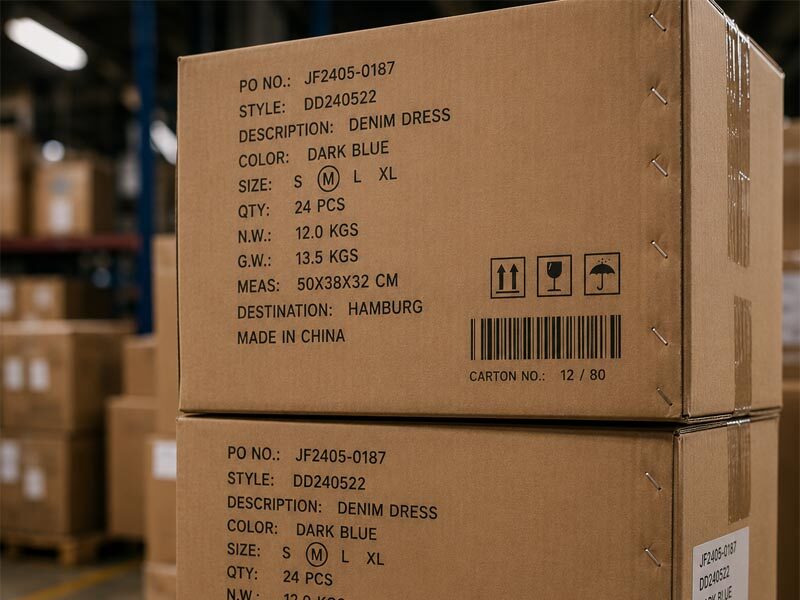
Carton Mark

Folding / Hanger Packing
Production Support Beyond Sampling and Manufacturing
Denim dress production does not end when sewing is finished. Shipment planning, daily communication, repeat production management, and seasonal coordination all affect how smoothly a collection moves from factory to warehouse. Jinfeng works with overseas fashion brands throughout development, production, packing, and delivery to keep denim dress programs more organized and easier to manage over time.
Shipment Planning and Export Coordination
- Folded packing or hanger packing
- Carton planning for denim garment weight
- Barcode, SKU, and carton mark verification
- E-commerce-ready packing preparation
- Express, air freight, or sea shipment arrangements
Daily Communication During Development and Production
- Email, WhatsApp, WeChat, and video calls
- Sample comments and fit adjustments
- Wash confirmation and fabric updates
- Production progress and QC feedback
- Packing review and shipment coordination
Repeat Orders and Seasonal Collection Support
- Repeat denim dress orders
- Seasonal replenishment planning
- Fabric and wash updates
- Size extensions and grading adjustments
- Packaging and label revisions for different channels

Denim Dress Projects We Can Support
Case 1: Olivia Carter, Senior Buyer, United States
| Item | Details |
|---|---|
| Brand Type | Mature women’s fashion brand |
| Country | United States |
| Product Range | 3 denim dress styles |
| First Order | 1,800 pcs |
| Fabric Direction | 7-10 oz cotton denim |
| Sample Time | 7 days |
| Bulk Production | 28 days |
| Key Focus | Placket gaping, hip ease, wash consistency |
Olivia’s team planned a spring denim dress capsule with a button-front mini dress, belted shirt dress, and washed A-line midi dress. The goal was stronger fit, cleaner finishing, and better campaign presentation than generic wholesale denim styles.
Jinfeng reviewed fabric weight, button spacing, placket structure, hip allowance, collar balance, and wash effect before sampling. The first sample round was completed in 7 days, followed by fit corrections and pre-production approval.
The first bulk order included 1,800 pcs across 3 styles. Production focused on stable measurements, consistent washing, and private label presentation, giving the brand a cleaner path to test denim dresses as a seasonal growth category.

Case 2: Emily Brooks, Product Development Manager, Australia
| Item | Details |
|---|---|
| Brand Type | Premium casualwear label |
| Country | Australia |
| Product Range | 3 warm-weather denim dresses |
| First Order | 2,400 pcs |
| Fabric Direction | 5.5-8 oz lightweight denim |
| Sample Time | 6-8 days |
| Bulk Production | 30 days |
| Key Focus | Drape, garment weight, armhole comfort, shrinkage |
Emily’s brand needed denim dresses for warm-weather selling, including a sleeveless midi dress, lightweight maxi dress, and soft washed shirt dress. The challenge was avoiding heavy, stiff denim while keeping enough structure for retail presentation.
Jinfeng reviewed fabric hand feel, dress length, hem movement, neckline stability, and shrinkage risk before sample development. Lightweight denim was selected to support softer movement and better comfort for resort and premium casual styling.
The order included 2,400 pcs across 3 styles. Production focused on post-wash length, armhole shape, garment balance, and softness, helping the brand position denim dresses as wearable premium casual pieces rather than heavy denim products.

Case 3: Sophia Mitchell, Merchandising Director, United Kingdom
| Item | Details |
|---|---|
| Brand Type | Multi-channel fashion brand |
| Country | United Kingdom |
| Product Range | 4 trend-led denim dress styles |
| First Order | 3,200 pcs |
| Fabric Direction | 8-10 oz stretch denim |
| Stretch Ratio | 2-5% elastane |
| Sample Time | 7-10 days |
| Bulk Production | 32 days |
| Key Focus | Stretch recovery, zipper strength, seam tension, SKU accuracy |
Sophia’s team planned a trend-led denim capsule with corset denim dresses, bodycon mini dresses, and washed black denim styles. The collection needed strong visual impact while still meeting commercial production standards.
Jinfeng reviewed stretch direction, recovery, seam tension, zipper strength, black denim rubbing risk, label placement, and packing accuracy during development. For fitted styles, measurement tolerance and post-wash recovery were treated as priority control points.
The first order reached 3,200 pcs across 4 styles. Production focused on fitted silhouette stability, hardware durability, color fastness, and barcode / SKU accuracy, supporting a trend-driven launch with stronger fit and fulfillment control.

Why Fashion Brands Work With Jinfeng for Denim Dress Production
Women’s Fashion Experience Behind Denim Dress Development
Denim dresses require more than denim sewing experience. Fit balance, neckline shape, waist proportion, movement comfort, and silhouette control all affect how the garment performs in retail, photography, and daily wear.
Jinfeng’s development experience includes:
- Women’s dresses and fitted silhouettes
- Occasionwear and trend-led collections
- Woven and knit women’s garments
- Fashion sets and contour-focused styles
- Private label women’s apparel production
This background allows denim dress development to focus on body fit and styling direction first, instead of treating the product like standard denim workwear or basic woven apparel.
Production Capacity for Repeat Orders and Seasonal Programs
Strong-selling denim dresses often continue into replenishment orders, wash updates, color extensions, and larger seasonal production. Keeping fit, measurements, and wash appearance stable across repeat runs becomes increasingly important as programs grow.
Jinfeng operates with:
- 18 organized production lines
- Around 300,000 pcs monthly capacity
- Coordinated multi-factory production support
- Production planning for repeat programs
- Export-focused manufacturing management
This production structure supports both smaller development runs and larger repeat production programs for overseas fashion brands.
Development Support Before Bulk Production
Many denim dress projects begin long before bulk sewing starts. Fabric selection, wash planning, pattern development, trims, labels, and fit correction all influence whether the final garment can move smoothly into production.
Jinfeng supports development with:
- 2 dedicated sample development rooms
- 7 experienced pattern makers
- 20 professional sample makers
- 7-15 day sample development timelines
- Support for tech packs, reference samples, and custom concepts
For denim dresses, testing fabric weight, stretch recovery, wash effect, and construction details early helps reduce unnecessary revisions later during production.
Communication That Supports Faster Decisions
Denim dress development usually involves ongoing approvals around fit, washing, trims, labels, packaging, and production timing. Clear communication helps projects move faster and keeps production aligned with the intended product direction.
Our team supports communication through:
- Email, WhatsApp, and WeChat
- Voice calls and video meetings
- Sample comments and fit review
- Production updates and shipment coordination
- Technical discussion during development and QC
Fast and practical communication becomes especially important during seasonal launches, repeat orders, and time-sensitive production schedules.
FAQ About Denim Dress Manufacturing

Ready to Develop Your Denim Dress Collection?
Work with Jinfeng to develop custom denim dresses from concept or tech pack to sample, bulk production, private labeling, quality control, and export delivery. Our team helps fashion brands turn denim dress ideas into production-ready garments with clearer development and stable execution.
Suitable for
- Fashion brands developing denim dress collections
- Mature buyers needing repeat production support
- Boutique labels launching seasonal denim drops
- Private label women’s apparel programs
- Brands needing sampling, bulk production, and export coordination


