 Skip to content
Corsetry Construction
Structured corsetry development for fashion collections that need controlled shaping, stable support, clean internal construction and repeatable bulk production.
- 7+ senior womenswear pattern makers work on corset, strapless and structured dress patterns.
- 2 sample rooms and 20+ sample machinists support complex sample development before production release.
- 15+ QC inspectors check measurements, cup symmetry, boning position, sewing, finishing and packing.
- 18+ sewing lines and 6+ flexible production lines support style allocation after the approved corsetry standard is released.
- Complex corset, lace, mesh and sequin samples are normally planned around 15–25 days, depending on materials and revision scope.
Corsetry Development Backed by Specialist Womenswear Teams
Pattern Engineering
Sample Development
Production Control
What Modern Corsetry Construction Needs to Control
Modern fashion corsetry uses internal structure to create shape without turning the garment into a rigid costume. Successful construction balances support, visual proportion, skin comfort, movement and a repeatable production method.
Shape Comes From Pattern
A corset silhouette starts with pattern geometry rather than with boning alone. Panel distribution, seam direction, bust suppression, waist shaping and front-to-back balance determine how the garment follows the body before structural components are added. A panel can look correct on a flat table yet pull the neckline outward, push the cup upward or create uneven waist pressure when worn. Jinfeng pattern development therefore reviews upper bust, full bust, under-bust, waist, front length, back length and neckline relationship together. Fit feedback is translated into pattern corrections instead of being hidden through stronger boning or tighter closures. For commercial womenswear, a stable pattern should keep the intended silhouette while allowing the wearer to sit, move, breathe and dress without abnormal pressure. Pattern accuracy also affects later grading: poorly balanced seams become more visible across XS–XL, especially when cups, curved panels and boning channels cross several body zones.
For structured fashion collections, the pattern also controls where stress travels during wear. A curved seam near the bust, a lowered waist point or a deep neckline changes how tension reaches the side seam and back closure. Jinfeng reviews these relationships during fitting instead of treating each measurement as an isolated number. The result is a pattern that supports the design line while remaining understandable to cutting, sewing and QC teams.
Structure Must Work as a System
Fashion corsetry usually combines an outer shell, structural lining, cup or bust support, boning, reinforcement, closure and finishing. Each part changes the performance of the others. A soft satin shell can show boning ridges if the internal layer is too hard; a thick cup can raise the neckline and alter bust coverage; a strong lace-up back can distort side seams when the panel balance is weak. Jinfeng reviews components as one system, checking fabric weight, stretch, lining stability, cup thickness, boning type, channel position, zipper or lace-up stress and skin contact. Support is distributed rather than concentrated in a single component. For a party dress or occasion bodice, the objective is controlled shaping with a polished exterior, not maximum compression. Internal construction should remain visually quiet while carrying the forces created by waist shaping, bust support and closure tension.
Component interaction becomes more important when fabrics change across a collection. A lace version may need a stable base, a mesh version may depend on power-mesh support, and a satin version may need quieter internal edges to protect the surface. Jinfeng can keep the same visual family while adjusting internal construction by style. The production file records those differences so a line operator does not apply the lace solution to the satin version or the satin solution to a stretch-mesh garment.
Production Repeatability Matters
A one-off corset can be adjusted by hand until it looks right. A commercial fashion program must reproduce the same construction across colors, sizes, sewing operators and production batches. Repeatability depends on measurable standards: panel notches, seam allowances, cup position, boning length, channel width, neckline measurement, waist tolerance, closure placement and lining attachment. Jinfeng moves approved corrections into final patterns, size charts, sewing instructions, trim records and QC checkpoints before bulk release. A Golden Sample then provides a physical reference for production and inspection. The same approach supports later reorders because boning position, cup type, anti-slip placement, zipper details and finishing methods are recorded instead of relying on verbal memory. Strong corsetry construction is therefore a production discipline as much as a design technique.
Repeatability also protects commercial planning. When 10–30 related styles move through development, small undocumented changes can multiply into production errors. Jinfeng separates pattern revisions, trim approvals and sewing standards by style, then links each approved version to its PP and Golden Sample. Clear records help merchandising and QC teams identify the correct standard during production, phased shipment and later replenishment. A structured garment should be reproducible because the engineering is documented, not because one experienced machinist remembers how the first sample was assembled.

Fashion Teams That Benefit From Corsetry Expertise
Occasionwear Brands
Premium Ecommerce Brands
Designer Fashion Labels
Product and Sourcing Teams
Corsetry Applications Across Modern Womenswear Collections

Corset Mini Dress

Corset Midi Dress

Corset Maxi Dress

Bustier Dress

Corset Top

Strapless Structured Dress

Lace Corset Dress

Satin and Mesh Corset
Inside a Modern Fashion Corset Structure

Outer Fashion Shell

Structural Lining

Cup and Bust Support

Boning Framework

Closure and Tension
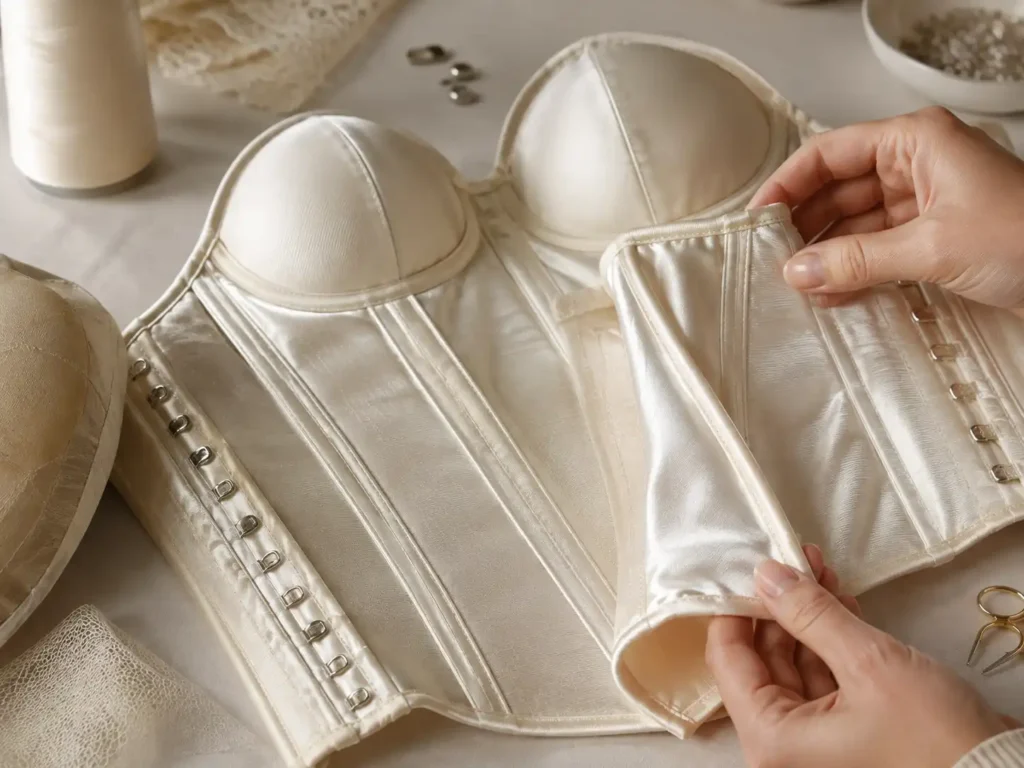
Finishing and Protection
Boning Engineering for Support Without Hard Pressure
Boning gives a corset bodice vertical stability, but stronger does not automatically mean better. Placement, channel construction, length, flexibility and end protection determine whether the finished garment supports the silhouette comfortably.

Placement Follows Structural Lines
Boning should reinforce the pattern rather than fight it. Jinfeng reviews panel seams, bust contour, waist suppression, side-body shape and closure stress before confirming boning lines. A vertical piece placed directly over a curved body zone can create pressure or visible distortion, while missing support near a critical seam can allow collapsing. Placement is therefore checked on the fit sample, especially around center front, side front, side seam and back closure. The final layout is recorded so production does not change the number or location of pieces between sizes or batches without review. When a design uses lace, mesh or satin, boning position is also judged by how strongly the support line shows through the outer shell. Small changes in channel location can improve both comfort and surface appearance without weakening the silhouette.
Placement review also considers garment edge distances and movement zones. Boning ending too close to a neckline can create a hard visible point, while a piece extending too low can dig into the waist or interfere with sitting. Side-front support may need a different angle from center-front support because the body curve and cup transition are different. Jinfeng checks these details against the approved fit rather than using a fixed spacing formula for every corset style.

Channels and Ends Need Protection
A boning channel carries repeated friction and bending, so channel width, stitching and end finishing are part of structural quality. Channels that are too narrow can force the boning to twist; channels that are too loose can allow movement and uneven pressure. Jinfeng checks seam-channel construction, stitch security and clean end protection during sample development. Boning ends should not cut through lining, create a hard point against skin or produce a visible bump at the neckline or waist. Different materials may also need different allowances for movement. Complex corsetry is therefore reviewed inside-out as well as from the exterior. During bulk inspection, QC looks for exposed ends, uneven lengths, broken pieces, asymmetric placement, twisted channels and discomfort points. These checks are more useful than a simple pass/fail statement about whether boning exists.
The channel itself must also survive repeated dressing and movement. Stitch density, seam allowance and the relationship between channel stitching and the outer-shell seam are reviewed when the sample is opened inside-out. On lighter fabrics, the team checks whether channel bulk telegraphs to the surface after pressing. On lined garments, the lining should cover the structure without trapping the boning so tightly that it cannot flex. These points are added to workmanship and QC instructions when they affect bulk consistency.

Support Level Must Match Use
A party dress, bridal-inspired bodice and waist-training corset do not need the same support level. Jinfeng focuses on fashion corsetry where controlled shaping, stable wear and a clean visual line matter more than extreme compression. Boning hardness, width and quantity are therefore evaluated against outer fabric, lining, cup structure, neckline and intended wear. A lighter corset top may use flexible support to prevent collapse, while a strapless occasion dress can require stronger stabilization near the bust and back closure. Fit samples are used to judge movement, sitting comfort, underarm pressure and how the waist behaves during wear. If support changes during development, the team reviews pattern, lining and closure effects before approving the new structure. Boning is treated as one part of the garment system, not a shortcut for fixing a weak pattern.
Support is also reviewed against the sales context. A corset mini intended for partywear may prioritize a defined waist and secure neckline, while a structured midi intended for dinner or wedding-guest use may need a softer feel for longer wear. Jinfeng can compare support options during sampling and keep the approved result as a physical reference. The goal is consistent wearer experience across the collection, not the highest possible rigidity.
Bust and Cup Construction for Stable Necklines
Cup engineering changes bust shape, neckline height, coverage and support. Corsetry development therefore needs controlled cup selection, accurate positioning and fit validation across the intended size range.

Cup Shape Changes the Silhouette
Fixed cups are not interchangeable pieces hidden inside a dress. Thickness, volume, curvature and edge shape can change the visible bodice even when the outer pattern remains unchanged. Jinfeng can evaluate soft, structured, thin or shaping cup directions by project, then fit the cup together with the neckline, upper bust and under-bust pattern. A cup with too much projection can push the outer shell forward and raise the neckline; a shallow cup can flatten the intended silhouette or reduce support. During sampling, cup edges are checked for visible ridges, especially under satin and smooth woven fabric. The final cup type is recorded with size, position and attachment method so later production does not substitute a visually similar component that changes fit. Cup development may require 5–15 days when a special specification must be sourced or adjusted.
Outer-fabric behavior is reviewed at the same time. Smooth satin can reveal every cup edge, lace can disguise some transitions but expose others through motif placement, and mesh can show the internal cup directly. Jinfeng therefore checks cup edge treatment, lining coverage and attachment method under the intended shell fabric. The approved cup is not selected only by nominal size; the visible silhouette, wearer comfort and production availability all need to agree before PP.

Position Controls Coverage and Support
Cup position affects where the bust sits inside the garment and how securely the neckline stays against the body. Jinfeng checks cup center, lower edge, under-bust relation, center-front distance and side coverage against fitting photos and measurements. Position can need revision even when cup size itself is correct. A small horizontal shift may improve cleavage balance; a vertical adjustment may improve upper-bust coverage or reduce gaping. Strapless and low-neckline styles need especially careful review because there is less fabric available to compensate for incorrect cup placement. Anti-slip tape, boning and lining can support stability, but they should reinforce a correctly positioned cup rather than force the garment into place. Bulk QC compares cup position and symmetry against the approved sample and sewing instruction.
Position also affects grading and photography. If the base-size cup is shifted inward or upward to improve cleavage, the same correction cannot automatically be copied across every size. Jinfeng records the approved reference points and reviews how cup spacing and neckline width should change with the grade. During sample review, front, three-quarter and side views are useful because a cup can appear centered from the front while sitting too high or too far forward from another angle.

Grading Must Preserve Bust Logic
Scaling a corset from one sample size into several sizes requires more than enlarging the cup and waist by the same percentage. Bust volume, under-bust width, cup spacing, neckline shape and panel distribution change at different rates. Jinfeng reviews grade rules together with the brand’s size chart, target market and fit preference. The goal is to preserve the intended visual proportion and support level across XS–XL or an agreed extended range. Smaller sizes should not become overly rigid because the same boning and cup geometry were copied from a larger base size; larger sizes should not lose coverage because the neckline was enlarged mechanically. Measurement QC and selected size-set review help identify grading issues before full bulk production, especially for strapless, bustier and deep-neck corset styles.
When component suppliers offer cups in discrete size steps, the pattern grade must also account for the available component range. A theoretical pattern increment is not useful if the selected cup jumps abruptly between sizes. Jinfeng can review cup availability before locking the grade, then align pattern, cup and lining decisions. The same logic applies to boning length and anti-slip placement. Multi-size engineering is planned as a system rather than as separate purchasing and pattern decisions.
Waist Panels and Closures Carry the Corset Load
A clean corset silhouette depends on how panel geometry, waist shaping and closures distribute tension. The visible waistline must remain balanced while seams and fastening points carry repeated wear.

Panel Geometry Creates Controlled Shape
Corset panels divide body contour into manageable curves. Jinfeng reviews center-front, side-front, side, side-back and back relationships according to the design rather than using one generic panel layout. Seam direction influences how the garment shapes the bust, waist and torso, and even small asymmetry can become obvious on satin or fitted woven fabric. The pattern team checks seam lengths, notches, curve transitions and waist alignment before samples are sewn. When a design includes a basque-like waist, pointed center front or high side seam, panel balance must also support the intended visual proportions below the bust. During fitting, wrinkles are read as structural information: diagonal pulling can indicate panel imbalance, insufficient room or closure tension rather than a simple sewing error. Corrections are applied to the pattern so bulk production receives a stable geometry.
Panel design also influences cutting efficiency and seam visibility. A decorative curved panel may look strong in a sketch but create unnecessary seam bulk under satin or make lace matching difficult. Jinfeng can review whether a line is structural, decorative or both, then keep the elements that contribute to silhouette and brand appearance. When simplification is possible, the decision is tested through sampling rather than changed directly in bulk. Good panel engineering preserves the intended design while reducing avoidable sewing risk.

Waist Shaping Needs Wearable Ease
Fashion corsetry often aims for a defined waist rather than aggressive reduction. Jinfeng reviews waist measurement together with rib area, under-bust, hip transition and closure method.
Excessive negative ease can force the zipper to bow, pull side seams forward or make boning press into the body. Too much ease can remove the sculpted look and allow the bodice to collapse.
Fit sampling therefore checks the garment in standing and seated positions, including breathing comfort and the relation between waist seam and skirt or top hem.
The approved waist standard is recorded in the measurement chart and PP sample. For multiple sizes, grade rules must maintain proportion rather than applying one fixed reduction value across the entire size range.
The relationship with the lower garment is equally important. On a corset dress, the skirt can pull downward from the waist seam, while a corset top has a free lower edge that can flip or dig into the body.
Jinfeng checks how the waist transitions into the next section, including seam bulk, lining, zipper position and movement. A stable waistline should look defined in photography without forcing the wearer to hold one posture for the garment to sit correctly.

Closures Need Reinforced Balance
Zippers, lace-up backs and hook-and-eye systems create concentrated stress. Jinfeng checks whether the surrounding fabric and lining can carry that load without stretching, rippling or tearing. Invisible zippers on satin need flat installation and controlled seam tension; lace-up backs need stable eyelet or loop zones and balanced left-right panels; hook-and-eye closures need accurate spacing and secure reinforcement. Closure length also affects dressing and waist fit, especially in fitted dresses with little stretch. During sample review, the team checks how the closure behaves when the garment is worn rather than only when laid flat. Bulk inspection compares closure position, seam flatness, reinforcement, matching color and function against the approved production standard.
Closure selection can also change the perceived fit range. Lace-up backs allow limited adjustment but require disciplined panel spacing; zippers create a cleaner fixed fit but expose measurement errors more quickly. Hook systems can support a compact opening yet need accurate alignment to avoid twisting. Jinfeng reviews the commercial use, dressing method and desired back appearance before finalizing the closure. The approved reinforcement, stitch method and hardware specification are recorded with the production standard so later substitutions do not alter tension behavior. Production planning also checks whether the fastening method can be inspected consistently at line speed.
Fabric Systems for Structured Corset Fashion
Outer fabric and internal support must be developed together. Fabric changes can alter drape, transparency, stretch, seam visibility, pressure marks, lining requirements and even the pattern itself.
| Fashion Direction | Outer Fabric | Internal Support Direction | Main Construction Risk |
|---|---|---|---|
| Structured Satin Corset | Medium-weight satin | Stable lining + boning + fixed cup | Boning show-through, shine marks, zipper rippling |
| Stretch Satin Corset | Stretch satin | Controlled stretch lining + flexible support | Recovery loss, waist growth, seam tension |
| Lace Corset Dress | Lace over base fabric | Stable base + lining + cup + boning | Motif distortion, seam visibility, edge damage |
| Mesh Corset Dress | Stretch mesh or fashion mesh | Power mesh / lining + cup + boning | Transparency, hole risk, uneven tension |
| Structured Woven Bodice | Crepe, suiting or woven blend | Lining + boning | Excess stiffness, seam bulk, comfort pressure |
| Sequin Corset | Sequin fabric | Protective lining + controlled structure | Abrasion, broken needles, skin contact, bulk |
| Power-Mesh Support | Power mesh as internal layer | Integrated support layer | Compression imbalance, recovery, seam stress |
| Soft Fashion Corset | Lightweight woven or satin | Lighter lining + flexible boning | Collapse, wrinkling, insufficient neckline stability |
Pattern Development Turns Style Into Production Geometry
Corsetry becomes scalable only when visual design is converted into measurable pattern logic. Jinfeng treats the pattern as the main structural reference for samples, grading, PP approval and bulk QC.
Development Starts With Structure Review
A sketch or reference image rarely contains enough information for reliable corsetry production. Jinfeng first identifies neckline, bust shape, waist position, panel lines, closure, lining, cup, boning direction, hem or skirt transition and target fit. Tech packs are reviewed for measurements and construction notes, while original samples can be measured to understand proportion and internal assembly. Missing information is converted into development questions rather than guessed silently. Fabric is reviewed at the same stage because stretch, weight and thickness can change the amount of support required. Once the structure is clear, the pattern team establishes key reference points such as upper bust, full bust, under-bust, natural waist, corset waist, center-front length, side length and back height. A good development start reduces later sample rounds because the pattern is built around the intended wearing condition rather than a flat visual imitation.
For multi-style collections, the structure review also identifies which principles can be shared. Several corset dresses may use the same support concept but require different cup positions, neckline heights or closure methods. Jinfeng can group related styles for development efficiency while keeping individual pattern and trim records. Such grouping helps a brand maintain a coherent visual language across the collection without forcing identical construction onto garments with different fabrics or fit requirements.
Fit Feedback Becomes Pattern Corrections
Fit comments only create value when they are translated into measurable changes. Jinfeng reviews fitting photos, garment measurements, local pressure points, neckline behavior, cup position, side-seam angle and waist balance. Comments such as “too loose at the top” or “waist feels tight” are converted into specific pattern actions: neckline reduction, panel redistribution, cup repositioning, waist release, side-height change or closure adjustment. Updated patterns are dated and linked to revised samples so the team can track what changed between rounds. Changes in outer fabric, lining, cup or boning may also trigger pattern review because the garment can behave differently even when dimensions remain the same. The objective is a pattern that explains the approved fit, not a sample that looks acceptable because sewing operators manually adjusted it.
Clear feedback reduces unnecessary rounds. Jinfeng encourages comments that identify the body area, observed problem and desired change, supported by fitting images or measurements where possible. A note such as “upper edge stands away by 12 mm at center front” gives the pattern team more direction than “bust feels wrong.” The correction record then becomes part of the project history, helping merchandising, sampling and later QC teams understand why the pattern changed and which version is approved.
Final Patterns Must Be Production Ready
Before bulk release, approved corrections move into a final pattern set with size chart, grade rule, seam allowances, notches, lining pieces and structural references. Corsetry often needs separate information for outer shell, lining, cup position, boning channels, closure reinforcement and decorative overlays. Jinfeng links these details to sewing instructions and QC measurements so production teams do not need to interpret the style from photos. Final patterns also support repeat orders because later teams can identify the exact approved geometry rather than rebuild the shape from a finished garment. When a brand changes fabric, color, cup or closure on a repeat style, the pattern is reviewed again where necessary instead of assuming every material change is neutral.
Production readiness also means the pattern can be interpreted consistently by more than one sewing team. Important construction lines are supported by notches, reference marks and written instructions instead of depending on the sample maker’s memory. Jinfeng links the final pattern to the approved fabric, cup, boning and closure specifications. If a new colorway uses a fabric with different stretch or thickness, the team can review whether the original pattern remains valid before a repeat order begins.

Corset Size Grading Must Preserve Shape and Support
One approved sample size does not guarantee a stable size run. Corsetry needs deliberate grade rules so bust volume, waist shaping, panels, cups and support remain proportionate across the range.
Bust and Waist Cannot Scale Equally
Bodies do not enlarge by one uniform percentage, and corset patterns cannot be graded that way either. Jinfeng reviews bust, under-bust, waist, side height, front length and back length according to the brand’s size chart. Cup spacing, cup volume and neckline width may need different increments from waist and panel widths. A grade that simply expands every line can push cups too far apart, increase neckline exposure or weaken waist definition. Conversely, a grade that keeps the upper bodice too narrow can create pressure and distortion in larger sizes. Grade rules are therefore established around the approved base pattern and target market. When a style uses fixed cups or strong boning, the component size range is checked alongside pattern increments so internal parts match the intended body proportions.
The brand’s fit philosophy remains part of the grade decision. Some labels prefer a close, sculpted waist with more bust ease; others want a softer upper edge and less compression. Jinfeng follows the supplied size chart and approved fit comments instead of imposing one house corset fit on every collection. Grade rules can therefore preserve both measurement logic and brand identity. The base-size sample establishes the direction, while size-set review confirms whether the same visual proportion survives at the edges of the range.
Boning and Panels Need Size Logic
Boning length and placement can change as torso length and panel width change. Copying the same internal layout across every size can create a support line that ends too close to the bust, waist or garment edge. Jinfeng reviews whether boning should lengthen, shift or remain fixed according to the pattern and component availability. Panel seams also need to stay visually balanced; a narrow center panel that looks elegant in the base size can become disproportionately wide or narrow after mechanical grading. Selected size-set samples or pre-production measurement reviews are useful for high-risk corsetry programs. The approved grade rule becomes part of the production standard so bulk cutting, sewing and QC teams are working from the same multi-size logic.
Component availability can influence the final grade. A boning length that works perfectly in the base size may sit too close to the neckline in a shorter torso size, while a larger size may need a different support distribution rather than simply longer pieces. Jinfeng can flag these points before bulk and document approved size-dependent changes. Panel notches and seam references are also checked after grading so sewing accuracy does not decline as piece shapes become wider or more curved.
Measurement QC Protects the Size Run
Corset grading is only useful if bulk garments stay within the approved measurements. Jinfeng checks key points such as upper bust, bust, under-bust, waist, center-front length, side length, back width, neckline and closure length according to the agreed chart. Measurement checks are combined with visual inspection because two garments can share the same waist measurement yet differ in cup position or panel balance. QC also monitors cup symmetry, boning layout and neckline stability across sizes. When a brand develops XS–XL or an extended range, the inspection plan can focus extra attention on the smallest and largest sizes, where grading errors are most likely to become visible.
Measurement data is reviewed together with construction observations. If the waist is within tolerance but the side seam rotates forward, the issue may still indicate imbalance. If cup position matches the chart but the neckline gaps in the smallest size, a grade-rule correction may be needed. Jinfeng uses measurement checks as evidence, not as the only definition of fit. Combining numbers with garment balance helps prevent a technically “in-spec” corset from reaching bulk shipment with a visible size-related problem. Selected garments can be checked again after finishing because pressing and lining attachment may slightly change the final measured shape.

Complex Corset Samples Need Structured Revision Rounds
Corsetry is validated through fit and construction, not by approving the first garment from photographs. Jinfeng separates sample stages so structural changes are resolved before PP and bulk production.
First Sample Tests the Engineering Direction
The first sample tests whether the pattern, fabric and internal structure can produce the intended silhouette. For corset, strapless, lace, mesh and evening styles, a first sample is normally planned around 15–25 days after materials and development details are confirmed. Jinfeng reviews neckline, cup shape, cup position, upper-bust fit, waist shaping, panel alignment, boning behavior, closure tension and lining coverage. The first sample is not treated as a production standard. Its role is to expose engineering questions early. If the outer fabric creates unexpected ridges, if boning feels too hard or if a cup changes the neckline, those issues are documented before revision. Photos and measurements can support remote review, while the brand’s fit comments guide the next correction list.
The team also checks whether the proposed construction is realistic for production. A hand-positioned cup, manually eased seam or improvised internal tape can make one sample look excellent while creating an unstable bulk method. Jinfeng identifies such hidden adjustments during development and replaces them with repeatable sewing or pattern solutions where possible. Sample review therefore covers both fit quality and manufacturing feasibility. The strongest first-sample outcome is a clear correction plan, not an artificial appearance of perfection.
Revised Samples Prove Corrections
A revised sample should demonstrate measurable progress rather than simply look “better.” Jinfeng records pattern changes, measurement changes, fabric replacements, cup adjustments, boning changes, closure changes and sewing-method corrections between rounds. Revised samples are then compared against the previous comments. If a material change affects fit, the team checks whether a new pattern adjustment is also required. Common corsetry revisions include moving cup position, reducing neckline gaping, changing boning hardness, improving anti-slip placement, releasing waist pressure, flattening a zipper or adjusting panel symmetry. Complex revisions can require additional time depending on material availability and the extent of pattern work. Clear revision records reduce the risk of old construction details returning during PP or bulk production.
Version control becomes especially important when several structural changes happen at once. Jinfeng can separate pattern corrections from material and trim substitutions so the effect of each decision remains visible. If a revised sample uses a new cup and a new lining, the team records both rather than attributing the entire improvement to the pattern. Such records make PP approval more reliable because the final garment can be traced back to the combination of changes that produced the approved fit and appearance.
Approval Needs More Than Appearance
Before a corsetry sample progresses to PP, the brand should confirm fit, measurements, fabric, color, cup, boning, lining, closure, sewing and visible finishing. Jinfeng also reviews whether the structure can be repeated at production speed without hidden hand adjustments that are unrealistic for bulk. If the style includes lace placement, sequin protection, mesh coverage or special trims, those details are checked alongside the corset structure. Approval is strongest when comments refer to specific areas and measurable standards rather than a general “looks good.” The resulting confirmed sample direction can then be transferred into PP preparation with fewer unresolved variables.
Commercial approval should also consider the planned size range and production method. A visually strong sample may still need a size-set review when the cup system or neckline is sensitive to grading. The team checks whether approved components are available in production quantities and whether the sewing method can be repeated without excessive manual correction. Packing implications are reviewed for styles with molded cups, satin surfaces or rigid support. These checks reduce the risk of discovering production limitations after fabric and trims have already been committed. The approval record should therefore show both the visual decision and the production conditions behind it.

PP Approval Locks the Corsetry Production Standard
PP approval is the point where development decisions become manufacturing controls. Fabric, cups, boning, measurements, sewing, labels and packing should be stable before production is released.
Construction Details Are Frozen Before Bulk
Jinfeng uses the PP stage to confirm the final combination of outer fabric, lining, cup, boning, anti-slip, closure, measurements and sewing method. Corsetry is sensitive to late changes because one component can affect several other areas. Changing cup thickness can alter neckline height; changing boning hardness can alter comfort and surface appearance; changing a zipper can affect seam tension. Approved trims and construction details are therefore recorded before bulk. If a change is requested after PP, the team reviews cost, lead time, pattern effect, material availability and whether a new sample is required. A controlled change process is safer than allowing production operators to adjust structure informally.
The PP record also becomes a communication boundary. Merchandising, purchasing, production and QC teams can work from the same approved specification instead of relying on separate chat messages. Jinfeng links construction changes to updated files so an old cup, boning layout or lining method does not reappear on the line. For multi-style programs, each PP standard remains style-specific. Shared components can be identified for efficiency, but the team still records where placement or sewing differs between garments. The result is a controlled release point with one agreed version for purchasing, production and inspection.
Golden Sample Gives Production a Physical Reference
After PP approval, a Golden Sample can serve as the physical reference for production, QC and later repeat orders. Jinfeng compares bulk garments with the approved sample for surface appearance, cup shape, panel balance, boning placement, closure finish, lining behavior and overall silhouette. The Golden Sample works together with pattern files, size charts, trim records and sewing instructions; it does not replace them. A physical reference is especially useful for corsetry because tactile details such as support level, cup firmness and lining feel are difficult to communicate through measurements alone. Keeping the approved standard also helps later programs return to the same construction logic when a successful style is reordered or developed in new colors.
During bulk, the Golden Sample can be brought to line review, finishing and final inspection when a detail is difficult to judge from written instructions alone. It is especially useful for neckline feel, cup firmness, waist shaping and the way lining sits against the shell. Jinfeng can retain approved references for repeat programs, while still rechecking fabrics and trims when supplier batches or colors change. The reference supports continuity without creating a false promise that every later material batch will behave identically.
Sample-to-Bulk Transfer Prevents Construction Drift
Strong sampling has little value if production receives incomplete instructions. Jinfeng transfers approved corsetry details into pattern, trim, sewing and QC records before line release.
Approved Patterns Become the Production Base
The final pattern set is the starting point for bulk cutting. Jinfeng transfers the approved outer-shell pattern, lining pattern, relevant support pieces and grade rules together with the size chart. Pattern notches, seam allowances and panel identifiers reduce the risk of pieces being assembled in the wrong relationship. Corsetry is particularly sensitive to small panel errors because left-right asymmetry can shift the bust, waist or closure. Cutting direction is also controlled for fabrics such as satin, stretch satin, lace and mesh. Production should not rely on tracing the sample or adjusting panels by eye. A recorded final pattern gives cutting, sewing and QC teams a common geometric reference.
Cutting preparation also checks fabric relaxation, stretch direction and directional surface behavior where relevant. Stretch satin and mesh can change dimensions if cut under tension, while satin panels can reflect light differently when cut in inconsistent directions. Jinfeng connects these material controls with the approved pattern so structural measurements are not undermined before sewing starts. Cutting QC can verify panel identity, size, direction and visible defects before bundles reach the line, reducing the chance of discovering geometry problems after the corset is assembled. Bundle identification and size separation are kept clear so closely shaped panels are not mixed during line feeding.
Trim Records Protect the Internal Structure
Cup type, cup size, boning type, boning length, anti-slip tape, zipper, hook-and-eye, lace trim and lining specifications are recorded before bulk purchasing and line issue. Jinfeng keeps trim details so approved components are not replaced with similar-looking alternatives without review. Small substitutions can change support, comfort or appearance. A different cup thickness can affect neckline shape; a different boning hardness can create pressure; a zipper with different tape stiffness can change seam flatness. Trim approval therefore supports both purchasing control and construction consistency. The same records are valuable for repeat orders because the team can identify what was used previously and which items require fresh supplier confirmation.
Purchasing control matters because many corsetry components look similar without performing the same. Two boning materials can have different rebound; two cups with the same nominal size can have different projection; two anti-slip tapes can feel different against skin. Jinfeng keeps supplier and specification references where available and confirms replacements before use. When substitutions are unavoidable, the team can evaluate whether a revised sample or approval photo is needed. Component discipline protects both fit and brand consistency during large programs. Approved alternatives can be documented in advance when a component has known supply risk.
Sewing and QC Instructions Close the Loop
Production handover includes sewing methods and inspection points, not only materials. Jinfeng can record seam allowance, stitch density, zipper construction, neckline finish, lining attachment, boning position, cup position, anti-slip location, pressing standard and key QC checks. In-line inspectors then look for structural drift while garments are still on the line rather than waiting for final inspection. If a recurring issue appears, production can be corrected before the same error reaches hundreds of pieces. Final QC checks measurements, construction and finished appearance against the approved standard. The handover process turns sample knowledge into repeatable production instructions and reduces dependence on individual operators remembering how the sample was made.
Production teams also need clear escalation rules. If in-line inspection finds repeated neckline gaping, boning exposure or cup shift, the issue should be reviewed against the approved sample and pattern rather than corrected independently at each sewing station. Jinfeng’s merchandising, production and QC teams can use the shared records to identify whether the cause is cutting, sewing, component placement or measurement. A controlled correction prevents inconsistent fixes from creating a second problem later in the line. The same escalation path helps prevent isolated rework from becoming an undocumented construction change. Final approval notes remain available to the merchandising team during shipment preparation.

Corsetry Workmanship Details Brands Can Inspect

Boning Channels

Boning End Protection

Cup Alignment

Seam Symmetry

Lining Attachment

Closure Finish
Corsetry Quality Control Before Bulk Shipment
Corset inspection needs product-specific checkpoints. Jinfeng combines incoming material review, cutting checks, in-line sewing inspection, measurement control, finished garment inspection and packing QC.
| QC Point | What Is Checked | Common Failure to Prevent |
| Cup Symmetry | Height, spacing, shape, left-right balance | Uneven bust appearance |
| Cup Position | Center, under-bust relation, neckline relation | Low support or incorrect coverage |
| Boning Position | Channel location, left-right consistency | Twisting, collapse, pressure |
| Boning Length | Approved length and end clearance | Poking, visible bumps, breakage |
| Panel Symmetry | Seam alignment, waist line, notches | Distorted silhouette |
| Upper-Bust Fit | Neckline measurement and stability | Gaping or slipping |
| Waist Measurement | Approved chart and tolerance | Excess pressure or loose shaping |
| Closure | Flatness, reinforcement, function | Rippling, opening, seam stress |
| Lining | Coverage, attachment, clean edge | Exposure, twisting, discomfort |
| Anti-Slip | Position, continuity, comfort | Strapless movement |
| Surface Finish | Pressing, puckering, pressure marks | Poor photo appearance |
| Final Garment | Balance, movement, workmanship | Sample-to-bulk inconsistency |
| Packing | Folding, protection, label and SKU check | Compression marks or warehouse errors |
What Drives Corsetry Construction Cost
Structural Fabric Layers
Cups and Boning
Panel Complexity
Closure Construction
Sample Revision
QC Intensity
From Approved Corsetry to Branded Bulk Delivery
Bulk Production
Multi-Style Programs
Private Labels
SKU and Barcodes
Protective Packing
Export Coordination
A Multi-Style Corsetry Program From Fit to Bulk
An anonymized designer-led fashion program shows how structured corsetry moves through product development, revision and production when several related styles must share a consistent construction standard.
Program Scope and Development Pressure
The program covered 14 structured womenswear styles and approximately 28,000 pieces across corset mini dresses, strapless dresses, bustier silhouettes and related partywear. Fabrics included satin, lace, structured woven material and lining. Construction details included fixed cups, boning, anti-slip tape, lace-up backs and invisible zippers. The largest challenge was not producing one attractive sample; the development team needed to keep a coherent bust and waist language across 14 styles while allowing each neckline, cup shape and closure to work differently. Early reviews identified several recurring risks: cup positions were inconsistent between silhouettes, boning showed through lighter satin, some strapless necklines opened at the upper bust, and lace-up backs created uneven tension when waist shaping was too aggressive. The project was therefore divided into structure families so related styles could share approved principles without forcing one identical pattern across the collection.
The order size also required decisions that would still work beyond the sample room. With approximately 28,000 pieces planned, minor inefficiencies in channel sewing, cup placement or closure reinforcement could become significant labor and consistency issues. Jinfeng therefore evaluated which construction details were essential to the visual identity and which could be standardized across related styles. Shared components were considered where suitable, but style-specific fit controls remained separate. The development goal was a collection-level system rather than fourteen unrelated sample exercises.
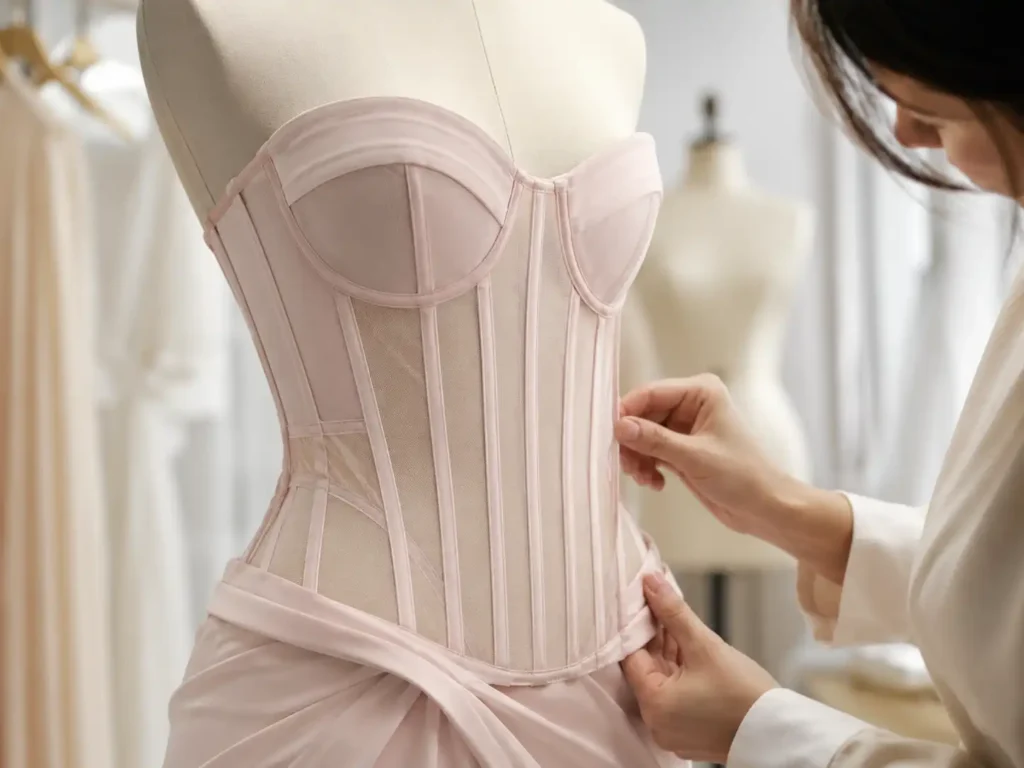
Pattern and Sample Corrections
Jinfeng created and revised corset structure patterns according to each silhouette. The team adjusted upper-bust shaping, cup position, boning lines, anti-slip placement and waist suppression based on fit feedback. Satin styles received extra review for surface pressure and zipper flatness; lace styles required attention to motif placement and lining coverage; strapless styles were checked for neckline stability during movement. Development moved through first sample, fit sample, revised sample and PP stages rather than pushing unresolved garments directly into production. Complex samples were scheduled according to material readiness and revision scope, with corset development generally planned around the established 15–25 day complex-sample window. A common feedback format helped the brand compare style families, while pattern and trim changes were recorded separately so approved solutions were not lost when several samples were moving at the same time.
A version matrix was used to keep the development path clear across the style group. Each sample round recorded pattern status, cup status, boning direction, fabric change, closure change and approval notes. Such organization mattered because several samples were being reviewed in parallel. When one correction proved successful on a related silhouette, the team evaluated whether the same principle could be transferred, then tested it rather than copying it automatically. The process reduced repeated experimentation while protecting differences in neckline and fabric behavior.
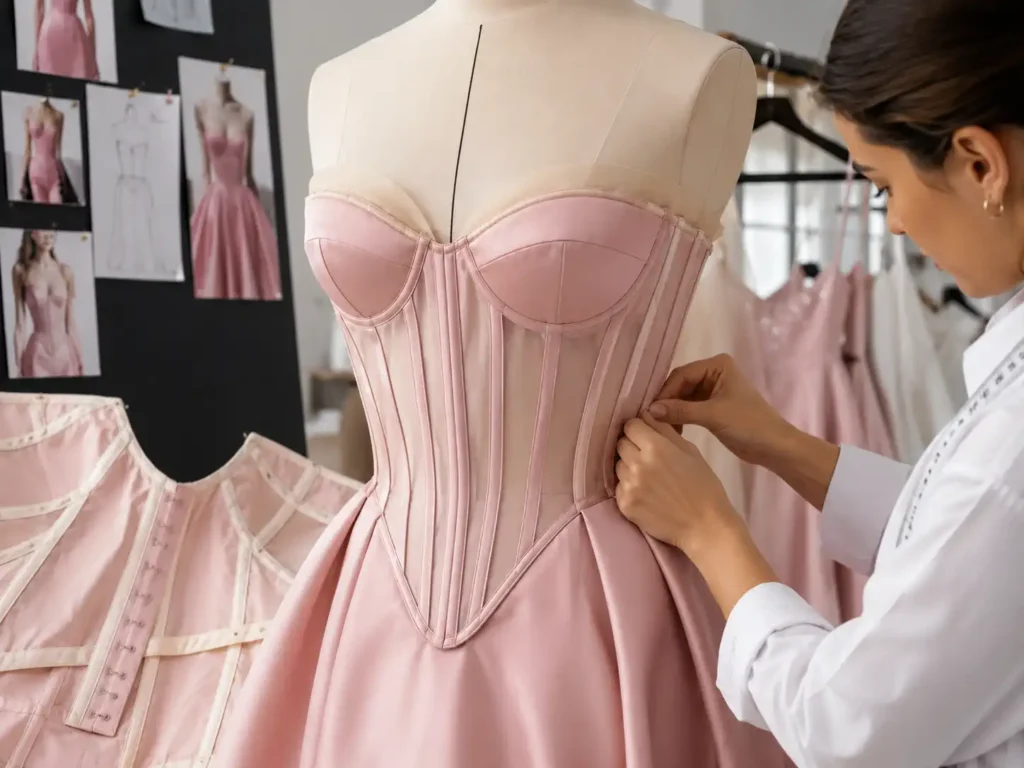
Bulk Standard and Repeatability
Before bulk release, approved patterns, size charts, cup specifications, boning positions, sewing methods, trim details and QC checkpoints were transferred into production files. Golden Samples provided physical references for the main structure families. In-line inspection focused on cup symmetry, boning consistency, panel alignment, neckline stability, waist measurements, closure finish and lining control. Final inspection also reviewed satin pressure marks, lace damage, anti-slip placement and packing protection. The program moved into phased bulk production after PP approval, allowing production and QC capacity to follow style complexity rather than forcing every garment through the same line plan. Pattern, cup, boning and workmanship records were retained to support later color extensions and next-season structured styles. The value of the project came from preserving construction logic across a collection, not from copying one corset pattern fourteen times.
Phased production also allowed the team to use early line feedback as a control signal. Repeated small deviations in cup height, boning end position or zipper flatness could be corrected before later batches reached the same stage. Packing standards were adjusted to protect molded areas and satin surfaces during carton loading. After shipment, the retained pattern and construction records created a base for future replenishment and color extensions, while material batches would still be rechecked before any repeat production.
Frequently Asked Questions About Corsetry Construction
Boning can be selected in different widths, hardness levels and materials according to the garment. Common structured fashion directions include plastic-style boning, softer flexible support and spiral-type options by project. Selection depends on silhouette, fabric, lining, comfort and support level. Final type and supplier specification are confirmed during development rather than assumed from the reference image.
Placement follows pattern seams, bust contour, waist shaping, closure stress and the intended support line. Jinfeng checks placement on the fit sample and reviews whether any channel creates pressure, surface ridges or distortion. Approved position and length are recorded before bulk so production does not improvise the internal layout.
The team reviews satin weight, lining stability, channel position, seam allowance, boning hardness and pressing. A harder support piece directly under a smooth shell can create ridges even when the pattern is correct. Sample testing helps determine whether support, lining or channel placement should change before the satin construction is approved.
Cup type, thickness, shape and position are evaluated together with upper bust, under-bust, neckline and outer fabric. Jinfeng checks symmetry, coverage, support and visible cup edges during fitting. Special cup development can require additional sourcing time, while the approved cup specification is recorded for PP and bulk production.
Grading considers bust volume, under-bust, waist, panel distribution, cup position, neckline and garment length rather than enlarging every line by one percentage. Jinfeng follows the brand’s size chart and develops grade rules from the approved base pattern. Selected size-set review and measurement QC can be used for higher-risk size ranges.
Yes. Strapless construction can combine pattern shaping, cups, boning, anti-slip tape, lining and a stable closure. Fit sampling is important because neckline security depends on upper-bust and waist balance, not on boning alone. Jinfeng checks support, comfort, coverage and movement before the structure is locked for production.
Yes, but changes are reviewed for pattern, neckline, comfort, cost, sourcing and lead-time effects. A different cup thickness or boning hardness can change the fit even when the outer pattern stays the same. Revised samples may be needed when the structural effect is significant. Final components should be locked before PP approval.
Complex corset, strapless, lace, mesh, sequin and evening samples are commonly planned around 15–25 days after development details and material direction are confirmed. Timing can extend when custom fabrics, special cups, unusual trims or major pattern revisions are required. Revised and PP timing depends on the approved correction list and material readiness.
PP approval should cover outer fabric, lining, color, cups, boning, anti-slip, closure, measurements, sewing, visible finishing, labels and packing direction. Jinfeng then transfers the approved pattern, size chart, trim details, sewing instructions and QC points into production. Late structural changes are reviewed before being accepted.
QC combines material review, cutting checks, in-line inspection, measurement checks, finished garment review and packing control. Corsetry-specific checkpoints include cup symmetry, cup position, boning location and length, panel alignment, upper-bust stability, waist measurement, closure, lining, anti-slip, surface finish and final garment balance.

Start Your Corsetry Development With Clear Project Files
Corsetry projects move faster when structure, materials and commercial requirements are reviewed together before sampling begins.
Send Jinfeng Apparel a tech pack, reference garment, sketch or line sheet together with the planned product type, target quantity, fabric direction and size range. For structured bodices, include any known cup, boning, neckline, closure, lining or support requirements. The development team can then review pattern difficulty, material direction, sample route, likely structural risks and the information still needed before an accurate quotation or production plan is issued.
For established collection programs, include:
- Reference images, sketches or tech packs
- Style count and planned quantity
- Target size range and measurement chart
- Outer fabric and lining direction
- Cup, boning and support requirements
- Closure and trim details
- Private-label and packing files
- Required launch or delivery window


