 Skip to content
Corset Dress Pattern Development
From Design Intent to Production-Ready Corset Fit
Jinfeng Apparel develops corset dress patterns for fashion collections where bust support, cup position, boning, waist shaping and neckline stability must work together before bulk production.
- 7+ senior womenswear pattern makers supporting structured dress development
- 2 dedicated sample rooms and 20+ sample machinists
- Corset, bustier, strapless, bodycon and structured occasionwear pattern capability
- Bust, upper-bust, under-bust, waist, hip, neckline and lining reviewed during development
- Complex corset styles commonly move through first sample, fit review and around two revised samples according to structure and feedback
- PP and Golden sample standards used before approved designs move into bulk production
Pattern Development for Established Fashion Programs
Fashion Brand Teams
Technical and Fit Teams
Sourcing and Product Teams
For multi-style programs, development must also remain manufacturable. Fabric availability, trim specifications, construction complexity, size distribution, MOQ, packing requirements and production planning all influence the final pattern solution.
Our role is to keep the intended visual result while preventing a beautiful sample from becoming an unstable bulk-production specification.
Pattern Capability Built Around Structured Womenswear
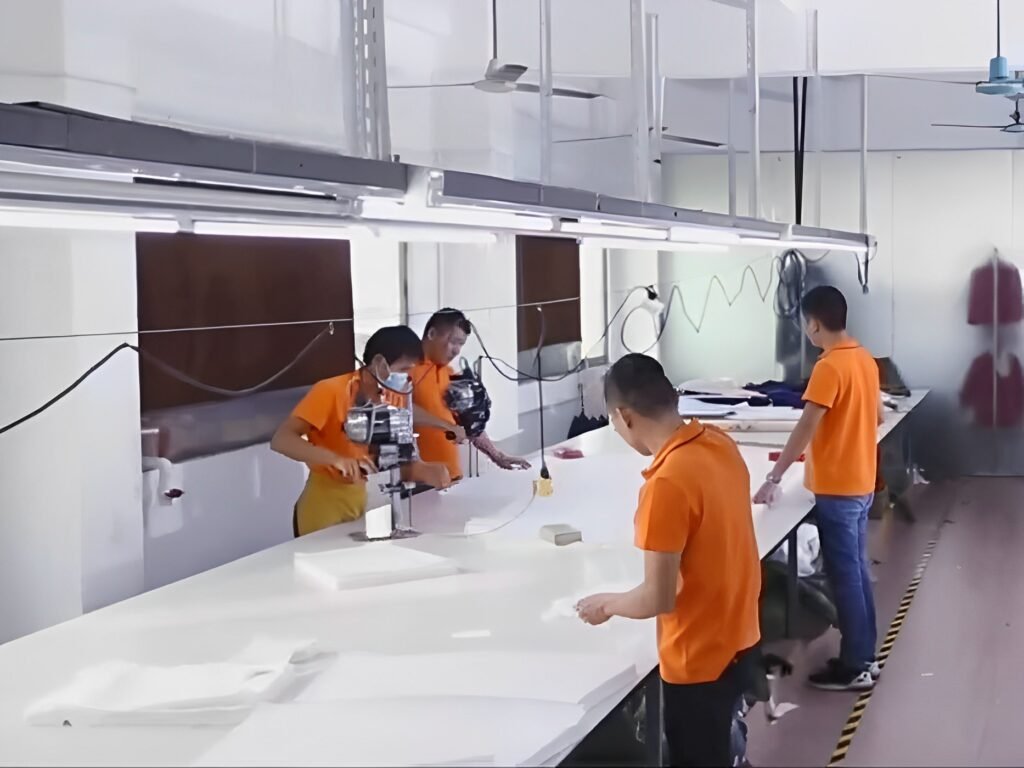
7+ Senior Pattern Makers
2 Sample Rooms

20+ Sample Machinists

Production System
What a Production Corset Pattern Must Control
A production corset pattern has to convert visual design into body balance, structural support and repeatable sewing instructions. A pattern can look correct on paper and still fail once cups, lining, boning, fabric stretch and body tension begin interacting.
Body Proportion Comes Before Decoration
Corset fit begins around the body, not around the decorative seam lines shown in a sketch. Bust, upper bust, under bust and waist have different functions. Bust measurements influence volume and coverage. Upper-bust measurements affect neckline contact and strapless stability. Under-bust measurements control how the bodice anchors beneath the bust. Waist measurement creates shaping but also determines comfort, closure tension and the way vertical panels sit on the body.
Front length is equally important. A bodice that is too short can pull upward over the bust, distort the cup position and make the waistline rise. A bodice that is too long may collapse or create pressure at the waist. For fitted corset dresses, hip and skirt measurements also matter because excessive lower-body tension can pull the entire bodice downward or twist side seams.
Pattern development therefore starts by identifying the intended fit relationship rather than forcing all styles onto one standard block.
Structure Must Follow Stress Lines
A corset bodice experiences tension in several directions. Bust volume pushes forward, the waist creates horizontal tension, the closure creates concentrated pull, and vertical boning is expected to hold the intended shape without becoming uncomfortable.
Panel seams need to follow useful shaping lines. Cup seams need enough volume where the body requires it. Boning channels should support the structure rather than simply create visible vertical lines.
The zipper or lace-up area must be strong enough for the planned fit, and internal layers need enough stability to stop the outer fabric from carrying all structural stress.
For a satin corset mini, the outer shell may look smooth while almost every important support decision sits underneath it. For a lace or mesh corset style, internal construction becomes even more important because support materials can affect transparency and the final visual balance.
Production Repeatability Must Be Designed Early
A one-off sample can be adjusted by hand until it looks good. Bulk production cannot depend on individual hand correction.
Final pattern pieces need clear seam relationships, notches, panel balance, cup position, boning position and alignment references. Fabric direction needs to be understood before cutting. Stretch fabrics require confirmed stretch direction and recovery behavior. Lace placement may need repeatable motif rules. Lining and support layers need compatible pattern dimensions rather than being treated as smaller copies of the shell.
Approved fit comments are converted into updated pattern files, size charts, measurement records, fabric and trim approvals and sewing instructions. Development is only considered ready for production when the garment can be reproduced through a controlled process.

Corset Dress Patterns We Develop for Fashion Collections

Strapless Corset Mini

Bustier Mini Dress
Bustier-inspired styles expose more of the upper body structure and often use clearly defined cups. Cup seam shape, under-bust position and neckline height need to align visually with the intended design.
A cup placed several millimeters too high or low can noticeably change the body proportion, even when the garment measurement chart appears correct.

Satin Corset Midi

Stretch Satin Corset
Stretch satin can create a closer fit but adds recovery and tension variables. Too much negative fit may overload the zipper or flatten the bust.
Too little control can reduce waist definition. Stretch direction, recovery, seam tension, cup stability and lining behavior are reviewed together before the pattern is locked.
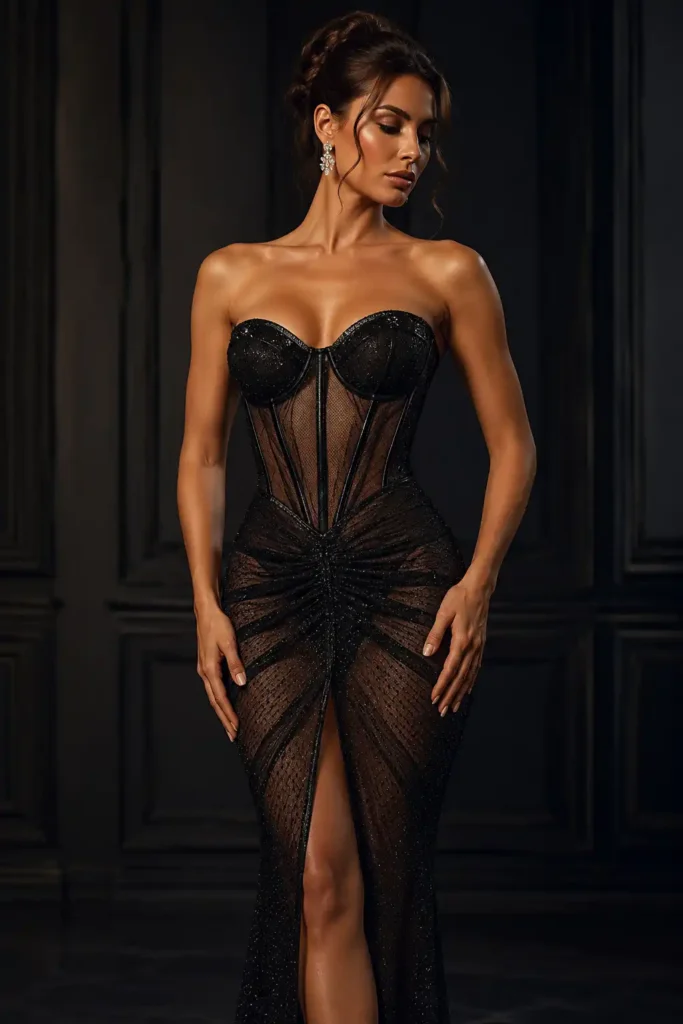
Mesh Corset Dress

Lace Corset Dress

Structured Occasion Corset

Corset Maxi Dress
Corset Pattern Architecture from Cup to Closure
Corset architecture is strongest when panel shaping, cups, internal support and closures are developed as one structure. Adding boning late cannot correct a pattern whose bust or waist geometry is already wrong.
Panel Lines Carry Shape
Front and side panels determine far more than appearance. Their curvature controls where volume is created and where the bodice draws inward toward the waist.
A front panel that is too flat may compress the bust or push it upward. Excessive curve at the wrong position can create hollow areas beside the cup. Side panels influence waist shaping and the transition toward the back. When panel seams are part of the visible design, they also need visual symmetry after the garment is worn rather than only when it is laid flat.
Seam placement must consider boning channels, cup edges, lining attachment and closure construction. In some styles a seam provides an efficient line for boning. In others, support needs a separate channel or internal layer.
Pattern development therefore considers the garment from shell to lining rather than treating front-panel lines as purely decorative style lines.
Cup and Under-Bust Geometry
The cup needs enough three-dimensional volume for the intended fit without creating an unstable neckline.
Cup height, width, depth and position affect how the upper edge sits against the body.
The under-bust line determines where the cup transitions into the corset body and whether support feels anchored or floating. Fixed bra cups, underwire direction or softer internal cups can all change the required pattern relationship.
An incorrect cup often shows symptoms elsewhere: neckline gaping, wrinkling below the bust, excess tension at center front or an unnatural waist position.
Sample fitting is used to separate a cup-volume issue from an upper-bust, front-length or panel-shaping issue before the pattern is revised.
Closure and Back Tension
A zipper, lace-up back or hook-supported closure is part of the fit system.
A close-fitting corset dress places tension on the closure whenever the wearer moves, sits or breathes. Back-panel dimensions therefore need to account for closure type and intended fit. Zipper installations require enough structural support to stay flat.
A lace-up construction changes adjustability and back opening behavior. Hook-and-eye reinforcement can reduce stress at selected closure points.
The closure cannot be selected only at the final trim stage. Its width, placement and tension need to be considered while the pattern is being developed.

Corset Fit Control Map
Corset development concentrates on measurement relationships rather than a single bust or waist number. Small shifts in upper bust, under bust, front length or waist position can change support, coverage and the entire visual proportion of a fitted bodice.
Corset Fit Control Map
| Measurement / Control Point | Main Function | Typical Risk When Incorrect | Pattern Response |
|---|---|---|---|
| Bust | Overall bust volume and coverage | Compression, excess room, distorted cup | Adjust cup/panel volume |
| Upper Bust | Top-edge contact and stability | Gaping, slipping, exposed neckline | Refine upper bodice contour |
| Under Bust | Support beneath bust | Weak anchoring, wrinkles, poor lift | Correct under-bust curve |
| Natural Waist | Shaping and comfort | Over-compression or loose waist | Adjust panel intake and ease |
| Front Length | Bust-to-waist balance | Bodice rides upward or cup shifts | Correct vertical balance |
| Back Length | Back fit and closure position | Back wrinkles, zipper distortion | Correct back panel length |
| Neckline Depth | Coverage and visual proportion | Gaping or excessive exposure | Adjust neckline and support |
| Hip / Lower Dress Fit | Controls lower-body pull | Skirt tension drags bodice | Correct hip ease and balance |
Cup Shape Development Requires Physical Fit Validation
Cup development is one of the clearest differences between ordinary dress pattern making and structured corset development. The goal is not maximum padding. The goal is controlled volume, stable positioning, appropriate coverage and a natural relationship with the corset body.
Cup Position Changes the Silhouette
Cup position affects neckline height, bust projection, center-front proportion and the visible length of the waist.
A cup positioned too high may make the neckline look short and create pressure beneath the bust. A low cup can reduce support and expose more upper bust than the original design intended. Width also matters. A cup that is too narrow can compress the sides of the bust; excessive width can create an empty area and move the visual bust point outward.
During fitting, the pattern team reviews cup position together with upper-bust contour and front-body length. Moving the cup alone is not always the correct correction.
Cup Type Must Match Construction
Corset dresses may use fixed bra cups, softer shaping cups or another internal cup solution depending on fabric, neckline, desired support and comfort.
Cup thickness and stiffness affect the shell. A rigid cup beneath lightweight satin may create a visible edge.
A soft cup may not provide enough shape for a strapless bodice. Lace and mesh styles may need careful layering so cup support remains visually clean.
Cup selection is therefore confirmed together with fabric, lining and boning direction rather than purchased as an isolated trim.
Sample Fitting Decides Final Position
A cup should not be approved from flat garment measurements alone.
Fit review looks at bust coverage, top-edge contact, under-bust position, comfort, neckline symmetry and how the cup behaves during movement.
Comments are then converted into a measurable action: change cup position, change cup shape, alter front-panel volume, adjust under-bust curve or revise upper-bust tension.
Once the fit direction is confirmed, cup specifications and placement references are carried into PP and bulk documentation.

Boning Should Support the Pattern, Not Rescue It
Boning stabilizes a corset structure, controls collapse and helps maintain the intended bust-to-waist line. It cannot compensate for a bodice whose cup, waist or panel pattern is incorrectly shaped.
Boning Placement Follows Support Needs
Boning placement is evaluated around the structural lines of the garment.
Vertical support may be positioned along selected seams or dedicated channels depending on panel layout. Areas close to the closure often need stability because of concentrated tension. Other channels may support waist shaping or keep long front and side panels from collapsing.
Adding more boning is not automatically better. Excessive rigidity can reduce comfort and make the garment feel costume-like when the intended product is fashion occasionwear.
Channel Construction Matters
A boning channel must hold the support piece in the intended position without creating visible distortion.
Channel width, seam consistency and end finishing influence both appearance and comfort. Boning that is too long can press into the body.
Poorly protected ends can create sharp pressure points. A channel that shifts or twists can produce visible ridges through satin or other smooth fabrics.
Sample construction therefore checks the boning together with shell thickness, lining, interlining and seam allowances.
Boning and Waist Shaping Work Together
Corset shaping comes from the pattern first and the support system second.
Panel curvature defines the reduction between bust, waist and lower bodice. Boning helps hold those curves under wear. If the pattern relies on boning to force an unrealistic waist shape, pressure increases at the closure and seam lines.
Jinfeng Apparel reviews waist shaping together with support level, comfort and intended occasion. A party corset mini may require a different balance from a structured evening corset intended for longer wear.
Fabrics and Internal Materials Change Pattern Behavior
The same paper pattern can behave very differently in satin, stretch satin, mesh, lace or structured woven fabric. Internal layers can also change stretch, stiffness, thickness and seam behavior. Fabric selection therefore forms part of pattern engineering.
| Material Direction | Main Pattern Effect | Internal Support Focus | Main Development Risk |
|---|---|---|---|
| Satin | Low stretch, high surface visibility | Lining / selected interlining | Seam rippling, zipper bulging, wrinkles |
| Stretch Satin | Tension and recovery affect fit | Stable lining where required | Over-compression, growth, uneven seams |
| Lace | Motif and edge affect cutting | Lining / support layer | Motif mismatch, bulk at seams |
| Mesh | Stretch and transparency | Power mesh / lining as required | Distortion, transparency inconsistency |
| Power Mesh | Compression and recovery | Can act as internal support | Excess pressure or uneven stretch |
| Structured Woven | Strong shape retention | Lining / selected support | Excess stiffness or restricted comfort |
| Lining | Alters friction and internal stability | Must match shell behavior | Pulling, exposure or movement mismatch |
| Interlining | Adds hidden stability | Neckline / bodice / waist areas | Bubbling, stiffness, incompatibility |
Support Trims Are Part of Corset Engineering
Bra Cups
Control bust shape, projection and coverage.
Cup shape, thickness, softness and location are confirmed through sample fitting.
Boning
Anti-Slip Tape
Zippers
Hook and Eye
Underwire and Internal Tapes
From Reference Image to First Production Pattern

Design Review

Measurement Review

Fabric Direction

Trim Direction

Pattern Planning

First Sample Cutting
Sampling Turns Pattern Theory into Wearable Fit
Corset samples are used to verify body balance, structural support and production feasibility. Complex structured styles commonly require a first sample followed by around two revised samples, although the actual number depends on design changes, fabric changes, fit comments and construction complexity.
First Sample — Structure Before Perfection
The first sample confirms whether the main development direction works.
Pattern makers and sample machinists review where the cup sits, whether the upper bust closes cleanly against the body, whether the under-bust line is correctly positioned, whether the waist shape is achievable, how the boning behaves and whether the closure sits flat.
At this stage, a sample may reveal that the problem is not where it first appears. Neckline gaping can come from excessive upper-bust width, insufficient cup volume, incorrect front length or the wrong internal support. A pulling zipper may reflect waist tension, back-panel balance or overly rigid construction.
The objective is to identify the cause before making a correction.
Revised Sample — Convert Comments into Pattern Actions
Comments such as “cup looks too flat” or “waist feels loose” are not enough for controlled production.
Each concern is translated into a defined action: adjust cup volume, reposition the cup, modify the upper-bust contour, reshape a panel, change boning position, correct front-body length, change lining behavior or revise closure tension.
Changes affecting bulk production are recorded in the pattern, size chart, measurement notes, material approval or sewing instruction. When fabric or structure is changed substantially, the new sample is treated as a development change rather than a cosmetic revision.
PP and Golden Sample — Lock the Production Standard
PP is reached after key areas are confirmed: structure, measurements, fabric, color, trims, construction, packing direction, bulk quantity and production feasibility.
Once approved standards are locked, later changes can affect material procurement, cost, production planning and delivery. The Golden sample then becomes an important physical reference for production and QC.
Corset development therefore does not end when a sample looks good in photos. It ends when the approved garment has a pattern, measurements, materials and workmanship standard that can be reproduced in quantity.

Common Corset Fit Problems and Pattern Corrections
Cup Gaping
Bust Compression
Corset Slipping
Waist Too Loose
Zipper Bulging
Boning Discomfort
Panel Asymmetry
Lining Exposure

Corset Size Grading Is Not Simple Scaling
A base-size corset can fit beautifully while smaller and larger sizes fail around the bust or neckline. Corset grading needs defined grade rules and proportional review across the parts of the body carrying structural tension.
- Bust and Cup Proportions Need Separate Attention
Increasing a garment circumference does not automatically create the correct cup volume.
As size changes, bust projection, cup width, upper-bust contour and under-bust relationship may need different adjustments from the waist. A larger garment cannot be created safely by expanding every panel by the same percentage.
The same principle applies to smaller sizes. Over-reducing the upper bodice can create unwanted compression even when the waist looks correct.
- Vertical Measurements Matter During Grading
Front length, neckline position and waist location influence where the entire corset sits.
If width is graded without reviewing vertical balance, larger bust sizes may pull the bodice upward while smaller sizes may appear too long through the front. Strapless designs make such errors particularly visible because no shoulder strap can compensate for position.
Size grading therefore considers width and vertical proportion together.
- Bulk Measurement Control Completes the Grading System
Grade rules only become useful when production measurements follow them.
Bulk orders can be produced across multiple sizes according to the confirmed size chart and size ratio. Measurement QC then checks defined points against the approved standard.
The same size information continues into size labels, polybag identification and carton breakdown, connecting pattern grading with production and packing control.
Pattern Corrections Must Reach the Production Floor
A fit comment has little value if it is corrected on one sample but never transferred into the documents used for cutting, sewing and QC.
Final Pattern Records the Approved Shape
Changes to cup shape, panel curve, waist intake, front length, neckline or closure position need to appear in the final pattern rather than relying on sample-room memory.
When an adjustment changes a related component, linked areas are reviewed as well. Moving a cup can affect neckline position. Changing waist shaping can affect boning and zipper tension. Replacing fabric can change seam behavior and measurement.
Size Chart and Grade Rule Carry Fit Across Sizes
The approved base size is connected to the final measurement chart and grading direction.
Critical measurement points are identified so production QC is not left checking only total bust, waist and hip. Fit-sensitive styles may require closer attention to neckline, front length, upper bust or other style-specific points.
PP and Golden Sample Create Physical References
The PP sample brings approved pattern, materials, trims, construction and measurements together before production.
The Golden sample provides a physical reference for shape, workmanship and appearance. Production teams and QC can compare bulk garments against the same approved direction rather than interpreting older development samples.
Revision Records Protect Repeat Orders
Pattern, size chart, fabric reference, trim specification, sewing instruction and QC notes also create a foundation for future repeats or related styles.
Historical records improve efficiency, but new fabric batches, colors, trim availability, packaging requirements and production schedules still need confirmation for each repeat program.
Corset Quality Control Starts Before Final Inspection

Material Check

Cutting Control

Corset Sewing Control

Inline Inspection

Measurement Review

Finished Garment Review
Anonymous Corset Collection Development Program
An anonymous fashion brand program illustrates the scale and coordination required when corset development moves beyond one isolated style. The program involved 18 structured dress styles and approximately 42,000 pieces across the confirmed collection, within the current multi-style order range handled for established brand programs.
Development Scope

The collection combined corset minis, structured party dresses, strapless styles and occasion dresses. Fabrics included satin, stretch satin, lace, mesh elements and lining materials.
Structural components varied by style and included built-in cups, boning, anti-slip support and concealed closures.
The collection could not be developed from one universal corset block because neckline, cup direction, fabric stretch and skirt structure changed between styles.
Main Fit Risks

The main development concerns were cup shape, upper-bust contact, under-bust position, waist shaping, boning position, neckline stability and zipper behavior.
Several styles also required different solutions because smooth satin exposed seam and closure distortion, while lace and mesh styles required more careful internal-layer decisions.
Rather than approving garments from appearance alone, fit comments were classified by pattern, material, trim or sewing cause before revisions were released.
Sampling and Pattern Control

Styles moved through first samples, fit review and revised samples according to complexity. Approved changes were transferred to updated patterns and measurement files instead of being held only in fitting comments.
PP approval brought together the final pattern, fabric, cups, boning, trims, construction and packing direction. Golden samples were then retained as production references.
The process allowed several related corset silhouettes to move into one coordinated production program without treating every style as an unrelated order.
Bulk Production Handover

Bulk preparation used confirmed pattern versions, size charts, material records, trim requirements and QC points.
Critical structured areas—cup position, boning, waist measurement, neckline, zipper and lining—were monitored through production and final garment review. The program structure also created reusable development records for future color extensions, repeat orders and related structured styles.
Client identity, unreleased designs, original pattern files and private development materials remain confidential.
From Pattern Development to Commercial Production
MOQ by Style and Color
Corset Cost Drivers
Private Label Execution
Production and Delivery Planning
Corset Dress Pattern Development Frequently Asked Questions

Send Your Corset Development Files for Review
- Reference image, design sketch, line sheet or tech pack
- Original sample photos when available
- Target size chart and required size range
- Intended bust, neckline and support direction
- Preferred satin, stretch satin, lace, mesh or other fabric direction
- Cup, boning, zipper and internal support requirements already decided
- Quantity per style and color
- Private-label and packing requirements
- Target launch or delivery window
- Any current sample fit problems requiring correction

