Skip to content
Contrast-Fabric Dress Production
Mixed-material dress development built around fabric behavior, panel accuracy, fit validation and repeatable bulk production for established fashion programs.
A contrast-fabric dress succeeds only when every material works with the pattern, seam structure and final silhouette. Jinfeng Apparel develops mixed-fabric dresses from fabric pairing and panel engineering through sampling, PP approval, bulk production and QC.
- Ordinary dress first samples are typically developed in about 10-15 days; complex lace, mesh, sequin or structured styles are commonly 15-25 days, subject to material readiness and design complexity.
- 2 sample rooms, 7+ senior pattern makers and 20+ sample machinists support development and revision work.
- 15+ QC inspectors support incoming material, cutting, sewing, garment and packing control.
- Standard MOQ starts from 200 pcs per style/color; special fabrics, custom colors and trims are evaluated by project.
Production Depth Behind Mixed-Fabric Dress Programs
Since 2008
6 Owned Fashion Factories
100,000+ Monthly Capacity
18+ Sewing Lines
6+ Flexible Lines
12+ Merchandising Specialists
Built for Established Fashion Development Teams
Global Fashion Brands
Product and Sourcing Teams
Large Private-Label Programs
Contrast-Fabric Dress Directions We Develop

Satin + Mesh
- Typical use: sheer inserts, side panels, waist sections, neckline details
- Key control: seam tension, transparency, pressing temperature, zipper flatness

Ponte + Power Mesh
- Typical use: contour panels, shaping zones, corset-inspired sections
- Key control: stretch direction, recovery, seam stability, grading

Lace + Satin or Crepe
- Typical use: bodice panels, sleeves, waist inserts, yokes
- Key control: motif alignment, lining shade, edge finishing, snag prevention

Jersey + Woven Fabric
A stretch jersey bodice paired with a woven skirt can create a close-fitting upper body and more structured lower silhouette. The main production challenge is balancing a stretch section with a more stable section at the joining seam. Waist placement, recovery and seam feeding require sample validation before production.
- Typical use: fitted bodice with poplin, crepe or woven skirt
- Key control: waist seam, recovery, feed balance, finished proportion

Solid + Printed Fabric
- Typical use: skirt panels, yokes, side blocks, placement sections
- Key control: print direction, panel placement, shade matching, cutting layout

Matte + Shine Fabric
- Typical use: contour panels, evening styles, tonal contrast designs
- Key control: drape, reflection, pressing, crease protection
Six Failure Points to Resolve Before Bulk
Stretch Mismatch
Shrinkage Difference
Color Migration
Seam Puckering
Panel Misalignment
Sample-to-Bulk Drift
Fabric Compatibility Engineering Before Pattern Cutting
Fabric selection begins with performance, not only color or hand feel. Jinfeng reviews how each material behaves beside the other so panel design, lining, fit, sewing and finishing decisions are built on the actual fabric combination.

Stretch, Recovery and Seam Balance
When a dress combines stretch and non-stretch materials, the pattern cannot be developed as if both sections respond equally on the body. Stretch direction is reviewed alongside recovery, garment silhouette and panel location. Ponte, jersey, power mesh and stretch satin can each behave differently even when all are described as stretch fabrics. A panel near the bust, waist or hip may carry more movement and tension than a decorative section near the hem.
Development starts by identifying which material controls fit and which material follows the shape. If a power-mesh panel is expected to support the body while a satin panel provides visual contrast, seam position, seam tension and pattern ease need to work together. A jersey bodice joined to a woven skirt requires a stable waist join without flattening the stretch section or distorting the woven section. Similar checks apply to side panels, yokes and cut-out borders.
Sample fitting is used to confirm whether seam lines stay flat during movement and whether the contrast panel returns to the intended position after wear. Where fabric behavior changes materially, Jinfeng can update the pattern, size chart and construction notes before a revised or PP sample is approved. The objective is not to force two fabrics together, but to make the fabric pair behave as one garment.

Weight, Drape and Transparency
Two fabrics with attractive colors can still create an unbalanced dress if their weights and drape are incompatible. Lightweight mesh or chiffon moves differently from ponte, crepe or structured woven fabric. Satin may drape smoothly but reveal seam tension and pressing marks more clearly than a matte material. Lace can add visual density while remaining physically light, creating another type of balance problem.
Jinfeng reviews fabric weight, hand feel, drape and transparency against the intended silhouette. For a fitted style, the heavier material may determine body contour while the lighter material needs controlled support or lining. For a flowing skirt, a structured contrast panel can interrupt movement if it is too rigid or placed in the wrong direction. Transparent sections require lining decisions that match the intended coverage, photo appearance and movement of the garment.
Lining is treated as part of the material system rather than a separate finishing decision. Lining color, length, stretch and attachment method can change the appearance of mesh, lace, pale satin and cut-out structures. Fabric approval therefore includes the shell materials and any lining needed to achieve the approved visual result.

Shrinkage, Surface and Pressing Response
Fabric changes can affect finished measurements even when the paper pattern remains unchanged. Jinfeng records shrinkage risk, fabric width, color, dye lot and relevant material notes before bulk. Rayon, viscose, cotton blends and knits may require particular attention to relaxation or washing behavior, while satin, velvet, sequin, organza and tulle require care around surface handling and pressing.
Pressing response matters because mixed-fabric garments cannot always be finished under one temperature or pressure setting. A method that smooths crepe may leave a mark on satin; a method suitable for woven fabric may deform mesh or damage decorative surfaces. Finishing instructions therefore need to reflect the most sensitive material in the garment as well as the seam structure joining the fabrics.
If the original material is unavailable or replaced, Jinfeng rechecks composition, weight, stretch, recovery, drape, transparency, shine, shrinkage, color, MOQ, cost and lead-time impact. Pattern or lining changes are reviewed before the substitution is accepted. A replacement fabric may look similar on a hanger but still require a revised sample before production.
Contrast Color Control Across Light and Dark Panels
Sharp color contrast raises a different production risk from ordinary single-fabric dresses. Fabric batches, rubbing behavior, wash performance and lining or thread colors need to be managed together when dark and light materials share one garment.

Color Pair Risk Assessment
Black and white, navy and ivory, red and pale pink, dark green and nude, or saturated print beside a light solid all create visible contrast. The stronger the contrast, the easier it is to notice shade inconsistency or color transfer. Fabric approval therefore records the selected color, dye lot where relevant and the relationship between shell, lining, zipper and thread colors.
Satin and velvet also create visual shade changes because surface direction and light reflection affect appearance. Printed fabrics add another variable: the printed ground may need to match a solid panel while print direction must remain consistent across cut pieces. A color decision is therefore connected to cutting direction and material handling, not only Pantone selection.
For repeat orders, approved swatches, color records and fabric references help the team compare later batches. A replenishment program still requires batch review because dye lots and material supply can change over time.

Colorfastness and Transfer Review
Colorfastness requirements depend on fabric type, target market and program risk. Jinfeng can coordinate project-based testing for rubbing fastness, washing fastness, perspiration fastness and other relevant items through client-appointed or recognized third-party laboratories when required. Testing is not presented as a universal default for every fabric; the test plan follows material risk and program requirements.
Dark-color transfer deserves particular attention when a dark contrast section touches a pale body panel, lining or skin-facing area. Problems can appear during sewing, pressing, packing, transport or later wear. Material approval should therefore consider not only the initial shade but also how the color behaves under friction, moisture and normal garment care.
Where the risk is material, fabric alternatives, different color placement or revised construction can be considered before the program is locked. Preventing a high-risk pairing at development stage is more efficient than trying to correct transfer after bulk sewing.

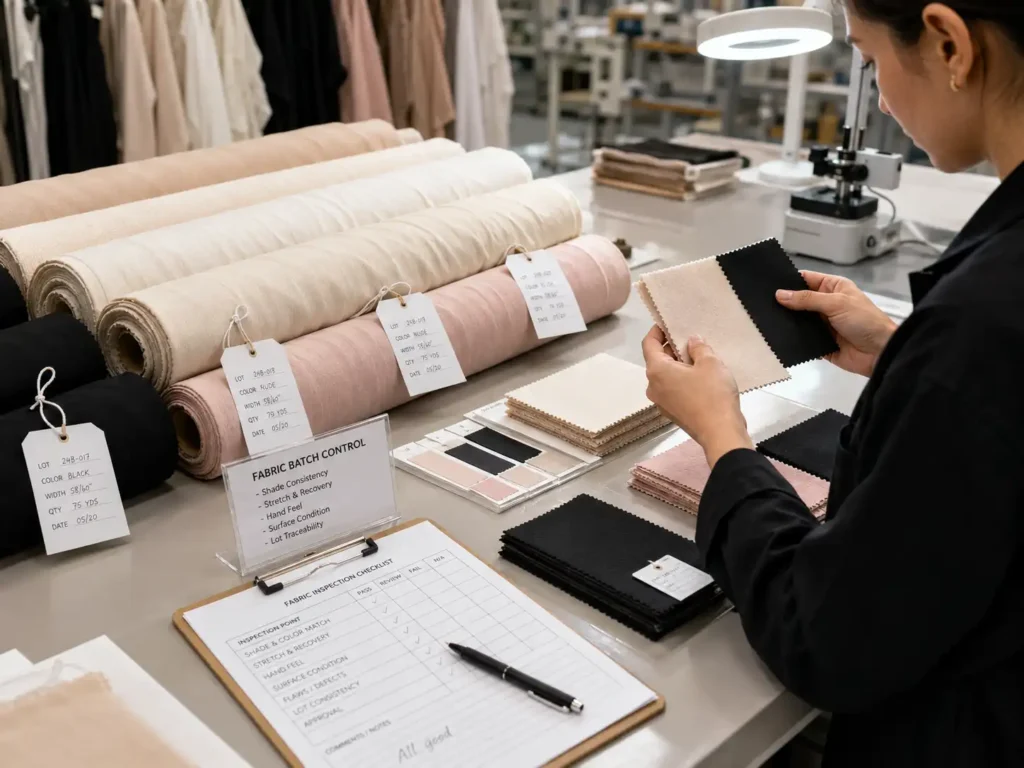
Bulk Shade and Lot Management
Bulk consistency begins when fabric arrives. Incoming QC can review color, weight, hand feel, width, shrinkage, fastness records and visible defects. Fabric batches are kept identifiable so shade differences are not mixed randomly across panels or sizes. Cutting preparation also confirms front/back side and direction where surface reflection matters.
For multi-color programs, labels, color stickers, barcodes and carton marks must follow the correct SKU structure. A garment can pass sewing inspection and still create an operational problem if color identification or packing is wrong. Jinfeng therefore links bulk color control with private-label and packing records rather than treating them as separate departments.
Approved color references are retained for repeat-order review. Reorders can start from recorded material and color information, while new batches still require confirmation before cutting.
Fabric Combination Decision Matrix
The matrix below shows how common pairings change development focus. Final decisions depend on the exact fabric source, weight, stretch, color, construction and fit target supplied for the program.
| Main Fabric | Contrast Fabric | Typical Application | Main Production Risk | Sample Focus | Bulk Control |
|---|---|---|---|---|---|
| Ponte | Power Mesh | Bodycon contour panels | Stretch and recovery mismatch | Fit, seam tension, panel shape | Stretch direction, symmetry, measurements |
| Satin | Mesh | Sheer inserts, neckline, waist | Puckering, transparency, snagging | Seam method, lining coverage | Seam flatness, mesh damage, pressing |
| Satin | Lace | Occasion bodice or panel | Motif position, shade and edge quality | Placement, lining color, drape | Motif alignment, snagging, seam finish |
| Jersey | Woven | Fitted bodice with structured skirt | Waist seam and recovery imbalance | Waist placement, movement, proportion | Feed balance, seam stability, size checks |
| Crepe | Satin | Tonal matte-shine contrast | Drape and surface response | Panel proportion, pressing | Shade, seam flatness, crease control |
| Solid Woven | Printed Fabric | Yoke, skirt or side blocks | Print direction and placement | Scale, color relationship, panel position | Cutting direction, repeat placement, shade |
Panel Engineering Shapes the Finished Silhouette
A contrast line is also a pattern line. Position, angle and proportion affect how the body is visually shaped, so panel engineering must connect design intent with bust, waist, hip, neckline, armhole and length control.
Panel Lines Become Pattern Lines
A contrast panel may define the waist, create a longer torso, sharpen the hip line or frame the bust. Once the design is converted into pattern pieces, every visual line becomes a sewing line with seam allowance, notches, fabric direction and joining requirements. An attractive sketch can lose its proportion if the seam line is moved during pattern development or if fabric behavior changes the joined shape.
Jinfeng’s pattern team reviews bust, waist, hip, length, neckline, armhole, strap and other key points against the intended silhouette. A side panel on a bodycon dress requires different judgment from a decorative hem panel on an A-line dress. A sheer waist insert also needs coverage and movement review, while a satin contour panel may require particular attention to seam flatness and zipper position.
Pattern development therefore looks at both body fit and visual segmentation. Panel geometry should remain deliberate after seam allowance, lining and construction methods are added. The first sample provides the physical check that the pattern lines create the intended result on a garment rather than only on a technical drawing.
Size Grading Without Losing Contrast Proportion
Size grading is especially important when a contrast panel creates a strong visual effect.
Simply enlarging every pattern piece without reviewing the relationship between bust, waist, hip, armhole and panel position can make the larger sizes look materially different from the approved base size.
Jinfeng uses size charts, grade rules, pattern version control and sample feedback to protect proportion across the size range. The objective is to keep functional fit correct while maintaining the visual relationship between main and contrast sections. Contour panels, waist blocks, cut-out borders and sheer inserts may need careful grading because their location is noticed immediately when the dress is worn.
Bulk measurement control later checks the finished garment against approved size specifications and the PP or Golden sample standard. For fit-sensitive programs, measurements and visual panel position should be reviewed together. A garment can meet one measurement while still looking wrong if the contrast line has shifted or twisted.
Seam Position, Balance and Movement
Panel placement must work while standing, walking and sitting.
Seams crossing high-movement zones can pull differently depending on fabric stretch and seam construction.
Waist joins, side panels, bust seams, back panels and skirt inserts therefore need movement review during fitting.
Seam balance also affects how a dress hangs. A stable woven section joined to a stretch section may change side-seam direction if feed balance is not controlled. A long skirt with mixed fabrics can develop uneven visual weight if panel direction or drape is inconsistent. For fitted styles, seam tension can alter bust and hip contour even when the paper measurements appear correct.
Fit comments are translated into pattern changes rather than left as informal notes.
Revised pattern, updated measurements and construction notes create a clear base for the next sample and later bulk production.
Sampling Validates Fabric Behavior Before Production
Sampling is used to prove the material pairing, panel shape, fit and construction before bulk. The goal is a production-ready standard, not simply a visually similar prototype.

Fabric Pair Review Before the First Sample
Development can begin from a tech pack, reference image, original sample, sketch or line sheet. Before cutting, Jinfeng reviews the proposed materials for weight, stretch, recovery, drape, transparency, color, lining need, MOQ and bulk availability. Where only a visual reference is supplied, the team identifies likely fabric directions and flags areas where exact material behavior will affect the silhouette.
The first fabric pair does not have to be accepted automatically. If one material is too rigid, too transparent, too weak in recovery or difficult to source at bulk scale, an alternative can be presented for swatch or sample approval. Any substitution is reviewed for pattern, cost and lead-time impact before it becomes the working material.
Ordinary dress first samples are typically developed in about 10-15 days. Complex corset, strapless, lace, mesh, sequin or comparable high-risk structures commonly require about 15-25 days, while custom fabrics or special trims follow supplier readiness. Timing is confirmed after the style and materials are reviewed.

First Sample and Fit Review
The first sample checks more than appearance. Fit review covers bust, waist, hip, length, strap, armhole, neckline, back coverage, slit and other relevant points against the size chart, reference sample and design comments.
For contrast-fabric dresses, review also includes panel position, left-right balance, seam behavior, transparency, lining exposure and how the two fabrics move together.
A sample may look correct on a hanger but show tension, waviness or transparency problems when worn.
Fit photos, measurement comments and specific revision notes help the pattern maker determine whether the issue comes from pattern shape, fabric behavior, seam construction or material choice.
The correction is then recorded rather than handled as a verbal production instruction.
For ecommerce or campaign programs, photo-ready samples can be arranged by project, but photo appearance and production readiness are treated as separate approvals when materials or construction standards differ.

Revised Sample, PP Sample and Golden Sample
Revised samples are commonly developed in about 7-15 days depending on the modification.
A major material change, significant pattern correction or structural revision may require a new sample rather than a minor adjustment. The revision record tracks measurement, fabric, trim, construction, cost and lead-time impact.
The PP sample is the final production confirmation sample. It should reflect approved pattern, measurements, grade rules, shell fabrics, lining, trims, construction, labels, packing and QC requirements. Once approved, major changes to fabric, color, size, trims, construction or packing require re-evaluation because they can affect purchasing, cost, production timing and bulk consistency.
A Golden sample can then serve as a reference for production, QC, repeat orders and issue review. The development process ends with a controlled standard that production teams can execute, not only a sample that looked good once.
Pattern Corrections Are Closed Before Bulk Cutting
Fit comments only become useful when they are converted into controlled production documents. Jinfeng records the source of the issue, revision action and downstream impact before the pattern is released for PP approval and bulk.
From Fit Comment to Pattern Revision
Comments such as “waist panel too high,” “mesh insert pulls,” “hip panel feels tight” or “lining shows at the side seam” are first classified by cause. The pattern maker checks whether the issue comes from body proportion, seam position, fabric stretch, lining, construction or an incorrect measurement. Relevant bust, waist, hip, length, strap, armhole and neckline points are reviewed against the approved size chart and reference.
Once the cause is identified, pattern files and measurement records are updated. Fabric changes are also captured because a replacement with different weight, stretch or shrinkage may require a new pattern correction. The revised sample then verifies whether the change solved the original problem without creating a new one elsewhere.
A clear revision trail is particularly important on mixed-fabric styles because one change can affect several pattern pieces and seam joins. Version control prevents the production team from cutting an earlier panel shape after a later sample has already been approved.
Production-Ready Pattern Release
The final pattern is released together with the approved size chart, grade rules and construction information. For mixed-fabric dresses, the production package should identify which pieces use each fabric, relevant stretch or direction requirements, lining relationships and panel joining standards.
Jinfeng does not treat an approximate sample as sufficient for bulk. PP approval is used to confirm the final garment before production. The approved pattern and sample provide the reference for cutting and measurement QC, while production instructions carry seam, trim, label and packing requirements forward.
When a major pattern or material change is requested after PP approval, cost, lead time and production risk are reviewed again rather than silently changing the bulk standard. The approach protects both design intent and production stability.
PP Lock Connects the Approved Sample to Bulk
A mixed-fabric program becomes scalable only when the approved sample is translated into a production package. PP lock reduces the chance of material, panel, sewing or packing changes appearing after bulk has started.
What the PP Approval Locks
PP approval confirms final pattern, fabric, color, trims, measurements, construction, labels, packing and QC standard. For contrast-fabric dresses, the lock also needs to protect the exact relationship between materials: main-fabric reference, contrast-fabric reference, panel position, lining method, thread and zipper color, stretch direction where relevant and approved pressing appearance.
The approval stage provides a clear decision point. Minor visual preferences can no longer be treated as informal changes once materials have been ordered and production has been scheduled. If a new fabric, different color or revised construction is requested, Jinfeng rechecks sample needs, cost, lead time and production risk before implementation.
Production Handover Package
Sample-to-bulk transfer connects the sample room with the production floor. The handover can include final pattern files, size chart, fabric references, trim card, BOM, sewing instructions, label placement, packing instructions and QC checklist. Mixed-fabric styles also require correct piece identification so similar-looking panels are not cut or bundled from the wrong material.
Production teams work from the locked standard rather than memory. Merchandising and QC teams can compare incoming fabric, first cutting, sewing progress and finished garments against the same approved references. The system helps prevent a common problem in apparel manufacturing: the sample team understands the style, but bulk production receives incomplete or outdated instructions.
Change Control After Approval
Material arrival, bulk color, trim availability or commercial requirements can still create change requests. Changes are documented by category – fabric, color, trim, measurement, construction, label, packing or delivery – and reviewed for impact before the production standard is revised.
For established programs, disciplined change control is faster than uncontrolled correction later. A small unrecorded adjustment to seam method or material source can spread across thousands of units before anyone notices. Recording the decision at the PP stage keeps development and production aligned.

Cutting Control Protects Every Contrast Panel
Cutting errors cannot be repaired easily after mixed fabrics are sewn together. Direction, batch, panel identity and size bundling are checked before pieces reach the sewing line.
Fabric Direction and Batch Separation
Incoming materials are inspected for color, hand feel, weight, width, shrinkage risk and visible defects according to the project requirement. Dye lot and surface direction are particularly important when fabrics create noticeable shade or shine changes. Satin, velvet, printed materials and other directional surfaces must be cut consistently so adjacent panels do not look like different colors under light.
Stretch direction is confirmed for knit, power mesh, stretch satin and other elastic fabrics. A panel cut in the wrong direction can change fit, recovery and seam behavior even when its outline matches the pattern. Fabric direction therefore becomes part of the cutting instruction rather than an operator preference.
Panel Identification and Size Bundling
Mixed-fabric garments increase the number of cut components and the risk of confusing similar panel shapes. Cutting preparation confirms final pattern version, piece count, main and contrast material allocation, front/back side and size grouping. Pieces are bundled by size so an incorrect panel is not introduced during sewing.
Print placement, lace motif and directional fabric require additional attention. The approved sample and cutting instruction provide the visual reference for where the panel should sit and how the material should face.
Defect Interception Before Sewing
Mesh holes, lace damage, satin snags, fabric stains, shade differences and other defects are easier to isolate before the garment reaches the sewing line. Cutting QC checks material condition and cut accuracy so defective pieces can be stopped before labor is added.
The purpose is not only fewer defects at final inspection. Early interception reduces rework, protects line efficiency and makes bulk appearance more consistent from the first pieces onward.

Seam Control Keeps Mixed Materials Flat and Aligned
A contrast-fabric dress often exposes seam quality more clearly than a single-material style. Inline control focuses on seam behavior, alignment, symmetry and visible finishing while production is still in progress.
Seam Tension and Feed Balance
Satin, mesh, lace, jersey, ponte and lightweight woven fabrics do not feed through sewing in the same way. When two materials meet, stitch type, stitch density, seam allowance and machine handling must suit the actual pair. Poor feed balance can create waviness, pulling or distortion that becomes more visible along a contrasting seam line.
The approved sample and sewing instruction establish the expected result. Early production pieces are checked for seam flatness, stretch response and appearance before the same method is repeated across the order. Where a problem appears, sewing method or operator handling can be corrected before the issue spreads.
Symmetry and Panel Placement
Contrast design makes left-right differences easy to notice. Side panels, waist bands, bust sections, sheer inserts and neckline details need consistent placement across garments. Inline QC checks symmetry, seam position, zipper flatness, lining location, strap position, neckline and other style-specific points while garments are being assembled.
Panel alignment also connects to body fit. A seam can be technically secure but visually wrong if it twists, slopes or shifts away from the approved pattern. Comparing work-in-progress garments against the PP or Golden sample helps keep both construction and visual proportion under control.
Rework Before Errors Multiply
Inline inspection is designed to find issues during sewing rather than after every garment is complete. A recurring seam or panel problem is stopped, corrected and rechecked before production continues. Rework records can include zipper bulging, lining exposure, shade issues, measurement deviations, panel mismatch and other recurring risks.
Early correction protects production time and final consistency. It also creates feedback for repeat orders because the project record shows which areas required special attention in the previous batch.
Mesh holes, lace damage, satin snags, fabric stains, shade differences and other defects are easier to isolate before the garment reaches the sewing line. Cutting QC checks material condition and cut accuracy so defective pieces can be stopped before labor is added.
The purpose is not only fewer defects at final inspection. Early interception reduces rework, protects line efficiency and makes bulk appearance more consistent from the first pieces onward.

Contrast-Fabric Dress QC from Material to Packing
Jinfeng uses staged quality control rather than relying on final inspection alone. 15+ QC inspectors support material, cutting, sewing, garment and packing checks, with the exact checkpoints adjusted to the fabric combination and construction risk.
| QC Stage | Key Checks for Contrast-Fabric Dresses | Risk Controlled |
|---|---|---|
| Incoming Material QC | Color, weight, hand feel, width, shrinkage, colorfastness records, defects, mesh snags, lace damage, satin shade | Wrong fabric, unstable batch, visible defects |
| Cutting QC | Pattern version, panel direction, stretch direction, print placement, piece quantity, size bundling, shade separation | Wrong panel, wrong direction, mixed sizes, shade mismatch |
| Sewing / Inline QC | Stitch density, seam allowance, seam flatness, symmetry, zipper, lining, panel placement, straps, neckline | Puckering, twisting, misalignment, repeated sewing errors |
| Garment QC | Measurements, appearance, fit effect, color difference, stains, holes, loose threads, zipper function, pressing | Size drift, visible defects, poor final appearance |
| Packing QC | Labels, hangtags, barcodes, size stickers, polybags, folding, carton marks, packing ratio | SKU errors, wrong labeling, receiving problems |
Complex Fabrics Need Different Production Rules
Satin

Mesh

Power Mesh and Ponte

Lace

Jersey and Knit

Sequin, Organza and Tulle
Production Allocation Matches Fabric and Construction Risk
Woven and Occasionwear Allocation
Stretch and Knit Allocation
Multi-Style and Repeat Programs
Cost and MOQ Follow the Real Construction
Two-Fabric Material Requirement
Panel Complexity
Color Count
Lining and Trims
Sampling and Pattern Work
Production Quantity
Contrast-Fabric Dress Production Frequently Asked Questions
Yes, when the fabric pair is reviewed for stretch direction, recovery, weight, seam behavior and panel location. A stable woven section and a stretch section should not be patterned or sewn as if both behave equally. Sample fitting is used to confirm seam balance, movement and fit before the construction is locked for bulk.
Puckering is controlled through fabric review, seam construction, stitch density, seam allowance, feed balance and pressing method. Lightweight satin or mesh joined to a firmer fabric may require different handling from a same-fabric seam. Inline sewing checks are used to correct recurring waviness before it spreads across bulk production.
Yes, high-contrast color combinations can carry transfer risk depending on dye, fabric type and end use. Jinfeng can coordinate project-based rubbing, washing, perspiration or other relevant colorfastness testing when required. Fabric batches and approved swatches are also recorded for bulk and repeat-order comparison.
They may. Rayon, viscose, cotton blends, knits and other materials can change differently after relaxation or washing. Unequal shrinkage can distort panel lines or finished measurements, so material risk is reviewed before bulk and reflected in pattern, cutting or care decisions where required.
Panel grading follows the approved size chart, grade rules and garment proportion rather than only enlarging a decorative shape. Bust, waist, hip, armhole, neckline and other relevant measurements are considered together so the visual relationship between main and contrast sections remains consistent across the intended size range.
Ordinary dress first samples are commonly about 10-15 days. Complex lace, mesh, sequin, corset, strapless or comparable high-risk structures are commonly about 15-25 days. Custom fabrics, special trims and revision scope can extend development, so timing is confirmed after the style and material review.
Jinfeng uses PP sample approval, Golden sample reference, final pattern, size chart, BOM, fabric and trim records, sewing instructions, QC checklist and packing instructions. The production package connects the approved sample with cutting, sewing, inspection and packing so bulk teams work from the same locked standard.
It can. Additional pattern pieces, two-fabric purchasing, higher cutting identification, alignment-sensitive sewing, lining, extra QC and material wastage can increase cost. Pricing depends on the actual fabric pair, panel complexity, order quantity, color count, trims, packing and testing requirements rather than the visual style name alone.
Standard MOQ starts from 200 pcs per style/color. A contrast design may also depend on the MOQ of both fabrics, custom colors, lace, mesh, special trims or packaging. Fabric availability and supplier requirements are checked before the bulk quotation is finalized.
Send a tech pack, reference image, original sample, sketch or line sheet together with target quantity, size range, preferred main and contrast fabrics, color direction, launch timing and private-label requirements. Jinfeng can then review fabric compatibility, panel risk, sampling route, MOQ fit and production feasibility before formal development starts.

Start with a Fabric and Construction Review
A strong contrast-fabric program starts before the first pattern is cut.
Send the available development files and Jinfeng can review the proposed fabric pairing, panel structure, fit sensitivity, sample route, MOQ conditions and production risks before the project enters formal sampling. Clear early information reduces repeated material changes and helps the pattern, sample and sourcing teams work from the same target.
For the most useful review, include:
- Tech pack, reference image, sketch or original sample
- Target style count and estimated quantity by style/color
- Main fabric and contrast fabric preferences, if already selected
- Target color combinations or Pantone references, when available
- Size range and measurement chart
- Lining, zipper, support or trim requirements
- Private-label, barcode and packing requirements
- Target launch window and preferred shipping arrangement