 Skip to content
Clubwear Matching Set Manufacturer
Custom clubwear sets engineered for strong silhouettes, coordinated fit, reliable bulk production and retail-ready private-label delivery.
- MOQ starts from 200 pieces per style/color for production-ready clubwear programs.
- 2 sample rooms, 7+ senior pattern makers and 20+ sample machinists support coordinated top-and-bottom development.
- 6 owned women’s fashion factories, 10+ long-term production partners and 100,000+ pieces of regular monthly capacity support multi-style collection planning.
- 15+ QC inspectors review fabric shade, stretch recovery, measurements, trim security, size pairing and set packing before shipment.
Jinfeng Apparel develops crop-top-and-skirt sets, corset sets, mesh sets, sequin sets, satin sets, fitted-pants sets and three-piece clubwear collections for established fashion brands. Development covers fabric direction, pattern correction, sample revisions, PP approval, bulk control, branded packing and export coordination. Each program begins with an assessment of silhouette, stretch, coverage, construction and launch timing, so visual impact remains compatible with wearability and repeatable production.
A Manufacturing System Built for Clubwear Collections
Since 2008
Six Owned Factories
Ten Plus Partners
Two Sample Rooms
Fifteen Plus Inspectors
Monthly Capacity
Regular monthly capacity exceeds 100,000 pieces across the manufacturing network. Capacity planning is confirmed by style complexity, material arrival, PP approval, factory allocation, inspection windows and packing requirements. A large collection can be divided by fabric and construction group, while campaign styles, priority colors and warehouse dates are reflected in the production sequence rather than relying on one general completion promise.
Clubwear Programs Developed for Established Fashion Brands
Clubwear Labels
Fast Fashion Brands
Premium Ecommerce
Partywear Collections
Sourcing Teams
Retail Programs
Where Clubwear Matching Set Projects Commonly Fail
Weak Stretch Recovery
Unbalanced Set Proportions
Shade Mismatch
Unstable Openings
Trim Discomfort
Packing Errors
Clubwear Matching Sets We Develop

Crop Top Skirt Sets

Corset Matching Sets

Mesh Two-Piece Sets

Sequin Party Sets

Satin Clubwear Sets

Top And Pants Sets

Top And Shorts Sets

Three-Piece Club Sets
Build Coordinated Products With More Selling Flexibility

Complete Outfit Selling

Separate Piece Selling

Capsule Extensions

Repeatable Core Styles
Clubwear Fabric Selection Matrix
Fabric selection determines silhouette, comfort, transparency, recovery, sewing behavior, photography and bulk stability. Jinfeng Apparel compares hand feel, weight, stretch direction, recovery, drape, shine, shrinkage, color risk, lining needs, MOQ and lead-time effect before a material is approved for sampling or bulk production.
| Fabric Direction | Best-Fit Products | Development Focus | Bulk Risk | QC Focus | Common Support |
|---|---|---|---|---|---|
| Jersey / Rib Knit | Crop tops, skirts, fitted pants | Stretch direction, recovery, negative ease | Growth after wear, twisting, neckline deformation | Measurements, seam recovery, wash stability | Elastic, clean binding, coverstitch |
| Ponte / Roma | Structured sets, fitted skirts, pants | Compression, thickness, smooth silhouette | Size inconsistency, seam impressions | Weight, recovery, side-seam balance | Stable waistbands, concealed zippers |
| Power Mesh | Transparent layers, cut-outs, fitted sets | Transparency, stretch, lining map | Runs, holes, edge growth, shade variation | Surface inspection, stretch direction, seam security | Lining panels, elastic stabilization |
| Stretch Satin | Corset tops, mini skirts, fitted sets | Shine direction, recovery, drape | Snagging, puckering, creasing, color difference | Cutting direction, zipper flatness, pressing | Lining, boning, fine needles |
| Lace | Corset sets, party tops, skirts | Pattern placement, edge use, transparency | Misaligned motifs, holes, fraying | Motif alignment, seam finish, lining coverage | Nude lining, lace trim, binding |
| Sequin Fabric | Party sets, holiday drops | Backing, weight, skin contact | Loose sequins, broken needles, scratching | Sequin security, seam thickness, packing protection | Full lining, protected folds |
| Velvet | Winter clubwear, evening sets | Pile direction, pressure marks, drape | Shade change by direction, crushing | Nap alignment, surface marks, pressing | Soft lining, protective packing |
| PU / Coated / Denim | Structured tops, mini skirts, street-club sets | Thickness, seam allowance, edge finish | Cracking, needle marks, dye transfer, stiffness | Surface review, seam strength, folding method | Metal trims, topstitching, tissue protection |
Fit Engineering for Tops, Skirts and Pants
Coordinated fit is the foundation of a successful matching set. A top and bottom cannot be graded or approved as unrelated garments when exposed midriff, waist placement, body contour and movement shape the complete visual result.
Upper-Body Security and Proportion
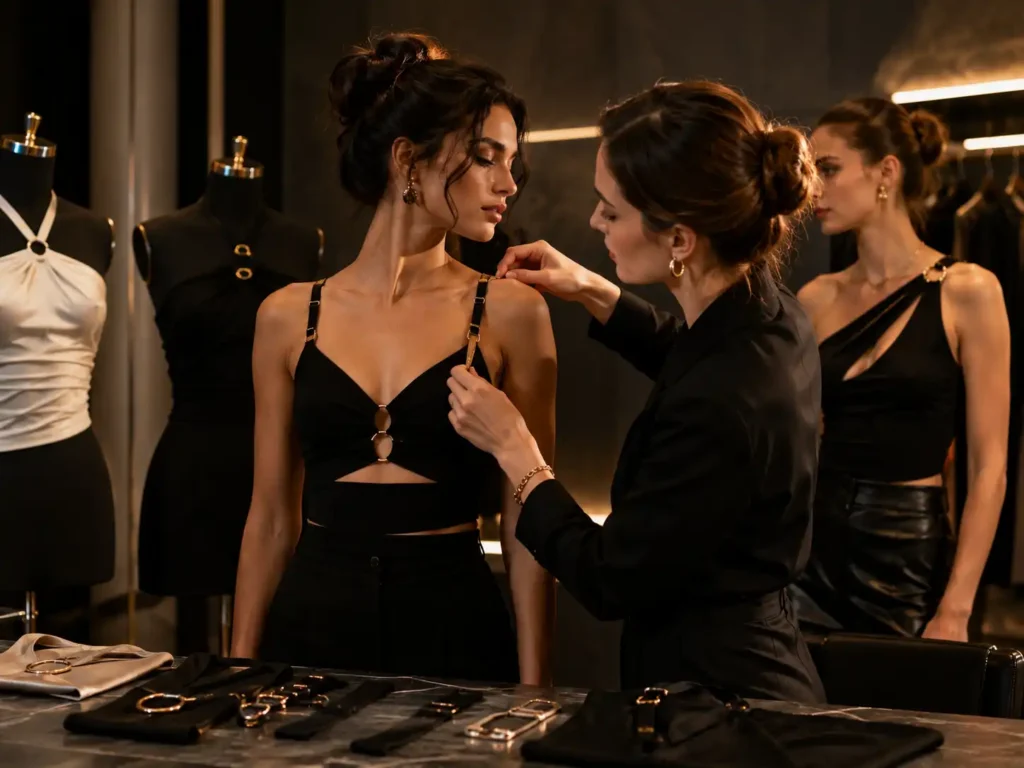
Clubwear tops often use strapless, halter, asymmetric, deep-V, corset or cut-out structures. Development reviews upper bust, full bust, under bust, cup position, neckline depth, strap length, armhole shape and back coverage. Support can come from cups, boning, elastic, lining, tape or pattern contouring. Sample review includes standing, sitting and movement checks because a neckline stable on a dress form may shift during dancing or arm movement. Top length is assessed with the matching waistband position, not as an isolated dimension. A 1-2 cm change can alter torso proportion, exposed midriff and the visual waistline. Fit comments are recorded with measurements and sample images so each revision produces a clear pattern action rather than a vague instruction such as “make it tighter.”
Skirt and Pant Engineering
Mini skirts require a balance between visual impact and secure coverage. Development reviews center-front, side and center-back length, hem shape, slit position, rise during walking and waistband movement. Stretch fabrics may shorten when worn over the hip, while woven skirts need enough ease for sitting. Fitted pants require correct front rise, back rise, crotch curve, hip contour, thigh width and inseam. Excessive negative ease can create seam stress and transparency; insufficient recovery can create bagging at the seat and knee. Test fittings include walking, sitting and bending. Built-in shorts, linings or stable inner layers can be evaluated when a design needs additional coverage without changing the exterior silhouette.
Grading, Tolerance and Material Response
A size chart defines how top and bottom measurements change across the intended range. Bust, waist and hip increments may not follow the same rate, particularly for corset tops and fitted skirts. Jinfeng Apparel records grading rules, critical measurements and style-specific points of measure before size-set or bulk production. Brands may supply their own chart, block, fit model standard and tolerance manual. Material stretch is reviewed by direction and by garment location because necklines, waistbands, cut-outs and straps respond differently even when cut from one fabric. Shell, lining, elastic and seam construction must work together. Fit approval should use the final bulk material whenever possible, since a similar-looking substitute may change recovery, compression and finished measurements.

Construction Details Behind High-Impact Clubwear

Corsetry And Boning

Cut-Out Stabilization
Straps And Necklines

Ruching And Drawstrings

Mesh And Lining Maps

Zippers Chains And Trims
How We Keep Every Set Consistent
Same-Batch Fabric Planning
Shade Grouping
Proportion Control
Size Pairing
SKU And Barcode Accuracy
Packing Verification
From Design Reference to Approved Clubwear Sample
Sample development converts an image, sketch, original garment or tech pack into measurable production instructions. Clubwear samples receive special attention to stretch, exposure, support, trim comfort and the relationship between coordinating pieces.
Project Review, Fabric and Trim Direction
Initial review covers silhouette, neckline, top length, bottom rise, fabric direction, lining, closure, trims, size range, quantity plan and launch timing. Missing details are identified before pattern work begins. A reference image can guide visual direction, yet controlled sampling still requires construction, material and measurement decisions. Available fabric options are compared by composition, weight, stretch, recovery, drape, transparency, shine, color availability and MOQ. Cups, boning, zippers, hooks, chains, rhinestones, elastic, labels and packing materials are reviewed for compatibility. When a material change affects compression, transparency or drape, pattern and lining decisions are reassessed rather than carried over automatically.
Pattern, First Sample and Revision Timing
Pattern makers establish the garment shape using the approved size chart, fit preference and construction direction. First samples focus on silhouette, proportion, movement and key details. Internal reference timing is 7-10 days for simple first samples, 12-18 days for medium-complexity sets or jumpsuits, and 15-25 days for corset, strapless, lace, mesh or sequin styles. Custom materials or special trims may require 20-35 days or the supplier’s development cycle. Fit comments are converted into measurable actions covering neckline depth, strap length, cup position, waist suppression, rise, skirt length, lining coverage and cut-out shape. Revised samples generally require 7-15 days, depending on the modification scope and material readiness.
PP Approval and Multi-Style Sample Management
The PP sample confirms final fabric, color, trims, measurements, construction, labels and packing direction before bulk production. PP samples generally require 7-15 days after final materials are available. Approved elements are recorded as the production standard, and later changes may affect costing, material booking and factory scheduling.
For collections containing 10-30 styles, sample priorities can be arranged by hero SKU, campaign date, fabric readiness, pattern complexity and bulk timeline. Style groups receive separate revision trackers and approval status, reducing confusion when several tops, skirts, pants and layers are being developed in parallel.

Specialized Production Matched to Each Clubwear Style

Partywear Production

Stretch Womenswear

Matching Set Coordination
Our Clubwear Matching Set Production Process
Requirement Review
Material Direction
Pattern Development
Sample Review
PP Approval
Bulk Production
Set Packing
Shipment Coordination
Workmanship Designed for Movement and Close-Up Inspection
Clubwear receives close visual attention in photography and repeated physical stress during wear. Workmanship therefore needs clean exterior lines, comfortable interiors, secure stress points and construction capable of holding the intended silhouette.

Seam, Edge and Opening Construction
Stretch jersey, power mesh, satin, lace, sequins, velvet and PU cannot share one sewing method. Stitch type, needle, thread, seam allowance and reinforcement are selected according to stretch, thickness, surface sensitivity and stress. Fitted seams need enough strength without becoming rigid, while transparent panels require neat internal construction. Necklines, cut-outs, armholes and waist openings are checked for waviness, rolling, stretching and asymmetry. Binding, facing, lining, elastic or stabilizing tape may be used according to the design. Edge tension is controlled so openings remain close to the body without cutting into skin or losing recovery after repeated wear.

Stress Points, Zippers and Structural Support
Strap joins, zipper bases, hooks, slit ends, drawstring anchors and chain attachments experience concentrated force. Reinforcement should remain discreet while resisting movement. Bartacks, backing layers, seam tape or localized pattern changes can be used. Fitted skirts, corset tops and satin pieces expose zipper problems immediately, so zipper length, tape weight, seam stabilization, pressing and insertion method are reviewed together. Cups, boning channels, underwire, lining and support layers are inspected for position, symmetry and comfort. Sample testing determines whether a construction is ready before sewing instructions are released to the bulk line.

Embellishment and Interior Finish
Sequins, rhinestones, beads and chains need secure placement, comfortable backing and consistent spacing. Decorative layouts are compared with approved reference positions, while loose surfaces, sharp edges and missing elements are identified during in-line and final checks. Packing reduces friction between decorated pieces. Interior quality is equally important: lining length, seam coverage, boning ends, cup edges, elastic joins and care labels are reviewed for scratching, bulk and show-through. Premium perception depends on how the outfit feels during extended wear, not only how it appears in a campaign image.
Turning Approved Samples Into Repeatable Bulk Production
Bulk consistency depends on version control and disciplined handover. A visually approved sample is useful only when patterns, measurements, fabric, trims, sewing instructions, color references and packing files all point to the same final standard.
Production Standards and First-Unit Control
Every approved revision is reflected in the active pattern set, measurement chart, BOM and workmanship instruction. Old versions are separated to prevent accidental cutting. Fabric records include name, composition, weight, color, stretch direction, hand feel and approved supplier reference; trim records cover dimensions, finish, color and attachment method. Complex styles may receive an early production-unit review before full-line output. Measurements, seam construction, lining, trims, zipper behavior, proportion and surface appearance are compared with the PP standard. Corrections are made before a problem spreads across a large quantity. The same review can confirm whether top and bottom pieces remain visually balanced after bulk materials and production sewing methods are applied.
In-Line Measurement and Repeat-Order Readiness
Critical points such as bust, waist, hip, top length, skirt length, rise, inseam, strap length and neckline depth are checked during production. Measurement tolerances can follow the brand’s quality manual or an agreed project standard. Repeated deviation triggers production correction rather than waiting for final inspection. Pattern files, grade rules, fabric references, trim records, sewing notes, QC findings and packing instructions are retained for future production. Repeat orders can move more efficiently when approved conditions remain available, yet new colors, new batches and substituted fabrics still receive review because shade, stretch, drape or supplier performance can change. After-shipment feedback may be added to the repeat-order record to prevent known issues from returning.
Quality Control for Fit, Stretch and Set Accuracy
Quality control follows materials, cutting, sewing, finished garments, pressing, packing and shipment preparation. Clubwear sets add coordinated checks for stretch behavior, exposure zones, shade, component sizing, trims and top-bottom pairing.
| QC Stage | Main Checks | Clubwear Set Risk | Control Record |
|---|---|---|---|
| Incoming Fabric | Shade, weight, surface, stretch, defects | Top-bottom mismatch, weak recovery, visible marks | Fabric inspection and batch records |
| Cutting | Direction, size, panel accuracy, shade grouping | Satin shine mismatch, twisted knit panels, wrong mesh direction | Cutting and bundle identification |
| Sewing | Seam type, tension, reinforcement, symmetry | Popped seams, wavy openings, uneven ruching | In-line inspection notes |
| Fit Measurements | Bust, waist, hip, length, rise, straps | Poor proportion, exposure, inconsistent sizing | Measurement sheets and tolerance review |
| Structural Details | Cups, boning, lining, zippers, cut-outs | Discomfort, bulging, unstable openings | Workmanship checklist and sample comparison |
| Embellishments | Sequins, rhinestones, chains, hardware | Loose trims, sharp edges, missing elements | Trim-security inspection |
| Finished Appearance | Pressing, balance, stains, surface marks | Satin creases, velvet crushing, PU damage | Finished-garment review |
| Set Pairing | Style, color, size, top-bottom match | Mixed sizes, shade mismatch, missing component | Pairing and packing checklist |
| Labels and Barcodes | Main label, size, care, hangtag, SKU | Wrong retail data or warehouse rejection | Label and barcode verification |
| Final Inspection | Quantity, workmanship, measurements, packing | Repeated defects reaching shipment | AQL or client-defined inspection record |
Private-Label Packing for Complete Clubwear Sets

Main And Size Labels

Care Label Information

Hangtags And Strings

Barcode And SKU Labels

Protective Polybag Packing

Cartons And Warehouse Marks
MOQ and Quotation for Clubwear Set Projects
What Shapes The Quotation
What Changes The MOQ
Brand Protection and Long-Term Collection Support
NDA-Based Cooperation
Confidential Product Files
Repeat-Order Records
Frequently Asked Questions

Start Your Clubwear Matching Set Program
Share enough project detail for a focused manufacturing review. Jinfeng Apparel can evaluate silhouette, fabric direction, stretch and recovery, pattern risk, trim requirements, MOQ, sampling route, production allocation, private-label packing and launch timing before a formal development plan is confirmed.
Clear files help the team distinguish a visually strong concept from a production-ready style and identify decisions needed before sampling begins.
Please include:
- Reference images, sketches, original samples or tech packs
- Planned styles and quantity per style/color
- Fabric preference, color direction and surface effect
- Target size range and brand measurement chart
- Cups, boning, lining, zippers, chains, rhinestones or other trim requirements
- Main labels, care labels, hangtags, barcode and packaging files
- Sample approval target, warehouse date and preferred shipment method
- Quality manual, AQL level or inspection requirements when applicable
Kelly coordinates initial project review and directs suitable programs to the development, merchandising, production and quality teams. Contact Jinfeng Apparel through info@jinfengapparel.com or WhatsApp +86 18929465598. NDA-based review is available before confidential collection files are shared.
Form Fields: Name | Tel/WhatsApp (optional) | Email Address | Message | Upload Your Files
Submit Button: Send Inquiry

