 Skip to content
Carton Packing Solutions for Delicate Dresses
Garment-specific packing engineered around fabric sensitivity, dress structure, embellishment risk, carton efficiency and arrival condition.
At Jinfeng Apparel, carton packing starts with the dress rather than the box. Packing plans are developed around how each garment folds, where pressure can build, which surfaces can snag, which structures can deform, and how many pieces can be safely loaded without creating unnecessary carton volume.
- 10–30 styles can be managed within a single brand order program.
- Typical brand programs range from 20,000–80,000 pieces across multiple dress constructions.
- Packing risk reviews cover 8 common failure areas, from wrinkles and snagging to deformation and carton identification errors.
- Pack-out control can follow 8 inspection checkpoints before cartons are released for shipment.
Packing Is Part of Finished Dress Quality
Protect Delicate Surfaces
Preserve Garment Shape
Improve Arrival Condition
The real measure of packing quality appears when cartons are opened at a distribution center, warehouse or retail operation. A strong packing specification aims to reduce excessive steaming, reshaping, untangling and corrective handling after receiving. Carton dimensions, pieces per carton, garment orientation and internal separation all influence arrival condition. Better arrival condition also supports faster receiving because garments are easier to count, sort and prepare for downstream operations when packing remains consistent across the order.
Dress Programs We Support With Packing Control
Global Fashion Brands
Occasionwear Brands
Party, event and occasion dresses often combine soft fabrics with higher-risk construction such as corsetry, rhinestones, sequins, feathers, mesh overlays or 3D details. Packing must protect surface finish while preventing heavy decorated areas from pressing into lighter sections.
For occasionwear programs, carton packing is treated as an extension of finishing and quality control so the garment remains presentable after bulk transport rather than requiring excessive reshaping at destination.
Multi-Channel Retailers
A retailer supplying stores, ecommerce fulfillment and regional distribution centers may require different carton quantities, assortments and markings for the same style. Packing therefore needs more than physical protection. Style, color, size ratio, carton number and destination identification must remain clear and consistent.
Jinfeng can structure pack-out instructions around the approved order matrix so physical packing and inventory information follow the same commercial plan.
Premium Ecommerce Brands
Private-Label Programs
Sourcing and Import Teams
What Can Go Wrong Inside a Carton?

Excessive Wrinkling

Surface Pressure Marks

Fabric Snagging
Mesh, lace, chiffon and loose decorative surfaces can catch on sequins, stones, hooks, exposed zipper hardware or other garments.
Snagging risk becomes higher when a dress is allowed to shift inside its bag or when decorated panels contact soft layers directly. Protective separation should target the actual contact point rather than simply adding more material around the entire garment.

Embellishment Damage
Beads, sequins, rhinestones, metal trims and dimensional decoration can be damaged by repeated point pressure.
The problem is not limited to loose decoration. A firmly attached stone can still press into another part of the garment and leave an impression. Packing decisions should consider decoration location, density and hardness, then prevent decorated zones from becoming primary load-bearing areas inside the carton.

Bodice Deformation
Corset panels, cups, boning and shaped necklines can distort when garments are flattened beyond their intended form. Once a structured bodice is compressed under multiple layers, steaming alone may not fully restore the shape.
Folding and carton loading should therefore protect critical structural zones and control how upper-layer weight is transferred through the stack.

Dimensional Detail Crushing

Moisture or Surface Contamination

Packing and Assortment Errors
Match Packing Method to Dress Risk
No universal carton method works equally well for every delicate dress. The risk profile changes with fabric surface, garment structure, embellishment weight, fold location and expected carton pressure. Jinfeng groups styles by their dominant packing risk before bulk pack-out is approved.
| Dress Type | Primary Packing Risk | Main Protection Focus | Bulk Control Priority |
|---|---|---|---|
| Satin Slip Dress | Creasing and surface marking | Smooth layer contact and low-pressure folds | Fold location and carton compression |
| Chiffon Dress | Wrinkling and layer movement | Controlled folding and layer separation | Consistent garment positioning |
| Lace / Mesh Dress | Snagging and abrasion | Isolation from hooks and hard trims | Surface contact inspection |
| Velvet Dress | Pile pressure and marking | Reduced surface compression | Orientation and stacking pressure |
| Beaded / Sequin Dress | Point pressure and snagging | Embellishment isolation | Contact-zone protection |
| Corset Dress | Bodice deformation | Shape retention and controlled folding | Structure protection |
| 3D Embellished Dress | Crushing of raised details | Clearance and localized protection | Detail orientation |
| Long Occasion Gown | Excess folding and weight concentration | Fold planning and balanced support | Carton depth and garment layout |
Folded, Hanging, or Individually Boxed?

Folded Carton Packing

Hanging Garment Packing

Individual Box Packing
Build Protection From Garment to Carton

Individual Garment Bag

Tissue or Interleaving Layer

Localized Detail Protection

Bodice and Shape Support

Layer and Orientation Control

Carton Space Control
Match Resort Occasions With the Right Dress Structure
Surface behavior changes the packing method long before the carton is sealed. Jinfeng treats fabric sensitivity as a garment-engineering issue because folds, pressure and layer contact can alter appearance even when the fabric itself has not torn or stained.

Satin and Other Smooth Filament Surfaces
Satin surfaces reveal pressure more easily than many stable woven fabrics because reflected light makes small creases, fold marks and surface impressions highly visible. A heavy zipper, hook, bead cluster or folded seam positioned against a large satin panel can leave a noticeable mark after long compression. Packing therefore begins by mapping the visible garment zones and choosing folds that move hard components away from those areas.
Fold radius also matters. A very sharp fold can create a line that requires extended steaming later, while a larger and more controlled fold spreads stress over a wider area. When several satin dresses share one carton, each unit should follow the same approved fold so pressure points do not vary randomly across the shipment.
Inner separation is most useful where one layer of satin meets a hard or textured surface. Adding tissue everywhere is not automatically better. Too much interleaving increases volume and can create inconsistent folds. The objective is controlled contact, not maximum material usage.
For bulk production, the approved sample should show the exact fold order and garment orientation. Packing-line photographs or a visual standard can then be used to compare the bulk pack-out with the approved method. Consistent handling is especially important when a single brand order includes multiple satin styles with different strap, zipper and drape constructions.
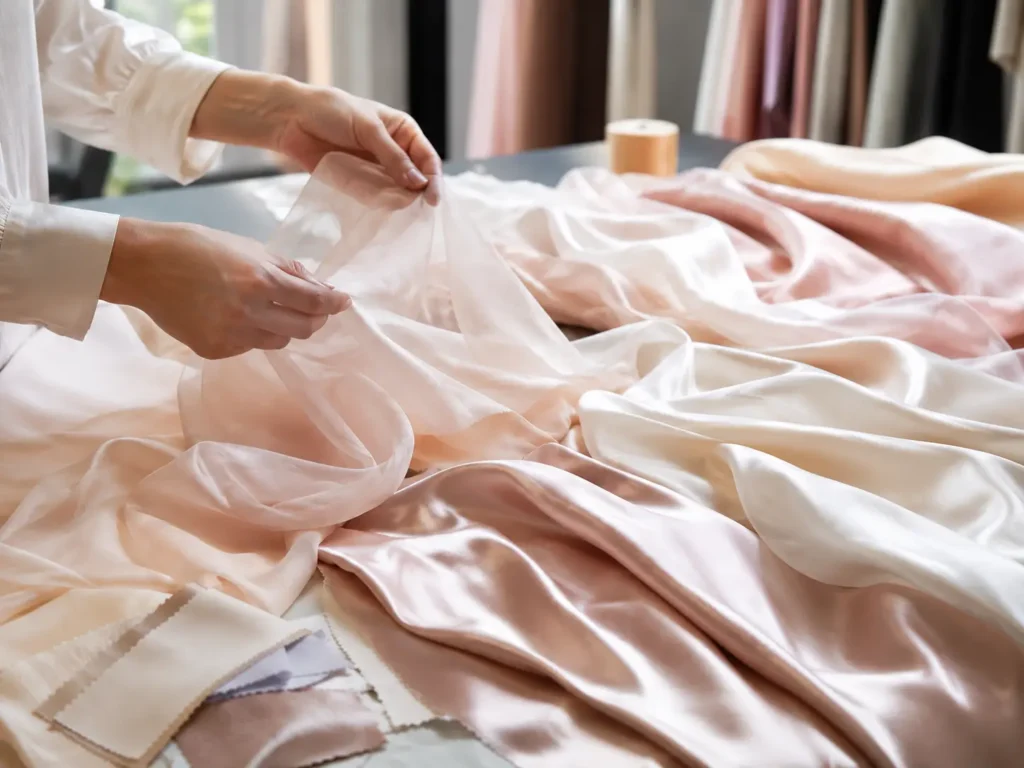
Chiffon, Mesh and Lace
Lightweight open or semi-transparent fabrics create a different risk profile. Chiffon moves easily, mesh can catch on protruding components, and lace may have exposed loops or raised motifs. Loose folding allows layers to migrate during handling, which increases the chance that a hook, sequin edge or zipper component reaches a sensitive surface.
The first control point is separation from hardware. Hooks, decorative stones, metal adjusters and coarse trim edges should not sit directly against a vulnerable layer. When the dress combines a decorated bodice with a soft chiffon or mesh skirt, the fold plan should keep the decorated zone isolated from the skirt rather than letting the two surfaces compress together.
Layer movement also needs control. A garment should be stable enough inside its bag that the fold does not collapse into a random shape during carton loading. At the same time, excessive tension should be avoided because pulling chiffon or mesh tight can distort edges and seams.
Lace and mesh garments should be checked after trial packing for snag points that may not be visible during flat inspection.
A detail can appear smooth on the hanger yet catch another layer once folded. Pack-out review should therefore include the garment in its real shipping configuration.

Velvet and Textured Fabrics
Velvet and other directional surfaces require pressure control because pile direction and prolonged compression can change how light reflects across the garment.
A pressure mark may appear even when no physical damage exists.
Fold placement should avoid large visible areas where possible, and repeated hard pressure from labels, fasteners or trims should be redirected.
Stacking orientation deserves attention because identical garments create repeated layers of the same seams and components. If every unit places a thick waistband or zipper pull in exactly the same location, the pressure can build through the carton.
Alternating direction or adjusting layer arrangement may produce a more balanced stack.
The final decision should consider the garment as a whole.
A velvet mini dress with simple construction may tolerate controlled folded packing, while a velvet corset dress with molded cups and rhinestone details may require a more protective method.
Fabric type alone never determines the complete solution.
Protect Beading, Sequins and 3D Embellishments
Embellishment changes carton packing from a simple folding task into a contact-management problem. Hard decorative components create localized pressure, exposed edges can catch adjacent fabrics, and dimensional details can collapse when the carton stack transfers weight through the same area.
Control Point Pressure Before It Reaches the Fabric
A rhinestone, bead or metal decoration can act as a small pressure point inside a compressed carton. Even when the decoration remains firmly attached, the force may transfer into satin, mesh, lining or another garment. The packing review therefore considers where the hard elements sit after folding and what surface will be directly opposite them.
One common control method is to reposition the fold so the embellished area does not face a large visible panel. Another is to introduce a separating layer exactly where hard and soft surfaces meet. For heavier bead clusters, the stack arrangement may also need adjustment so decorated zones are not aligned vertically through every garment layer.
The objective is not to eliminate all pressure. International transport will always involve stacking and handling. The objective is to keep concentrated pressure away from areas where it can create a visible mark, break a decorative component or distort the garment.
During pack-out review, the dressed sample should be folded, bagged and placed into the proposed carton configuration. Inspection after a controlled hold period can reveal pressure zones that are impossible to predict from a garment hanging freely on a rack.
Plan Fold Lines Around Decoration
A fold line should never be selected only because it makes the garment smaller. For embellished dresses, the line also needs to avoid dense decoration, rigid trims and dimensional details whenever possible.
A sequin panel positioned directly on a fold can create several problems at once: the sequins may overlap unnaturally, sharp edges may press into the backing fabric, and the folded bulk can become significantly thicker than the rest of the garment. Similar issues appear with beaded seams, appliqué clusters and 3D floral areas.
Jinfeng therefore treats fold planning as part of style review. The garment is first divided into high-risk and low-risk zones. Softer, more flexible sections are preferred for major folds, while decorated or structural zones are kept flatter where possible.
Long dresses can require more than one fold, so the challenge becomes distributing those folds without concentrating weight.
A consistent folding diagram is especially valuable for bulk orders because the same 20,000- to 80,000-piece program can contain several decorated styles with very different risk patterns.
Make Local Protection Repeatable in Bulk
A good sample-room solution is not enough if the method requires five minutes of manual arrangement for every garment. Bulk packing must balance protection with repeatability.
Local protection works best when packers can immediately identify where the material belongs and how much should be used.
Visual standards can show the embellished zone, the interleaving position, the approved garment direction and any support that must remain in place.
QC should verify protection placement during packing rather than only looking at sealed cartons.
Once a carton is closed, a missing protective layer is difficult to detect without reopening the shipment.
For multi-style programs, packing methods can be grouped by risk family. Lightweight decorated styles may share one protection method, while heavy beaded corset dresses use another.
Grouping simplifies line training while still respecting important product differences.
Keep Structured Dresses in Shape
A structured dress can pass every measurement check and still arrive in poor condition if carton pressure collapses the construction. Corsetry, cups, boning, shaped necklines, bubble hems and dimensional details require packing decisions based on form as well as surface protection.
Corset Bodices and Boning
Corset dresses depend on controlled shape. Boning channels, panel seams and waist structure create a form that should not be treated like a soft knit top. A sharp fold through the bodice or heavy vertical compression can change the relationship between panels and create distortion that is difficult to correct through steaming.
Packing review begins by identifying the structural center of the garment. The bodice may need to remain flatter while softer skirt areas absorb the main folds. When a corset includes embellishment, shape protection and surface protection must be solved together rather than as separate issues.
Stacking is also important. Multiple corset bodices positioned directly above each other can form a thick rigid zone inside the carton. A different orientation or pack layout may distribute weight more evenly.
The final method should remain clear to both production and QC teams. Approved photographs can show how the bodice sits inside the bag, where folds begin and how garments are layered inside the carton.
Molded Cups, Necklines and Internal Support
Molded cups and shaped necklines can dent or flatten under pressure. Once the cup shape changes, the dress may appear defective even when stitching remains intact. Support must therefore prevent unnecessary collapse without stretching the neckline or pushing the garment outside its intended shape.
Cup protection does not always require a bulky insert. The correct method depends on cup firmness, surrounding fabric, garment depth and the number of pieces placed in the carton. Some styles can be nested carefully; others need separation so pressure from the next garment does not sit directly on the cup apex.
Internal support elements such as underwires, stays and rigid interfacing also need attention. A folding method that forces those components into an unnatural angle can create a permanent set or visual distortion.
Pack-out review should treat the garment as a three-dimensional product. Flat measurements alone cannot confirm whether the dress will survive stacking in acceptable presentation condition.
Bubble Hems, Bows and Dimensional Details
Volume-based details are designed to create space. Packing removes space, so the challenge is determining how much compression the feature can tolerate and how easily it recovers.
Bubble hems may flatten if several garment layers concentrate pressure on the same section. Large bows can crease along unintended lines. Ruffles, rosettes and dimensional appliqués can lose their arrangement after extended compression. Some details recover quickly; others need manual reshaping.
A good packing specification identifies which features may collapse temporarily and which should remain protected. Garment orientation can be adjusted so dimensional elements sit in lower-pressure zones. In some programs, fewer pieces per carton may be justified because the cost of restoring shape after receiving would be higher than the freight saved through aggressive compression.

Engineer Carton Size Around the Garment
Carton dimensions should come after the folded garment is understood. Jinfeng evaluates garment volume, risk zones, approved fold, packing quantity and route requirements together. The result is a pack-out that protects the dress while avoiding avoidable empty space or unnecessary compression.
| Variable | How It Is Reviewed | Risk If Incorrect | Packing Output |
|---|---|---|---|
| Folded garment length | Measured from approved fold | Excess carton length or forced fold | Internal carton length |
| Folded garment width | Checked at widest packed point | Side compression or movement | Internal carton width |
| Packed garment depth | Reviewed under realistic layering | Over-compression | Carton depth |
| Pieces per carton | Set by garment volume and risk | Wrinkles or inefficient cube | Pack quantity |
| Embellishment density | Mapped by contact zone | Point pressure | Layer orientation |
| Structure sensitivity | Checked on bodice and details | Shape deformation | Support requirement |
| Gross carton weight | Aligned with shipment plan | Handling and stacking issues | Weight limit |
| Assortment requirement | Taken from order matrix | Receiving errors | Carton breakdown |
Match Carton Construction to the Supply Chain

Ocean Export Programs

Palletized Retail Distribution

Multi-Style Consolidation

Parcel and Ecommerce Fulfillment
Standardize Every Packing-Line Step
Jinfeng operates across 16 owned factories, 20+ satellite production resources and 300 production lines, including more than 50 quick-response lines. Packing consistency matters at that scale because a strong packing method loses value if execution changes between styles, lines or shifts. The approved pack-out therefore needs to become a simple operating standard.
Release Packing Only After Garment Approval
Packing should begin only after the garment has passed the relevant finishing and quality stages. Packing a garment with unresolved pressing, measurement, decoration or cleanliness issues simply hides the defect inside the carton.
Before bulk pack-out, production documentation should identify style, color, size, packing method, fold direction, inner protection and pieces per carton. For sensitive products, reference photographs are especially useful because they show the exact garment position more clearly than a written instruction alone.
The packing line should also know which style groups require special handling. A chiffon dress with no hard decoration does not need the same controls as a beaded corset mini. Clear grouping helps reduce both under-protection and unnecessary material use.
Fold, Protect and Bag in a Fixed Sequence
The folding sequence should remain consistent from first unit to last. A common process begins by laying the garment in the approved orientation, arranging straps or sleeves, placing any required interleaving or local protection, folding through the approved zones, then inserting the garment into its individual bag.
For embellished or structured styles, the packer should confirm the sensitive zone before completing the fold. Decoration should not become trapped under a hard seam, and cups or corset panels should not be forced into an unnatural shape.
Consistency matters more than speed alone. A packing method that changes with each operator produces unpredictable carton pressure and makes later QC difficult. Visual work instructions help preserve the same configuration across long bulk runs.
Load, Verify and Seal the Carton
Carton loading should follow the approved orientation and quantity.
When alternating garment direction is part of the pressure-control strategy, the sequence needs to be clear enough to check quickly.
Before sealing, carton contents should be verified against the order breakdown.
Style, color, size assortment, quantity and carton number must match the required shipping plan.
Only after the contents and pack-out are confirmed should the carton be closed, marked and transferred for shipment preparation.
Packing QC Before Every Carton Is Released
Style and PO Match
Color and Size Accuracy
Color and size assortment should match the approved breakdown. A carton containing the correct total quantity but the wrong size ratio creates downstream inventory problems.
The pack line and QC check should therefore use the same commercial assortment document.
Garment Condition
Fold Orientation
The approved fold should be reproduced consistently. A reversed or shifted fold can move hard components into sensitive areas, especially on embellished or structured dresses.
Fold checks are therefore important even when the garment still fits inside the carton.
Protection Placement
Pieces per Carton
Carton Identification
Shipping marks, carton numbers, style references and required barcode information should match the final contents.
Accurate identification allows warehouses and distribution teams to process the shipment without unnecessary opening and resorting.
Seal and Dispatch Readiness
Validate the Pack-Out Before Bulk Shipping
Bulk packing should not be the first time a delicate dress is tested inside its real shipping configuration. A pack-out review allows the garment, protection method and carton layout to be evaluated together before thousands of units follow the same standard.
Start With a Representative Packing Trial
A useful trial uses finished garments that accurately represent bulk construction. The sample should include actual fabric weight, decoration, lining, trims and internal structure because substitutions can change the packing result.
The proposed fold is completed exactly as planned for production, including individual bag, tissue, local support and carton orientation. Enough garments should be packed to reproduce the intended layer pressure rather than evaluating a single dress in an empty carton.
The first review checks obvious issues: carton fit, excess movement, over-compression, decoration contact, bodice pressure and ease of packing. If the method is difficult to execute consistently, it should be simplified before bulk production.
Review Pressure, Recovery and Handling Risk
The packed configuration should be reopened and inspected for visible fold lines, pressure marks, displaced decoration and structure distortion. Sensitive areas can then be compared with the original approved garment condition.
A garment that requires unreasonable recovery work after a normal pack-out is a signal that the method needs adjustment. Possible corrections include changing fold location, reducing pieces per carton, moving a hard component, adding targeted separation or altering orientation.
Where a brand or retailer specifies a named transit-test procedure, carton performance requirement or third-party laboratory protocol, the production packing specification should be aligned with that requirement before release.
Freeze the Approved Method
Once the pack-out is accepted, the method should be documented. The approval record can include fold photographs, protection positions, pieces per carton, carton identification and any style-specific notes.
Bulk packers then follow the approved standard, while QC uses the same reference to inspect production. The purpose is not to create more paperwork.
The purpose is to prevent the pack-out from drifting after the first few cartons.

Reduce Freight Without Crushing the Dress
Freight optimization should remove wasted space without transferring cost into garment damage. The best pack-out sits between two extremes: loose cartons that carry unnecessary air and over-compressed cartons that increase wrinkles, deformation and recovery work.
Avoid Paying to Ship Empty Volume
Oversized cartons increase cube and may require more internal stabilization. In a large fashion program, small differences in carton volume multiply across hundreds or thousands of cartons. Right-sizing therefore matters, but only after the real folded garment dimensions are known.
Grouping similar styles into common carton families can reduce unnecessary carton variation while preserving efficient utilization. A soft lightweight style may support a higher packing quantity than a structured embellished style, even when their flat garment measurements look similar.
Do Not Treat Compression as Free Space
Adding more garments to a carton reduces carton count only until the extra pressure begins to change arrival condition. Satin crease recovery, corset deformation and embellishment pressure can create hidden downstream cost.
A better commercial decision compares freight savings against the likely need for steaming, reshaping, handling or rework. For high-value occasionwear, one additional carton may be less expensive than recovering several dozen compressed garments at destination.
Optimize at Order Level
A seasonal order should be evaluated across all style families rather than carton by carton. Some styles can pack densely, while others need more space. Using several approved pack-out groups often produces better total cube efficiency than forcing every style into the same pieces-per-carton target.
Order-level planning also improves loading because carton families can be organized around predictable dimensions and weights. The goal is a repeatable shipping system rather than an isolated “smallest possible carton” result.
Keep Carton Marks and Assortments Accurate

PO Identification

Style Identification

Color Identification

Size Assortment

Carton Numbering

Barcode and Shipping Marks
Use Packaging Materials With a Clear Purpose
Right-Sized Corrugated Cartons
Targeted Paper-Based Protection
Reduce Unnecessary Layers
Representative Delicate Dress Packing Case
A representative brand program shows how packing decisions change when one order contains many dress constructions. The following order profile reflects the size and style mix commonly managed within Jinfeng production programs while keeping the brand identity confidential.
Program Profile: 24 Styles and 48,600 Pieces
The program included 24 dress styles totaling 48,600 pieces. Product groups covered lightweight satin dresses, chiffon and mesh styles, sequin party dresses, corset minis and several styles with dimensional floral decoration.
Using one packing method for all 24 styles would have created unnecessary risk. The lightweight styles could tolerate a denser fold, while corset and decorated products required more controlled layer pressure.
The merchandising and production teams therefore divided the order into three packing-risk groups:
- Group A:soft satin, chiffon and lightweight woven styles
- Group B:moderate embellishment or lace/mesh combinations
- Group C:corset, heavy decoration and dimensional-detail styles
Each group received a separate fold, protection and carton-loading standard.
Packing Decisions by Risk Group
Group A focused on wrinkle and surface control. Fold direction was chosen to keep visible satin panels away from hard components, and carton quantity was set around folded volume rather than a fixed number applied to every style.
Group B required more contact management. Interleaving was positioned between decorated areas and soft mesh or lace sections, while garment orientation reduced direct overlap of embellishment zones.
Group C received the strongest structural control. Corset bodices and dimensional details were kept away from major fold lines, and carton loading avoided placing repeated hard zones directly above one another.
The resulting specification used different pieces-per-carton bands across the three groups rather than one universal target. Higher-risk styles packed at lower density, while simpler lightweight styles used carton space more efficiently.
Bulk Execution and Order Control
Before the full order moved through packing, representative garments from all three groups were reviewed in their intended carton configuration.
Fold sequence, protection placement, garment orientation and carton identification were then documented for bulk execution.
Packing-line QC checked style, color, size assortment, fold direction, protection placement, pieces per carton, carton number and shipping-mark accuracy before release.
The result was a packing system built around the product mix instead of around a single carton rule. Such an approach allows large multi-style fashion orders to remain commercially efficient without treating a delicate corset dress and a lightweight chiffon style as the same shipping product.

Frequently Asked Questions About Dress Packing

Send Us Your Dress Packing Requirements
- Tech pack or clear dress drawings
- Front, back and detail photographs
- Fabric composition and surface description
- Beading, sequin, rhinestone or 3D decoration details
- Bodice, cup, boning or structural information
- Order quantity and style breakdown
- Size and color assortment
- Existing packing manual, if available
- Current carton specification, if already defined
- Shipping destination and retailer requirements
- Any known wrinkle, crushing or arrival-condition problem


