 Skip to content
Bridesmaid Dress Manufacturer
Custom bridesmaid dress development for fashion brands, occasionwear labels, and private-label women’s dress programs.
Jinfeng Apparel helps fashion brands develop bridesmaid dresses from fabric direction, pattern making, and sample revision to PP approval, bulk production, QC, and private-label packing. For satin, chiffon, crepe, lace, mesh, and tulle bridesmaid collections, our team focuses on color consistency, fit balance, lining coverage, hem control, size grading, and export-ready delivery.
- Since 2008— custom women’s fashion manufacturing experience for global apparel programs.
- 6 owned women’s fashion factories— production structure for bridesmaid, occasionwear, formalwear, wedding guest, and private-label dress programs.
- 10+ long-term satellite production partners— flexible capacity support for multi-style collections and phased delivery.
- MOQ from 200 pcs/style/color— suitable for organized custom production, not ready-stock resale or single-item fulfillment.
- OEM, ODM, and private-label support— development from tech packs, references, original samples, fabric swatches, or line sheets.
- Guangdong-based supply chain— fabric, trim, sample, production, QC, packing, and export coordination in China’s apparel manufacturing region.
Manufacturing Facts for Bridesmaid Dress Programs
Since 2008
- Custom women’s fashion manufacturing since 2008.
- Dresses, occasionwear, formalwear, and private-label programs.
- Color, lining, size, and packing risks reviewed before bulk.
6 Owned Factories
- Owned factory resources for core womenswear programs.
- Style allocation by fabric, structure, and production risk.
- Stronger control from PP sample to final packing.
10+ Production Partners
- Flexible capacity for seasonal collection programs.
- Production planning by fabric group and style difficulty.
- QC and packing standards coordinated under one project structure.
MOQ 200 Per Color
- MOQ from 200 pcs per style/color.
- Fabric and packaging MOQ reviewed separately.
- Color and size planning confirmed before quotation.
OEM / ODM Support
- OEM from tech pack, sample, or size chart.
- ODM from reference photo, moodboard, or line sheet.
- Fabric, fit, and construction review before sample work.
Private-Label Delivery
- Labels, hangtags, barcodes, and SKU labels.
- Polybags, stickers, cartons, and carton marks.
- Packing records by style, color, and size.
Built for Brand-Level Dress Production
Best Fit Projects

- Clear product direction.
- Bulk production plan.
- Fabric and color plan.
- Size chart or fit standard.
- Private-label requirements.
- Repeat-order potential.
Not the Right Fit

Jinfeng Apparel is not positioned as a no-MOQ, dropshipping, ready-stock, or single-item fulfillment supplier. Bridesmaid dresses require fabric batch control, shade review, sample development, size grading, lining confirmation, PP approval, and packing accuracy. These steps do not match projects with only a few trial pieces, unclear design direction, no sample budget, or only lowest-price comparison. The best cooperation starts when brand teams respect development work, production standards, and realistic lead time. Mismatch indicators:
- No-MOQ requests.
- Ready-stock purchasing.
- Single-item fulfillment.
- 1–50 pcs test orders.
- No sample budget.
- Lowest-price-only sourcing.
Bridesmaid Dress Manufacturing for Fashion Teams
Occasionwear Brands
Occasionwear brands need bridesmaid dresses to fit within a wider formal dress assortment.
A collection may include satin maxi dresses, chiffon wrap dresses, crepe one-shoulder gowns, and lace-detail midi styles. Jinfeng Apparel supports these programs by reviewing fabric drape, neckline stability, hem sweep, lining coverage, and photo-ready finishing before bulk production.
- Fabric story and formal dress construction.
- Fit review and PP sample approval.
- Private-label packing for collection launches.
Bridesmaid Labels
Bridesmaid dress labels often need consistent color stories across different silhouettes.
One sage green story may include halter, strapless, slip, A-line, and wrap styles.
Jinfeng Apparel helps manage fabric batches, lining color, zipper color, thread color, SKU records, and packing separation so the final collection remains coordinated across style variations.
- Same-color multi-style development.
- Lab dip and shade review when required.
- SKU and carton-level color control.
Formalwear Retailers
- Retail-ready finishing and measurement control.
- Care labels, hangtags, and polybags.
- Carton marks and warehouse receiving support.
Premium Ecommerce Brands
- Photo sample and size chart execution.
- Color confirmation and fit adjustment.
- Packaging accuracy and launch-calendar coordination.
Sourcing Offices
Sourcing offices need factories able to follow documents, track revisions, and prepare clear production updates. Jinfeng Apparel can work from tech packs, BOM files, trim cards, label artwork, packaging instructions, and quality manuals. Bridesmaid dress orders are managed through fabric tracking, sample approval, PP sealing, inline review, final inspection, and export document coordination.
- Project tracking and document control.
- QC coordination and production updates.
- Shipment and export preparation.
Brand Groups
- Multi-style and multi-batch planning.
- Factory allocation by garment risk.
- Repeat-order records and brand-level protection.
Risks Brands Face in Bridesmaid Dress Production
Shade Difference
Color consistency is one of the highest risks in bridesmaid dress production. Satin shine direction, chiffon transparency, lining color, and fabric batch variation can change how sage, champagne, dusty blue, or burgundy appears under daylight, indoor lighting, and camera flash. Jinfeng Apparel checks color direction before sampling and reviews bulk shade with fabric and trim records before production.
- Lab dip review when required.
- Bulk fabric shade and lining match.
- Thread, zipper, trim, and SKU color records.
Fit Inconsistency
A bridesmaid group usually includes different body shapes and size needs. Fit inconsistency appears through tight busts, loose waists, uneven strap length, gaping necklines, unstable wrap fronts, or uncomfortable armholes. Jinfeng Apparel reviews measurement points, sample feedback, grade rules, and fit comments before PP approval, helping brands build a more stable size range.
- Bust, waist, hip, and dress length.
- Strap length, armhole, and neckline depth.
- Slit height and size grading review.
Uneven Hem Length
Long chiffon and satin bridesmaid dresses expose hem problems quickly. Fabric slipping, bias cutting, layered skirts, lining mismatch, and pressing errors can create uneven bottom edges. Jinfeng Apparel checks hem balance during sample review and bulk inspection, especially for maxi and floor-length styles where front, back, and side lengths must stay controlled.
- Outer layer and lining length review.
- Side seam balance and pressing recovery.
- Hanging check before packing.
Fabric Mismatch
A design may look strong in a reference image but fail when the chosen fabric does not match the intended drape. Lightweight chiffon may need lining; satin may show wrinkles; crepe may change body shape; lace may require motif placement review. Jinfeng Apparel reviews fabric handfeel, weight, stretch, transparency, and drape before recommending a sample route.
- Swatch review and fabric substitution.
- Lining choice and pattern adjustment.
- Cost update after material changes.
Weak Details
Bridesmaid dresses rely on details such as invisible zippers, adjustable straps, bra cups, side slits, wrap ties, pleats, and lining. Weak detail execution can create consumer complaints even when the main fabric looks correct. Jinfeng Apparel reviews closure strength, strap stability, seam cleanliness, lining attachment, and wearer comfort during sample and bulk stages.
- Zipper smoothness and strap slider strength.
- Tie length and cup placement.
- Seam finish and lining security.
Delivery Pressure
Wedding season and occasionwear launches leave limited room for late samples or delayed bulk. Jinfeng Apparel manages timeline planning through requirement confirmation, fabric tracking, sample tracking, revision records, PP approval, bulk schedule, QC feedback, packing confirmation, and shipment arrangement. Large programs are planned by style group and fabric readiness.
- Sample deadline and PP approval date.
- Fabric arrival and production window.
- QC window and shipment plan.
Custom Bridesmaid Dress Product Range

Chiffon Bridesmaid Dress
- Best for garden weddings, summer weddings, destination weddings, and soft color stories.
- Key focus: transparency, lining, layer control, and pleating.
- Bulk control: hem balance, pressing, and packing recovery.

Satin Bridesmaid Dress
Satin bridesmaid dresses create a polished, premium look, but satin exposes shade difference, snagging, wrinkles, shine direction, and seam marks. Jinfeng Apparel reviews matte satin, stretch satin, and heavier satin options according to silhouette, color, and target price. For satin bridesmaid programs, sample review focuses on neckline shape, bust coverage, zipper smoothness, pressing marks, lining movement, and anti-crease packing.
- Best for modern weddings, evening ceremonies, and premium ecommerce.
- Key focus: shine direction, shade review, and snag prevention.
- Bulk control: pressing, zipper flatness, and packing protection.

Crepe Bridesmaid Dress
Crepe bridesmaid dresses offer a cleaner surface and more structured drape than chiffon. The fabric works well for wrap dresses, one-shoulder gowns, fitted midi styles, and minimalist formal looks. Jinfeng Apparel reviews crepe weight, opacity, handfeel, stretch level, and seam appearance before pattern development. Bulk QC focuses on side seam smoothness, waist shape, zipper flatness, and hem balance.
- Best for minimalist weddings and mature occasionwear brands.
- Key focus: fabric weight, opacity, and clean drape.
- Bulk control: seam smoothness, waist shaping, and wrinkle control.

A-Line Bridesmaid Dress
A-line bridesmaid dresses remain strong because the silhouette is easy to wear across body shapes. The manufacturing challenge is not the outline alone, but bust fit, waist placement, skirt volume, lining length, and hem symmetry. Jinfeng Apparel reviews bodice structure, waist seam, skirt sweep, zipper placement, and fabric drape during sampling. A-line dresses also allow brands to develop one body block across several colors.
- Best for inclusive size ranges and classic bridal-party collections.
- Key focus: waist placement and bust coverage.
- Bulk control: skirt balance, grading, and hem symmetry.

Slip Bridesmaid Dress
Slip bridesmaid dresses look simple, yet manufacturing tolerance is strict. Satin surface, bias cut, strap length, neckline depth, and lining coverage can change the whole look. Jinfeng Apparel reviews strap placement, bust coverage, fabric weight, seam tension, and pressing before PP approval. For online brands, slip bridesmaid dresses need clean campaign samples and carefully packed bulk pieces to reduce crease issues.
- Best for modern wedding stories and minimalist bridal parties.
- Key focus: bias control, strap length, and neckline depth.
- Bulk control: lining, pressing, and crease-aware packing.

Halter Bridesmaid Dress
Halter bridesmaid dresses create strong shoulder and neckline visuals but require careful support. Neck pressure, bust security, back closure, lining position, and strap tension need sample testing. Jinfeng Apparel reviews neckline depth, halter width, tie or clasp method, bra cup option, and anti-slip structure where needed. Bulk production checks strap consistency, seam strength, and symmetrical front panels.
- Best for summer weddings and destination ceremonies.
- Key focus: bust support and neck comfort.
- Bulk control: strap strength and front symmetry.

One-Shoulder Dress
One-shoulder bridesmaid dresses bring a formal, contemporary look. The asymmetrical neckline must remain balanced across sizes, and the armhole cannot pull or gape. Jinfeng Apparel reviews shoulder width, diagonal neckline, side seam tension, inner support, and zipper placement before sample approval. For multi-size orders, grade rules must preserve the one-shoulder angle without distorting the body line.
- Best for modern ceremony themes and evening weddings.
- Key focus: neckline angle and armhole comfort.
- Bulk control: side seam tension and grade balance.

Wrap Bridesmaid Dress
Wrap bridesmaid dresses are popular because they adjust across body shapes, but tie length, neckline coverage, waist security, and inner fastening must be controlled. Jinfeng Apparel reviews overlap depth, waist tie length, inner button or hook options, fabric drape, and movement safety. Chiffon and crepe wrap styles need special attention to transparency, pulling, and hem balance during bulk production.
- Best for mixed-size bridal groups and relaxed weddings.
- Key focus: overlap, tie length, and waist security.
- Bulk control: neckline coverage, hem balance, and inner fastening.

Lace Detail Dress
Lace-detail bridesmaid dresses may use lace overlays, lace trims, mesh panels, or motif placement. The value comes from texture, but risk comes from fraying, snagging, motif mismatch, lining color, and seam placement. Jinfeng Apparel reviews whether lace is used as fabric or trim, then controls cutting position, edge finishing, lining shade, and joining method during sampling and bulk QC.
- Best for romantic weddings and premium bridal-party capsules.
- Key focus: motif placement and lining color.
- Bulk control: edge finishing, snag control, and seam joining.
Bridesmaid Dress Fabrics and Production Control
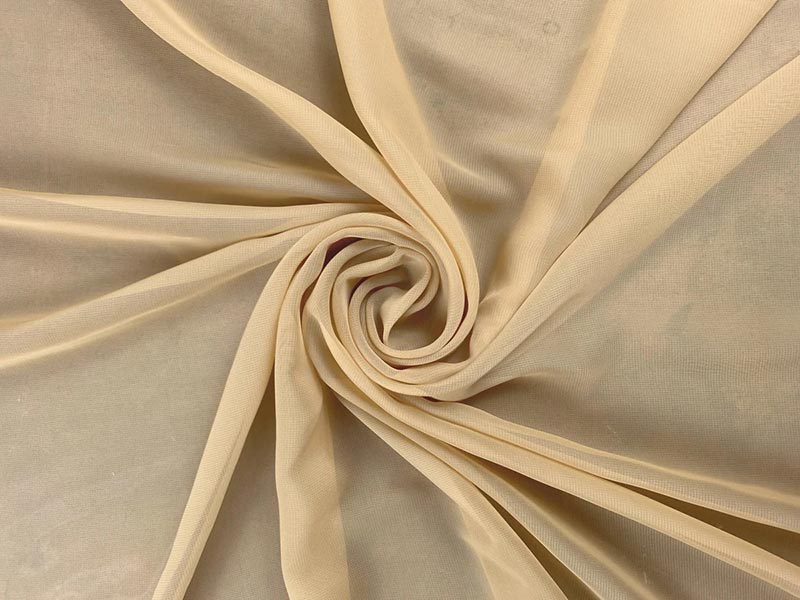
Chiffon
- Transparency and lining.
- Pleating and side seam balance.
- Outer hem and packing recovery.
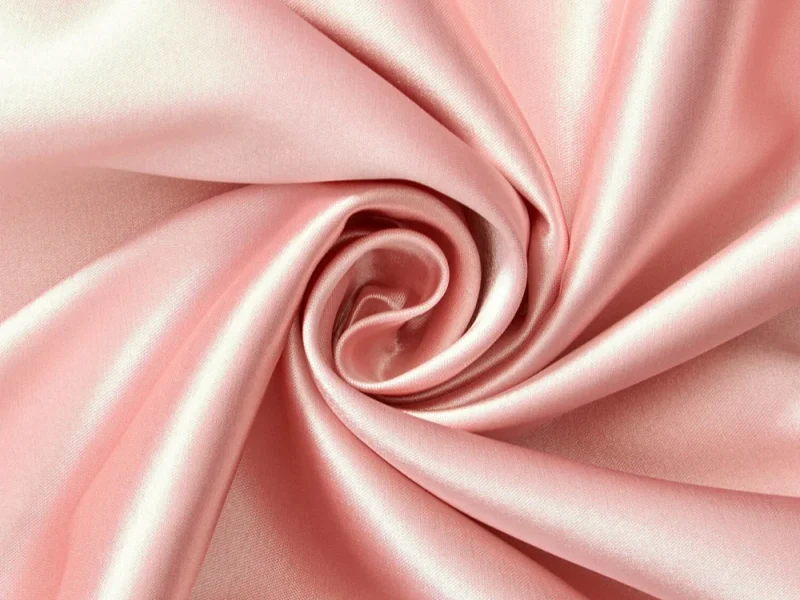
Satin
Satin brings a polished look for bridesmaid, evening, and wedding guest dresses. The commercial value is high, but surface problems are easy to see. Shade difference, shine direction, snagging, wrinkles, zipper bumps, and pressing marks can affect final quality. Jinfeng Apparel reviews satin type, weight, stretch level, lining need, and packing method before confirming production direction.
- Shine direction and shade review.
- Snagging and seam mark prevention.
- Zipper flatness and anti-crease packing.

Crepe
Crepe supports cleaner silhouettes with less shine than satin and more structure than chiffon. It works well for one-shoulder, wrap, A-line, fitted midi, and formal maxi dresses. The production focus is fabric weight, opacity, side seam smoothness, waist shaping, and hem balance. Jinfeng Apparel reviews whether stretch crepe, woven crepe, or heavier crepe best fits the style and price target.
- Handfeel and drape.
- Opacity and seam smoothness.
- Waist shape and wrinkle recovery.

Lace
- Motif placement and lining shade.
- Edge finish and seam position.
- Fabric damage and hole inspection.

Mesh
- Transparency and stretch direction.
- Edge finish and lining coverage.
- Recovery and hole-risk review.
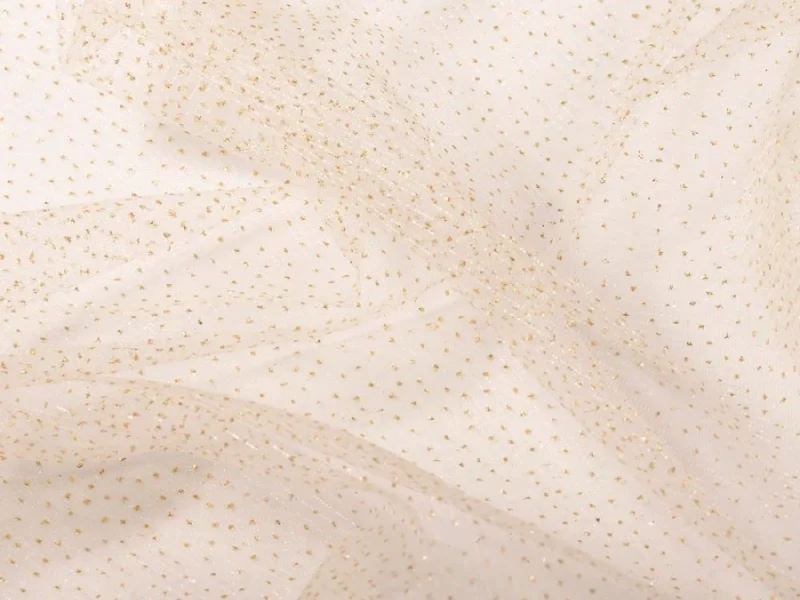
Tulle
- Layer count and skirt volume.
- Lining comfort and static risk.
- Packing protection and compression review.
Satin and Chiffon Production Control
Satin and chiffon are two of the most common bridesmaid dress fabrics, yet each fabric behaves differently in sampling, cutting, sewing, pressing, and packing. Jinfeng Apparel reviews these materials by garment structure and bulk risk.
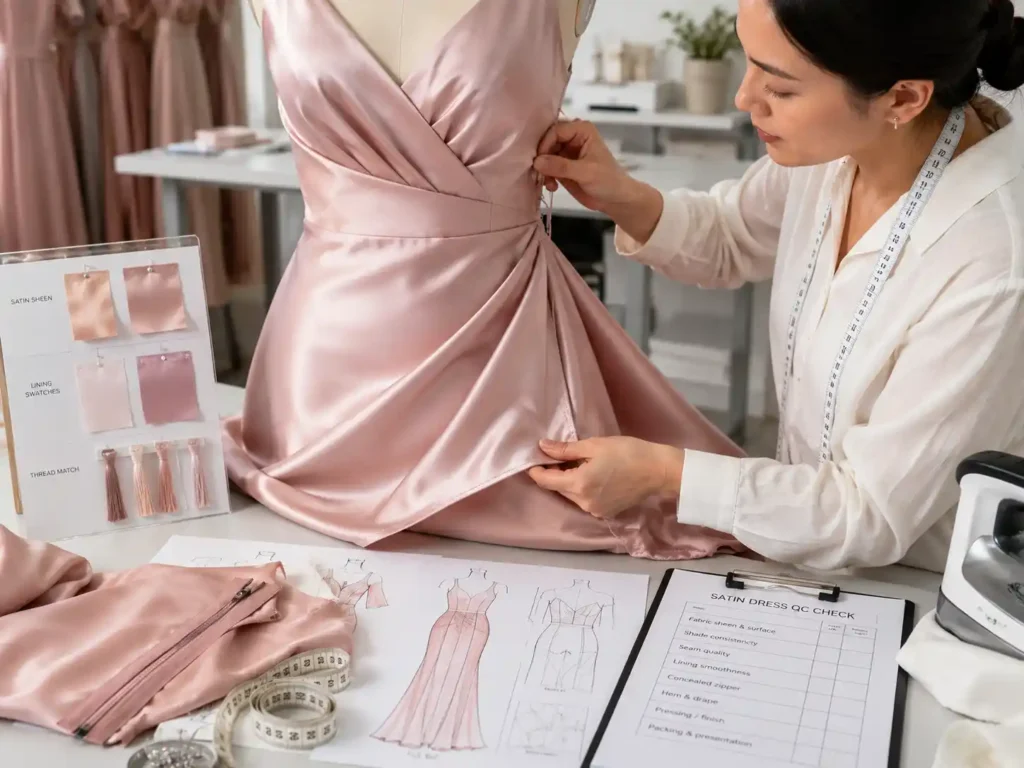
Satin Bridesmaid Dresses Need Surface Discipline
Satin creates premium shine and strong photo appeal, especially for slip dresses, halter gowns, one-shoulder maxi dresses, and modern formalwear. The surface also makes production problems visible. A small snag, zipper bump, shine-direction error, or pressing mark can affect final appearance.
Fabric direction should be reviewed for weight, stretch, shine level, and opacity. Lightweight satin can look fluid but may show body lines or wrinkles. Heavier satin gives a more polished shape but may increase cost and sewing complexity. Champagne, sage, dusty blue, blush, and navy can shift under lighting because satin reflects light. Jinfeng Apparel reviews fabric shade, lining shade, thread color, and zipper color before bulk.
Key satin controls include:
- Fabric weight, stretch, shine level, and opacity.
- Lining shade, thread color, and zipper color.
- Stitch tension, needle marks, and seam pulling.
- Zipper flatness and bias-control for slip styles.
- Pressing standard and anti-crease packing.
- Polybag fold position, hanger method, and carton compression.
Chiffon Bridesmaid Dresses Need Layer Discipline
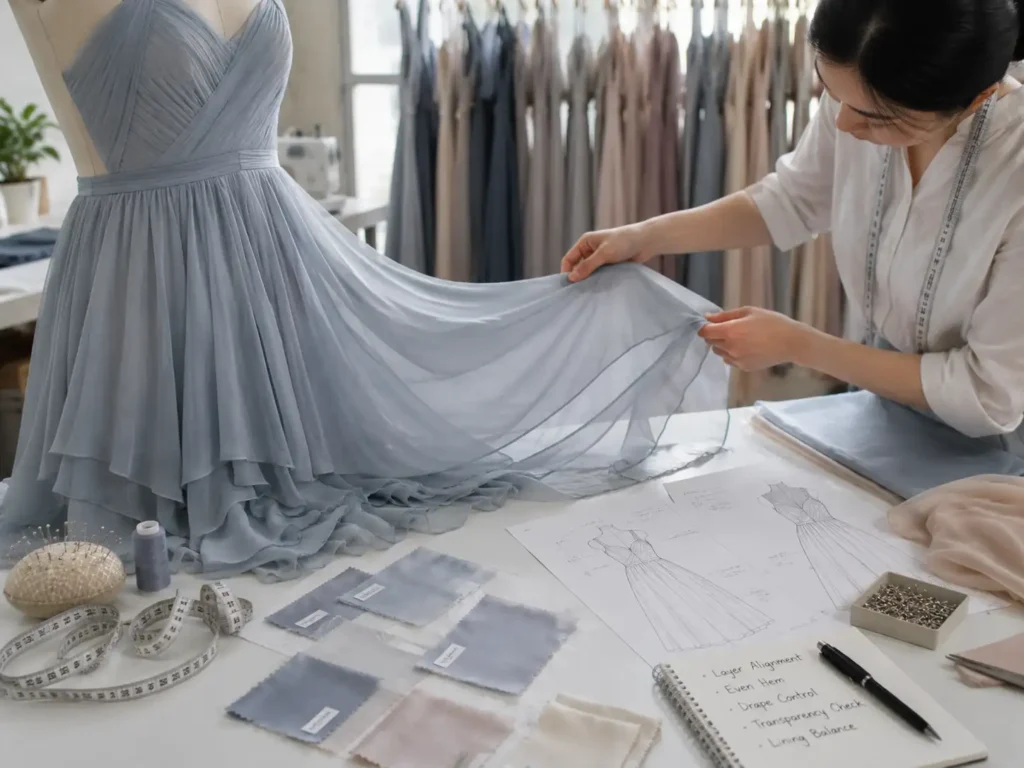
Chiffon is valued for softness, movement, and romantic layering. It fits garden weddings, destination weddings, soft color stories, and multi-style bridal-party collections. Chiffon is not easy to control in bulk because the fabric slips during cutting and can create uneven hems or mismatched layers.
Light colors often need lining. Ivory, blush, champagne, and pale blue must be reviewed for opacity, lining shade, and inner seam visibility. Cutting alignment and layer control affect final garment balance. Long skirts need special attention to side seam length and hem curve. Pleats, gathers, and wrap fronts can look uneven when chiffon tension changes. Sample review should confirm volume, waist placement, and drape before PP approval.
Key chiffon controls include:
- Transparency and lining shade.
- Cutting alignment and layer control.
- Side seam length and hem curve.
- Pleat, gather, and wrap-front balance.
- Front, back, and side length after hanging.
- Lining length below outer-layer prevention.
Color Planning for Bridesmaid Collections
Color is a commercial decision and a production control point. Bridesmaid programs often need the same color story across different silhouettes, fabrics, and sizes, so lab dip, bulk shade, and trim color must be reviewed before production.
| Color Direction | Common Fabric Choices | Brand Use Case | Production Risk | Jinfeng Control Focus |
|---|---|---|---|---|
| Sage Green | Chiffon, satin, crepe | Garden weddings, spring launches | Shade can shift yellow or grey under different light | Lab dip review, lining match, thread and zipper color |
| Dusty Blue | Chiffon, satin | Coastal weddings, soft formalwear | Satin reflection may deepen color in photos | Bulk shade review, shine direction, sample photography check |
| Champagne | Satin, crepe | Premium bridal-party looks | Light color may show lining, seam, and stain issues | Opacity check, lining shade, clean handling, and packing |
| Blush Pink | Chiffon, tulle, lace | Romantic weddings, boutique programs | Pale shade may reveal transparency or color unevenness | Fabric layer review, lining match, final shade check |
| Burgundy | Satin, crepe, chiffon | Autumn weddings, formal evening events | Dark shade may show color transfer or fabric flaws | Colorfastness review by project, stain check, pressing control |
| Navy | Crepe, satin, chiffon | Classic formalwear and retail programs | Deep shade may show dust, shine marks, and pressing lines | Surface inspection, thread match, packing protection |
| Black | Satin, crepe, mesh | Modern wedding parties and formal collections | Lint, shine marks, and seam tension show clearly | Clean sewing, pressing control, final surface check |
| Ivory | Chiffon, satin, lace | Maid-of-honor capsules and bridal extensions | Transparency and shade mismatch are highly visible | Opacity review, lining confirmation, trim color check |
Fit Control for Multi-Size Bridesmaid Orders
Bridesmaid dress orders often include a wider size spread than standard fashion drops. The style must look coordinated across body types while still meeting the client’s size chart and fit standard. Jinfeng Apparel connects sample feedback, pattern correction, grade rules, and bulk measurement review.
Measurement Points With Real Wear Impact
Bridesmaid dress fit is not only about bust, waist, and hip. Long formal styles also rely on neckline depth, strap length, armhole, waist placement, dress length, slit height, lining length, and hem sweep. When one measurement point is unstable, the whole garment may feel different across sizes.
Bust and neckline must feel secure during standing, walking, and posing. Halter, strapless, wrap, and one-shoulder styles need closer review. Waist placement affects body proportion, especially in A-line, wrap, and fitted midi dresses. Hip ease must be reviewed for sitting and movement. Maxi and floor-length styles need clear measurement standards. Brands should confirm whether length is measured from shoulder, high point shoulder, center front, or waist seam. Side or front slits must balance visual appeal and wearing safety.
- Bust, waist, hip, and dress length.
- Neckline depth, strap length, and armhole.
- Waist placement, slit height, lining length, and hem sweep.
- Measurement method confirmed before PP approval.
Size Grading and PP Sample Discipline
A first sample may look strong in one size, but bulk orders need grade rules.
Jinfeng Apparel reviews whether design details can scale properly across sizes. Strap width, neckline depth, bodice panel, waist seam, lace placement, and hem sweep may need adjustment when sizes expand.
Fit samples are useful when the brand needs on-body review before PP approval. PP samples lock fabric, trim, measurement, construction, and workmanship standards for bulk.
Golden samples can be used as production references for sewing, QC, and packing checks. Finished garments can be checked against the confirmed size chart and tolerance requirements provided by the client.
- Fit sample for on-body review.
- PP sample for bulk standard.
- Golden sample for production and QC comparison.
- Bulk measurement check by size and tolerance.
Design Details That Affect Bulk Quality

Adjustable Straps
- Slider size and slider color.
- Strap length and attachment point.
- Seam strength and symmetry.

Invisible Zippers
- Zipper length and zipper color.
- Seam tension and lining attachment.
- Pressing and flatness review.
Lining Coverage
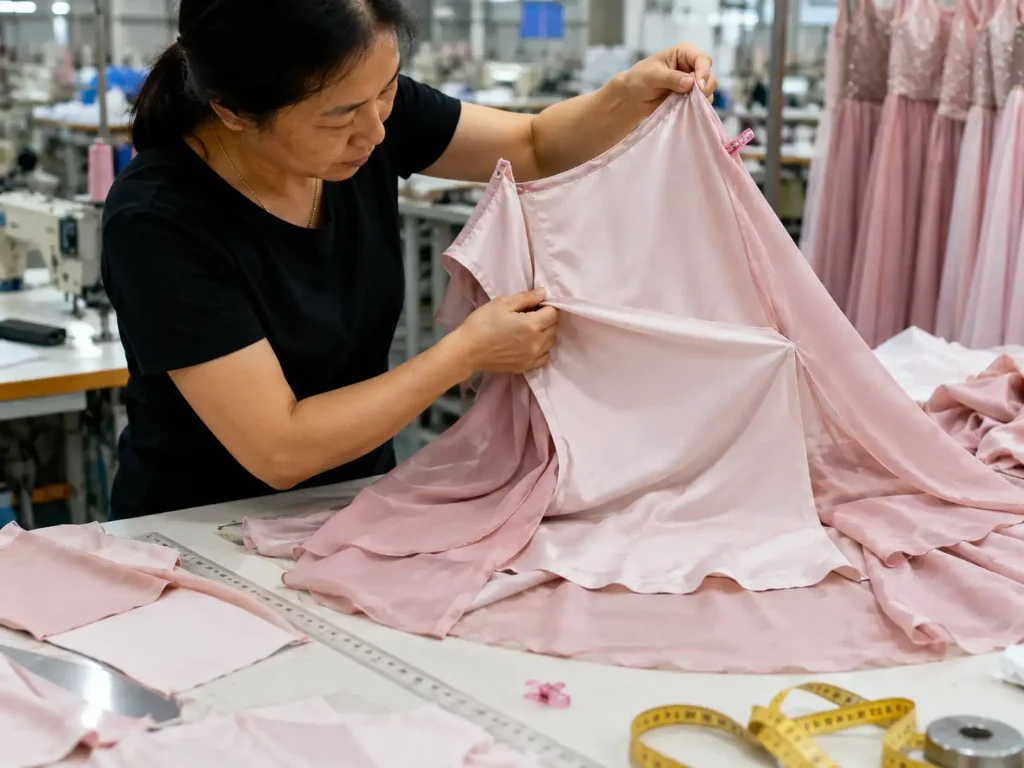
- Opacity and lining shade.
- Lining length and attachment.
- Seam comfort and coverage control.

Bust Support
- Cup position and neckline depth.
- Support method and seam symmetry.
- Size grading and movement comfort.

Slit Height
- Slit height and placement.
- Reinforcement and lining opening.
- Seam finish and grade consistency.

Pleats and Gathers
- Pleat spacing and gather tension.
- Waist alignment and reference marks.
- Pressing and side balance control.

Wrap Waist
- Overlap depth and tie length.
- Inner closure and waist placement.
- Neckline coverage and movement safety.

Lace Trim
- Lace width and motif direction.
- Edge finish and attachment method.
- Comfort and symmetry review.
Collection Development Beyond Single Dress Styles
Same Color, Many Styles
- Multi-style color coordination.
- Lab dip and fabric shade review.
- Lining, thread, zipper, and label records.
Same Style, Many Colors
A single bestselling silhouette may expand into blush, champagne, dusty blue, navy, burgundy, and black. Jinfeng Apparel reviews whether the fabric has stock colors or requires custom dyeing. Each color needs trim matching, SKU setup, and packing separation. When a new color uses a different fabric batch, bulk color must be confirmed again before production.
- Color expansion and trim matching.
- SKU accuracy by color and size.
- Batch review before repeat production.
Maid-of-Honor Capsules
Maid-of-honor styles often need a slightly elevated look while staying coordinated with the bridesmaid group. A brand may use satin, lace detail, a different neckline, or a stronger color. Jinfeng Apparel reviews fabric tier, detail placement, lining, shape, and cost impact. Private-label packing can keep the capsule separated from regular bridesmaid styles.
- Premium detail and coordinated color.
- Lining, shape, and cost review.
- Style-level packaging separation.
Destination Wedding Range
- Lightweight fabric and soft drape.
- Anti-crease review and hem balance.
- Delivery planning for travel-oriented collections.
Retail-Ready Assortment
Retail-ready bridesmaid programs need product, label, size, color, and carton accuracy. A collection may include multiple styles and size ratios by market. Jinfeng Apparel supports care labels, fiber content labels, hangtags, SKU stickers, polybags, carton marks, and warehouse labels. QC includes garment inspection and packing verification before shipment.
- Retail finishing and label control.
- Barcode accuracy and carton separation.
- Garment and packing verification.
Repeat-Order Library
- Pattern records and fabric references.
- Packing notes and reorder review.
- New color, trim, and fabric replacement check.
Bulk Production Control for Bridesmaid Orders
Bulk bridesmaid dress production needs clear standards before cutting starts. Multi-style, multi-color, and multi-size programs can become difficult when the team does not control sample references, fabric batches, trims, measurement standards, production sequence, QC points, and packing instructions.
Production File Control
Jinfeng Apparel prepares production references based on approved samples and confirmed documents. For bridesmaid dresses, production files may include pattern file, measurement chart, BOM, fabric record, trim card, label artwork, care label information, size ratio, color plan, SKU list, packing instruction, and carton mark requirements.
The approved sample, PP sample, or golden sample should be available as production reference. Bulk fabric shade, handfeel, weight, transparency, and lining match are reviewed before cutting. Zipper, thread, strap slider, bra cup, hook, boning, lace trim, label, and polybag details need confirmation before bulk work. Bust, waist, hip, dress length, strap length, neckline depth, slit height, and hem sweep must follow the confirmed size chart and tolerance requirements.
- Pattern, size chart, BOM, and fabric record.
- Trim card, label artwork, SKU list, and packing instruction.
- PP sample, fabric standard, and measurement standard.
Production and QC Rhythm
Bridesmaid dress production is controlled by style grouping and risk level. Satin styles may need surface handling and packing focus. Chiffon styles need cutting and hem control. Lace styles need motif placement and edge review. Structured halter or strapless styles need support and fit checks.
Before cutting, Jinfeng confirms fabric batch, color, shrinkage concern, cutting direction, layer count, and marker planning. During sewing, the team checks seam tension, zipper flatness, strap attachment, lining security, waist seam, pleats, gathers, and hem balance. Before packing, finished garments are inspected for measurements, surface marks, shade consistency, loose threads, pressing, label placement, SKU stickers, and polybag information. Projects of 20,000–80,000 pcs are planned by style group, fabric arrival, sample approval, and packing method.
- Fabric batch, color, cutting direction, and marker review.
- Sewing checks for seams, zippers, straps, lining, and hems.
- Finished garment and packing inspection before shipment.
QC Points for Bridesmaid Dress Manufacturing
Shade Check
- Bulk shade and lining match.
- Thread, zipper, and trim color.
- Color approval before cutting when required.
Measurement Check
- Size chart and tolerance control.
- Bust, waist, hip, and length.
- Strap, neckline, armhole, slit, and hem points.
Hem Balance
Maxi and floor-length bridesmaid dresses expose hem problems easily.
Jinfeng Apparel checks outer layer and lining length, side seam drop, front and back balance, pressing recovery, and hanging behavior. Chiffon, tulle, and layered dresses require extra attention because fabric movement can create uneven bottom edges after sewing or pressing.
- Outer hem and lining length.
- Front, back, and side balance.
- Hanging review and pressing recovery.
Lining Check
- Opacity and lining shade.
- Length, attachment, and seam security.
- Comfort and coverage review.
Strap and Zipper
- Strap strength and slider movement.
- Zipper movement and zipper flatness.
- Symmetry and closure security.

Workmanship for Bridesmaid and Formalwear Styles
Bridesmaid dresses sit between fashion dresses and formalwear. Workmanship must support beauty, movement, comfort, and consistent brand presentation. Jinfeng Apparel reviews workmanship from inside construction to final pressing, because formal dresses often reveal quality problems more clearly than casual garments.
Sewing and Inside Construction
A clean outside look depends on controlled inside workmanship. Chiffon, satin, crepe, lace, and mesh need different seam handling. Satin may show stitch tension and pulling; chiffon may fray or slip; lace may need careful edge finishing; mesh may stretch or distort. Jinfeng Apparel reviews seam method, needle selection, thread color, seam allowance, lining attachment, and reinforcement for stress points.
Formal dresses may require clean overlock, narrow seam, French seam, bound edge, or lined construction depending on fabric and price target. Strap attachment, zipper end, slit opening, waist tie, side seam, and neckline must be reinforced where needed. Lining, seam bulk, and trim edges should not scratch or irritate the wearer.
- Seam method and needle selection.
- Thread color, seam allowance, and lining attachment.
- Reinforcement for straps, zippers, slits, ties, and necklines.
Pressing and Final Appearance
Pressing has a direct effect on bridesmaid dress presentation.
Poor pressing can create shine marks, uneven hems, zipper bumps, seam waves, and packaging creases. Jinfeng Apparel reviews pressing needs according to fabric type and garment shape.
Satin requires careful heat and pressure to reduce shine marks and crease lines. Chiffon needs soft handling to keep flow and avoid flattened pleats. Crepe requires seam smoothing and wrinkle review. Lace and mesh need surface protection and careful finishing to avoid deformation. Before packing, garments are checked for loose threads, stains, seam twisting, zipper bumps, uneven hems, lining exposure, label placement, and fold marks.
- Satin heat and pressure control.
- Chiffon, crepe, lace, and mesh finishing review.
- Loose thread, stain, zipper, hem, lining, and fold checks.
MOQ, Sampling and Production Planning
Jinfeng Apparel’s MOQ starts from 200 pcs per style/color. Bridesmaid dress programs with multiple styles and colors should plan MOQ by style/color unit, not by the total order count alone. Lead time depends on fabric, trims, sample approval, bulk complexity, and packing needs.
| Project Item | Planning Reference | Notes for Bridesmaid Dress Programs |
|---|---|---|
| Basic MOQ | From 200 pcs per style/color | Size distribution can be planned inside the confirmed style/color quantity |
| Multiple Colors | 200 pcs per color is the standard planning basis | Custom dyeing, special shade, lace, print, or certified fabric may require higher fabric MOQ |
| Sample Development | 7–15 working days after fabric and trim direction is confirmed | Complex lace, tulle, structured bodice, or beaded details may need longer review |
| Revised Sample | 5–10 working days after revision points are confirmed | Fit, fabric, measurement, construction, and trim updates should be recorded |
| PP Sample | Confirmed before bulk cutting | Locks fabric, trim, measurements, workmanship, labels, and packing standard |
| Bulk Production | Often 30–45 days after PP approval and material readiness | Large multi-style programs need schedule review by style group and fabric arrival |
| Private Label Materials | Lead time confirmed by label and packaging suppliers | Hangtags, barcode stickers, printed polybags, and special cartons may have separate MOQ |
| Shipment Planning | Air, sea, or split shipment can be reviewed by project | Launch date, warehouse rules, and carton data affect final plan |
How Bridesmaid Dress Quotations Are Built
A professional bridesmaid dress quotation cannot be based on a picture alone. The same silhouette may have very different cost depending on fabric weight, fabric width, lining, construction, trims, size range, color count, packaging, and delivery needs.
What Affects Unit Cost
Fabric affects consumption, wastage, sewing difficulty, and final appearance. Chiffon, satin, stretch satin, crepe, lace, mesh, and tulle have different cost levels, wastage rates, and sewing risks. Fabric width, cutting direction, bias cut, print direction, and lace motif matching can change consumption.
Lining is often necessary for light colors, chiffon, lace, and mesh. Lining color, weight, stretch, and length add cost but protect opacity and comfort. Construction also matters: pleats, gathers, wrap fronts, slits, adjustable straps, bra cups, boning, lace panels, double layers, and invisible zippers increase production time. More colors increase fabric sourcing, lab dip, trim matching, SKU setup, packing separation, and QC work. Wider size ranges need grade review, measurement checks, and sometimes fit sample review.
- Fabric weight, width, and cutting consumption.
- Lining color, length, and stretch compatibility.
- Construction difficulty, trims, and size range.
- Color count, SKU setup, and packing separation.
How Jinfeng Helps Control Cost
Cost control should not weaken brand-level appearance.
Jinfeng Apparel may review fabric substitution, construction simplification, trim replacement, color consolidation, size-ratio planning, cutting layout, and split shipment options.
For example, a satin maxi dress may keep its main visual while adjusting lining, zipper, packing, or fabric weight to fit a target price range.
Final quotation becomes accurate after fabric, trims, sample, packing, and quantity are confirmed.
- Fabric substitution and construction simplification.
- Trim replacement and color consolidation.
- Size-ratio planning and cutting layout review.
- Split shipment options when launch timing requires.
Private-Label Bridesmaid Dress Delivery
Private-label bridesmaid dress manufacturing is more than adding a woven label. For formal dress programs, brand presentation continues through care labels, hangtags, barcode stickers, size labels, SKU labels, polybags, carton marks, and warehouse documents. Jinfeng Apparel supports private-label garment delivery based on client files and packing requirements.
Label and Packaging Elements
Woven main labels, size labels, care labels, and fiber content labels can be arranged according to project requirements. Care label content should match fabric composition, market needs, and client instructions. Hangtag artwork, paper thickness, surface finish, string type, and attachment method need confirmation before bulk.
Bridesmaid collections often include many style, color, and size combinations. SKU labels and barcode stickers help warehouses identify items correctly. Clear polybags, warning labels, size stickers, color stickers, and brand stickers can be arranged when required. Printed polybags may have separate MOQ from packaging suppliers. Carton marks should show correct style, color, size ratio, quantity, carton number, gross weight, net weight, and destination instructions when required.
- Main labels, size labels, and care labels.
- Hangtags, hang strings, barcode stickers, and SKU labels.
- Polybags, stickers, carton marks, and packing lists.
Packing Control for Multi-Style Orders
Packing accuracy is essential for bridesmaid dress programs.
A 15-style order with 8 colors and 6 sizes can create hundreds of SKU combinations.
Jinfeng Apparel checks packing instruction before bulk packing starts, then verifies label placement, polybag information, SKU stickers, carton marks, and packing list consistency.
For ecommerce-ready or retail-ready delivery, warehouse guide, barcode files, and carton requirements should be shared early.
- Packing instruction before bulk packing.
- Label placement, SKU sticker, and carton mark verification.
- Warehouse guide and barcode file review.
Compliance Support for Global Fashion Programs
Quality Documentation
- Factory profile and production process information.
- QC process and packing process.
- Measurement standards and final inspection coordination.
Fabric and Testing Support
- Fabric supplier confirmation.
- Certificate scope review.
- Third-party testing coordination and sample submission support.
Audit Coordination
Some clients require audit-related documentation or supplier qualification review before placing larger orders. Jinfeng Apparel can coordinate Sedex / SMETA / BSCI-related document review and factory audit support by project and by actual production arrangement. The available record must be confirmed with the specific factory, date, scope, and client requirement. Support may include:
- Audit-related documents.
- Factory review preparation.
- Process explanation and client-appointed inspection coordination.
Bridesmaid Dress Project Examples

United States Occasionwear Brand
A U.S. occasionwear brand planned a bridesmaid-inspired formal dress capsule for spring and summer weddings. The project included 18 styles across satin, chiffon, and crepe, with sage, dusty blue, champagne, navy, and blush color stories. Total production volume reached about 42,000 pcs, with size distribution across regular and extended ranges.
- 18 styles / 42,000 pcs / 3 fabric groups — project data: satin, chiffon, and crepe; technical difficulty: multi-color coordination became unstable when satin colors looked different from chiffon colors; solution: Jinfeng grouped styles by fabric type and reviewed color direction before sampling.
- 5 color stories — project data: sage, dusty blue, champagne, navy, and blush; technical difficulty: zipper, lining, and thread colors needed closer matching; solution: lining shade, zipper color, and thread color were confirmed by style group.
- Satin and chiffon controls — project data: satin required surface handling, while chiffon required hem and lining checks; technical difficulty: one generic QC standard could not protect both fabrics; solution: separate inspection notes were prepared by fabric.
- Packing by SKU — project data: many color and size combinations required clear carton handling; technical difficulty: packing confusion could affect warehouse receiving; solution: packing instructions were built by style/color/size.

Australia Bridal-Party Capsule
An Australian fashion label developed a destination-wedding bridesmaid capsule with 12 styles and about 26,000 pcs.
The collection focused on lightweight chiffon, crepe wrap dresses, and satin slip styles in soft neutral tones.
The brand needed travel-friendly packing and clean ecommerce presentation.
- 12 styles / 26,000 pcs / 3 fabric groups — project data: chiffon, crepe, and satin slip styles; technical difficulty: pale colors created transparency and packing concerns; solution: Jinfeng reviewed lining color and length before sampling.
- Destination wedding focus — project data: lightweight fabrics and soft neutral tones; technical difficulty: travel packing could create creases and uneven presentation; solution: fold position and polybag method were reviewed before packing.
- Chiffon hem control — project data: chiffon maxi styles needed clean flow; technical difficulty: uneven hems could appear after hanging; solution: outer-layer and lining balance were checked after sample handling.
- Color extension planning — project data: approved styles had later color potential; technical difficulty: new fabric lots still needed review; solution: base patterns and fabric notes were retained for future resort occasionwear extension.

United Kingdom Boutique Chain
A UK boutique chain prepared a bridesmaid and wedding guest dress program with 24 styles and around 68,000 pcs. Products included lace-detail midi dresses, satin one-shoulder gowns, chiffon A-line dresses, and crepe wrap styles. Private-label packing and warehouse receiving accuracy were required.
- 24 styles / 68,000 pcs / 4 product groups — project data: lace-detail midi, satin one-shoulder, chiffon A-line, and crepe wrap styles; technical difficulty: several fabrics and silhouettes required separate production controls; solution: Jinfeng grouped styles by fabric, structure, and sample approval status.
- Private-label packing — project data: hangtags, barcode files, SKU labels, and carton marks were required; technical difficulty: many SKUs increased receiving risk; solution: packing files were checked before production packing.
- Lace placement and lining — project data: lace styles required better consistency; technical difficulty: motif placement and lining color could shift appearance; solution: motif direction and lining shade were reviewed before bulk cutting.
- Reorder planning — project data: best-performing colors had repeat potential; technical difficulty: future orders still needed batch review; solution: pattern, fabric, trim, measurement, and packing records were retained.
Frequently Asked Questions
Start Your Bridesmaid Dress Project
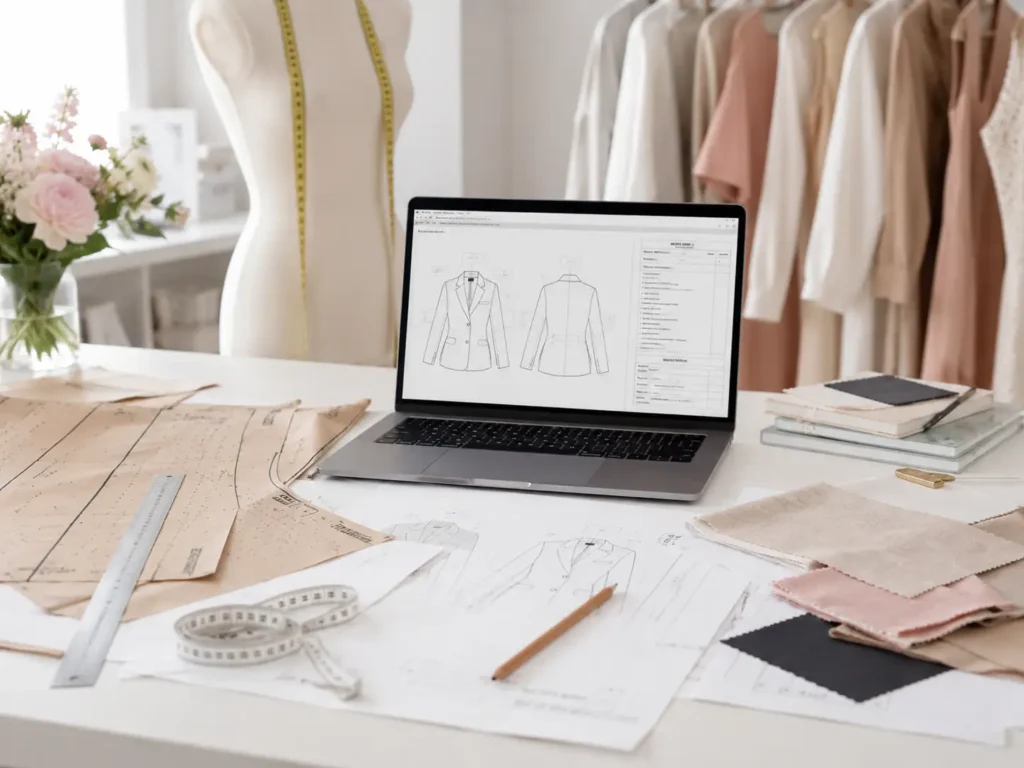
Share your bridesmaid dress direction with Jinfeng Apparel, and Kelly will help your team review the next step. For a more accurate response, please send reference images, tech packs, target quantity by style/color, fabric preference, color plan, size range, label requirements, packaging files, and launch timing. If your program includes 10–30 styles or a larger order plan, include the style list and priority samples so our team can review fabric grouping, sampling order, MOQ, PP approval route, bulk schedule, QC focus, and packing requirements.
Please include:
- Reference image or tech pack.
- Quantity per style/color.
- Fabric and color direction.
- Size range and size chart.
- Label and packaging files.
- Target delivery date.


