Skip to content

If you run a Shopify store in the partywear space, a bodycon dress is not just another dress category. It is one of the few products that can attract attention in seconds, trigger strong purchase intent, and still create hesitation at the exact same time. That is because party shoppers do not only ask whether a dress looks attractive on a model. They also ask whether it will hold them in smoothly, flatter their figure, stay comfortable for hours, and match the mood of a real event. In other words, a bodycon dress sells on emotion first, but closes the sale on trust.
For Shopify sellers, this matters more than many realize. Partywear shoppers compare quickly, judge visually, and often buy for a specific event with a specific deadline. If your product page is vague, your fit is unstable, or your fabric feels cheap, the customer leaves. If your store explains the dress clearly, shows the right details, and offers a style that feels confident instead of risky, the same product type can become one of the strongest profit drivers in your collection.
A bodycon dress is a fitted dress designed to shape closely around the body, usually with stretch fabric, contouring seams, lining, or ruching to create a smooth and flattering silhouette. For Shopify party stores, this category performs best when the product is supported by strong fabric choice, reliable fit, clear size guidance, and occasion-based styling. Stores that treat bodycon dresses as technical fashion products rather than simple trend pieces usually see stronger conversion, fewer fit complaints, and better repeat demand.
Think about the last time a shopper searched for a party dress online. She was probably not looking for “a dress” in the broad sense. She was looking for a birthday dress, a club dress, a dinner dress, a wedding guest dress, a vacation night-out dress, or something that made her feel more polished than what she already had in her wardrobe. That is exactly why bodycon dresses remain important. They sit at the meeting point of trend, confidence, shape, and occasion. And when this category is developed and presented properly, it can do far more than bring clicks. It can bring serious, repeatable business.
What Is a Bodycon Dress?
A bodycon dress is a close-fitting dress built to follow the natural lines of the body instead of falling away from it. Most bodycon styles rely on stretch fabric, controlled construction, or shaping details to create a sleek and defined look. In the partywear market, a bodycon dress is popular because it combines visual impact with occasion relevance, especially for customers shopping for events where confidence, photos, and silhouette matter.
Bodycon Dress Basics
The word “bodycon” comes from “body conscious,” but in real product terms, that phrase is too simple. A true bodycon dress is not just a tight dress. It is a dress designed to sit close to the body in a controlled and intentional way. That difference matters. A badly made tight dress can feel restrictive, look cheap, and create pressure in all the wrong places. A well-made bodycon dress can feel supportive, smooth the silhouette, and create a more refined appearance even when the design is minimal.
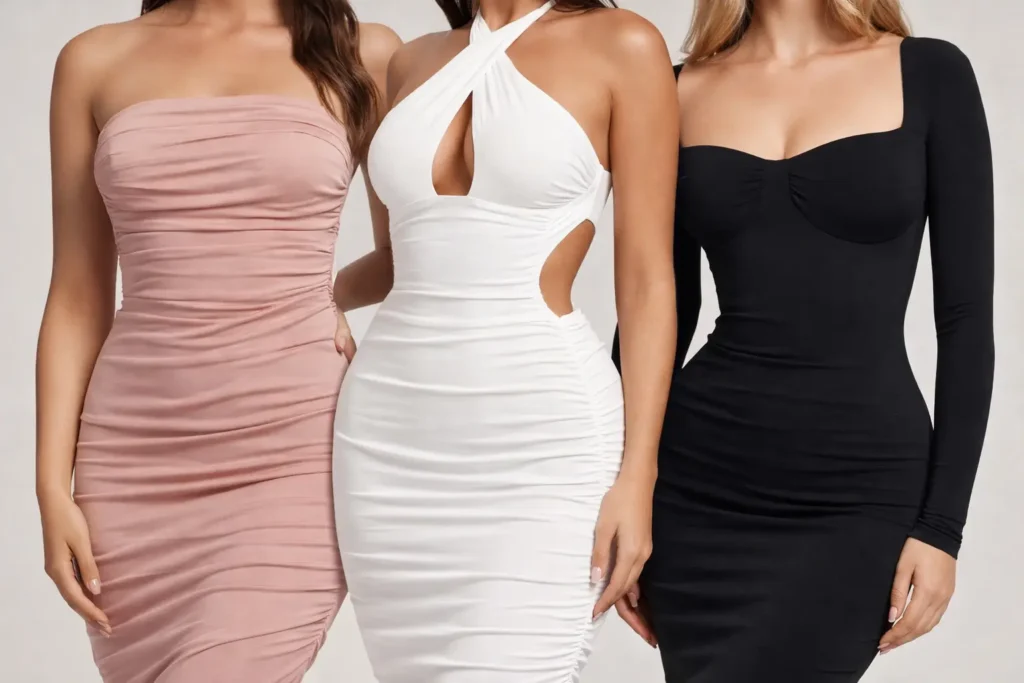
Most bodycon dresses share a few core features. They often use stretch fabrics such as polyester-spandex, nylon-spandex, rayon blends, or structured knits. They may include double layers, lining, ruching, contour seams, darts, or panel construction. They are usually cut with a closer fit at the bust, waist, and hip than casual dresses. The hem can range from mini to midi to maxi, but the common thread is body-skimming shape.
From a commercial point of view, bodycon dresses matter because they solve a very specific customer need. Party shoppers are often not searching for loose or relaxed silhouettes. They want shape, polish, and a look that feels event-ready without requiring too much styling work. That is why bodycon dresses often perform well in the following categories:
| Use Occasion | Why Bodycon Works | Common Features |
|---|---|---|
| Birthday parties | Strong visual impact in photos | Mini length, ruching, bold colors |
| Cocktail events | Clean, elegant silhouette | Midi length, smooth fabric, minimal trim |
| Club or night-out looks | High energy, fitted appearance | Cut-outs, mesh, shiny finishes |
| Wedding guest parties | Defined shape with dressy polish | Midi bodycon, refined neckline, lined fabric |
| Holiday events | Easy to glam up | Velvet, metallic, sequins, long sleeves |
A useful way to think about this category is that bodycon dresses sell “result,” not only “design.” The customer wants to know what she will look and feel like in the dress. She is not buying fabric alone. She is buying confidence, shape, occasion readiness, and the expectation that the dress will help her look intentional in front of other people.
This is exactly why Shopify stores cannot treat bodycon dresses casually. A loose summer dress can still sell with average copy and standard photos because the fit is forgiving. A bodycon dress is less forgiving. Every weakness shows. If the fit is off, customers notice it immediately. If the lining is poor, they notice. If the fabric shines too much under indoor lighting, they notice. If the dress rides up after walking a few steps, they notice that too. So the category may look simple from the outside, but it is actually one of the clearest examples of how product development and product communication must work together.
Why Choose Bodycon Dress for Parties
Partywear is one of the strongest natural homes for a bodycon dress because the category answers a direct emotional need. Most party customers want to stand out, not disappear. They want a dress that looks intentional in photos, feels feminine, and gives a stronger silhouette than everyday wear. A bodycon dress does that quickly. Even a simple bodycon shape in the right color can feel more dressed-up than a more complicated loose-fit design.
There is also a very practical reason why this category stays popular in partywear. A bodycon dress can carry the outfit almost by itself. That makes it easier for the customer to build a finished look. She often only needs heels, a bag, and a few accessories. This matters on Shopify because customers often make quick visual decisions. If the dress immediately communicates “ready for tonight,” conversion potential goes up.
At the same time, the category is competitive. Many stores sell bodycon dresses, but many do not explain them well. They rely on attractive model photos and very short descriptions. That approach can bring traffic, but it does not always bring trust. Party shoppers care about details such as:
- Is the fabric thick enough to smooth the body?
- Does the dress have lining?
- Is it see-through under flash?
- Does the fit feel sculpting or just tight?
- Is it better for dinner, clubbing, birthdays, or formal parties?
- Can it work for curvier figures?
- Will it stay in place while moving?
These are not small concerns. They are the real questions behind purchase hesitation.
The stores that do well in this category usually understand one thing clearly: the customer is not only buying style. She is buying reassurance. She wants to feel that the dress was made for a real night out, not only for a product photo. That is why product education matters so much here.
A party-focused bodycon dress can also be highly versatile from a merchandising angle. The same general silhouette can be adapted for different customer groups and price points through changes in fabric, sleeve length, trim, neckline, and finishing details. For example:
| Product Direction | Target Customer Need | Example Design Choice |
|---|---|---|
| Minimal chic | Clean, upscale event dressing | Midi bodycon, square neck, smooth stretch knit |
| Sexy nightlife | Bold, high-energy partywear | Mini length, mesh panels, cut-outs |
| Birthday glam | Photo-ready celebration look | Bright color, ruching, shimmer detail |
| Elegant guestwear | Polished special occasion outfit | Longer length, double lining, refined drape |
| Trend-driven social look | Viral, youthful styling | Asymmetric neckline, sculpting fit, visible texture |
This flexibility is valuable for Shopify stores because it allows one category to serve multiple search intents without losing focus. A store does not need fifty unrelated dress styles to compete. It often needs a better-structured bodycon line, clearer occasion positioning, and stronger production quality.
Which Fabrics Suit Bodycon Dress?
The best fabrics for a bodycon dress combine stretch, recovery, opacity, support, and surface appeal. In partywear, fabric choice affects much more than comfort. It changes how the dress shapes the body, how it looks in photos, how long it keeps its form, and whether the customer feels secure wearing it for several hours. A bodycon dress can only perform well when the fabric supports both fit and occasion.
Stretch Fabrics for Bodycon Dress
Stretch fabric is the foundation of most bodycon dresses, but many sellers underestimate how much fabric quality affects the final product. Two dresses may look similar on screen, yet feel completely different on the body. One may smooth gently, stay in place, and recover after wear. The other may cling awkwardly, twist at the seams, lose shape, or feel thin under direct light. This difference usually starts with fabric selection.
The most common fabric groups used in bodycon production include polyester-spandex, nylon-spandex, rayon-spandex, rib knits, ponte-style knits, and double-layer stretch jersey. Each has its own role. Polyester-spandex is widely used because it is cost-effective, holds color well, and offers reliable stretch. Nylon-spandex can create a cleaner, sleeker, more sculpted surface, especially in fitted styles. Rayon blends can feel softer and more fluid, though they may offer weaker recovery if the construction is not strong enough. Rib knits add texture and a more casual-sexy feel, while ponte or heavier knits can create better support and a more premium hand feel.
A bodycon dress fabric must be judged on more than softness. In real development work, the more important questions are:
- How well does the fabric recover after stretch?
- Does it become shiny or stressed at seam points?
- Is it thick enough to avoid showing every undergarment line?
- Does it support the body or simply cling to it?
- Can it stay smooth after sitting, walking, and several hours of wear?
- Will it remain stable in mass production?
This table gives a clearer technical view:
| Fabric Type | Usual Weight Feel | Recovery Level | Body-Shaping Effect | Best For | Main Caution |
|---|---|---|---|---|---|
| Polyester-Spandex Jersey | Light to medium | Medium to high | Smooth, commercial | Entry to mid-range party bodycon | May feel cheap if too thin |
| Nylon-Spandex Knit | Medium | High | Firm, sculpted | Premium fitted dresses | Needs careful sizing |
| Rayon-Spandex Blend | Light to medium | Medium | Soft, draped body fit | Softer feminine bodycon styles | Lower stability in repeated wear |
| Rib Knit | Medium | Medium | Casual contour effect | Day-to-night fitted dresses | Texture may enlarge silhouette visually |
| Ponte Knit | Medium to heavy | High | Structured support | Midi bodycon, cleaner lines | Higher cost, less fluid drape |
| Double-Layer Jersey | Medium to heavy | High | Smoothing and secure | Better partywear and curve styles | More fabric consumption |
For party dresses, medium-weight fabrics often outperform very light fabrics because they create a cleaner finish and more confidence. Light fabrics can reduce cost, but they often increase complaints. Customers notice when a dress feels thin, reveals too much under strong lighting, or loses shape at the hip and seat area. In partywear, these issues are not minor. They directly affect whether the customer keeps the dress or returns it.
Data from fashion e-commerce operations consistently points to fit, quality feel, and “not as expected” issues as major reasons for returns in fitted apparel categories. In practice, bodycon dresses are especially sensitive because the shopper has less tolerance for visible flaws. A casual oversized sweatshirt can survive some inconsistency. A bodycon dress usually cannot.
From a manufacturing standpoint, one of the most important decisions is whether the dress should rely on fabric stretch alone or whether it should combine stretch with construction support. For example, a well-designed bodycon dress may include:
- double-layer front panels
- lining at bust or skirt area
- strategic ruching at the waist
- stronger elastic at neckline edges
- stabilized shoulder seams
- hidden zipper support in lower-stretch styles
These details often separate a dress that looks good only in content photos from one that performs well after shipping, fitting, and real wear.
Trendy Fabrics for Party Bodycon Dress
Beyond core stretch fabrics, party bodycon dresses often depend on fashion surfaces that create mood and occasion appeal. This is where the category becomes more commercially exciting, but also more complex. Trend fabrics can raise perceived value quickly, yet they also create higher technical risk if the product is not engineered well.
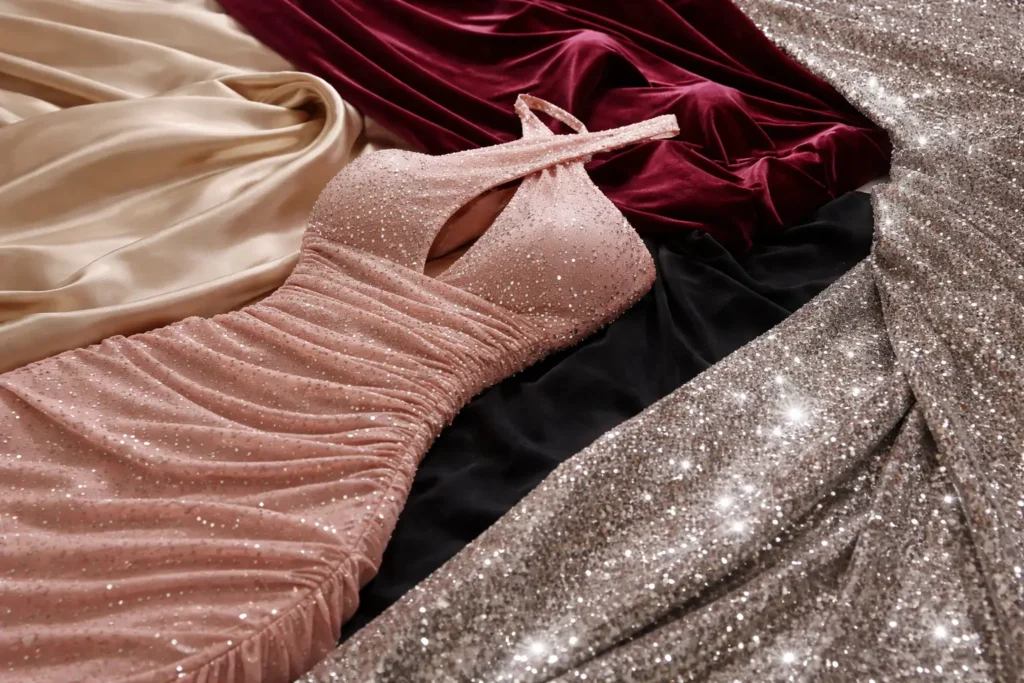
Some of the strongest trend fabric directions for party bodycon dresses include mesh, velvet, satin-finish stretch fabrics, metallic knits, sequin textiles, lace overlays, flocked mesh, and glitter-infused blends. Each one changes the product story.
Mesh is especially common because it adds a seductive or elevated effect without always making the dress feel too heavy. It can be used for sleeves, yokes, waist panels, overlay effects, or ruched outer layers. Mesh often photographs beautifully, especially when layered over a fitted lining. But poor mesh quality can snag, wrinkle, or lose shape easily, so the underlying construction matters just as much as the outer visual.
Velvet creates a richer and more luxurious impression, especially in darker colors like black, burgundy, emerald, and midnight blue. It tends to perform well for holiday collections and colder-season party drops. However, velvet changes light reflection, which means seam placement and fit tension become more noticeable. It also requires more care in cutting and sewing.
Satin-look bodycon fabrics are appealing because they feel more elevated than standard knits, but they can be risky if they lack enough structure. A satin-looking stretch dress can look glamorous online yet reveal every tension point when worn. That is why many successful party styles combine shine with lining, ruching, or layered construction.
The chart below helps connect fabric choice to occasion logic:
| Fabric Direction | Best Selling Season | Common Customer Use | Visual Strength | Product Risk |
|---|---|---|---|---|
| Mesh overlay | All year | Birthday, club, night-out | Sexy, layered, modern | Snagging, unstable shape |
| Velvet stretch | Fall/Winter | Holiday, dinner party, evening | Rich, luxe, soft sheen | Heat retention, pressure marks |
| Satin-look stretch | Spring/Fall | Cocktail, date night, elegant party | Glossy, elevated | Shows tension if poorly fitted |
| Sequin fabric | Holiday peak | Birthday, New Year, eventwear | High impact, photo-ready | Skin irritation, heavier wear |
| Metallic knit | Holiday and festival | Statement party dressing | Bold, trendy | Can look cheap if finish is low grade |
| Lace or flocked overlay | Year-round selective use | Romantic or feminine party looks | Textural and dressy | Construction complexity |
For Shopify store owners, the key commercial lesson is this: trend fabric should not be chosen only because it is eye-catching. It should be chosen based on whether the target customer will actually wear it comfortably for the event she is buying for.
A birthday shopper may accept bolder fabric, stronger shine, and more dramatic detail because the event is about attention. A wedding guest shopper may still want a fitted silhouette, but usually with more elegance, more movement, and less surface aggression. A vacation party shopper may want stretch, body shape, and nightlife energy, but in a fabric that packs well and feels easy to wear in warm weather.
This is why smart bodycon assortments are usually built in layers:
- reliable core fabrics for steady best sellers
- elevated fabrics for premium-looking event styles
- seasonal trend fabrics for short-term momentum
- experimental statement fabrics for content and attention
A good manufacturer becomes especially valuable here because trend fabrics are not only sourcing decisions. They are development decisions. The supplier needs to understand how the fabric behaves when cut close to the body, how it reacts to stitching and finishing, and whether it can maintain consistency in repeat orders.
For stores working with a manufacturer like Jinfeng, this matters because party-driven bodycon dresses are not generic products. They depend on how well the team can connect fabric, silhouette, sampling, and bulk execution. If that chain is weak, the dress may look fashionable at first but fail where it counts most: on the customer’s body, at the customer’s event, under the customer’s expectations.
Styling a bodycon dress well is not about adding more things. It is about making the silhouette work for the right occasion, the right customer mood, and the right level of confidence. For Shopify stores in the partywear space, styling guidance matters because customers do not buy a bodycon dress only for the garment itself. They buy it for a moment: a birthday dinner, a girls’ night out, a cocktail event, a wedding after-party, a club booking, a vacation party, or a holiday celebration. The more clearly the store helps the customer picture that moment, the easier it becomes for her to say yes.
A bodycon dress is one of the easiest categories to overdress or under-style. If the dress already has a strong silhouette, too many accessories can make the look feel heavy. If the dress is very minimal, weak styling can make it feel unfinished. This is why the best-performing bodycon collections are usually grouped by occasion, not just by color or length. Customers think in event language. They search for “birthday dress,” “night out dress,” “cocktail dress,” “vacation party dress,” and “wedding guest dress.” Stores that reflect this logic in styling content often create better engagement and stronger conversion.
From a retail point of view, styling content also reduces friction. It answers quiet questions before the customer needs to ask them. What shoes work best? Is the dress good for a rooftop dinner or only for a club? Should it be paired with bold earrings or kept clean? Can it work in cooler weather with outerwear? These details matter because party shoppers often make fast decisions, but those decisions are still full of hidden hesitation.
The bodycon category performs especially well when stores use styling to do three things at once:
- show the customer where the dress belongs
- show her how much effort the look requires
- show her that the dress can still feel wearable, not intimidating
That last point is especially important. Many customers admire fitted partywear but do not always feel comfortable wearing it. Good styling helps the dress feel more approachable. A structured blazer, a refined heel, or a cleaner hairstyle can shift the feeling from “too much” to “exactly right.”
Cocktail and Evening Looks
A bodycon dress for cocktail and evening occasions usually performs best when the styling is polished, controlled, and visually clean. The dress itself already carries a strong line through the body, so the surrounding elements should support that line instead of competing with it. This is why cocktail styling often works better with fewer, more intentional pieces rather than loud layering or too many decorative accessories.
For evening settings, midi bodycon dresses tend to offer the widest commercial flexibility. They feel more elevated than mini lengths, travel well across age groups, and are easier for customers to imagine wearing to dinner, events, and semi-formal parties. Mini bodycon dresses can also work well, but they usually read as younger, bolder, and more nightlife-driven. A Shopify store should understand this difference clearly because the same fitted silhouette can serve two very different shopping moods depending on length, neckline, and fabric finish.
For cocktail events, these design details tend to perform strongly:
- square necklines for a clean, modern look
- one-shoulder cuts for soft statement appeal
- long sleeves for cooler seasons and a more refined finish
- ruching at the waist for shape with visual forgiveness
- smooth, lined fabrics for a polished surface in photos
- dark tones and jewel tones for higher perceived elegance
The most successful evening bodycon styling often follows a “one focal point” rule. If the dress has a bold neckline, the jewelry should usually stay lighter. If the dress is minimal and monochrome, the accessories can carry more of the visual interest. This kind of guidance is useful on product pages because many customers are not fashion stylists. They want fast clarity, not theory.
A practical product merchandising table can help shape an evening assortment more effectively:
| Evening Style Type | Best Length | Best Fabric Direction | Footwear Pairing | Customer Mood |
|---|---|---|---|---|
| Cocktail bodycon | Midi | Smooth stretch knit, lined jersey | Strappy heels | Elegant, balanced |
| Dinner party bodycon | Midi or mini | Double-layer knit, satin-look stretch | Minimal heels or pumps | Refined, feminine |
| Holiday evening bodycon | Midi | Velvet, metallic knit, sequin mix | Heeled sandals | Festive, visible |
| Lounge-to-evening bodycon | Midi | Rib knit, clean stretch jersey | Pointed heels or boots | Easy polish |
| Formal party bodycon | Midi or maxi | Heavier sculpting knit | Elegant heels | Sophisticated, secure |
For Shopify store owners, styling bodycon dresses for evening also means thinking about how the product is photographed. A dress can look sharp in studio lighting but fail to communicate atmosphere. Eveningwear benefits from imagery that shows the product in motion, under softer light, or in settings that suggest an actual event. Lifestyle context often helps customers understand whether the dress feels expensive, flattering, and realistic for the occasion.
The strongest evening bodycon pages usually include practical styling guidance inside the product copy itself. For example:
- works well with metallic heels and a small structured clutch
- suitable for dinner, cocktail events, and late-night celebrations
- ideal when the customer wants shape without heavy embellishment
- pairs well with a blazer or cropped jacket in cooler months
This kind of language makes the product easier to imagine wearing. And in partywear, imagination is a major part of conversion.
Birthday and Celebration Styles
Birthday and celebration styling follows a different logic from cocktail dressing. It is usually more expressive, more visual, and more open to bold trend details. The customer is often shopping for attention, photos, compliments, and a stronger sense of occasion. She is not trying to blend in. She is trying to feel like the center of the night.
This changes what works. In birthday bodycon styles, design details that might feel too strong for a dinner event can become exactly the right choice. These include:
- brighter colors like hot pink, red, cobalt, lime, silver, or white
- asymmetrical necklines
- cut-outs and open-back features
- shimmer, metallic, or sequin surfaces
- feather trims or statement texture
- mini lengths with strong shape definition
- ruched mesh overlays for a more dramatic look
For Shopify stores, this is a category where emotion matters heavily. Customers shopping birthday looks often respond to product names, collection structure, and visual identity more than they do in other categories. “Birthday bodycon,” “girls’ night bodycon,” “celebration mini dress,” and “party-ready bodycon” are easier to connect with than generic tags like “new dress arrival.”
There is also a strong commercial advantage in dividing the celebration category into mood-based subgroups. This helps the customer shop faster and helps the store speak more directly to her intent.
| Celebration Mood | Best Bodycon Direction | Common Design Details | Visual Goal |
|---|---|---|---|
| Birthday glam | Mini bodycon | Shine, ruching, cut-outs | Photo-ready confidence |
| Girls’ night | Mini or midi | Bold color, body-skimming fit | High energy |
| Vacation party | Mini bodycon | Lightweight stretch, open back | Easy sexy look |
| Bachelorette | Mini bodycon | White, pink, feather or mesh accents | Fun and memorable |
| Holiday celebration | Midi or mini | Velvet, sequins, metallic details | Festive and standout |
This is also where stores should be more specific about styling combinations. Customers want direction that feels useful and immediate. They respond well to ideas like:
- pair with strappy heels and a crystal mini bag
- style with statement earrings and a sleek ponytail
- best suited for indoor parties, club events, and birthday dinners
- works with minimal layering so the dress remains the focus
Another detail that matters in celebration styling is comfort confidence. A birthday customer may accept a stronger look, but she still wants to feel stable while walking, sitting, dancing, and taking photos for several hours. That means the product content should not stop at style. It should also answer questions about lining, stretch, support, and movement.
This is where many stores miss the mark. They push visual excitement but say almost nothing about how the dress behaves in real life. A better approach is to combine glamour with reassurance. For example:
- double-layer fabric for a more secure feel
- ruched finish helps soften the fit through the waist
- stretch fabric designed for movement and shape retention
- lined bust or skirt area for better coverage
These are simple details, but they change how safe the customer feels making the purchase.
There is another angle worth mentioning here. Celebration bodycon dresses often rely heavily on social media discovery. They perform especially well when the product already looks like content. This means the dress should work in mirrors, close-up shots, night lighting, and movement clips. A dress that looks great only in a static front-facing image is usually less valuable in this category than one that also looks strong from the side, from the back, and in motion.
From a manufacturing perspective, that means details like seam placement, neckline stability, hem behavior, and lining opacity become even more important. In birthday and eventwear categories, customers see the product from more angles and under more lighting conditions. That raises the standard. A strong celebration bodycon is not just “pretty.” It is visually convincing from every direction that matters.
Do Bodycon Dress Fit All Figures?
A bodycon dress can work for many different figures, but only when the style, fabric, length, and construction are chosen well. The real issue is not whether all body types can wear bodycon dresses. Of course they can. The more useful question is which kind of bodycon dress gives each customer the best balance of shape, comfort, confidence, and movement. In partywear, the success of this category depends less on body type labels and more on how intelligently the product is designed.
This point matters because bodycon dresses are often discussed in an oversimplified way. Some stores market them as universally flattering without explaining why. Others make the opposite mistake and present them in a way that feels limited to only one body shape or one age group. Both approaches are too shallow. Customers do not need empty reassurance. They need accurate guidance.
A better way to think about fit in bodycon dresses is through product variables:
- fabric weight
- stretch recovery
- lining
- seam placement
- neckline balance
- ruching or panel support
- hem length
- bust-to-waist-to-hip proportion
These factors often matter more than generic size talk. A customer may wear the same dress size across different brands, yet still have a very different experience depending on how the garment was built. That is why fit communication is one of the most important profit tools in this category. When stores explain fit in a more realistic way, they reduce uncertainty. When they reduce uncertainty, they reduce returns.
There is also a key commercial truth here. Bodycon dresses do not need to fit every customer in the exact same way to sell well. What matters is that each product clearly signals who it works for and why. A strong product page does not hide behind vague language. It explains the dress with enough honesty that the right customer feels seen.
Bodycon Dress for Petite and Tall
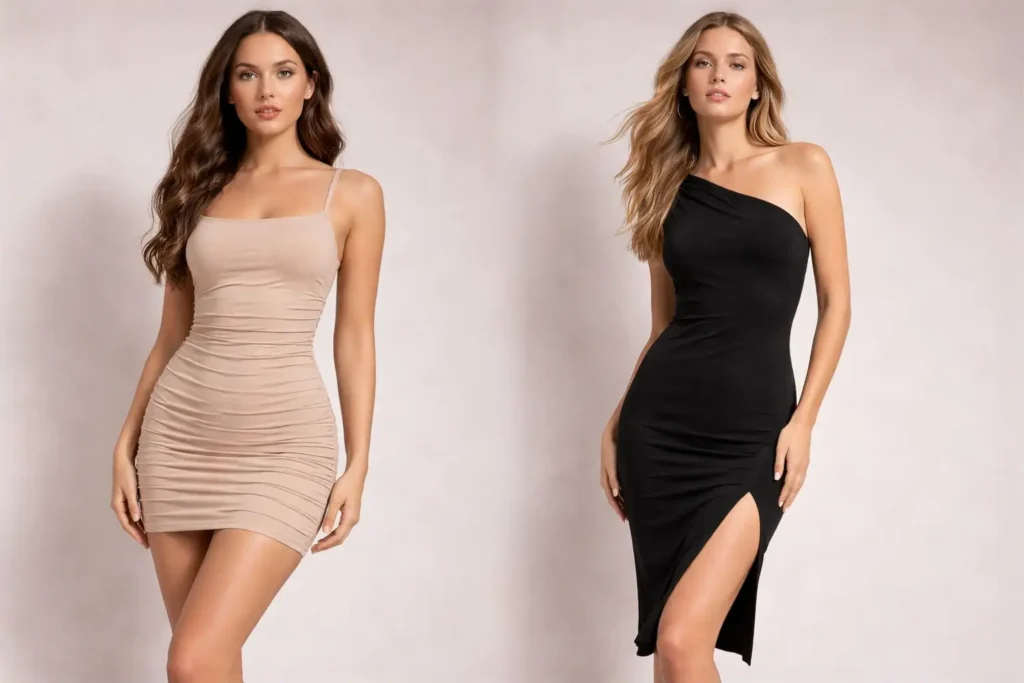
Petite and tall customers often experience bodycon dresses very differently, even when they buy the same style. This is because fitted dresses are affected heavily by length proportion, torso placement, and where key design features fall on the body. In looser dress categories, those issues may be less noticeable. In bodycon dresses, they become obvious.
For petite customers, one of the biggest risks is visual overload. A dress with too much extra fabric, heavy gathering, oversized details, or a hem that falls at an awkward point can make the frame feel shorter and less balanced. Petite shoppers usually respond better to styles that keep the line clean and direct. This often includes:
- mini lengths that visually lengthen the leg line
- midi lengths that stop at a flattering point, not too low
- vertical ruching rather than bulky side volume
- simple necklines like square, scoop, or clean one-shoulder
- narrower straps and cleaner trims
- controlled cut-outs rather than too many interruptions
Torso length also matters. A bodycon dress with shaping seams placed too low can drag the visual center down on a petite frame. Even if the waist technically fits, the dress can still feel “off” because the balance is wrong.
Tall customers tend to face the opposite issue. Many fitted dresses become too short in the body, too short in the hem, or too tight at vertical tension points because the style was graded wider but not thoughtfully adjusted in length. This often creates practical problems:
- mini dresses that feel unsafe when walking or sitting
- bust shaping that sits too high
- waist placement that looks incorrect
- straps that pull too tightly
- hems that ride up with movement
For tall customers, these design improvements usually help:
- longer torso adjustment in the pattern
- slightly deeper rise through the body length
- more secure neckline anchoring
- midi and longer mini options
- stronger support at seams so the dress keeps balance during wear
The table below shows how the same bodycon dress detail may be experienced differently:
| Design Element | Petite Fit Concern | Tall Fit Concern | Better Solution |
|---|---|---|---|
| Mini length | May still work well | Often too short | Offer two length directions |
| Waist seam | Can sit too low visually | Can sit too high | Test on more than one height range |
| Ruching | Can add shape or bulk | Usually easier to carry | Keep volume controlled |
| Straps | Can overwhelm if too thick | May feel too short | Adjust proportion by size range |
| Midi hem | Can shorten the frame | Often elegant and easy | Choose flattering hit points |
From a Shopify store perspective, one of the smartest ways to improve conversion here is to stop using lazy fit phrases. “True to size” is usually not enough for bodycon dresses. Customers want more useful information, such as:
- runs short for taller customers
- stretch level is high, but length is best for average height
- works especially well for petite frames due to shorter body length
- midi cut offers more coverage while staying fitted
These details sound small, but they answer the questions customers really have.
From a factory perspective, this is where better pattern development makes a visible difference. A manufacturer that understands fitted women’s fashion should not only grade width. It should think about vertical proportion, balance, neckline security, and movement. That is particularly important for brands that plan to turn a bodycon dress into a repeat bestseller, because fit complaints usually become more expensive as order volume increases.
Bodycon Dress for Curvy Shapes
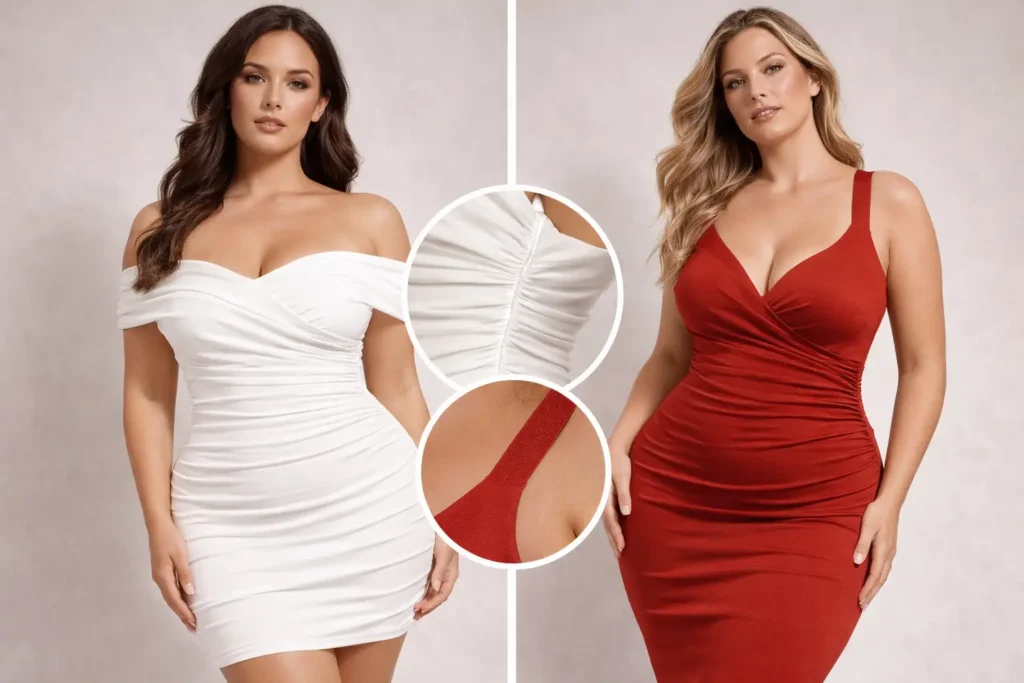
Curvy customers are often important to the bodycon category because the silhouette naturally celebrates shape. But this does not mean every fitted dress works equally well for curvier figures. In fact, this is one of the areas where product quality becomes most visible. A weak bodycon dress may technically go over the body, yet still fail in the places that matter most: support, smoothing, opacity, balance, and confidence.
For curvy body shapes, the most important fit issues usually include:
- bust support and neckline security
- waist definition without excessive pressure
- enough room at the hip without distortion
- fabric opacity under stretch
- seam placement that does not cut awkwardly across the body
- enough recovery so the dress keeps its shape over time
This is why curvy-friendly bodycon dresses usually perform better when they include construction support rather than relying only on stretch. Helpful features often include:
- double-layer fabric
- strategic ruching through the waist or hip
- contour seams that shape rather than flatten
- stronger elastics or stabilized edges at necklines
- denser fabric weight for smoother coverage
- lining in sensitive areas
Ruching deserves special attention because it is one of the most commercially useful details in bodycon design. It does several things at once. It softens tension, adds texture, reduces the appearance of direct pressure points, and gives the fabric more visual forgiveness. That is why ruched bodycon dresses often perform well across a wider customer range than very flat, untextured styles.
Another important detail is neckline architecture. Many stores focus only on whether a dress looks sexy, but curvier customers often need to know whether that neckline will stay in place through a full evening of movement. A dress that slips, gaps, or exposes too much unpredictably may get attention in photos, but it does not build customer trust. For this reason, neckline choices like square necks, softly curved necklines, thicker straps, and well-supported off-shoulder shapes tend to feel more reliable than very loose or unstable cuts.
The table below shows which features often matter most for curvy-focused bodycon design:
| Product Feature | Why It Matters | Better Result |
|---|---|---|
| Double lining | Adds coverage and smoothing | More confidence, less transparency risk |
| Ruched waist or side panels | Softens tension | More forgiving visual effect |
| Medium-heavy stretch knit | Gives support, not just cling | Cleaner silhouette |
| Stable neckline | Improves wear confidence | Less adjusting during events |
| Balanced hem length | Supports movement and coverage | Better real-life wearability |
| Strong recovery fabric | Prevents sagging after wear | Better long-term performance |
It is also worth noting that curvy customers are not all looking for the same bodycon experience. Some want stronger sculpting and a more held-in feel. Others want softness, comfort, and less compression. A good store should not treat “curvy” as one single fit category. It should explain what each dress actually offers. For example:
- smoothing bodycon with strong hold
- softer stretch bodycon with flexible comfort
- ruched bodycon for more forgiving fit through the waist and hip
- lined midi bodycon for more secure event wear
That kind of language helps customers choose based on preference, not just size.
For Shopify product pages, this is an area where honesty builds long-term value. A dress does not need to promise miracles. It needs to describe itself clearly. If it is highly compressive, say so. If it is soft and forgiving but not heavy-sculpting, say that too. The customer appreciates clarity far more than empty flattery.
For manufacturers, curvy-friendly bodycon development is not only about adding more width to the pattern. It requires a better understanding of balance. The bust, waist, and hip relationship must be handled carefully. The fabric must remain stable under tension. The seams must support the body instead of fighting it. When these things are done well, the bodycon category stops feeling narrow and starts becoming one of the most commercially useful dress lines in a party-focused collection.
Bodycon dresses can be very profitable on Shopify, but only when the store treats them as a controlled product category rather than a random trend item. On the surface, bodycon dresses look attractive because they photograph well, have strong partywear demand, and often create fast visual interest on collection pages and social media. But the real profit does not come from clicks alone. It comes from having the right fit, the right fabric, the right pricing logic, the right product page content, and a supply partner who can keep quality stable when you start reordering.
This matters because fitted dresses are one of those categories where revenue can look strong while profit quietly weakens in the background. A store may see high traffic and good initial sales, but if return rates rise because of fit complaints, thin fabric, weak lining, or poor customer expectations, the category becomes much less attractive. So the smarter question is not “Can bodycon dresses sell well?” The smarter question is “Can this bodycon dress line keep enough margin after production, marketing, shipping, discounts, and returns?”
For many Shopify stores, the answer is yes, but only under clear operating conditions:
- the styles must match real customer demand
- the fit must be predictable enough to reduce costly returns
- the product page must answer customer concerns before checkout
- the fabric and construction must support the silhouette properly
- the store must know which designs deserve restocking and which should remain test styles
Bodycon dresses are especially suitable for Shopify because they sit in a strong intersection of visual appeal and occasion-driven demand. Customers do not usually buy them as “maybe later” products. They often buy for a plan: a birthday, a party weekend, a vacation, a club night, a bridal event, or a seasonal celebration. That urgency helps conversion. But urgency alone does not protect margin. Profit grows when the product feels as good in real life as it looked on the store page.
A useful way to look at this category is through margin pressure points:
| Profit Driver | Why It Helps | Profit Risk if Ignored |
|---|---|---|
| Strong visual appeal | Increases click-through and interest | High traffic but low conversion if fit trust is weak |
| Occasion-based demand | Creates faster purchase decisions | High expectations, more disappointment if product underperforms |
| Repeatable silhouettes | Easier to scale winning shapes | Over-ordering the wrong fit can tie up cash |
| Medium fabric usage | Supports attractive pricing structure | Cheap material choices can lead to returns |
| Social media relevance | Helps content and ads perform | Weak product experience damages repeat business |
The stores that make bodycon dresses work long term are usually not the ones chasing every short-term trend. They are the ones building a balanced structure: a few reliable core fits, a few fashion-forward seasonal pieces, and a supply model that allows them to test demand without locking too much cash into unproven styles.
Sourcing Bodycon Dress
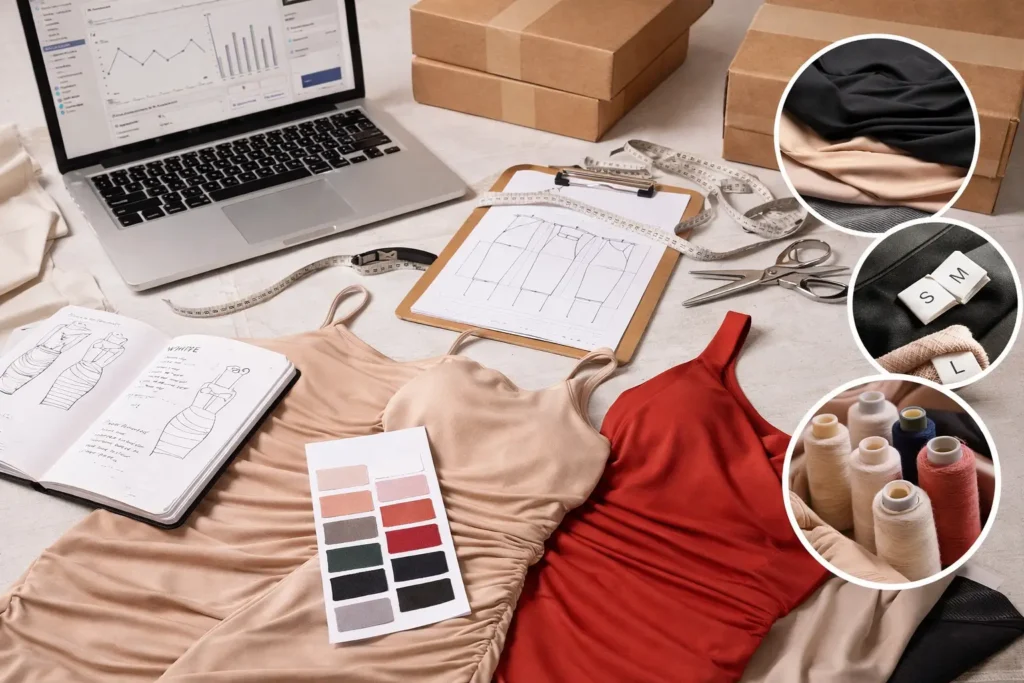
Sourcing is where profit begins or disappears. A bodycon dress may seem easier to develop than a heavily structured gown or a complex tailored piece, but that is often misleading. Because the silhouette sits so close to the body, every small mistake becomes easier to see. Weak stretch recovery, uneven stitching, poor seam tension, wrong fabric thickness, unstable necklines, and inconsistent grading all show up very quickly in fitted products. That is why sourcing a bodycon dress should never be treated as a price-only decision.
A good sourcing plan usually starts with understanding what kind of bodycon line the store is actually trying to build. A birthday dress line, a cocktail bodycon range, and a curve-focused sculpting collection may all fall under the same broad category, but they do not require the same development priorities. One may need bold fashion fabrics and lower repeat volume. Another may need reliable, high-stability knits and more predictable restocking. If the sourcing direction is unclear, the collection often becomes inconsistent.
For Shopify sellers, bodycon sourcing usually works best in stages:
- sample development to confirm fit and fabric behavior
- small trial orders to test customer reaction
- repeat production on proven winners
- controlled expansion into more colors, lengths, or neckline variations
This kind of staged approach protects cash flow. It also reduces the risk of overcommitting to a silhouette that looks strong in a photo but performs weakly in real sales.
A practical sourcing breakdown looks like this:
| Sourcing Stage | Main Goal | Suggested Volume | Main Question |
|---|---|---|---|
| Development sample | Test fit and material | 1–3 samples | Does the dress look and feel right on body? |
| Sales trial | Test real market demand | 100–300 pcs/style | Do customers buy and keep it? |
| Repeat order | Replenish proven seller | 300–1000 pcs/style | Can quality stay consistent? |
| Scale order | Expand winning line | 1000+ pcs/style | Can the factory maintain delivery and fit consistency? |
For bodycon dresses, the sampling stage is especially important because the product lives or dies on wear experience. A dress can look attractive in flat lay photography or on one well-styled model, yet still fail on broader customer use. That is why experienced factories often make a visible difference here. They can help adjust pattern balance, recommend more suitable fabric weight, improve neckline support, and reduce revision rounds.
This is also where manufacturers like Jinfeng become relevant to Shopify-focused dress brands. A store selling partywear does not only need a factory that can “make dresses.” It needs one that understands close-fitting women’s fashion, occasionwear expectations, quick sample development, and repeat production stability. Those things matter because bodycon dresses often become one of the categories customers reorder in new colors, new trims, or updated seasonal versions. If the supplier cannot hold the same fit logic across repeat runs, the store loses trust and margin.
Sourcing decisions should also be tied to customer feedback data. After a style launches, the most useful questions are:
- Which sizes sold fastest?
- Which return reasons appeared most often?
- Did customers complain about length, transparency, support, or comfort?
- Did one fabric finish outperform others?
- Did the same fit perform better in mini or midi form?
That information should go back into the next sourcing decision. The most profitable dress lines are rarely built on intuition alone. They improve because the store keeps learning from real product performance.
Marketing Bodycon Dress
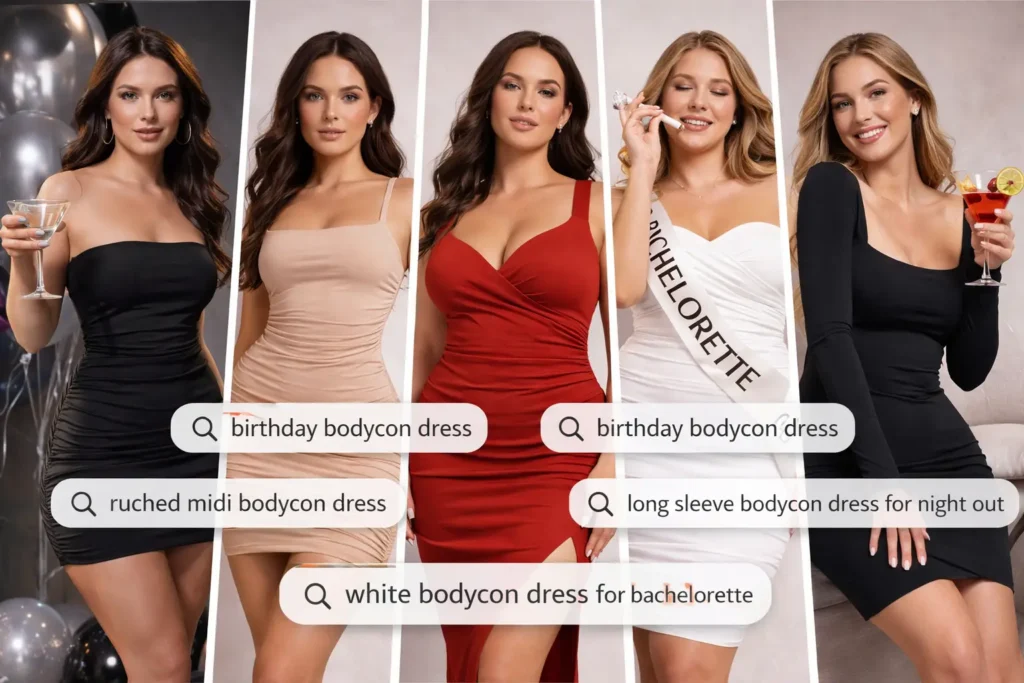
Marketing a bodycon dress well requires more than attractive photos and a few trend words. This category is highly visual, but it is also highly sensitive to customer doubt. Most shoppers looking at bodycon dresses are interested, but not fully confident yet. They want shape, confidence, and event impact, but they also worry about fit, comfort, movement, and whether the dress will look the same on them as it does in the content. Good marketing works when it turns curiosity into trust.
One of the biggest strengths of the bodycon category is that it naturally fits high-intent shopping behavior. Customers often search with a clear use case in mind:
- birthday bodycon dress
- black party bodycon dress
- ruched midi bodycon dress
- long sleeve bodycon dress for night out
- bodycon dress for curvy figure
- white bodycon dress for bachelorette
These searches are useful because they are not vague browsing terms. They often come from customers who already know roughly what they want. That means the product page has a real chance to convert if it answers the right questions.
For Shopify stores, strong bodycon marketing usually depends on five areas working together:
| Marketing Element | What It Should Do | Common Mistake |
|---|---|---|
| Search keywords | Bring in relevant traffic | Using broad dress terms only |
| Collection structure | Help customers shop by event or mood | Grouping all fitted dresses together without logic |
| Product imagery | Show the dress clearly from multiple angles | Relying on one front-facing image |
| Product copy | Explain fit, support, and occasion use | Writing only emotional language |
| Social proof | Show how real customers experienced the dress | No reviews or no fit-specific review detail |
The first marketing layer is search intent. Bodycon dresses usually perform better when the store speaks in occasion language rather than only fashion language. For example, “birthday bodycon dress” often carries more buying intent than a generic phrase like “trendy bodycon dress.” This does not mean stuffing product pages with awkward keywords. It means aligning category names, filters, descriptions, and product naming with how customers actually shop.
The second layer is imagery. Because bodycon dresses are shape-driven, one image is never enough. Customers usually need to see:
- front view
- side view
- back view
- close-up of fabric or texture
- movement shot if possible
- event-style image or styled look
This is especially important in partywear because lighting changes how the dress feels. A black lined midi bodycon may look very simple in a white-background studio image, but feel much more premium in an evening setting photo. A mesh mini may look bold in a campaign image but need a close-up shot to show how the lining works.
The third layer is product page language. Bodycon copy should not only say that the dress is flattering or stylish. Those words are too vague by themselves. Customers want useful specifics. Product pages should explain things like:
- stretch level
- lining details
- length expectation
- neckline feel
- ruching location
- occasion suitability
- fit recommendation
For example, compare these two styles of product messaging.
Weak version:
“Sexy and flattering bodycon dress for your next night out.”
Stronger version:
“Designed in a medium-weight stretch knit with side ruching and a lined upper body, this midi bodycon dress creates a smoother fit through the waist and hip. Best suited for dinners, cocktail events, and evening parties when the customer wants shape with a cleaner finish.”
The second version gives the customer something to work with. It reduces guesswork. That matters because returns often happen when the customer expected one thing and received another.
The fourth layer is content and social proof. Because bodycon dresses are often bought for visible social moments, customer content carries unusual weight. Reviews that mention fit, comfort, and event type are especially valuable. So are try-on videos, model size references, and styling clips. In many cases, a short real-life video showing how the dress moves is more persuasive than another polished campaign photo.
The fifth layer is restocking discipline. One of the biggest mistakes Shopify stores make is assuming that a bodycon dress selling well once means the entire category should be expanded broadly. Profit comes from identifying which exact style logic works. Maybe the winner was not “bodycon” in general. Maybe it was “ruched black midi bodycon in medium-weight lined fabric.” The more accurately the store understands the winning formula, the better it can scale profit without unnecessary inventory risk.
A useful commercial benchmark is to separate bodycon dress performance into three levels:
| Performance Level | What It Usually Means | Recommended Action |
|---|---|---|
| High traffic, low conversion | Product looks interesting but trust is weak | Improve fit details, imagery, and copy |
| Good conversion, high returns | Customer likes the idea but product disappoints | Fix fit, lining, fabric, or size guidance |
| Good conversion, low returns | Strong product-market fit | Reorder, expand carefully, build around winner |
Bodycon marketing works best when the store understands that confidence is the real product being sold. The dress is the vehicle. The customer wants to look good, feel secure, and avoid regret. The more clearly the brand helps her do that, the more profitable the category becomes.
How to Care for Bodycon Dress
A bodycon dress is one of the easiest partywear products to sell and one of the easiest partywear products to damage if the customer does not care for it properly. That is because this category depends heavily on stretch, recovery, close fit, surface finish, and shape retention. A loose dress can often survive rough washing and still look acceptable. A bodycon dress usually cannot. When the fabric loses recovery, when the lining shifts, when the mesh snags, or when the neckline stretches out, the customer notices immediately.
For Shopify stores and fashion brands, care guidance is not just a small after-sales detail. It directly affects customer satisfaction, repeat purchase, and return-related complaints. Many customers do not return a dress only because it arrived badly made. They also become unhappy because the dress looked good once, then changed after one wash or one night out. In fitted partywear, that difference matters a lot.
Customers usually care about very practical questions:
- Can I machine wash it?
- Will it become loose after wearing it for a few hours?
- Will the fabric turn shiny at the hips or seat area?
- Is it safe to steam?
- Can I hang it in my wardrobe?
- Will sequins or mesh get damaged easily?
- How do I keep the dress looking new for the next event?
These are real wearing questions, especially for party shoppers who may spend more on a fitted dress than on a basic daily item. A bodycon dress is often bought for birthdays, dinners, vacations, weddings, nightlife, holidays, and event photos. That means the customer usually expects two things at the same time: it should look impressive, and it should still look good after the event.
For this reason, bodycon care should be explained in a clearer and more useful way than a simple wash symbol. Stores that want fewer complaints and better long-term trust should give customers direct, easy-to-follow guidance. The key care areas are:
- washing method
- drying method
- storage method
- stain handling
- heat control
- fabric-specific precautions
- long-term shape protection
A useful rule is this: the more fitted the dress, the more carefully it should be treated. This is especially true when the dress includes one or more of the following:
- high elastane content
- double-layer construction
- mesh overlay
- velvet or brushed surface
- sequins or trims
- metallic shine
- ruched side seams
- lined bust or skirt panels
The more features a bodycon dress has, the more likely rough handling will shorten its life.
Washing and Storage Tips
The first thing customers need to understand is that most bodycon dresses should not be treated like a basic cotton T-shirt. The silhouette depends on fabric memory. Fabric memory means the material can stretch around the body and return close to its original state. Heat, harsh washing, and aggressive spinning slowly weaken that ability. Once that happens, the dress may start to feel looser, flatter, shinier, or uneven in shape.
For most party bodycon dresses, the safest cleaning options are:
- hand wash in cool or lukewarm water
- or use a delicate machine cycle with the dress placed inside a protective garment bag
- use mild detergent
- avoid bleach
- avoid fabric softener on stretch-heavy fabrics
- never use strong heat drying
Why does this matter? Because elastane and similar stretch fibers are sensitive to heat and friction. Many bodycon dresses contain around 3% to 10% elastane, sometimes more in sculpting styles. Even when the main fabric is polyester, rayon, or nylon, the stretch component is often what gives the dress its shape. Damage that stretch element, and the dress loses one of its most important functions.
This table gives a clearer care guide by fabric type:
| Bodycon Fabric Type | Best Washing Method | Water Temperature | Drying Method | Main Risk |
|---|---|---|---|---|
| Polyester-spandex knit | Gentle hand wash or delicate bag wash | Cold to lukewarm | Air dry | Heat weakens stretch recovery |
| Nylon-spandex sculpt knit | Hand wash preferred | Cold | Lay flat or hang lightly | Pressure shine and stretch fatigue |
| Rayon blend bodycon | Gentle hand wash | Cold | Lay flat | Can lose shape when wet |
| Mesh overlay bodycon | Hand wash only if possible | Cold | Flat dry | Snagging and twisting |
| Velvet stretch bodycon | Hand wash or specialist care | Cold | Air dry, no crushing | Surface marks, texture flattening |
| Sequin bodycon | Hand wash carefully or specialist clean | Cold | Flat dry | Trim breakage and lining stress |
| Double-layer lined bodycon | Gentle hand wash | Cold to lukewarm | Flat dry | Water weight can distort the shape |
Customers also need realistic guidance about washing frequency. A fitted party dress does not always need full washing after every short wear, especially if it was worn for only a few hours in a clean environment. In some cases, airing it out and spot-cleaning minor marks is gentler than full washing. This matters because too-frequent washing causes unnecessary stress.
A practical recommendation looks like this:
| Wear Situation | Suggested Care |
|---|---|
| Worn briefly indoors, no visible stains | Air out, inspect, no full wash needed |
| Worn for dinner or a short event | Spot clean if needed, then air out |
| Worn for all-night party or club use | Gentle wash after use |
| Worn in hot weather or on vacation | Gentle wash after use |
| Worn with perfume, body oil, or makeup transfer | Spot treat quickly, then wash gently if required |
That kind of advice is useful because customers often over-wash special occasion dresses. Over-washing shortens garment life, especially in fitted fashion.
Storage is another place where many good dresses are damaged quietly. A bodycon dress may look fine after washing, then lose shape because it is hung badly, pressed under heavy items, or squeezed too tightly in a wardrobe. The safest storage method depends on the dress construction.
For lighter, simpler knit bodycon dresses, hanging can work if the hanger supports the shoulders properly. For heavy dresses, double-layer dresses, or embellished styles, folding is often safer. Thin straps should never carry too much fabric weight over time, especially if the dress is long or heavily decorated.
Here is a simple storage guide:
| Dress Construction | Better Storage Method | Why |
|---|---|---|
| Light mini bodycon | Hanger with shoulder support | Keeps shape without much pull |
| Heavy midi bodycon | Fold flat or use padded hanger | Prevents shoulder stretching |
| Thin strap bodycon | Fold or hang with support loops | Avoids strap distortion |
| Sequin or embellished bodycon | Fold with tissue between folds | Protects surface and lining |
| Velvet bodycon | Hang with space around it | Prevents crushing marks |
| Mesh bodycon | Fold or separate carefully | Reduces snag risk |
Customers should also avoid these common storage mistakes:
- hanging a heavy dress on a thin wire hanger
- folding a sequined dress without a protective layer
- placing rough denim or zippers next to mesh
- crushing velvet under heavy knitwear
- storing the dress when still slightly damp
Even a beautiful dress can start looking tired very quickly when stored carelessly.
Longevity Tips
A bodycon dress keeps its value when it keeps its shape. Most customers do not judge longevity by technical fabric performance language. They judge it by simple real-life outcomes:
- Does it still hug the body well?
- Does the neckline still sit correctly?
- Has the fabric become loose at the hips or seat?
- Does it still look smooth in photos?
- Can it be worn again without looking worn out?
These are the standards that matter.
In real wear, bodycon dresses usually weaken in five high-stress areas:
- neckline edges
- underarm seams
- waist tension points
- hip and seat stretch zones
- hem area, especially in mini dresses
Those zones take the most pressure because the dress fits closely and moves with the body. Sitting, walking, dancing, and pulling the dress down during wear all add stress. That is why bodycon dresses need both good production and good user care.
A very practical issue is overstretching. Many customers think damage only comes from washing, but repeated over-tension during wear can be just as harmful. If the dress is too tight for the intended fit, or if the customer is constantly pulling at the hem or neckline during use, the fabric and seams tire faster. This is especially common in mini bodycon dresses and low-support strapless styles.
The main signs of early wear are usually:
| Early Sign | What It Often Means |
|---|---|
| Fabric stays slightly stretched after wear | Recovery is weakening |
| Surface becomes shiny at the hip or seat | Fabric is under too much tension |
| Neckline starts rolling or gaping | Edge support is losing stability |
| Lining twists or shifts | Wash stress or weak inner attachment |
| Mesh pulls appear | Surface is too delicate or caught on objects |
| Hem flips or curls more than before | Fabric memory is weakening |
Customers can slow down that wear by following a few habits that are simple but effective:
- rotate dresses instead of wearing the same one repeatedly within a short period
- let the dress rest after a long event before storing it
- avoid sitting on rough surfaces like unfinished wood, concrete edges, or metal seating
- remove rings, bracelets, and bags carefully around mesh or delicate finishes
- avoid overusing perfume directly on the fabric surface
- clean makeup marks early before they set deeply into the fibers
This matters because many party dresses are damaged not in the wash, but during the event itself. Crossbody chains, glitter bags, belt edges, sharp nails, and jewelry are common reasons for snags and pulls.
Heat control is another major point. Many customers try to “refresh” a bodycon dress quickly using hot steam or direct ironing, but this can create new problems if done carelessly. Strong heat can flatten texture, weaken stretch fibers, distort lining, and leave pressure marks on shiny or velvet surfaces.
A safer guide looks like this:
| Garment Need | Safer Option | Avoid |
|---|---|---|
| Light wrinkles | Low steam from distance | Direct hot iron on stretch area |
| Creased lining | Turn inside out, low heat cloth barrier | Pressing hard on outer fabric |
| Refresh after storage | Hang in a steamy bathroom briefly or use low steam | High heat blast near elastane zones |
| Velvet surface marks | Gentle steam, no pressing | Ironing directly on velvet |
This is especially important for dresses made with polyester-spandex and nylon-spandex blends, because excessive heat can permanently affect elasticity.
For brands and stores, it is also smart to tell customers that not all bodycon dresses are built for the same intensity of reuse. A heavily embellished birthday mini and a clean lined black midi may both be bodycon dresses, but their long-term wear performance will usually differ. The cleaner lined midi often survives repeated use better because it has fewer vulnerable decorative elements. The statement birthday mini may create stronger first-impact styling, but often needs gentler handling.
That kind of clarity helps set better expectations.
Stain, Makeup, and Odor Handling
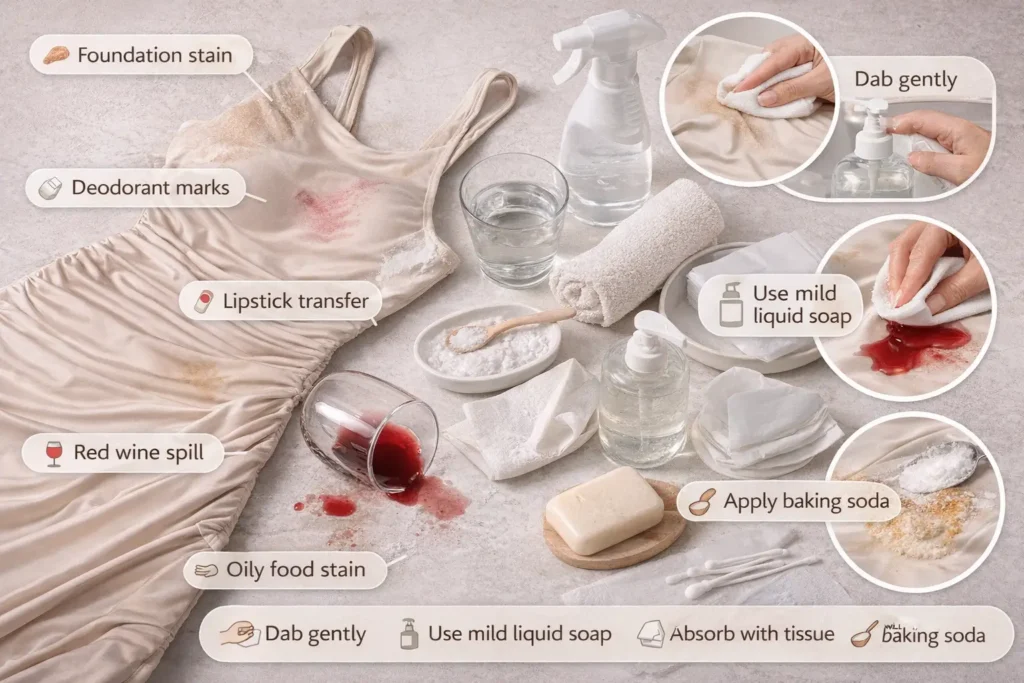
One of the most common real-life problems with party bodycon dresses is not full washing. It is local damage from makeup, perfume, deodorant, body shimmer, food, or drink. Customers often notice these marks right after an event, and the way they respond in that moment affects whether the stain becomes permanent.
For fitted dresses, fast and gentle action is usually better than aggressive scrubbing. Strong rubbing can damage stretch fibers, roughen the surface, or leave the fabric looking lighter in one area.
The most common partywear marks include:
- foundation around the neckline
- deodorant residue under the arm
- lipstick or lip gloss transfer
- perfume marks on delicate fabrics
- wine or cocktail splashes
- body shimmer or glitter residue
- food oil spots from dinner events
A practical stain guide is more useful to customers than generic “clean immediately” advice:
| Stain Type | First Action | What to Avoid |
|---|---|---|
| Foundation or makeup | Dab gently with damp cloth and mild soap | Rubbing hard or using strong remover |
| Deodorant marks | Wipe gently with soft damp cloth | Scratching at dry residue |
| Lipstick | Blot carefully, use mild detergent on hidden test area | Hot water first |
| Drink splash | Dab quickly with clean cloth | Letting sugar-based stains dry fully |
| Oily food stain | Blot first, then mild soap treatment | Spreading the stain by rubbing |
| Perfume mark | Air out and wipe lightly if needed | Spraying more perfume to cover it |
Odor handling is also important. Many customers wash the whole dress after a short event only because of perfume, smoke, or general party odors. But in some cases, airing the dress for several hours in a well-ventilated space is enough. This is gentler on the garment and better for shape retention.
A practical after-event routine can be:
- Hang or lay out the dress immediately after wearing.
- Check for visible stains before storing it.
- Air it out for several hours.
- Spot treat only where needed.
- Wash gently only if the dress truly needs it.
This routine protects the dress better than throwing it straight into a laundry basket.
What Customers Should Know Before Reordering or Packing for Travel
Many bodycon dresses are bought for travel, birthdays, bachelorette trips, destination dinners, and holiday parties. That means customers often pack them tightly in luggage, wear them in warm environments, and expect them to look fresh with little effort. This creates another layer of care needs.
For travel, customers should know:
- fold the dress inside out if the surface is delicate
- place tissue or a soft layer between sequins or trims
- do not overpack on top of velvet or embellished dresses
- unpack as early as possible after arrival
- use low steam, not aggressive ironing
- check straps and neckline before hanging in hotel wardrobes
Packing method can have a visible effect on the wearing result:
| Travel Situation | Better Care Choice |
|---|---|
| Weekend trip with one party dress | Fold flat with minimal pressure |
| Vacation with multiple fitted dresses | Separate with soft garment layers |
| Sequin or mesh dress in luggage | Pack inside out with surface protection |
| Velvet bodycon for holiday dinner | Avoid tight folding pressure |
| Last-minute event prep | Use low steam from distance |
This is also useful information for Shopify brands because travel-friendly care guidance helps customers feel more prepared, especially for event purchases.
Why Care Guidance Matters for Product Satisfaction
For customers, bodycon dress care is not only about cleaning. It is about preserving the reason they bought the dress in the first place: shape, confidence, and visual impact. A fitted party dress that loses structure quickly feels disappointing, even if the original design was attractive. That is why practical care education increases satisfaction.
For brands, clearer care instructions can help reduce some of the most common frustration points:
- complaints about stretching after one wear
- disappointment with transparency after washing
- damaged trims from rough handling
- misshaped necklines from bad storage
- avoidable returns caused by care mistakes rather than product defects
Care does not replace good manufacturing, but it protects the value of good manufacturing. The best result comes when both sides are strong:
- the factory builds the dress correctly
- the customer cares for it correctly
That combination gives the dress a better chance of staying beautiful for the next dinner, the next birthday, the next holiday trip, or the next order from the same customer.
For a bodycon dress, that is what really matters. Not just how it looks on day one, but how well it keeps its shape, finish, and confidence value after real life begins.