Skip to content
Backless Dress Bust-Support Solutions
Built-in support development for fashion brands creating open-back dresses that need secure bust shaping without compromising the intended silhouette.
- 7+ senior pattern makerswork on bust, underbust, neckline, strap, side coverage and back-opening proportions.
- 2 sample rooms and 20+ sample machinistssupport fit-sensitive dress development and structured sample revisions.
- Support structures can combine built-in cups, boning, structural lining, anti-slip components and controlled side tensionaccording to the design.
- Development focuses on what remains visible, what must stay covered and where the garment can safely carry support once the back is opened.
External Support or Built-In Dress Support
Backless styling removes the rear band used by a conventional bra, so support has to come from either an external solution worn with the garment or an engineered structure built into the dress. For a new collection, the second route gives the development team more control over fit, coverage and repeatability.
| Support Route | Common Methods | Main Strength | Main Limitation | Best Use |
| External Support | Adhesive bra, breast tape, low-back bra, lifting covers | Flexible for an existing garment | Performance depends on wearer, skin, movement and back opening | Retail styling guidance |
| Light Built-In Support | Fixed cup, soft cup, double lining | Cleaner interior and more shaping | Limited lift when the bodice has little anchoring | Light fashion dresses |
| Structured Built-In Support | Cup, boning, side panel, underbust control | Better shape and bodice stability | Requires accurate pattern and fitting | Party and occasion dresses |
| High-Structure Support | Cup framework, boning, waist anchoring, reinforced lining | Stronger control with an open back | More development and sewing work | Corset-inspired and formal styles |
Why Backless Dresses Lose Their Normal Support
A conventional bra distributes load around the torso. Once a dress removes much of the back, the garment loses one of its strongest stabilizing zones. The remaining front bodice, side seams, straps, underbust area and waist must carry more responsibility without creating visible bulk or changing the intended open-back shape.
Rear Anchoring Disappears as the Back Opens
A standard bra does more than cover and shape the bust. The band around the body forms a stable horizontal anchor, while cups and straps work against that anchor. A deep-back dress removes part of the zone where a normal band would sit. A fully open-back design removes even more. Support can no longer depend on a hidden rear band, so the dress pattern has to create alternative load paths.
The first questions are structural rather than decorative:
- How deep does the back opening finish?
- Where do the side seams end relative to the bust?
- Does the design have shoulder straps, a halter neck or no straps?
- Can the waist carry part of the bodice tension?
- Is enough side coverage available to stabilize the bust?
- Does the outer fabric have enough recovery to hold its intended shape?
- Can an internal lining add support without showing around the open back?
A backless style can look secure on a hanger while becoming unstable once worn. The front neckline may open, the sides may pull forward, the cup may shift or the back edge may distort. Pattern development therefore begins by identifying what structural areas remain available after the visual back opening is fixed.
Support Must Move Into the Remaining Garment
Once rear support is reduced, load can be redirected through several remaining areas. The front bodice can hold a cup framework. The underbust can create a stable lower reference line.
Side panels can control outward movement. Shoulder or halter straps can carry vertical load. A fitted waist can help stop the entire bodice from moving upward or downward. Structural lining can distribute tension without adding visible external components.
No single element carries every style. A soft satin backless slip dress may only need controlled cup placement, side coverage and lining. A corset-inspired backless mini can use cups, boning, a tighter underbust structure and waist anchoring. A strapless backless dress needs even more careful engineering because both the conventional back band and shoulder straps are reduced.
The goal is not maximum rigidity. Excess structure can make a lightweight dress bulky, uncomfortable or visually heavy. Development has to produce enough stability for the intended occasion while keeping the original silhouette, drape, neckline and skin exposure.
Six Elements Behind Built-In Bust Support
Built-In Cups
Underbust Control
Boning Framework
Side Stabilization
Structural Lining
Lining can do more than cover transparency. A correctly selected lining can stabilize the outer fabric, spread load across the bodice and reduce distortion around the cup and side seams. The lining’s stretch, recovery, weight and hand feel need to suit both the shell fabric and the desired support level. Power mesh or firmer stretch lining can provide internal control for selected fitted styles. Softer lining is better when the goal is comfort and clean finishing rather than compression. The lining pattern also matters: a fully duplicated outer pattern may not always create the best support. Internal sections can be shaped specifically around the bust, underbust or side area.
Waist Anchoring
Backless Structures Need Different Support Strategies

Low-Back Dress

Deep Open-Back Dress

Halter Backless Dress

Strapless Backless Dress

Corset Backless Dress

Cut-Out Backless Dress
Built-In Cups Must Match the Dress Structure

Soft Shaping Cups

Molded Structured Cups
Plunge-Compatible Cups

Removable or Flexible Cups
Support Trims Change Fit, Comfort and Stability

Boning
Underwire
Anti-Slip Tape

Elastic and Support Tape
Fabric and Lining Decide How Support Actually Performs
The same internal structure behaves differently in satin, stretch satin, jersey, mesh, lace or a stable woven shell. Support development therefore starts with fabric behavior. Drape, recovery, transparency and weight determine how much internal reinforcement can be added without changing the intended fashion appearance.
Outer Fabric Controls How Much Structure Can Stay Hidden
Satin creates a polished surface but can expose internal ridges, seam pressure and cup edges. Structured woven fabric hides support more easily but may feel too rigid for a fluid silhouette. Jersey follows the body closely, yet weak recovery can allow the neckline or side areas to stretch during wear. Lace and mesh create visual openness while demanding careful support and lining placement.
Several material properties are reviewed before the pattern is finalized:
- Stretch direction:determines where the bodice can expand and where it must remain stable.
- Recovery:influences whether the garment returns to shape after movement.
- Weight:affects how much the skirt or lower body pulls on the bodice.
- Drape:controls whether added structure changes the visual flow.
- Transparency:determines where internal components remain visible.
- Surface sensitivity:affects whether cups, seams or boning show through.
- Shrinkage and dimensional stability:influence whether approved fit remains consistent after finishing or care.
A backless satin mini and a backless stretch-mesh bodycon can share the same visual idea but require very different construction. The satin version may rely on clean internal structure with careful seam placement. The mesh version may need controlled stretch zones and strategic lining so support remains functional without eliminating the transparent effect.
Structural Lining Can Carry More Work Than the Shell Fabric
Lining selection should follow function rather than only color matching.
A soft lining improves comfort and opacity.
A firmer stretch lining can stabilize the bust and sides. Power mesh can add controlled compression in selected areas while allowing the outer layer to stay visually light.
Internal layers may also be split by function. The bust section can use a more stable material while the lower body remains softer. Side panels can receive added control without making the center back opaque. Cup attachment can be built into the internal layer so the outer fabric stays clean.
The lining pattern requires separate attention. Copying the outer pattern exactly can create excess bulk or fail to provide enough tension where the support system needs it. Internal pattern pieces may be shaped around the underbust, cup, side seam or waist to create the required hold.
Bulk consistency depends on using the approved lining specification, stretch direction and cutting orientation.
A substitute with similar color but different recovery can change the way a backless bodice sits on the body even when the outer fabric remains unchanged.
Fabric Choice Can Reduce Unnecessary Internal Complexity
More support components are not always better. A fabric with controlled stretch and strong recovery can reduce the amount of internal reinforcement required. A weak, unstable fabric may force the construction to rely on additional lining, tape or boning.
Material direction can therefore become part of cost and comfort optimization. When a design concept allows several fabric options, Jinfeng evaluates whether a more stable alternative can deliver the intended sheen, drape or stretch while simplifying the internal structure. The goal is cost control without weakening brand-level appearance.
Any fabric substitution introduced after first sampling must trigger another fit review. Changes in stretch, recovery, thickness or drape can affect cup position, neckline tension, side coverage and back opening. Fabric approval and structure approval are therefore connected decisions rather than separate sourcing steps.

Pattern Geometry Controls the Entire Support System
Bust support is built into measurements and proportions before it is built into trims. Bust, upper bust, underbust, waist, front length, back length, side seam, neckline and strap position determine whether the internal support components sit where the body actually needs them.
Bust, Upper Bust and Underbust Need Separate Control
The bust circumference shows overall volume but does not fully describe how a fitted backless bodice should sit. Upper-bust control affects neckline contact and stability. Underbust control influences where the cup and lower support structure can anchor. Treating all three as one generic chest measurement often produces a dress that looks acceptable flat but becomes unstable on the body.
During pattern development, several relationships are reviewed together:
- bust circumference against cup width and projection;
- upper bust against neckline and armhole contact;
- underbust against cup base and internal support;
- bust point against cup position;
- front length against bust volume;
- side seam position against side coverage.
An open back increases the importance of these relationships because there is less rear structure available to compensate for a weak front fit. A loose upper bust can cause the neckline to gap. An incorrect underbust can allow the cup to float. A short front length can pull the entire bodice upward and increase back-opening distortion.
The fit sample therefore checks more than total circumference. Front, side and three-quarter views are used to see whether the garment holds the intended bust position while preserving the neckline.
Front Length, Back Length and Back Depth Must Stay Balanced
Back depth is a design choice, but every deeper opening changes garment balance. Lowering the back without adjusting front and side geometry can transfer too much tension toward the neckline or side seam. The bodice may tilt forward, the side opening may migrate or the lowest back point may lift during movement.
Front length must accommodate bust volume without forcing the waistline upward. Back length needs to maintain the intended opening position. The side seam becomes the transition between those two lengths and should remain visually vertical unless the design intentionally changes it.
For low-back and deep-back dresses, sample evaluation should compare:
- highest and lowest points of the back opening;
- distance from underarm to back edge;
- side seam angle;
- waistline level from front to back;
- strap connection points;
- zipper or closure position;
- lining edge visibility.
A clean backless silhouette is therefore not simply created by cutting away fabric. The remaining pattern must be rebalanced around the new opening.
Straps and Necklines Carry Structural Load
Thin straps are visually delicate but can carry significant tension when the back is open. Strap length, width, stretch and attachment angle affect both lift and comfort. An overly short strap may improve static support while creating neck or shoulder pressure. An overly long strap can allow the cup and neckline to drop.
Halter styles transfer more load toward the neck. Spaghetti-strap dresses distribute load through two shoulder points. Cross-back or tie constructions create different directional forces. Strapless backless styles remove the strap completely, pushing more work into the upper bust, sides and waist.
Neckline depth also changes the amount of front fabric available to stabilize the bust. A deep V reduces center-front containment, so side and underbust structure become more important. A straight neckline can offer more upper-bust control but may require anti-slip measures.
Pattern decisions therefore connect directly to support performance. A beautiful neckline that cannot hold its intended position is not production-ready.

Bust Size Changes the Required Support Strategy
Size grading for an open-back dress cannot rely on uniform enlargement. As bust volume increases, cup projection, underbust control, side containment, strap load and back-opening proportion may need different adjustments. The visual design should remain consistent while the structure continues to function across the approved size range.
| Fit Area | Smaller Bust Range | Medium Bust Range | Fuller Bust Range | Main Grading Risk |
|---|---|---|---|---|
| Cup Volume | Light shaping may be sufficient | Projection needs closer control | Greater projection and containment may be required | Cup scales without matching body shape |
| Underbust | Moderate stabilization | Stronger relation to cup position | Becomes a key support anchor | Underbust grows too loosely |
| Side Coverage | Can remain visually narrow | Needs balanced containment | Often needs more carefully shaped coverage | Side opening exposes bust |
| Straps | Lower vertical load | Moderate load | Higher load unless bodice carries more support | Neck or shoulder pressure |
| Waist Anchor | Optional in soft styles | Useful in fitted styles | More important in structured styles | Waist becomes too tight |
| Back Opening | Visual depth easier to maintain | Requires rebalancing | May need controlled width or side transition | Opening enlarges disproportionately |
Choose Support Level Before Adding More Structure
Light Support
Moderate Support
Structured Support
Movement Testing Reveals Problems a Mannequin Cannot

Standing Fit

Walking Stability

Sitting Comfort

Arm Movement

Turning and Side Movement
Turning the torso can distort asymmetrical tension between left and right sides. Boning, elastic and straps should work evenly so one side does not pull the neckline or back opening out of alignment. The test is useful for designs with side cut-outs, diagonal straps or asymmetric openings where load is not distributed evenly.

Event-Level Wear
Backless Dress Sampling From Structure to Approval
Project Review
Fabric Direction
Pattern Development
First Sample
Fit Sample
Revised Sample
Photo-Ready Review
PP Sample
Golden Sample
Sample Revisions Solve Support Before Bulk Production
First samples are development tools, not ceremonial approvals. A support problem should be diagnosed by location and cause. Cup position, neckline tension, side coverage, back depth and strap load are corrected differently, so revision work needs clear fit feedback rather than a general request to “make it tighter.”

Cup and Bust Problems Require More Than Size Changes
Several common problems can appear around the bust:
- cup sits too high or too low;
- upper cup edge gaps;
- lower bust feels compressed;
- cup looks flat compared with the intended silhouette;
- left and right cup positions appear uneven;
- neckline pulls away from the body;
- side bust becomes exposed;
- cup edge shows through the shell fabric.
Making the whole bodice smaller rarely solves every issue. Cup position may need to move independently from the waist.
Cup shape can require more projection without adding width. The underbust can need greater stability while the upper edge needs less tension. Lining may need a more stable section behind the cup while the outer fabric stays unchanged.
Revision starts by identifying where the approved body reference and sample disagree. Bust point, cup base, upper-bust edge, side seam, neckline and underbust are marked separately. Changes are then transferred into the pattern and construction notes.
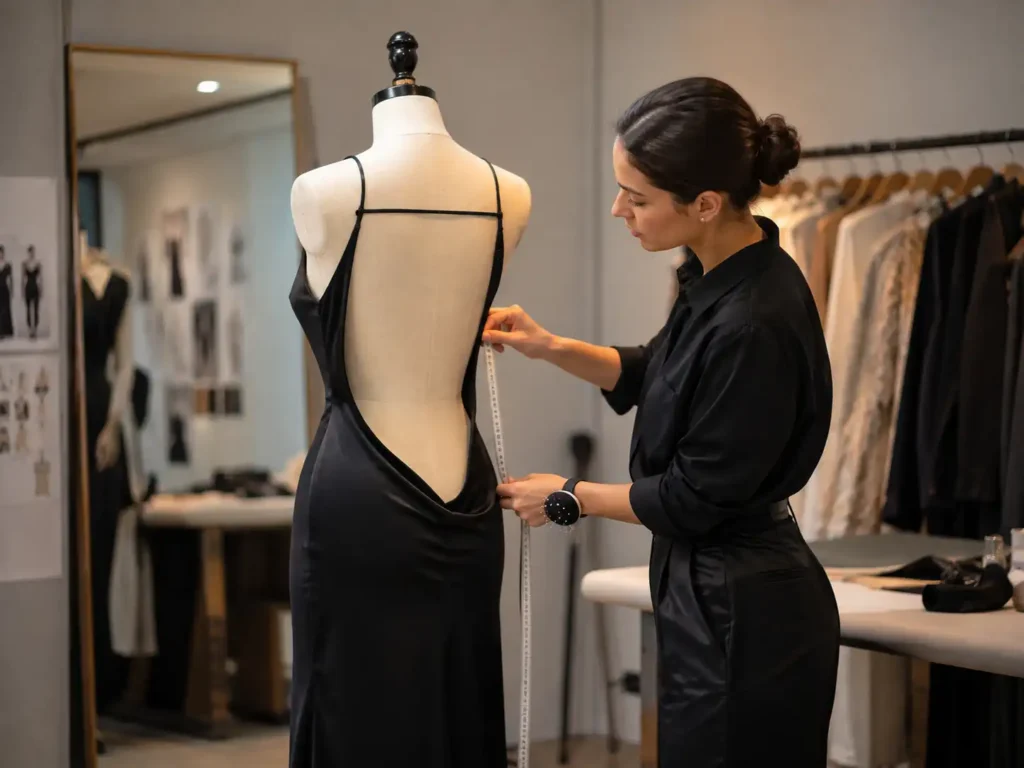
Back and Side Problems Often Come From Tension Balance
An open back can collapse, flare away from the body or move upward even when the back pattern itself looks correct. The source may be excessive front tension, an incorrect side seam angle, short straps, insufficient waist stability or lining with the wrong recovery.
Typical revision actions include:
- changing side seam position;
- modifying the transition from underarm to back opening;
- reducing or increasing back-opening width;
- adjusting strap length or attachment angle;
- correcting front-to-back length balance;
- changing internal lining tension;
- strengthening the side panel;
- relocating support tape or boning.
Side exposure deserves particular attention. Reducing the opening visually may solve exposure but change the design. A better correction can be reshaping the side pattern or internal support so coverage improves without visibly closing the back.
Fit photos from front, side and back are useful because a backless dress can appear correct from one direction while failing from another.

Comfort Problems Must Be Corrected Before Approval
Strong support that hurts the wearer is not a successful result. Boning may end at a pressure point, anti-slip tape may grip too aggressively, an underwire may sit incorrectly or a halter strap may carry too much vertical load.
Revision therefore includes comfort checks:
- pressure at the neck or shoulders;
- pressure under the bust;
- boning contact during sitting;
- restricted breathing at the waist;
- rubbing along the side opening;
- stiffness from multiple internal layers;
- difficulty putting on or removing the garment.
Support can often be redistributed rather than reduced. A halter strap carrying too much weight may be relieved by stronger internal side control. An uncomfortable waist may be corrected by changing boning or pattern shape instead of simply adding ease everywhere.
Only approved changes move forward into PP preparation.
Sewing instructions and QC checkpoints should reflect the final structure so bulk production does not recreate an earlier sample version.
Bulk Production Must Reproduce the Approved Support
Approved Pattern
Cup Specification
Boning Specification
Lining and Support Materials
Measurement Control
Golden Sample Comparison
Fit-Sensitive QC for Backless Support Construction
Backless dresses with internal support need product-specific inspection. A normal garment check can find stains or loose threads but still miss a cup positioned too high, a side opening that exposes too much, or a boning channel that changes the approved silhouette.

Bust and Support Components Are Checked as One System
Incoming materials are reviewed before sewing because the support system starts with component consistency. Cup form, boning, lining, elastic, support tape and shell fabric need to match approved specifications. A lining with weaker recovery or a cup with a different shape can change fit even when sewing measurements remain within range.
During sewing and in-line inspection, attention goes to:
- cup left-right symmetry;
- cup placement against pattern reference points;
- underbust seam position;
- boning channel position;
- boning length;
- boning end comfort;
- support tape or elastic tension;
- lining attachment;
- strap attachment and adjustment;
- side seam balance.
Support structures are particularly sensitive to accumulated variation. A small change in cup placement combined with a slightly longer strap and softer elastic can produce a visible fit difference even though each component appears acceptable by itself.
QC therefore compares the garment with the approved structure rather than inspecting isolated parts.

Measurements Focus on Areas That Control Exposure and Stability
Backless styles require more targeted measurement than a basic dress. Bust circumference alone is not enough. Inspection can include upper bust, underbust, waist, front length, back length, neckline depth, strap length, side opening and back depth according to the style.
Measurement results are compared with the confirmed specification and PP reference. The inspection also checks whether left and right sides remain symmetrical and whether the back opening falls at the intended height.
Visual fit-sensitive checks include:
- neckline lying flat;
- no unexpected side-bust exposure;
- cup centered inside the bodice;
- no visible cup-edge impression where appearance requires a clean surface;
- back edge remaining balanced;
- straps carrying even tension;
- zipper or closure sitting flat;
- lining staying inside the garment.
Satin and other smooth surfaces receive extra attention because internal structure can create visible pressure marks. Mesh or lace versions require additional checks for transparency, lining boundaries and edge stability.

Finished Garments Are Compared With the Approved Reference
Final garment inspection combines measurements, appearance and structural review. A backless dress can pass basic dimension checks but still differ from the approved sample in cup projection, side containment or back-opening shape.
The Golden Sample provides a physical reference for comparison. Inspectors can review:
- bust silhouette;
- cup shape;
- neckline position;
- side coverage;
- waist shape;
- back-opening depth;
- boning appearance;
- strap position;
- overall front-side-back balance.
Pressing also matters. Excess heat or pressure can mark satin, distort cup foam or change the appearance around boning channels. Finishing should preserve the approved shape rather than flattening the structure.
Packing is checked so cups, boning and open-back edges are not crushed into an unwanted form during storage or shipment. The objective is for the garment reaching the brand’s warehouse to reflect the support and silhouette approved during development.
Support Construction Changes Development and Garment Cost
Development Cost
Construction Cost
Cost Optimization
Structured Bust Support Proven Through Dress Development
An anonymous established fashion brand needed a multi-style collection combining open, strapless and corset-inspired silhouettes with stronger bust stability. The order covered 18 styles and approximately 42,000 garments, using satin, stretch satin, lace, mesh, structured woven fabrics and multiple internal support constructions.

From Visual Concept to Stable Bust Structure
The collection included fitted minis, structured occasion dresses, corset-inspired silhouettes, low-back styles and strapless constructions. Several designs relied on built-in cups, boning, internal lining, anti-slip components and controlled side panels. The challenge was not simply adding support. Each style needed a different balance between skin exposure, cup shape, upper-bust fit, waist shaping and comfort.
Development began by grouping styles according to structural difficulty rather than treating all 18 styles as one production category. Softer satin and stretch-satin designs were separated from more structured corset silhouettes. Open-back and strapless styles received additional review around upper bust, underbust, side coverage and back-opening stability.
- cup shape not matching the intended neckline;
- cup position changing the visual bust height;
- side opening becoming too exposed on fitted styles;
- boning creating visible ridges on smooth satin;
- anti-slip tension becoming uncomfortable;
- waist shaping pulling the back opening upward;
- strap tension affecting neckline position;
- support requirements changing across the size range.
Pattern and sample revisions were made around the actual cause of each problem. Cup position and underbust structure were adjusted independently where required. Boning locations were changed on styles where the first construction felt too rigid. Lining direction and support panels were revised on stretch styles to improve recovery without adding visible bulk.

Bulk Control Focused on Support Repeatability
Once the structures were approved, bulk production control concentrated on keeping internal specifications consistent across the 42,000-piece program.
Support components were treated as production-critical details rather than hidden accessories.
Production records covered cup specification, cup placement, boning location, lining construction, strap length, key measurements and sewing instructions.
Fit-sensitive QC compared finished garments with approved references for bust silhouette, neckline, side containment, waist shape and back-opening balance.
Different fabrics also received different finishing attention.
Smooth satin required careful handling around cups and boning so internal construction did not show through the surface.
Mesh and lace styles required checks around lining boundaries and exposed edges.
Structured woven styles were reviewed for symmetry and bodice balance.
The project demonstrated a manufacturing principle used across Jinfeng’s structured dress development: support is most reliable when it is designed into the pattern, validated in fitting and then converted into measurable bulk-production standards.
Built for Fit-Sensitive Backless Dress Development
7+ Pattern Makers
2 Sample Rooms
20+ Sample Machinists
15+ QC Inspectors
6 Owned Factories
10+ Production Partners
Backless Dress Bust Support Frequently Asked Questions
Yes. Built-in support can use cups, underbust shaping, boning, structural lining, side stabilization, anti-slip components or waist anchoring. The correct combination depends on back depth, neckline, straps, fabric, bust coverage and target size range. A cup by itself may provide shaping without enough stability, so the full bodice structure should be reviewed before sampling.
For some styles and wearers, a correctly developed built-in structure can reduce or remove the need for a conventional bra. Performance depends on bust volume, support expectation and how much garment structure remains around the front, sides and waist. A deep open-back dress for a fuller bust normally needs more than a simple padded cup.
No. Boning is useful when the bodice needs stronger vertical stability, but a soft backless dress may work better with controlled pattern shape, cups, lining or side support. Adding unnecessary boning can make a lightweight style rigid or uncomfortable. Sample fitting determines whether boning adds meaningful support.
Stable woven fabrics and structured stretch fabrics are easier to control, but satin, stretch satin, jersey, mesh and lace can also work when the internal construction is matched correctly. Stretch, recovery, weight, drape and transparency matter more than the fabric name alone. Lining can provide stability where the shell remains soft or visually light.
Fuller-bust development usually needs closer control of cup projection, underbust stability, side containment, strap load and waist anchoring. Size grading should not simply enlarge the base-size pattern. Representative fit samples help confirm whether the open-back proportion and support structure remain balanced across the intended size range.
Yes, but the combination is structurally demanding because shoulder straps and much of the rear anchoring are both removed. Support may need to come from upper-bust fit, cups, boning, side control, anti-slip elements and the waist. Fit and movement testing are important before bulk approval.
Back depth depends on the front structure, side coverage, strap configuration, waist anchoring, fabric and desired support. There is no single safe depth for every design. Lowering the back changes the load carried by the remaining bodice, so the opening should be reviewed as part of the complete pattern rather than as an isolated measurement.
Fit review looks at cup position, upper-bust contact, underbust stability, neckline, side coverage, strap pressure, waist tension and back-opening balance. Standing, walking, sitting and arm movement can reveal issues that do not appear on a hanger. Approved corrections are transferred into pattern and construction records.
The approved pattern, cup specification, boning positions, lining, support materials, measurements, sewing instructions, PP sample and Golden Sample create the production reference. In-line and finished-garment QC checks structure and appearance against those references rather than relying only on general workmanship inspection.
It can. Cups, boning, structural lining, underwire, support tape, additional pattern work, fit samples and extra sewing operations add cost according to the design. Cost optimization should focus on using the necessary support efficiently rather than removing components that protect the approved fit and appearance.

Send Your Backless Dress for Structure Review
A backless concept is easier to price and develop once the support expectation is clear.
Send Jinfeng Apparel the design information already available, and our development team can review the relationship between back depth, neckline, bust structure, fabric, lining, cups, support components and target size range before formal sampling.
Useful project information includes:
- Reference image or tech pack — shows the intended front, side and back silhouette.
- Target size range — helps evaluate cup, grading and support requirements.
- Fabric direction — identifies stretch, recovery, transparency and structure risks.
- Bust-support expectation — light shaping, moderate support or a more structured bodice.
- Back-opening requirement — indicates how much rear anchoring remains available.
- Order plan by style and color — supports production and material evaluation.
- Private-label requirements — labels, hangtags, barcodes, packing and warehouse details.
- Target launch timing — helps coordinate sample approval and production planning.