 Skip to content
Appliqué Dress Development
Develop Appliqué Dresses from Motif Concept to Production-Ready Garments
Jinfeng Apparel develops appliqué-led fashion dresses for established womenswear brands, occasionwear labels, premium ecommerce programs and multi-style collections. Development begins with the relationship between the motif, base fabric, garment pattern and intended fit rather than treating appliqué as a decoration added after the dress is finished.
- Complex dress samples involving lace, mesh, structured construction or decorative workmanship are normally planned around 15–25 days for the first sample, depending on actual design complexity, material readiness and development requirements.
- 7+ senior pattern makers, 2 sample rooms and 20+ sample machinistssupport pattern correction, fit review, placement adjustment and sample revisions.
- Projects can progress through First Sample, Fit Sample, Revised Sample, PP Sample and Golden Samplewhere the style requires multiple approval stages.
- MOQ starts from 200 pcs per style/color, subject to fabric, decorative components, construction, packaging and production requirements.
Appliqué Development Starts Before the Decoration Is Attached
Visual Direction
Garment Engineering
Production Repeatability
Built for Fashion Programs Where Decoration Must Stay Controlled
Established Fashion Brands
Occasionwear and Partywear
Premium Ecommerce Programs
Product Development Teams
Four Problems That Commonly Weaken an Appliqué Dress
Strong Motif, Weak Garment
Placement Changes After Fitting
Sample Looks Better Than Bulk
Decoration Reduces Wearability
Appliqué Dress Styles We Develop for Fashion Collections

3D Floral Mini Dresses
- Focus: motif height, visual balance and dimensional recovery
- Fit points: bust, waist, hip and mini length
- Production concern: consistent orientation and secure attachment
- Packing concern: avoiding flattened 3D elements
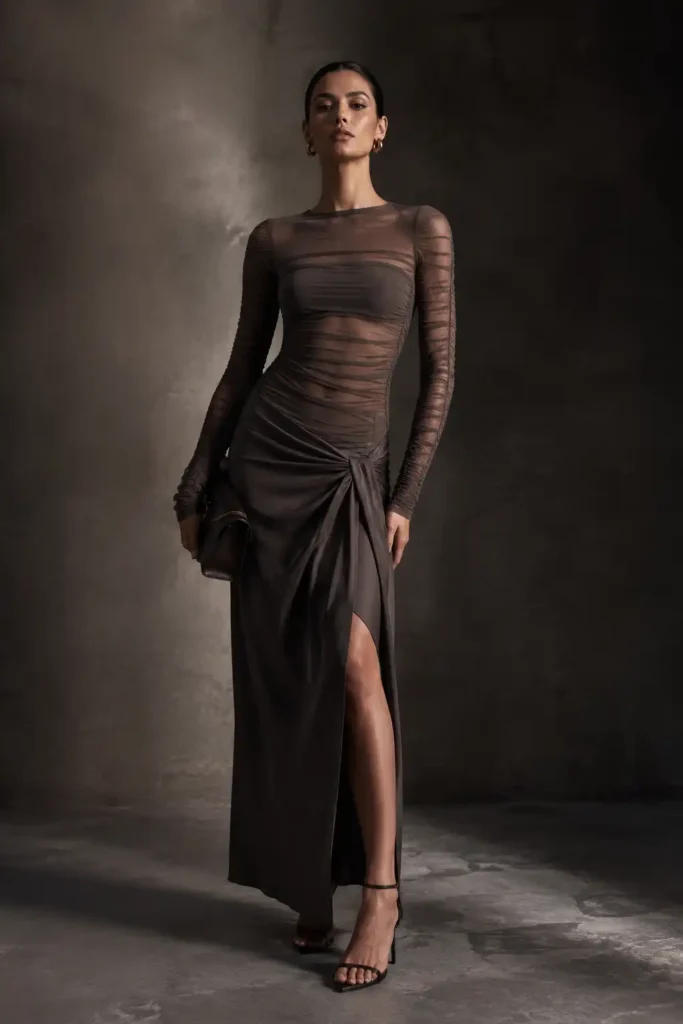
Appliqué Mesh Dresses
- Common bases: mesh and power mesh
- Key risks: distortion, holes, transparency shifts
- Fit points: neckline, bust coverage and side body
- QC focus: motif position, mesh damage and lining relationship

Lace-Appliqué Midi Dresses

Appliqué Corset Dresses
Corset-based silhouettes combine decorative impact with more demanding internal structure. Motifs cannot interfere with cup shaping, boning channels, neckline stability, anti-slip construction or back closure. Development usually begins with the corset architecture before decorative positioning is locked. The visual center of a flower or lace motif should work with the bust shape rather than fight against it. Fit revisions may move cup height, upper-bust coverage or waist shaping, so placement is normally reviewed again before PP approval.

Floral Occasion Dresses

Statement Maxi Dresses
Match Appliqué Construction to the Right Base Fabric
Base fabric determines how an appliqué dress behaves on the body and in production. A motif that works cleanly on structured woven fabric can distort stretch mesh, mark satin or overwhelm lightweight tulle. Fabric selection therefore considers hand feel, drape, stretch, transparency, lining requirements, decorative weight and bulk-production risk together.

Mesh and Tulle Need Weight Control
Mesh is frequently used where appliqué should appear visually suspended over the body. Jinfeng works with mesh, power mesh and tulle within party, clubwear and occasionwear development. Mesh commonly falls around 40–120 gsm, although actual specifications depend on construction. Stretch, recovery and transparency must be reviewed before decorative placement is approved.
Heavy motifs placed on a very soft mesh can pull the surface downward or change the neckline shape. Dense stitch areas can also create a hard spot next to a flexible area. For fitted garments, decoration should be considered alongside stretch direction and body tension.
Lining length and color affect the visual result as much as the outer mesh. A floral element may look balanced on a mannequin but appear misplaced once lining coverage, bust shaping or cut-out proportions change.
Control points:
- mesh stretch and recovery
- motif weight per decorated zone
- transparent versus lined areas
- neckline stability
- hole or snag risk around attachment
- seam allowance hidden behind transparent panels

Satin Requires a Cleaner Attachment Strategy
Satin is valuable for occasion and cocktail styles because of its light reflection and smooth surface. The same surface makes needle marks, puckering, snagging and pressing errors easier to see. Decorative treatment must therefore avoid creating a visibly distorted area around the motif.
Jinfeng works with satin and stretch satin in dresses where color difference, sheen direction, zipper flatness and pressing require specific attention. A large appliqué over satin may also change the local drape, so supporting material and attachment density must be reviewed during sampling rather than decided only from artwork.
Placement near the center front, waist or hip should be checked under natural fall. If the appliqué creates tension, the surrounding satin may ripple even when the pattern measurements are technically correct.
Control points:
- shine direction
- snagging and needle visibility
- puckering around decorative edges
- local stiffness
- pressing temperature and pressure
- packing creases around dimensional areas

Lace Demands Motif and Edge Awareness
Lace already contains visual pattern, so adding appliqué or using cut lace motifs requires clear separation between the base lace structure and the applied element. Flower direction, edge shape, lining color, seam position and negative space all influence the result.
Jinfeng’s lace-development work covers pattern placement, matching, lining, edge finishing and damage control. When a motif approaches a side seam or waist seam, the team reviews whether the visual element should stop before the seam, continue across it or be repositioned.
An elegant lace-appliqué effect usually comes from controlling negative space rather than filling every area with decoration.
Control points:
- pattern direction
- left/right balance
- motif edge stability
- seam interaction
- lining-color visibility
- holes, fraying and damage

Structured and Stretch Wovens Need Different Rules
Structured woven bases can support stronger motif shapes but may make an appliqué zone visually rigid if too much reinforcement is added.
Stretch woven fabrics create the opposite challenge: decoration can reduce stretch locally and change the fit between decorated and undecorated areas.
Corset mini dresses, fitted cocktail dresses and structured occasion pieces often need pattern work completed before final motif position is approved.
A flower at the waist should not interrupt boning, closure or shaping seams.
A motif over the hip should not create a non-stretch zone that restricts movement.
Fabric substitution during development also requires renewed review.
Changing weight, stretch, drape or lining can affect pattern balance and may require a revised sample rather than a simple fabric swap.
Motif Placement Must Follow the Garment, Not the Sketch
Appliqué placement becomes reliable when the visual artwork is translated into measurable garment landmarks. Front-view beauty alone is not enough. Motif scale, direction, density, symmetry, seam clearance, zipper clearance and body position must work with the actual pattern and finished fit.
Start with Visual Scale and Body Position
A motif should be assessed against the size of the garment area receiving it.
One 18 cm floral element creates a very different impression across a narrow upper bodice than across a full skirt.
Design review therefore looks at the visual relationship between motif size and the available body area instead of treating the motif as a fixed graphic.
Manage Symmetry Deliberately
Symmetrical placement requires strict comparison of left and right positions. A difference that looks minor on a cutting table can become obvious once the dress is worn, especially around the bust, shoulder or neckline.
Asymmetrical designs need equal control. Intentional asymmetry should remain intentional rather than drift unpredictably between garments. The approved sample therefore acts as a visual standard, while production information records the controlled location and orientation.
Avoid Unplanned Seam Conflicts
Motifs frequently approach princess seams, darts, side seams, waist seams, zippers or slits.
Decorative areas can become bulky when several material layers are caught in one seam.
Edge alignment can also become difficult if a large motif is cut in half without a planned continuation method.
Protect Zippers and Openings
Invisible zippers need enough clean fabric around the opening to remain flat and functional.
Dense appliqué immediately beside a zipper can create stiffness, extra thickness or snagging. Similar concerns apply around button areas, hook-and-eye closures and side slits.
Placement should therefore respect both the visual direction and the mechanical opening of the garment.
Check the Dress in Motion
A static front photo does not reveal everything. A motif around the hip may fold differently when sitting. A large dimensional flower near the armhole may interfere with movement. Decoration near a slit may catch as the skirt opens.
Fit review should include front, side and back appearance, plus normal movement where the garment category requires it. Adjustment at sample stage is much less disruptive than discovering movement problems after bulk attachment standards have already been fixed.

Pattern and Fit Control the Final Appliqué Position
Fit corrections can move decoration even when the motif artwork never changes. Bust shaping, waist reduction, neckline correction, strap adjustment, side-seam balance and hem changes all alter the three-dimensional surface supporting the decoration. Final appliqué placement should therefore follow the approved garment pattern rather than an early flat sketch.
Bust and Upper-Bodice Changes Matter Most
A floral motif near the bust can shift when cup volume, bust width, upper-bust coverage or dart shaping changes. Structured designs add another layer because bra cups, boning, under-bust shaping or anti-slip construction may occupy the same zone.
Jinfeng’s pattern team works across bust, upper bust, under bust, waist, hip, neckline depth, strap position, armhole, slit height and garment length. The company has 7+ senior womenswear pattern makers, 2 sample rooms and 20+ sample machinists supporting development and revision.
For an appliqué corset dress, decorative approval should follow key structural corrections. Locking the floral layout before the cup and waist are stable creates unnecessary rework.
Waist Shaping Changes Motif Geometry
A flower or decorative panel spanning the waist behaves differently on a straight block and a sharply shaped silhouette.
Reduction at the waist can change the angle between upper and lower motif areas.
Designs crossing a waist seam may need separate upper and lower placement references rather than one continuous flat measurement.
Bodycon and close-fitting silhouettes deserve extra attention because even a small change in stretch or local stiffness can affect how the fabric follows the body.
Hip Fit Affects Movement and Visual Balance
Large appliqué elements on the hip can make the garment feel stiffer or visually wider.
For fitted midi and mini dresses, hip ease and walking comfort are reviewed alongside decoration.
If the base fabric has stretch but the motif area does not, the applied zone may behave like a rigid patch.
The development decision may involve reducing motif density, moving the appliqué slightly, changing the supporting layer or adjusting the local pattern.
Neckline and Strap Revisions Can Reframe the Design
Neckline depth and shoulder or strap position are visually dominant. A motif sitting perfectly around the neckline in the first sample may look too high or too low after coverage is corrected.
Appliqué around halter, one-shoulder, strapless or asymmetric necklines should therefore be reviewed after the neckline itself is approved.
Length Changes Affect Lower Placement
Hem and slit placement need equal discipline. If a mini dress is shortened after fitting, a motif originally positioned 12 cm above the hem may become visually crowded. If a maxi hem is corrected for balance, vertical floral placement may need to be rechecked.
Bulk-relevant fit changes are documented in updated pattern and measurement files rather than remaining as informal comments.

Attachment Quality Must Protect Shape, Comfort and Finish
Decorative workmanship is successful only when the applied element remains visually clean, securely attached and compatible with the garment underneath. Attachment routes are confirmed according to motif material, edge construction, base fabric and dress structure rather than assuming one method suits every appliqué program.
Edge Finish Must Match the Motif
A clean decorative edge gives the garment a deliberate, high-value appearance. Raw or loosely finished edges can work for selected fashion concepts, but the decision should be intentional and repeatable.
Lace-derived motifs may need controlled trimming and secure edge treatment. Structured fabric motifs may require a different approach because a thick edge can become visible against satin, mesh or a fitted bodice.
Attachment Density Must Match the Base Fabric
More attachment is not automatically better. Dense securing on lightweight fabric may cause puckering or stiffness. Too little attachment can allow corners or petals to lift.
The correct balance depends on motif size, shape and intended three-dimensional effect. Raised petals may deliberately remain free at selected edges while the center is secured. Flat appliqué may need a more continuous attachment route.
Reinforcement Is Used Where the Garment Needs It
A support layer may be needed where decorative weight exceeds what the base fabric can hold comfortably. Reinforcement should solve a structural problem without creating an obvious hard patch.
For transparent designs, support placement becomes especially sensitive because backing can be visible through mesh or lace. The supporting method should therefore be evaluated as part of the visual design rather than hidden as an afterthought.
Skin-Contact Areas Need Extra Review
Armholes, necklines, underarms, side body and upper bust can become uncomfortable if decorative edges, dense stitching or rough materials touch the skin.
Jinfeng already manages similar comfort risks on sequin and structured fashion garments through lining, edge handling and local construction adjustment. Appliqué projects should receive the same location-specific review.
Decorative Components Need Production Approval
Specialty appliqué materials may involve separate sourcing, development lead times or upstream processing. Jinfeng does not assume every motif, material or technique can use the same route. Material specifications, sample construction, attachment method and production allocation are confirmed according to the actual project before bulk commitment.
No unverified equipment or decoration capacity is used as a substitute for sample validation.

Control Appliqué Placement Across the Full Size Range
One decorative coordinate cannot always be copied unchanged across every garment size. Placement may need to follow a fixed reference, a proportional relationship or a size-specific adjustment depending on silhouette, motif scale and the body area involved.
| Control Area | Sample Approval | Size Development | Bulk Control |
|---|---|---|---|
| Neckline motif | Distance from neckline and center front | Recheck after neckline grading | Compare against approved placement reference |
| Bust motif | Position relative to bust shaping | Review bust width and cup changes | Check left/right balance and visual height |
| Waist motif | Relationship to actual waist seam or waistline | Confirm waistline shift by size | Maintain intended visual center |
| Hip motif | Height and side-seam clearance | Review hip width and movement | Check distortion on fitted sizes |
| Side placement | Distance from side seam | Review panel width change | Prevent drift toward front or back |
| Zipper area | Clearance from zipper tape and seam | Keep functional opening clear | Check zipper flatness and motif interference |
| Slit area | Motif distance from slit top and edge | Recheck if slit height changes | Confirm opening movement |
| Hem motif | Distance from approved finished hem | Review after length grading | Inspect orientation and bottom balance |
Sampling Turns Visual Feedback into Production Instructions
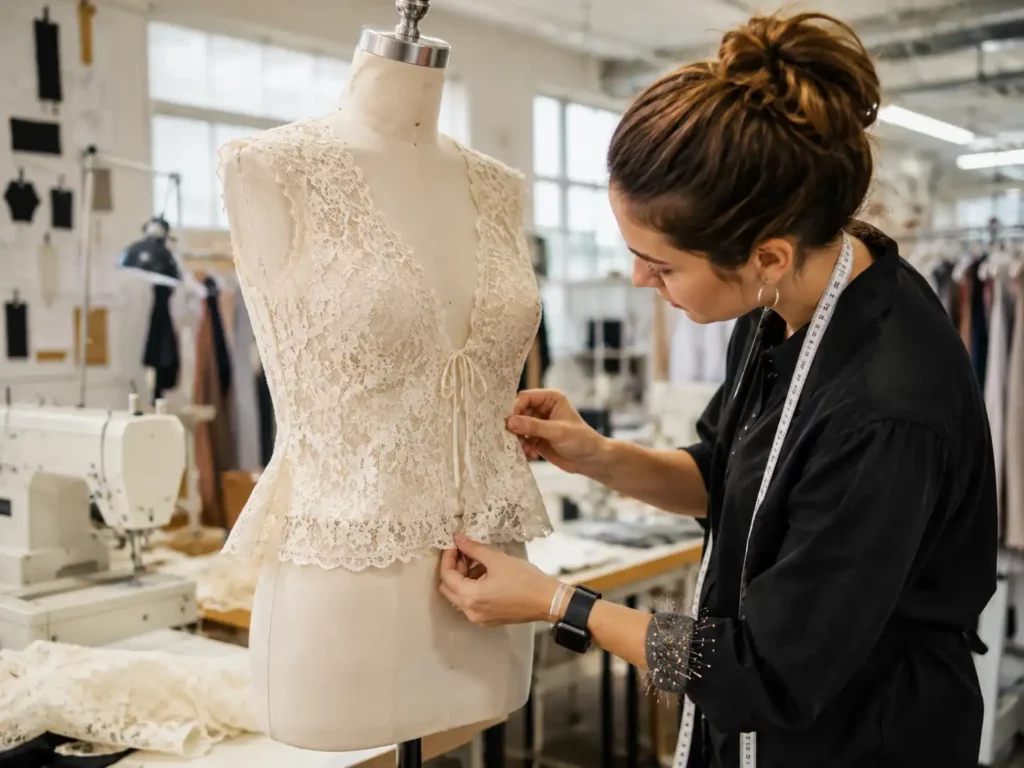
First Sample Review

Fit Sample Review
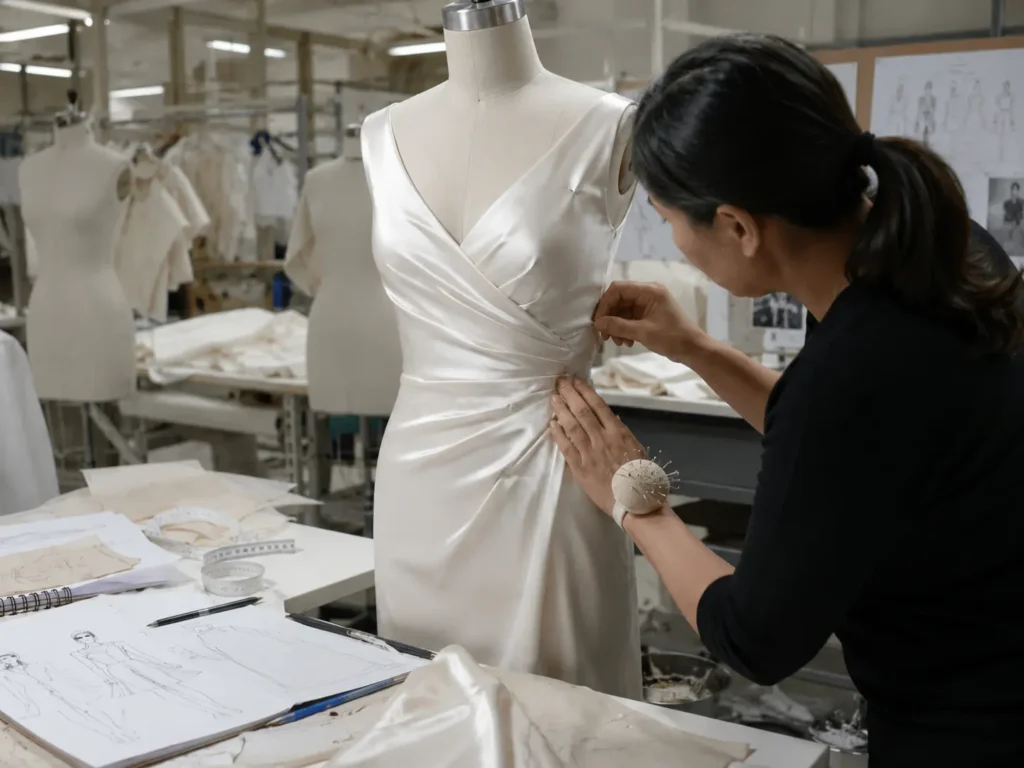
Revised Sample

Photo-Ready Sample

PP Sample

Golden Sample
A Development Team Built for Complex Fashion Dresses
7+ Senior Pattern Makers
2 Sample Rooms
20+ Sample Machinists
Approved Samples Must Become a Repeatable Bulk Standard
Appliqué projects fail when the sample room and production line operate from different assumptions. Jinfeng transfers approved garment information into bulk references covering pattern, materials, decorative placement, construction, measurements, labels, packing and QC before production is released.

Final Pattern Becomes the Shape Standard
Bulk production should use the approved pattern version rather than an earlier sample pattern. Pattern records can include revised pattern, PP pattern, lining pattern, size grading and trim placement references.
For decorative styles, placement needs to remain connected to the correct pattern version. A motif located from an outdated bodice panel can shift once fit revisions are applied.

Materials Are Locked Against Approved References
Base fabric, lining and decorative materials should match approved direction for hand feel, stretch, color, appearance and construction compatibility.
Where material substitutions become necessary, the difference in weight, stretch, drape, color and cost is reviewed before deciding whether another sample is required.

Placement Becomes a Production Instruction
Approved motif position should not rely only on a photograph. Production teams need measurable references such as center front, neckline, waist seam, side seam, slit or panel edge.
Critical decorative orientation and left/right balance are communicated before repeated garment assembly begins.

PP Lock Protects Production Stability
After PP confirmation, changing fabric, color, trim, motif, construction, measurement or packaging can alter cost, sourcing and lead time.
Changes are therefore evaluated formally rather than accepted as an informal late adjustment.
Bulk Production Controls Decorative Consistency Before Final Inspection
Material Preparation
Cutting and Panel Control
Placement Preparation
Sewing and Attachment
In-Line Inspection
Finishing and Packing
Pressing needs extra care around dimensional decoration, satin surfaces and sensitive embellishment. Packing methods are selected according to garment length, dimensional detail, private-label requirements and shipment conditions.
Appliqué Dress QC Follows the Garment from Material to Packing
Inspection must cover both the decorative element and the underlying dress. A motif can be perfectly attached while the zipper bulges, lining shows or finished length is wrong. The garment can also fit well while appliqué orientation varies between units. Both sides need to be reviewed together.
| QC Stage | Appliqué / Decoration Focus | Garment Focus |
|---|---|---|
| Incoming Material | motif color, edge condition, damage, decoration consistency | fabric color, hand feel, width, defects, shrinkage concerns |
| Cutting | placement preparation, mirrored direction, panel identification | correct pattern version, fabric direction, stretch direction, panel quantity |
| Sewing | attachment stability, edge cleanliness, symmetry | seam quality, seam allowance, zipper flatness, lining attachment |
| In-Line | motif height, orientation, seam interaction, loose areas | neckline, bust, waist, hip, straps, slit and measurement consistency |
| Finishing | lifted edges, crushed 3D areas, surface marks | pressing, stains, loose threads, appearance and function |
| Final Inspection | missing or damaged motifs, left/right visual balance | measurements, fit effect, zipper, lining, color and finished appearance |
| Packing | protection from compression or abrasion | labels, barcodes, size stickers, folding, polybags and carton marks |
What Changes the Cost of an Appliqué Dress Program
Appliqué pricing cannot be reduced to the number of flowers on the garment. The real cost comes from the combined effect of the base fabric, decorative material, placement density, pattern work, attachment time, lining, sample revisions, production complexity, size range, packaging and required inspection.
Motif Size and Quantity
Placement Density
Base Fabric
Handwork and Attachment Complexity
Pattern and Sample Revisions

Private Label, Packing and Design Protection Stay Connected
Private Label Execution
Packing for Decorative Dresses
Confidential Development Files
Frequently Asked Questions About Appliqué Dress Development

Send Your Appliqué Dress Program for Development Review
Appliqué dress development is easier to plan when the garment structure and decorative idea are reviewed together from the beginning.
Send the available project files and Jinfeng can evaluate the dress construction, fabric direction, motif placement, pattern requirements, sample route, MOQ fit and bulk-production risks before the development path is confirmed.
For a more useful first review, provide as much of the following as available:
- Tech pack, sketch or front/back reference image
- Motif artwork or appliqué reference
- Intended base fabric or fabric direction
- Target quantity per style/color
- Planned size range
- Main measurements or size chart
- Preferred color direction
- Lining and closure requirements
- Private-label and packaging needs
- Launch or target delivery window


