Skip to content
Maxi Wedding Guest Dress Manufacturer
Custom maxi wedding guest dress development for fashion brands needing elegant occasionwear, reliable sampling, and stable bulk production.
Jinfeng Apparel helps fashion brands develop maxi wedding guest dresses from design reference, fabric direction, pattern development, and fit correction to PP sample approval, bulk production, QC, private-label packing, and export delivery. Our work focuses on long-length dress balance, fabric drape, lining coverage, slit placement, neckline stability, photo-ready sample finishing, and repeatable production standards for occasionwear collections.
- Since 2008— women’s fashion manufacturing experience for custom dress, occasionwear, resortwear, and private-label programs.
- 6 owned women’s fashion factories— production structure for satin, chiffon, lace, mesh, sequin, crepe, and printed maxi styles.
- 10+ long-term satellite production partners— flexible capacity support for seasonal wedding guest programs and phased delivery.
- MOQ from 200 pcs/style/color— suitable for organized custom production, not stock resale or micro-order fulfillment.
- Anonymous wedding guest program range: 12–24 styles / 28,800–62,400 pcs— maxi dress capsules across US, UK, and Australian fashion markets.
- NDA-based cooperation— tech packs, samples, artwork, private labels, and unreleased styles handled as protected project materials.



Built for Wedding Guest Dress Programs
Since 2008
- Women’s fashion manufacturing experience since 2008.
- Dress development, fabric review, sampling, and export support.
- Production records support repeat orders and seasonal extensions.
6 Owned Factories
- Owned factory resources for core womenswear production.
- Style allocation by fabric and construction complexity.
- Better control from PP sample to bulk production.
10+ Partner Factories
- Capacity support for seasonal occasionwear programs.
- Partner allocation by garment risk and delivery schedule.
- Unified production notes, QC points, and packing standards.
MOQ 200
- MOQ from 200 pcs per style/color.
- Fabric, trim, color, and packing minimums reviewed separately.
- Style-color-size planning confirmed before quotation.
OEM / ODM
- OEM support from tech packs and original samples.
- ODM support from references, sketches, and line sheets.
- Fabric, fit, and finishing review before sampling.
Private Label
Private-label support includes woven labels, size labels, care labels, hangtags, barcode labels, polybags, carton marks, and packing instructions.
Wedding guest dresses often enter seasonal drops, online launches, and retail programs, so label accuracy and packing consistency matter as much as garment appearance.
- Woven labels, size labels, and care labels.
- Hangtags, barcodes, polybags, and carton marks.
- Packing instructions reviewed before bulk delivery.
Designed for Brand-Level Dress Development
Best Fit Orders
- Multi-style wedding guest dress collections.
- Seasonal occasionwear launches.
- Private-label womenswear programs.
- Repeat-order planning.
- Fabric and fit development.
- Photo-ready sample preparation.
Not Designed For
Jinfeng Apparel is not positioned for ready-stock dresses, single-piece fulfillment, no-MOQ requests, micro test runs, or pure lowest-price sourcing. The production model is built around custom development, sampling, PP approval, bulk production, QC, and brand delivery. Clear project planning helps protect fit accuracy, fabric consistency, label accuracy, and delivery preparation. Brands with real quantity plans receive more useful technical feedback, better sample planning, and more accurate cost evaluation. Unfit requests include:
- Ready-stock dress supply.
- Single-piece fulfillment.
- Unmanaged micro orders.
- Blind price guessing without files.
- Lowest-price-only sourcing.
- Projects without sample budget or bulk plan.

Turn Wedding Guest Demand into a Manufacturable Dress Collection
Wedding guest maxi dresses sit between occasionwear, formalwear, and fashion-driven ecommerce. End shoppers may search for satin maxi dresses, floral chiffon gowns, black-tie guest dresses, garden wedding dresses, or destination wedding outfits. Behind every visible style, a brand still needs fabric selection, pattern development, sample correction, size grading, lining control, slit stability, QC, and packing execution.
Product Development Before Bulk Production
Jinfeng Apparel approaches maxi wedding guest dresses as a product development project, not a simple long dress order. A satin slip maxi needs smooth surface control, bias behavior review, and strap balance. A chiffon floral maxi needs lining coverage, print direction, hem control, and wrinkle-aware packing. A lace maxi needs motif placement, seam allowance planning, and trim protection. A sequin gown needs surface protection, sewing method review, and abrasion control during packing.
For a fashion brand, the key decision is not only whether a factory can sew a dress. The stronger question is whether the manufacturing partner can translate wedding guest occasionwear into production-ready garments across 10–30 styles, multiple colors, multiple sizes, and private-label packing.
Jinfeng Apparel supports the full path from reference review to bulk delivery, helping brands reduce sample delay, fabric mismatch, bulk inconsistency, and packing errors.
Key planning areas include:
- Fabric direction by ceremony scenario.
- Pattern review for long-length balance.
- Sample correction before PP approval.
- Style-specific QC by fabric and construction risk.
- Private-label packing for ecommerce, retail, and warehouse receiving.
- Record keeping for repeat orders and new color development.
Dress Development by Wedding Scenario

Black-Tie Wedding
- Full-length balance and formal drape.
- Satin, crepe, velvet, lace, or sequin review.
- Neckline, zipper, slit, and hem control.

Garden Wedding
- Floral print and soft drape review.
- Transparency, lining length, and skirt sweep control.
- Tiered, ruffle, bias, and wrap construction checks.

Beach Wedding
- Breathable fabric and travel-ready packing.
- Chiffon, viscose, rayon, satin, or printed woven review.
- Transparency, lining, and wrinkle behavior checks.

Formal Reception
Formal reception dresses balance elegance with comfort. One-shoulder satin, halter neck crepe, cowl neck slip, lace overlay, and high-slit maxi styles are common.
Jinfeng focuses on neckline stability, strap strength, lining smoothness, zipper flatness, walking ease, and final pressing so bulk pieces look refined after packing.
- One-shoulder, halter, cowl, lace, and slit styles.
- Neckline stability and strap strength.
- Lining, zipper, walking ease, and pressing review.

Summer Wedding
- Lighter color and floral print direction.
- Transparency review for white, ivory, and pastel tones.
- Daylight, studio, and packing appearance checks.

Destination Wedding
Destination wedding styles need packability, movement, and camera-friendly details. Brands often request flowy maxi dresses, printed resort gowns, halter neck dresses, or soft ruffle silhouettes. Jinfeng reviews fabric drape, hem sweep, fold marks, carton packing, and polybag size so finished garments arrive ready for ecommerce or retail preparation.
- Flowy maxi, printed resort, halter, and ruffle styles.
- Fabric drape, hem sweep, and fold-mark review.
- Carton and polybag planning for long dresses.
Custom Styles for Occasionwear Collections

Satin Slip Maxi
- Satin sheen and bias behavior.
- Strap placement, cowl depth, and body skim.
- Fabric batch, thread shade, and pressing review.

Floral Chiffon Maxi
- Print direction and panel balance.
- Transparency, lining length, and skirt layering.
- Marker planning and seam control.

Halter Neck Maxi
- Neck tie strength and bust coverage.
- Back opening and armhole shape.
- Ring, slider, lining, and movement review.

Strapless Maxi
- Upper bust edge and inner grip.
- Boning, cups, zipper, and waist hold.
- Fabric body reviewed before sampling.

One-Shoulder Maxi
- Asymmetric neckline tension.
- Shoulder width, strap angle, and armhole comfort.
- Side seam, zipper, and hem balance.

Cowl Neck Maxi
- Cowl drape and neckline depth.
- Fabric weight and strap length.
- Front coverage, lining, and pressing review.

Ruffle Maxi
- Ruffle width and density.
- Panel balance and cutting direction.
- Fabric consumption, hem, and packing review.

Lace Maxi
- Lace motif and scallop edge planning.
- Lining color, transparency, and underlayer length.
- Marker planning for size consistency.

Mesh Overlay Maxi
- Mesh transparency and recovery.
- Lining coverage and seam visibility.
- Soft mesh, printed mesh, or embroidered mesh review.

Sequin Guest Gown
- Sequin direction and garment weight.
- Seam bulk, lining comfort, and zipper clearance.
- Surface protection and packing abrasion control.

Printed Resort Maxi
- Print scale and panel placement.
- Fabric width, color matching, and lining tone.
- Packing folds and PP sample confirmation.

Long-Sleeve Formal Maxi
- Shoulder width and sleeve mobility.
- Armhole, bust coverage, and skirt drape.
- Sleeve twist, cuff, and lining connection.
Fabric Direction Before Sampling
Fabric choice decides the final look, cost, fit, and production risk of a maxi wedding guest dress. Jinfeng Apparel reviews drape, weight, transparency, stretch, wrinkle behavior, lining needs, color risk, and supplier MOQ before sample development.
| Fabric | Visual Effect | Best Use | Development Risk | Jinfeng Control Focus |
|---|---|---|---|---|
| Satin | Smooth shine, formal finish | Slip maxi, cowl neck, one-shoulder, formal reception | Snagging, shade variation, seam puckering, pressing marks | Fabric batch review, seam test, lining match, pressing standard |
| Stretch Satin | Shine with body fit | Fitted maxi, corset bodice, body-skimming guest dress | Tension distortion, recovery issues, size instability | Stretch direction, pattern correction, bust and waist balance |
| Chiffon | Light, flowing, romantic | Floral maxi, garden wedding, summer ceremony | Transparency, cutting movement, hem unevenness | Lining length, panel balance, narrow hem, print direction |
| Crepe | Clean, refined, formal | Minimal maxi, halter, formal reception | Surface texture variation, drape mismatch | Weight check, fit sample, seam flatness, ironing method |
| Lace | Decorative, feminine, premium | Lace maxi, sleeve detail, overlay panel | Motif mismatch, transparency, supplier MOQ | Motif placement, lining tone, scallop edge, seam planning |
| Mesh | Sheer, layered, modern | Mesh overlay, long sleeve, evening detail | Transparency, stretch recovery, seam visibility | Lining coverage, stitch method, stretch test, edge finish |
| Sequin Fabric | High visual impact | Evening gown, formal guest dress, party capsule | Heavy fabric, abrasion, seam bulk, packing damage | Sequin direction, lining comfort, zipper protection, packing layer |
| Organza | Crisp volume, structured effect | Ruffle, layered skirt, formal detail | Stiffness, fraying, packing crease | Panel balance, edge finish, steam plan, packing method |
| Tulle | Soft volume, layered romance | Layered maxi, occasion skirt, sleeve detail | Snagging, uneven layers, transparency | Layer count, lining length, hem alignment, handling control |
| Viscose / Rayon | Soft drape, relaxed elegance | Resort maxi, destination wedding, printed dress | Shrinkage, wrinkle, shape change | Shrinkage review, fabric pre-check, fit sample, packing fold |
Fit Control for Long-Length Occasion Dresses
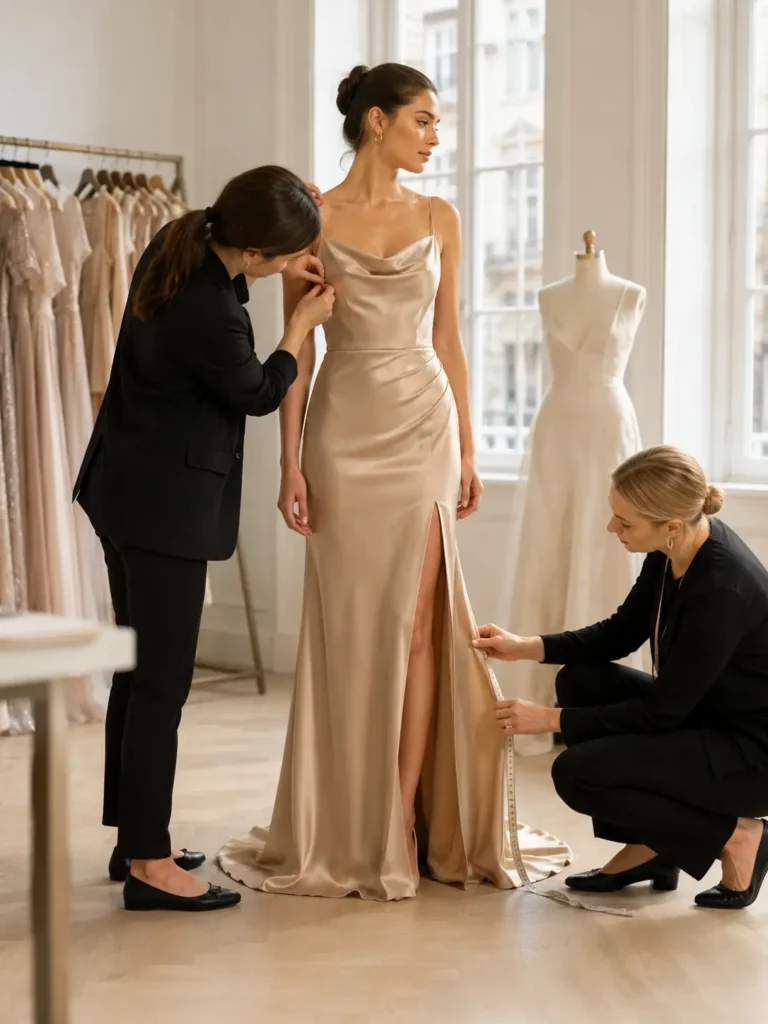
A maxi wedding guest dress cannot be developed by extending a short dress pattern. Full-length construction changes fabric consumption, skirt weight, hem movement, lining coverage, walking ease, and size balance. Jinfeng Apparel reviews pattern logic before sampling so the dress can move from concept to production-ready garment.
Pattern and Size Review
Key fit points include bust coverage, neckline depth, strap length, waist placement, hip ease, slit height, back opening, zipper position, lining length, and hem sweep. For US market dress programs, common size ranges may cover XS–XL, S–XL, 0–12, 2–14, or extended ranges depending on brand grading rules. Jinfeng can work from the client’s measurement chart or help review sample measurements according to garment structure.
Long dresses create special risks. A satin slip maxi may twist at the side seam when fabric direction is not handled well. A chiffon maxi may appear uneven after hanging. A lace maxi may lose proportion when motif placement changes across sizes. A strapless maxi may slide if upper bodice tension is not supported.
Jinfeng uses sample review, fitting feedback, photo notes, measurement checks, and pattern correction to improve fit before PP approval.
Key review areas include:
- Bust coverage, neckline depth, and upper-body security.
- Strap length, armhole, and back opening balance.
- Waist placement, hip ease, and skirt drape.
- Slit height, lining length, and hem sweep.
- Fabric direction and side seam twist.
- Size grading for long-length silhouettes.
- PP sample reference before bulk pattern release.
Control Skirt Length, Lining and Movement
Maxi length is one of the most important control points for wedding guest dresses. A beautiful design can fail when the hem drags too much, front and back length do not balance, lining shows outside, side seams twist, or the skirt does not move naturally during walking and photography.
Maxi Length and Hem Balance
Jinfeng Apparel reviews length through multiple production details: center front length, center back length, side seam length, waist-to-hem drop, lining length, slit height, hem curve, and fabric hanging behavior. For high-heel styling, formal events, and ecommerce photography, target length must be confirmed before sample approval. A 2 cm change at hem level can strongly affect visual proportion, especially in satin, chiffon, mesh, and lace dresses.
Fabric weight also changes length behavior. Chiffon may stretch or relax after hanging. Satin may show uneven pressing at the hem. Lace may need scallop planning before length can be finalized. Sequin fabric may require simplified hem finishing to avoid bulky edges.
Jinfeng checks the approved sample and final pattern before bulk cutting, then uses measurement review and visual inspection during production to help maintain length consistency.
Control focus includes:
- Center front, center back, and side seam length.
- Waist-to-hem drop and hem curve.
- Lining length and hem clearance.
- Slit position and walking movement.
- Fabric hanging behavior after steaming or handling.
- Size grading and long-length tolerance.
- Final inspection against PP sample reference.

Detail Development for Brand-Level Finishing
Neckline Shape
- Neckline depth and upper-body coverage.
- Cowl, halter, and strapless structure review.
- Lining roll, edge stability, and fitting feedback.
Strap Structure
- Strap width and attachment seam.
- Slider choice, thread color, and pull strength.
- Strap length matched with bust and back opening.
Back Design
- Back depth and strap angle.
- Zipper, facing, and lining attachment.
- Bra coverage and wearing stability review.
Slit Placement
- Slit height and movement test.
- Side seam reinforcement and bartack position.
- Lining clearance and PP sample standard.
Ruching Control
- Elastic tension and gathering direction.
- Sewing sequence and pattern allowance.
- Symmetry and QC comparison across sizes.
Drape Behavior
- Fabric weight and cutting direction.
- Seam placement and sample drape.
- Fit photos reviewed before PP approval.
Lining Coverage
- Lining length and handfeel.
- Color match, static risk, and seam connection.
- Movement, opacity, and comfort review.
Zipper Finish
- Invisible zipper length and color match.
- Seam allowance, stitch tension, and top hook.
- Lining clearance and pressing control.
Hem Finish
- Hem method by fabric type.
- Thread color and stitch visibility.
- Pressing marks and fold position.

Sewing, Finishing and Pressing Standards
Wedding guest maxi dresses sit in a more delicate category than casual dresses. The garment must look refined in photos, feel comfortable during long events, and maintain shape after packing. Jinfeng Apparel manages workmanship through sewing method review, trim compatibility, seam control, lining control, finishing, and packing preparation.
Workmanship Standard by Fabric and Structure
For satin dresses, seam tension and pressing temperature need attention because puckering and shiny press marks are easy to see. For chiffon and organza, cutting movement and edge finish affect symmetry. For lace and mesh, seam visibility and lining coverage decide product value. For sequin gowns, seam bulk, zipper clearance, and surface abrasion need careful handling. For structured bodices, boning, cups, grip tape, or inner support must be reviewed before bulk approval.
Strong workmanship also depends on clear production documents. Jinfeng prepares sample comments, pattern updates, sewing notes, measurement requirements, fabric and trim references, label details, packing instructions, and QC focus before bulk production. Wedding guest maxi dress collections often include multiple fabrics and silhouettes, so each style needs its own control standard instead of a generic sewing instruction.
The goal is not only a beautiful sample. The goal is repeatable workmanship across colors, sizes, and production batches.
Workmanship controls include:
- Satin seam tension and pressing temperature.
- Chiffon, organza, and tulle edge finishing.
- Lace motif placement and seam allowance.
- Mesh transparency, stretch recovery, and edge stability.
- Sequin surface protection, seam bulk, and lining comfort.
- Structured bodice support through cups, boning, or grip tape.
- Label, hangtag, and packing notes linked with approved samples.
Manage Satin, Lace, Mesh and Sequin Risks
Wedding guest maxi dresses often use fabrics with strong visual effect and higher production risk. Jinfeng Apparel reviews fabric behavior early because fabric mistakes create sample delays, cost changes, bulk inconsistency, and return risk.
Complex Fabric Processing
Satin needs smooth surface handling, batch color review, seam tension control, and correct pressing. Chiffon needs stable cutting, transparency review, lining plan, and hem balance. Lace needs motif placement, scallop edge planning, lining tone, and careful seam allowance. Mesh needs stretch direction, transparency control, edge finishing, and recovery testing. Sequin fabric needs surface protection, seam bulk control, lining comfort, and zipper clearance. Velvet needs nap direction, shade review, cutting direction, and packing protection.
For multi-style collections, fabric grouping helps improve development efficiency. A brand may prepare 18 wedding guest maxi styles with 5 satin looks, 4 chiffon floral styles, 3 lace looks, 2 mesh overlays, 2 sequin gowns, and 2 crepe formal dresses. Jinfeng can group sample development by fabric category, confirm swatches, review risk points, and prepare separate QC notes for each fabric family.
Complex fabrics are not rejected; they are managed through early evaluation, proper sampling, and clear bulk standards.
Key fabric controls include:
- Satin batch color, seam tension, and pressing standard.
- Chiffon transparency, lining, panel balance, and narrow hem.
- Lace motif placement, scallop edge, and lining shade.
- Mesh stretch direction, coverage, recovery, and edge finish.
- Sequin weight, abrasion, zipper clearance, and packing protection.
- Velvet nap direction, pressure marks, and carton handling.

From Reference to PP Sample Approval
Project Review
- Tech pack, reference image, or original sample review.
- Fabric, trim, color, size, and quantity plan check.
- Initial risk and cost driver comments.
Fabric Direction
Fabric direction is discussed through available swatches, color references, drape videos, or alternative options.
Satin, stretch satin, chiffon, crepe, lace, mesh, sequin, organza, tulle, rayon, and viscose each create different sample behavior and bulk risks.
- Fabric handfeel, weight, drape, and opacity.
- Lining, trim, and color matching.
- Supplier MOQ and delivery impact review.
Pattern Development
Pattern development follows once fabric and construction direction are clear.
Maxi wedding guest dress patterns require review around bust, waist, hip, neckline, strap, armhole, back opening, skirt sweep, slit height, lining length, and hem balance.
- Bust, waist, hip, and neckline review.
- Strap, armhole, back opening, and slit position.
- Hem sweep and lining length planning.
First Sample
The first sample is used to verify concept feasibility, not to force premature bulk approval.
Feedback may cover neckline depth, strap length, bust coverage, waist position, hip ease, slit height, lining length, hem balance, zipper smoothness, and finishing.
- Concept feasibility and construction review.
- Fit, lining, zipper, and hem comments.
- Written sample notes for revision planning.
Fit Review
- Fit photos and measurement notes.
- Movement, hem, lining, and slit review.
- Pattern update direction before revision.
Revision
- Confirmed changes converted into sample actions.
- Pattern, fabric, trim, and construction notes updated.
- High-risk details rechecked before PP sample.
PP Sample
- Final fabric, color, and trim standard.
- Measurement, construction, and finishing approval.
- Label, packing, and QC notes confirmed.
Bulk Standard
For multi-style wedding guest dress capsules, Jinfeng can group samples by fabric, silhouette, complexity, and launch priority. Hero styles for photography or early wholesale review can move first, while complex lace or sequin pieces receive extra validation before bulk planning.
- Style grouping by fabric and complexity.
- Hero sample priority for photography.
- Bulk-ready records prepared after PP approval.

Keep Approved Samples Repeatable in Bulk
Many dress projects fail after sample approval because bulk production loses the approved fabric handfeel, neckline shape, length balance, lining coverage, or finishing standard. Jinfeng Apparel treats PP sample approval as the bridge between development and production, not a simple signature step.
PP Sample to Bulk Production
After approval, key references are organized for bulk execution: final pattern, size chart, grade rule, BOM, fabric reference, trim reference, thread color, zipper standard, lining method, sewing notes, measurement points, label placement, packing method, and QC focus. The approved sample or Golden sample becomes the visual reference for production and inspection.
Wedding guest maxi dresses require extra PP discipline. Long hems need clear length points. Satin needs pressing reference. Chiffon needs lining and transparency reference. Lace needs motif placement notes. Sequin dresses need surface protection and packing guidance. Strapless and corset styles need inner structure standards. Private-label programs need label, hangtag, barcode, and carton mark confirmation before packing.
For multi-style orders, each style receives its own production control notes. One instruction cannot cover satin slip, chiffon floral, lace overlay, and sequin gown styles at the same time. Jinfeng uses a project-based approach to reduce misunderstandings during bulk production.
Bulk handover includes:
- Final pattern, size chart, and grading rule.
- BOM, fabric reference, and trim card.
- Thread, zipper, lining, and label standards.
- Sewing notes and measurement points.
- Packing method and carton mark requirements.
- QC focus by fabric and structure.
- Golden sample reference for production comparison.
QC Focus for Wedding Guest Dress Orders
Fabric Check
- Shade, surface, snag, and stain review.
- Stretch, handfeel, transparency, and batch consistency.
- Lining, zipper, thread, and trim matching.
Cutting Check
Cutting accuracy affects side seam balance, hem level, motif placement, and size consistency.
Maxi dresses require careful marker planning because long panels use more fabric and can shift during handling. Jinfeng checks fabric direction, print direction, lace motif, size bundle, and panel accuracy before sewing begins.
- Fabric direction and marker planning.
- Print direction, lace motif, and panel accuracy.
- Size bundle and long-panel control.
Measurement Check
Measurement QC covers bust, waist, hip, strap length, front length, back length, sleeve length, slit height, and hem sweep.
For maxi dresses, length tolerance must be managed carefully because small variations are visible. Jinfeng compares bulk measurements with the approved size chart and sample reference.
- Bust, waist, hip, and strap length.
- Front length, back length, and side seam length.
- Slit height, lining length, and hem sweep.
Seam Check
- Seam tension and stitch consistency.
- Puckering, twisting, and skipped stitch review.
- Fabric-specific seam allowance and symmetry check.
Zipper Check
Invisible zippers must be smooth, flat, and aligned with body seams. Wedding guest maxi dresses often use long center-back or side zippers, and poor zipper sewing can affect fit and wearing experience.
Jinfeng checks zipper length, color, smooth opening, top hook, lining clearance, and pressing around zipper edges.
- Invisible zipper smoothness and flatness.
- Zipper color, length, and top hook.
- Lining clearance and edge pressing.
Lining Check
Lining QC reviews opacity, length, seam comfort, side seam matching, hem position, and color coordination. Light colors, mesh, lace, and chiffon need more careful lining control.
Jinfeng checks whether lining supports the garment without showing outside the outer shell.
- Opacity, length, and seam comfort.
- Side seam matching and hem position.
- Color coordination and outer-shell balance.
Slit Check
Slit height, reinforcement, and lining clearance are important for walking comfort and modesty.
Jinfeng checks slit opening, bartack, seam strength, lining avoidance, and appearance on dress form. Slit placement must remain consistent across sizes and colorways after PP approval.
- Slit opening and bartack.
- Seam strength and lining clearance.
- Consistent placement by size and color.
Pressing Check
- Steam method and seam flatness.
- Hem finish and fabric-safe pressing.
- Fold lines and packing position.
Packing Check
Packing QC includes label position, hangtag, barcode, size sticker, polybag, carton mark, color split, size ratio, and garment folding. Wedding guest maxi dresses need packing methods suited to long length and delicate fabric. Jinfeng checks packing against approved private-label instructions before shipment preparation.
- Label, hangtag, barcode, and size sticker review.
- Polybag, carton mark, and color split.
- Garment folding and packing list accuracy.

Samples Prepared for Ecommerce and Campaign Shoots
Wedding guest maxi dresses often need photo-ready samples before bulk production. A sample may be used for model photography, campaign assets, wholesale presentation, social launch, fit review, and internal merchandising meetings. A rough sample can slow launch decisions even when the design idea is strong.
Photo-Ready Sample Support
Jinfeng Apparel reviews the sample appearance from a brand presentation angle. Satin shine must look clean under studio light. Chiffon should move naturally and avoid uneven hem shadows. Lace should show proper motif balance. Mesh should have controlled transparency. Sequin styles need surface protection and smooth lining so the model can move comfortably. Neckline shape, strap length, waist position, and slit placement all affect photo performance.
Photo-ready preparation does not replace technical approval. The sample still needs measurement review, construction check, fabric record, and fit feedback. When brands plan a wedding season drop, photo sample timing should be coordinated with fabric readiness, fitting schedule, model shoot dates, and PP sample approval.
Jinfeng can help prioritize hero styles first, especially when a collection includes 10–30 designs with different levels of complexity.
Photo sample review includes:
- Studio-light fabric surface check.
- Neckline, strap, waist, and slit review.
- Hem movement and long-length balance.
- Lace motif, mesh transparency, and sequin comfort.
- Pressing and garment presentation before shoot.
- PP approval route after photo review.
Private Label Finishing for Dress Collections
Woven Label
- Neck, side seam, or special label position.
- Label size, color, fold type, and sewing standard.
- Delicate fabric comfort and distortion review.
Size Label
- Size label format and placement.
- Language and size naming review.
- Match with size sticker and carton breakdown.
Care Label
- Fiber composition and wash symbol review.
- Satin, chiffon, lace, mesh, and sequin care needs.
- Placement by garment structure and comfort.
Hangtag System
- Hangtag size and string type.
- Barcode position and SKU identification.
- Fabric-safe attachment point review.
Polybag Packing
- Polybag dimensions and fold method.
- Size sticker placement and color split.
- Surface protection for satin and sequin styles.
Carton Mark
- Style, color, size ratio, and quantity.
- Carton breakdown and shipment information.
- Packing list alignment before release.
Plan Quantities by Style and Color
Jinfeng Apparel’s MOQ starts from 200 pcs per style/color. For wedding guest maxi dress programs, the total order may include many styles, colors, and sizes, so quantity planning must be clear before quotation and sample scheduling.
| Project Structure | Example Quantity | Fit for Jinfeng | Notes for Planning |
|---|---|---|---|
| 1 style / 1 color | 200 pcs | Can be evaluated | Suitable for a focused dress launch when fabric and trims are available |
| 1 style / 2 colors | 400 pcs total | Can be evaluated | Each color should usually meet 200 pcs; lining, zipper, and thread colors need confirmation |
| 5 styles / 2 colors each | 2,000 pcs total | Strong fit | Suitable for a wedding guest capsule with clear fabric direction and size ratio |
| 12 styles / mixed colors | 20,000–30,000 pcs total | Strong fit | Suitable for a seasonal launch with sampling priority and grouped fabric planning |
| 18–24 styles / multiple colors | 40,000–70,000 pcs total | Strong fit | Requires line sheet, fabric grouping, PP approval plan, and packing standard |
| 30 styles / broad assortment | 60,000–80,000 pcs total | Project review required | Best handled with phased sampling, production allocation, and shipment planning |
| 4 styles / 50 pcs each | 200 pcs total | Not aligned | MOQ is not calculated as total across all styles |
| 1 style / 2 colors at 100 pcs each | 200 pcs total | Not aligned | Each color normally needs its own production quantity and material plan |
| Custom dye / exclusive print | Supplier-based | Needs review | Fabric supplier MOQ, lab dip, print artwork, lead time, and color approval affect feasibility |
| Private-label packaging | Material-based | Needs review | Labels, hangtags, printed bags, and cartons may have separate supplier MOQ |

Multi-Style Production Management
Wedding guest dress collections are often developed as a group, not as one isolated dress. A mature brand may request 10–30 styles in one program, with satin slip maxi dresses, chiffon floral gowns, lace overlay styles, sequin pieces, crepe formal dresses, and printed resort maxis in the same launch plan.
Without structured project management, sample comments, fabric references, trims, size charts, and packing instructions can quickly become disorganized. Jinfeng Apparel groups multi-style projects by fabric family, silhouette, construction complexity, and launch priority. Satin styles can share related fabric review points. Chiffon styles can be checked together for transparency, lining, and hem control. Lace and sequin pieces receive separate risk review. Hero styles for shooting or early sales review can move ahead of lower-priority styles.
A clear development tracker helps both teams follow sample status, revision notes, fabric availability, trim confirmation, PP approval, and bulk readiness. For larger orders, production allocation should consider fabric arrival, cutting sequence, sewing complexity, QC window, private-label material readiness, and packing schedule.
Jinfeng Apparel’s owned factory network and long-term production partners allow more flexible planning, while each project still needs realistic timing based on fabric and construction.
Management focus includes:
- Fabric family grouping.
- Silhouette and construction complexity review.
- Hero style and photo-sample priority.
- Sample tracker and revision notes.
- PP approval sequence by style.
- Production allocation by fabric arrival and sewing difficulty.
- QC window and packing readiness.
- Shipment schedule by launch priority.
Choose a Manufacturer for Repeatable Occasionwear
Jinfeng Apparel Fit
- Custom wedding guest maxi dress development.
- Seasonal occasionwear capsules.
- Private-label packing and repeat-order support.
- Fabric, pattern, PP sample, QC, and export coordination.
Different Supplier Models
Ready-stock suppliers may work for immediate resale but cannot create exclusive styles. Single-item fulfillment vendors may support online drops but do not match custom bulk production. Cheapest cut-and-sew workshops may quote fast but often lack fabric guidance, pattern correction, PP discipline, and private-label control. Trading-only suppliers may communicate well but depend heavily on external factories. A mature dress program needs a manufacturing partner able to manage development records, garment standards, and repeat-order files.
- Ready-stock vendors: fast inventory, weak exclusivity.
- Micro fulfillment vendors: order handling, weak custom bulk fit.
- Basic workshops: fast quotes, weak development control.
- Trading-only suppliers: communication, limited direct production control.
- Development-led manufacturer: stronger path for brand-level occasionwear.
Protect Unreleased Wedding Guest Designs
Design File Protection
Tech packs, sketches, reference images, original samples, pattern files, and line sheets are treated as confidential project materials.
Jinfeng does not use private client materials for public display without authorization. During internal development, files are used for sample making, pattern review, fabric sourcing, and production preparation only.
- Tech packs, sketches, and reference images.
- Original samples, pattern files, and line sheets.
- Controlled internal use for development and production.
Private Label Protection
Brand labels, hangtags, barcodes, packaging files, SKU systems, and carton marks require careful handling. Wedding guest dress collections may launch before public release, so private-label details should remain protected through sampling, bulk packing, and shipment preparation. Jinfeng can work with submitted label files and packing instructions under project confidentiality.
- Labels, hangtags, and barcode files.
- Packaging files, SKU systems, and carton marks.
- Confidential handling through sampling and shipment.
Anonymous Case Use
Jinfeng may present anonymized project examples by region, product type, fabric challenge, order structure, and solution method, without exposing brand identity, unreleased designs, original tech packs, price data, or launch plans.
Protected storytelling allows future clients to understand manufacturing capability while respecting existing brand confidentiality.
- Anonymous region and product category.
- Fabric challenge and solution method.
- No private brand identity, price data, or launch information.
Realistic Order Structures for Wedding Guest Dress Programs

United States Premium Ecommerce Occasionwear Brand
A US-based premium ecommerce fashion brand planned a wedding guest capsule for spring and summer events. The program included 18 styles and 46,800 pcs total, covering satin slip maxi dresses, halter crepe gowns, chiffon floral maxi dresses, and one-shoulder formal styles. The main concern was sample-to-bulk consistency because the brand needed photo-ready samples first, then bulk pieces matching the approved fit and drape.
- 18 styles / 46,800 pcs / 4 product groups — project data: satin slip maxi dresses, halter crepe gowns, chiffon floral maxis, and one-shoulder formal styles; technical difficulty: photo samples and bulk pieces needed matching fit, drape, and finishing; solution: Jinfeng grouped the project by fabric family and construction type.
- Satin and chiffon controls — project data: satin and chiffon styles were priority pieces; technical difficulty: satin required shine, seam tension, lining, and pressing review, while chiffon required transparency, print direction, and hem balance; solution: each fabric group received separate sample comments and PP notes.
- Neckline and strap review — project data: one-shoulder and halter styles needed refined support; technical difficulty: open necklines can distort during wear; solution: Jinfeng added neckline, strap, and armhole checks before PP approval.
- Packing and SKU planning — project data: bulk planning included size ratio, color grouping, label placement, and carton breakdown; technical difficulty: multi-style ecommerce packing carried receiving risk; solution: packing files were organized before shipment preparation.

Australia Eventwear and Destination Wedding Label
An Australian eventwear label prepared a destination wedding and resort occasionwear collection with 24 styles and 62,400 pcs total. Products included printed chiffon maxis, soft rayon-blend resort gowns, ruffle maxi dresses, lace-trim styles, and minimal crepe halter dresses. The pain point was fabric selection: the brand wanted dresses suited to warm-weather ceremonies, travel packing, and outdoor photography.
- 24 styles / 62,400 pcs / 5 product groups — project data: printed chiffon maxis, rayon-blend resort gowns, ruffle maxi dresses, lace-trim styles, and crepe halter dresses; technical difficulty: warm-weather event dresses needed drape, coverage, and packability; solution: Jinfeng reviewed fabric options by drape, transparency, wrinkle behavior, lining needs, and print direction.
- Chiffon and rayon review — project data: soft fabrics were used across many styles; technical difficulty: chiffon and rayon could change hem movement and packing appearance; solution: hem balance, lining, and fold-mark checks were added before bulk planning.
- Ruffle and light-color controls — project data: ruffle styles and pale tones needed extra review; technical difficulty: ruffles increased fabric consumption, while light colors increased transparency risk; solution: ruffle-heavy styles were sampled earlier and light colors received lining review.
- Collection planning — project data: sample sequencing was arranged by complexity; technical difficulty: 24 styles could overwhelm development flow; solution: fabric groups, sample priorities, size-ratio planning, and packing requirements were documented before bulk preparation.

United Kingdom Private Label Dress Program
A UK private-label program prepared 12 maxi wedding guest dress styles with 28,800 pcs total for formal event retail and online sales. The collection included lace overlay maxis, mesh sleeve gowns, sequin guest dresses, satin cowl neck styles, and long-sleeve crepe dresses. The main challenge was finishing quality across delicate materials and private-label packing accuracy across multiple SKUs.
- 12 styles / 28,800 pcs / 5 product groups — project data: lace overlay maxis, mesh sleeve gowns, sequin guest dresses, satin cowl neck styles, and long-sleeve crepe dresses; technical difficulty: delicate materials required separate finishing standards; solution: Jinfeng reviewed lace motif placement, mesh transparency, sequin surface protection, zipper clearance, and lining comfort.
- Private-label file control — project data: woven label, care label, hangtag, barcode label, polybag information, and carton mark format were required; technical difficulty: SKU-level packing errors could affect retail receiving; solution: private-label files were checked before packing.
- Style-specific QC — project data: every fabric group carried different risks; technical difficulty: one generic dress standard could not protect the full order; solution: QC focus points were prepared by style.
- Future repeat value — project data: the order structure created a useful foundation for later colors and repeat production; technical difficulty: repeat orders still need batch confirmation; solution: pattern, fabric, trim, label, and packing records were retained for future review.

Support Test, Launch and Repeat Programs
Wedding guest dress demand often follows seasonal calendars, event cycles, and social content performance. A brand may launch a small capsule, identify hero styles, add new colors, replace fabrics, adjust size ratios, or prepare replenishment. Jinfeng Apparel supports long-term cooperation by keeping project records and reviewing key variables before each repeat order.
Repeat Orders and Seasonal Collections
Repeat production may call on pattern records, size charts, BOM, fabric references, color records, trim details, sewing instructions, label files, packing instructions, QC notes, Golden samples, and after-shipment feedback. These records help brands avoid starting from zero for every new order. However, repeat orders still need professional confirmation. New fabric batches, color changes, lining substitutions, zipper changes, and packaging updates can affect the final garment.
For same-pattern new fabric programs, Jinfeng reviews drape, stretch, thickness, transparency, shrinkage, and pressing behavior before reusing the pattern. For same-style new colors, lining color, thread color, zipper shade, hangtag SKU, and bulk color approval need review. For bestseller replenishment, fabric availability and QC reference should be confirmed before production starts.
Repeat support can include:
- Pattern, size chart, and grading records.
- BOM, fabric reference, and color notes.
- Trim, zipper, lining, and thread details.
- Sewing notes and QC comments.
- Label files and packing instructions.
- Golden sample and after-shipment feedback.
- New color and fabric substitution review.
- Replenishment planning by style and color.
Recommended Visual Assets for Stronger Trust

Product Detail Images
- Neckline, strap, zipper, slit, and lining.
- Hem, ruching, lace edge, and sequin detail.
- Clean construction-focused photography.

Fabric Swatches
- Satin, chiffon, crepe, lace, mesh, and sequin.
- Organza and tulle texture review.
- Drape and fabric fall visuals.

Pattern Process
- Pattern paper and cutting notes.
- Dress form fitting and sample markings.
- Waist, hem, neckline, strap, and lining review.

Sample Review
- First sample, revised sample, and PP sample scenes.
- Fit comments and neckline adjustment.
- Hem correction and fabric behavior.

QC Visual Proof
- Fabric, measurement, seam, and zipper checks.
- Lining inspection and pressing review.
- Length, slit, and hem balance visuals.

Packing Proof
- Folded dress, polybag, and size sticker.
- Hangtag, barcode, carton mark, and packing list.
- Generic or approved materials only.
Frequently Asked Questions About Maxi Wedding Guest Dress Manufacturing

Start Your Wedding Guest Dress Project
Jinfeng Apparel supports custom maxi wedding guest dress programs for fashion brands, sourcing teams, occasionwear labels, premium ecommerce fashion brands, and private-label womenswear collections. Send your project files for review, and the team will check style structure, fabric direction, MOQ fit, sample approach, private-label needs, bulk production feasibility, and delivery planning.
For faster evaluation, please include:
- Reference images, sketches, original samples, or tech packs.
- Style list or line sheet for 10–30 style collections.
- Target quantity per style/color.
- Fabric preference, color plan, and trim details.
- Size range, size ratio, or approved measurement chart.
- Label, hangtag, barcode, and packing requirements.
- Target launch date, delivery window, and shipment preference.
- Special QC standard, AQL requirement, or inspection guide when available.