Skip to content


A dress may look uncomplicated in a product photograph, yet its production cost can change dramatically when a brand selects a different lining, widens the skirt, or adds internal support. That difference becomes serious when a collection includes hundreds of pieces in several colors and sizes. For established fashion brands, knowing the real cost of a custom dress is not simply about finding a low unit price. It is about deciding whether a design can be manufactured consistently, delivered on schedule, and sold at a sustainable margin.
Custom dress manufacturing cost includes fabric, lining, trims, pattern development, sampling, cutting, sewing, finishing, quality control, packaging, overhead, and factory margin. The final amount depends on the approved garment design, fabric consumption, construction complexity, color and size quantities, and delivery terms. Sampling, specialized testing, freight, and import costs may be charged separately, so a factory unit price should never be confused with total landed cost.
At Jinfeng Apparel, a custom womenswear manufacturer based in Guangdong, China, costing begins with the actual product specification rather than a universal price list. Consider two satin midi dresses that look nearly identical online. One uses a simple shell and standard zipper; the other needs a supportive inner bodice, carefully matched panels, and retail-ready packaging. Their quotes cannot sensibly be compared until the differences are understood. This guide follows the figures and decisions that determine a realistic production budget, from the first sample through the arrival of finished garments at the destination warehouse.
How Much Does Custom Dress Manufacturing Cost?
Custom dress manufacturing has no single dependable price per piece. Cost varies with fabric consumption, lining, sewing time, garment structure, order quantity, and quality requirements. An unlined jersey dress is generally less demanding than a supported corset or embellished evening dress. A credible estimate therefore requires an identifiable design, material specifications, an expected size range, and production quantities rather than a reference photograph alone.
How Is the Cost per Dress Determined?
A useful starting point is the difference between a garment’s appearance and its construction. A clean-looking slip dress may require bias cutting, a carefully stabilized neckline, an invisible zipper, and precise pressing. A ruched party dress may use inexpensive-looking fabric but require extra material to create its folds and additional sewing time to keep the gathering consistent. The manufacturing team has to cost what will actually be cut and assembled, including the operations that customers never see.
Material consumption matters immediately. If one hypothetical design requires 1.6 meters of a $4.20-per-meter fabric, its main fabric costs $6.72 before other components. If a wider skirt raises consumption to 2.5 meters at the same price, main fabric costs $10.50. That $3.78 difference becomes $1,890 across 500 dresses. These are arithmetic illustrations, not published prices or standard consumption rates; actual fabric usage depends on approved patterns, usable width, cutting efficiency, and the sizes being produced.
The calculation must then allow for trims, cutting, sewing, finishing, inspection, packaging, factory operating expenses, and a reasonable production margin. Development work may be charged separately. A quotation that excludes required lining or branded packaging is not equivalent to one that includes them. This is particularly important for premium dresses, where an apparently small change in construction can affect the finished garment’s fit, durability, and appearance across an entire order.
Which Dress Types Cost More to Produce?
Dress category helps identify potential cost drivers, but it should never be used as a substitute for specifications. A basic jersey bodycon dress may have relatively few pieces and straightforward sewing, although stretch recovery and measurement accuracy remain important. A satin midi dress needs controlled cutting and handling so that seams, zippers, and pressing do not damage the surface. A floor-length gown can use considerably more material because of its length, skirt circumference, and any additional layers.
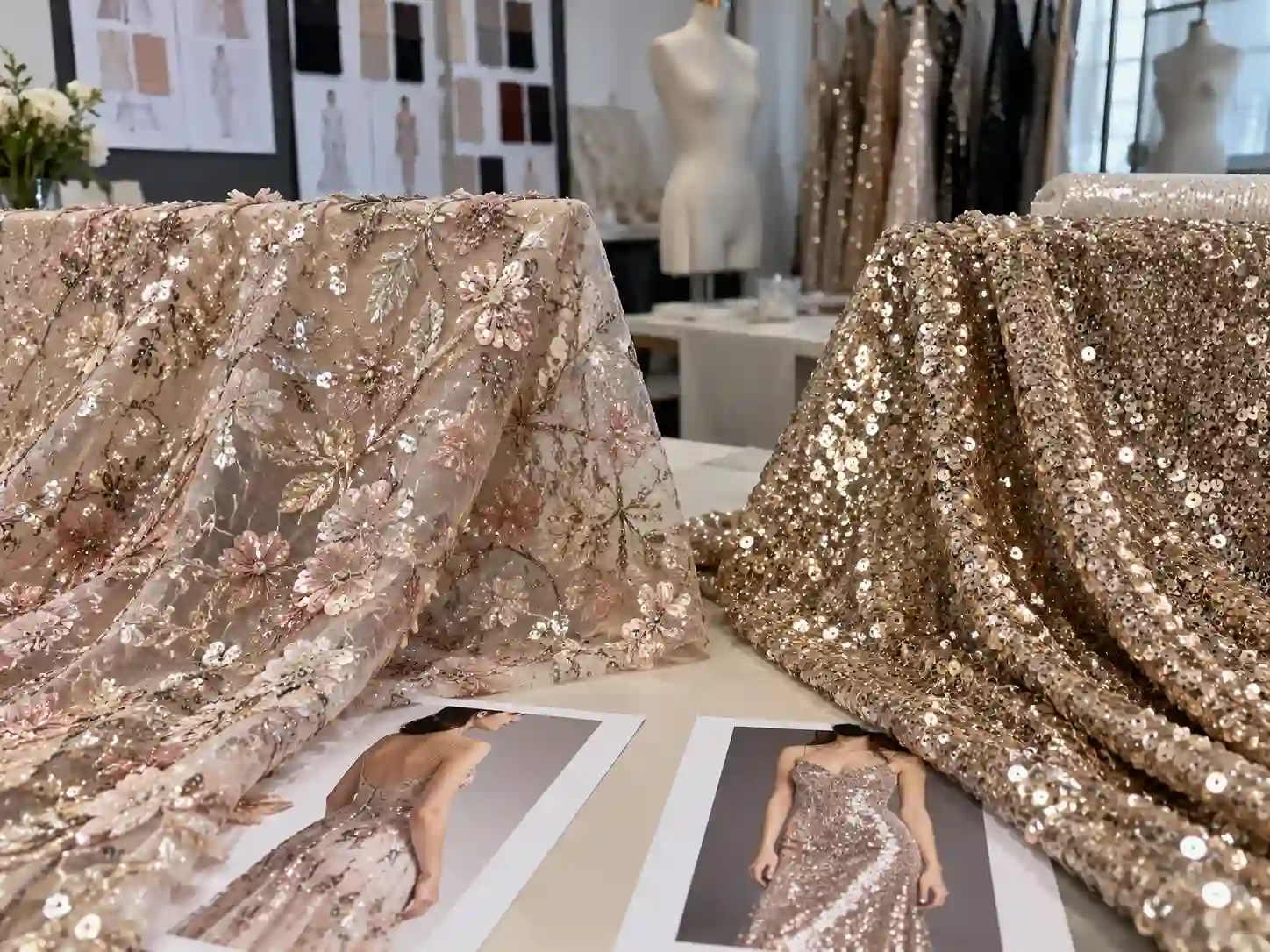
Structured garments introduce another level of work. A corset or strapless dress may need cups, boning, internal stabilization, secure closures, and repeated fitting decisions. Lace dresses can require careful motif placement and protected seam finishes, while sequin and beaded garments may need slower handling and extra checks for loose decoration. A short, heavily embellished dress can therefore cost more to manufacture than an unembellished maxi dress. Comparing prices only by hem length or product name misses the most important information.
Jinfeng Apparel’s dress development work covers satin, mesh, lace, sequin, bodycon, corset, occasionwear, and other custom styles. For each project, the practical questions are how much material is required, how difficult the pattern is, which operations must be completed, and what standard the approved sample establishes. These answers give a brand a more useful early budget than an unsupported market-average figure, especially when planning an assortment with several distinct silhouettes.
Is an Early Estimate a Final Factory Quote?
An early estimate is a planning figure based on stated assumptions. A formal quotation should be tied to confirmed materials, construction details, order quantities, packaging, and commercial terms. Suppose a brand submits only a photograph of a fitted satin dress. The picture may not reveal whether the bodice is lined, whether the skirt is cut on the bias, or what type of closure supports the back. A manufacturer can discuss possible costs, but it cannot responsibly price every hidden detail as though it were already approved.
During development, the brand may request a wider hem, heavier lining, a different zipper, or an additional color. Each change can affect material purchasing, sewing operations, or minimum quantities. A quote established before those decisions should be revised when the underlying specification changes. The same applies when an order changes from one color at 500 pieces to several colors with smaller quantities per color. Even though total volume appears similar, production and supplier conditions may be different.
For that reason, Jinfeng Apparel evaluates the design information, material availability, construction, order breakdown, and delivery requirements before confirming production pricing. A usable quote identifies the garment or style number, material basis, quantity, unit price, sample charges, MOQ, packing scope, trade terms, validity, and exclusions. Brands can then compare the quoted garment with the approved sample and technical documents instead of relying on a number that may have been calculated for a different product.

What Is Included in a Dress Manufacturing Quote?
A complete dress manufacturing quote accounts for main fabric, lining, trims, cutting, sewing, finishing, quality control, packaging, allocated overhead, and factory margin. Pattern development, samples, special testing, and logistics may sit outside the recurring production unit price. The important distinction is not whether every expense appears on a separate line, but whether the quotation defines precisely which materials, services, and delivery responsibilities are included.
How Are Materials and Fabric Consumption Costed?
Main fabric is often a substantial cost component, but price per meter is only half the calculation. The other half is the number of meters needed for the approved dress pattern and its cutting conditions. A fabric that is narrower, directional, or printed with a large motif may create a less efficient marker layout. Lace that has to match at a visible seam can require additional material. A fully lined dress must also account for the lining’s separate width, consumption, and price.
For example, 2.10 meters of satin at an illustrative $3.80 per meter costs $7.98, while 0.80 meters of lining at $2.40 adds $1.92. The combined $9.90 is not yet a garment cost; it excludes the zipper, other trims, sewing, inspection, and packaging. This example assumes the stated meterage already includes the applicable cutting allowance. If consumption is calculated from net pattern area instead, the correct loss or marker-efficiency factor must be incorporated once, not added repeatedly under several cost headings.
Trims deserve similar attention. Invisible zippers, hook-and-eye closures, cups, boning, elastic, labels, and decorative components can have different purchasing conditions. A standard component may be available immediately, whereas a custom color or special piece may involve a supplier MOQ or setup expense. Jinfeng Apparel evaluates fabric width, weight, drape, transparency, supplier availability, and trim suitability together because the cheapest component does not necessarily produce the best overall manufacturing result.
How Do Labor, Finishing, and Quality Control Add Up?
Cutting and sewing cost comes from the operations needed to turn material into an approved garment. Cutting involves spreading fabric, preparing a marker, cutting pieces, checking them, and separating sizes and colors. Sewing includes individual seams, attachments, hems, closures, reinforcement, and assembly of any lining or internal support. Factories may estimate these operations using standard allowed minutes and a defined costing rate, although the rate’s inclusions must be clear to avoid charging the same overhead twice.
Suppose an illustrative dress requires 35 sewing minutes and a direct-operation costing rate of $0.14 per minute. Its modeled sewing amount is $4.90. Adding 12 minutes of lining attachment at the same rate adds $1.68 per garment, or $840 over 500 dresses. Neither the minutes nor the rate is claimed as an actual Jinfeng Apparel benchmark. Real costing also needs to account for production efficiency, operator skills, machinery, and the method used to allocate indirect expenses.
Finishing and inspection are not optional extras when a dress is intended for consistent retail presentation. Satin can show pressing marks, chiffon hems can become uneven, and corset seams must hold the required shape. Incoming material inspection, cutting checks, sewing checks, garment measurements, appearance review, and packing verification all take time. Routine factory quality control may be included in the price, while independent laboratory tests or third-party inspections may need separate agreement. A quote is stronger when those boundaries are explicit.
What Does an Itemized Unit Cost Look Like?
An itemized model makes it easier to see where a price comes from and to test the effect of design changes. The following example describes a hypothetical satin midi dress produced in one 500-piece program. All dollar values are illustrative calculation inputs, not Jinfeng Apparel offers, supplier price lists, or verified industry averages. They are included to show how a purchasing team can connect materials and production operations to a factory unit price without mixing manufacturing expenses with shipping or development charges.
| Cost component | Illustrative basis | Cost per dress |
| Main satin fabric | 2.10 m × $3.80 | $7.98 |
| Lining | 0.80 m × $2.40 | $1.92 |
| Zipper and other trims | Assumed component budget | $1.35 |
| Cutting | Assumed operation allocation | $1.10 |
| Sewing | 35 min × $0.14 | $4.90 |
| Pressing and finishing | Assumed allocation | $0.80 |
| Routine quality control | Assumed allocation | $0.65 |
| Labels and standard packing | Assumed allocation | $0.70 |
| Remaining overhead and factory margin | Combined illustration | $3.10 |
| Modeled factory unit price | Before separately quoted project costs | $22.50 |
The modeled price includes the fabric allowance already assumed in the meterage, so a second arbitrary wastage percentage should not be added. The sewing line is treated as a direct-operation charge, while the remaining overhead allocation covers only expenses not already placed elsewhere. Pattern development, samples, optional testing, international freight, and import charges remain outside the table. Changing the production assumptions changes the result; the purpose of this model is transparency rather than suggesting that any satin midi dress should cost $22.50.
For a real quotation, the brand should ask whether routine inspection, standard private labels, carton packing, material wastage, and agreed finishing are included. A unit price with an incomplete scope is difficult to compare and may lead to extra invoices or disagreements after sample approval. A detailed specification and a clear list of exclusions are more valuable than a long cost sheet whose figures cannot be traced back to the approved garment.
Which Dress Features Increase Manufacturing Cost?
Dress features raise manufacturing costs when they require more fabric, extra components, complicated pattern pieces, longer sewing operations, or additional inspection. Common examples include internal corset support, multiple lining layers, ruching, pleats, lace matching, sequins, and hand embellishment. Fabric width, directional patterns, and special printing can also affect material efficiency, meaning design details often change several cost categories at the same time.
How Do Fabric Width and Construction Change Material Cost?
A dress can become more expensive without changing its silhouette if the replacement fabric has a different usable width or cutting behavior. A narrower fabric may leave more unused space between pattern pieces, while a material with a directional sheen may prevent certain pieces from being rotated. Large repeated prints and decorative motifs create further restrictions if the finished garment needs matching lines or consistent placement. The actual effect must be checked with a marker plan rather than guessed from the fabric description.
Imagine a pattern that requires 2.00 meters of one suitable fabric but 2.25 meters of another because of usable width and layout restrictions. At the same illustrative $4.20 per meter, the second option adds $1.05 to the main fabric cost per dress, or $630 across 600 pieces. This is a conditional calculation, not a general rule about narrow fabrics. Fabric weight can also influence cost, but heavier fabric is not automatically more expensive; fiber, finishing, supplier terms, and price per meter all matter.
Garment construction can multiply the material effect. A lined maxi dress may need separate lining pattern pieces, whereas a ruched bodice needs enough fabric to form its gathers. A dramatic ruffle or wider hem can increase consumption beyond what a flat product photograph suggests. Jinfeng Apparel reviews fabric behavior alongside the silhouette because material suitability and cutting efficiency should be considered before a design moves into bulk production.
Do Corset, Ruching, and Lining Require More Labor?
Corset and strapless dresses are particularly sensitive to internal construction. A bodice may require shaped cups, boning channels, stabilization layers, reinforcement, and a secure fastening system. Each component must fit the pattern and work with the garment’s fabric. Changes that appear minor on the outside can therefore introduce new sewing operations and fitting concerns. Removing support simply to lower cost can undermine comfort, coverage, and the ability of the finished garment to hold its shape.
Ruching increases time in a different way. Gathering must be distributed and fixed so the garment looks balanced on both sides and across sizes. Pleats may require careful positioning, pressing, or specialist processing, depending on their type and the material. Lining adds separate cutting, assembly, and attachment operations, as well as its own fabric expenditure. A partial lining can sometimes meet a garment’s coverage needs, but a structured bodice or transparent fabric may need fuller support or protection.
Consider an illustrative design revision that adds 15 direct-operation minutes. At $0.14 per minute, that is $2.10 extra labor per dress before the cost of new materials or additional inspection. At 500 pieces the modeled labor difference is $1,050. Jinfeng Apparel approaches such decisions by asking whether the added structure performs an essential function, improves the appearance enough to justify its cost, or can be simplified without compromising the approved product.
Are Lace, Sequins, and Custom Prints Expensive?
Decorative materials can increase costs through both the purchasing price and the care required during production. Lace may need pattern matching across seams or careful placement of motifs at necklines and hems. Sequin fabric can create challenges in cutting, sewing, needle selection, surface protection, and final inspection. Hand-applied beads or rhinestones add individual attachment operations that are difficult to evaluate using fabric consumption alone. The design must account for the time required to achieve a secure, consistent finish.
A hypothetical embellishment operation taking 20 additional minutes at $0.14 per minute adds $2.80 in modeled direct labor per garment. At 500 pieces, that is $1,400 before the price of the decorative materials, scrap allowance, and related inspection. A more economical alternative might use concentrated embellishment on the bodice instead of full coverage, although whether that preserves the design’s appeal must be judged on a physical sample rather than assumed from a spreadsheet.
Custom prints bring a different set of expenses. Artwork preparation, color approval, print method, supplier minimums, and placement requirements can affect cost. A print that must sit at a precise position on every bodice may reduce cutting efficiency compared with an all-over repeat. For large collections, custom printing may be commercially worthwhile because it creates a recognizable product. The sensible question is whether the distinctive appearance supports the planned retail positioning and expected sales volume, not whether specialized decoration can be eliminated entirely.

How Do MOQ and Order Size Affect Cost?
MOQ and order size affect purchasing efficiency, production setup, and the amount of development cost allocated to each garment. Larger volumes may improve some per-unit costs, but they also create greater inventory commitments. Jinfeng Apparel’s standard starting MOQ is 200 pieces per style/color, not 200 pieces across an entire collection. Special fabrics, custom colors, trims, and packaging may have additional supplier minimums.
What Does 200 Pieces per Style/Color Mean?
A minimum order quantity defines the smallest quantity normally accepted under specified production conditions. For Jinfeng Apparel, the stated starting point is 200 garments for each style and each color, subject to material availability, construction complexity, and scheduling. This means 200 black dresses of one approved style may meet the basic quantity threshold, but 100 black dresses and 100 red dresses of that same style ordinarily do not meet the per-color minimum. Similarly, several different designs cannot simply be added together to satisfy the requirement.
The numbers become clearer with a collection example. If a brand orders a satin midi dress in black, red, and navy at 200 pieces each, the total is 600 pieces. Sizes can be distributed within each confirmed style/color quantity according to the approved size ratio. A hypothetical black-dress allocation might be 20 XS, 40 S, 60 M, 50 L, and 30 XL, totaling 200. This distribution is only an arithmetic example; it is not a suggested size curve for every market.
Material suppliers may impose separate conditions. Custom dyeing, proprietary prints, certified fabrics, unusual lace, and specialized packaging may require quantities higher than the garment minimum. For established brands, the practical approach is to plan finished-garment quantities and material commitments together. An order strategy that focuses on priority colors and commercially tested styles can be more manageable than launching numerous variants that each struggle to meet purchasing and production minimums.
What Changes at 200, 500, and 1,000 Pieces?
Order volume affects two different financial questions: what the factory charges to produce each garment, and how one-time development expenses are allocated within the overall project. These should be kept separate. The first may change with purchasing terms, line efficiency, and production scheduling. The second decreases mathematically as a fixed budget is distributed across a larger quantity, even if the actual manufacturing unit price stays unchanged.
Assume a purely illustrative factory price of $22.50 per dress and a separate fixed development budget of $1,200 for the project. With no change in the production price or other conditions, the effective cost per garment moves as shown below. This table does not claim that Jinfeng Apparel offers these rates or that factories provide a guaranteed discount at specific quantities; it demonstrates how allocation works when all other inputs are held constant.
| Order quantity | Manufacturing total | One-time development | Project total | Effective cost per dress |
| 200 pcs | $4,500 | $1,200 | $5,700 | $28.50 |
| 500 pcs | $11,250 | $1,200 | $12,450 | $24.90 |
| 1,000 pcs | $22,500 | $1,200 | $23,700 | $23.70 |
The table shows a lower effective figure at higher volume because the same $1,200 is spread over more pieces. It does not show the impact of higher freight, storage, inventory financing, or unsold garments. A brand should not order 1,000 pieces purely to achieve a $1.20 lower allocation than at 500 pieces if demand is uncertain. In a seasonal collection, sell-through expectations and replenishment flexibility can matter as much as the theoretical unit-cost improvement.
Do Colors, Sizes, and Repeat Orders Change Pricing?
More colors can add supplier coordination and production complexity because fabric purchasing, shade approval, cutting separation, labels, and carton records may need to be managed individually. A 600-piece design split into three colors at 200 each fits the stated starting structure more naturally than the same total spread across four colors at 150 each. Custom dyeing may create additional minimums, while stock fabric colors can sometimes simplify purchasing. The right launch assortment should reflect the brand’s sales records and the supplier’s actual material conditions.
Size ranges also affect work, although adding a size does not automatically add a fixed surcharge to every garment. The pattern must be graded, markers adjusted, measurements controlled, and pieces packed correctly. Extended sizes may require additional fabric consumption or fitting review. The appropriate size distribution is the one supported by the target market and product’s established fit, rather than a generic ratio copied from an unrelated collection.
Repeat orders can reduce some development effort when an approved pattern, fabric reference, trim specification, and packaging instruction remain valid. Jinfeng Apparel supports continuing collection work by retaining relevant pattern, measurement, material, and packing records. A repeat production run still requires fresh checks where materials, suppliers, colors, or specifications have changed, and its quote may move with current purchasing conditions. The long-term advantage is often the ability to reproduce the intended dress consistently rather than a guaranteed reduction in every future unit price.

What Extra Costs Are Often Overlooked?
A dress factory’s unit price may exclude one-time development, sample revisions, specialist testing, independent inspection, custom packaging setup, international transport, and import-related charges. These costs can materially change the total project budget even when the garment price stays constant. The safest approach is to identify each expense, who is responsible for paying it, and whether it is already covered by the agreed trade terms.
Are Pattern Development and Sampling Separate Expenses?
Pattern making and sampling take place before repeatable bulk manufacturing is ready to begin. Pattern development translates a concept into pieces that can be cut and sewn, while the sample tests fit, construction, material behavior, and appearance. A structured corset may need a more involved development process than a loose-fitting, unlined dress. Fit adjustments, alternative fabrics, and changes to the neckline or hem may require revised samples, each with its own technical and material demands.
Jinfeng Apparel charges for samples rather than treating all development as free. Depending on the project and qualifying bulk-order conditions, sample fees may be credited against a subsequent production order that meets the applicable MOQ. This is not an unconditional refund, and it should be confirmed as part of the agreed terms. Sample courier charges and special material sourcing may also need separate consideration, particularly where components are ordered specifically for the project.
A brand’s budget should distinguish the first sample, fit revisions, pre-production approval, and any additional showroom or photographic samples. It is also useful to record which revisions result from changed design preferences and which relate to bringing the original specification into agreement. Establishing these boundaries early reduces misunderstandings and makes development expenditure easier to manage. The aim is to approve a garment that can be manufactured consistently, not simply to minimize the cost of the first physical sample.
What Do Labels, Testing, and Inspection Add?
Private-label details can be easy to overlook because individual components seem inexpensive. Yet a finished dress may need a main label, size label, care label, hangtag, barcode sticker, individual polybag, and correctly identified export carton. Some retailers add warehouse receiving labels, protective tissue, or specific carton assortments. If illustrative packaging specifications add $0.60 per piece, the cost increases by $300 for 500 pieces or $1,200 for 2,000 pieces, before any one-time artwork or material setup charges.
Testing and inspection should be distinguished from routine garment checks. A factory’s quality system may cover incoming fabrics, cutting, sewing, measurements, finishing, and packing. A brand may separately require laboratory testing for colorfastness, dimensional stability, composition, or substances relevant to its destination market. An outside inspection agency may also be asked to examine goods before dispatch. Testing requirements vary by product and jurisdiction, so no single checklist can be assumed appropriate for every dress or destination.
The commercial question is whether the quote includes the requested tests, inspection services, sample submissions, and any necessary retesting. Jinfeng Apparel supports project-specific quality control and private-label packaging, but special testing or third-party services require an agreed scope. Brands should also confirm who supplies label artwork and how care instructions, product information, and barcode data will be approved. Clear documentation avoids last-minute packing changes that can delay a shipment or generate additional charges.
How Do Trade Terms and Shipping Change Total Cost?
A garment priced EXW does not carry the same delivery responsibilities as one priced FOB or DDP. Under Incoterms 2020, EXW generally makes goods available at a named place, leaving the purchaser with extensive onward responsibilities. FOB applies to sea and inland waterway shipments and covers delivery of goods on board the vessel at the named port. DDP places extensive destination-delivery and import-clearance responsibilities on the seller. For containerized freight handed to a carrier before loading, FCA may be more suitable than FOB depending on the arrangement.
This difference matters when two factories appear to have widely separated prices. One quote may cover only the factory handover while another includes export handling or longer-distance delivery. Neither figure establishes the final destination cost until freight, insurance where applicable, customs brokerage, duties, taxes, destination handling, and final transport have been assessed. Import charges should be estimated using the shipment’s actual classification, origin, destination, and current rules rather than an invented flat percentage.
Jinfeng Apparel can assess shipment arrangements according to the project’s destination and delivery requirements, including coordination with a client-nominated forwarder. The brand should confirm the exact Incoterms rule and named place, which party arranges each transport leg, and which charges are already included. For time-sensitive collections, the cheapest freight option is not necessarily commercially preferable if it misses a critical sales window. A split shipment may sometimes balance urgency and cost, but only when the numbers and schedule support it.
How Can Brands Compare Quotes and Control Costs?
Brands should compare factory quotes against identical approved specifications, quantities, quality requirements, packing instructions, and delivery terms. Cost control works best when it improves fabric yield, reduces unnecessary sewing operations, or simplifies sourcing without damaging fit or appearance. A reliable decision combines the quoted unit price with one-time development, logistics, import charges, and realistic sales expectations rather than selecting the lowest number alone.
What Information Makes a Quote Comparable?
A clear technical pack is the foundation of a useful quotation. It should identify the garment’s silhouette, construction, materials, measurements, grading requirements, trims, and finishing. Photographs are helpful, but they rarely reveal the lining, internal support, seam finishes, or tolerances needed to cost the garment accurately. A reference sample, fabric swatch, bill of materials, or approved trim card can fill in details that a photograph cannot show, while a specific order breakdown clarifies the expected production scale.
A fashion brand requesting comparable quotations should specify the same information to each supplier: style number, main fabric and lining specifications, color list, size distribution, quantity per style/color, labeling and packing instructions, testing requirements, target completion date, and preferred trade terms. If some choices are not final, they should be identified as assumptions. A quote based on a lower-weight fabric or a simplified lining should be described as an alternative, not quietly compared with the original design as though nothing changed.
Jinfeng Apparel’s quotation process starts with product information, continues through construction and material evaluation, and considers production operations and quantities before issuing a price and its conditions. Brands also benefit from asking what will trigger a revision: fabric substitution, changes to the approved pattern, smaller color lots, additional testing, or a revised shipping arrangement. This turns a factory quotation into a practical working document that can support sample approval, purchasing decisions, and later production reviews.
Which Cost Changes Protect Quality and Appearance?
Not every cost reduction is worth making. Removing essential corset support, weakening a zipper specification, or eliminating necessary lining can create visible defects or a poor wearing experience. Better opportunities often come from selecting a commercially suitable stock fabric, reducing decorative operations that contribute little to the design, sharing standard trims across related styles, or improving marker layouts. These measures need to be evaluated on approved samples so that financial savings do not come at the expense of the finished product.
A fabric-efficiency calculation shows the value of a small improvement. If a pattern adjustment reduces planned consumption by 0.10 meters per dress and the material costs $4.20 per meter, the saving is $0.42 per garment, or $420 across 1,000 pieces. This is only valid if fabric grain, drape, motif placement, and fit remain acceptable. A theoretical saving that causes fabric distortion or increased rejection may not be a saving at all once production problems are considered.
Jinfeng Apparel evaluates fabric substitution, pattern and construction adjustments, suitable trim alternatives, color consolidation, and production planning as ways to control cost without weakening the intended brand presentation. For example, selective embellishment may retain the visual focal point of a party dress while reducing handwork elsewhere. A partial lining may be suitable in one design but unacceptable in another. The useful standard is whether the revised garment still meets the approved fit, appearance, durability, and quality requirements.
How Do Landed Cost and Retail Margin Fit Together?
A manufacturing quotation becomes a reliable commercial plan only when the brand knows what it will cost to receive the garments at the required destination. Landed-cost calculations typically consider factory charges and the applicable shipping, insurance, duties, customs, and delivery expenses, while accounting treatment may determine whether development expenses and certain taxes belong in inventory cost. Charges already included in a quoted trade term must not be added again. The correct model depends on the brand’s contract and destination rules.
The following scenario continues the hypothetical $22.50 factory-price example for a 500-piece order. It assumes a separate $1,200 development budget, $1,150 freight budget, and $1,050 import and destination budget. These are planning figures, not verified rates, taxes, or Jinfeng Apparel customer records. They also assume none of the additional amounts is already included in the factory quotation, so the arithmetic can be followed without overlapping cost categories.
| Project cost | Total for 500 dresses | Allocated per dress |
| Factory production | $11,250 | $22.50 |
| Development budget | $1,200 | $2.40 |
| Assumed freight | $1,150 | $2.30 |
| Assumed import and destination expenses | $1,050 | $2.10 |
| Modeled total project cost | $14,650 | $29.30 |
If the dress sells for an illustrative $69, the simple margin on the modeled $29.30 cost is ($69 − $29.30) ÷ $69, or approximately 57.5%. That is not the brand’s final profit margin: payment fees, marketing, fulfillment, returns, markdowns, and business overhead can reduce the result. In addition, a brand may account for certain development spending or recoverable taxes differently. The number is useful as a decision model only when its scope is stated clearly and applied consistently across styles.
A purchasing team should test the model at more than one selling price and sales volume. A seasonal dress that looks profitable at its full retail price may perform differently after markdowns or a slower-than-expected sell-through. For a long-term collection, the strongest manufacturing decision balances attractive design, a realistic production quantity, product consistency, and enough margin to support the brand after the goods leave the factory. That is also the basis for a productive discussion with Jinfeng Apparel about material options, construction details, and the cost of an approved design.
A dependable production budget is built one decision at a time. The design determines materials and operations; the order plan shapes purchasing and factory efficiency; the delivery agreement determines which logistics costs belong to each party. When these details are agreed before bulk production, brands gain more than a clearer price. They gain a better chance of receiving garments that match the approved sample, fit their target market, and arrive ready for the intended sales channel.
Since 2008, Jinfeng Apparel has focused on custom women’s fashion manufacturing, supporting pattern development, fabric sourcing, sampling, bulk production, quality control, private-label packaging, and export coordination. Its model is intended for brands with defined products and genuine production plans, rather than ready-stock purchasing or single-piece fulfillment. For a fashion team planning its next dress collection, the most useful factory conversation starts with the design, desired quality, quantity by style and color, and a realistic target cost. A transparent quotation should make every subsequent product decision easier to evaluate.
Frequently Asked Questions
How much does it cost to manufacture one custom dress?
There is no dependable universal price because a custom dress can range from a simple unlined knit style to a structured or heavily embellished garment. Its cost depends on fabric quantity and price, trims, construction time, inspection, packaging, and order volume. Early estimates may help with budgeting, but a formal price should be linked to a defined technical specification and production quantity. Illustrative examples in this article explain the calculation; they are not supplier quotations.
What is the minimum order quantity for custom dresses?
Jinfeng Apparel’s published starting MOQ is 200 pieces per style/color, subject to the design, material availability, and production arrangements. It is not 200 pieces across multiple unrelated styles or a combination of colors below the individual minimum. Custom-dyed fabric, special prints, unusual trims, and branded packaging may also have separate supplier minimums. A collection plan should confirm garment quantities and material sourcing conditions before the brand approves development and bulk production.
Is custom dress sampling included in the bulk price?
Sampling is generally a distinct development stage because creating a first garment requires pattern work, material preparation, cutting, sewing, checking, and often fit corrections before mass production is possible. Jinfeng Apparel charges sample fees separately, although a fee may be credited against a qualifying bulk order under agreed project conditions. Brands should clarify the number of sample rounds, the cost of design changes, any special materials, and sample shipping rather than assuming unlimited revisions or unconditional refunds.
Does a higher order quantity always reduce the dress price?
A larger order can spread certain development and setup expenses across more garments and may improve purchasing or factory efficiency. It does not guarantee a lower production price in every situation, particularly when materials, color splits, construction, or delivery schedules change. Higher volume also increases cash committed to inventory and may create markdown risk if demand is overestimated. Brands should compare effective project cost with expected sell-through rather than treating the largest possible order as automatically the best choice.
What is usually excluded from a dress factory quotation?
Exclusions depend on the supplier and the agreed trade terms, so the quotation must be read rather than guessed at. Items that may be separate include pattern development, sample revisions, special testing, independent inspection, custom packaging setup, freight, insurance, customs brokerage, duties, taxes, and final delivery. A factory price under EXW is not equivalent to a price under FOB or DDP. Asking for the exact scope and exclusions prevents misleading comparisons between suppliers.
How can a fashion brand lower dress manufacturing costs without reducing quality?
Cost control often begins with reviewing fabric efficiency, unnecessary construction operations, material sourcing, and the number of colors or special components. A suitable stock fabric may avoid custom-dye minimums; improved cutting layouts may reduce consumption; and selected decoration may preserve a design’s appeal with less handwork. Every proposed change should be checked against an approved sample, including its drape, fit, opacity, support, and durability. Cutting essential lining or inspection merely to obtain a lower quote can create more expensive problems later.
How do I calculate the landed cost of a custom dress?
Start with the agreed manufacturing charges and add the applicable freight, insurance, customs, duties, nonrecoverable taxes, and destination costs that are not already included in the trade term. For internal commercial analysis, a brand may also allocate development spending across its order, while accounting treatment should be confirmed separately. Divide the relevant total by the number of saleable garments to obtain a per-piece planning figure. This cost can then be compared with the intended selling price and expected markdowns to test the collection’s economics.