Skip to content

Red-Carpet Dress Development
From high-impact gown concepts to production-ready occasionwear for established fashion brands and multi-style collection programs.
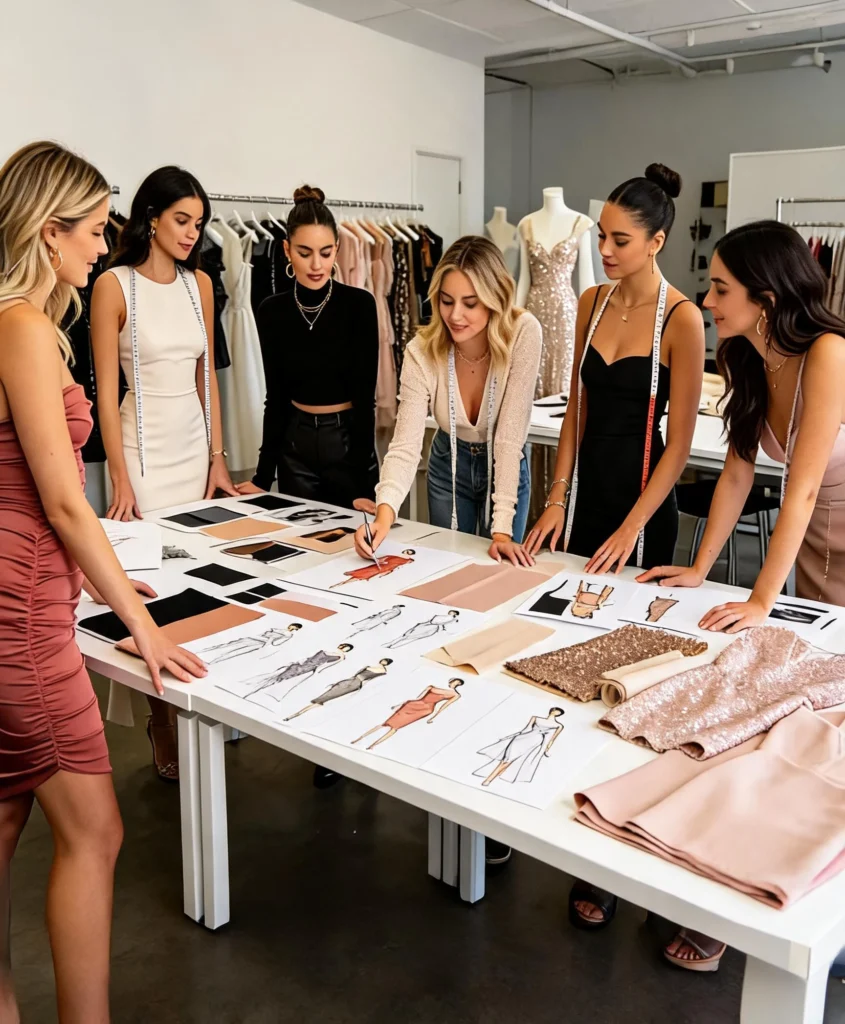
Jinfeng Apparel develops red-carpet-inspired dresses where visual impact must be supported by sound pattern work, fabric behavior, internal structure and repeatable manufacturing standards.
- Since 2008 in custom women’s fashion development and production.
- 2 sample rooms, 7+ senior pattern makers and 20+ sample machinists support development, revisions, photo-ready samples and PP samples.
- Evening and formal styles are developed around bust support, waist position, gown length, slit height, lining structure and fabric behavior.
- Complex satin, mesh, lace, sequin, tulle, organza, velvet and corset-based styles can be reviewed from development through bulk production.
- 15+ QC inspectors cover material, in-line, garment and packing inspection across the production system.
Built for Brands Developing High-Impact Occasionwear
Occasionwear Brands
Product Development Teams
Premium Fashion Collections
Development Resources Behind Complex Dress Programs
Since 2008
2 Sample Rooms
7+ Pattern Makers
20+ Sample Machinists
15+ QC Inspectors
Multi-Factory Production
Where Red-Carpet Dress Development Usually Goes Wrong
Silhouette Loses Impact
Bust Support Fails
Fabric Changes the Design
Movement Exposes Problems
Surface Details Become Unstable
Sample Quality Cannot Scale
From Statement Concept to Production-Ready Gown
Red-carpet development works best when each decision is made in sequence. Starting production before structure, fabric and sample standards are settled increases the chance of expensive revisions later.
Start with the Design Logic
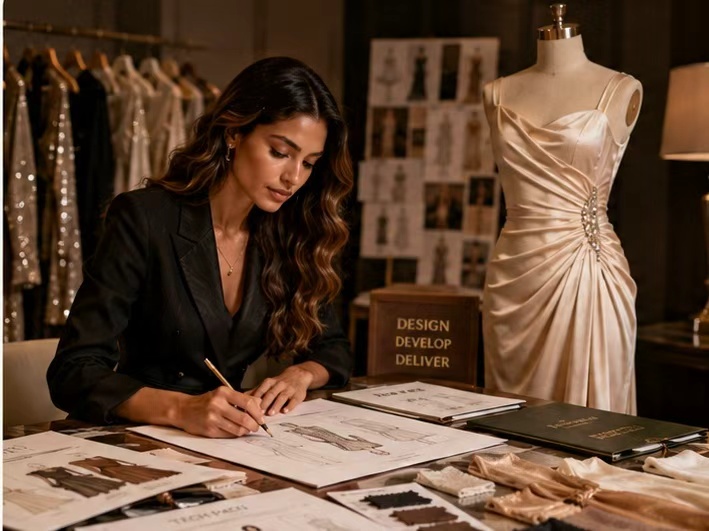
Development can begin from a tech pack, sketch, line sheet, reference image or original garment.
The first review should identify the style’s visual anchors: neckline, shoulder line, bust shape, waist position, hip line, volume, slit, train, transparency, embellishment and overall proportion. Not every reference detail should be copied mechanically. Some elements may require reinterpretation because the selected fabric, size range or target production method behaves differently from the original visual reference.
Fabric and structure are reviewed at the same stage. A draped satin gown requires sufficient fluidity; a corset dress needs a base fabric and lining combination capable of holding structure; a sheer mesh section needs an intentional transparency plan; a sequin gown needs seam and skin-contact control. Early review also considers whether specialty trims, custom colors or particular materials may create separate MOQ or lead-time requirements.
Build the Development Sequence
Once the style direction is workable, development moves through pattern preparation, material and trim readiness, sample cutting, sewing, internal measurement review, fitting observation, pressing and visual assessment. Comments should identify the exact issue rather than use broad feedback such as “make it fit better.”
A useful development path is:
Reference / Tech Pack → Structure Review → Fabric Direction → Pattern → First Sample → Fit & Visual Review → Revision → Revised Sample → PP Sample → Production Standard → Bulk Production → QC
A change in fabric, neckline, boning, cup position, slit height or length may require pattern updates. A change in pattern may alter consumption or sewing time. Development therefore remains connected to costing and production rather than operating as a separate creative exercise.
Lock the Standard Before Bulk
Production should begin from a confirmed standard rather than from memory of the last fitting.
The approved pattern, measurement file, fabric reference, trim specifications, construction notes, label requirements, packaging instructions and PP or sealed sample create the reference set for bulk.
For complex eveningwear, the production standard may also identify neckline position, cup and boning locations, slit level, lining coverage, train or floor-length reference, sequin or lace placement, pressing expectations and protection needed during packing.
Clear standards reduce the risk that a visually refined sample becomes inconsistent when different operators and production stages are involved.

Red-Carpet Silhouettes We Can Develop for Collections

Structured Corset Gown
Corset gowns depend on bust support, cup position, boning, lining and waist shaping. The outer fabric must work with the internal structure rather than fight it.
Sampling focuses on bust height, neckline security, torso length and the transition from fitted bodice to skirt. Bulk checks need to keep the boning and cup positions consistent across sizes.

Draped Satin Gown

Sheer Mesh Gown

Sequin Statement Dress

High-Slit Evening Gown

One-Shoulder Gown

Backless Column Dress

Floor-Length Train Gown
Train development requires control of overall length, hem sweep, fabric weight and movement. The train should extend the silhouette without pulling the bodice backward or becoming disproportionately heavy.
Sampling is used to evaluate walking, turning, floor contact and how the gown will be folded or protected during packing.
Fabric Direction Shapes the Entire Red-Carpet Result
The same pattern can look elegant, rigid, inexpensive, unstable or completely different when executed in another fabric. Material selection therefore happens as part of development, not as a purchasing step after the design is already fixed.

Satin for Controlled Shine and Drape
Satin is a major eveningwear direction because it can create clean light reflection, fluid movement and a polished surface. Jinfeng Apparel works with satin and stretch satin directions according to silhouette and fit requirements.
A bias-like or draped gown needs sufficient softness and fall, while a structured bodice often benefits from a heavier or more stable quality.
The main risks are visible quickly under strong light: snagging, wrinkles, seam puckering, shade differences, pressure marks and inconsistent shine direction.
Pattern pieces need appropriate grain direction, and cutting and sewing handling must protect the face of the fabric. Lining also affects the way satin hangs; a stiff or poorly matched lining can make a fluid outer layer look rigid.
Sample review should include front, back and side views after pressing, not only immediately after sewing. Bulk fabric approval should consider color, surface consistency and whether replacement lots visually match the approved sample.

Mesh, Tulle and Organza for Transparency and Volume
Sheer fabrics are often used to create illusion necklines, exposed panels, layered skirts, soft volume and sculptural shapes. Mesh and power mesh add varying levels of stretch, while tulle and organza can create more volume or firmness. Each choice changes the construction method.
Development should define the exact transparency level rather than simply specify “mesh.” Skin-tone lining, double layers, partial lining or power mesh reinforcement can create very different visual results. Stretch direction matters around armholes, necklines and cut-outs because an unstable edge can grow during sewing and cause a wavy appearance.
For layered skirts, volume must be controlled through fabric stiffness, number of layers and panel shape. Extra layers increase consumption and packing volume. Before bulk, the approved sample should establish layer count, lining length, seam treatment and how the material is protected from snags.
Lace and Sequin for Surface Identity
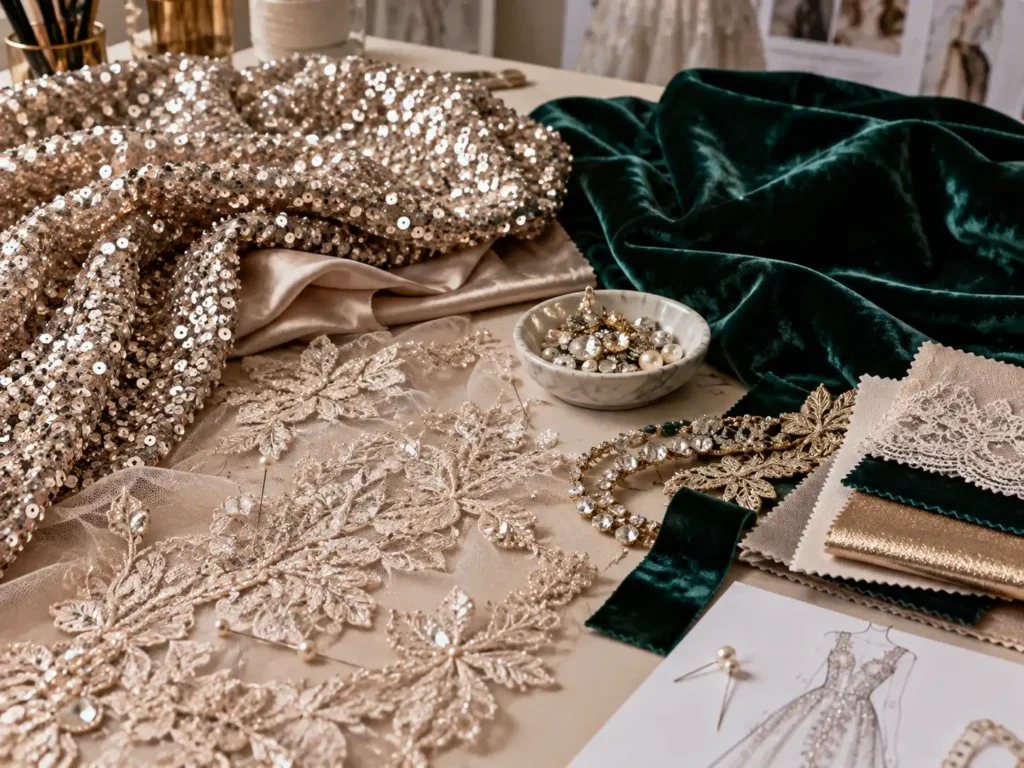
Lace and sequin materials create strong close-up detail but require more controlled placement. Lace motifs may need alignment across seams, bodice panels or neckline edges. A small shift can make two garments appear noticeably different. Some lace also requires an underlying lining or mesh base to support transparency and comfort.
Sequin fabric introduces additional concerns: dropped sequins, sharp edges against skin, thick seam allowances, broken needles during sewing, heavy garment weight and crushing during packing. Areas around armholes, side seams and waist seams deserve special attention because the body repeatedly contacts them.
For both materials, development should determine whether the surface design is all-over or placement-sensitive. Placement-sensitive fabrics may increase consumption because cutting positions cannot be optimized as aggressively as plain fabric.

Fabric Approval Before Production
A fabric is not approved simply because its name matches the tech pack.
Development review should consider composition, weight, width, stretch, hand feel, drape, transparency, color, shrinkage risk, surface behavior, MOQ and lead time.
When an original material is too expensive, unavailable or unsuitable for production,
Jinfeng Apparel can review alternatives based on the required visual effect and structure. A replacement should be treated as a new development variable.
Changes in weight, stretch or drape may require a revised pattern or sample even when the replacement looks similar on a swatch card.
Internal Structure Creates the External Silhouette
The cleanest red-carpet silhouettes often depend on components that are barely visible from outside. Cups, boning, lining, underwire, anti-slip support, closures and reinforcement determine whether a dress stays where the design intended.
Bust and Corset Support
Corset and bustier structures need more than added boning. Cup shape, cup position, underbust line, boning length and waist position must work with the wearer’s torso. If the cup sits too high or too low, the neckline changes. If boning ends at an awkward point, pressure can become uncomfortable or visible from outside.
Jinfeng Apparel can develop dresses with bra cups, boning, underwire and lining according to the style. Sample fitting is used to judge support, visual proportion and comfort. For strapless or deep-neck styles, support cannot rely only on tightening the body measurement; internal engineering must carry part of the load.
Bulk production instructions should fix cup and boning positions relative to pattern points. Consistency matters because a one-centimeter positional shift can visibly change the upper body of a closely fitted dress.
Lining as a Structural Layer
Lining affects opacity, comfort, movement, seam concealment and silhouette. It can also stabilize delicate outer materials. Satin, lace, mesh, sequin and velvet styles may each require a different lining decision.
A lining that is too short can become visible through a slit. A lining that is too tight can pull the outer skirt upward. A lining with excessive stiffness can reduce the movement of chiffon or satin. In corset gowns, internal layers may also support boning and cups.
Development therefore defines lining coverage and length as part of the sample standard.
Bulk QC checks need to confirm that lining is not twisting, showing through openings or changing the approved outer silhouette.
Closures and Security
Invisible zippers, metal zippers, hooks, anti-slip tape, strap sliders and other components influence fit and wearing security.
A zipper on a fitted satin gown must close smoothly without creating a ridge. Hooks at the top of a zipper can reduce stress on the closure. Anti-slip support can assist selected strapless shapes when appropriate.
Trim selection is controlled by size, color, strength, comfort and compatibility with the garment.
Decorative solutions cannot compromise function. A red-carpet-inspired dress still needs to survive dressing, walking, sitting and repeated wear without the closure system distorting the approved shape.

Draping, Volume and Train Need Movement Control
A gown is not a static object. Draped folds, asymmetric volume, layered skirts and trains change as the wearer moves, which makes movement an important development condition rather than an afterthought.
Control Draped Lines
Draping may appear spontaneous, but repeatable production needs reference points. The development sample should establish where folds begin, where excess fabric is controlled and how each draped area relates to the waist, hip, shoulder or neckline.
Fabric behavior becomes critical. Softer satin can collapse into fluid folds, while firmer fabric creates stronger sculptural shapes. Increasing fabric quantity does not automatically create better drape; excessive weight may pull the neckline or waist downward.
For production, major drape positions can be translated into pattern shape, notches, stitch points or sewing instructions. The goal is to retain controlled variation without making every garment dependent on one operator improvising the folds.
Balance Volume Against Proportion
Volume needs to support the wearer rather than overwhelm the body. Layer count, panel width, gathering, pleats, organza stiffness and tulle density all influence final scale.
A dramatic skirt attached to a narrow bodice also changes stress at the waist seam.
The bodice may need reinforcement so the skirt weight does not distort the waist. Large volume further affects material consumption, pressing and carton volume.
Sampling should judge the gown at full length. A skirt that looks balanced on a table may appear disproportionately heavy once the bodice is fitted on body.
Develop the Train as a Functional Element
Train length is part of the visual identity, but it also affects mobility and logistics. The development team needs to evaluate the relationship between front floor length, back extension, hem sweep and fabric weight.
A train that is too heavy can pull the entire dress backward. One that is too narrow may twist rather than fan naturally. Lining and outer fabric need compatible lengths so the lining does not peek out during movement.
Packaging also changes with long gowns. Folding positions, surface protection and pressing standards should be considered before bulk because poor packing can create hard creases across satin, velvet or structured trains.
Neckline and Body Proportion Drive the Fit
Red-carpet-inspired gowns often expose more structure than everyday dresses. A small error at the neckline, bust, waist or slit can dominate the entire visual result, especially in fitted or floor-length silhouettes.
Bust, Underbust and Neckline
Bust fit cannot be judged by bust circumference alone.
Cup position, underbust line, cleavage depth, neckline width and torso length influence how the upper body is shaped.
Deep-V and strapless designs require particular attention because a neckline can become unstable when the wearer moves. Internal support, tape, cups, boning or lining may help depending on construction.
Sample comments should identify whether the issue is circumference, vertical position or structure instead of simply reducing measurements.
Waist and Hip Balance
The waistline is a visual anchor. Moving it upward or downward changes leg proportion and skirt volume.
Corset gowns often need a precise relationship between underbust, waist and high hip so the bodice does not roll, compress unevenly or sit above the intended position.
Hip measurements also influence slit opening and side-seam balance.
A floor-length column gown with insufficient hip ease can pull diagonally and change the position of the slit. A fitted skirt with excessive ease can lose the intended red-carpet line.
Length, Slit and Hem Sweep
Key length measurements may include full dress length, waist-to-floor length, front hem position, back hem or train extension, lining length and slit height.
Slit position should be assessed on body and during movement. Hem sweep needs enough width for walking while staying compatible with the silhouette. A column dress, mermaid shape and full A-line gown require very different sweep allowances.
Brands can provide their own size charts and measurement tolerances. Development then converts the approved sample into graded patterns and measurable QC points rather than assuming one sample size can be enlarged proportionally in every area.
Embellishment and Trim Control the Final Finish

Lace Placement
Lace motifs may require alignment at neckline edges, bodice seams, waist joins or sheer sections.
Development defines where visual continuity matters most and where cutting tolerance is acceptable. Lining color and edge finishing are reviewed at the same time.
Sequin Security
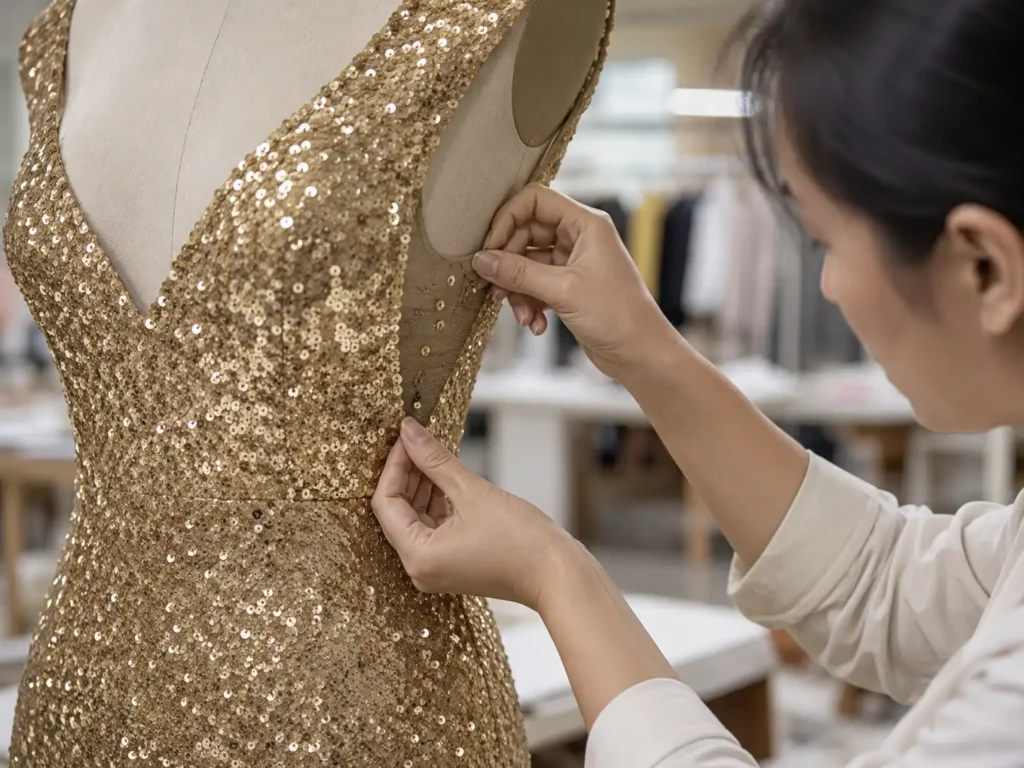
Sequins can detach during cutting, sewing and handling. Seam allowances may need local clearing where thick layers make sewing unstable.
Skin-contact zones are reviewed for scratch risk, while final packing needs to protect the surface from pressure and abrasion.

Rhinestone Details

Zipper Flatness

Cups and Boning

Lining and Protection
Pattern Development Turns Visual Ideas into Garments
Pattern development is where proportion becomes measurable. For complex eveningwear, the pattern needs to express the intended silhouette while leaving enough control for fitting, grading, sewing and later production.
Build the First Pattern Around the Style
The first pattern starts from the garment’s structural logic rather than from generic dress blocks alone. A corset bodice, asymmetric neckline, fitted column skirt and layered tulle gown each demand different pattern strategies.
The development review identifies major control areas such as bust position, waist seam, high hip, shoulder balance, neckline, armhole, slit, lining and full length. For long dresses, hem balance requires attention because slight pattern distortion becomes more visible across a long vertical line.
Fabric is considered at the same time. Stretch satin may need different ease from non-stretch satin. Mesh may need stabilization around openings. Velvet requires nap direction. Sequin placement can affect cutting layout. The pattern therefore develops together with material behavior.
Convert Fitting Comments into Pattern Changes
Useful fitting feedback identifies the cause of the problem. A loose neckline may need a neckline-pattern correction rather than an overall bust reduction.
A twisting skirt may relate to grain, hip balance or side-seam shape. A high slit may need a positional change rather than additional lining alone.
Jinfeng Apparel tracks revision information such as sample version, client comments, modified area, measurement change, pattern impact, material impact, construction impact and whether another sample is required.
Clear revision records reduce a common risk in multi-style programs: the sample changes, but the pattern or production instruction remains on an earlier version.
Prepare for Grading and Bulk Measurement
An approved sample is only one size. Production needs a grading strategy that protects key design proportions as the size range changes.
Not every point should grow at the same rate.
Bust shaping, neckline depth, strap length, corset height, slit height and floor length may need controlled grading rather than mechanical enlargement. Brands can provide established size specifications, while
Jinfeng Apparel can review how style details relate to the provided measurements.
Bulk QC then checks measurable points against the approved specification instead of relying only on visual judgment.

Sampling Is Where the Gown Earns Approval
Complex dress development rarely depends on a single sample. Each version should solve defined issues and move the style closer to a stable production standard.

First Sample
The first sample validates the main idea: silhouette, fabric behavior, structure, major measurements, neckline, waist position, slit, length, lining and construction feasibility.
A first sample is not expected to hide every development issue. Its value is identifying which elements work and which need correction before more material and production time are committed.
For red-carpet-inspired gowns, visual review should include front, back and side views as well as close-ups of neckline, zipper, lining, corset details, embellishment and hem.

Revised Sample
Comments from the first fitting are converted into specific changes. Revisions may affect measurements, paper patterns, fabric, trims, support components, sewing method, cost or development timing.
Examples include lowering a cup, raising a neckline, balancing a train, shortening lining behind a slit, adjusting boning length, changing satin quality or improving sequin comfort.
If a fabric or structural change materially affects the fit, a revised sample may be more reliable than moving directly to production approval.

Photo-Ready and Fit Review
For visually led collections, a sample may also be evaluated for photography and video.
Strong lighting can reveal satin puckering, visible lining, uneven ruching, loose mesh or poorly aligned embellishment that is less obvious during a quick fitting.
Pressing quality is also assessed because a photograph often magnifies creases and seam impressions.
A polished sample should therefore be reviewed after finishing, not only immediately after sewing.

PP and Sealed Standard
A PP sample establishes the version intended for production. Final confirmation should cover approved fabric and color, pattern, measurements, trims, construction, label placement and packing requirements.
For complex gowns, the approved standard can additionally identify cup position, boning placement, slit height, lining coverage, train length, lace or sequin treatment and pressing expectations.
Jinfeng Apparel does not publish a universal sample-time promise for every dress. Development timing is set according to structure, fabric and trim readiness, revision requirements and project schedule, which is more reliable for complex styles than applying one fixed number to every gown.
Red-Carpet Dresses Must Perform Beyond the Fitting Room

Light Reflection

Close-Up Detail

Movement on Camera

Finished Presentation
Turning Couture-Like Ideas into Repeatable Production
A striking sample can depend on individual hand adjustments. A commercial collection needs something harder: the same visual idea expressed through instructions, patterns and QC points that can be repeated across quantities.
Protect the Signature Details
Commercialization should first identify which elements define the style. It may be a neckline shape, sculptural shoulder, corset waist, dramatic slit, draped hip, long train, lace placement or concentrated embellishment.
Those visual anchors should not be removed simply to make production easier. Instead, development looks for ways to keep them while simplifying less important construction where necessary.
For example, unnecessary internal layers may sometimes be reduced without changing the outer silhouette; a difficult trim may be replaced with a more stable alternative; lining coverage may be adjusted to improve comfort and production repeatability.
Remove Ambiguity from Construction
Production problems often come from areas that were “understood” during sampling but never formally recorded.
Bulk preparation needs clear answers:
- Which pattern version is final?
- Which fabric lot and color standard are approved?
- Where exactly does the slit start?
- What is the boning position?
- What lining coverage is required?
- Which areas need lace alignment?
- How are sequins treated at seams?
- What pressing result is acceptable?
- How should the train be folded and protected?
Balance Visual Impact with Production Economics
Complex gowns consume more fabric, sewing time, pressing time and QC effort than ordinary dresses. Cost can also rise through layered construction, corset work, placement lace, sequins, custom trims and special packing.
Jinfeng Apparel reviews cost through fabric, trims, pattern work, sewing time, construction complexity, QC, packing and order quantity.
Cost optimization can involve alternative materials, construction simplification, trim changes, color consolidation, size-ratio planning or production planning without intentionally weakening the visual areas that define the garment.
Bulk Quality Control for Statement Evening Dresses
Fifteen-plus QC inspectors support material, production, garment and packing inspection. Evening and formal styles require product-specific checks because a technically sewn garment can still fail visually through proportion, surface handling or finishing.
| Control Point | Main Risk | What Is Checked | Production Reference |
|---|---|---|---|
| Fabric | Shade, snagging, surface variation | Color, face condition, stretch, transparency, nap or shine direction | Approved fabric reference |
| Bust / Corset | Weak support, wrong cup position | Bust measurement, cup level, boning position, neckline security | Approved PP / pattern |
| Waist | Poor proportion, twisting | Waist measurement, seam level, side balance | Measurement file |
| Slit | Too high, inconsistent opening | Slit start point, seam strength, lining relation | Pattern + PP sample |
| Full Length | Uneven floor line | Front, side and back length | Approved measurement |
| Train / Hem | Pulling or unbalanced sweep | Hem balance, train extension, lining | Approved sample |
| Zipper | Bulging or waviness | Zipper flatness, top closure, seam tension | Workmanship standard |
| Lace | Uneven motifs | Placement, seam alignment, edge finishing | Approved visual reference |
| Sequins | Drop, scratching, seam bulk | Attachment, seam treatment, skin-contact zones | Sample standard |
| Mesh | Holes or unstable edge | Transparency, stretch, neckline and armhole stability | Fabric + sample |
| Lining | Exposure or twisting | Coverage, length, slit relation and comfort | PP sample |
| Pressing | Shine marks, wrinkles | Surface finish, seam impression, final shape | Finish standard |
| Packing | Crushing or hard folds | Folding, protection and label/SKU accuracy | Packing approval |
Built to Support Multi-Style Eveningwear Programs
6 Owned Factories
10+ Production Partners
18+ Sewing Lines
6+ Flexible Lines
Multi-Style Coordination
Repeat and Multi-Batch Support
An Anonymous Red-Carpet-Inspired Occasionwear Program
A representative large-brand order structure shows how statement development changes once multiple styles, fabrics and production quantities need to move together.

Project Scope
An anonymous established occasionwear program involved 18 styles and approximately 32,000 garments, a scale within Jinfeng Apparel’s typical larger multi-style brand order range. The collection combined floor-length evening gowns, structured corset dresses, satin draped styles, mesh-panel dresses and selected sequin statement pieces.
The commercial goal was not to reproduce one celebrity gown. The brand wanted a coordinated collection with stronger red-carpet visual language while retaining repeatable construction, consistent sizing, private-label presentation and a production structure suitable for a multi-SKU launch.

Main Development Risks
Several variables had to be controlled at the same time:
- Satin required attention to shine direction, wrinkles, zipper flatness and color consistency.
- Corset styles needed stable cup, boning and waist positions.
- Mesh styles required controlled transparency and stable edges around exposed sections.
- Floor-length gowns required hem and slit consistency.
- Sequin styles needed skin-comfort and packing protection.
- Different styles still had to follow one brand-level approach to labeling, size identification and presentation.

Development and Sample Control
The program was managed style by style through fabric review, pattern development, first samples, fitting comments and revised samples where required. Development comments were recorded before styles moved toward PP approval.
Corset and floor-length styles received additional attention around bust support, waist position, lining and hem balance. Satin styles were reviewed after pressing because surface appearance changed the visual assessment. Mesh styles were checked for transparency and edge stability rather than being approved only from flat measurements.
The final production references combined approved patterns, measurements, materials, trims and workmanship details rather than relying on images alone.

Production Preparation
Once individual styles reached approval, the collection was divided according to product structure and manufacturing requirements. Labels, size information, hangtags, SKU identification, polybags and carton instructions were coordinated at program level while sewing and QC remained style-specific.
Bulk control emphasized measurement consistency, corset position, slit height, lining, zipper appearance, satin surface, embellishment security and final pressing. Shipment planning was based on the collection schedule rather than treating each style as an unrelated order.
For confidentiality, brand name, original design files, unpublished styles, pricing and order documentation are not disclosed.
Protecting Designs, Materials and Brand Information
Design Protection
Tech packs, sketches, reference samples, paper patterns, measurement charts and unpublished designs can be handled as confidential project materials.
Client brand names or unpublished designs are not intended for public case promotion without permission.
Private-Label Protection
Labels, hangtags, barcode files, packaging specifications and related private-label information form part of the protected project record.
Private-label details are managed alongside garment development rather than treated as a separate final-step decoration.
Compliance by Project
A Manufacturing Fit for Established Fashion Programs
Best Fit for Jinfeng
- A suitable project normally has a reference image, tech pack, sketch, original sample or line sheet; a defined product category; planned quantities; a size direction; and an intended launch or production window.
- Jinfeng Apparel’s MOQ starts from 200 pcs per style/color, with actual requirements affected by fabric availability, custom dyeing, printing, special lace or sequins, trims, private-label packaging, construction complexity and production schedule.
- The manufacturing model works particularly well for established occasionwear, eveningwear, premium ecommerce, private-label and multi-style womenswear programs where development needs to continue into production and repeat orders.
Before We Quote or Sample
- A useful initial review should include style references, planned quantity by style and color, fabric preference, size range, label or packaging requirements and target delivery timing.
- Without enough information, a responsible manufacturer can discuss feasibility and direction but cannot lock a precise final price or production schedule. Complex gowns may change materially in cost after fabric, lining, corset structure, embellishment and construction are confirmed.
- Sample fees, special material MOQ and final timelines are evaluated according to the specific program rather than presented as one fixed figure for every gown.
Red-Carpet Dress Development Frequently Asked Questions

Start Your Red-Carpet Dress Development Program
A strong statement dress begins with a visual idea, but production success depends on what happens after the sketch: material direction, pattern interpretation, support structure, sample fitting, revision control, PP approval and clear bulk standards. Jinfeng Apparel supports established fashion brands that need red-carpet-inspired concepts developed into finished womenswear programs rather than isolated one-off garments.
For an initial project review, send enough information for the development team to understand both the design and the commercial plan.
- Reference image, sketch, original sample or tech pack
- Target quantity per style/color
- Planned style count and color direction
- Fabric reference or preferred material
- Size chart or intended size range
- Corset, cup, boning, lining or embellishment requirements
- Label, hangtag, barcode and packaging requirements
- Target launch or delivery window
- Existing sample comments, when a previous prototype needs improvement
After review, the next step can be organized around feasibility, fabric direction, sample planning, production requirements and the information still needed before accurate quotation or scheduling.