Skip to content

A decorative detail can look effortless on a finished dress and still be one of the hardest parts of the garment to manufacture consistently. A floral motif across a corset bodice, a tonal panel on satin, or delicate decoration over mesh may begin as a simple visual idea, yet the production decision quickly reaches into fabric behavior, fit, machine time, handwork, pressing, quality control, packing, and repeat-order consistency. That is why choosing between appliqué and embroidery should not be treated as a purely aesthetic preference. The right technique has to look convincing from a distance, remain clean in close-up photography, feel acceptable against the body, and stay stable when the design moves from one approved sample into hundreds or thousands of finished garments.
Appliqué builds a motif by attaching an additional fabric or decorative material to the garment, while embroidery creates most of the visible design with thread stitches. Appliqué is often better suited to large shapes, layered surfaces, and material contrast; embroidery usually offers greater control for fine lines, lettering, and intricate motifs. For dresses, the better option depends on motif scale, fabric stability, stretch, drape, comfort, expected care, production cost, and the level of repeatability required in bulk production.
The difference becomes obvious when a beautiful sample reaches the factory floor. Dense embroidery that looks luxurious on a small swatch can stiffen a fluid satin panel, while a large appliqué that saves stitch coverage can create its own problems if the added fabric does not stretch with a fitted dress. The most useful way to compare the two methods is therefore not to ask which technique is more premium, but to follow each one through design development, fabric testing, production, fitting, and quality control before deciding which version genuinely serves the garment.
What Is the Difference Between Appliqué and Embroidery?
Appliqué creates decoration by attaching a separate piece of fabric or decorative material to a base garment, while embroidery creates the motif mainly with thread stitches. Embroidery is generally stronger for fine lines and intricate detail, whereas appliqué is especially useful for larger shapes, layered surfaces, and visible material contrast. Both techniques can be combined, but their cutting, stabilization, handling, cost, and quality-control requirements remain different.
What Is Appliqué?
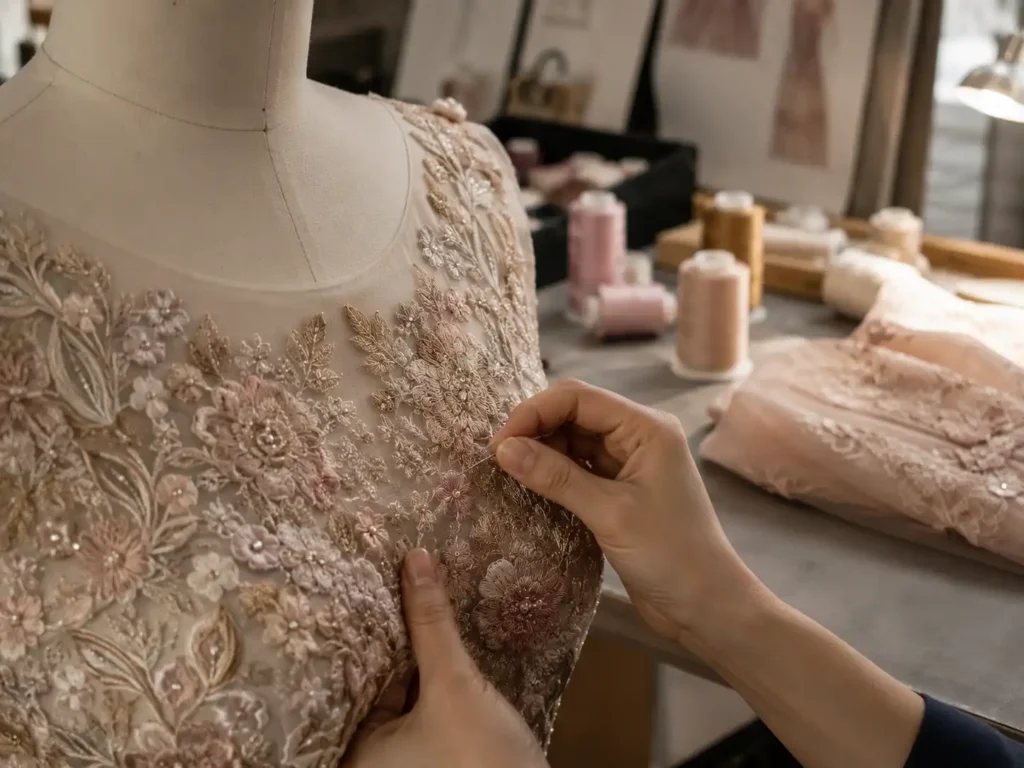
Appliqué is easiest to understand as a shaped material added onto another textile surface. The applied piece may be lace, organza, satin, mesh, velvet, jacquard, or another decorative fabric, and it may form flowers, leaves, letters, abstract shapes, geometric panels, or larger surface compositions. In commercial womenswear, the material itself is part of the design language. A lace flower placed over mesh produces a different depth and transparency from the same flower reproduced with thread, while a satin appliqué on matte crepe creates contrast through reflected light rather than stitch density alone.
The technical work begins once that shape has to be reproduced consistently. Every appliqué component needs a defined size, orientation, grain direction where relevant, placement reference, and edge treatment. A motif that looks balanced on a flat pattern can change when the bodice curves over the bust or when side seams pull the panel into three-dimensional shape. Materials that fray easily may need a covered edge, transparent materials may expose backing or temporary fixation marks, and heavy components can require support from the base fabric. Good appliqué development therefore treats the applied material, the garment fabric, and the pattern shape as one system instead of separate choices.
What Is Embroidery?
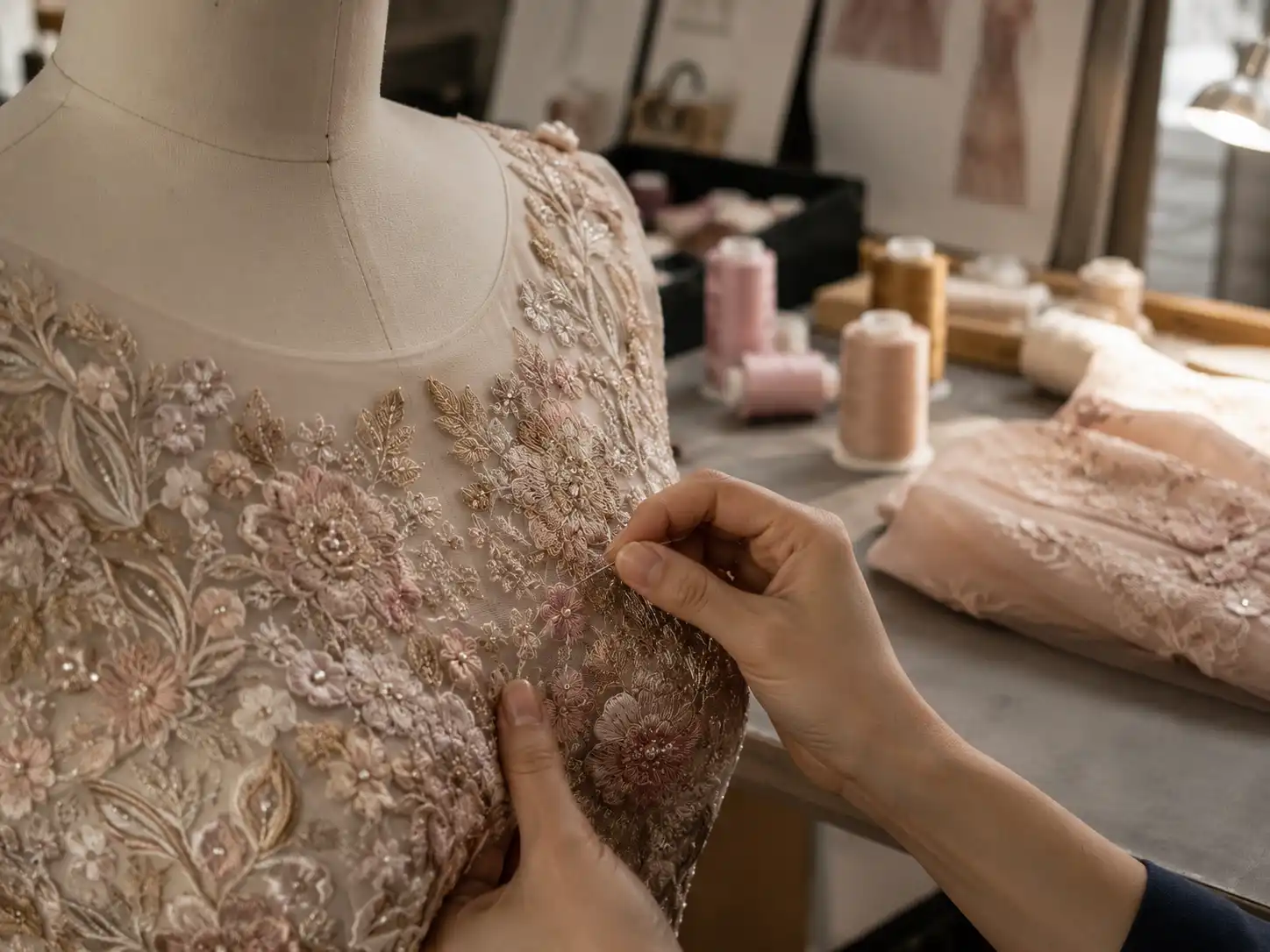
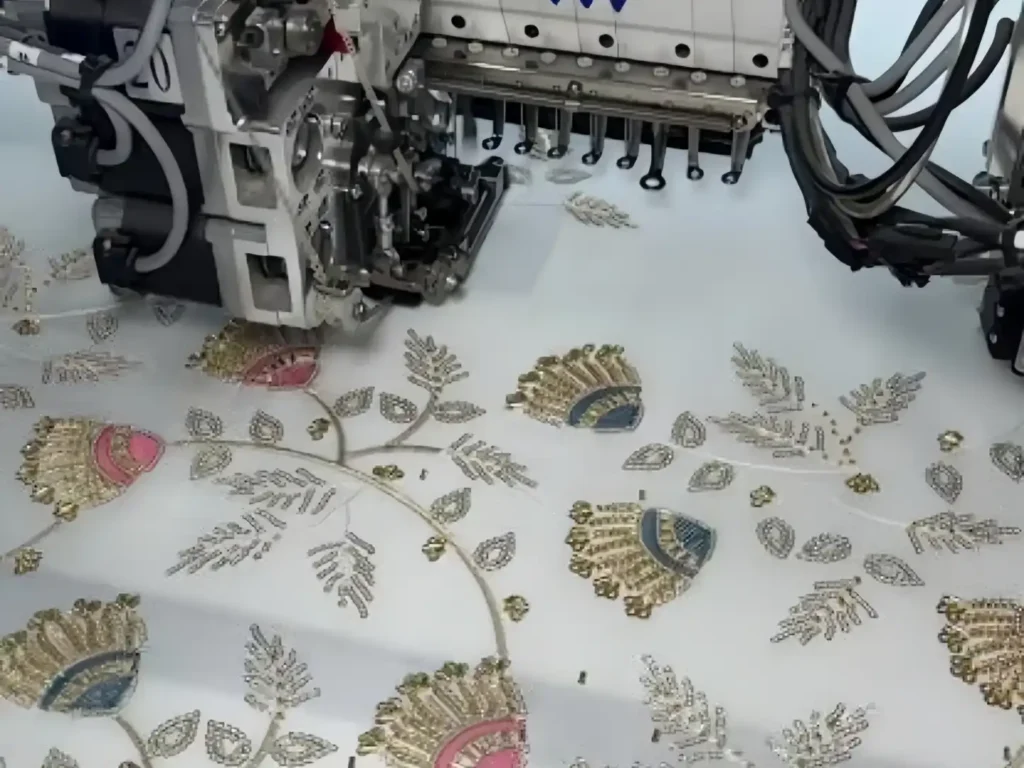
Embroidery creates decoration with controlled stitches placed directly onto the garment fabric or onto a component that will later be assembled into the garment. In production, computerized embroidery is common because motif dimensions, stitch paths, thread colors, and sequences can be repeated once the artwork has been properly digitized. A single floral motif may combine satin stitches around narrow borders, fill stitches across broader areas, and running stitches for veins or outlines. Thread direction also becomes part of the visual effect because light catches the surface differently depending on stitch angle and density.
The important point is that an embroidery file is not simply a picture converted into machine instructions. Digitizing determines underlay, stitch direction, density, sequence, trims, and how the motif loads the base fabric. A stable woven panel can tolerate a denser design than lightweight satin or elastic mesh, while an identical stitch file may create puckering, excessive stiffness, or loss of stretch on a more delicate substrate. For that reason, sample approval should use the intended fabric or a technically equivalent material. Embroidery is particularly strong for small lettering, narrow borders, fine botanical work, and detailed motifs that would be difficult to cut as separate fabric pieces.
Are They the Same?
Appliqué and embroidery are not the same technique, although they frequently appear together on the same dress. A large organza flower may be appliqué because the petals themselves are separate pieces of fabric, yet embroidery can still secure the perimeter and add veins, outlines, or decorative accents. The finished motif therefore contains both processes, but they perform different functions. This distinction matters in production because embroidery relies heavily on digitized stitch information, thread references, stabilizer choices, and machine positioning, while appliqué introduces material sourcing, component cutting, orientation, placement, and edge-control requirements.
Mixed decoration can be a very practical solution when a design contains both broad color fields and small detail. Instead of filling a large flower completely with dense thread, the main petal area can be built from fabric while embroidery provides the outline and fine internal lines. That can reduce unnecessary stitch coverage without losing visual definition, but it also creates a more complex operation sequence. The factory needs to know which step comes first, whether the motif crosses seams or darts, and whether later pressing, lining, or closure installation will damage or distort the decoration.
| Production Detail | Embroidery | Appliqué |
| Main visible material | Thread stitches | Added fabric or decorative material |
| Primary digital/technical file | Digitized stitch file | Cut pattern or template plus placement reference |
| Common measurement | Motif width × height in mm | Cut-piece width × height in mm |
| Additional textile layer | Usually none beyond backing | One or more visible layers |
| Main alignment concern | Motif position and stitch registration | Component position, orientation, and edge alignment |
| Common surface risk | Puckering, thread breaks, distortion | Bubbling, fraying, lifting edges, misplacement |
| Useful repeat-order record | Stitch file, thread code, placement | Material code, cut pattern, placement, edge finish |
How Are They Made?
A typical embroidery workflow begins with artwork review, digitizing, thread selection, stabilization planning, and test stitching on the intended fabric. The test is checked for dimensions, thread coverage, distortion, color, hand feel, and the condition of the surrounding fabric. After the file is adjusted, the production team determines whether decoration should be completed on flat cut panels or at a later garment stage. Flat-panel work usually provides better access and more consistent positioning, but the correct sequence depends on seam construction, motif location, and whether the artwork crosses several components.
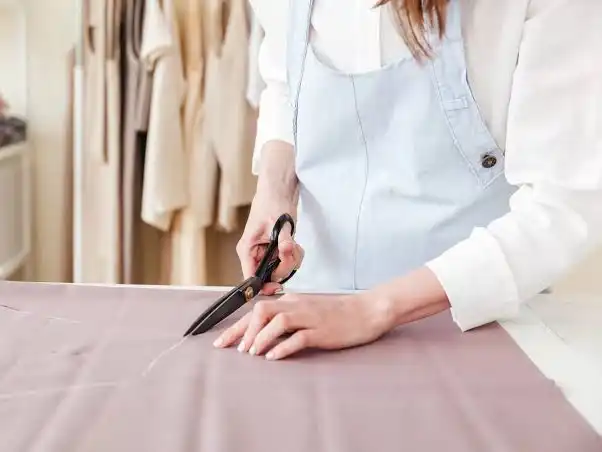
Appliqué introduces a separate preparation stream because the decorative material must be sourced, inspected, cut, sorted, and positioned before it is secured. Directional materials require particular care: velvet has nap, prints have orientation, satin has noticeable sheen direction, and lace motifs may need selective cutting rather than maximum marker efficiency. Neither technique is automatically simpler. Embroidery can involve a high stitch count but limited component handling, while appliqué can reduce stitched fill yet add cutting, placement, temporary fixation, trimming, and edge finishing. Production efficiency depends on the complete process, not on the name of the technique.
Which Technique Creates the Better Dress Effect?
Embroidery usually creates finer, more integrated detail, while appliqué produces stronger material contrast, layering, and three-dimensional surface effects. Neither is visually superior in every dress. The better result depends on motif size, viewing distance, base-fabric texture, silhouette, lighting, and how much surface relief the design should carry without making the garment feel stiff, bulky, or uncomfortable in actual wear.
Which Gives More Detail?
Embroidery has a clear advantage when a motif depends on very fine lines, small lettering, narrow botanical details, or complicated internal shapes. Thread can create elements that would be impractical to cut from fabric, especially when the design contains thin stems, tiny leaf veins, or closely spaced outlines. At small scale, the edge treatment required by appliqué can occupy too much of the visible motif, making the result heavier than the original artwork. Embroidery can keep those details visually lighter because a running stitch or narrow satin column needs much less physical width than a cut fabric component with a secured perimeter.
More detail is not automatically more attractive, however. Dresses are seen at multiple distances: close-up in ecommerce photography, at arm’s length during fitting, and from several meters away at events. Very fine embroidery can disappear at distance, while a single large appliqué flower can remain visually dominant. A practical design review therefore considers minimum line width, overall motif dimensions, the number of thread colors, and how much of the garment panel the decoration occupies. When detail exists only because the software allows it, the finished dress can become visually busy without becoming more desirable.
Which Creates More Texture?
Embroidery creates texture through accumulated thread, and the final relief depends on stitch type, density, underlay, thread thickness, and the number of layers created in the digitized program. Satin stitching can form a raised, glossy border, while fill stitches create a flatter but still structured surface. Appliqué creates a different kind of texture because an additional textile remains visible. Organza brings transparency, velvet adds pile, lace creates openwork, and satin introduces directional shine. The designer is therefore choosing not only a method of attachment but also a second surface with its own physical behavior.
Three-dimensional floral appliqué pushes that effect further because petals may be only partly secured and allowed to stand away from the base. This can photograph beautifully on occasionwear, but the garment has to survive ordinary use. Raised petals can catch jewelry, thick decoration can feel bulky at the waist, and rough embroidery backing can irritate skin on an unlined bodice. A strong sample review includes touch and movement: bend the decorated panel, sit in the dress, lift the arms, check the reverse side, and compress the garment as it would be packed. Texture has to remain attractive after handling, not only on the sample-room table.
Which Works Better for Large Motifs?
Appliqué often becomes more attractive as motif size increases because a broad area of color or texture can be created with fabric instead of filling the entire region with thread. A large floral panel across the front of a dress may require substantial stitch coverage if executed as full embroidery, and that stitched area can become locally stiff. Replacing the major petal fields with appliqué while keeping embroidered outlines and details can reduce thread buildup and preserve a clearer material contrast. The benefit is especially noticeable when the design is intended to read from a distance rather than reward only close inspection.
Large appliqué still needs careful engineering because bigger pieces are more sensitive to bubbling, grain direction, inaccurate placement, and differences in stretch between the base and applied materials. A non-stretch motif across the hip of a fitted dress can effectively lock a region that was supposed to expand with the wearer. Designers should therefore judge motif scale relative to the garment panel, not only in absolute millimeters. A 150 mm design may be modest on a full skirt but dominant on a narrow corset front. The key question is how much of the functional panel becomes decorated and whether that decorated area still behaves like the pattern requires.
Can They Be Combined?
Combining appliqué and embroidery can provide a strong balance between scale, detail, and production efficiency. Large fabric shapes can establish the main color field, embroidery can secure their edges and create fine internal lines, and selected beads, sequins, or rhinestones can be added only where the design needs extra light-catching detail. This layered approach can create a more sophisticated surface than asking one technique to perform every visual function, while also giving the development team more control over where weight, stiffness, and manual work are concentrated.
The challenge is sequencing. Every additional process introduces dependencies that need to be written into the sample and bulk-production instructions. If embroidery crosses an appliqué edge, the applied piece must be positioned first. If rhinestones are attached before a high-heat pressing step, they may be damaged. If the motif crosses a side seam, the artwork needs alignment marks on multiple pattern pieces. Successful mixed decoration therefore relies on separate specifications for materials, stitch files, placement, edge finish, and order of operations. Hybrid decoration works best when it is planned as a single production system from the beginning rather than assembled through late sample-room improvisation.
How Do Fabric and Dress Structure Affect the Choice?
Fabric behavior can completely change whether appliqué or embroidery works well. Stable fabrics usually tolerate decoration more easily, while lightweight, sheer, stretchy, or highly reflective materials need tighter control. Stretch percentage, recovery, drape, thickness, transparency, grain direction, and motif placement should be evaluated together because decoration can alter fit and movement even when the base pattern itself is correct.
Which Fabrics Suit Appliqué?
Appliqué is most predictable when the base fabric can support another layer without losing the movement or appearance that makes the garment desirable. Stable woven materials, structured bodices, and medium-weight panels often provide an easier foundation because they do not change shape dramatically during handling. The applied material does not have to match the base composition, but the two should behave sensibly together. A rigid appliqué on elastic jersey can restrict stretch, a heavy lace motif on chiffon can pull the panel downward, and a shiny satin component cut in the wrong direction can appear to be a different shade even when it comes from the same roll.
Before approval, practical teams record properties that affect real production rather than relying only on fabric names. Weight in grams per square meter helps indicate how much mass is being added, stretch should be considered in both main directions, and shrinkage after the intended care method can reveal whether two materials will fight each other later. Transparency matters because adhesive, backing, or edge stitching may remain visible, while grain, print direction, nap, and sheen influence cutting orientation. The purpose of these records is not to create paperwork; it is to prevent visually small material differences from turning into large bulk-production inconsistencies.
| Fabric Property | Practical Record | Relevance to Decoration |
| Fabric weight | GSM from supplier or test record | Added weight can change drape and support needs |
| Stretch | Lengthwise and crosswise percentage | A mismatch can restrict fit or create rippling |
| Shrinkage | Percentage after intended care test | Different shrinkage can cause bubbling or distortion |
| Thickness | Measured where practical | Influences edge bulk and seam crossing |
| Transparency | Opaque, semi-sheer, or sheer | Determines whether backing and thread paths are visible |
| Direction | Grain, print, nap, or sheen orientation | Prevents inconsistent appearance between components |
| Component count | Pieces per garment | Affects handling time, placement control, and QC workload |
Which Fabrics Suit Embroidery?
Embroidery is easiest to control on fabrics that remain dimensionally stable while repeated needle penetrations and thread tension are applied. More structured woven materials provide a forgiving base, but lightweight satin, chiffon, stretch mesh, jersey, and other fashion fabrics can still be embroidered when the stitch design, stabilizer, hooping method, and motif size are adjusted appropriately. The useful question is not whether a fabric can technically receive embroidery; most can under some conditions. The real question is how much stitch load it can carry before the decoration changes drape, elasticity, surface quality, or comfort.
A small 40 mm motif and a broad 250 mm filled panel behave very differently even on the same fabric. Lightweight materials may need additional stabilization to prevent puckering, while stretch fabrics require support that controls movement during stitching without permanently removing the elasticity needed in wear. Satin deserves particular care because repeated needle penetration and local stiffness are easy to see on its reflective surface. For sample approval, the full combination should be tested together: base fabric, thread, backing or stabilizer, stitch file, motif dimensions, and finishing method. Approving artwork alone leaves too many variables unresolved for reliable bulk production.
How Do Stretch and Sheer Fabrics React?
Stretch fabrics are sensitive because decoration can locally remove the elasticity that the pattern depends on. A bodycon dress may fit correctly when the base material stretches around the hip, but a large low-stretch appliqué placed across that area can create a restricted zone. Dense embroidery can produce a similar effect because thousands of stitches effectively lock the decorated region together. The wearer may experience pulling, tension lines, or reduced movement even though the original pattern dimensions have not changed. This is why the finished decorated panel should be tested under stretch rather than judged only from a fabric supplier’s specification sheet.
Sheer fabrics create another layer of difficulty because construction normally hidden inside opaque garments becomes visible. Mesh and organza can reveal backing edges, thread tails, adhesives, joins, and inconsistent trimming, especially when photographed against skin or under direct lighting. A practical review checks both the front and reverse sides, views the garment on a mannequin or fitting model, and observes the motif when the fabric is relaxed and stretched. Transparent dresses also magnify color-matching problems because the decoration, lining, and skin or underlayer interact visually. The cleaner the base fabric, the less opportunity there is to hide a careless decorative process.
Does Placement Affect Fit?
Decoration placement can affect fit whenever the motif crosses a shaped or high-movement area. The bust, waist, hip, shoulder, and armhole are not flat surfaces, so a motif positioned on a two-dimensional pattern piece may look different once the garment follows the body. A horizontal embroidered band can appear curved across the bust, a rigid appliqué may interfere with a dart or corset panel, and dense decoration near an invisible zipper can add bulk that makes closure installation less clean. Placement therefore needs to be judged both on the flat panel and on the fitted sample.
Comfort should influence the location just as strongly as symmetry. Decoration around the underarm can rub, heavy elements at the side seam can create pressure when the wearer sits, and rough edge finishing near a neckline can quickly make an otherwise attractive dress unpleasant to wear. Production specifications should use fixed reference points rather than subjective instructions such as “slightly below the neckline.” Distances from center front, high-point shoulder, neckline seam, waist seam, or side seam can be recorded in millimeters, while the approved sample remains the visual reference for how those measurements should look on a three-dimensional body.
Which Is Better for Cost and Production?
Neither technique is automatically cheaper. Embroidery cost is influenced by digitizing, stitch count, thread colors, machine time, stabilization, and handling, while appliqué can reduce large filled stitch areas but adds material sourcing, cutting, placement, and edge-finishing work. A useful cost comparison therefore starts with the actual artwork, fabric, motif dimensions, operation sequence, and expected order quantity rather than assumptions about the technique itself.
Which Uses More Stitching?
Full embroidery usually uses more stitches when a design contains large solid areas because thread creates the entire visible fill. Appliqué changes that equation by using fabric for the central field while stitching is concentrated around edges and selected details. The most useful number for costing embroidery is therefore the actual stitch count from the approved digitized file, not motif area alone. Two designs measuring the same 120 mm by 120 mm can have very different machine workloads if one is a light outline and the other contains dense multi-color fills.
Stitch count still does not tell the whole story because a complicated appliqué can contain several separate pieces that each require cutting, sorting, positioning, and inspection. A design with ten small components may use fewer stitches than a large embroidered fill but consume more manual handling time. For production teams, the better comparison combines motif size, stitch count, number of colors, number of appliqué pieces, decorative locations per garment, and trial rework. Those figures turn the conversation from “embroidery feels expensive” into a measurable discussion about which operations are actually driving cost and how the visual effect might be simplified without losing its identity.
Which Takes Longer to Produce?
Production time should be separated into machine time and total process time. Embroidery can have a long machine cycle when the design contains many stitches or frequent color changes, but once the panel is positioned and the program is running, much of the process is automated. Appliqué may lower the amount of stitched fill while increasing human handling because components have to be cut, sorted, positioned, temporarily secured, attached, trimmed where required, and checked for edge alignment. A technique that looks faster from the machine perspective can therefore be slower across the complete production line.
Sampling time matters as well. Embroidery may require repeated digitizing revisions to correct density, thread direction, or puckering, while appliqué may need new component shapes when edges lift or the added material changes the way the panel sits. This is one reason a realistic production question is not “How fast does the embroidery machine run?” but “How many approved-quality garments can the complete process produce during a normal working period?” Production planning must include preparation, loading, machine work, handling, inspection, and rework rather than treating one equipment speed as the throughput of the entire decorative process.
How Do Material Costs Differ?
Embroidery mainly adds thread and stabilization-related materials, while appliqué introduces another visible textile with its own price, yield, color matching, and sourcing conditions. A small shape cut from a readily available woven fabric may cost very little, but the same component made from specialty lace, beaded mesh, custom-dyed satin, or a directional textile can become a meaningful cost item. Irregular appliqué shapes can also create cutting waste, and patterned or directional materials may need wider spacing to keep every component facing the same way or using the correct part of a motif.
Hidden materials should not be ignored. Depending on the design, both techniques may use backing, topping, temporary fixation materials, protective tissue, or additional packing protection. The useful comparison is therefore total material consumption per finished garment, including usable yield and process waste, rather than a simple “thread versus fabric” calculation. In higher-volume production, even a small difference in component count or handling time can become significant. The best cost engineering usually happens during sampling, when a motif can still be adjusted without forcing the bulk-production team to choose between an approved appearance and an unrealistic production method.
How Does Complexity Affect MOQ?
Complex decorative work can raise the practical minimum quantity because development effort, material sourcing, supplier minimums, setup time, and production-control costs have to be spread across a workable order. Embroidery can add digitizing and testing work, while appliqué may require dedicated fabrics, specialty lace, custom colors, or other materials that carry their own supplier minimums. A decoration that looks small on the garment can therefore influence order economics if it depends on a component that is not readily available in the required color or specification.
For Jinfeng Apparel, the standard MOQ starts from 200 pieces per style and color, while fabric availability, color development, trims, construction complexity, packaging requirements, and production scheduling can change the final requirement. Complex decorative techniques such as embroidery may also affect sample cost, sewing time, inspection workload, unit price, and lead time. In practice, the best moment to manage those effects is before the sample is visually locked. Consolidating thread colors, reducing unnecessary components, using a technically suitable stock material, moving decoration away from difficult seams, or combining appliqué with embroidery can preserve the design while making repeatable production more realistic.
How Do Appliqué and Embroidery Affect Quality?
Both techniques can produce durable, premium-looking dresses when the design and production method are engineered correctly. Embroidery commonly introduces risks such as puckering, skipped stitches, thread breaks, and fabric distortion, while appliqué adds placement error, fraying, bubbling, and edge-security risks. Quality control should inspect the motif itself, its measurable position on the garment, and its effect on fit, comfort, drape, and the surrounding fabric.
Which Is More Durable?
There is no dependable rule that embroidery is always more durable than appliqué or the reverse. Embroidery durability depends on thread quality, stitch structure, base-fabric strength, and how exposed the motif is during wear. A well-engineered motif on a stable woven fabric can perform very well, while long floating stitches in a snag-prone area may remain vulnerable even if the embroidery looks flawless when new. Appliqué durability depends heavily on the applied material, the edge finish, and whether the added component moves in a way that is compatible with the garment underneath it.
Wear location also matters. Decoration near the shoulder may experience friction from a handbag strap, side-seam embellishment can rub against the wearer’s arm, and hip decoration may repeatedly contact chairs. A raw-edge appliqué designed to soften with wear should not be evaluated by the same standard as a fully enclosed edge intended to remain crisp. Practical durability review therefore considers repeated flexing, reasonable care simulation, light abrasion in exposed areas, and the condition of the surrounding fabric. The strongest technique is the one that remains acceptable under the actual use conditions of the dress, not the one that sounds more robust in theory.
How Does Washing Affect Each?
Care can reveal weaknesses that are invisible during first inspection because the thread, backing, base fabric, and appliqué material may respond differently to moisture, heat, and agitation. In embroidery, the surrounding fabric can shrink more than the stitched region and create puckering after washing or steaming. Appliqué introduces another textile system, so different shrinkage rates can cause bubbling, edge stress, or surface distortion. Raw edges may fray more than expected, while poorly secured perimeters can begin to lift even when they looked acceptable on the newly finished sample.
Testing should reflect the intended care label rather than using one aggressive routine for every product. A dry-clean-only evening dress and a machine-wash casual dress have different performance expectations, but both should be reviewed after the care method the customer is actually instructed to use. Useful checks include dimensional change, color transfer, edge fraying, loose thread, shape distortion, loss of stretch, and pressing marks. The garment should also be inspected after it has dried completely because some temporary rippling disappears as the fabric relaxes, while other problems become more obvious only after the panel returns to its final dry condition.
What Causes Puckering?
Puckering appears when the decoration system creates tension that the base fabric cannot absorb evenly. In embroidery, common contributors include excessive stitch density, unsuitable underlay, tight thread tension, over-tight hooping, insufficient stabilization, and stitch sequences that repeatedly pull the fabric toward one area. Lightweight satin and mesh are especially sensitive because their structure offers less resistance to concentrated stitch load. Appliqué can pucker when either material is stretched during positioning or when the base and applied textiles shrink differently after pressing or care.
Troubleshooting should be systematic because simply adding heavier backing can hide one symptom while making the dress unacceptably stiff. Start by confirming that the fabric was relaxed before decoration, then check grain and stretch direction, stitch density, sequence, stabilizer, hooping or temporary fixation tension, and the compatibility of the two materials. Edge stitching should also be reviewed because a tight perimeter can draw the base inward. Finally, inspect the panel again after pressing and garment assembly. Some distortion is introduced after decoration during sewing, so a perfectly flat test piece does not guarantee that the final dress will remain flat once seams, lining, and closures are added.
What Defects Should QC Check?
Decoration needs its own inspection criteria because a general instruction such as “check workmanship” is too broad for a style in which motif placement and surface quality carry much of the product value. Embroidery QC should look for thread breaks, skipped stitches, loose loops, incorrect density, visible backing, distorted outlines, color errors, and needle damage to the base fabric. Appliqué inspection adds edge fraying, uneven trimming, lifting corners, bubbling, wrong orientation, misaligned layers, and variation in cut-piece shape between garments.
Placement should be measurable as well as visual. A centered motif across a corset bodice often needs tighter control than scattered floral components intended to look organic. Inspectors should compare motif dimensions, distances from defined reference points, left-right symmetry, color references, edge security, surface flatness, back-side cleanliness, seam interaction, and comfort against the body. Jinfeng Apparel’s broader quality process includes fabric and trim inspection, cutting checks, sewing in-line inspection, measurement control, finished-garment inspection, pressing review, packaging checks, and pre-shipment inspection, which is especially useful when decoration can affect more than appearance alone.
| QC Item | Practical Check | Common Risk |
| Motif size | Width × height against approved specification | Incorrect scaling |
| Placement | Distance from fixed garment reference points | Visible misalignment |
| Symmetry | Left/right comparison where required | Uneven visual balance |
| Thread or material color | Approved code, swatch, or lot reference | Shade inconsistency |
| Edge security | Full perimeter inspection | Fraying or lifting |
| Stitch quality | Continuous visual review | Skips, loops, breaks, density variation |
| Base fabric | Flatness around decoration | Puckering or distortion |
| Reverse side | Cleanliness and comfort | Exposed backing or rough edges |
| Seam interaction | Decoration near seams and closures | Excess bulk or mismatch |
| Fitted appearance | Compare on body/mannequin to approved sample | Restricted stretch or shifted motif |
Which Technique Should You Choose for Dresses?
Choose embroidery when fine line work, lettering, small motifs, and thread texture are central to the design. Choose appliqué when larger shapes, contrasting materials, layered surfaces, or dimensional effects matter more. For commercial dresses, the decision should also account for fabric stretch, drape, comfort, motif location, care method, order volume, cost, and whether the approved appearance can be reproduced consistently in bulk.
Which Is Better for Party and Evening Dresses?
Party dresses can carry stronger decorative effects because photography, nightlife lighting, and immediate visual impact often play an important role in how the product is sold. Appliqué is effective for oversized flowers, bold graphic shapes, and layered organza or lace elements that need to remain visible from a distance. Embroidery works well when the design requires intricate borders, controlled botanical motifs, narrow detailing around corset panels, or precise surface work that should feel integrated rather than attached. Both can also be combined with sequins, beads, or rhinestones when the added materials are planned around comfort and production sequence.
Evening dresses usually demand a more careful relationship between embellishment and silhouette because longer skirts and cleaner vertical lines make local stiffness, weight, and placement differences easier to see. A heavily decorated area can interrupt fluid drape or shift the visual balance of the garment. The fitting stage should therefore answer practical questions that photographs cannot: whether the wearer can sit comfortably, whether decoration scratches under the arm, whether the bodice remains flexible, whether a heavy motif pulls the neckline, and whether the hem still hangs evenly. A decorative technique is successful only when it strengthens the intended silhouette instead of competing with it.
Which Works Better on Mesh and Lace?
Mesh and lace are among the least forgiving substrates because their open or transparent structures expose construction that can remain hidden on opaque fabrics. Embroidery on mesh can create an attractive floating effect, but excessive stitch density can collapse the mesh, create rippling, or remove needed stretch. Backing and thread tails can also remain visible through transparent areas. Appliqué can be highly effective with lace because selected motifs can be cut and positioned around the neckline, bust, or waist instead of relying on the repeat of a full lace fabric, giving the designer more control over where visual density appears.
The edge finish is critical because poorly cut lace motifs or visible stabilization can quickly make a premium dress look unfinished. Mesh styles also need to be checked against skin or the intended lining because transparency changes how every layer is perceived. In practical womenswear production, mesh dresses require control of transparency, lining, holes, and stretch, while lace garments add motif matching, joining, lining, and edge-damage risks. Decoration magnifies those issues, so the finished sample should be inspected from the front, reverse, and side, under direct light, and while the garment is worn rather than only flat on a table.
Which Works Better on Satin?
Both techniques can work on satin, but satin makes small construction problems unusually visible because its smooth surface reflects light across broad areas. Dense embroidery can produce puckering, local stiffness, or needle marks, while appliqué introduces another layer that may change drape. If satin is used for the appliqué itself, grain direction becomes critical because two pieces from the same roll can reflect light differently when cut at different angles and appear to be mismatched in color. The cleaner the satin, the more obvious these differences become in photography.
A strong satin decoration sample should therefore be inspected under several lighting angles rather than only under flat overhead factory lighting. Side lighting can reveal rippling and pressure marks that disappear when viewed directly from the front. Pressing also needs control because excessive heat or pressure can alter surface shine. The most successful construction preserves three things simultaneously: the intended decoration, the clean reflective surface, and the fluidity of the dress. If the motif looks impressive but creates a stiff patch or visible halo around itself, the technique, stitch density, backing, or material combination should be revised before bulk approval.

What Should Be Approved Before Bulk Production?
Decorative work should be approved as part of the completed garment rather than only as an attractive swatch. The final approval package should identify the artwork version, motif width and height, placement measurements, base fabric, appliqué material where relevant, thread references, embroidery stitch file, appliqué cut pattern, component count, edge treatment, backing or stabilization method, seam-crossing instructions, care method, and clear photographs of the approved appearance. The approved garment itself remains important because technical files cannot fully describe how decoration should sit on a three-dimensional body.
The final fitting should confirm that the motif remains visually centered, the decorated area lies flat, stretch zones still function, zippers or seams near the motif operate correctly, and the garment remains comfortable around the neckline, underarm, waist, and hip. For repeat orders, preserving pattern files, material references, decoration files, placement records, and the approved sample helps reduce variation between replenishment batches. A manufacturer that participates in development, sampling, fabric and trim coordination, bulk production, and quality control can usually identify these risks earlier, which is why brands benefit from discussing decoration before the design becomes expensive to change.
Choosing between appliqué and embroidery becomes much easier once the decision is tied to the dress rather than to the technique itself. Embroidery is a strong option when the design depends on fine detail, precise line work, lettering, or controlled thread texture. Appliqué becomes attractive when large shapes, contrasting textiles, layered depth, or dimensional decoration define the look. In many successful dresses, the most practical answer is a controlled combination of both. The goal is not to maximize decorative complexity; it is to preserve the visual idea while maintaining fit, comfort, drape, durability, realistic cost, and consistent bulk production.
For brands developing new dress collections, early technical review can prevent expensive changes after a sample is already approved. Jinfeng Apparel works with custom womenswear projects from development and sampling through fabric and trim coordination, bulk production, quality control, private-label preparation, and export delivery. When a design includes embroidery, appliqué-style layered decoration, lace placement, sequins, mesh, satin, or other sensitive surfaces, discussing the motif, base fabric, garment structure, order plan, and acceptable finish at the beginning gives the production team much more room to protect the intended appearance without creating unnecessary manufacturing risk.