Skip to content

A strap adjuster is one of the smallest visible components on a dress, yet it can influence fit, comfort, appearance, and the customer’s impression of quality every time the garment is worn. When a shoulder strap slowly lengthens during an evening, twists inside the slider, scratches the skin, or looks noticeably heavier than the satin around it, the problem rarely comes from one simple choice such as metal versus plastic. The result is created by the complete strap system: finished strap width, thickness, surface texture, stretch, slider opening, center-bar geometry, hardware finish, garment tension, and the way the component is assembled. For development teams, that makes strap hardware a fitting and construction decision rather than a last-minute trim purchase. Metal can deliver a compact, refined, jewelry-like look and strong resistance to deformation, while plastic can reduce weight and avoid conventional metal corrosion. The better choice is the one that works with the actual dress, not the one that sounds more premium on a component list.
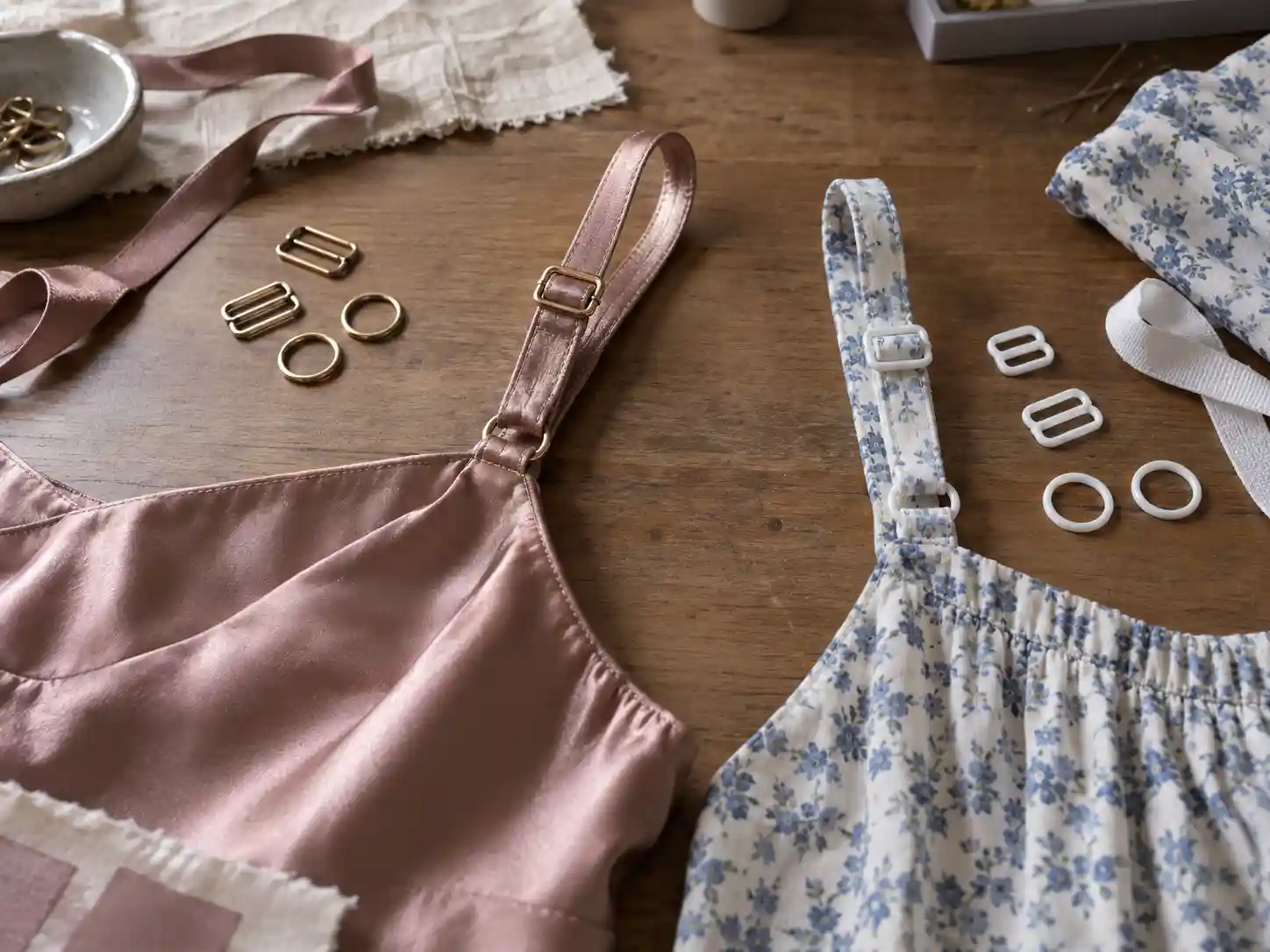
Metal strap adjusters are usually the stronger choice when a dress needs compact rigid hardware, a polished visible finish, or a jewelry-like detail. Plastic adjusters are often better when low weight, visual discretion, or corrosion-free construction matters more. Neither material automatically prevents slipping: strap width, thickness, friction, slider geometry, threading path, and garment tension determine whether an adjustable shoulder strap stays where the wearer sets it.
Consider two satin slip dresses that look almost identical on a hanger. After an hour of walking and sitting, one keeps the neckline exactly where the wearer set it, while the other begins to drop on one side. The difference may be only a slightly oversized slider opening, a smoother strap surface, or a center bar that creates too little friction. That tiny component can become a visible quality issue, which is why experienced development teams test the strap and hardware together before a sample is approved for production.
What Are Metal and Plastic Strap Adjusters?
Metal and plastic strap adjusters perform the same basic job: they let the wearer shorten or lengthen a shoulder strap and help hold that setting during use. The meaningful differences come from rigidity, weight, surface finish, dimensional accuracy, and interaction with the strap. A useful specification therefore includes the slider opening, center bar, strap width, strap thickness, finish, and approved sample rather than material name alone.
What the Adjuster Controls
On a slip dress, bodycon dress, camisole dress, resort dress, or lingerie-inspired style, the adjuster forms part of the garment’s fit system. Moving the slider changes the effective shoulder-strap length, which can alter neckline position, bust coverage, armhole depth, back placement, and the amount of tension carried by the upper bodice. A small change can be noticeable on low-neck or close-fitting designs because the strap connects directly to the balance of the front and back garment. The slider works by forcing the strap to bend around a center bar and frame, creating enough friction to resist unintended movement while still allowing the wearer to adjust it deliberately. That balance is sensitive to the real strap construction. An 8 mm satin tube, an 8 mm elastic, and an 8 mm folded jersey strap share the same nominal width but can generate very different friction inside the same hardware. For this reason, component selection should happen with a production-equivalent strap rather than loose ribbon or a supplier photograph.
Metal and Plastic Materials
The labels “metal” and “plastic” are useful for broad sourcing, but they are not complete performance specifications. Metal sliders can use different base metals or alloys and may be polished, painted, plated, coated, or otherwise finished in gold, silver, gunmetal, black, rose gold, antique tones, or customized colors. These choices influence mass, stiffness, surface hardness, scratch visibility, corrosion behavior, and cost. Plastic sliders also vary by polymer, frame thickness, molding accuracy, edge finish, color, translucency, and surface texture. A dense, well-molded plastic slider should not be judged by the same expectations as a thin component with rough parting lines or inconsistent dimensions. For repeat orders, the technical record should include supplier reference, nominal size, measured internal opening, external dimensions, center-bar form, finish or color reference, and the strap construction used in approval. That record helps prevent a familiar problem in fashion production: a replacement component that is described by the same commercial name but behaves or looks different from the original approved trim.
Rings and Sliders
Rings and sliders are frequently purchased as a set, especially for narrow adjustable straps, but they do different jobs. The slider provides length adjustment, while the ring normally acts as a connection or turning point between the adjustable section and the garment body or another strap segment. When both pieces are exposed, they should be reviewed as one visual and dimensional system. A delicate slider paired with an oversized ring can make a fine spaghetti strap look heavy, while a small ring can force a thicker strap to bunch or enter the connection at an awkward angle. Finish consistency is equally important. Two trims may both be sold as “gold” but show different undertones, gloss levels, or plating depth when placed next to each other on satin. In premium-looking dresses, those small mismatches become surprisingly visible because hardware often sits against clean fabric with little visual distraction. The most reliable approval is a matched ring-and-slider set tested on the final strap, not two independently chosen catalog items.
Common Strap Sizes
There is no universal rule that assigns one strap width to one dress category, because fashion proportion, fabric weight, support needs, and design intent vary. Still, narrow adjustable dress straps are often developed within a relatively compact dimensional range. The table below is best used as a practical sourcing reference rather than a mandatory standard. The key measurement is the finished sewn strap, not the cut piece or pattern width. Folding, seam allowance, elastic insertion, turning, pressing, and fabric bulk can all change the final thickness and usable width, so a nominal 10 mm slider should still be physically checked against the real 10 mm strap before approval.
| Finished Strap Width | Typical Visual Effect | Common Applications | Hardware Focus |
| 5-6 mm | Very delicate | Fine slip dresses, lingerie-inspired styles | Compact frame, smooth edges, close width match |
| 8 mm | Delicate but stable | Satin slips, fitted mini dresses | Small ring-slider sets, careful friction check |
| 10 mm | Balanced | Bodycon, party, camisole dresses | Suitable for many elastic or folded-fabric straps |
| 12 mm | More substantial | Structured fitted styles, heavier fabrics | Check bar thickness and visual bulk |
| 15 mm | Clearly visible strap | Casual and resort styles | Easier handling, hardware becomes more visible |
| 18-20 mm | Functional visual presence | Sport-inspired or heavier strap designs | Hardware becomes a deliberate design feature |
Which Strap Adjuster Performs Better?
Metal generally offers greater rigidity and a refined visible finish, while plastic usually offers lower weight and freedom from conventional metal corrosion. Neither material automatically holds a strap better. Adjustment stability depends more heavily on slider geometry, strap surface, finished thickness, opening clearance, threading path, and garment tension, so performance should be judged on the complete strap assembly rather than on material reputation.

Strength and Deformation
For most dress shoulder straps, the actual loads are modest compared with luggage, safety webbing, or outdoor equipment, so the objective is not to select the strongest hardware available. The useful target is a slider that remains dimensionally stable under normal garment tension without becoming unnecessarily heavy or bulky. Metal has an advantage in stiffness because a relatively fine metal frame can resist bending while keeping a small visual profile. That makes it attractive for eveningwear and narrow straps where the component must look delicate. Plastic can also be reliable when the material, wall thickness, molding, and frame geometry are appropriate, but very thin molded sections may flex more under firm adjustment. Failure modes should be considered separately. Metal may bend, scratch, develop rough edges, or lose finish while remaining intact; plastic may show stress whitening, corner cracking, distortion, or center-bar damage. In development, the relevant question is whether the specific slider stays stable on the actual dress, not whether one material category is theoretically stronger than another.
Adjustment Stability
One of the most persistent misconceptions in strap development is that metal grips better simply because it is harder. A slider holds position because the strap bends around the bar and creates friction at several contact points. Smooth satin usually produces less friction than textured elastic, while thicker folded straps can create substantially more resistance than flat tape. Internal clearance matters at the same time. An oversized slider may allow the strap to move sideways, rotate, or creep even if the hardware is rigid; an undersized slider can hold strongly but become difficult to adjust and may abrade the fabric. A practical sample test is simple: mark the strap next to the slider, put the garment on a fit model, walk, sit, raise the arms, rotate the shoulders, and then measure whether the mark has shifted. Running the same routine with two candidate components gives a useful comparative result that cannot be obtained by sliding loose hardware along a trim card in the sample room.
Weight and Balance
Plastic normally has a weight advantage, but the effect depends on proportion. A few grams may be irrelevant on a wide strap or structured garment, yet the same difference can become noticeable on a 5-8 mm satin spaghetti strap supporting a lightweight slip dress. A heavier slider can encourage the hardware to migrate toward the shoulder, pull a soft strap backward, or feel more prominent when the component rests against the skin. Weight should therefore be compared with garment mass, strap width, hardware placement, and design intent rather than considered as a standalone number. Metal can still be the better solution on a lightweight dress when a very small component provides the desired jewelry-like appearance, while plastic may suit a style where the hardware should visually disappear. The development goal is balance: the slider should look proportional, stay in the expected position, and avoid becoming the part of the strap the wearer notices most during movement.
Wash and Surface Durability
Durability should be split into structural integrity, surface appearance, and the condition of the textile that moves through the hardware. Metal sliders deserve careful inspection at the center bar, corners, and other high-contact points because plating or coating can experience repeated abrasion there. Applicable care testing should also look for discoloration, dulling, residue, corrosion, or color transfer onto pale fabric. Plastic avoids traditional metal corrosion, but it can still scratch, distort under unsuitable heat, show stress marks, or age differently depending on the polymer and molding quality. The strap needs equal attention. A slider can remain physically perfect while its edge slowly fuzzes a satin tube or damages elastic. For that reason, the most useful evaluation checks hardware condition, strap condition, adjustment stability, and final garment appearance together. A component passes only when the entire strap system still looks and performs acceptably after the intended use and care conditions.
| Performance Factor | Metal Adjuster | Plastic Adjuster | What Decides the Result |
| Rigidity | Usually higher for a compact frame | Depends more on polymer and section thickness | Frame geometry and intended load |
| Weight | Usually higher | Usually lower | Hardware size relative to strap and garment |
| Visible finish | Strong decorative and jewelry-like options | Often more discreet or functional | Brand styling and exposed hardware |
| Corrosion concern | Finish and environment dependent | No conventional metal corrosion | Moisture, sweat, care method and material quality |
| Adjustment holding | Not automatically better | Not automatically worse | Friction, clearance, strap texture and threading |
| Surface damage | Possible scratching or finish wear | Possible scratching, stress marks or deformation | Edge quality and repeated movement |
Which Adjuster Is More Comfortable?
Plastic often has an advantage in weight, but comfort depends more strongly on shape, edge smoothness, scale, strap tension, and where the slider sits on the body. A small rounded metal slider can feel better than a poorly molded plastic one. Comfort should therefore be checked on the finished garment through different strap settings and normal movement rather than predicted from material type alone.
Weight Against the Body
Metal has higher density than plastic, so components with comparable dimensions will not feel identical in the hand. Whether that matters on the wearer depends on how narrow the strap is, where the hardware sits, and how light the dress construction is. On a fine slip dress, the slider can be one of the heaviest items attached to the strap, so its mass may encourage the component to move toward the shoulder or become more noticeable when the wearer walks. The larger issue is often concentrated pressure rather than total weight. A rigid slider on a narrow strap can create a firm contact point if it sits beneath a bra strap, jacket, bag strap, or other layer. Sample fitting should therefore check several adjustment lengths. A slider that sits comfortably when the shoulder strap is nearly fully extended may move into a sensitive area when shortened by 30-50 mm, which is easy to miss when development teams approve only one mannequin position.
Edge Quality
Surface finishing often matters more to comfort than the headline material. Metal hardware should be checked around inner corners, the center bar, seams or join points, plating build-up, and any stamped or cast edge that could touch skin or fabric. Plastic deserves the same attention at parting lines, gate marks, flashes, corners, and molded transitions. These defects can be almost invisible from the front while still being obvious when rubbed across a fingertip. A simple tactile review is valuable because any ridge that is easy to feel by hand may become much more noticeable on the upper back after several hours of wear. Dark components should be inspected under strong light, as burrs are harder to see against black or gunmetal finishes. Good comfort is often created by details customers never consciously identify. When the hardware is smooth and correctly scaled, it disappears into the experience of wearing the dress; when it is rough, the entire garment can feel cheaper.
Size and Pressure
The slider needs enough internal space for the strap to bend around the center bar without being crushed, but excessive clearance creates its own comfort and stability problems. When the opening is too tight, fabric can bunch, adjustment becomes difficult, friction rises sharply, and a hard lump may form where several layers concentrate around the bar. When the opening is too loose, the strap can wander sideways, twist, and force the slider to sit diagonally against the body. These effects are particularly visible on narrow satin straps because small changes in alignment stand out against the smooth fabric. A finished 8 mm strap should therefore be checked in the actual 8 mm candidate hardware rather than approved from catalog dimensions alone. Suppliers may measure nominal sizes differently, and the real strap thickness varies with seam allowance, turning method, elastic insertion, or lining. Comfort comes from matching the whole cross-section, not simply matching two width numbers.
Skin Contact and Placement
The location of the adjuster changes with body height, shoulder slope, bust volume, total strap length, and the wearer’s preferred setting, so one fixed fit position cannot represent every customer. A low slider may rub against the back when the wearer sits against a chair, while a higher slider can become trapped beneath another garment or bag strap. On low-back and lingerie-inspired dresses, the component may remain directly against bare skin for long periods. Fit evaluation should therefore include walking, arm raising, shoulder rotation, sitting, leaning forward, and testing both shorter and longer strap settings. This also helps reveal whether the hardware moves into an uncomfortable location as the strap is adjusted. A well-designed adjustable strap should provide useful range without forcing the slider into a pressure point at either end. The strongest sign of success is not that the wearer notices a comfortable slider; it is that she stops noticing the hardware altogether.

How Does Strap Design Affect the Choice?
Strap design often influences performance more than adjuster material. Finished width, thickness, stretch, surface texture, seam construction, and entry angle all change friction inside a slider. The same metal or plastic component can work well on one strap and poorly on another. Reliable development therefore approves the slider together with the actual production-equivalent strap rather than approving trim and strap as separate items.
Width and Clearance
Width is the first dimension most teams check, but a 10 mm strap and a slider labeled 10 mm do not guarantee a good match. A finished self-fabric strap can change slightly after turning and pressing, while elastic may narrow under tension and soft edges can compress inside the frame. Too much side clearance encourages rotation, twisting, and diagonal seating. Too little clearance can bunch the strap and make assembly inconsistent. The useful measurement is the actual usable internal opening of the hardware compared with the finished strap in its relaxed condition, followed by a physical adjustment test. Teams should also record the center-bar thickness and outer dimensions because these influence the bend radius and visual scale. The goal is not to impose one universal tolerance across all suppliers; it is to document the relationship that worked on the approved garment. Once the strap and slider are treated as a matched pair, future repeat orders and cross-style developments become much easier to control.
Thickness and Construction
Thickness is often underestimated because specifications tend to emphasize width. A 10 mm satin tube may contain several folded fabric layers along the seam, a 10 mm lingerie elastic can be much flatter, and a 10 mm jersey strap may compress significantly under pressure. The same slider will therefore create different resistance in each case. Thicker straps often increase friction, but too much thickness can make the component hard to adjust or create visible bunching. The sewing method changes the cross-section as well. Turning a narrow tube, topstitching both edges, inserting elastic, adding clear elastic for stability, or using a bonded construction can all alter the way the strap passes around the bar. When fabric changes during sampling, the slider should be rechecked even if width remains unchanged. A move from lightweight satin to heavier stretch satin can change thickness, compressibility, and surface behavior enough to alter the adjustment feel. The hardware has stayed the same, but the strap system has not.
Stretch and Recovery
Stretch straps create dynamic loads because tension changes continuously while the wearer moves. On a fitted dress, elastic may lengthen when the arms rise or torso twists, then recover when the body returns to a neutral position. Each cycle changes the force acting around the slider. If friction is too low, the component can creep gradually along the strap; if friction is too high, the customer struggles to adjust it and repeated movement may damage the textile. During sample development, a practical comparison is to mark the strap beside the slider, stretch the assembly repeatedly under consistent conditions, and then check whether the reference mark has moved. The same test can be run across two or three candidates. Elastic recovery should be reviewed separately because low-recovery material may remain slightly elongated and create the impression that the slider moved when the hardware actually stayed fixed. Strap elastic and slider behavior must therefore be interpreted together rather than as two isolated quality checks.
Surface Texture
Surface texture can change adjustment more than small differences in material hardness. Satin is smooth and may travel relatively easily around polished hardware, while brushed elastic, matte tape, or textured woven straps create more resistance. This matters when a collection uses the same nominal strap width across different fabrics. A brand might develop a satin slip, a mesh bodycon dress with elastic straps, and a jersey style with self-fabric straps; using one slider across all three can simplify purchasing, but it should not be assumed to perform identically. Hardware finish also changes friction. Highly polished metal, matte coated metal, glossy plastic, and lightly textured plastic do not necessarily feel the same against the strap. A stronger production reference therefore identifies the approved supplier code, finish, size, and strap combination, with a requirement to recheck performance if strap material or construction changes. That small discipline prevents a large number of avoidable fit and repeat-order problems.
Which Adjuster Fits Different Dresses?
Metal works especially well when visible hardware supports a polished, decorative, or jewelry-like design, while plastic suits dresses where low weight or a discreet appearance is more important. Dress category alone should not determine the choice. Strap width, garment tension, fabric surface, care conditions, hardware visibility, and the intended visual character of the style should be considered together before approval.
Slip Dresses
Slip dresses make strap hardware easy to notice because the overall design is often clean and minimal. With fewer seams and embellishments competing for attention, a small ring or slider can become an obvious detail. Metal is a natural option when the hardware should add refinement, particularly with gold, silver, gunmetal, black, or other finishes that coordinate with the dress palette. Plastic can be more suitable when the designer wants the adjuster to visually recede, especially in clear, black, or closely matched colors. Functionally, the bigger challenge is usually slipping rather than strength. Satin and satin-like fabrics have smooth surfaces, so slider clearance and center-bar geometry should be checked carefully. A good sample review examines strap movement after walking, slider rotation, abrasion, puckering around the strap attachment, left-right symmetry, and visible finish consistency. The most successful hardware looks proportional to the strap and feels intentional. An oversized slider can make a delicate dress look coarse, while a tiny but poorly matched slider can compromise holding stability.
Bodycon Dresses
Bodycon dresses place more continuous tension through the upper body, especially when shoulder straps help stabilize a fitted neckline or bust area. The slider therefore needs to resist gradual movement while the garment stretches and recovers during sitting, walking, dancing, and arm movement. Metal can be useful when a compact, rigid component is desired, while plastic can perform equally well when size, frame strength, and friction are correctly matched. The development team should focus on the balance between too little and too much resistance. Too little allows strap creep; too much makes adjustment difficult and can abrade the strap. Fit grading matters as well. Hardware cannot compensate for a strap length that has been poorly graded across sizes. The team should confirm not only that each size offers enough adjustment range, but also where the slider sits on the body at short, medium, and long settings. A technically adjustable strap still feels wrong if the hardware lands in an uncomfortable or visually awkward position on part of the size range.
Party and Occasion Dresses
Party and occasion dresses often use hardware as part of the visible styling language. A metal slider can coordinate naturally with rhinestone trims, decorative chains, exposed zippers, corset-inspired hooks, or jewelry-like details, but finish matching becomes critical when several metal components appear on the same garment. Two suppliers can both describe a finish as gold while producing noticeably different undertones, gloss, or depth. Those differences become more obvious on clean satin, dark bodycon fabrics, or pale occasionwear where the hardware sits against a simple background. Plastic still has a place when the slider should disappear rather than decorate. Black plastic on a black elastic strap can be visually quieter than a shiny metal component, even on a highly styled party dress. A useful design question is whether the adjuster is meant to be seen or ignored. Once that decision is clear, material, finish, scale, and matching ring selection become much easier to resolve without forcing one hardware solution across every style in the collection.
Resort and Lingerie Styles
Resortwear introduces warm-weather conditions, perspiration, humidity, travel, frequent casual wear, and sometimes contact with sunscreen or body products, so weight and surface durability deserve extra attention. Plastic eliminates conventional metal corrosion and can be a practical option where very light hardware is desirable. Metal can still work well, but the chosen finish should be evaluated for the garment’s actual use and care expectations. Lingerie-inspired dresses have a different emphasis: hardware scale is small, direct skin contact is common, and rings and sliders may intentionally reference bra or corsetry details. A coordinated metal set can create a polished fashion effect, while plastic gives a softer and less decorative result. Fabric interaction remains central. Satin emphasizes shine, lace makes size and edge quality visible, mesh can leave the component directly against skin, and elastic introduces repeated dynamic tension. The best choice is the one that supports the style while remaining stable and unobtrusive during actual wear.

How Should Brands Choose Strap Adjusters?
The most reliable selection process approves strap adjusters as part of a finished strap system. Measure the strap and hardware, test adjustment during body movement, inspect skin-contact surfaces, verify color and finish, review applicable care risks, document the approved supplier reference, and check the same characteristics in bulk. Price and sourcing convenience matter, but they should be considered after functional suitability is established.
Sample Approval
A trim card shows what a slider looks like; a finished sample shows whether it works. The component should be assembled with the intended bulk strap construction, because testing loose ribbon or a substitute elastic can produce a false sense of security. During sample review, the team should measure finished strap width, confirm the usable slider opening, check that the strap lies flat, move the hardware through its full adjustment range, and evaluate whether resistance feels controlled rather than loose or jammed. The garment should then be worn and checked at short, medium, and long strap settings while the fit model walks, sits, raises the arms, and rotates the shoulders. After movement, the strap position should be rechecked and the textile inspected for abrasion, glazing, fuzzing, or twisting. Keeping a physical approved slider, matching ring, supplier code, finish reference, and garment sample together creates a stronger repeat-order standard than relying on a photo or generic line in the tech pack.
Practical Evaluation
When two or three candidate components look acceptable, a simple internal scoring method can make the decision more disciplined. The table below is not an industry pass-fail standard and should not be presented as one; it is a practical comparison tool that helps the same development team evaluate each option against identical criteria. A metal slider may score very well for visual finish and rigidity but lower for weight or skin comfort, while a plastic option may score highly for low mass yet appear too casual for a particular evening style. The value comes from separating those factors rather than letting one attractive feature dominate the decision. The final choice should reflect the priorities of the dress: a fine satin slip may weight appearance and strap stability heavily, while a lightweight resort dress may place greater emphasis on low mass, surface comfort, and environmental exposure. Consistent scoring also leaves a useful record when styles are reviewed again months later.
| Evaluation Item | What to Check | 1 Indicates | 5 Indicates |
| Adjustment feel | Movement through the slider | Too loose or too tight | Smooth and controlled |
| Position holding | Movement during normal wear | Obvious creep | Stable setting |
| Edge smoothness | Skin and strap contact surfaces | Rough or sharp | Smooth and unobtrusive |
| Strap alignment | Twisting and sideways travel | Frequent misalignment | Strap remains flat |
| Finish quality | Plating, coating or molding | Visible inconsistency | Clean and consistent |
| Visual proportion | Scale against strap and dress | Clearly unsuitable | Balanced with design |
| Ring compatibility | Size and color match | Noticeably mismatched | Coordinated set |
| Post-test condition | Hardware and strap after handling | Visible damage | No meaningful change |
Cost, MOQ and Sourcing
The unit price of a slider is only one part of its commercial impact. Standard black, clear, silver-tone, or other commonly stocked hardware is often easier to source than a special plated finish, unusual frame shape, custom color, or logo-developed component. Customized hardware can carry an independent supplier minimum and additional development time even when the garment order itself meets the factory’s production quantity. For custom buckles, chains, sliders, and similar hardware, supplier minimums can move into several hundred pieces and may reach roughly 500-1,000 pieces for particular custom developments, depending on material, finish, tooling, color, supplier policy, and timing. Development teams should therefore compare unit price, trim MOQ, any plating or mold charge, lead time, and whether the same approved component can be reused across multiple styles or repeat orders. A slightly more expensive standard component that remains stable across seasons can be commercially safer than a cheaper trim that changes finish or dimensions between batches.
Bulk Production Control
Approval is not complete when the sample is signed off. Bulk hardware still needs to match the standard that was tested. Incoming inspection should compare usable opening size, outer dimensions, center-bar form, finish and color, edge smoothness, molding or plating quality, ring-slider compatibility, and adjustment behavior with the real production strap. Sewing teams should also control the threading path, because even a correctly specified slider performs poorly when the strap is routed inconsistently. Finished-garment inspection should compare left and right straps for orientation, resistance, twist, and attachment security. For collections that repeat styles across seasons, records become especially valuable because they reduce the risk of silent component substitution. Jinfeng Apparel manages strap sliders within its broader trim-development process, so brands developing custom dresses can review strap construction, slider specification, finish, sourcing requirements, sample behavior, and bulk consistency as one connected production decision rather than a series of unrelated trim purchases.
Conclusion
Metal and plastic strap adjusters can both deliver excellent results, but neither material can rescue a poorly matched strap system. Metal is often the stronger choice when the design needs a compact rigid component, a visible polished finish, or a jewelry-like detail. Plastic often makes more sense when low weight, visual discretion, or corrosion-free construction is a priority. The decisive work happens in the small interactions between strap width, thickness, surface friction, slider geometry, body movement, finish quality, and production consistency. When those factors are tested together, the hardware usually disappears into the experience of wearing the dress. When they are ignored, a component only a few millimeters wide can become the reason a neckline drops, a strap twists, or a customer remembers the garment for the wrong reason. For brands developing adjustable-strap dresses, the safest approach is simple: approve the strap and slider as one system, document the result, and make bulk production match it.