Skip to content

Barcode and SKU Packing
Barcode and SKU packing for custom womenswear, built around accurate style, color and size identification from bulk production through carton release.
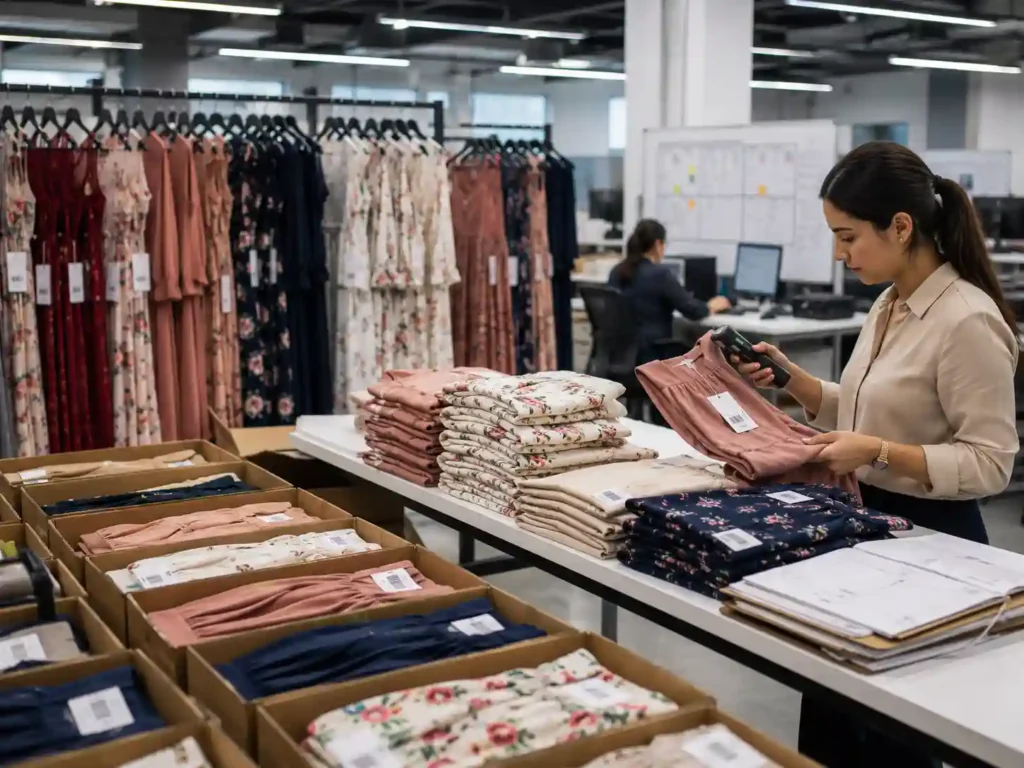
- 30+ finishing and packing workers supporting garment folding, labeling, individual packing and carton preparation.
- 15+ QC inspectors supporting garment, packing and pre-shipment quality checks.
- 12+ merchandisers and order follow-up specialists coordinating packing files, order breakdowns and shipment preparation.
- 100,000+ pcs regular monthly capacity across Jinfeng Apparel’s structured womenswear production system.
Packing Capacity Built for Multi-SKU Womenswear
30+ Packing Specialists
15+ QC Inspectors
Quality control covers more than garment appearance.
Packing checks include label position, barcode readability, size and color identity, polybag condition, carton quantity, carton marks and the consistency between physical goods and packing records. Problems found before shipment can be isolated and corrected before cartons enter the export or warehouse receiving process.
12+ Order Coordinators
Merchandisers organize the files behind the physical packing work: style lists, size and color breakdowns, barcode files,
SKU tables, packing instructions, warehouse guides and carton-mark requirements.
Clear file control is especially important when one collection contains many visually similar dresses in several colors and sizes.
100,000+ Pcs Monthly Capacity
A SKU system must remain usable when production moves from approved samples into commercial volume.
Jinfeng’s regular monthly capacity supports multi-style womenswear orders while production, QC, finishing and packing teams work from the same approved style, color, size and packaging information.
Built for Brands With Complex Packing Requirements

Global Womenswear Brands

Premium Ecommerce Programs

Specialty Retail and Chains
Retail programs may add PO information, hangtag requirements, price labels supplied by the brand, carton marks, size-ratio packing and warehouse receiving labels.
The packing team can follow approved retail instructions while QC checks whether the information on garment labels, hangtags, unit packs and cartons remains consistent before shipment.

Sourcing and Product Teams
Sourcing offices and product teams often manage multiple styles with different factories, launches or warehouse destinations.Clear SKU tables, barcode files and packing instructions allow the team to review the delivery structure before cartons are sealed. Jinfeng can coordinate packing requirements alongside sampling, bulk production, QC and export preparation.
What Barcode and SKU Packing Means in Apparel
In apparel, barcode and SKU packing means keeping every physical garment connected to the correct product identity from style and color through size, unit packing, carton assignment and shipment records. The main challenge is not printing a label; it is preventing identity errors as the number of variants grows.
Style, SKU and Barcode Serve Different Jobs
A style number identifies a design or product family. A SKU usually identifies a sellable variant, such as one specific style, color and size combination. A barcode is the machine-readable code associated with an item or packaging level. Brands may also use UPC, GTIN or internal barcode systems according to their own retail and inventory structure. Jinfeng works from the barcode files and SKU tables supplied and approved by the brand rather than issuing retail identity numbers on the brand’s behalf.
For a dress style available in Black, Ivory and Red across XS, S, M, L and XL, one design can create 15 separate style-color-size identities. A packing team must distinguish those variants even when the garments look almost identical after folding.
Variant Identity Must Follow the Garment
The identity chain normally starts before packing. Approved style number, color name or code, size system, SKU and barcode data need to match the physical garment.
The same identity may then appear on a size label, hangtag, barcode sticker, SKU sticker, polybag label, carton mark or warehouse label according to the brand’s instructions.
A wrong label can turn a correctly manufactured dress into the wrong inventory item. For fashion operations with frequent launches, a single mismatch can create relabeling work, receiving delays, inaccurate stock or downstream fulfillment errors.
Packing Connects Production With Warehouse Receiving
Packing is the point where garment manufacturing data becomes warehouse-ready physical inventory.
A complete system links approved product information to unit packs and then to carton-level records. Style, color and size breakdowns need to remain aligned with carton quantities, mixed-size ratios, carton numbers and packing lists.
Jinfeng treats the final pack as part of production delivery. The goal is a finished unit that can be identified, counted and received according to the brand’s approved packing and warehouse instructions.

Where Barcode and SKU Packing Errors Become Expensive
Wrong Variant Label
Duplicate or Outdated Barcode Data
Color and Size Mix
Carton Ratio Error
Warehouse Label Mismatch
Packing List Conflict
Map Every Style, Color and Size Before Packing
A reliable packing plan starts with a variant map, not at the end of the sewing line. The SKU table should show how each style, color and size connects to the barcode reference, unit-pack identity and carton rule. Mapping becomes increasingly important as collections expand across multiple styles and colorways.
A 12-Style Collection Can Create 180 Variant Identities
If a collection contains 12 styles, three colors per style and five sizes per color, the program can create 180 style-color-size combinations before any warehouse-specific labels or carton rules are added. Quantity does not need to be equal across all SKUs; brands often weight M and L more heavily than XS or XL according to sales history.
The table below shows the structure rather than real client data. Barcode values should come from the brand’s approved barcode file.
Style | Color | Size | Example SKU | Barcode File Ref. | Unit Pack | Carton Rule |
DR241 | Black | XS | DR241-BLK-XS | BC-001 | Polybag + size/SKU label | Mixed-size carton |
DR241 | Black | S | DR241-BLK-S | BC-002 | Polybag + size/SKU label | Mixed-size carton |
DR241 | Black | M | DR241-BLK-M | BC-003 | Polybag + size/SKU label | Mixed-size carton |
DR241 | Black | L | DR241-BLK-L | BC-004 | Polybag + size/SKU label | Mixed-size carton |
DR241 | Black | XL | DR241-BLK-XL | BC-005 | Polybag + size/SKU label | Mixed-size carton |
DR241 | Ivory | XS | DR241-IVY-XS | BC-006 | Polybag + size/SKU label | Color-separated carton zone |
DR241 | Ivory | M | DR241-IVY-M | BC-008 | Polybag + size/SKU label | Color-separated carton zone |
DR316 | Red | S | DR316-RED-S | BC-041 | Hangtag barcode + polybag | SKU-specific carton |
DR316 | Red | M | DR316-RED-M | BC-042 | Hangtag barcode + polybag | SKU-specific carton |
DR316 | Red | L | DR316-RED-L | BC-043 | Hangtag barcode + polybag | SKU-specific carton |
Files Required Before Barcode and SKU Packing
Accurate packing depends on accurate input files. Jinfeng can execute barcode and SKU packing from approved brand information, but the brand or sourcing team remains the source of truth for SKU logic, barcode data, label artwork and warehouse-specific requirements.
SKU Master and Product Breakdown
The core file should identify every sellable variant by style, color and size. Useful fields include brand style number, color name or code, size, SKU, ordered quantity and any channel-specific reference.
A clear file prevents identical-looking variants from being distinguished only by garment appearance.
Barcode File and Label Artwork
Barcode information should be supplied in an approved format with a clear reference to the matching SKU. Hangtag artwork, barcode sticker artwork, price sticker requirements, size labels and care labels should use final approved text and positioning. Revised artwork needs a clear version so old files do not remain active during bulk packing.
Packing Instruction and Color-Size Breakdown
Packing instructions should define folding method, individual polybag requirements, sticker location, quantity per carton, size ratio, color ratio, mixed-carton rules and any carton-level identification.
For multi-SKU collections, a separate color-size breakdown helps the packing team reconcile physical quantities with the planned allocation.
Warehouse Guide, Carton Mark and PO Information
Retailers, ecommerce warehouses and nominated logistics partners may require specific carton marks, PO references, carton numbering, warehouse labels or receiving information. These requirements should be available before final packing begins. Waiting until cartons are sealed can create unnecessary reopening, relabeling or carton restructuring.

Barcode Sticker Execution From Garment to Carton
Barcode execution has several physical locations, and each location serves a different operational purpose. Jinfeng can apply barcode stickers according to approved brand files on hangtags, unit packs, cartons or warehouse labels while checking the surrounding SKU, style, color and size information.
- Hangtag Barcode Control
Hangtags often carry retail-facing product information such as brand style number, color, size, barcode or price data supplied by the brand. Before bulk attachment, artwork, dimensions, print content, hanging position and barcode reference should be approved. A beautiful hangtag with the wrong variant information is still a packing failure.
During packing, the garment identity must match the hangtag identity. Size labels and garment color provide physical checkpoints, while the SKU or style-color-size reference provides the data checkpoint. Where multiple channels use different hangtags, files should be separated clearly by PO, market or destination to prevent mixing.
- Polybag Barcode and SKU Identification
An ecommerce-ready unit may carry a barcode sticker, SKU label, size sticker, color sticker or a combination defined by the warehouse guide. Placement should keep the code visible and readable without covering required warning text, brand artwork or closure areas. The label should remain flat enough for reliable scanning and should not detach easily during transit or warehouse handling.
Polybag identification becomes especially useful when garments are folded. Once a dress is inside an opaque or printed bag, the warehouse may depend almost entirely on external unit-pack information. Even with a clear polybag, similar colors and sizes can be difficult to distinguish quickly without a structured label.
- Carton and Warehouse Label Matching
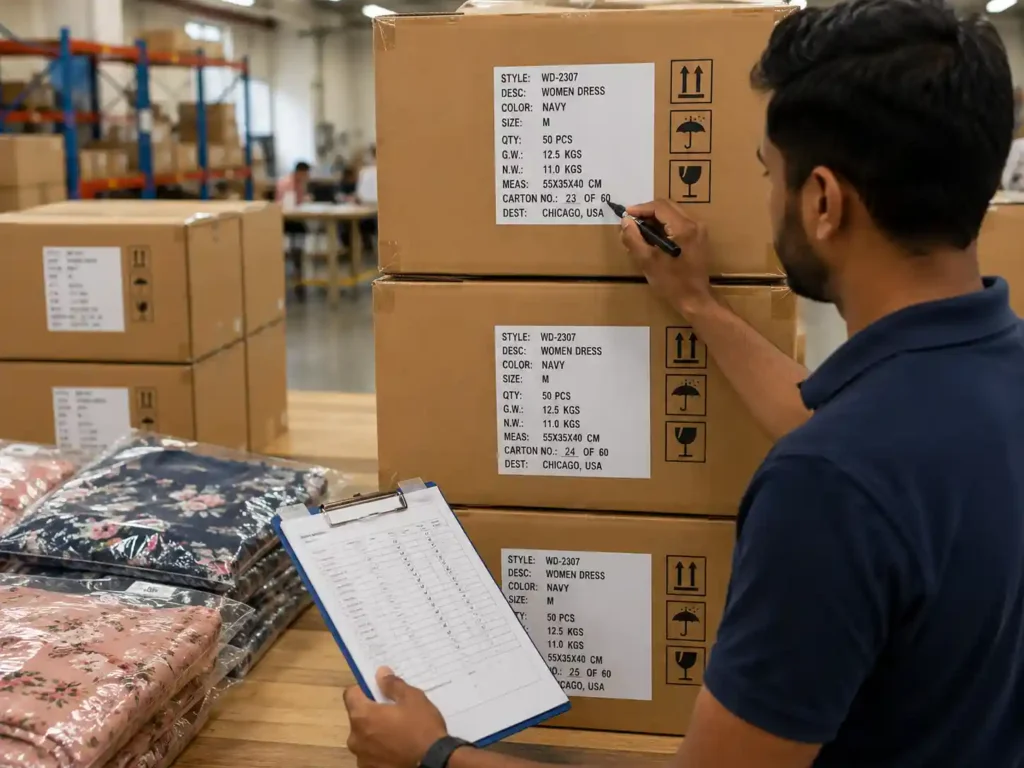
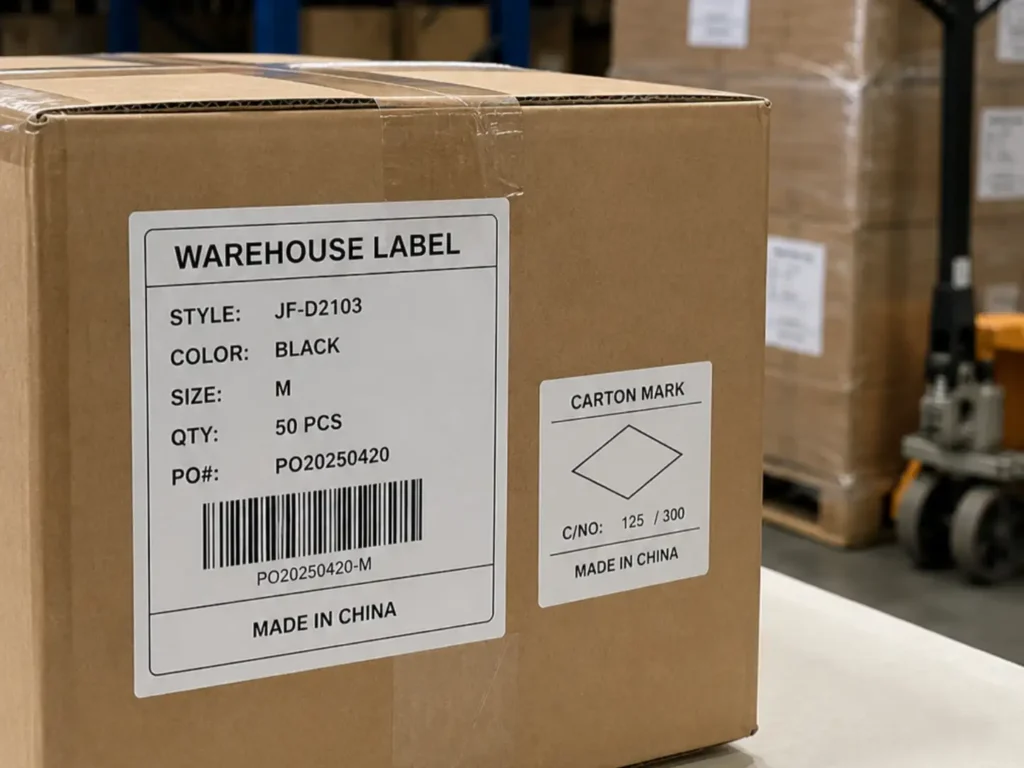
Carton-level identification connects multiple unit packs to shipment and receiving records. Depending on the program, a carton mark can show PO number, style, color, size range, carton number, quantity, destination or shipping reference. A separate warehouse label may be required by the receiving facility.
Carton data must follow actual packed contents. If a mixed-size carton contains XS through XL, the internal ratio and total quantity should match the carton record and packing list. Jinfeng checks carton-level quantity, SKU, color, size, barcode references and carton marks before shipment release according to the approved packing plan.
Individual Garment Packing by SKU and Product Type

Identity Is Checked Before Folding
Packing starts with the physical garment, not the bag. The style, color and size need to match the approved order breakdown before hangtags and external labels are applied.
A label check after the garment is fully packed is less effective if the internal size has already been mixed. For garments with similar silhouettes and colors, the packing table should not depend on memory.
Size labels, garment measurements where relevant, production bundles and the approved SKU map provide stronger controls. Final folding follows the brand’s instruction so the unit arrives in a consistent presentation.

Unit Pack Configuration Follows the Sales Channel
A common ecommerce configuration may include a folded garment, approved brand labels, hangtag, barcode sticker, SKU label, size sticker and individual polybag. Retail programs may use hanging presentation, price labels supplied by the brand, additional carton information or other warehouse-specific requirements.
Jinfeng can also support thank-you cards, brand stickers, custom polybags, dust bags or paper boxes when the program calls for them. Packaging material availability, artwork, MOQ and cost should be confirmed before bulk packing so the final configuration is commercially workable.
Packing Method Changes With Fabric and Construction
Multi-SKU and Mixed-Carton Packing Control
Mixed cartons are useful for ecommerce warehouses, retail replenishment and multi-size womenswear programs, but they create more control points than single-SKU cartons. Jinfeng can arrange mixed-size or mixed-color cartons according to approved packing instructions while controlling carton quantity, size ratio, color ratio, SKU and carton identification.
Size Ratios Must Be Defined, Not Assumed
A carton might require a ratio such as XS:S:M:L:XL = 1:2:3:2:1, or a completely different breakdown based on store demand. The ratio should be written in the packing instruction and connected to the SKU table. Packing workers then follow the approved allocation rather than distributing sizes by appearance or convenience.
For repeat orders, the ratio can change even when the garment style stays the same. New sales data, warehouse allocation or destination requirements may lead a brand to increase M and L while reducing XS. Jinfeng therefore rechecks the current order breakdown rather than treating old carton ratios as permanent.
Mixed Colors Need Clear Separation Logic
A brand may allow several colors in one carton or require each color to remain separated. When colors are mixed, unit packs need clear color and SKU identification, especially for black, navy, dark brown or similar shades that are difficult to distinguish quickly through a folded pack.
Internal carton arrangement can follow the brand’s instructions, including color grouping, size grouping or an ordered layer sequence. The aim is not merely to fit the largest number of pieces into a carton; the packed structure should support counting, receiving and distribution.
Carton Traceability Connects Physical Goods to Records
Every sealed carton should have a defined identity within the shipment. Carton number, quantity, style or SKU range, color-size breakdown and destination information should align with the final packing list and carton mark.
Packing QC reviews the carton after unit packs are prepared but before shipment release. Discrepancies in quantity, ratio, labels or marks should be corrected before the carton becomes part of the export shipment. This control reduces the risk of arriving at a warehouse with correct total units but incorrect internal allocation.

Ecommerce-Ready and Retail-Ready Packing Compared
Ecommerce and retail programs share the need for accurate SKU identification, but the receiving and presentation rules can differ. Jinfeng can follow approved channel-specific instructions so the same womenswear collection can be prepared for online fulfillment, specialty retail or chain-store receiving without treating every destination as identical.
| Packing Element | Ecommerce-Ready Focus | Retail-Ready Focus | Jinfeng Execution Focus |
|---|---|---|---|
| Individual polybag | Common for unit protection and warehouse identification | Used when required by retailer or distribution center | Correct bag type, folding and unit identity |
| SKU label | High importance for variant-level inventory | High importance for store and warehouse allocation | Match style, color and size to approved SKU table |
| Barcode sticker | Common on unit pack or hangtag | Common on hangtag, unit pack or retailer label | Use brand-supplied barcode reference and approved placement |
| Size/color sticker | Speeds warehouse picking and returns handling | Supports allocation and store receiving | Match physical garment and external label |
| Hangtag | Brand presentation and product identity | Retail presentation, barcode and price information where supplied | Artwork, variant and attachment check |
| PO information | Used when required by fulfillment program | Often important for retail receiving | Match approved PO and carton records |
| Carton mark | Supports inbound sorting and shipment control | Often follows retailer-specific format | Carton number, quantity and destination accuracy |
| Warehouse label | Destination-specific | Frequently required by distribution centers | Apply approved receiving label to correct carton |
| Mixed-size carton | Useful for inventory allocation | Common in store or DC ratio packing | Follow approved size/color ratio |
| Packing list | Shipment and receiving reconciliation | Shipment, PO and warehouse reconciliation | Match physical carton breakdown |
Packing QC Before Cartons Leave the Factory
Packing QC is the control layer between finished garments and warehouse receiving. Jinfeng reviews labels, unit packs, carton contents and final shipment records so packaging reflects the approved product and order data, not just a visually neat finished carton.
Data Check Before Physical Packing
The latest approved SKU table, barcode file, packing instruction, color-size breakdown and carton-mark requirement need to be available to the packing and QC teams. When a revised file affects SKU names, barcode references or carton ratios, the active version should be clear before bulk labels are applied.
A file conflict is safer to resolve on screen or on a controlled sample pack than after hundreds of cartons have been sealed. For large collections, style grouping and file naming also reduce the chance of one program’s barcode data being applied to another style.
Unit-Level Packing Check
The unit check reviews garment style, color and size together with hangtag, barcode sticker, SKU label, size sticker, color sticker and polybag condition according to the approved configuration. Barcode readability can be checked before the unit enters the carton, particularly when labels sit on curved, glossy or heavily printed packaging surfaces.
QC also looks at presentation. A clean label on the correct SKU is not enough if a satin dress is badly creased, a sequin surface is rubbing against decoration, or a structured bodice is compressed. Product quality and packing quality meet at the same checkpoint.
Carton-Level Check
Carton packing adds quantity and ratio controls. QC reviews the total units per carton, size and color ratio, SKU range, mixed-carton rule, carton number, carton mark and warehouse label where required.
Gross and net weight, carton size or other shipment information can also be coordinated when included in the program.
A mixed carton may pass total-count inspection while still failing the approved ratio. Carton QC therefore compares both the overall quantity and the internal breakdown.
Final Release Against Shipment Records
Before shipment, the physical carton structure should match the final packing list and shipping preparation records. Pre-shipment inspection can also include garment measurements, appearance, labels and packaging according to the order’s quality requirements. Client inspection or AQL arrangements can be supported by project where required.
Final release is based on the approved requirements for the order rather than a blanket claim of zero defects. The purpose is to identify discrepancies early enough for correction before goods are handed to the forwarder or warehouse receiving process.
Carton Marks, Warehouse Labels and Packing Lists
Carton Marks
Warehouse Labels
Some warehouses require their own receiving label, location reference or routing information.
Jinfeng can apply client-provided warehouse labels or approved label files according to the packing instruction. Placement needs to remain visible after carton handling and should not conflict with required shipping marks.

Packing Lists and Export Coordination
From Approved Files to Warehouse-Ready Goods
File Intake
SKU Mapping
Label Approval
Bulk Production
Garment QC
Unit Packing
Carton Allocation
Final Release
Packing Is Managed as Part of Bulk Production

Merchandising Control
The merchandising team organizes product files, quantity plans, label artwork, packing instructions and client updates.
A fixed communication window helps reduce version confusion when style lists, barcode files or warehouse requirements change during the project.

Finishing and Packing
The finishing team handles pressing, folding, hangtags, barcode stickers, size labels, SKU labels, polybags and carton preparation.
The goal is a clean finished garment and a correctly identified sellable unit, not simply a sealed bag.

Quality Review
QC checks garment and packing details at several points, including incoming materials, cutting, sewing, finished garments, pressing and packaging.
Packing errors are treated as shipment-quality issues because they can affect receiving even when sewing quality is acceptable.

Shipment Coordination
Anonymous Multi-SKU Womenswear Packing Program
A representative U.S. womenswear program within Jinfeng’s normal brand-order range shows how quickly packing complexity grows. The order covered 18 styles and 43,200 finished garments, with three colors per style and an XS-XL size range. The structure created 270 style-color-size combinations before carton allocation was added.

Order Structure
- 18 womenswear styles
- 3 colors per style
- 5 sizes: XS, S, M, L, XL
- 270 SKU combinations
- 43,200 pcs total order quantity
- Uneven quantity by SKU based on the brand’s sales forecast rather than equal distribution
The collection included different dress constructions, so packing could not use one identical fold or bag size for every style. Longer dresses, structured bodices and delicate surfaces required separate handling notes while the SKU structure remained unified.

Packing Preparation
The project used a master style-color-size breakdown linked to the brand’s SKU and barcode references. Packing files were grouped by style and color, while hangtag and polybag identification followed the approved variant map.
Mixed-size carton ratios were defined in advance for selected styles, and other styles used more separated carton allocation.
Before bulk packing, the team reviewed label versions, individual-pack requirements, carton marks and warehouse instructions.
The purpose was to prevent a late-stage barcode revision from affecting already packed goods.

Unit and Carton Execution
Each garment moved from finishing into variant verification, hangtag and barcode application, folding and individual packing. Carton packing then followed the assigned SKU or ratio rule. Carton marks and physical contents were checked against the carton breakdown before sealing.
The large number of variants made data discipline more important than visual recognition. Black dresses in adjacent sizes could not be managed by appearance alone, and repeated style-color combinations required consistent SKU references across packing stations.

Shipment Release
Final checks compared packed quantities, carton information and packing records before shipment preparation.
Any discrepancy found during packing control was corrected before final release rather than deferred to the destination warehouse.
The same packing records can support later replenishment, subject to a fresh check of barcode files, quantities, colors, size ratios and destination rules for the repeat order.
Barcode, SKU and Warehouse Files Stay Protected
Barcode and SKU Files
SKU tables, barcode lists, style numbers and quantity breakdowns are treated as order data.
They are used to prepare and verify the correct garments and packaging for the corresponding project rather than displayed as marketing material.
Warehouse and PO Information
Warehouse addresses, receiving guides, carton rules, PO information and destination labels can expose commercial operations.
The information should circulate only among the teams that need it for packing, logistics and shipment coordination.
Brand and Packaging Artwork
Keep Packing Consistent Across Repeat Orders
Records That Support Reorders
Useful repeat-order records include patterns, size charts, BOM information, fabric and color references, trim details, label artwork,SKU tables, packing instructions, carton marks, QC notes and Golden sample references. Packaging history reduces the need to reconstruct every decision from old messages.
Changes Still Need Approval
A same-style reorder may introduce a new color, revised barcode, different size curve or another warehouse destination.
Those changes can alter SKU mapping and carton allocation even if the pattern stays unchanged. The current order files remain the authority for the new run.
Replenishment Benefits From Stable Data
Bestseller replenishment moves faster when the manufacturing and packing structure is documented. Jinfeng can call back approved references, compare them with the new order and update only the changed elements.
Stable recordkeeping supports long-term programs without assuming every repeat order is identical.

Packing Cost and MOQ Depend on the Configuration
Jinfeng Apparel’s basic garment MOQ starts from 200 pcs per style/color. Packaging materials can have separate supplier minimums, especially for custom printing, special labels, branded boxes or other made-to-order components. Cost should be reviewed with the packing specification rather than treated as one fixed add-on price.
Standard Production Packing
A straightforward configuration may use approved garment labels, hangtag where required, barcode or SKU sticker, clear polybag, export carton and carton mark. The final cost depends on labor, materials, quantity, carton structure and handling requirements.
Custom Private-Label Packaging
Printed polybags, custom tissue, dust bags, paper boxes, premium stickers, special hangtags or other branded components can add material MOQ, artwork setup, lead time and volume. Some packaging materials may also increase carton volume or freight cost.
Multi-SKU Handling Adds Management Work
More styles, colors, sizes, warehouse destinations and carton rules create more file review, label separation, packing control and QC checkpoints. Accurate quotation therefore needs the SKU table, quantity breakdown, packaging configuration and destination requirements whenever possible.
Barcode and SKU Packing Frequently Asked Questions

Send Your Barcode and SKU Packing Requirements
Jinfeng Apparel supports fashion brands that need custom womenswear manufactured, inspected and prepared for ecommerce, retail or warehouse receiving under a defined SKU and barcode structure. A useful first review does not require every production detail to be perfect, but the more complete the product and packing information, the more accurately our team can evaluate labeling, carton structure, packaging cost and execution risk.
For a faster project review, send the files already available for the program. Our team can compare the product breakdown with the proposed packing structure before sampling or bulk packing decisions are locked.
Please include when available:
- Reference images or tech packs
- Style list and target quantities
- Color and size breakdown
- SKU master table
- Barcode file
- Label and hangtag artwork
- Individual packing requirements
- Carton ratio or mixed-carton rules
- Carton-mark template
- Warehouse receiving guide or destination requirements