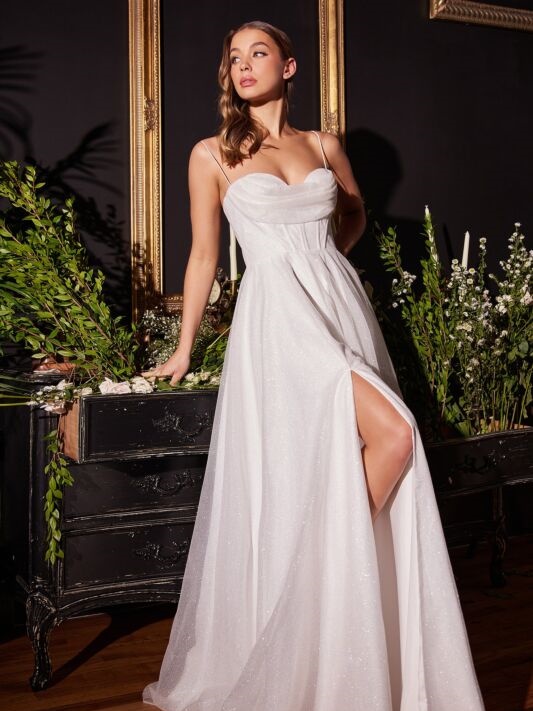
Skip to content

Sweetheart-Neck Dress Development
Turn sweetheart-neck concepts into production-ready dresses with controlled neckline shaping, bust fit, internal support, fabric behavior and repeatable bulk construction.
- 7+ senior pattern makers support neckline, bust, waist and body-proportion correction during development.
- 2 sample rooms and 20+ sample machinists support first samples, fit samples, revised samples, PP samples and Golden samples.
- Regular dress first samples commonly require around 10–15 days; more structured lace, mesh, corset-inspired or complex constructions commonly require around 15–25 days, subject to fabric and trim availability.
- Development continues from approved fit and material direction into PP sample, Golden sample, bulk production and QC, rather than stopping at a visually acceptable prototype.
Development Resources Behind Better Sweetheart-Neck Dresses
7+ Pattern Makers
20+ Sample Machinists
2 Sample Rooms
15+ QC Inspectors
PP Sample Control
Golden Sample Reference
Where Sweetheart-Neck Dress Development Usually Fails
Neckline Gaping
Bust Shape Distortion
Weak Upper Support
Grading Imbalance
Sweetheart-Neck Dress Styles We Develop

Strapless Sweetheart

Strappy Sweetheart

Corset Sweetheart
Corset-inspired styles may combine cups, boning, structured lining and a fitted waist.Development focuses on bust shaping, cup placement, center-front control and support without creating visible internal bulk.

Soft-Cup Sweetheart

Bodycon Sweetheart
Stretch fabrics can follow the body closely, but excessive stretch around the bust can flatten the sweetheart curve.
Recovery, side-seam balance and lining strategy need validation through fitting.

Sweetheart Mini Dress
Shorter lengths increase the visual importance of torso proportion.
Waist position, neckline depth and overall garment length need to work together so the silhouette remains balanced.

Sweetheart Midi Dress
Midi versions often use more structured or draped fabrics for occasionwear.
Neckline engineering must coordinate with waist shaping, skirt balance and fabric weight.

Evening Sweetheart Dress
Sweetheart Neckline Geometry Starts With the Pattern
A successful sweetheart neckline comes from a controlled relationship between the center-front dip, bust apex, upper-bust line, side coverage and neckline curve. Moving any one point can change both appearance and stability.
Center-Front Depth
The deepest point of the neckline defines much of the visual character. A small change can shift the dress from soft and commercial to dramatic and revealing.
Development therefore considers:
- Desired neckline depth in the base size
- Distance between neckline and bust apex
- Center-front length
- Fabric stretch and recovery
- Lining or support construction
- Intended bra or no-bra wearing condition
A low neckline with insufficient center-front stability may pull apart or distort during movement. A neckline positioned too high can lose the intended sweetheart character.
Bust Apex Relationship
The heart curve needs to sit naturally around the bust rather than simply being drawn symmetrically on a flat pattern.
Pattern review focuses on:
- Apex height
- Apex spacing
- Full-bust allowance
- Upper-bust tension
- Side-bust coverage
- Dart or princess-seam direction
A change in bust shaping often requires a related adjustment to the neckline. Correcting only the neckline edge without correcting the body beneath it usually creates another fit problem.
Side Coverage and Curve Balance
The outer ends of the sweetheart curve determine how securely the dress covers the side bust and how the neckline connects to straps, side seams or armhole structures.
Too little coverage can create exposure and instability. Too much coverage can visually close the neckline and alter the intended style.
Jinfeng pattern makers evaluate the neckline as part of the entire bodice rather than treating the heart-shaped edge as a standalone decorative line.

Building the Right Bust Support Structure

Shaped Lining
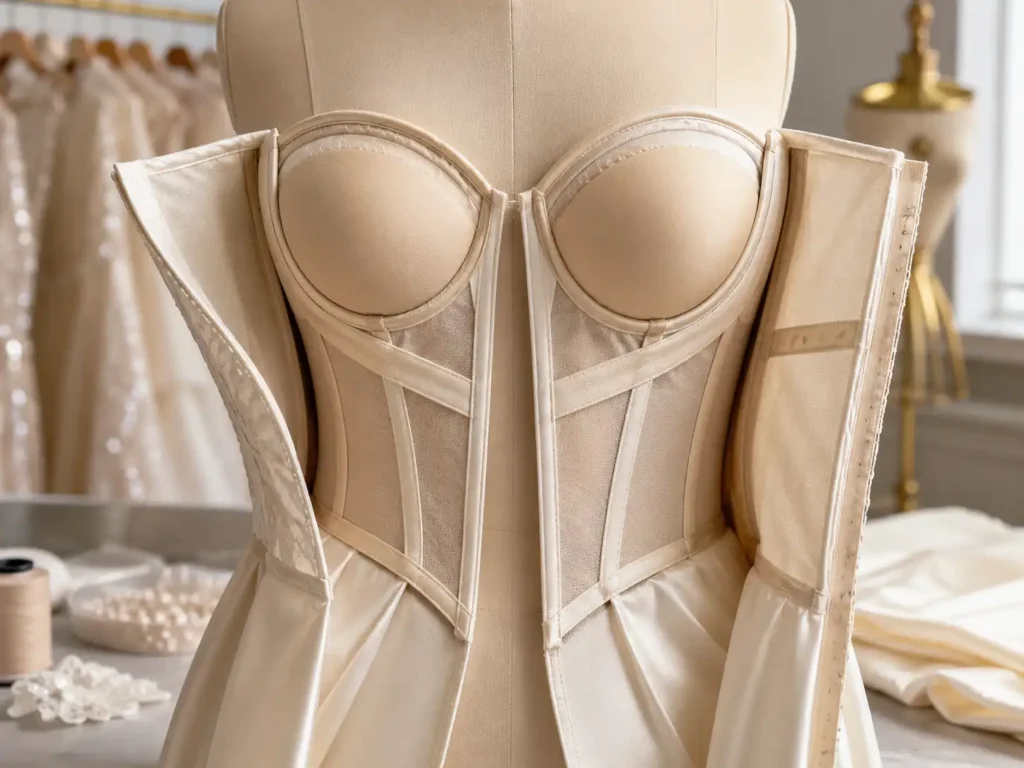
Bra Cups

Boning Support

Underwire Structure
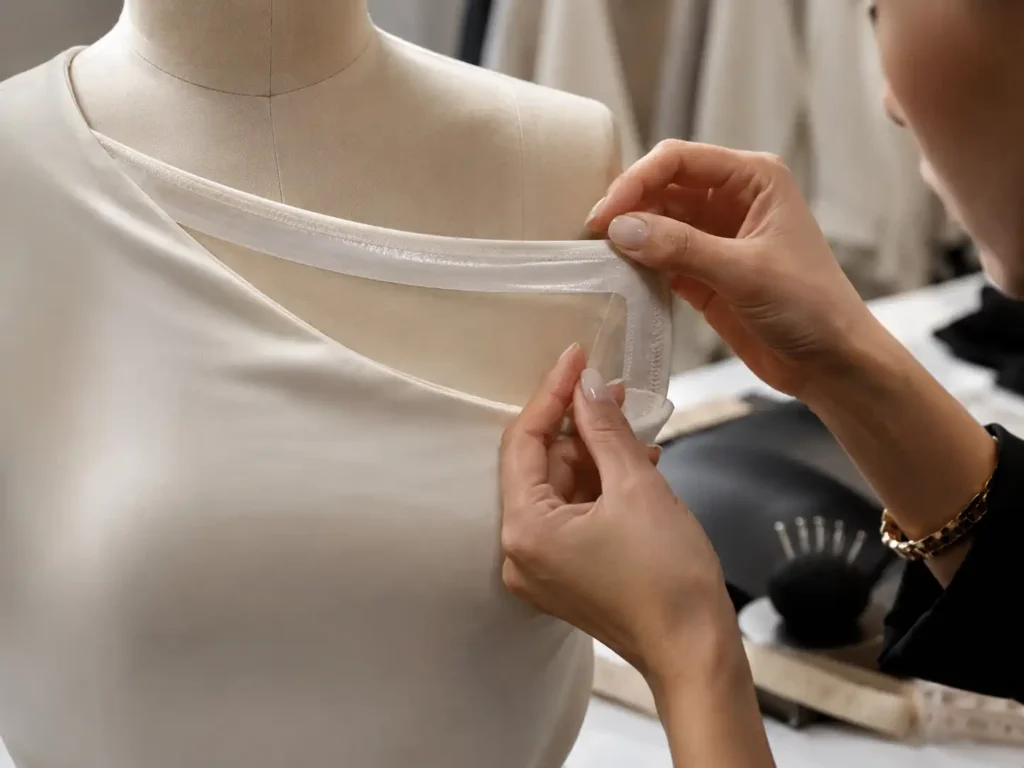
Anti-Slip Support

Strap-Assisted Support
Fabric Choices Change Sweetheart-Neck Performance
Fabric selection affects far more than color and hand feel. Stretch, recovery, weight, drape, transparency and surface behavior influence how sharply the neckline holds its curve, how closely the bodice follows the bust and whether additional lining or support becomes necessary.
| Fabric Direction | Sweetheart-Neck Behavior | Main Development Risk | Typical Control Focus |
|---|---|---|---|
| Woven Satin | Smooth, defined and visually premium | Snagging, zipper bulging, shine-direction differences | Grain direction, lining, pressing, zipper flatness |
| Stretch Satin | Cleaner body fit with moderate flexibility | Neckline spreading or bust compression | Stretch percentage, recovery, fit sample |
| Lace | Adds texture and occasionwear detail | Uneven motifs, unstable edges, lining visibility | Placement, symmetry, edge finish, lining color |
| Mesh | Creates lighter or layered neckline effects | Transparency, stretching and edge deformation | Mesh recovery, lining, stabilization |
| Power Mesh | Provides stronger stretch support | Excess compression or visible internal tension | Recovery, stretch direction, comfort |
| Jersey | Soft and close-fitting | Sweetheart curve may lose definition | Recovery, neckline stabilization, seam tension |
| Ponte | More stable stretch structure | Excess thickness around neckline seams | Seam bulk, shaping, pressing |
| Crepe | Controlled drape with a refined surface | Insufficient support in low structured necklines | Weight, lining, pattern balance |
Lining, Closures and Trims Affect Neckline Stability

Invisible Zippers
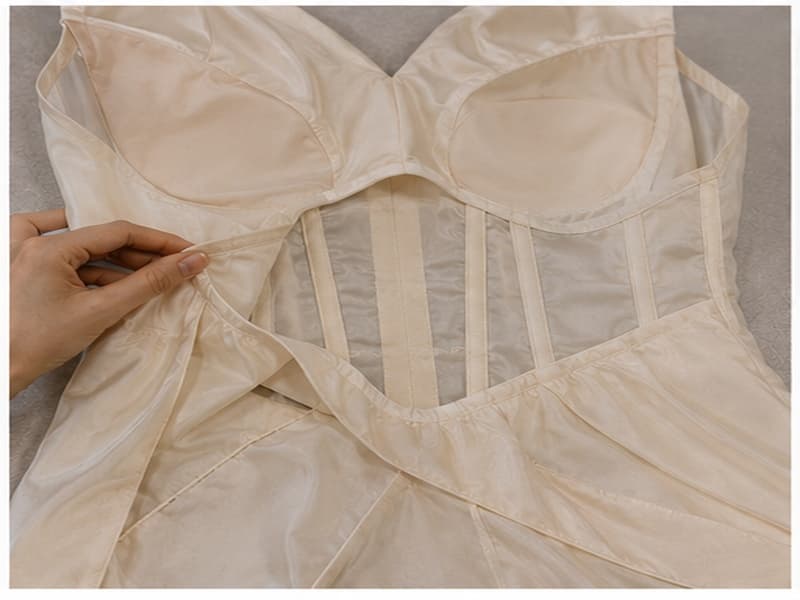
Internal Lining

Cups and Boning

Strap Hardware

Elastic and Support Tape
Elastic or anti-slip support can help stabilize selected areas, but tension needs testing during fitting so the bodice does not cut into the body.

Brand and Packing Trims
Woven labels, care labels, hangtags, barcode stickers, polybags and other private-label details are coordinated with garment development so approved dresses can move into branded delivery without rebuilding the packing specification later.

Sweetheart Fit Depends on the Whole Bodice
A neckline can be technically symmetrical and still fit poorly if the bust, waist, side seam and torso length are wrong. Jinfeng reviews the neckline together with the full bodice so local corrections do not create problems elsewhere.
Bust-to-Waist Balance
A fitted sweetheart dress relies on the relationship between bust shaping and waist suppression. Too much waist reduction can increase upward tension and distort the neckline; too little can reduce the intended fitted silhouette.
Upper-Bust Tension
The upper-bust area needs enough control to keep the neckline close to the body without creating a visible horizontal pressure line.
Strapless designs depend heavily on this relationship, while strapped styles can distribute some support through the shoulder.
Side-Seam Position
Side seams that rotate forward or backward often reveal an underlying fit imbalance. Such movement can also change side-bust coverage and neckline positioning.
Jinfeng evaluates:
- Bust circumference
- Waist circumference
- Hip relationship where relevant
- Front and back body length
- Side-seam balance
- Strap length and position
- Neckline depth
- Armhole relationship
- Back coverage
On-Body Proportion
Sweetheart dresses are judged on the body rather than on a hanger. Fit review therefore considers front, side and back appearance, not just flat garment measurements.
For mini, bodycon and corset-inspired designs, even a small proportion change around the upper torso can noticeably alter the commercial appearance of the style.
Grading Must Preserve the Sweetheart Shape
Size grading is not simply enlarging every point by the same amount. Bust volume, torso proportion and coverage change across a size range, while the visual character of the neckline should remain recognizable.
- Protect the Neckline Depth
If neckline depth increases too aggressively with size, larger sizes may become significantly more revealing than the approved base sample. If it barely changes at all, the neckline can appear proportionally too high.
The grading plan therefore reviews neckline depth together with bust growth and center-front length.
- Recheck Bust Apex Position
Bust apex position influences how the sweetheart curve sits on the body. Grading must consider horizontal and vertical bust development rather than applying only circumference increments.
- Maintain Side Coverage
Side-bust coverage requires particular attention for strapless and corset-inspired styles. Grading that increases neckline width without enough side support can reduce security.
- Confirm Strap Position
For strapped designs, the strap should still rise from a visually balanced point across different sizes. Incorrect movement can pull the neckline outward or create an awkward angle.
Jinfeng converts approved fit corrections into updated patterns, size charts and production files before bulk grading is treated as final.

From Design Reference to Development Plan
Jinfeng can begin development from different forms of product information. The goal is to convert creative direction into enough technical information for accurate sampling and later bulk production.
Tech Pack Development
Reference Image Development
Original Sample Development
Sweetheart-Neck Dress Sampling From First Fit to Golden Sample
Sampling is where neckline geometry, bust shaping, support structure, fabric and workmanship meet for the first time. A visually attractive first sample is useful, but the real target is a production-ready standard that can survive size grading and bulk manufacturing.

Requirement and Structure Review
Development begins by reviewing the style reference, intended silhouette, fabric direction, neckline depth, bust support, lining, closure, size range, quantity and private-label requirements.
Potential risks are identified before pattern making rather than waiting for them to appear during bulk production.

Pattern and First Sample
A simple dress sample may require around 7–10 days, while a regular dress first sample commonly requires around 10–15 days.
More complex structured, corset-inspired, lace, mesh, sequin or evening styles commonly require around 15–25 days. Special fabrics and trims follow supplier availability.

Internal Fit and Measurement Review
Before comments are closed, Jinfeng checks the sample against the agreed size chart, garment construction and intended visual result.
Photo or video feedback can support communication when development teams are overseas.

Revised Sample
Changes involving pattern, fabric, neckline depth, support structure or major construction may require a revised sample rather than relying on written instructions alone.
Revision history is recorded so old and new versions are not mixed.

PP Sample
The PP sample is used to confirm production-relevant details before bulk manufacturing.
Fabric, color, trims, measurements, construction and packaging should be aligned at this stage.

Golden Sample
Once approved, the Golden sample provides a physical reference for bulk sewing, QC and repeat-order comparison.
Sample Comments Become Controlled Production Corrections
“Please improve the neckline” is not enough information for consistent production. Every important fit comment needs to be translated into a defined correction and then reflected in the files used by pattern, sewing and QC teams.
Classify the Problem
Jinfeng first identifies whether the concern comes from:
- Pattern and fit
- Fabric
- Construction
- On-body appearance
- Color
- Trims
- Measurements
- Design accuracy
- Packing
- Cost target
A gaping neckline, for example, may come from excess upper-bust length, fabric stretch, insufficient support or a pattern imbalance. Each cause requires a different correction.
Update Development Files
Approved corrections can be transferred into:
- Updated pattern
- Revised size chart
- Updated BOM
- Fabric approval record
- Trim approval record
- Sewing instruction
- QC checklist
- Packing instruction
The production team should work from the latest approved version rather than relying on informal messages.
Identify the Root Cause
Bust, waist, neckline depth, strap position, side coverage, lining, zipper, fabric weight, stretch and internal support are reviewed before changing the pattern.
Changing only the most visible symptom can hide the real cause and create another problem during bulk production.
Decide Whether to Resample
Minor corrections may be confirmed through documented changes, while major pattern, fabric or structure changes generally require another physical sample.
This disciplined revision process reduces the risk of a first sample looking correct while the bulk production file still contains outdated specifications.
Workmanship Details That Hold the Neckline in Place
Sweetheart dresses expose workmanship very clearly. Curved edges, fitted bust sections and smooth fabrics leave little room for uncontrolled sewing tension, uneven lining or poor pressing.

Neckline Curve Sewing
The neckline curve needs smooth, even sewing without visible angular points, twisting or left-right imbalance.
Seam allowance handling, clipping, turning and pressing affect whether the final edge follows the pattern cleanly.

Neckline Stabilization
Selected fabrics can stretch during sewing, especially around bias or curved sections. Stabilization methods are chosen according to the material and desired softness.
Too much reinforcement makes the edge rigid; too little allows the curve to grow during production.

Lining Alignment
Shell and lining must work together. If the lining is tighter, looser or differently balanced, the neckline can roll outward or show along the edge.
Alignment is checked around the neckline, bust, armhole and zipper connection.

Cup and Boning Position
Internal support pieces must remain in the planned location through sewing and finishing.
Poor positioning can create:
- Uneven bust shape
- Visible ridges
- Pressure points
- Different left-right appearance

Zipper Flatness
Invisible zipper installation receives extra attention on fitted dresses and smooth fabrics.
Zipper bulging can affect both back appearance and overall bodice tension.

Pressing Control
Pressing is part of construction, not only finishing.
Satin, structured woven fabrics and curved seams need appropriate handling so the garment arrives with a clean neckline and balanced bust shape.
Turning the Approved Sample Into Repeatable Bulk Production
Bulk production begins with transferring approved development decisions into clear manufacturing controls. The objective is not merely to make more units, but to reproduce the approved silhouette, fit and construction through a larger production run.
Lock the Production Standard
Before production, relevant information is confirmed around:
- PP sample
- Golden sample
- Bulk fabric
- Fabric color
Control Material Consistency
Sweetheart dresses can change noticeably when fabric weight, stretch, recovery or shine varies between the approved sample and bulk material.
Bulk fabric is therefore reviewed against the approved direction before cutting proceeds.
Transfer Fit Into Sewing
Pattern lines, neckline construction, cup position, boning location, seam allowance and zipper method are translated into production instructions so line operators do not reinterpret the design independently.
Inspect During Production
QC is not delayed until finished garments are packed. Incoming material review, cutting checks, sewing checks, in-line inspection, finished-garment review, pressing review and packing QC create multiple opportunities to identify variation.
Preserve Repeat-Order Information
Confirmed pattern, fabric, trim, measurement and packing records can support future replenishment.
A repeat order is still rechecked when fabric batches, colors, stretch, weight or construction requirements change.

Sweetheart-Neck Dress QC Checkpoints
Quality inspection focuses on details that directly affect fit, appearance and consistency rather than relying on a generic final garment check.
| Inspection Point | Main Risk | Inspection Stage | Control Focus |
|---|---|---|---|
| Neckline Symmetry | Uneven left/right heart curve | Sample, sewing, final | Curve position and visual balance |
| Center-Front Dip | Too high, low or distorted | Pattern, sample, final | Position against approved sample |
| Bust Shape | Flattening, excess volume, pulling | Sample, in-line, final | Apex, cup and shaping consistency |
| Upper-Bust Fit | Gaping or compression | Fit sample, final | Body contact and comfort |
| Side Coverage | Exposure or loose side bust | Sample, final | Coverage against approved pattern |
| Strap Position | Pulling or uneven angle | Sample, final | Attachment point and length |
| Internal Support | Cup or boning movement | Sewing, final | Placement, comfort, symmetry |
| Zipper | Bulging, catching or uneven seam | Sewing, final | Flatness, function and alignment |
| Lining | Visible edge or tension | Sewing, final | Shell/lining balance |
| Measurements | Size inconsistency | In-line, final | Approved measurement chart |
| Fabric Appearance | Snagging, color or surface issues | Incoming, final | Approved fabric reference |
| Pressing | Distorted curves or seam impressions | Finishing | Clean neckline and bodice shaping |
| Packing | Wrong SKU, size or color | Packing | Garment-to-label consistency |
Developing Multi-Style Sweetheart Collections Without Losing Control
Style Grouping
Sample Priority
Revision Records
Fabric Grouping
Production Allocation
Packing Coordination
Representative Sweetheart-Neck Collection Development Program
The following anonymized program structure reflects the scale and complexity commonly handled in mature multi-style brand orders. Brand identity and confidential design files remain protected.

Program Brief
A US occasionwear program included 18 dress styles across sweetheart, corset-inspired, strappy and fitted silhouettes.
Planned order quantity across the program was approximately 46,800 garments, with individual style quantities allocated according to launch priority, color plan and sales forecast.
Development covered:
- Sweetheart mini dresses
- Structured midi dresses
- Strapless occasion styles
- Strappy sweetheart versions
- Satin fitted dresses
- Lace-overlay versions
- Mesh-panel variations
- Corset-inspired bodices

Development Risks
Early development identified several recurring risks across the assortment:
- Deep neckline versions required stronger center-front control.|
- Stretch satin styles needed different pattern tension from woven satin styles.
- Lace and mesh versions required separate lining and edge-finishing solutions.
- Strapless styles required more attention to upper-bust stability.
- Similar-looking styles could not automatically share identical cup and boning positions.
- Size grading needed review around neckline depth and side coverage.
Treating all 18 styles as one construction family would have created avoidable fit and production differences.

Development Control
Styles were grouped by fabric and internal structure.
Pattern review and sample priority were organized around those groups.
Fit comments were converted into updated patterns, measurement information, BOM changes and sewing instructions before PP approval.
Structured styles moved through additional attention around cup placement, support and neckline stability.
Softer strappy designs used lighter construction where rigid support was unnecessary.

Bulk Translation
Approved materials, patterns, support methods and Golden sample references were transferred into the relevant bulk production standards.
QC focused on:
- Neckline shape
- Bust symmetry
- Strap position
- Side coverage
- Zipper flatness
- Lining exposure
- Measurements
- Fabric condition
- Pressing
- SKU packing
Production Capacity Backed by Structured Project Management
Production Network
Manufacturing Lines
Project Follow-Up
Quality Team
NDA Protection
Repeat-Order Records
Sweetheart-Neck Dress Development Frequently Asked Questions

Start Your Sweetheart-Neck Dress Development
Send the product information already available, whether it is a complete tech pack, reference image, original sample or collection line sheet. Jinfeng Apparel reviews the style from a development and production perspective before sampling begins, including neckline structure, bust shaping, fabric direction, support requirements, size range, quantities, private-label needs and target launch schedule.
For a more useful first review, include as much of the following information as possible:
- Reference image, sketch, original sample or tech pack
- Planned styles and colorways
- Quantity per style and color
- Fabric preference or target hand feel
- Target size range and size chart
- Desired neckline depth and coverage
- Strapless, strappy or corset-inspired structure
- Cup, boning, lining or support requirements
- Logo, label and packaging requirements
- Target launch or delivery window
The development team can then evaluate fabric availability, construction risks, sampling approach, production feasibility and the information still required before quotation or bulk planning.