 Skip to content
What Will Define Bodycon Dress Trends in 2027?

Your trusted Women’s Apparel Manufacturer from China

Bodycon dressing is returning at an interesting point in the fashion cycle. After seasons of oversized tailoring, relaxed columns, fluid slips and understated minimalism, fitted dresses are moving back into the conversation with a different attitude. The most relevant versions no longer depend on extreme compression alone. They use draping, asymmetric necklines, longer proportions, strategic transparency, corset-influenced structure and stretch fabrics that are expected to move with the body rather than simply squeeze it. That makes 2027 less about reviving a single old silhouette and more about rebuilding body-conscious dressing for several occasions, from nightlife and birthdays to cocktail events, eveningwear and polished ecommerce collections.
Bodycon dress trends in 2027 are likely to center on sculpted but wearable silhouettes, a wider mix of mini, midi and maxi lengths, halter and asymmetric necklines, strategic ruching, sheer layering, corset references, richer color and fabric choices that balance stretch with recovery. The strongest products will look fitted without appearing rigid, and they will hold their intended waist, hip, neckline and hem shape through real movement rather than only during a still photo.
The interesting part begins after the moodboard. Two dresses can look almost identical in a campaign image, yet one keeps straight side seams, stable bust coverage and a clean waist after hours of wear while the other twists, rides upward and loses shape. For designers and product teams, that difference is where trend forecasting becomes garment engineering. The following sections look at the 2027 direction through the practical details that determine whether a bodycon idea feels current on screen and remains convincing once it reaches a fitting room, a wardrobe and eventually a repeat production run.
Is Bodycon Back for 2027?
Yes. Bodycon is returning, but 2027 is unlikely to be a literal replay of the ultra-tight bandage-dress era. The stronger direction combines close fit with longer proportions, draping, support, strategic sheerness and more comfortable stretch fabrics. Modern bodycon is becoming a broader dress language that can move from clubwear into cocktail, evening, date-night and polished everyday collections.
What Is Driving the Bodycon Revival?
Body-conscious dressing has been rebuilding momentum rather than suddenly appearing as a one-season novelty. Recent runway and fashion-media coverage has already brought fitted silhouettes back into focus, while professional Spring/Summer 2027 forecasting emphasizes femininity, sensuality, lace, slits, expressive color and comfort. Those signals create a favorable environment for bodycon because the category naturally works with curve definition, exposed shoulders, elongated lines and tactile materials. The difference is that the current mood does not require every fitted dress to look like a classic club mini. A jersey column, ruched midi or sleek halter maxi can communicate the same body-aware idea in a more contemporary way.
There is also a practical commercial reason for the revival: bodycon can stretch across more wearing occasions than its reputation suggests. A soft rib-knit dress can sit in premium basics, while a stretch-satin or corset-influenced version can move into occasionwear. Mesh and cutout versions still serve nightlife and festival capsules, but the category no longer needs to be defined by those products alone. That gives a collection team more room to build a coherent fitted story without producing several dresses that compete for exactly the same customer and event. The revival looks stronger when bodycon is treated as a silhouette platform rather than one nostalgic look.
How Is Modern Bodycon Different From 2010s Styles?
The clearest change is that modern bodycon is not necessarily compressed from neckline to hem. Earlier mass-market interpretations often relied on aggressive stretch, very short lengths and a uniformly tight line. They produced an instantly recognizable silhouette, but the design vocabulary was narrow. Newer fitted dresses introduce visual relief through diagonal draping, asymmetry, softer ruching, transparent overlays, longer skirts and sculpted upper-body construction. The garment can remain close through the waist and hip while allowing the neckline, shoulder or skirt to create movement. That makes the silhouette feel designed rather than simply reduced in circumference.
Length is especially important in this shift. A fitted midi or maxi changes the emotional reading of bodycon immediately. Instead of signaling only nightlife, it can read as cocktail, dinner or evening dressing when paired with a clean halter, one-shoulder neckline, open back or controlled slit. The same applies to fabric. A dense ponte bodycon has a different level of polish from a lightweight club jersey, while stretch satin or double-layer mesh can introduce sheen and depth. For 2027, the most useful question is not whether an old bodycon style is returning, but which familiar elements can be reworked through proportion, fabric and construction so the result feels current.
Are Comfort and Support Redefining the Fit?
Comfort is becoming one of the clearest dividing lines between an older bodycon product and a better modern one. A fitted dress can use negative ease and still be comfortable if the pattern reduction matches the fabric’s extension and recovery. Problems appear when the garment is simply made smaller without considering sitting, walking, arm movement, bust support or how the textile behaves after twenty or thirty minutes on the body. Mini dresses may ride upward when hip tension is excessive; midis can restrict stride; halters can pull at the neck; strapless shapes can slide downward if the upper edge lacks adequate support.
Stretch is only half of the equation. Recovery determines whether the fabric returns close to its original dimension after being extended. A soft knit can feel pleasant during fitting but gradually lose waist definition or allow the neckline to grow. For bodycon development, transverse stretch, longitudinal stretch, recovery, bust coverage, side-seam alignment, hem security and post-wash size stability should be considered together. The practical goal is not maximum tightness. It is a controlled silhouette that stays visually consistent while the wearer moves normally, and that expectation will become increasingly important as bodycon moves into longer-wear occasions rather than remaining limited to short nightlife use.
Which Bodycon Silhouettes Will Lead 2027?
No single bodycon silhouette is likely to dominate 2027. The stronger direction is a family of fitted shapes spanning minis, midis and maxis, with halter, strapless, asymmetric, ruched and corset-influenced variations. Current 2027 signals favor elongated lines, exposed shoulders, controlled draping and purposeful skin exposure, giving brands several ways to modernize bodycon without repeating the same tight mini in different colors.
Which Lengths Will Matter Most?
Mini bodycon dresses will remain relevant because they naturally fit party, birthday, club and going-out categories, but the key development question is how they behave on the body. A nominal dress length tells only part of the story. Torso length, hip circumference, hem opening and stretch direction all influence where a mini actually sits once worn. A dress that looks safe on a hanger can climb several centimeters through normal walking if the hip is over-reduced or the fabric has poor vertical stability. That is why fitted minis need movement fitting rather than approval from static measurements alone.
Midi and maxi lengths expand the category in a different way. A midi offers enough surface area for diagonal ruching, asymmetric drape, long sleeves and side slits, which makes it suitable for cocktail, dinner and date-night dressing. A maxi can push bodycon into a more sculptural and evening-focused space, especially in jersey, stretch satin or a layered mesh construction. The commercial point is not to choose one winning length for 2027. It is to give each length a clear role in the assortment so the mini delivers energy, the midi delivers versatility and the maxi delivers drama without making the collection feel repetitive.
Silhouette | Commercial Length | Strong Detail | Best Occasion | Main Development Risk |
Bodycon Mini | Upper to mid-thigh | Halter, corset, ruching | Party, birthday, club | Hem riding and coverage |
Bodycon Midi | Below knee to mid-calf | Asymmetry, drape, slit | Cocktail, dinner, date night | Restricted stride |
Bodycon Maxi | Ankle to floor | Halter, open back, sculpted line | Evening, occasion | Hem width and movement |
Sheer Bodycon | Mini to midi | Layered mesh zones | Party, festival | Transparency under stretch |
Corset Bodycon | Mini to midi | Structured bust and waist | Party, occasion | Cup and waist balance |
Ruched Bodycon | Mini to maxi | Side or diagonal gathering | Multi-occasion | Gathering consistency |
Are Halter and Strapless Shapes Growing?
Halter shapes are well positioned because they create a clean front while shifting attention to the shoulders and back. In bodycon, the same neckline can support very different products: a high-neck jersey maxi can look streamlined and sophisticated, while a plunging halter mini remains firmly in partywear. The technical issue is weight distribution. When a long skirt, dense fabric or embellishment is attached to a narrow halter neckline, too much load can transfer to the neck. Bust shaping, back placement, fabric tension and sometimes internal support need to share that load so the garment does not become uncomfortable after extended wear.
Strapless bodycon creates a different engineering challenge because there is no visible shoulder support. Strong fabric recovery helps, but it is not a substitute for upper-body structure when the garment is heavy or the neckline sits low. Depending on the design, internal elastic, anti-slip tape, shaped lining, built-in cups or boning may be appropriate. The point is not to overbuild every strapless dress; it is to match support to fabric weight and silhouette. A simple strapless look is successful only when the outside remains visually clean and the wearer does not need to keep pulling the dress upward.
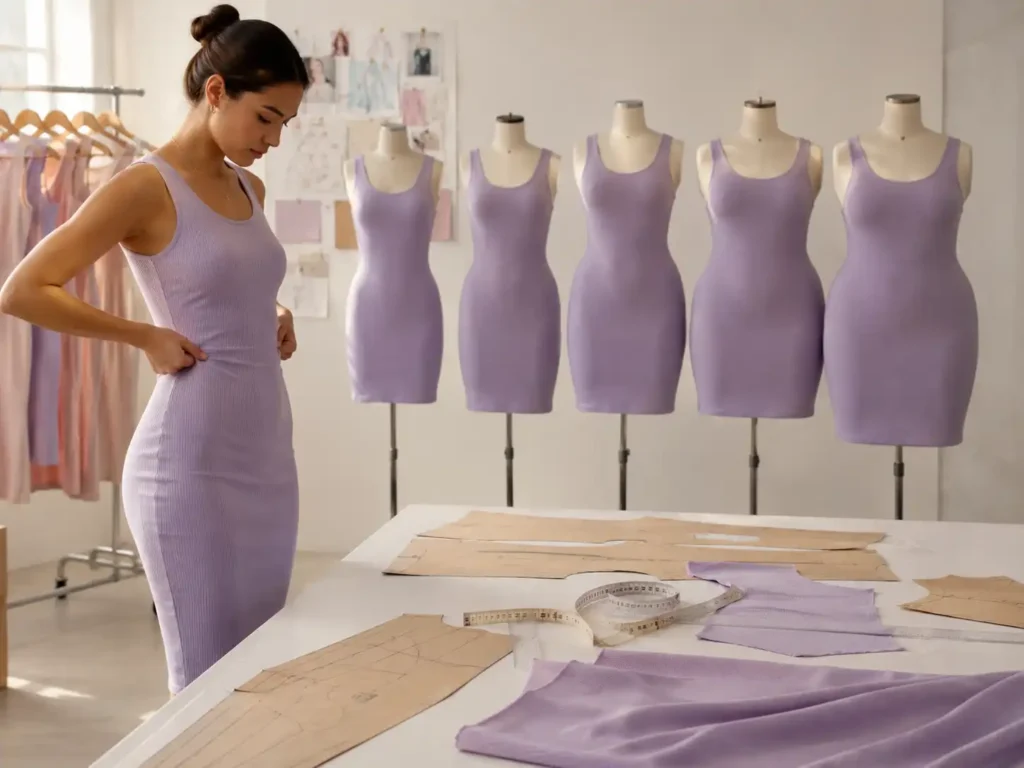
Do Draping and Ruching Still Matter?
Ruching remains one of the most useful ways to refresh a fitted silhouette because it changes both appearance and the way the garment interacts with the body. The more current approach is strategic rather than excessive. Side gathering can soften the stomach area and visually narrow the waist; diagonal ruching can direct the eye across the body; concentrated hip gathering can create controlled volume; and long asymmetric drape can make a maxi feel fluid instead of static. These treatments allow a brand to maintain a recognizable bodycon base while giving individual styles a clearer design identity.
Production consistency is the difficult part. Ruching depends on repeatable extra length, gathering ratio, securing points and sewing tension. If those controls move even slightly, one side of a bulk dress may appear more gathered than the other or the side seam may be pulled out of alignment. Lining can also fight the outer layer if the two materials recover differently. A good fit review therefore checks ruching direction, density, symmetry and side profile, not only the front photograph. In 2027, the strongest ruched products will likely feel intentional and sculptural rather than simply covered in gathering from top to bottom.
How Are Corset and Asymmetric Shapes Evolving?
Corset-influenced bodycon remains commercially useful because corsetry and stretch fit solve different parts of the garment. Bodycon creates continuity through the waist and hip, while structured cups, boning or shaped panels can give the upper body clearer architecture. A genuine corset influence is not just decorative topstitching. Cup shape, padding, boning position, waist tension, zipper stability and lining all affect whether the dress actually supports the body. When those elements are balanced, a corset bodycon can move from birthday or party use into cocktail and premium occasion categories without losing its fitted identity.
Asymmetry creates newness through line rather than internal structure. One-shoulder necklines, diagonal openings, uneven ruching and asymmetric cutouts interrupt the predictable symmetry associated with older bodycon styles. They also photograph well because the eye reads the design direction immediately. The risk is overloading one garment with too many competing ideas. A one-shoulder ruched midi often has more clarity than a style combining an asymmetric neckline, multiple cutouts, boning, sequins and complex straps at once. For 2027 assortment planning, a strong hero detail can create distinction while leaving enough visual space for fabric quality and fit to remain visible.
Which Fabrics Will Shape 2027 Bodycon Dresses?
Stretch jersey, rib knit, ponte, power mesh, stretch satin and elastane-blend constructions are likely to remain central to 2027 bodycon development. The important shift is toward choosing fabric by recovery, weight, opacity, surface and directional stretch rather than stretch percentage alone. A bodycon fabric must create the intended contour and still maintain neckline, waist, hip and hem behavior after movement, wear and washing.
Which Stretch Fabrics Work Best?
Jersey remains one of the most versatile bodycon choices because it can move from simple fitted basics to highly draped fashion dresses. Lower weights create softness and gather easily, but they can reveal underwear lines, seam allowance transitions and areas of uneven tension. Rib knit adds vertical texture and often provides generous width stretch, making it useful for fitted casual and premium-basic dresses. The trade-off is dimensional behavior: as many rib structures expand across the body, they can shorten vertically or lose recovery if the construction is too soft for the amount of negative ease used in the pattern.
Ponte provides a more structured surface and usually greater opacity, which can support cleaner body shaping and polished office-to-evening or cocktail silhouettes. Power mesh serves a different purpose: it can be an outer layer, transparent panel or internal shaping component depending on density and recovery. Stretch satin moves bodycon into a more occasion-focused direction because its smooth surface and shine immediately elevate the look, but the same reflective face makes zipper distortion, pulling and seam puckering easier to see. There is no universal best fabric; the right material is the one whose mechanical behavior matches the visual brief and the expected wearing occasion.
Fabric | Typical Reference Weight | Stretch Character | Useful Bodycon Application | Main Watchpoint |
Jersey | 140-240 gsm | Medium-high | Soft bodycon, ruched dress | Growth and show-through |
Rib Knit | 180-320 gsm | High | Fitted knit dresses | Width stretch and length loss |
Ponte | 250-420 gsm | Medium-high | Structured bodycon | Weight and mobility |
Power Mesh | 100-250 gsm | High | Sheer panels, shaping layers | Transparency and seam tension |
Stretch Satin | 120-250 gsm | Medium | Party and occasion bodycon | Snagging and zipper distortion |
Standard Mesh | 40-120 gsm | Low-medium | Overlays and sheer panels | Holes, distortion and opacity |
These weight ranges are practical development references from the manufacturer’s fabric knowledge base rather than universal industry standards. Mills can produce different structures outside these ranges, so fabric performance should always be verified on the actual quality selected for sampling and bulk production.
How Important Are Stretch and Recovery?
Stretch answers how far a fabric can extend; recovery answers what happens after the extension is released. For bodycon, recovery is often the more important commercial property. A fabric may stretch comfortably over the hip and still be unsuitable if it grows at the waist, leaves the neckline loose or develops ripples along the side seam after extended wear. This is one reason composition labels alone tell very little about fit performance. Two polyester-elastane jerseys with similar weights can behave differently because of yarn quality, knit structure, finishing, elastane content and heat setting.
Directional behavior also matters. A fabric with substantial crosswise stretch but limited lengthwise stretch will react differently from a four-way construction. Vertical stretch can improve sitting and walking comfort, but it can also change hem position and increase length growth. Before approving a bodycon fabric, product teams should compare stretch direction, recovery after repeated extension and garment dimensions after washing or conditioning. A practical test is to mark a measured section of fabric, stretch it to the intended working extension, release it and observe how closely it returns after several cycles. Formal laboratory testing can go further, but even disciplined development-room checks reveal a great deal before the pattern is finalized.
Are Mesh and Sheer Layers Still Relevant?
Sheer dressing remains relevant, but the more wearable translation is often controlled transparency rather than an entirely see-through garment. Mesh sleeves, neckline panels, waist inserts, side sections and transparent outer layers can communicate the trend while keeping coverage deliberate. Double-layer mesh can reduce transparency and create depth without the visual weight of a conventional lining, while power mesh can provide greater support when the design needs stronger recovery. These approaches are particularly useful for party, festival and evening bodycon because they create contrast between exposed and covered areas without requiring heavy embellishment.
Opacity must be checked under stretch. A mesh swatch can look moderate when flat and become dramatically more transparent over the bust or hip. Color also changes the result: pale mesh may expose seam allowances and lining edges that disappear in black. Necklines require additional attention because elastic mesh can grow at deep V, halter, off-shoulder and wide openings if the edge is not stabilized correctly. Printed mesh adds another variable because the artwork can distort as the material stretches. For a 2027 sheer bodycon style, fabric density, number of layers, lining color, stretch direction and final coverage should be approved on the actual worn sample, not from a flat swatch alone.
How Do Fabric Weight and Structure Affect Fit?
Fabric weight changes how closely a dress records the small contours of the body. Lightweight jersey can drape beautifully and create soft ruching, but it can also reveal underwear edges, seam allowances and localized tension. Denser ponte usually smooths those details and creates a more sculpted surface, although the added weight can feel too warm or restrictive in a heavily gathered summer style. Rib knit introduces texture that can visually lengthen the body, but its width expansion can alter garment length once the ribs open around the wearer. These are not minor technical details; they change the silhouette customers actually see.
Structure also affects negative ease and pattern choice. A pattern developed for firm 320 gsm ponte should not be transferred unchanged to a 160 gsm soft jersey and expected to produce the same fit. The lighter fabric may stretch farther, grow faster and need additional neckline stabilization. Stretch satin has its own demands because the smooth surface exposes pulling, shine-direction differences and pressing marks. The best development sequence is therefore fabric selection, fabric behavior review, first pattern, fitted sample, correction and then grading. Locking the pattern first and substituting a dramatically different fabric later may save time on paper but often creates extra rounds of sample correction.

What Colors and Details Will Define 2027?
Black will remain commercially important, but 2027 bodycon is unlikely to depend on neutrals alone. Early Spring/Summer 2027 and Resort signals point toward stronger pinks, bright color, aquatic blue-green tones, washed lights and expressive combinations. In details, ruching, lace, strategic transparency, slits, rosettes, metallic effects and selective embellishment can refresh fitted silhouettes more effectively than simply adding more exposure.
Which Colors Are Emerging for 2027?
It is still too early to declare one universal color of 2027 because the full womenswear runway cycle is not complete as of August 2026. What is already visible is a shift toward greater color confidence. Professional SS27 forecasting has highlighted expressive pink and a broader palette that includes bleached lights and aquatic blue-green directions, while Resort 2027 reporting has shown designers using brighter color as a central part of the look rather than a minor accent. For bodycon, that favors a portfolio approach instead of betting the whole assortment on one predicted shade.
Core darks such as black, deep brown and navy remain useful because they work across seasons and often make fit and surface irregularities less visible. Seasonal brights can create campaign impact and distinguish new drops, while pale tones can move fitted dresses toward summer, resort or occasion use. Color approval should always happen on the intended fabric, because a shade behaves differently on rib knit, matte jersey, translucent mesh and high-shine satin. Light colors also need more demanding opacity checks. A jersey that is completely acceptable in black can become too revealing in ivory once stretched over the hip or bust.
Are Sheer and Metallic Effects Still Growing?
Sheer and metallic effects remain useful because they create visual impact without requiring a radically new silhouette. Transparency works best when it is controlled: a mesh shoulder, waist panel, sleeve or outer layer can make a simple fitted dress feel directional while keeping sensitive areas covered. Metallic treatments suit holiday, birthday, party and festival capsules because they react strongly to event lighting and social photography. They can appear through coated textiles, metallic yarn, sequins, rhinestones or glossy foils, giving product teams several levels of intensity rather than one all-over treatment.
The production risks are different for each surface. Coated fabrics can mark under heat or abrasion. Dense sequins can reduce effective stretch and may require lining to protect the skin. Rhinestones add localized weight and can distort a soft knit panel if placement is not balanced. Reflective materials also magnify sewing defects because puckering and uneven tension catch the light. For 2027, the more sophisticated approach is selective shine: enough metallic or sheer effect to create a memorable image, but not so much that the dress becomes difficult to wear, pack, press or reproduce consistently across bulk production.
Which Embellishments Will Feel Current?
Tactile decoration is becoming more interesting again as fashion moves away from strict minimalism. Rosettes, jewel-like details, sequins, rhinestones, lace appliques and localized surface treatments can all work on bodycon because the fitted base already provides a clean canvas. Placement should support the silhouette. A rosette positioned where asymmetric drape begins can strengthen the line; rhinestones concentrated around a neckline can pull attention upward; and a fully sequined mini can remain simple in pattern because the textile already carries most of the visual information.
Weight and durability should be considered before a decorated sample is approved. Heavy embellishment on one side of a soft stretch dress can pull the neckline or make an asymmetric panel sag. Beads and stones positioned under the arm may look attractive on a mannequin but become irritating during wear. Different attachment methods also fail in different ways: sewn sequins can catch, hotfix stones can release under unsuitable heat or care conditions, and dense embroidery can reduce stretch locally. A strong 2027 embellished bodycon therefore needs a balance between impact, stretch compatibility, skin comfort and packing protection rather than decoration added as a final styling layer.
How Can Cutouts Look More Refined?
Cutouts look more modern when their shape follows the garment’s structure rather than appearing as unrelated openings added after the silhouette is complete. A narrow side opening can connect naturally to diagonal ruching, a back cutout can extend a halter line, and a small waist opening can visually sharpen an asymmetric seam. The most successful versions usually have one clear purpose: change the proportion, reveal a controlled area or create negative space that helps the eye understand the pattern. That is more refined than combining multiple openings simply to maximize exposure.
Stretch makes cutout development more complicated than the flat pattern suggests. A 6 cm opening measured on the table can become substantially wider on the body, and the surrounding fabric may pull differently across sizes. Edge finishing also matters because a binding or narrow hem that is too tight can cause the opening to curl, while one that is too loose can gape. In one documented nine-style mesh-bodycon and cutout program of roughly 8,600 pieces, the practical development issues included transparency, recovery, neckline stability, cutout proportion and bust coverage. That kind of project illustrates why the cleanest cutout often requires more fitting work than its simple appearance suggests.
How Will Bodycon Dresses Change by Occasion?
Bodycon is expanding beyond traditional nightlife dressing. Minis will continue to serve parties and clubwear, while ruched or asymmetric midis can move naturally into cocktail and date-night categories. Fitted maxis, stretch satin, lace, corset construction and refined mesh allow body-conscious silhouettes to reach evening and occasionwear, where fabric quality, movement, coverage and finishing matter as much as visual impact.
Which Styles Work for Party and Clubwear?
Party and clubwear can carry the most expressive interpretation of bodycon because visual impact is part of the purchase decision. Mini proportions, mesh, cutouts, sequins, rhinestones, halter necks and saturated colors all fit naturally within this market. The strongest products usually have a hierarchy, however. If the textile is fully sequined, the silhouette can stay clean. If the neckline is dramatic, the waist may not need three additional cutouts. If the garment relies on heavy asymmetric ruching, a simpler solid fabric can allow the construction itself to become the hero detail.
Fit tolerance is also low because customers move, sit and dance in these dresses. A club mini that continually rides upward or a neckline that grows after an hour becomes uncomfortable quickly, even if the initial product image is strong. In stretch partywear, bust coverage, hip tension, hem security, side-seam alignment and recovery should be treated as primary product features rather than invisible technical matters. This is especially important for ecommerce-led collections: campaign imagery creates interest, but stable fit, consistent sizing and wearable exposure determine whether the dress is kept, reviewed positively and considered for repeat purchase.
Which Styles Suit Cocktail and Eveningwear?
Cocktail and evening bodycon usually benefits from a calmer design language. Longer lengths, cleaner surfaces, controlled draping and more substantial fabrics can keep the silhouette sensual without making it feel limited to nightlife. A ruched asymmetric midi can work well for cocktail use because it combines close fit with enough coverage for dinners and events. Stretch satin adds polish, while ponte or a substantial jersey creates a smoother, more sculpted surface. These fabrics also make small construction defects more visible, so zipper flatness, seam alignment and pressing quality become part of the design impression.
For eveningwear, fitted maxis are particularly useful. Halter necklines, open backs, a single side slit or long diagonal drape can create drama without heavy embellishment. Walking ease must be checked carefully because a narrow ankle-level hem can restrict stride even when the fabric stretches. Lining also needs to move with the shell rather than fighting it. The important development shift is to treat a bodycon evening dress as an occasion garment with its own support, movement and finishing requirements, not as a club mini that has simply been lengthened. That difference is what allows the silhouette to support a more premium positioning.
Are Bodycon Dresses Moving Into Occasionwear?
Yes, provided bodycon is treated as a fit language rather than a dress code. Occasionwear does not require loose shapes; it requires an appropriate balance between exposure, fabric, construction and formality. A close-fitting midi in substantial stretch satin, crepe or ponte can work for a cocktail setting, while a sheer ultra-short mini in the same fit family would communicate something very different. Lace panels, shaped busts, draped waists and refined sleeves can also soften the visual message without giving up curve definition.
The development standard rises as the garment moves into longer-wear and more formal settings. Customers are more likely to notice lining comfort, zipper behavior, bust support, seam quality and fabric surface because the dress may be worn for several hours and photographed under varied lighting. That creates an opportunity for brands that historically treated bodycon as a low-complexity nightlife category. Better fabric and construction can move the same fundamental silhouette into a broader occasion and price architecture, allowing one collection to serve dinner, cocktail, wedding-adjacent events, holiday parties and evening use without losing a consistent design identity.

How Do Mini, Midi and Maxi Serve Different Occasions?
Length changes both styling and engineering, so it should be chosen around the wearing situation rather than trend alone. Mini bodycon remains the most direct option for birthdays, parties, clubwear and festival capsules. It photographs easily and works well with halter, strapless, sequin and metallic treatments. Midi offers more flexibility for date night, cocktail and dinner because it provides enough surface for sophisticated ruching, long sleeves, asymmetry and controlled slits. Maxi changes the emotional reading most dramatically, allowing close fit to feel fluid, sculptural or formal when paired with the right fabric and neckline.
Each length also carries a distinct fit risk. Minis need reliable hip coverage and must be checked for riding during walking. Midis need enough hem opening or stretch for a normal stride, particularly when the silhouette is very narrow below the knee. Maxis need careful slit position, hem balance and fabric-weight control so the skirt does not pull excessively on the upper body. A strong assortment can therefore include all three lengths without unnecessary duplication, as long as each version is designed around its actual occasion rather than created by adding or removing centimeters from one base pattern.
How Can Brands Develop 2027 Bodycon Styles?
A 2027 bodycon concept becomes commercially useful only after trend ideas are translated into fabric, pattern and production standards. The process should define the occasion, select fabric by stretch and recovery, fit the garment on the intended body profile, resolve bust-waist-hip balance and movement, approve a production reference, then control fabric, measurements, seams, color, length and post-wash behavior through bulk production.
How Should Trends Be Evaluated for Production?
A runway image or social post tells a product team what looks interesting; it does not show whether the idea will work at the target cost, across the required size range or through several thousand units. A halter-bodycon direction immediately creates practical questions about garment weight, neck pressure, bust support, dressing method and neckline recovery. A ruched trend raises another set of questions around gathering ratio, securing points, lining behavior and size grading. Converting trend language into these product questions early is one of the best ways to reduce development loops later.
Four filters are particularly useful: customer relevance, assortment differentiation, achievable cost and repeatable construction. A design may be visually strong but redundant if three existing styles already serve the same occasion. It may also be attractive at sample stage but too dependent on manual adjustment to reproduce consistently on a bulk line. Experienced manufacturing input is valuable at this point because the best answer is not always to reject complexity. Sometimes fabric substitution, seam simplification, a different lining structure or a revised cutout can preserve the visible idea while reducing risk. The goal is to protect the design intent while making the product easier to fit, sew and repeat.
How Do Pattern and Fabric Work Together?
In bodycon development, the pattern and fabric function as one system. A woven garment receives much of its wearing ease from the pattern; a stretch bodycon dress receives a significant part of its ease from textile extension. Change the fabric and the effective fit changes even when every paper-pattern measurement remains the same. Moving from high-recovery ponte to soft jersey can make the waist grow and the hem climb. Moving from jersey to dense rib knit can change width stretch and vertical length. Replacing standard mesh with power mesh can alter both pressure and transparency.
This is why late fabric substitutions are risky. Fabric relaxation before cutting, grain or knit direction and lot-to-lot behavior can all influence the finished silhouette. In one documented European premium bodycon program, ten jersey, rib-knit and ponte styles totaling about 16,000 pieces required focused control of stretch recovery, bust-waist-hip proportion, side-seam twisting, hem riding and post-wash stability. The response included fabric-recovery review, relaxation, cutting-direction control, pattern correction and stronger garment-measurement checks. The practical lesson is simple: approve the production fabric and fit together whenever possible, and do not assume composition and nominal weight alone guarantee equivalent behavior.
Which Fit Problems Should Be Tested in Sampling?
Sampling should expose problems that a technical drawing cannot. Bust coverage needs to be checked from several angles and during arm movement. Waist fit should be reviewed after sitting and standing repeatedly, because some stretch fabrics relax with body heat and tension. Hip pressure should be evaluated from the side, where excessive negative ease can pull a seam forward or backward. Mini hems should be observed after walking, not just measured while the model stands still. Strapless, halter, deep-V and one-shoulder necklines also need movement tests because stability can change dramatically when the arms are raised or the body turns.
A useful fitting session records both appearance and behavior. Teams can note whether the neckline returns after being stretched, whether the hem stays in a similar position after ten minutes of movement and whether the side seam remains reasonably vertical. Wash or conditioning checks are especially useful for jersey, rib and elastane blends because shrinkage and torque may not appear until after care. The aim is not to turn every fashion sample into a laboratory project. It is to choose a small set of repeatable checks that reveal the most common failure points before the cost of correction is multiplied by bulk production.
Checkpoint | What to Observe | Common Failure | Likely Bulk Consequence |
Bust | Coverage and support through movement | Gaping or excessive exposure | Fit complaints and inconsistent appearance |
Waist | Contact after extended wear | Fabric grows or bags | Loss of bodycon shape |
Hip | Tension and mobility | Excess compression | Riding and seam distortion |
Side Seam | Vertical alignment | Twisting forward or backward | Visible bulk inconsistency |
Neckline | Recovery after stretch | Gaping or rolling | Exposure and poor presentation |
Hem | Position after walking | Rides upward | Coverage problems |
Cutout | Size while worn | Opening grows excessively | Unintended exposure |
Wash Check | Measurements and torque | Shrinkage or twisting | Returns and repeat-order inconsistency |
What Should Be Controlled in Bulk Production?
Bulk bodycon production needs a clearer reference than the original sketch. Once development is complete, the approved sample, pattern, measurement specification, fabric standard and construction details should form the working baseline. Fabric consistency comes first because a change in stretch, recovery or weight between lots can alter fit even when sewing remains identical. Cutting direction should be controlled because inconsistent grain or knit orientation can contribute to twisting. Sewing tension also matters on stretch seams: stitches must move without breaking, while the seam should remain flat rather than developing visible waves.
Measurements should focus on positions that actually drive fit, including bust, waist, hip, garment length, neckline dimensions and the location of slits or cutouts. Color consistency, zipper condition, side-seam alignment and post-wash dimensions are also high-value checks for bodycon. The deeper commercial benefit appears when a successful style is reordered. Keeping the approved pattern, fabric reference, measurement history, trim details and earlier QC findings reduces the chance that a replenishment run gradually drifts away from the original fit. For brands planning seasonal bodycon programs, that continuity matters as much as the first launch because a trend becomes valuable only when a successful style can be reproduced reliably.
Jinfeng Apparel’s documented production model covers custom dress development, fabric sourcing, pattern development, sampling, sample revision, PP approval, bulk production, quality control and private-label delivery. The company also has dedicated knit and stretch womenswear capacity for bodycon, jersey and ponte styles. For teams preparing 2027 fitted collections, the practical value of that capability is not a generic claim of being able to make dresses; it is the ability to review fabric behavior, fit risk and production repeatability before a trend-driven style is committed to volume.
Share This Article :

Jerry Lee
Categories

Latest blogs
Table of Contents
Here, developing your OEM/ODM private label clothing collection is no longer a challenge—it’s an excellent opportunity to bring your creative vision to life.

