
Bias-Cut Pattern Development
Production-ready bias-cut patterns for fluid dresses, skirts and coordinated fashion collections.
- True-bias placement is developed around the actual fabric, not transferred unchanged from a straight-grain block.
- Selected woven fabrics may require 12–48 hours of hanging review before the final hem and length are locked.
- Development can cover first sample, fit correction, revised sample, PP approval, grading and controlled bulk transfer.
- Standard MOQ starts from 200 pieces per style/color, subject to fabric, color, trims, construction, packaging and schedule.
Pattern Development Backed by Womenswear Production Resources
Since 2008
Two Sample Rooms
Seven-Plus Pattern Makers
Twenty-Plus Sample Machinists
Fifteen-Plus QC Inspectors
Multi-Style Production Support
Built for Structured Fashion Development Programs
Best Fit for Brand Programs
- Slip, midi, maxi, skirt and coordinated collection development
- Fabric-led programs requiring drape and fit control
- Multiple colors or sizes under one approved style standard
- Sample-to-bulk projects with private-label requirements
- Repeat programs requiring pattern and material records
Outside the Service Scope
- No PDF sewing-pattern retail
- No one-piece personal tailoring
- No ready-stock or dropshipping fulfillment
- No unverified copy of protected designs
- No bulk release without pattern, sample and material approval
Where Bias-Cut Garments Commonly Lose Balance
Bias-cut failures rarely come from one sewing operation. Grain placement, material movement, pattern balance, handling time and approval timing interact throughout development. A garment can look acceptable immediately after sewing and still change once the fabric settles under its own weight.
Growth, Narrowing and Uneven Drop
Woven fabric cut near the true bias gains diagonal movement absent on the straight grain. Under gravity, a long dress may grow vertically while becoming narrower across selected areas. Front and back panels may also drop at different rates when their shapes, seam lengths or fabric directions are not balanced. Locking the hem too early can create a visibly uneven finished length after pressing, hanging or wear.
Jinfeng reviews the fabric before finalizing the development path. Weight, construction, surface finish, stretch, recovery, opacity and expected garment length are considered together. Selected samples are allowed to settle for an agreed period, commonly within a 12–48 hour working range, before the final length and hem balance are reviewed. The actual duration remains fabric- and style-specific.
During review, measurements are taken from stable reference points rather than from the lowest moving edge. Center front, center back, side length, waist level and seam junctions are compared before and after resting. A consistent measurement condition helps the team distinguish normal settling from a pattern imbalance. Corrections can then be distributed through panel shape and seam length instead of removing an arbitrary amount from the entire hem.
Approved values are carried into the sample comments and final inspection method.
Side-Seam Rotation and Surface Distortion
Poor grain placement can pull a side seam toward the front or back. Opposing bias directions may behave differently, while satin surface reflection makes even small distortions visible. A seam appearing straight on a flat table can rotate on the body when bust, waist and hip tension are introduced. Unequal handling during cutting or sewing can make the problem worse.
Control begins with grainlines marked on every production pattern piece. Left and right panels are paired deliberately, not placed wherever marker efficiency looks best. Sample fitting checks seam position from front, side and back views. When rotation appears, correction may involve grain adjustment, panel reshaping, ease redistribution, seam-sequence changes or a different fabric direction rather than simply taking in the garment.
Surface direction is checked under normal viewing light because satin reflection can make a balanced garment appear mismatched when panels are rotated. Pattern identification and marker notes must show the required face and top direction. Cut panels are also protected from stretching between the table and sewing line. When recurring rotation begins at one operation, the line corrects handling or feed before more garments are assembled; final pressing is not used to conceal structural twist.
Paired seams are compared before lining or hems hide the evidence.
Neckline, Strap and Hem Instability
Cowl necklines, low backs, narrow straps and long hems place concentrated loads on fabric already moving diagonally. A neckline may continue opening after a fitting, a strap point may drift, or one area of the hem may drop more than another. Lightweight satin can also show puckering, pressure marks or zipper distortion when stabilization is too rigid or uneven.
Pattern development therefore connects neckline shape, facing or binding, strap position, lining, closure method and hem finish. Stabilization is applied only where needed and tested against the desired drape. The approved sample records the final construction, while QC checks position and balance after the garment has rested under the defined inspection condition.
Support materials are evaluated for weight, recovery, adhesion where relevant and visibility through the outer fabric. Narrow test sections can compare alternatives before a complete revised sample is made. Strap attachments are reinforced without creating hard points, and lining is allowed to move where the silhouette requires freedom. Final inspection checks the garment after fastening, movement and recovery so coverage and symmetry are judged under wear conditions, not only while the piece lies flat.
Closure function and edge recovery are checked again after pressing and cooling.
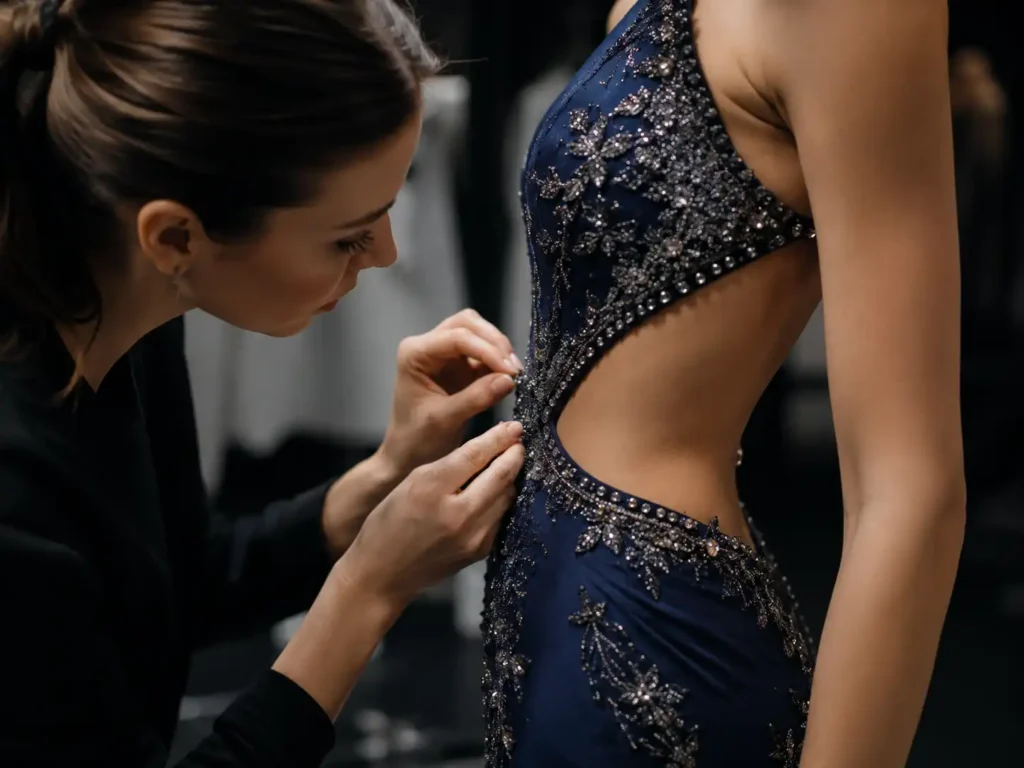
More Than Converting a Straight-Grain Pattern
Fabric-Specific Development
- Fabric weight, width and surface direction
- Diagonal growth and recovery
- Opacity and lining requirements
- Seam slippage and pressing sensitivity
Pattern and Fit Engineering
- True-bias or near-bias placement by panel
- Ease distribution based on drape
- Front-to-back and left-to-right balance
- Size-specific risk review before grading
Production-Ready Release
An approved pattern is not released to bulk merely because the first sample looks attractive. Material details, sample comments, measurements, construction, labels and quality checkpoints must agree. Jinfeng converts approved development decisions into controlled records used by the sample room, production team and QC team.
- Final pattern and grading rules
- Approved measurement chart
- Fabric, lining and trim record
- Sewing and inspection references
Bias-Cut Styles Supported for Fashion Collections

Bias-Cut Slip Dresses

Cowl-Neck Dresses

Bias Midi Dresses

Bias Maxi Dresses

Bias-Cut Skirts

Lace-Trim Bias Slips

Asymmetric Bias Dresses

Bias Coordinated Sets
Fabric Direction Changes Every Pattern Decision

Polyester Satin
- Review shine direction and color consistency
- Check snagging, seam slippage and pressing marks
- Confirm lining and opacity in final colors

Stretch Satin
- Record stretch percentage by direction
- Avoid uncontrolled negative ease
- Recheck measurements after resting
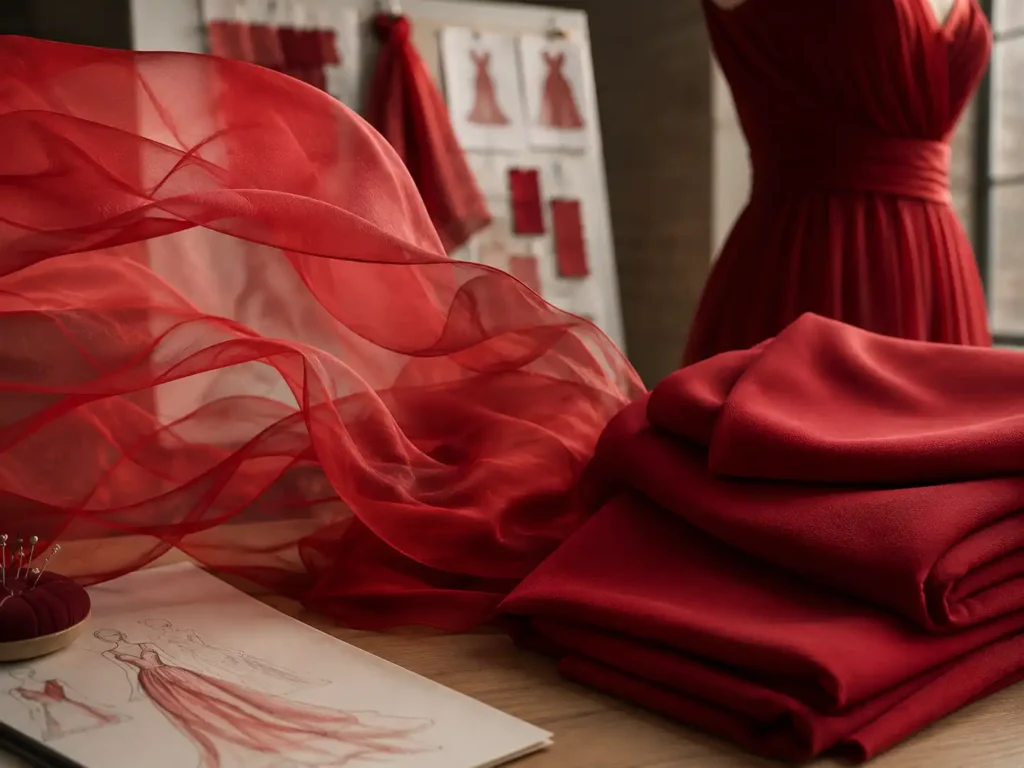
Crepe-Back Satin
- Confirm visible face and surface direction
- Test hem finish and seam appearance
- Review long-length drop before final approval

Viscose Woven
Viscose woven fabrics can create soft, elegant drape but may be more sensitive to shrinkage, distortion and moisture. Fabric relaxation, pre-production testing and stable cutting conditions are important. A pattern approved in an unwashed sample may not remain accurate if bulk fabric changes after finishing or care testing. Shrinkage and dimensional stability should be reviewed before final grading.
- Check shrinkage and wet dimensional change
- Control handling during cutting and sewing
- Confirm care instructions with approved testing data

Chiffon and Lightweight Crepe
- Develop shell and lining as separate systems
- Check layer-to-layer drop after hanging
- Protect narrow seams from distortion
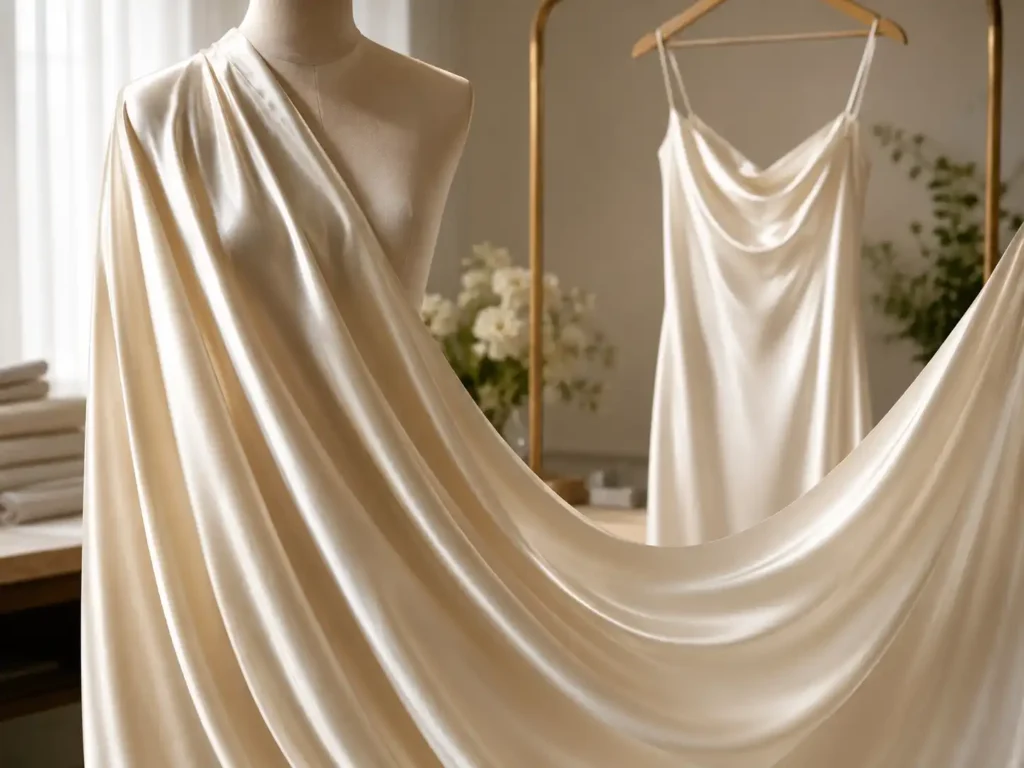
Silk and Silk-Like Satin
Silk and selected silk-like satins offer refined movement and surface depth but expose cutting, needle, seam and pressing errors quickly. Fiber claim, fabric source, batch consistency and care method require confirmation. Development may need single-layer cutting, fine seams, controlled pressing and longer handling time. Final feasibility, MOQ and testing remain subject to the selected material and source.
- Review batch, width, defects and usable yield
- Test seam method with actual bulk-quality fabric
- Approve packing protection before production
True-Bias Geometry Built for Controlled Drape
Bias-cut pattern development starts with geometry, not styling language. Every panel, seam and support component must preserve the intended 45-degree behavior while remaining stable enough for repeatable cutting and sewing.
Establishing the Functional Bias Line
A true-bias panel is normally positioned near 45 degrees to the fabric lengthwise and crosswise grain, yet the working angle cannot be treated as a decorative mark. Fabric construction, usable width, directional surface and panel shape can alter placement. Our pattern makers establish the grain line from the intended hang, then verify whether adjoining panels meet on compatible directions. Long dresses receive extra attention because a small angle error becomes visible across the full skirt length. For cowl necks, the neckline fold and body grain must work together; for skirts, hip contour and hem sweep determine where movement should begin.
Pattern pieces are checked at full scale before marker planning. Mirrored or paired pieces are identified clearly, and one-way surfaces are flagged. When a style mixes straight-grain support with bias outer panels, each grain instruction remains independent. The aim is controlled diagonal mobility rather than uncontrolled stretch.
Reference points are placed where the garment must remain visually stable: bust apex, waist level, hip line, cowl fold, slit top and hem junction. Seam lengths are walked before cutting, and curves are blended without changing the chosen grain. A mini marker or full-width test can reveal whether long panels fit the usable fabric width without rotation. If yield pressure conflicts with the approved angle, design and commercial teams review the tradeoff before any pattern alteration.
- Confirm the working grain on every major panel
- Match adjoining seam behavior before sample cutting
- Mark directional surfaces and mirrored components
- Review panel angle against usable fabric width
Balancing Length Before Final Hemming
Bias panels lengthen under their own weight because yarns move and settle diagonally. Growth is rarely identical at center front, side seam and center back. A final hem drawn directly from a flat pattern can therefore become uneven after hanging. Development includes a balance allowance, an agreed hanging period and a hem-level review on the approved fitting form or fit model. Garment length, panel count, fabric weight, seam type and trims all affect settling.
Long slips and evening dresses may require more growth management than short camisoles, while asymmetrical hems need reference points rather than a single floor measurement. Linings are assessed separately because shell and lining often settle at different rates. The production specification records when the garment may be hemmed and where length is measured. Bulk teams then follow the same sequence instead of correcting individual pieces by eye.
The review also considers how zipper tape, trims, facings and seam finishes redistribute weight. A beaded neckline or heavier back closure can change the drop after an otherwise balanced toile has been approved. When embellishment is planned, the representative sample carries production-equivalent weight. Measurement records identify the garment condition, hanger or form, elapsed rest time and reference points, allowing the same leveling decision to be repeated during pre-production and finishing.
- Measure front, back and side balance after resting
- Separate shell and lining hem decisions
- Define a consistent hang-before-hemming sequence
- Record final length points in the approved specification
Controlling Seams Without Blocking Movement
Bias seams must hold shape while allowing the body of the garment to drape. Too much stabilization can create a rigid ridge; too little can produce rippling, growth or zipper distortion. Seam allowance, stitch density, thread, needle, pressing and handling are reviewed as one system. Curved or long seams may need differential control during sewing, and enclosed seams require enough allowance for clean construction without excess bulk.
Necklines, armholes, waist joins and zipper openings usually need more support than free-hanging skirt seams. Stay tape, narrow interfacing, binding or lining may be selected after trial sewing with the intended fabric. Support is applied only where the silhouette requires it. Sample review checks seam mobility, surface marking and the appearance after hanging, pressing and wear simulation. Approved construction notes translate the result into repeatable production instructions.
Seam tests are assessed from both face and inside. The team checks whether allowances shadow through, whether stitches open under body movement, and whether pressing produces glazing or imprints. Fine adjustments may involve thread size, needle selection, stitch length, presser-foot pressure or sewing sequence, but specifications are recorded only after the combination has been tried on the nominated quality. Operators then receive a physical reference and concise callouts for the operations most likely to stretch.
- Test seam method on the selected fabric quality
- Stabilize openings and closures selectively
- Compare pressed and relaxed seam appearance
- Lock stitch and handling notes before bulk sewing

Compensation Guide for Bias-Cut Fabrics
Two fabrics with the same fiber label can hang differently because weave density, weight, finish, width and recovery vary. Development decisions are therefore based on actual fabric behavior and approved construction, not fiber name alone.
| Fabric profile | Main behavior | Pattern response | Sample control | Production checkpoint |
|---|---|---|---|---|
| Lightweight satin | High diagonal movement; surface shows handling marks | Protect neckline and zipper areas; allow controlled length settling | Hang shell before leveling; inspect seam grin and puckering | Confirm single-layer or controlled lay cutting; protect surfaces through packing |
| Crepe-back satin | Fluid drop with more body and texture | Balance sweep against hip fit; test preferred face direction | Compare hem finish, side seam fall and pressed appearance | Keep face direction, shade and panel pairing consistent |
| Viscose woven | Soft drape; possible shrinkage and moisture sensitivity | Reserve grading decisions until dimensional results are known | Measure before and after resting or approved care test | Apply bulk shrinkage information to pattern and cutting instructions |
| Chiffon or light crepe | Layer shift, transparency and variable drop | Develop shell and lining separately; reduce bulky intersections | Check layer balance, seam strength and opacity on body | Control ply movement, notches, panel pairing and hem sequence |
| Silk or silk-like satin | Refined movement; defects and needle marks remain visible | Minimize unnecessary seams; protect high-stress openings | Approve needle, thread, seam and pressing trials | Review usable width, defects, batch consistency and packing protection |
Eight Controlled Steps From Brief to Production
Technical Brief Review
Fabric Behavior Review
Initial Pattern Build
First Sample Cutting
Hang and Fit Review
Pattern Revision
Approval and Grading
Bulk Technical Transfer
Pattern Deliverables Ready for Technical Handover
Base Pattern Set
Measurement Specification
Grain and Cutting Notes
Construction Specification
Revision Record
Production Checkpoints
First Samples Tested for Hang and Movement
The first sample must answer more than “Does it fit?” It must show whether pattern geometry, fabric behavior and construction remain balanced after the garment is sewn, rested and worn.
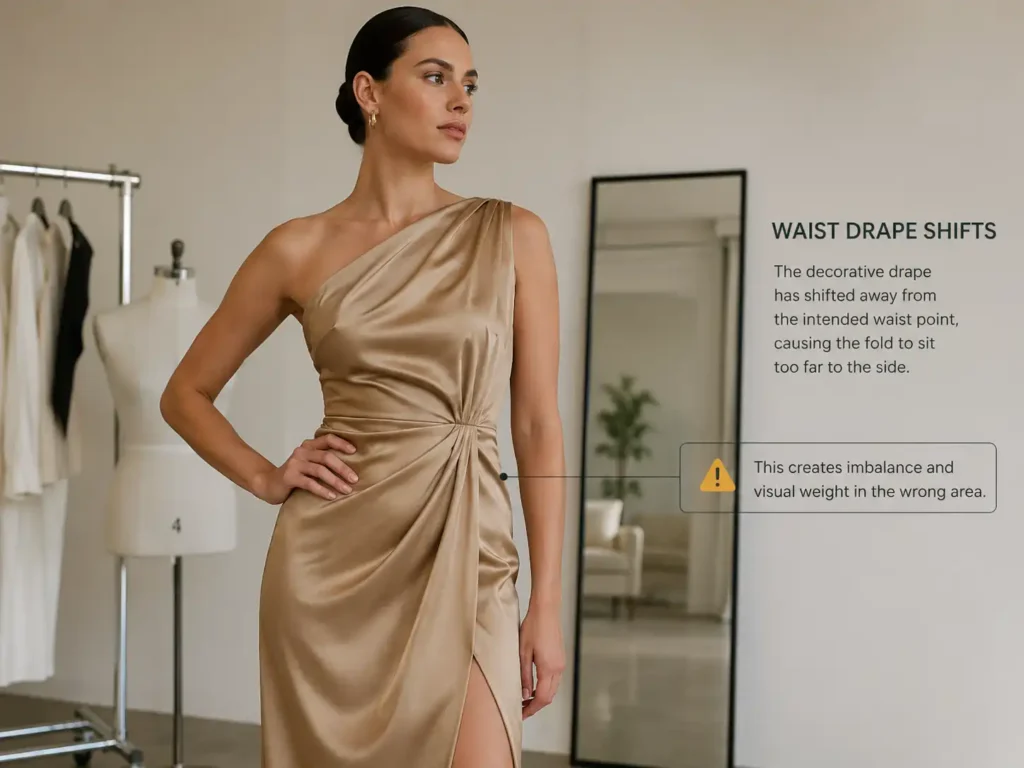
Reviewing Drape From Every Viewing Angle
Bias garments are assessed from front, back and both sides because a clean front can conceal a twisted side seam or an uneven back drop. Review begins with the garment placed naturally on the fitting form or model, without pulling the hem into position. We observe neckline fall, bust coverage, waist definition, hip release, seam direction, panel flare and the relationship between shell and lining. For dresses, the distance from key balance points to the floor helps identify where growth is concentrated.
Movement is then introduced through walking, sitting and arm motion where relevant. A slip dress may fit correctly while standing yet pull across the thigh during a stride. A cowl can look balanced at rest but open excessively after movement. Findings are separated into pattern, fabric and construction causes before corrections are assigned. Photographs and measurement notes give the next sample a measurable target.
Lighting and surface reflection are considered when reviewing satin because diagonal shadows can reveal tension not obvious in flat measurements. The sample is checked with intended undergarment coverage where the brief defines it. A review sheet records the viewing condition, sample size, model or form reference and open decisions. Consolidated evidence prevents one team from correcting fit while another unknowingly changes the design line.
- Review front, back and side seam fall
- Check coverage and recovery after movement
- Compare shell and lining behavior
- Record visual and measured correction points
Measuring After a Controlled Rest Period
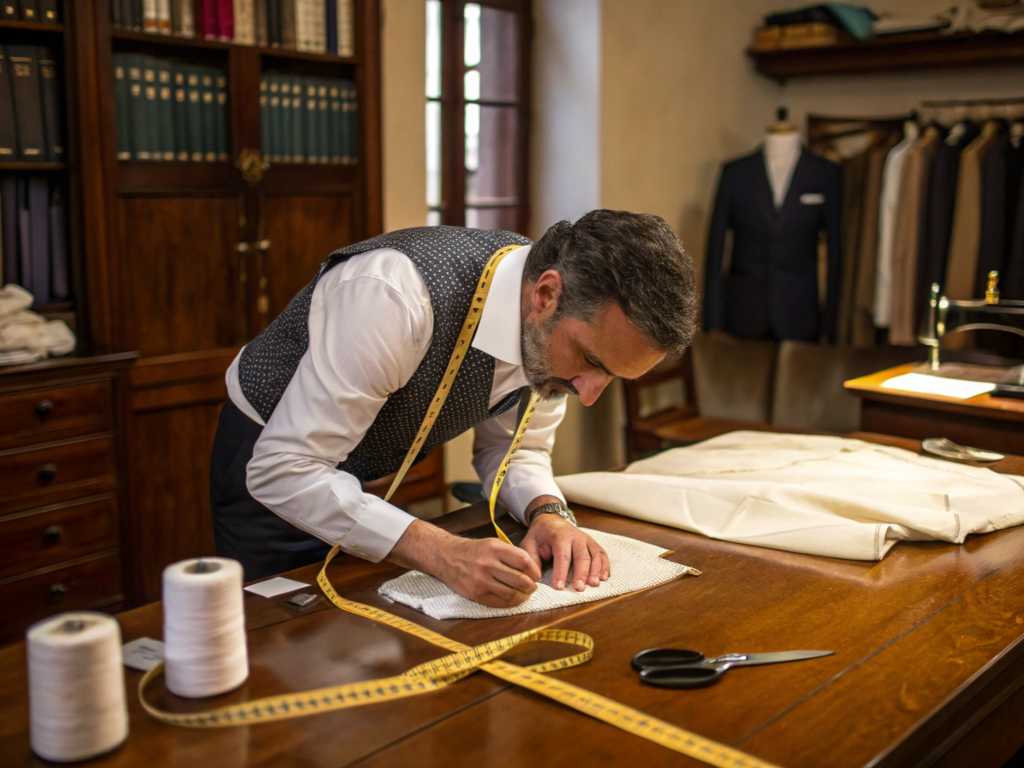
Immediate post-sewing measurements can be misleading because bias panels continue to settle. The sample is allowed to rest or hang for a period suited to garment length, fabric weight and construction. The same condition is used again when comparing revisions. Measurements focus on points affected by diagonal movement: total length, side length, neckline depth, armhole shape, waist and hip position, seam alignment and hem level.
Growth is not corrected by shortening every pattern edge equally. The location and direction of movement reveal whether the cause is panel angle, insufficient support, seam tension, fabric instability or uneven layer behavior. A long dress may require redistribution through the pattern, while a localized neckline issue may need reinforcement rather than a global length change. The correction report distinguishes temporary settling from structural distortion.
Before and after values are recorded in the same units and rounded consistently. If a hem continues moving beyond the expected review window, material behavior is escalated before grading or bulk planning. The team may request another fabric lot, a revised construction trial or a longer observation period. Approval is withheld until the change can be explained and repeated, protecting later size and production decisions from unstable evidence.
- Define the sample condition before measurement
- Compare matching reference points, not loose edges
- Trace growth to pattern, material or construction
- Recheck the revised sample under the same condition

Approving Construction With the Pattern
Pattern approval cannot be separated from sewing approval. Seam choice changes stiffness and can alter how a bias panel falls. Zipper tape may hold one side of a dress more firmly than the opposite seam. Binding can shorten a neckline, while a heavy hem can pull the skirt longer. During first-sample review, critical operations are examined for appearance, strength and influence on drape.
Trial alternatives are requested when a construction method creates puckering, seam grin, rolling edges, stretching or excessive bulk. The selected solution is added to the technical specification with the pattern revision. Pressing is also reviewed because temperature, pressure and movement can permanently distort delicate surfaces. Approval is granted when pattern, material and sewing method produce the intended silhouette together—not when each element passes in isolation.
Wear and closure function are checked before the method is locked. Invisible zippers must operate without catching the lining, narrow straps must carry garment weight, and slits must retain reinforcement without a visible hard patch. Interior workmanship is photographed where assembly order matters. The approved route names the relevant seam, finish and support locations, giving production teams a usable instruction rather than a general request for “clean workmanship.”
- Inspect seam, zipper, binding and hem behavior
- Compare alternatives on actual development fabric
- Add approved methods to the technical file
- Keep the approved sample as the production reference
Fit Control Without Flattening Natural Drape

Bust and Cowl Control

Waist and Hip Balance

Neckline and Armholes

Straps and Open Backs

Side Seams and Zippers

Hem and Layer Balance
Sample Revisions Driven by Recorded Evidence
Revisions are controlled through measured findings, annotated images and versioned patterns. Every correction must state the observed problem, proposed action and approval result.

Separating Pattern, Fabric and Sewing Causes
A twisted seam does not automatically mean the pattern is wrong.
Panel angle, fabric skew, inaccurate cutting, stretching during sewing or uneven pressing can produce a similar visual result. Our review first identifies where the deviation begins and whether it appears symmetrically. Pattern pieces can be checked against the cut components, seam lengths compared, and the garment observed after resting. Fabric surface and weave are reviewed for bow or skew when relevant.
Corrections are assigned only after the likely cause is isolated. Pattern geometry may be revised when balance points or seam direction are incorrect. A cutting instruction may change when panels are shifting before sewing. Construction notes may be strengthened if an operator is stretching one layer against another. The revision record prevents repeated pattern changes from masking a process problem and keeps development time focused on improvements suitable for production transfer.
Material observations stay linked to roll, color or sample source when available. A correction accepted in one quality is not automatically transferred to another fabric carrying the same style number. Where evidence remains inconclusive, a small controlled trial can compare one variable at a time—for example, identical panels sewn with two stabilization methods. The outcome is easier to interpret than a full sample containing several simultaneous changes.
- Document where and when the issue appears
- Compare pattern, cut panel and sewn garment
- Assign one accountable correction route
- Verify the result in the next controlled sample

Managing Revision Rounds and Approvals
Standard bias-cut dress samples commonly require more detailed review than straight-grain garments. The number of rounds depends on fabric availability, design complexity, fit changes and approval speed. A revision round begins with consolidated comments rather than separate messages from multiple stakeholders. We translate approved comments into pattern, construction and measurement actions, then issue a new version with a clear date and sample reference.
Simple styles can often reach an initial sample in 7–10 days. Standard dresses commonly require 10–15 days, medium-complexity styles 12–18 days and complex developments 15–25 days. Custom materials may extend development to 20–35 days. Revised or pre-production samples generally require 7–15 days after confirmed comments and materials. Timelines are planning ranges, not automatic promises; fabric sourcing, trim readiness and the scale of corrections are reviewed before confirmation.
Comment deadlines and courier transit are shown separately from sample-room work so the critical path remains visible. When several styles share a fit block or material, an agreed lead style can validate the base direction before related samples are completed. Parallel work is used only where unresolved decisions will not create avoidable rework. A development tracker records issue date, material status, fitting date, comment receipt and next required approval.
- Consolidate comments into one approved revision list
- Identify pattern, material and construction changes
- Issue a controlled version for every new sample
- Close each point as approved, revised or rejected

Locking the Pre-Production Reference
Pre-production approval closes the gap between a development sample and the garment intended for bulk manufacture. The approved pattern version, measurement specification, bill of materials, construction details, trims, labels, color, finishing and packing requirements must correspond. If production fabric differs from development fabric, a pre-production sample is required to confirm drape, fit and process again.
The sealed reference records acceptable appearance and critical tolerances. Known bias risks—grain direction, neckline growth, zipper flatness, garment resting and hem leveling—are highlighted for cutting, sewing and quality teams. Any change after approval is handled through a documented amendment. Production should never combine an old pattern, a new fabric and verbal sewing instructions. One synchronized reference set protects design intent and supports consistent inspection across lines and factories.
Release status is visible on every controlled file, and obsolete copies are removed from active folders or workstations. The pre-production meeting confirms who owns unresolved actions and whether they block cutting, sewing or shipment. If a late color or fabric addition behaves differently, approval is reopened for the affected variant. The original sealed sample remains intact as a comparison reference rather than being altered to demonstrate later corrections.
- Match pattern, fabric, trims and specifications
- Confirm the production-quality sample before release
- Seal critical visual and measurement standards
- Record every post-approval amendment
Size Grading Preserving Bias Proportion Across Sizes
Grading a bias style is not a uniform enlargement. Bust, waist, hip, neckline, strap and length increments must preserve fit, coverage, drape and construction across the intended size range.
Building Rules Around Body Zones
The approved base pattern provides the starting geometry, while the size specification defines how each body zone changes. Bust, waist and hip increments are distributed according to the silhouette and seam layout. Cowl width, neckline depth, armhole coverage, strap placement and open-back exposure require independent rules because scaling every coordinate by the same amount can change the design. Long skirt panels also need careful sweep and length treatment so larger sizes do not become disproportionately heavy or consume fabric without a fit benefit.
We compare graded pattern nests to identify abrupt movement at seams, notches and balance points. Curves are checked for continuity, and adjoining seam lengths remain compatible. Where the style includes lining, facing or internal support, those components follow the related shell changes. Grade rules are recorded with the measurement chart so later updates can be traced instead of reconstructed.
Vertical and horizontal increments are reviewed together. Raising or lowering the bust, hip or waist level can change the effective bias angle around the body even when circumference values are correct. Strap and slider ranges are coordinated with graded neckline positions. When hem sweep changes, marker width and seam count are considered before approval. The grade therefore preserves both fit logic and a production-feasible panel structure.
- Grade by fit zone and design function
- Preserve compatible seam and notch relationships
- Coordinate shell, lining and support components
- Review fabric consumption impact across sizes
Protecting Coverage and Drape Across Sizes
Bias fabric stretches around body volume and can reduce apparent length or coverage in larger sizes. A purely numeric grade may therefore pass flat measurements but fail on body. Bust apex position, underarm coverage, neckline opening, waist level, hip release and hem balance are assessed at selected sizes. For narrow straps or open backs, attachment points and adjustment range are checked against the size set.
Drape should remain intentional across the range. Adding excessive circumference can create side-seam collapse; adding too little can cause diagonal drag lines and restricted movement. The pattern maker distributes ease through the panel structure while maintaining the approved visual proportion. When a broad size range creates materially different support needs, a second base or split grade may be recommended instead of forcing one rule set across every size.
Selected fit samples are reviewed after resting, using consistent undergarment and measurement conditions. Comments distinguish grade-related issues from individual fit preference. A correction at one size is tested against the nested pattern before being propagated, preventing a local change from creating a discontinuity elsewhere. Size-specific support, such as wider straps or altered facing depth, is introduced only with design approval and clear specification.
- Check selected sizes at key coverage points
- Review vertical levels after circumference changes
- Maintain controlled ease through the panel structure
- Consider split grading for broad size ranges
Verifying Graded Patterns Before Release
Graded verification combines a measurement audit, nested-pattern review and selected physical sampling according to program risk. Pattern measurements are compared with the approved size chart and tolerances. Grain lines, notches, drill points, seam allowances, facings and lining pieces are checked at the smallest and largest released sizes. Marker feasibility is reviewed where wider panels approach usable fabric limits.
Physical verification can focus on boundary sizes, strategic middle sizes or known risk areas. Garments are allowed to rest under the same condition used for base-size approval before final length and balance are judged. Any grade correction is updated across the synchronized file set. Release occurs only after pattern version, size range and measurement specification match, giving cutting and quality teams one auditable reference.
The audit also checks label size codes, nested drill points, zipper lengths, trim dimensions and graded placement marks. A measurement outside tolerance is traced to pattern, sewing or fabric behavior before the grade is edited. Approved results are signed off by the responsible technical route and issued with a release date. Marker creation begins from released sizes only, preventing test or obsolete sizes from entering bulk cutting.
- Audit smallest and largest released pattern sizes
- Compare graded measurements with approved tolerances
- Review marker feasibility at high-consumption sizes
- Synchronize all files before production release
Production Transfer Protects the Approved Silhouette
An approved sample is only useful when cutting, sewing, finishing and quality teams receive the same technical standard. Transfer controls the details most likely to change bias garments in bulk.

Preparing Fabric Before Marker and Cutting
Production fabric is checked against the approved quality for width, composition, weight, surface, color, shrinkage and visible faults according to the agreed inspection plan. Bias-sensitive material needs stable handling before marker placement. Rolls or plies may require relaxation under controlled factory conditions, with timing determined by fabric behavior rather than a universal rule. Directional shine, nap, print orientation or face selection is confirmed before consumption is finalized.
Marker planning respects every approved grain line and mirrored-pair instruction. Consumption is evaluated against usable width, not nominal width alone. When long panels cannot fit the original layout, the pattern team reviews alternatives with design approval; marker operators must not rotate a panel or add an unapproved seam to improve yield. Cutting instructions identify single-layer requirements where necessary and define bundle control for pieces with a similar appearance but different directions.
The pre-cut review confirms the released size ratio, color allocation, pattern version and any engineered print or placement requirement. Marker summaries retain style, size, width and revision identification for traceability. Where fabric lots differ in usable width or behavior, they are evaluated separately rather than forcing one marker assumption across the full order. Any approved consumption change is returned to merchandising before bulk spreading expands.
- Verify production fabric against the approved quality
- Confirm relaxation and surface direction before marking
- Protect true-bias placement during consumption review
- Separate mirrored and direction-sensitive cut components

Checking Cut Panels Before Assembly
Cut panels can distort between the cutting table and sewing line. Critical pieces are checked against pattern references or controlled templates before bundling, especially necklines, zipper openings, long side seams and narrow straps. Notches and drill points must remain visible without weakening delicate fabric. Paired panels are kept together so shade, surface and diagonal behavior remain consistent within a garment.
Bundle size and transport method are selected to limit stretching, folding and edge damage. Slippery surfaces may require interleaving or protected containers rather than tightly tied bundles. When panel dimensions move outside the agreed checkpoint, the cause is addressed before sewing begins. Early cut-panel verification is faster and more reliable than trying to press a distorted garment back into shape after assembly.
Cut components are not left unsupported over table edges or moved by a single narrow point. The team checks first bundles from every released size and repeats checks after marker, fabric lot or cutting-method changes. Replacement panels remain matched for direction and shade. Records identify the inspected bundle and corrective decision, allowing later seam or balance defects to be traced back to cutting evidence rather than debated from memory.
- Verify critical panel length, width and grain reference
- Keep matched pairs within the same controlled bundle
- Protect cut edges during handling and transport
- Stop repeated deviations before sewing output expands
Standardizing Bias-Sensitive Sewing Operations
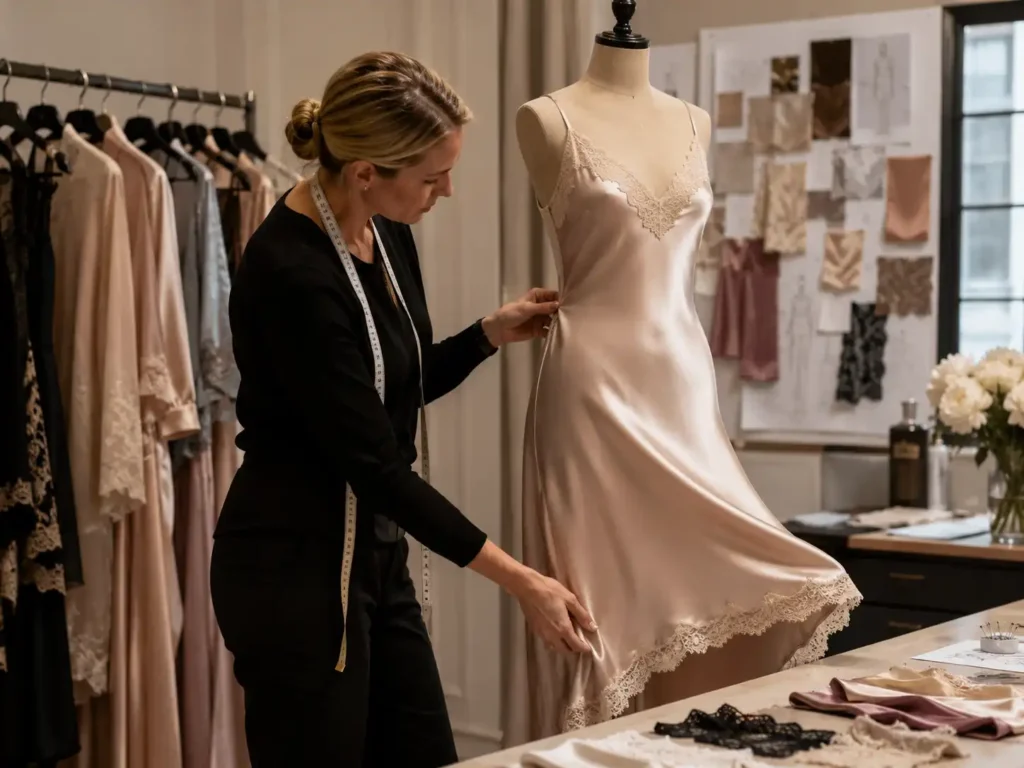
The sewing sequence is planned around stability.
Neckline stays, zipper reinforcement, waist joins or lining connections may need completion before free edges are repeatedly handled.
Operators receive the approved seam type, allowance, stitch and pressing method for each critical operation. Trial pieces or a pre-production meeting can demonstrate how layers are fed without stretching one side.
In-line quality checks focus on the earliest operation capable of creating the defect. Zipper waviness is checked during insertion, not only at final inspection. Side-seam length and balance are monitored before hems are closed. Pressing stations follow direction and temperature guidance validated during sampling. When more than one line or factory is assigned, the same sealed sample and technical notes are used to align workmanship.
Initial units are reviewed before line output increases. Approved samples or operation boards show the inside as well as the visible face, making seam allowance direction, reinforcement and lining attachment clear. Defect feedback names the operation and likely cause, and corrected units are rechecked before closure. Production figures never replace workmanship review; capacity is released progressively as the line demonstrates control of the critical bias operations.
- Sequence stable operations before repeated handling
- Train critical seams from approved sample evidence
- Inspect defects at the operation where they originate
- Align workmanship across assigned production lines

Resting, Leveling and Final Measurement
Completed bias garments may need a defined resting or hanging stage before final hemming and measurement. The production plan assigns space, identification and timing so garments are not mixed before leveling.
Length is checked at stated reference points under consistent conditions. Shell, lining and layered components are evaluated separately, then finished according to the approved hem relationship.
Final measurements are taken without pulling the garment into position. Quality teams check seam fall, neckline stability, zipper flatness, symmetry, surface condition and approved appearance alongside numeric tolerances. Packing begins only after the garment has cooled and recovered from pressing. Fold method, tissue, hanger or protective bag requirements are selected to reduce new creases and distortion during storage and transport.
Random packed garments can be reopened to verify whether presentation remains stable after the intended fold or hanger period.
Carton loading avoids concentrated pressure on delicate necklines, straps or trims. Where shipment includes multiple styles and colorways, packing records preserve style and size traceability. Final release links the inspected lot, approved reference and shipment documents, closing the technical record from pattern through dispatch.
- Apply one defined rest-before-hemming sequence
- Level garments at approved reference points
- Combine measurement checks with visual balance
- Protect the finished silhouette through packing
Bias-Cut Quality Gates From Fabric to Packing
Quality control follows the process points where diagonal movement can become a visible defect. Inspection standards are linked to the approved pattern, production sample and technical specification.
Stage | Control item | Method | Acceptance reference | Action on deviation |
Fabric release | Width, surface direction, shade, shrinkage and visible defects | Approved inspection and test records | Confirmed production fabric and material specification | Hold affected material; review pattern or marker impact before cutting |
Marker and cutting | Grain direction, mirrored pairs, panel shape and notch accuracy | Marker audit and sampled cut-panel comparison | Approved pattern version and cutting notes | Stop marker or bundle; recut or correct before sewing |
In-line sewing | Seam balance, neckline stability, zipper flatness and layer control | Operation checks against sealed sample | Construction specification and approved workmanship | Correct machine, method or handling; segregate affected output |
Garment resting | Length growth, side balance, shell and lining relationship | Timed rest followed by defined measurements | Approved rest condition and balance points | Extend review, level correctly or investigate systematic growth |
Final inspection | Measurements, drape, symmetry, appearance and function | Agreed inspection level plus visual review | Measurement tolerances and sealed sample | Repair, replace, sort or hold according to defect severity |
Packing release | Press recovery, fold or hanger method, labels and protection | Packing-line audit and carton review | Approved packing specification | Repack or hold before carton closure and shipment release |
Manufacturing Resources Supporting Complex Bias Programs
Established Since 2008
Dedicated Pattern Resources
Two Sample Rooms
Flexible Production Network
Merchandising Coordination
Quality and Finishing
Bias Dress Program Managed Across Eighteen Styles
The following anonymized program reflects a commercially realistic order structure. Style count, volume and timing are shown to explain the control route without identifying the brand or disclosing proprietary designs.

Program Scope and Commercial Parameters
A premium womenswear label developed an 18-style occasion and evening capsule containing bias slip dresses, cowl-neck midis, asymmetric skirts and lined satin gowns. Combined order volume was 42,000 pieces across approved colors and sizes, within the usual brand-order range of 20,000–80,000 pieces. Individual style quantities were allocated after sample approval and commercial review. The development brief included several satin weights, selected viscose woven qualities, narrow adjustable straps, invisible zippers, open backs and layered hems.
The main commercial risk was not style count alone. Similar-looking silhouettes behaved differently because fabric weight, lining, neckline shape and skirt length varied. A shared base could support proportion and measurement consistency, but each style needed its own bias angle, support and hem decision. The project was therefore organized by construction family rather than treating all 18 styles as one dress block.
Development priorities were ranked before sample work began. Long gowns and deep cowls carried the highest balance and coverage risk, while shorter skirts provided earlier evidence for fabric growth and seam behavior. Material substitutions were not approved by color alone; weight, hand, surface and diagonal movement were compared. Commercial allocation remained provisional until the related fabric-family sample reached the agreed fit and workmanship standard.
- 18 styles within a normal 10–30-style order cycle
- 42,000 total pieces across colors and sizes
- Multiple fabric behaviors under one fit direction
- Separate approval records for every style and material
Development Problems Identified Early
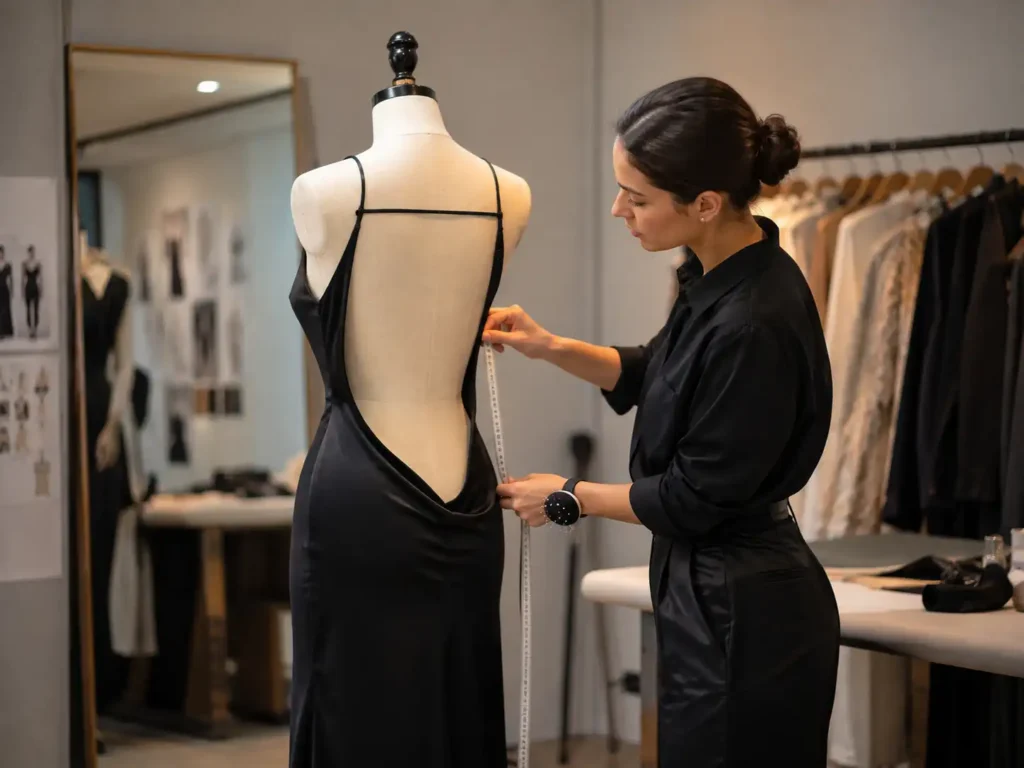
First samples revealed three recurring issues: side seams drifting toward the front on long dresses, cowl necklines opening beyond the intended coverage, and linings settling at a different rate from the satin shells. One zipper style also showed localized stiffness because reinforcement continued farther than the opening required.
None of the problems could be solved by shortening the hem or tightening the entire neckline.
Pattern review traced the seam drift to panel balance and sewing handling. Cowl corrections combined neckline geometry with controlled support. Shell and lining were rebalanced as separate pattern systems, and the rest-before-hemming process was written into the specification. Zipper reinforcement was reduced to the functional zone after a construction trial. Each change was tested on the related fabric group rather than copied blindly across all styles.
The review also found one narrow hem treatment added enough weight to alter the fall of a lightweight skirt.
A second method was sewn on equivalent panels and observed after the same rest period. The chosen finish improved the edge without pulling the side point lower. Findings were added to a shared construction library for the program, while style-specific exceptions remained attached to their own pattern and sample versions.
- Corrected panel balance instead of cosmetic pressing
- Controlled cowl coverage without removing fluidity
- Separated shell and lining growth decisions
- Limited zipper support to the required area

Approval and Production Transfer
Approved base patterns were graded by body zone, with cowl depth, strap placement, underarm coverage and hip release reviewed at selected sizes. Final file sets included pattern versions, measurement charts, cutting directions, construction callouts and bias-specific quality gates. A pre-production sample was confirmed for each fabric and construction family. Marker review protected grain direction while evaluating usable width and consumption.
Before bulk output, cutting, sewing, finishing and quality representatives reviewed the sealed references. In-line checks were positioned at zipper insertion, neckline stabilization and long side seams. Garments followed a controlled rest and leveling sequence before final hemming. The production team recorded recurring deviations by operation, allowing corrective action before the issue spread through the order.
Size and color allocations were released in stages aligned with fabric availability and approved line performance. First output from each construction family was checked against the corresponding sealed sample rather than a single generic dress. Marker, cut-panel and in-line records carried the same style and revision identifiers. Merchandising updates separated approved progress from held quantities, giving the brand a clear view of technical status and delivery risk.
- Graded fit points linked to the approved base
- Fabric-family pre-production references
- Early in-line checks at bias-sensitive operations
- Defined resting and hem-leveling instructions

Commercial Result and Reorder Readiness
The approved approach provided one synchronized technical record for all 18 styles while preserving style-specific pattern and fabric controls. Bulk decisions were made against sealed references, reducing dependence on subjective line-side corrections. The final delivery route remained aligned with the 42,000-piece allocation, and retained pattern, grade and construction records supported efficient review for later colors or related silhouettes.
No universal performance claim is implied by one program. Results depend on timely approvals, stable production materials and compliance with the agreed specification. The relevant proof is the method: fabric behavior identified before release, pattern causes separated from process causes, controlled revisions, and quality gates placed where defects could first occur.
For repeat review, the retained record showed which base measurements could remain unchanged and which fabric-dependent controls had to reopen. New colors using an approved quality could proceed through confirmation faster than a new satin weight. Related silhouettes could reference proven seam and support tests while still receiving their own balance review. The benefit was controlled reuse of evidence, not automatic approval based on visual similarity.
- One controlled record across development and production
- Style-specific approvals within a shared program structure
- Traceable patterns for future colors or related designs
- Measurable checkpoints replacing verbal correction
Commercial Planning for Samples and Bulk Orders
Development Timing
Order and Capacity Planning
Costing Inputs
Confidential Development and Controlled File Access
NDA Before Disclosure
Need-Based Access
Version and Sample Control
Bias-Cut Pattern Development Frequently Asked Questions

Build a Production-Ready Bias-Cut Program
Send the technical package for a focused review of pattern scope, fabric behavior, sampling route and bulk feasibility. Jinfeng Apparel will identify missing specifications, critical drape and fit risks, required development samples, grading needs and production checkpoints before quotation.
The most useful inquiry includes enough commercial information to match pattern engineering with the intended order: style count, quantities, size range, fabrics, target delivery and approval process. Files can be handled under an agreed NDA. After review, the team will confirm the development route, expected sample range, required materials and available production window.
Clear starting information allows faster technical decisions without weakening the final silhouette. Include the base-size measurement chart and name any fit model standard used for approval. For nominated fabrics, attach composition, weight, usable width, color count and sourcing status. For bulk planning, state the estimated quantity by style and color, delivery destination, inspection requirement and latest acceptable shipment window.
- Company name and contact details
- Tech pack, sketch or authorized reference sample
- Number of styles and quantity per style and color
- Base size, full size range and measurement chart
- Fabric composition, weight, width and sourcing status
- Required sample types and target approval date
- Bulk delivery destination and requested window
- Labeling, testing, finishing and packing requirements


