 Skip to content
Maxi Dress Hem Balance
Engineering even, intentional floor lines across front, side, and back views for premium maxi dress programs in woven and knit fabrics.
- Hem balance reviewed at the intended size, body posture, heel height, and measurement condition.
- Bias and semi-bias panels rested before final length confirmation, with hold time selected by fabric behavior.
- Front, side, and back checkpoints recorded separately; a single center-front length never represents the full hem line.
- Development support for 10–30 styles per program and brand order volumes from 20,000 to 80,000 pieces.
- Corrections traced through pattern, cutting, sewing, pressing, lining, and grading rather than hidden by final trimming.
Production Capacity Behind Controlled Maxi Dress Hem Balance
18+ Sewing Lines
6+ Flexible Lines
2 Sample Rooms
7+ Pattern Makers
15+ QC Inspectors
100,000+ Pieces Monthly
What Maxi Dress Hem Balance Means in Production
Hem balance is the relationship among visible hem points around a worn garment, not merely the center-front length on a flat table. Control begins with the intended silhouette and ends only after fabric, construction, pressing, and grading have stabilized.

Hem Length Is One Measurement; Hem Balance Is a System
A maxi dress can meet the center-front length specification and still look wrong from the side or back. The visual line depends on where the waist sits, how the hip and seat consume vertical length, how the skirt opens from the body, and how each panel follows grain. Front length, side length, center-back length, left-right level, side-seam direction, and lining clearance need separate review. An intentional high-low, handkerchief, dipped-back, or asymmetric design also requires balance: every low and high point must land in the approved position, and repeated garments must preserve the same visual rhythm.
Jinfeng establishes a reference condition before judging any correction. The garment is placed on the approved fit model or specified form, closed fully, settled at shoulder and waist, and allowed to hang without manual pulling. Footwear height and undergarment assumptions are recorded when they affect posture or floor clearance. A horizontal laser or level reference may support observation, while the tech pack retains measurable checkpoints. The decision combines measurements and view photographs, because neither source gives a complete answer alone. A flat-table length confirms construction; a worn or dressed-form view confirms balance around the body.
Repeated observation confirms whether the result is stable rather than accidental.

A Controlled Hem Must Survive the Production Sequence
An acceptable sample may lose balance in bulk when fabric lots relax differently, long panels are cut off-grain, tier seams stretch, operators pull during overlocking, linings restrict the shell, or steam reshapes one section more than another. Reliable control therefore follows the complete production route. Fabric rolls are evaluated for width, shade, bow, skew, relaxation, and directional behavior. Long panels are marked and bundled to preserve orientation. Sewing methods limit differential feed and unnecessary stretching. Garments rest before a critical hem decision, then pressing is performed under a defined method rather than used as a cosmetic rescue.
Bulk approval compares production garments with the sealed sample and measurement chart under the same viewing condition. The inspection plan identifies where to measure, how to position the garment, which points require side-by-side comparison, and when a garment needs re-hanging after pressing. Corrective action is assigned to its source: pattern, marker, cutting, sewing, lining, finishing, or grade. Final trimming is allowed only under an approved method and cannot replace root-cause control. A stable program produces the intended floor line across sizes, colors, fabric lots, and repeated order waves.
Release records preserve the final method for later color extensions and replenishment programs.
New materials reopen the relevant approval checks.
Maxi Dress Programs Requiring Engineered Hem Control

Occasion and Evening Dresses

Resort and Day Maxi Dresses
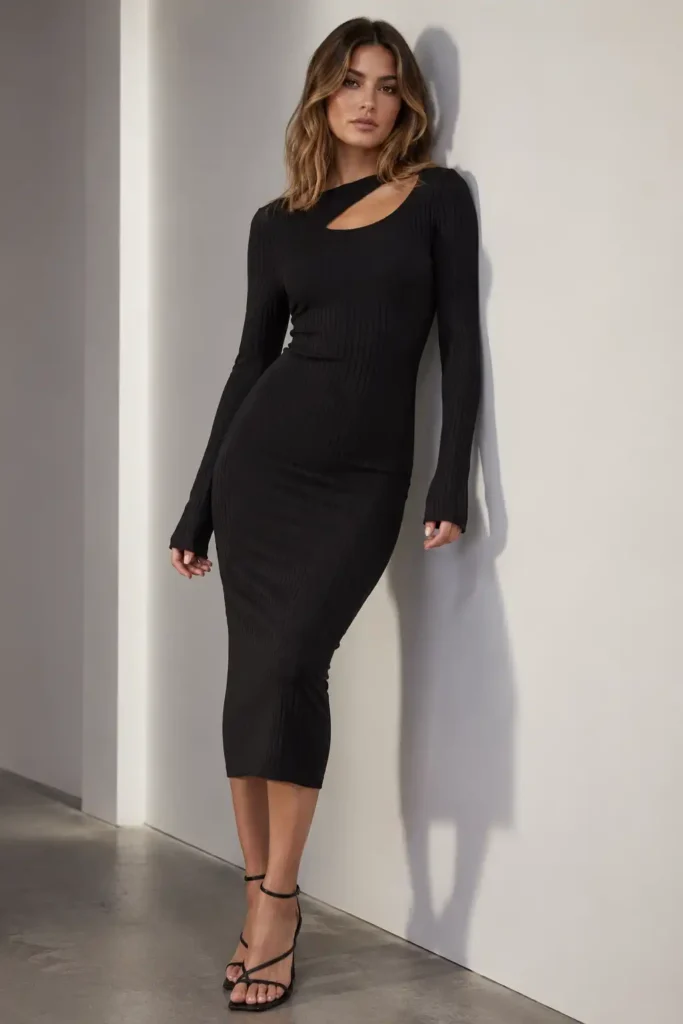
Knit and Stretch Maxi Dresses
Visible Hem Problems and Their Production Meaning
Front Hem Drops
- Record center front, front quarter, and side seam against one level reference.
- Compare shell and lining separately before changing pattern length.
- Confirm whether the condition repeats across sizes and fabric lots.
Back Hem Drops
- Photograph center back and both back-quarter points after settling.
- Check zipper length, waist seam level, and lining restriction.
- Compare the approved silhouette before reducing back length.
Side Seams Swing
- Trace side-seam direction through bodice, waist, hip, and skirt.
- Check notches, grain lines, and panel pairing before pressing.
- Review operator handling where long seams enter the machine.
Left and Right Differ
- Measure mirrored checkpoints from a common waist or shoulder reference.
- Rotate the garment on the form to separate form and garment effects.
- Track bundle and operator patterns when bulk variation appears.
Wavy or Roped Hem
- Test the real curved circumference, not a short straight swatch alone.
- Evaluate appearance before and after hanging, steaming, and care testing.
- Approve allowable fullness and stitch visibility by fabric and color.
Lining Pulls the Shell
- Define lining-to-shell clearance at front, side, and back points.
- Review waist, zipper, slit, vent, and hem attachment freedom.
- Inspect the joined garment after the required resting period.
Root Causes From Pattern Through Final Pressing
Hem imbalance rarely begins at the hem. A disciplined investigation follows the garment from body balance and pattern geometry through material conditioning, cutting accuracy, sewing sequence, lining behavior, finishing, and storage.

Pattern, Fit, and Grain Architecture
Pattern balance establishes where the garment hangs before fabric variation enters the process.
Shoulder slope, bust shaping, torso pitch, waist position, hip and seat allowance, skirt flare, and center-front or center-back grain all influence the lower edge. When a fitted bodice tilts forward, the front hem may fall even if every skirt panel matches its paper pattern.
When flare is distributed unevenly, side seams can migrate and create different floor clearances at front and back quarters.
Jinfeng reviews upper-body balance first, followed by horizontal lines and vertical seams. Waist seams, yokes, hip lines, tier joins, and printed stripes provide evidence.
A correct hem correction should preserve seam direction and silhouette; shortening an isolated point without correcting the driving geometry can leave a visible kink or unbalanced sweep. Grain lines are checked on long panels and compared with marker placement.
Bias and semi-bias shapes receive separate expectations because gravity changes their finished length.
Grade rules are treated as part of the architecture. Added bust, waist, hip, and seat dimensions redistribute vertical consumption across sizes. A uniform hem-length increment may fail when body-shape accommodation changes. Petite, tall, and extended-size ranges need dedicated balance checks rather than simple scaling from a middle size.

Fabric Relaxation, Cutting, and Panel Identity
Long garments magnify small material movements. Viscose, rayon, jersey, rib, soft twill, satin, chiffon, mesh, and loosely constructed fabrics can relax, grow, torque, or respond unevenly to humidity and steam.
Incoming control records roll width, usable width, bow, skew, shade, hand feel, and directional characteristics. Relaxation method and duration are selected by material response and confirmed during development. No universal hold time fits every fabric.
Cutting control protects grain and panel length. Spreading tension, ply height, marker direction, fabric face, nap, print orientation, and slippage are reviewed before bulk cutting.
Long narrow panels can shift during spreading or cutting even when top-ply outlines appear accurate. Bundle identification preserves left-right pairs and front-back orientation. Bias sections may require support during transfer to prevent stretch before sewing begins.
Panel checks compare critical lengths and notches before assembly. Repeated variation confined to one marker position or ply region points toward cutting; random variation after identical cut-panel checks points toward sewing or finishing. Evidence prevents unnecessary pattern changes when source material or handling created the difference. Pilot cutting can compare panels from the top, middle, and lower plies, while matched pairs reveal lateral movement. Findings are retained by roll and marker identity so development assumptions can be confirmed before the main cutting release.

Sewing, Lining, Pressing, and Storage
Long seams are vulnerable to differential feeding. Pulling the lower ply, supporting the garment unevenly, or allowing panel weight to hang from the machine can extend one side. Tier seams, gathered joins, godets, flounces, narrow hems, coverstitching, and overlocking need operation methods suited to fabric stretch and curvature. Notch alignment and finished seam length are checked at selected operations before later processes conceal the source.
Linings and internal structures can alter hang. A tight waist join, short lining, rigid tape, zipper tension, fusible shrinkage, or uneven boning attachment may lift or restrain selected areas. Shell and lining relationships are therefore confirmed during sample development and checked again in bulk.
Pressing can improve appearance but can also create length variation. Steam, heat, pressure, vacuum, garment support, and operator motion are controlled according to fabric. A garment is allowed to recover before final judgment. Hanger type, hanging duration, folding method, and carton pressure also matter for fluid or stretch fabrics. Final inspection uses a defined recovery condition so a temporary storage crease is not confused with a structural imbalance.
Operation trials establish which seams need support, stabilization, or revised feeding before normal line pace begins. Findings are confirmed on repeated garments after the full finishing route. Where a lining, zipper, or internal tape drives the fault, the responsible attachment is corrected and rechecked before lower-edge work proceeds.
Diagnose Front, Side, and Back Views Separately

Front View

Side View

Back View
Fabric Behavior Matrix for Maxi Dress Hems
Fabric category influences resting, cutting, sewing, pressing, and final inspection. Development trials confirm actual behavior by construction, weight, finish, color, and supplier lot before a bulk control plan is released.
| Fabric family | Primary hem risk | Development evidence | Bulk control focus | Final review condition |
| Viscose or rayon woven | Length drop, bow, skew, bias growth | Relaxation comparison, grain check, hanging observation, care test where required | Roll condition, panel orientation, long-seam feeding, pre-hem rest | Recovered after pressing and defined hanging period |
| Satin or charmeuse | Slippage, twisting, puckering, visible waviness | Full-circumference hem trial, seam and press trial, light reflection review | Low-tension spreading, panel pairing, feed control, clean handling | Level view under consistent light with shell settled |
| Chiffon or georgette | Layer migration, curved-edge stretch, uneven narrow hem | Layered sample, rolled-hem trial, hanging comparison | Ply control, basting or support method, operator handling | Shell layers separated, then viewed together |
| Jersey or rib knit | Self-weight growth, torque, coverstitch wave | Recovery test, hanging trial, seam feed trial | Panel support, differential feed, storage method | Recovered from hanger or fold method stated in spec |
| Cotton or linen blend | Crease set, wash movement, seam torque | Wash or steam trial, shrinkage result, grain check | Relaxation, marker direction, pressing discipline | Conditioned after approved care or press process |
| Lace, mesh, or layered fabric | Scallop variation, layer restriction, attachment pull | Placement map, layer clearance trial, seam support review | Motif matching, controlled joins, lining freedom | Outer layer and lining reviewed independently and together |
Hem Risks by Maxi Dress Construction

Bias Slip Dress
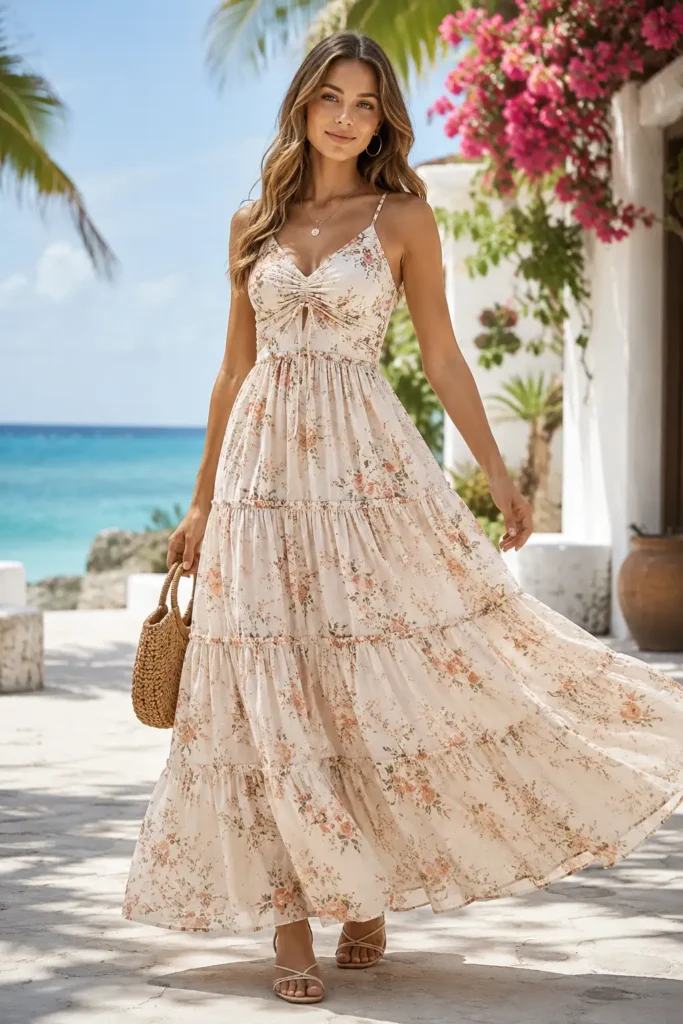
Tiered Maxi Dress

Fishtail or Mermaid

Wrap Maxi Dress

High-Low Hem

Layered Sheer Skirt
Pattern and Fit Corrections Before Hem Trimming
Correction begins where imbalance originates. Jinfeng uses fit evidence, pattern comparison, grain analysis, and repeat observation to separate body-shape accommodation from material growth and process variation.
Correct Upper Balance Before Lower Length
The hem reflects every balance decision above it. Shoulder pitch, neckline position, bust dart direction, princess seam length, waist seam level, torso length, and hip or seat shaping are reviewed before the lower edge changes.
If a fitted bodice tips forward, reducing front skirt length may create an acceptable standing photograph while leaving the waist tilted and side seams moving backward. The garment can then change again during walking or after pressing.
Fit sessions record horizontal and vertical references. Tape or thread lines may mark waist, hip, center front, center back, and side seams. Observations distinguish symmetrical garment issues from individual posture.
A correction is tested in the revised pattern and sample, then compared with the prior version under the same condition. For wrap, cowl, gathered, or elasticated designs, the securing method is standardized before measurements are taken.
Once upper balance is approved, skirt lengths are trued through the intended flare and curve. Seam lengths, notches, grain lines, and facing or lining relationships are updated together. Pattern records identify affected sizes and preserve any approved asymmetric design feature.
Revised pieces are walked at adjoining seams, then checked against the measurement chart and view references. The correction is rejected if it solves one floor point while moving the waist, twisting a seam, or changing the intended sweep.
Control Grain, Flare, and Seam Relationships
Long skirt panels need coherent grain architecture. Center panels, side panels, godets, flounces, and tiers may each use straight, cross, bias, or semi-bias direction.
A correction at one seam can redistribute flare and shift the neighboring panel. Jinfeng compares hanging samples with paper or digital pattern geometry, checking whether a visible drop follows a grain direction, marker orientation, or seam path.
Side seams receive special attention because they reveal front-back balance.
A seam should not be forced straight by trimming its end while remaining displaced through the hip and thigh. Panel seam lengths are walked, notch positions checked, and expected easing documented. Where curved seams join differently oriented grains, sewing sequence and support methods are established alongside pattern changes.
For printed, striped, or engineered motifs, visual placement also affects perceived balance. A level hem can appear tilted if a strong stripe or border is cut off-grain. Marker approval therefore combines pattern measurements, motif position, and usable fabric width. Bulk cut panels are checked against approved orientation before assembly.
The seam method is tested on the real curve and grain combination, since feed behavior can alter the relationship approved in the marker. Updated balance marks remain visible until the responsible operation is complete.
Prove the Correction Across Repeat Garments
One corrected sample does not establish process capability. Jinfeng repeats critical checks across revised samples, pre-production samples, and selected early bulk garments. The evidence set includes measurements, front-side-back photographs, seam direction, shell-lining clearance, fabric condition, and revision identification. Repeat garments help separate a stable pattern correction from a one-off handling result.
If variation remains, the team groups garments by roll, marker position, bundle, operator, line, pressing station, and inspection time. Patterns in the data guide corrective action. A consistent drop across every garment may support a pattern change; variation linked to one operation may require method adjustment and retraining; variation linked to one fabric lot may require revised conditioning or lot control.
Approved changes enter the graded pattern, measurement chart, operation bulletin, quality checkpoints, and sealed sample record. No correction relies on oral instruction alone. Early bulk results are reviewed before normal production pace resumes, protecting the full order from a localized or unverified adjustment.
Range-edge sizes and relevant color or fabric variants are included when weight, finish, or construction may change the result. Closure evidence identifies the approved revision, responsible team, and date of release.
Reorder files retain the proven conditions, allowing later production to repeat the approved method and reassess any material change before release.
Measurement Conditions, Checkpoints, and Tolerance Logic
The specification must state how a maxi dress is positioned, where each point begins and ends, and when the garment is judged. Tolerance is assigned by design function and fabric behavior, not copied blindly across all hem points.
| Control item | Defined method | Recommended specification logic | Decision use |
|---|---|---|---|
| High shoulder to hem | Garment closed and settled; measure along named path without stretching | State size, path, and target length; apply project-approved tolerance | Confirms overall front or back length |
| Waist seam to hem | Start at named waist seam point; follow panel direction | Use front, side, and back targets where silhouette requires | Separates bodice balance from skirt length |
| Left-right level | Compare mirrored points from one horizontal reference | Set symmetry requirement or maximum approved difference | Detects cutting, pairing, or feeding variation |
| Side-seam direction | Review on form or fit model from waist or underarm to hem | Define approved alignment or intentional displacement | Identifies front-back imbalance and twist |
| Lining clearance | Measure outer shell and lining at named front, side, and back points | Set minimum and target clearance by layer and style | Prevents exposure, pulling, or restriction |
| Rest and recovery | Record fabric condition, hanging support, duration, and post-press recovery | Use development evidence; avoid one fixed rule for every fabric | Makes sample and bulk judgments comparable |
| Visual floor line | Photograph front, true side, and back at level camera position | Attach approved view set and design notes | Confirms the intended silhouette beyond flat measurements |
Sample Approval Path for Hem Balance
First Sample
Fit Sample
Revised Sample
Size-Set Review
Selected sizes test grade behavior and range-specific body accommodation.
Core, petite, tall, or extended sizes are chosen according to the offered range and risk. Hem points, waist level, side-seam direction, and lining clearance are compared across sizes. Grade changes are approved with pattern records, not inferred from one middle-size sample. Range-edge results guide any dedicated vertical distribution rules. Results are linked to the approved grade revision.
Pre-Production Sample
The pre-production sample uses approved or production-representative materials, trims, construction, pressing, and finishing. Hem balance is reviewed after the specified rest and recovery condition. The team confirms measurement methods, visual references, operation controls, and inspection checkpoints. Release requires alignment among pattern, sample, tech pack, bill of materials, and production instructions. Any substitute material receives technical review before release. Line-start checks follow the same recovery condition.
Golden Sample
The sealed golden sample represents approved appearance and workmanship for bulk comparison. It carries clear identity, size, color, revision, and approval status.
A supporting record preserves measurements and front-side-back views because the physical garment may change with storage. Production, quality, and finishing teams use the same reference during line start, in-line review, and final inspection. Storage position and access are controlled.
Grading Hem Balance Across Size Ranges

Core Size Range

Petite Proportions
Tall Proportions

Extended Sizes
Transfer Approved Hem Control Into Bulk Production
Production stability depends on translating sample decisions into marker rules, operation methods, checkpoints, and traceable records. Jinfeng converts approved evidence into line-ready controls before full cutting and sewing begin.
Lock the Technical Package and Material Condition
Bulk release begins with aligned pattern revisions, graded nests, measurement charts, construction details, bill of materials, artwork or print direction, lining clearances, pressing notes, and sealed sample identity. Each document carries a controlled revision. Pattern files identify grain direction, panel pairs, notches, balance marks, and any intentional asymmetric points. Measurement charts state the position and condition for every critical length.
Production fabric is compared with development material for composition, weight, width, finish, hand feel, shade, stretch or recovery, bow, skew, and relaxation behavior. A change in mill, finish, coating, print process, or color can alter drop and pressing response. Material differences are evaluated before a marker or cutting schedule is released. Required resting or conditioning becomes part of the production calendar rather than an optional delay.
Style-specific view sheets mark high, low, and quarter points so visual inspection uses the same silhouette approved during fitting.
Pre-production meetings align merchandising, pattern, sample, cutting, sewing, quality, finishing, and packing teams. High-risk points are assigned to named operations and inspection stages. Photographs and approved samples support visual communication, while measurable criteria remain in the technical file.
Open decisions are closed before release. Any controlled exception includes responsible approval, affected sizes or colors, and a defined verification step.
Protect Length During Cutting and Sewing
Spreading controls cover tension, ply height, face direction, nap, print orientation, and alignment. Long panels receive support during movement from cutting to bundling. Cut-panel audits check selected lengths, notches, grain, symmetry, and pair identity before quantities enter sewing. Findings are linked to roll and marker information so a repeated source can be isolated quickly.
Line setup uses production fabric for operation trials. Teams verify feed, stitch formation, seam extension, gather ratio, zipper insertion, lining join, narrow hem, coverstitch, and pressing.
Long panels are supported at the machine to prevent gravity from pulling one ply. In-line measurements are placed before irreversible operations where correction remains controlled. A tilted tier, extended side seam, or restricted lining is addressed before the final hem hides evidence.
First-output garments are allowed to settle under the approved condition and compared with the golden sample.
Line pace increases only after measurements, seam direction, appearance, and floor-line views meet release criteria.
Results are retained by line, operation, size, and material lot, allowing later in-line findings to be compared with the approved start condition. Any new source of variation returns to controlled output until closure is proven.
Cut quantity and line allocation stay limited until the approved output demonstrates stable repeatability across selected garments.
Control Finishing, Recovery, and Packing
Finishing cannot become a repair department for uncontrolled length. Pressing instructions define temperature, steam, pressure, vacuum, garment support, and motion according to material response. Operators avoid stretching a curved hem or allowing a long skirt to hang unevenly from the board. Selected garments are rechecked after recovery because a hot or damp garment can show a temporary shape.
Final inspection confirms measurements, left-right level, side-seam direction, shell-lining clearance, hem appearance, and approved asymmetric points. Rework rules identify which corrections are allowed and which require technical review. Trimming is controlled by template or marked reference where approved, with enough recovery time before reinspection.
Packing trials consider hanger, fold, tissue, bag, carton pressure, and transport orientation. Fluid woven and stretch styles may recover differently after folding. Pre-shipment review uses the agreed condition and can include AQL or appointed third-party inspection according to project requirements.
Reopened garments are given the specified recovery before judgment. Approved packing references enter the release file so warehouse handling remains aligned with the tested presentation.
Final packing instructions identify the tested recovery condition for inspection.
Packing staff receive visual references for fold position, layer alignment, and carton presentation. Trial results are repeated when hanger, bag, tissue, carton quantity, or transport route changes before shipment.

Bulk Quality Gates for Stable Hem Balance
Incoming Fabric

Relaxation Release

Cut-Panel Audit

Line-Start Approval

In-Line Control
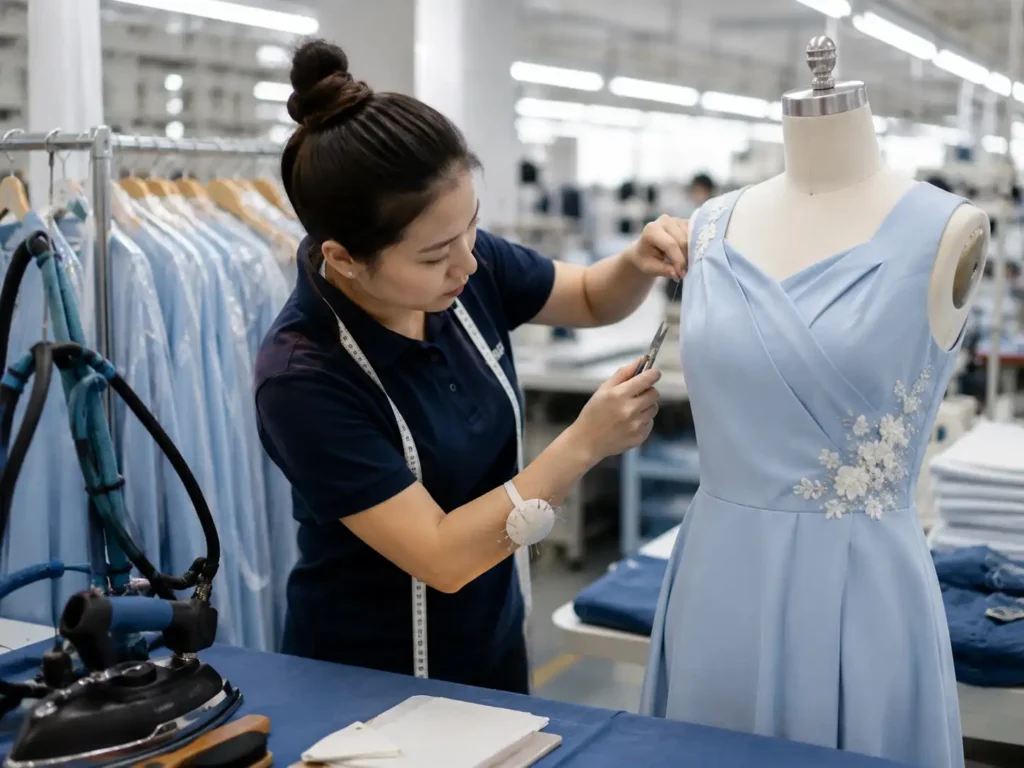
Finishing Review

Packing Trial

Pre-Shipment Inspection
Technical Evidence Available for Brand Review

Development Record
- Decision notes connect a visible symptom with the selected pattern, material, or process action.
- Revision dates and approval status prevent obsolete instructions from returning to production.

Production Control Record
Bulk records connect material lots, cutting checks, first-output approval, in-line findings, finishing review, and corrective actions. Photos support visible faults, while numerical fields capture lengths and differences at named checkpoints. Records can be adapted to an agreed reporting format, protecting communication among product, technical, sourcing, and quality teams.
- Trend review highlights repeated variation by roll, marker, operation, line, or size before shipment sampling begins.
- Corrective actions carry an owner, completion status, and verification result.
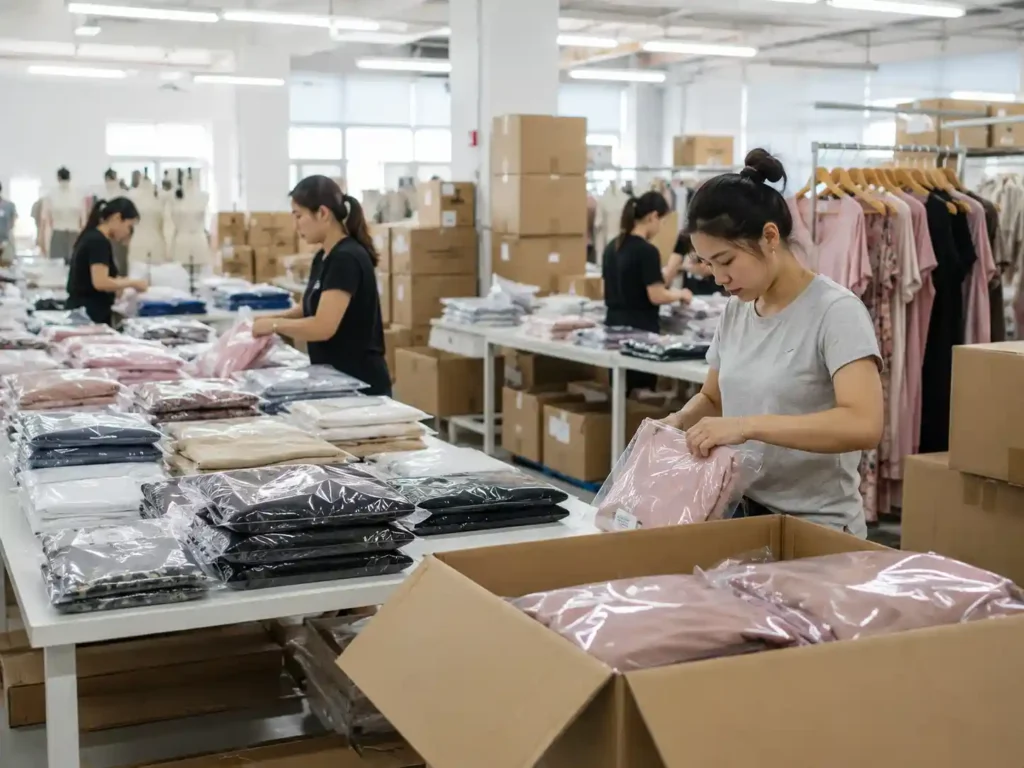
Shipment Release Record
Maxi Dress Program With Hem Correction
An anonymous resort and occasionwear program illustrates how Jinfeng can move from mixed hem symptoms to a controlled multi-style production release. Figures reflect a credible operating range for brand programs and do not identify any partner.

Program Scope and Initial Risk
The program covered 18 maxi dress styles across rayon challis, satin, chiffon overlays, lightweight cotton blends, and stretch linings. Total order volume was 48,000 pieces across approved colors and size ranges. Designs included six tiered silhouettes, four bias or semi-bias slips, three wrap dresses, three fitted occasion styles with godets, and two layered sheer styles. Development schedules overlapped, so one generic hem method would have created conflicting instructions.
Early samples showed three distinct patterns. Selected rayon styles dropped at front-quarter and side points after hanging. Two satin slips developed side-seam swing with left-right differences. One lined occasion style appeared level before zipper and lining attachment but lifted at side back after full assembly. Flat center-front measurements alone did not explain the appearance.
The same fitting setup and camera position were retained so revisions could be compared without introducing a new observation condition.
Jinfeng grouped the styles by fabric behavior and construction, then defined separate evidence needs. Rayon and bias groups received relaxation and hanging comparisons. Satin groups received marker, grain, seam-feed, and full-circumference hem trials. The fitted lined style received shell-only, lining-only, and assembled balance reviews before any lower-edge change.
Size-set priorities were chosen by construction family, ensuring grade evidence covered the highest-risk silhouettes rather than repeating identical checks on every style.

Correction and Production Transfer
The rayon investigation found combined bias growth and seam extension rather than a single pattern-length error. Resting sequence was moved earlier, long panels received improved support, and selected seam operations received feed and handling controls. Revised samples were measured at front, quarters, sides, and back after recovery. Pattern lengths were adjusted only where repeat evidence remained after process stabilization.
For satin slips, marker orientation and panel pairing were confirmed, then side-seam operation trials compared support and feed. The chosen method reduced seam extension and preserved the intended drape. A revised hem method was tested around the full sweep under consistent light. Left-right checkpoints entered the in-line inspection plan.
The lined occasion style revealed restricted movement at side-back lining joins and excess zipper-seam tension. Lining ease, attachment sequence, and zipper handling were corrected before the shell length was finalized. Updated instructions entered the pre-production package, supported by photographs, measurements, and approved samples. Size-set review covered middle and range-edge sizes for each construction family.
Revised samples were rechecked after pressing and recovery, confirming the shell remained free while the lining preserved the approved hidden clearance.
The approved correction was then translated into line-start checks for zipper tension, lining ease, and side-back clearance on repeated garments.

Bulk Result and Release Evidence
Bulk production was released by style group after first-output review. Cut-panel audits focused on long bias sections and mirrored pairs. In-line checks covered tier joins, long seams, lining attachment, zipper insertion, and hem operations. Garments selected for balance review recovered under the approved condition before three-view comparison. Pressing teams used fabric-specific methods, and rework rules prevented uncontrolled freehand trimming.
The 48,000-piece program moved through staged inspections with measurement and visual records linked to style, size, color, and production source. Findings were contained at the responsible operation, followed by verified new output. Final inspection covered approved critical points, garment appearance, lining clearance, packing, and specification measurements. The brand team received a concise release package containing approved revisions, view references, key inspection findings, and closure records.
The operating value came from separating three different root causes under one commercial program. Pattern correction, material conditioning, sewing control, and lining freedom were applied only where evidence supported them, preserving design intent across 18 styles without imposing one blunt rule on every maxi dress.
Production records allowed later colors and size groups to reuse the proven control route. Any new material behavior returned to technical review instead of inheriting an unsuitable rule. The release package therefore supported shipment approval and future program continuity without exposing confidential design or partner information.
Evaluate a Maxi Dress Hem Balance Manufacturer
Pattern Diagnosis
- Request one anonymized correction path from symptom to approved revision.
- Confirm pattern changes move into measurements, samples, and bulk files.
- Verify range-edge sizes receive evidence when grade behavior changes visible balance.
- Check how intentional asymmetry is preserved without accepting uncontrolled variation.
Fabric Testing
- Ask which result changes cutting, sewing, pressing, or inspection.
- Confirm material identity remains traceable during root-cause analysis.
- Review how a changed color, finish, or mill triggers renewed approval.
Sample Evidence
- Compare two revisions under the same fitting and recovery condition.
- Confirm obsolete versions cannot be mistaken for current approval.
- Check whether size-set findings enter graded patterns and measurement charts.
- Review how photographs and measurements share one revision identity.
Bulk Transfer
- Review a production instruction linked to a sample finding.
- Confirm early output is approved before normal pace expands.
- Ask how corrective action is verified before affected quantities move downstream.
- Confirm line teams can identify the sealed sample and current file.
Quality Depth
- Confirm affected output is contained and reinspection is documented.
- Align critical points, sampling level, AQL, and third-party scope by project.
- Examine trend records across sizes, colors, lines, and material lots.
- Ask which failures stop release and who approves closure.
Program Capacity
- Match factory allocation to construction and fabric competence.
- Protect resting, first-output approval, and final recovery in the calendar.
- Confirm technical staffing remains available during overlapping style releases.
Maxi Dress Hem Balance Frequently Asked Questions
No. Dress length is measured between defined points, often high shoulder to hem or waist to hem. Hem balance compares visible lower-edge positions around front, sides, quarters, and back under an approved wearing condition. Both are needed: measurements confirm construction, while three-view observation confirms the intended floor line and seam direction.
No. High-low, dipped-back, handkerchief, train, and asymmetric designs use intentional height changes. Control means approved high and low points, smooth transitions, correct left-right relationships, and repeatable placement across sizes. A design reference and named measurements prevent intentional shape from being mistaken for a defect.
Final timing follows fabric and construction trials. Bias panels often need recovery after cutting, sewing, and pressing because growth can occur at different stages. Development records the support method and relevant resting condition. Bulk uses the approved sequence rather than one universal duration for every fabric, finish, or silhouette.
Shell and lining are measured separately at named front, side, and back points, then reviewed together after attachment and recovery. Clearance must hide the lining while allowing the shell to move. Waist, zipper, slit, vent, and hem attachments are checked for restriction. Stretch and woven linings may require different ease and recovery logic.
Simple styles usually require 7–10 days, regular dresses 10–15 days, and complex corsetry, lace, mesh, sequin, or layered styles 15–25 days after required materials and specifications are ready. Custom fabric, special trims, certified materials, repeated revisions, or extensive testing can extend timing. A confirmed schedule follows design review.
Grade rules consider torso, bust, waist, hip, seat, flare, and total length. Selected size-set garments confirm horizontal levels, seam direction, quarter points, and lining clearance. Petite, tall, and extended ranges may need dedicated vertical distribution rather than a simple lower-edge length addition or reduction.
Pressing can improve shape and remove temporary distortion, but it should not hide a pattern, grain, cutting, sewing, or lining fault. Steam, heat, pressure, vacuum, and garment support can also create new variation. Garments need recovery before final judgment, and structural causes require correction at their source.
Affected garments are identified and grouped by material lot, marker, bundle, operation, line, operator, pressing station, size, or color. New output is checked after corrective action before production pace resumes. Rework receives an approved method and full reinspection of affected points. Records preserve closure for later colors and reorder waves.
Provide front, true-side, and back photographs; tech pack; measurement chart; size range; fit-model or form details; fabric composition and weight; lining construction; heel or floor-clearance assumption; sample status; and observed timing of the issue. A physical garment, pattern file, and care-test result improve diagnosis when available.
Yes. Critical measurements, three-view references, lining clearance, side-seam direction, asymmetric points, packing condition, and sampling rules can enter the inspection protocol. Jinfeng can support appointed third-party inspection and project-specific AQL requirements. The approved method should be agreed before bulk completion so inspectors judge under comparable conditions.

Send Your Maxi Dress Hem Balance Brief
Share the style, fabric, size range, target length, and visible hem concern. Jinfeng Apparel will review whether the main risk sits in pattern balance, grading, grain direction, fabric relaxation, cutting, seam feeding, lining restriction, pressing, or packing. A useful first review can be built from technical files and clear three-view photographs; a physical sample or pattern file supports deeper diagnosis.
Program planning can then align sample stages, material tests, production checkpoints, inspection evidence, and order calendar around the approved silhouette. Include the intended fit model or form, footwear assumption, care route, lining relationship, and any approved asymmetry. State when the imbalance appeared: after fitting, hanging, washing, pressing, packing, or transport. For an active program, identify style count, colorways, size range, order quantity, sample status, required inspection scope, and target delivery window.
Jinfeng can then propose the evidence needed for development approval and bulk release, including the first sample route and decision owners.
- Tech pack, pattern file, measurement chart, or graded size specification
- Front, true-side, and back images on the intended model or form
- Fabric composition, weight, construction, finish, supplier, and color information
- Shell, lining, zipper, slit, train, tier, godet, or asymmetric construction details
- Target size range, heel assumption, floor clearance, and care requirements
- Planned style count, colorways, quantities, delivery window, and inspection scope


