 Skip to content
Dress Fit Development
Build production-ready dress fit through pattern development, fit samples, measured revisions, grading control, and bulk-fit standards for fashion collections.
- 7+ senior pattern makers support fit-focused pattern development and correction.
- 2 sample rooms and 20+ sample machinists handle first, fit, revised, PP, and Golden samples.
- Fit review covers bust, waist, hip, neckline, armhole, strap, length, slit, lining, and movement balance.
- 15+ QC inspectors support measurement checks and bulk consistency after fit approval.
Fit Development Capacity Behind Every Approved Dress
7+ Senior Pattern Makers
Seven-plus senior pattern makers review silhouette, body proportion, seam balance, neckline shape, dart placement, waist position, hip ease, strap geometry, skirt balance, and construction limitations before a fit issue is treated as a simple measurement change. Pattern decisions are tied to the sample version and size information so an approved correction can be measured, graded, and released for production instead of remaining an informal visual adjustment. Fit-sensitive styles receive extra attention where a small curve, angle, or balance change can affect several body zones at once.
Sample Development Team
15+ QC Inspectors
Fifteen-plus QC inspectors help protect approved measurements after development moves into bulk production. Fit-related control can include material condition, cutting accuracy, in-line measurements, finished-garment measurements, pressing review, and comparison against the approved production reference. The objective is not to re-fit every bulk garment; it is to make sure the pattern, size chart, measurement method, tolerances, and physical reference used during development remain visible in production. Fit development only creates commercial value when the approved result can be reproduced consistently across sizes and batches.
Built for Teams Managing Fit-Sensitive Womenswear
Product Development Teams
Technical Design Teams
Sourcing and Brand Teams
Sourcing, merchandising, and brand teams need visibility into whether a fit issue can be corrected without creating new cost, lead-time, fabric, or construction problems. Fit revisions are reviewed against material readiness, sample status, production feasibility, and launch timing so commercial decisions remain connected to garment development. Jinfeng’s operating model supports established fashion brands, sourcing offices, and multi-style womenswear programs with sampling needs and planned bulk production, not ready-stock or dropshipping fulfillment. The aim is a controlled route from development files to an approved, repeatable production standard.
Common Dress Fit Failures We Correct During Development

Bust and Cup Balance
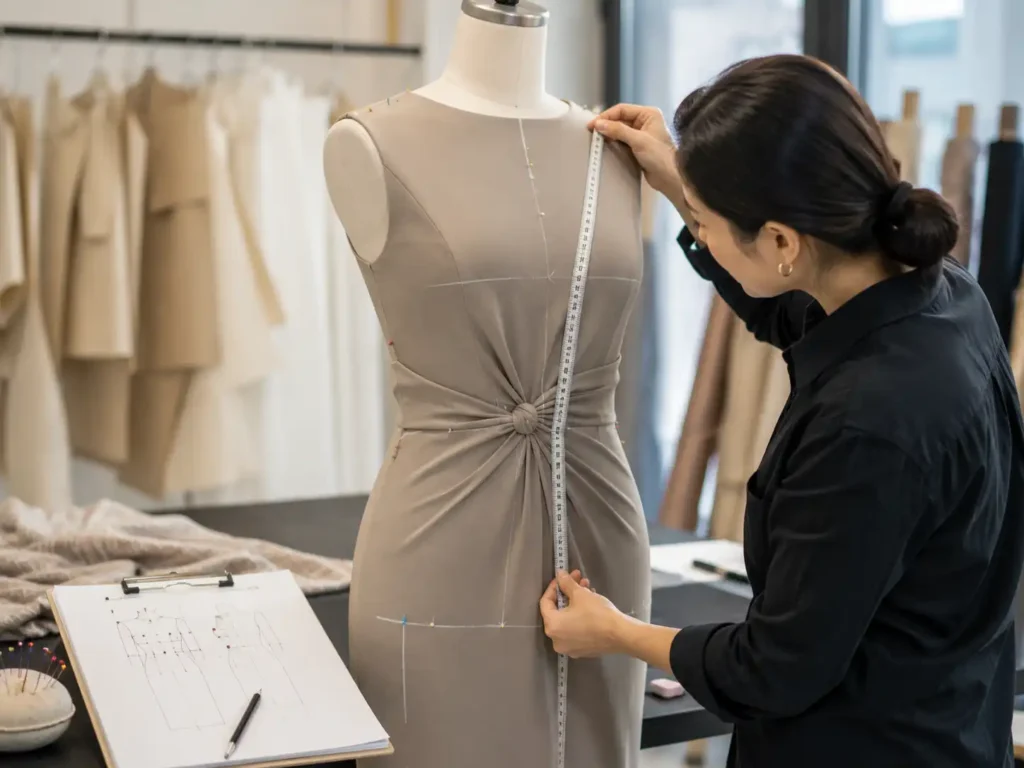
Waistline Placement

Hip and Seat Fit

Neckline and Armhole
Neckline gaping, rolling, collapsing, or excessive exposure often comes from pattern curve, strap angle, bust relationship, fabric stretch, or insufficient stabilization. Armholes can open away from the body, cut into the underarm, or expose too much side bust. Fit correction may involve neckline shape, shoulder or strap position, armhole curve, lining, tape, or panel balance. The revised area is checked again after normal arm movement because a neckline that looks clean at rest can still open, roll, or pull once the upper body moves.

Strap and Shoulder Position

Hem, Slit, and Ride-Up
Six Variables That Decide Whether a Dress Fits
Body Proportion
Pattern Balance
Fabric Behavior
Construction Method
Movement Requirement
Size Range
Dress Fit Zones That Need Separate Validation
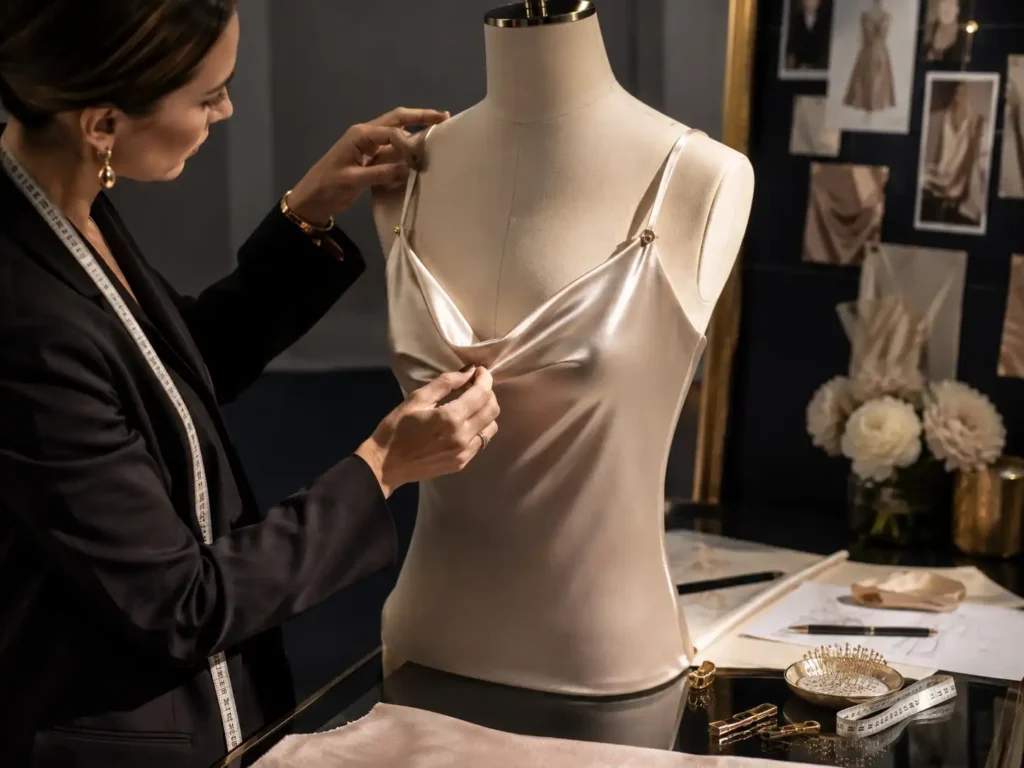
Neckline and Bust

Waist and Torso

Hip and Seat
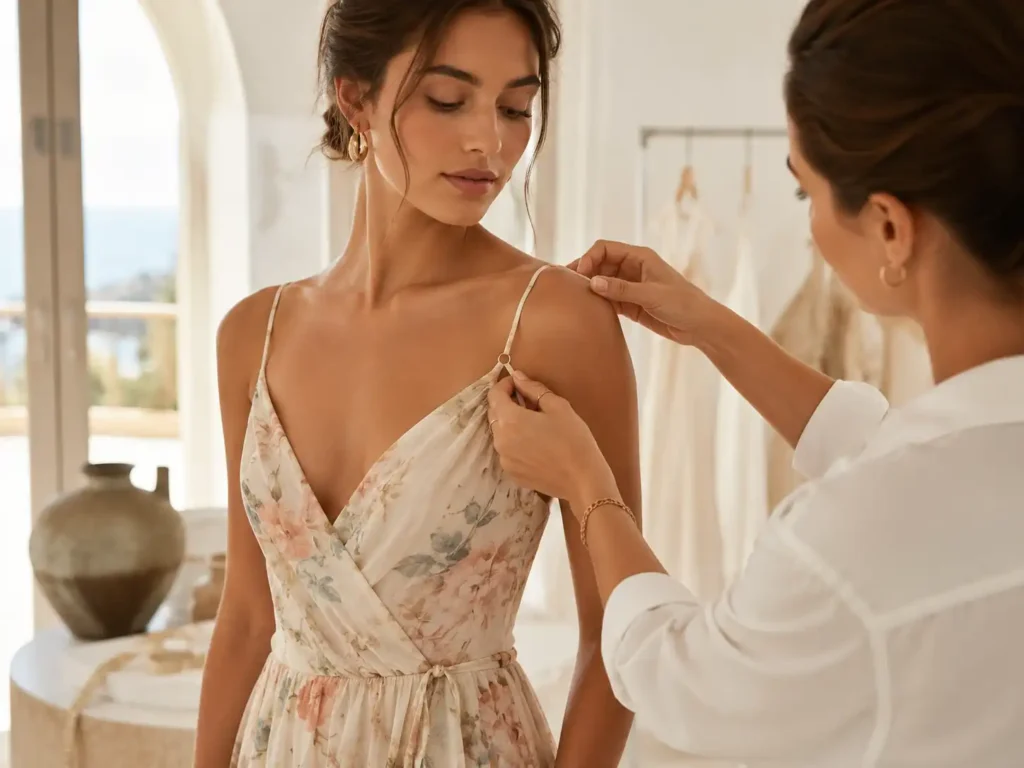
Armhole and Straps

Slit and Movement
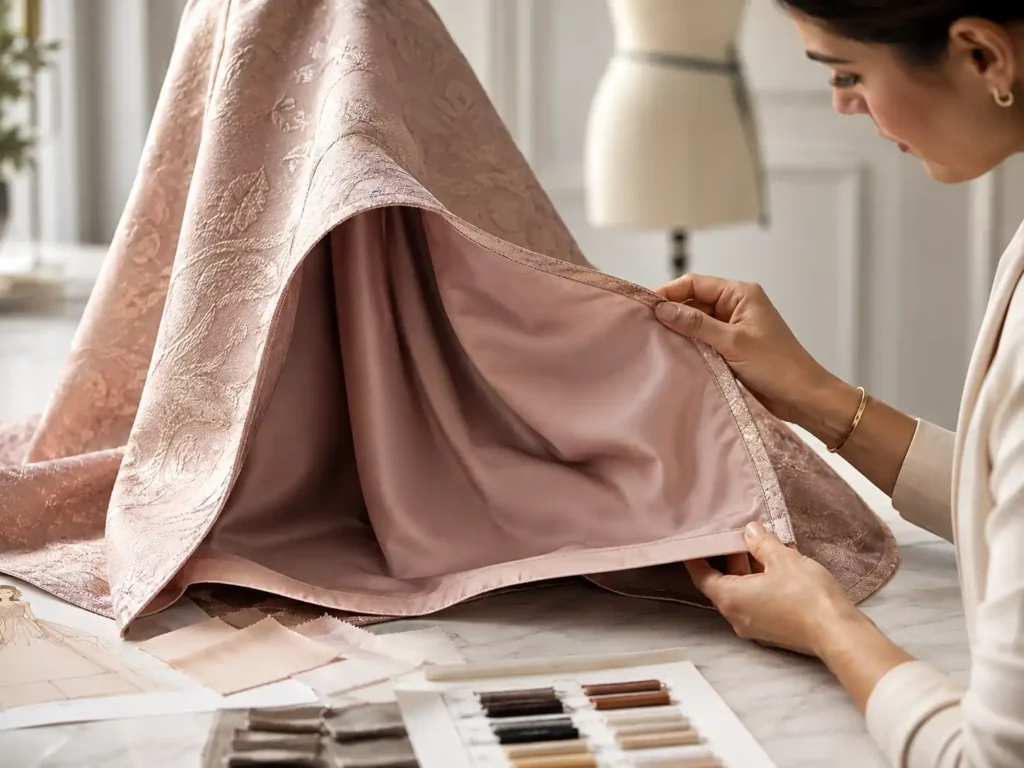
Hem and Length Balance
Fit-Sensitive Dress Styles Need Different Engineering

Bodycon Dress

Corset Dress

Slip and Bias Dress

Strapless and Halter

Backless and Cut-Out

Jumpsuit
Fabric Behavior Can Change the Entire Fit Result
Fabric is part of the fit system. A pattern cannot be approved responsibly without understanding how the selected material stretches, recovers, drapes, relaxes, shrinks, and interacts with lining or structure. Fabric substitution during sampling may require new fit decisions, not only a new color approval.

Stretch and Recovery Define Close-Fit Stability
Stretch fabrics allow a garment to fit closer to the body, but stretch percentage alone does not predict fit. Direction, force, recovery, weight, knit structure, finishing, and repeated wear all matter. Jersey, rib, ponte, stretch mesh, and stretch satin can behave very differently even when suppliers describe them with similar stretch percentages.
For bodycon, clubwear, fitted jumpsuits, and stretch occasion dresses, Jinfeng reviews whether the fabric returns close to its original dimensions after extension, whether the stretch direction matches the pattern, and whether seam construction can handle the tension. Weak recovery can cause a dress to loosen at the waist or hip, side seams to twist, necklines to grow, or hems to ride differently after wear.
Fabric relaxation before cutting also matters. Knit materials may change dimension after being unrolled, relaxed, or washed. A fit sample cut from unrelaxed fabric can create misleading measurements. Where the material is sensitive, fabric behavior is reviewed before final pattern release so fit comments are not used to compensate for an unstable material condition.
Where fit depends heavily on recovery, sample comments are evaluated after the garment has been worn and relaxed rather than only immediately after dressing. This helps separate a pattern problem from fabric growth and gives the pattern maker a more reliable basis for adjusting negative ease.

Drape, Weight, and Grain Change Silhouette
Satin, chiffon, rayon, crepe, mesh, lace, lining fabrics, and lightweight woven materials respond differently to gravity and movement. Heavier fabric can pull a neckline lower or lengthen a bias section. Stiff fabric can hold a shape away from the body. Very soft fabric can collapse around the waist or hip, making a pattern appear looser than intended.
Bias-cut and slip styles require special attention because grain direction changes stretch and drape even without elastane. A bias satin dress may continue to drop after hanging, affecting hem level and body balance. Grain direction also influences twisting and shine direction in satin. Pattern correction therefore considers whether a visual problem is coming from geometry or from how the fabric is hanging on the body.
When a brand requests a fabric replacement during sampling, Jinfeng rechecks drape, weight, stretch, lining requirement, shrinkage risk, pattern impact, cost, and material MOQ before confirming the next sample action. A fabric substitution is treated as a technical change whenever the behavior can alter fit.
Drape is also checked against construction details such as lining, zipper, hem finish, and seam density because added weight or stiffness can shift the visual balance. Final pattern approval therefore uses the intended material combination whenever fit depends strongly on gravity or bias behavior.
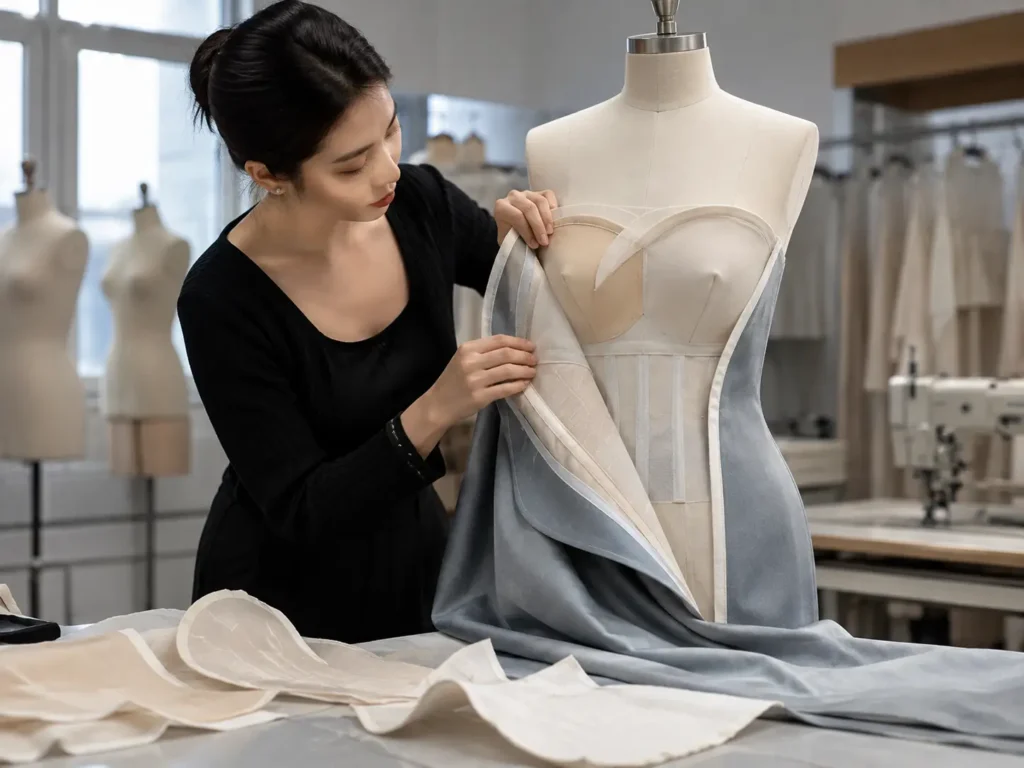
Lining and Structure Can Reduce or Redirect Ease
Lining is often invisible in product photos but directly affects comfort, stretch, transparency, support, and movement. A stretch outer fabric paired with a low-stretch lining can make a garment feel smaller than the pattern suggests. A heavy lining can reduce drape. A short lining can pull against a longer shell or create visible tension near slits and hems.
Structured dresses add another layer. Boning, interfacing, cups, elastic, zipper tapes, anti-slip strips, and seam bulk can change the way ease is distributed across the body. Corset and strapless styles need enough internal structure to hold position without creating pressure or unwanted shape distortion. Mesh and lace styles may need lining coverage that changes the effective stretch of the garment.
For fit approval, outer fabric, lining, and major structural components should represent the intended production construction closely enough for the result to be meaningful. A visually similar sample made with materially different behavior may not provide a reliable fit standard for bulk production.
The same principle applies to partial linings, mesh panels, and internal facings: each component changes how the shell stretches or moves. Fit approval records the construction actually tested so bulk teams do not reproduce only the outer appearance while changing the internal behavior.
Pattern Development Turns Fit Intent Into Geometry
Pattern development gives fit a repeatable structure. Jinfeng Apparel uses pattern review to translate silhouette, measurement, fabric behavior, and construction into controlled shapes that can be sampled, corrected, graded, and compared during bulk production.

Start With the Intended Silhouette and Base Size
Pattern development begins by understanding what the garment is supposed to do on the body.
A close-fit waist, relaxed hip, deep neckline, high slit, structured bust, low back, or bias drape creates different pattern requirements. The base size is then evaluated against the supplied size chart, original sample, fit model information, reference image, or brand block where available.
A strong pattern does more than match circumference measurements.
It controls vertical balance, seam direction, dart position, panel shape, neckline curve, armhole, shoulder or strap location, waist-to-hip relationship, skirt flare, and hem balance. For fitted styles, pattern ease must also reflect fabric stretch and recovery. For structured styles, the outer pattern must work with lining and internal support.
Jinfeng can review tech packs, original samples, reference photos, sketches, line sheets, and existing size charts. More complete information improves development accuracy because design intent can be separated from incidental details in a reference image. When information is incomplete, assumptions are identified during project review instead of being hidden inside the pattern-making stage.
The development brief should also define which fit points are non-negotiable and which can be adjusted for production feasibility. Establishing these priorities early prevents later sample rounds from chasing small cosmetic changes while a major balance or support issue remains unresolved.

Fit Comments Must Become Specific Pattern Actions
Comments such as “waist too loose,” “neckline gaps,” or “hip feels tight” are useful observations, but they are not yet production instructions. Pattern correction requires identifying where the excess or tension originates and how a change will affect surrounding areas. Reducing one seam can change side-seam direction. Shortening a strap can lift the neckline and armhole. Increasing hip ease can alter hem balance.
Jinfeng reviews fit photos, measurements, client comments, and sample behavior before deciding whether the action belongs in pattern shape, measurement specification, fabric, construction, or sewing method. Approved pattern changes can include dart adjustment, seam shaping, neckline curve correction, strap position, waistline shift, panel redistribution, hip curve, hem sweep, slit position, crotch length, or grade-rule preparation.
Important revisions are transferred into the updated pattern and related records rather than remaining only in messages. Pattern version control is critical when several samples are developed in parallel or when a style returns for repeat production months later.
When comments arrive from several people, conflicting instructions are clarified before pattern release. One approved action list is then used for the next version so the sample room does not combine separate opinions into an uncontrolled hybrid fit.
The next sample is then reviewed against the original comment list so every agreed correction is either verified, reopened, or closed with a clear reason.

Final Pattern Must Be Ready for Grading and QC
A pattern should not move into bulk merely because the latest sample “looks close.” Before production release, the final version needs to align with the approved size chart, measurement method, construction, fabric direction, trims, sample comments, and grade rules. Fit-sensitive measurements also need clear points of measure so QC can verify the same standard during bulk production.
For many dress programs, the final development sequence includes revised pattern, updated size chart, fit or revised sample, PP sample, and Golden sample. Not every style requires identical sample stages, but unresolved structural fit issues should be closed before PP approval. PP is used to confirm the intended production standard rather than continue major redesign.
Once locked, the pattern becomes part of the production handover together with approved material references, sewing instructions, measurement standards, QC checklist, and packing information. The objective is continuity: the fit decisions made during development must remain visible when the style reaches cutting, sewing, inspection, and repeat-order production.
Pattern release also includes a check that production teams can identify the correct version without ambiguity. Style code, size, version, and approval status should match the related sample and specification records before the pattern enters cutting or grading.
Critical fit points are highlighted for later inspection so production QC knows which measurements and visual relationships carry the highest fit risk.
Sampling Creates the Evidence Needed for Fit Approval
Review and First Sample
Development starts with available inputs such as reference image, tech pack, original sample, sketch, line sheet, size chart, fabric preference, target quantity, size range, and market. Fit-sensitive points are identified before pattern work so the first sample can test design interpretation, basic pattern balance, fabric direction, construction feasibility, key proportions, and major visual details. The first sample is not presented as a guaranteed final result. Clear findings at this stage create a better base for fit work and reduce the risk of spending later rounds correcting basic structural misunderstandings.
Fit and Revised Samples
PP and Golden Samples
PP sample is the production-preparation checkpoint. Fabric, color, measurements, construction, trims, labels, packing, and other bulk standards should be substantially locked, with major fit problems already resolved. A Golden sample can then serve as a retained physical reference for fit, workmanship, placement, appearance, and finishing when the project requires it. Together with final pattern, size chart, material references, and QC notes, these samples create a production standard that can be compared during bulk manufacturing and later repeat orders instead of relying on memory from the development stage.
Fit Sample Validation Goes Beyond Standing Still
A fit sample should answer whether the garment works on body, not only whether major measurements fall inside a chart. Jinfeng combines visual fit review, measurement review, movement checks, fabric behavior, and construction assessment before converting comments into revision actions.

Evaluate the Garment From Front, Side, and Back
Front-view approval alone misses many fit problems.
Side views reveal waist placement, bust projection, hip tension, side-seam direction, forward or backward balance, and hem level.
Back views show zipper behavior, back neckline, shoulder or strap position, seat fit, dart balance, and whether the garment pulls across the upper or lower back.
For remote fit review, clear photos can be organized around consistent views: front, side, back, and close-ups of affected zones.
When movement is important, short videos of walking, sitting, turning, or raising the arms can reveal problems that static photos hide. The purpose is not to collect more media; it is to give the pattern team evidence connected to a specific issue.
Fit comments should identify the location and effect rather than rely only on subjective descriptions. “Left armhole opens 12 mm at side bust” is more actionable than “top feels loose.” “Back hem sits 20 mm lower after walking” is more useful than “length looks strange.” Clear observations make pattern and measurement review more efficient across international development teams.
For complex styles, marking the affected zone directly on fit photos can reduce interpretation errors between teams in different countries. A short note linking the image to the relevant measurement or pattern piece gives the next revision a clear technical target.

Measure Key Points Against the Approved Method
Visual fit and measurement fit are related but not identical. A sample may look balanced while a key measurement is outside tolerance, or it may meet a number while the pattern distribution is wrong.
Jinfeng checks relevant points such as bust, waist, hip, dress length, strap length, armhole, neckline depth, slit height, hem width, and jumpsuit inseam or crotch where applicable.
Measurement method must stay consistent between sample development and bulk QC. If one team measures neckline depth from a different reference point or stretches a knit garment differently during measurement, the data becomes unreliable.
Points of measure should therefore be defined clearly enough that pattern, sample, technical, and QC teams are comparing the same garment geometry.
When a measurement is outside the expected range, the team also checks whether the issue comes from pattern, sewing, pressing, fabric stretch, relaxation, or measurement technique.
Not every deviation requires a pattern change.
Separating production variation from pattern logic prevents unnecessary revisions.
Tolerance discussions also need to reflect fabric and construction. A rigid woven corset panel and a soft stretch jersey cannot be judged by the same handling method, so measurement conditions are confirmed before data is used to approve or reject fit.
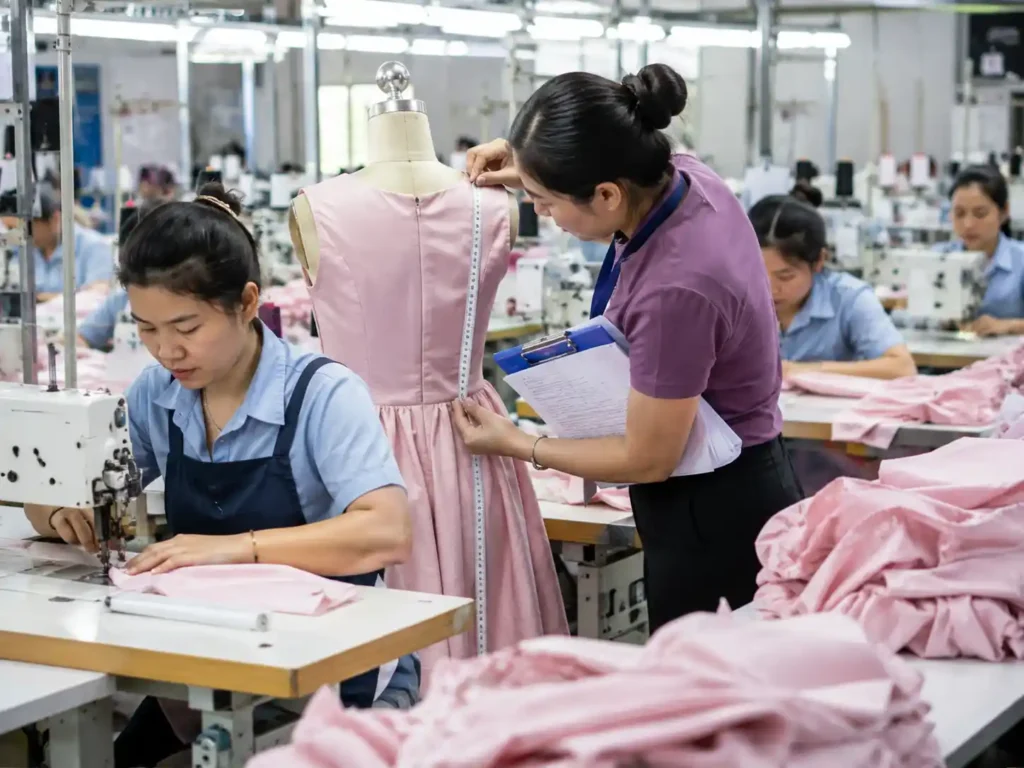
Movement Checks Protect Wearability and Market Fit
Occasion and fashion dresses are worn in motion. Slits must remain appropriate while walking. Strapless dresses must stay secure when arms move. Bodycon dresses should not climb excessively. Halter styles should not pull uncomfortably at the neck. Jumpsuits require enough torso and crotch movement. Maxi dresses need balanced length without creating tripping or drag problems.
Movement checks can include standing, walking, sitting, turning, raising arms, or other actions relevant to the style. The target is not athletic performance unless the product requires it; the goal is to confirm that the intended fashion silhouette remains wearable and visually controlled in normal use.
Any movement-related issue is reviewed with the same discipline as a static fit comment. Pattern shape, ease, slit position, strap angle, support, lining, stretch recovery, seam construction, and size range may all contribute. The approved correction must then be reflected in the next sample and related records before bulk release.
When a problem appears only in motion, video evidence can be paired with still measurements to show the pattern maker exactly when the distortion begins. This is especially useful for ride-up, slit opening, neckline movement, backless stability, and jumpsuit torso restriction.
Approval notes can also specify the movement condition used during review so later teams understand whether a slit, neckline, or fitted area was accepted only at rest or under normal wear.
Fit Feedback Must Convert Into Measurable Actions
Strong fit communication reduces repeated sampling. Jinfeng uses fit photos, measurements, technical comments, and pattern review to convert observations into actions that can be checked again in the next sample.
| Fit Observation | Technical Review | Typical Action | Validation Method |
| Neckline gaping | Neckline curve, bust balance, strap angle, fabric stretch | Correct neckline or upper-body pattern; review stabilization | Revised sample + neckline measurement |
| Waist feels loose | Waist placement, ease distribution, darts, side seams, fabric recovery | Redistribute shaping or adjust pattern intake | Fit sample + waist/side-seam review |
| Hip pulls or rides up | Hip ease, seat depth, negative ease, lining stretch | Adjust hip curve/ease or material relationship | Movement check + hip measurement |
| Side seam twists | Pattern balance, grain direction, fabric relaxation, cutting | Correct pattern balance or cutting direction | Revised sample + side-view check |
| Strap position feels wrong | Strap length, angle, anchor point, neckline and armhole | Reposition or resize strap; rebalance upper body | Front/side/back fit check |
| Hem hangs unevenly | Pattern balance, bias drop, seat shape, fabric relaxation | Correct pattern/hem after relaxation | Hanging check + final length measurement |
| Slit becomes too high | Slit position, movement, size grading, lining | Lower or reinforce slit; revise grade rule | Walking/sitting check + grading review |
Revision Tracking Keeps Fit Decisions From Getting Lost
Every Major Fit Change Needs a Controlled Record
Re-Sampling Depends on the Scale of the Change
Not every change requires a full new sample, but major fit or structure changes should not be approved only through text. Large pattern corrections, fabric replacement, major stretch changes, cup or boning changes, strapless support revisions, deep neckline changes, cut-out repositioning, major length changes, or jumpsuit crotch changes can alter the garment enough to justify a new physical validation. Smaller updates such as minor strap adjustment, simple hem correction, label position, or localized sewing refinement may be confirmed through a lighter review when they do not affect overall structure. The development team evaluates whether the change can be verified safely without creating a misleading approval shortcut. The next step can be a revised sample, PP sample, or production-ready release depending on the issue. PP is not used as an open-ended redesign stage. Before PP approval, pattern, measurements, fabric, color, trims, construction, lining, major decoration, labels, packing, cost, MOQ, and delivery assumptions should be sufficiently stable for bulk preparation.
Pattern Correction Before Bulk Protects the Approved Fit
Fit comments must be converted into the final production pattern before cutting starts. Jinfeng links sample feedback, measurements, pattern versions, size charts, grading rules, and PP approval so unresolved sample problems do not quietly become bulk-production problems.
Diagnose Before Changing the Pattern
A loose or tight area does not automatically tell a pattern maker where to add or remove volume. The root cause can sit somewhere else in the garment. A neckline gap may come from bust balance or strap angle. A tight hip may come from seat depth or lining restriction. A twisting seam may come from grain direction or front-back imbalance. A riding hem may come from negative ease or stretch recovery.
Before correction, the team compares fit photos, body behavior, sample measurements, size-chart targets, fabric properties, and construction. The goal is to identify the smallest technically correct change that solves the problem without damaging surrounding areas. When several issues are connected, they are corrected as a system rather than as independent numbers.
After the action is agreed, the pattern version and related measurements are updated. If the correction is substantial, a revised sample is used to verify the new geometry. The sample is checked again at the same critical zones so approval is based on evidence rather than memory of the previous version.
The diagnosis is documented before the next pattern version is issued so the team can verify whether the correction actually solved the original cause. If the symptom remains, the record makes it easier to reconsider fabric, construction, or measurement method instead of repeating the same pattern change.
Lock the Final Pattern, Size Chart, and Grade Direction
Once the fit is approved, the final pattern must align with the confirmed measurement chart and construction. Pattern pieces, seam relationships, notches, grain direction, and key style details need to correspond with the version used for PP or Golden sample. Obsolete versions should not remain in circulation where production could accidentally use them.
Fit-sensitive points are then connected to grading. Bust, waist, hip, neckline, armhole, straps, length, slit, back depth, and jumpsuit crotch may need different grade logic rather than one uniform increment. The base-size fit provides the reference, but the grade rule determines whether the same intent survives through the size range.
Where a brand supplies its own grade rules, Jinfeng can review them against the pattern and product structure. Where the project requires support, the team can develop or adjust size progression based on the approved base and available client requirements. Bulk measurement standards must use the same points of measure that were validated during development.
For multi-style programs, related silhouettes can share fit philosophy without sharing every pattern decision. Style-level records keep common brand proportions consistent while allowing corset, slip, stretch, and structured groups to use different ease and grading logic where needed.
The release package should make the approved base size, grade source, and final sample reference unmistakable before any production pattern is generated.
PP Approval Is the Gate Between Development and Production
PP approval should confirm the production standard, not hide unresolved development. Fabric, color, trims, measurements, construction, label placement, packing, and fit-sensitive details should be locked closely enough that production teams can reproduce the approved garment without guessing.
If a late change affects fit, pattern, fabric behavior, support structure, or major construction, the impact on cost, lead time, and production readiness is reviewed before release. A disciplined gate protects both sides: brands avoid large-scale rework, and production teams receive a stable specification that can be executed consistently.
Jinfeng treats PP and Golden sample references as part of the handover into cutting, sewing, QC, finishing, and packing. The value of fit development is realized only when approved decisions remain intact after the sample room is no longer the main team handling the style.
Bulk scheduling is confirmed after PP approval, material readiness, order quantity, construction complexity, packing requirements, and line planning are reviewed. Delivery planning is also project-specific rather than promised from one universal lead-time number.
Where several styles share a launch calendar, styles can be released individually after their own PP standards are approved rather than allowing one unresolved style to weaken the technical control of the whole collection. Production and delivery commitments are then aligned with the actual readiness of each style group.

Size Grading Must Preserve the Original Fit Intent
A base-size sample can be excellent while the full size range still fails. Grading has to protect proportion, support, coverage, movement, and style details across sizes rather than enlarge every measurement by the same amount.
Grade Rules Are Relationships, Not Simple Scale Factors
Bust, waist, hip, shoulder, armhole, neckline, strap, dress length, slit height, and back depth do not always grow at the same rate.
A uniform increase can distort the design, especially on corset, strapless, bodycon, cut-out, halter, and jumpsuit styles. Grade rules should reflect how the garment interacts with body proportion and fabric behavior.
For example, a slit may need controlled progression so exposure does not increase excessively in larger sizes. A strap may need a smaller increment than body circumference.
A corset panel may need redistributed width rather than equal expansion on every seam.
A jumpsuit needs coordination between torso, rise, hip, and inseam rather than treating top and bottom independently.
Jinfeng reviews grade direction against the approved base pattern and relevant size chart. The goal is to keep the visual intent recognizable across the range while maintaining wearable proportions and measurable consistency.
The same rule applies to visual design details. Cut-out position, cup width, corset panel distribution, waist-to-hem proportion, and strap placement may need controlled progression so the style still looks like the approved design in both smaller and larger sizes. Grade review therefore combines measurement logic with garment appearance rather than treating grading as a purely mathematical enlargement step.
Extended, Petite, and Tall Sizes Need More Than Length Changes
Petite and tall development can involve waist position, shoulder or strap length, armhole depth, neckline, slit height, torso length, and jumpsuit crotch in addition to overall garment length. Extended-size development can require different bust support, waist placement, hip ease, strap width, armhole coverage, lining coverage, and structural distribution.
Treating these ranges as automatic grading from a standard block can create poor balance and higher return risk. Where a project includes proportion-specific ranges, the critical points should be identified early enough to decide whether dedicated fit validation is needed.
For mature fashion programs, the size strategy also needs to align with SKU planning, size ratios, labels, packing, and bulk QC. Fit development therefore continues beyond the single approved sample and into the way each production size is defined and inspected.
A petite version may need a shorter upper torso, adjusted waistline, shallower armhole, revised strap length, and controlled slit position at the same time. A tall version can require the opposite set of changes. Extended sizes may need additional support or coverage rather than simply more circumference. These ranges are evaluated according to the product architecture and intended fit, not by one generic percentage rule.
Where sales data or existing brand blocks are available, those references can help determine which proportions deserve separate validation instead of relying only on generic industry increments.
Measurement QC Connects Grading to Bulk Reality
A grade rule has no commercial value if production measurements drift. The approved size chart and points of measure become QC references during cutting, in-line inspection, finished-garment measurement, and final inspection. Measurement tolerance must be realistic for the fabric and construction while still protecting the fit-sensitive dimensions of the style.
Stretch garments may require consistent relaxation and measurement conditions. Bias garments can require hanging or stabilization before final length checks. Structured dresses need attention to panel and support placement, not only circumference. The measurement method used during development should remain compatible with the method used during bulk QC.
Patterns, size charts, grade rules, PP references, and Golden samples together create a stronger size-control system than any one document alone. Jinfeng keeps these references connected so repeat orders can start from an established fit record while still rechecking fabric batch, color, trims, and production conditions.
Size-set or selected-size review can be used when the project needs additional confirmation before full production. The review focuses on the points most likely to distort after grading and on whether the garment still preserves the brand’s intended proportion. QC then measures the same points during bulk so grading decisions remain traceable from development through final inspection.

PP and Golden Samples Lock the Production Standard

PP Sample Standard
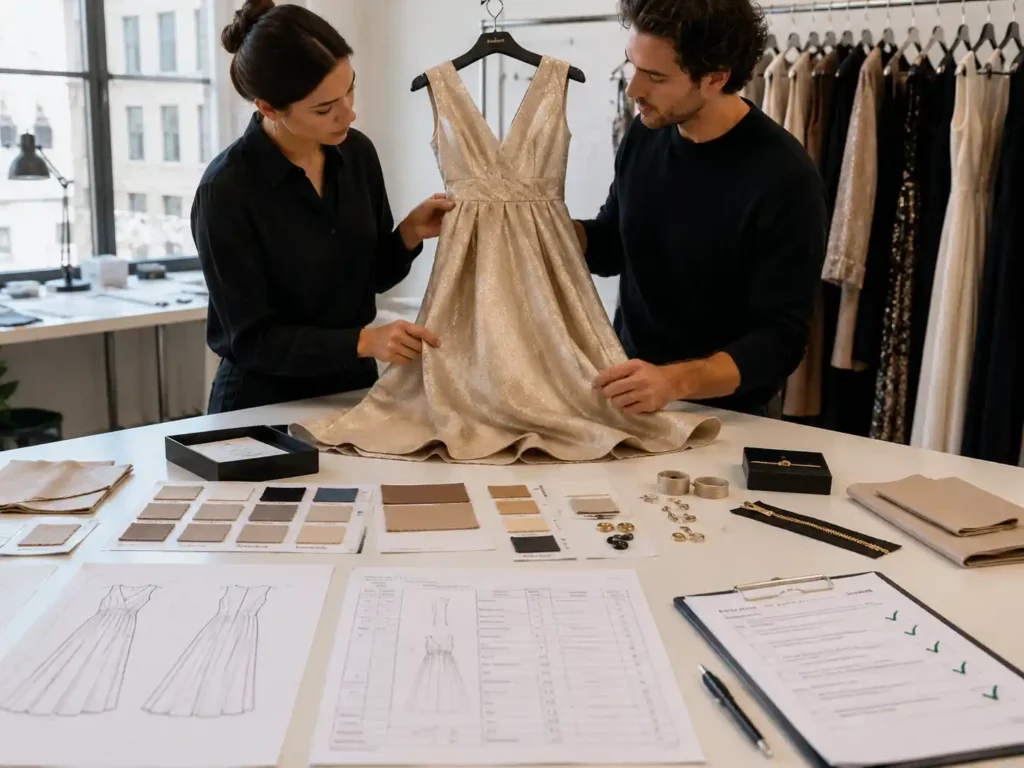
Golden Sample Reference

Document and Change Control
Sample-to-Bulk Transfer Keeps Fit Decisions Intact
Pattern and Size Handover
Materials and Sewing Handover
QC and Repeat-Order Handover
Measurement checkpoints, appearance standards, known fit risks, and Golden sample references are transferred into QC review. Development knowledge therefore becomes a production control rather than remaining only with the sample room. Pattern, size chart, fabric references, trims, sewing instructions, QC notes, and approved sample records can also be retained for repeat production. Reorders can begin from established fit data while still confirming new fabric batches, colors, materials, packaging, and current production conditions. The archive supports continuity without assuming every future production run will behave identically.
Bulk Fit QC Measures What Development Approved
Bulk quality control should protect the fit standard established during sampling. Measurement, pattern version, fabric condition, sewing, pressing, and sample comparison all influence whether thousands of garments behave like the approved reference.
| Control Stage | Fit-Related Checks | Typical Evidence | Main Risk Controlled |
|---|---|---|---|
| Incoming fabric | Stretch, recovery, shrinkage, weight, color/batch, lining compatibility | Fabric record / approved swatch | Material behavior changes fit |
| Fabric relaxation | Relaxation time and dimensional stability where required | Cutting preparation record | Knit or stretch distortion |
| Cutting | Pattern version, grain direction, layer accuracy, critical panels | Cutting check | Wrong geometry before sewing |
| In-line sewing | Key measurements, seam direction, strap/cup/boning position, elastic tension | In-line inspection | Fit drift during assembly |
| Finished garment | Bust, waist, hip, length, neckline, strap, slit, jumpsuit rise where relevant | Measurement sheet | Size inconsistency |
| Pressing and finishing | Shape, seam impression, hem balance, neckline, zipper behavior | Finishing inspection | Appearance changes approved fit |
| Final inspection | Size ratio, measurement tolerance, workmanship, Golden sample comparison | Final/AQL record by project | Shipment-level consistency |
| Repeat order | Pattern, size chart, material, trim and Golden sample record review | Archived style file | Fit variation between production runs |
Fit Development Program for Occasion Dresses
An established U.S. occasionwear brand developed a multi-style dress program with Jinfeng Apparel covering fitted, structured, and draped silhouettes. The project required more than sample sewing because fit decisions had to remain consistent across 18 styles, multiple sizes, several fabrics, and approximately 36,000 pieces of planned bulk production.
Program Scope and Fit Risks
The range combined bodycon mini dresses, corset and strapless styles, satin slips, mesh-panel dresses, and fitted occasion silhouettes. Each group created a different fit risk. Stretch styles needed controlled recovery and bust-waist-hip balance. Structured styles needed cup shape, boning position, upper-bust support, waist anchoring, and anti-slip stability. Satin styles needed drape, neckline, strap, bias, and hem balance. Mesh details required lining and opening control so fit remained secure without losing the intended visual exposure.
Development started from line-sheet information, reference images, size charts, and style-level construction direction. Key styles were prioritized first because their fit blocks and construction decisions could support related styles in the collection. Pattern review identified where similar silhouettes could share development logic and where fabric or structure required a separate approach.
The fit objective was not to force all 18 styles into one standard block. The brand needed consistent body proportion and size philosophy while allowing each silhouette to behave differently. Critical points were therefore defined by style group, including bust, waist, hip, neckline, armhole, strap, back opening, slit, dress length, cup position, and support structure.
The style map also separated shared components from unique fit risks so sample priorities could be set around the most influential blocks first. This reduced the chance of repeating the same upper-body or waist correction across several related styles after each had already moved into separate sampling rounds.

Fit Revision and Size Control
First and fit samples exposed several issues: inconsistent upper-bust grip on strapless styles, waistlines sitting slightly high on selected corset minis, side-seam movement on stretch bodycon styles, and uneven hem drop on a lightweight satin group.
Each issue was reviewed against pattern, fabric, construction, and measurement rather than solved by random alteration.
Corset patterns were adjusted around cup placement, upper-bust shaping, boning position, and waist distribution. Bodycon patterns were rebalanced with fabric recovery and side-seam behavior in mind.
Satin styles were allowed to relax before final hem evaluation, and strap positions were reviewed together with neckline and armhole coverage. Revised samples were measured against updated size charts, and major changes were recorded in the pattern and sample revision files.
After base-size approval, grading focused on protecting neckline, strap, slit, waist, and hip relationships rather than applying one uniform increment. Fit-sensitive sizes were checked against the intended range, and PP samples were used to confirm production-ready construction. Golden samples and measurement references were retained for bulk QC.
Revision records linked every major comment to the affected pattern, measurement, material, or construction point. The brand therefore received a clear approval trail rather than a series of visually similar samples with uncertain differences between versions.

Production Handover and Result
Before bulk cutting, final patterns, approved measurements, fabric and trim references, sewing instructions, fit comments, and QC checkpoints were transferred to production. Structured styles received clear support-placement references; stretch styles used controlled measurement and relaxation conditions; satin styles included handling and pressing considerations that could affect drape and hem balance.
The planned program moved into approximately 36,000 pieces across 18 styles after PP approval, with production split according to product structure and material requirements. In-line and finished-garment measurement checks focused on the fit-sensitive points defined during development, while Golden samples supported comparison of shape and construction details that could not be captured by measurements alone.
The project demonstrates the operating principle behind Jinfeng fit development: sample approval is not the finish line. The final value comes from translating fit comments into controlled patterns, size rules, production instructions, and QC references that remain usable when a multi-style collection reaches bulk production and later repeat orders.
Bulk scheduling and shipment planning were coordinated around approved PP standards, material readiness, and line allocation rather than fixed before fit development was closed. This kept launch planning connected to the technical status of the collection and reduced pressure to release unresolved styles simply to protect an early calendar assumption.
Dress Fit Development Frequently Asked Questions
Send a tech pack, size chart, reference image, original sample information, line sheet, or sketch when available. Include target fabric, size range, quantity per style/color, intended market, and any known fit comments. More complete inputs help the pattern and sample teams separate design intent from assumptions before development begins.
Yes. An existing sample can be reviewed together with measurements, fit photos, comments, and the current size chart. The team can identify whether issues relate to pattern balance, ease, fabric, construction, sewing, or measurement method before proposing the next pattern or sample action.
No. Minor, localized updates may be confirmed without a full new sample when they do not affect structure or overall fit. Major pattern changes, fabric changes, stretch changes, corset support revisions, neckline changes, cut-out changes, or significant length changes normally require new physical validation before production release.
The sequence depends on product complexity and approval needs. Jinfeng can support first sample, fit sample, revised sample, photo-ready sample, salesman sample, PP sample, and Golden sample. Fit-sensitive or complex dresses usually need enough stages to close structural issues before PP rather than forcing a fixed number of rounds.
Yes. Stretch, recovery, drape, weight, shrinkage, lining behavior, and grain can change fit even when the pattern is unchanged. A fabric replacement during sampling may require pattern review or re-sampling when the new material behaves differently from the approved development fabric.
The approved base pattern is connected to size-chart and grade-rule development. Bust, waist, hip, neckline, armhole, strap, length, slit, and other style-specific points are reviewed for size progression. Measurement QC during bulk helps verify that graded sizes remain within the approved production standard.
A fit sample focuses on body fit, proportion, movement, and measurement corrections. A PP sample is a production-preparation standard using approved or production-representative materials, construction, measurements, trims, labels, and finishing. Major fit issues should be resolved before PP approval.
Jinfeng supports NDA-based cooperation. Tech packs, patterns, size charts, samples, fit comments, labels, packaging files, unpublished designs, and other project information are used only for the approved development and production work. Unreleased brand materials are not displayed publicly without permission.
Yes. Pattern files, size charts, material references, trim records, QC notes, and Golden samples can support repeat-order preparation. New fabric batches, colors, trims, and production conditions still need confirmation because material variation can influence fit and final garment behavior.
Jinfeng Apparel’s MOQ starts from 200 pieces per style/color. Final MOQ depends on fabric availability, color development, trims, construction complexity, packaging requirements, and production schedule. Custom-dyed, printed, certified, lace, sequin, or specially developed materials may carry separate supplier MOQs.

Send Your Dress Fit Development Brief
If your team is developing fit-sensitive dresses, share the files that already exist rather than waiting until every detail is perfect. Jinfeng Apparel can review the current development stage, identify the information needed for pattern and sample work, and clarify whether the next action should be pattern review, first sample, fit sample, revised sample, grading review, or PP preparation.
Project evaluation also checks fabric direction, quantity, construction complexity, and production feasibility before commitments are made. Fit comments can be reviewed together with sample photos, measurements, size charts, and existing pattern information so the first discussion focuses on the actual development risk. For multi-style collections, identify hero styles, target launch dates, and the styles carrying the highest fit or construction risk.
Jinfeng can then help organize a realistic development sequence before sampling and bulk commitments are locked. NDA-based cooperation is available before detailed tech packs, unpublished designs, patterns, size charts, or private project files are shared.
For a useful first review, include:
- Company and market
- Product type and style count
- Tech pack, line sheet, sketch, or reference image
- Current size chart and target size range
- Existing fit comments or sample photos
- Fabric direction or approved fabric reference
- Quantity per style/color
- Target development and delivery window
- Private-label or packaging requirements where relevant
- NDA request before detailed file review, if required


