 Skip to content
Custom Mini Skirts
Mini skirt development for fashion collections that need controlled proportions, reliable fit, production-ready construction, and repeatable bulk execution.
- 8 core mini skirt development directions, from A-line and bodycon to denim, satin, sequin, and matching-set styles.
- 6 key control areas: waist, hip, skirt length, waistband, zipper or closure, and hem balance.
- Sample path can move from first sample to revised sample, PP sample, and Golden sample before bulk standards are released.
- OEM, ODM, private-label packing, QC, and repeat-order records can be managed within one womenswear production system.
Built for Established Fashion Collections
Collection-Driven Fashion Teams
Structured Product Development Programs
Mini Skirt Styles Developed for Real Collections

A-Line Mini Skirts

Bodycon Mini Skirts

Pleated Mini Skirts

Low-Waist Mini Skirts

Denim Mini Skirts

Satin Mini Skirts

Sequin Mini Skirts

Matching-Set Mini Skirts
Mini Skirts for Different Collection Positions

Party and Going-Out

Premium Ecommerce
Premium ecommerce assortments need photo-ready samples and clean close-up details. Fabric shine, drape, pressing, waist fit, hem line, zipper flatness, and decorative finish are visible at high resolution. Development teams often need samples that represent the intended bulk material and construction closely enough for campaign or product photography. Jinfeng Apparel can connect sample feedback to updated patterns, measurements, fabric records, sewing instructions, and QC checkpoints before bulk production. The goal is a garment whose product imagery and delivered stock remain visually aligned.

Y2K and Low-Waist

Structured Fashion

Resort and Summer

Collection Matching Sets
Fabric Direction Changes Fit and Production

Jersey and Ponte

Satin and Stretch Satin

Denim

Cotton, Twill and Suiting

Mesh and Lace

Sequin and Decorative Fabrics
Mini Skirt Fit Is Built Around Four Measurements
Mini length magnifies fit errors. Waist position, hip ease, front and back length, and hem movement need to work together before a style becomes safe for grading and bulk production.

Waist Placement Controls the Silhouette
A mini skirt can sit high, at the natural waist, or lower toward the hip, and each position changes visual proportion, comfort, pattern shape, closure length, and the way the garment moves. High-waist styles normally need a stable waist measurement and enough shaping through the upper hip so the skirt does not climb upward. Natural-waist styles rely on clean contouring between waist and hip. Low-waist styles need a different calculation because the circumference is larger and the finished line must remain visually balanced across sizes. Jinfeng Apparel reviews waist placement against the reference, size chart, target market, and fabric stretch before the pattern is finalized. Waistband width, interlining, elastic use, zipper position, and comfort ease are then matched to the selected construction. During sample review, the team checks whether the waistband stands flat, rolls, gaps at the back, presses into the body, or shifts during movement. Approved waist measurements move into the final pattern, size chart, PP standard, and bulk QC checklist so production is not judged by appearance alone.

Hip Fit Needs Fabric-Specific Ease
Hip fit determines whether a mini skirt looks clean, twists at the side seams, rides upward, restricts movement, or loses the intended silhouette. Bodycon styles may use controlled negative ease when the fabric has suitable stretch and recovery. Woven A-line or structured styles require positive ease and shaping through darts, panels, or flare. Low-waist designs need enough room at the high hip and full hip while keeping the intended drop line. The pattern team reviews hip circumference, fabric stretch direction, recovery, side-seam balance, back length, and movement comfort rather than applying one fixed ease rule to every fabric. Fit feedback from front, side, and back views helps identify drag lines, excess volume, seam twisting, or tension around the seat. If the fabric changes during sampling, hip ease and pattern shape may need to be reassessed because a softer, stiffer, or stretchier material can change the way the garment hangs. Bulk QC compares approved measurements with production garments and checks whether side seams remain balanced across the size range.

Mini Length Requires Coverage Control
Mini length is not only a fashion dimension; it affects wearing safety, styling position, lining coverage, and the difference between front and back balance. The same numeric length can fit differently when waist position, hip curve, fabric stretch, or model height changes. Development should confirm where the skirt is intended to sit, center-front length, center-back length, side length, lining length when used, and any slit or asymmetric hem. A fitted stretch mini can rise during walking or sitting, while a rigid woven skirt may need additional back length or hem sweep to move comfortably. Sample fitting should include standing and movement checks rather than a static front view alone. Jinfeng Apparel records approved length points in the measurement file and transfers them into PP and bulk inspection. For multi-size programs, grading needs to preserve the intended proportion instead of shortening or lengthening every size mechanically. A safe, commercially consistent mini should look intentional from the front, side, and back without unexpected exposure during normal movement.

Hem Balance Shows Bulk Accuracy
The hem is one of the fastest places to see whether a mini skirt has been cut, sewn, pressed, and measured consistently. A clean A-line needs a level sweep; a bodycon mini needs a stable finished length without side-seam lift; pleated skirts need equal pleat release and a controlled bottom line; satin and lightweight fabrics need smooth hems without waviness or press marks. Hem problems can come from grain direction, uneven stretching during sewing, incorrect side-seam balance, inconsistent pressing, or differences between lining and shell. During development, hem method should be selected according to fabric weight and visual requirement, then tested on the sample. Production instructions need to state the approved finish clearly. Final QC checks front, back, and side balance after pressing, not only before finishing. When a style includes a slit, the slit height and reinforcement are checked together with the hem because both affect movement and exposure. A stable hem confirms that pattern, cutting, sewing, and finishing are working to the same standard.
Waistband, Closure and Internal Structure Matter
A mini skirt can look expensive or poorly made from the waist alone. Support, closure, lining, and hidden finishing determine fit stability, comfort, and repeatable production.

Waistband Support Prevents Rolling and Gaping
Waistbands carry both visual and structural responsibility. A narrow fashion waistband, wider shaped waistband, elastic-back waist, clean facing, or low-waist finish each needs a different pattern and reinforcement method. Woven styles may require fusible interlining to stop the waistband from collapsing, stretching, or rolling after wear, while stretch styles need enough flexibility to preserve comfort without losing recovery. Interlining must match fabric weight and pressing behavior because a reinforcement that is too stiff can create a hard edge and one that is too soft may fail to hold shape. Sampling should check finished waist measurement, waistband height, back gaping, seam smoothness, and whether the waist stays in place while sitting and moving. Pressing trials are especially important for satin or delicate surfaces that can mark under heat. Once the structure is approved, waistband materials, seam allowance, interlining, stitch method, and measurement points should be written into the production instruction so bulk operators and QC teams follow the same construction rather than relying on a sample photo alone.

Zippers and Closures Need Fabric Matching
Invisible zippers are common in woven mini skirts because they can keep the side or center-back line clean, but a poorly matched zipper can bulge, wave, catch, or distort the waist seam. Zipper length, tape color, slider quality, seam allowance, fabric thickness, top hook, and installation position all affect the result. Light satin and thin woven fabrics need careful tension so the zipper does not create a ridge. Structured denim or street styles may use metal zippers, where tooth weight, plating, puller design, washing behavior, and skin contact become additional concerns.
Some styles may combine zipper closure with hook-and-eye reinforcement at the top to reduce stress on the zipper. Sampling should test opening, closing, waist alignment, and seam flatness. Bulk QC needs incoming zipper verification, in-line installation checks, finished open-close testing, and visual review after pressing.
Closure standards should also match the approved trim card so color, length, and hardware remain consistent through repeat orders.

Lining Controls Opacity and Comfort
Lining is not automatically required on every mini skirt, but it becomes important when the shell is sheer, scratchy, heavily decorated, very light, or likely to cling. Satin, lace, mesh, sequin, organza, and some light woven fabrics often need a lining decision early because lining changes hip ease, movement, opacity, hem behavior, and cost. A lining that is too tight can restrict movement even when the shell fits correctly. A lining that is too long may show below the hem, while one that is too short can fail to provide the intended coverage. Color also matters, especially under light fabrics where a mismatched lining changes the overall shade. Sample fitting should confirm lining length, seam placement, static behavior, comfort against skin, and whether the lining pulls the outer skirt upward. Approved lining specification should be treated as part of the BOM and PP standard. Bulk inspection checks lining attachment, coverage, color, length, and whether it stays concealed during normal movement.

Internal Finishing Protects Shape and Skin
Hidden details such as seam finishing, reinforcement, elastic, interlining, hooks, zipper guards, and decoration backing often decide whether a fashion mini is comfortable enough for real wear. Sequin edges can scratch; metal zippers can contact skin; lace or mesh seams can feel rough; waist elastic can twist or lose recovery; raw decorative areas can catch during dressing. Development should identify each skin-contact point and select a finish that supports the design without adding unnecessary bulk. Pleated skirts may need secure waist joining so pleat depth does not shift. Low-waist minis need clean inside finishing because the waist line often sits directly against the hip. Satin and light fabrics need seam allowances controlled so they do not shadow through the surface. Internal workmanship should be inspected before final pressing and packing because many defects are harder to correct once decoration and lining are closed. A clean inside finish helps the garment hold its shape and reduces avoidable returns caused by discomfort.
Design Details Need Production Rules

Pleat Control
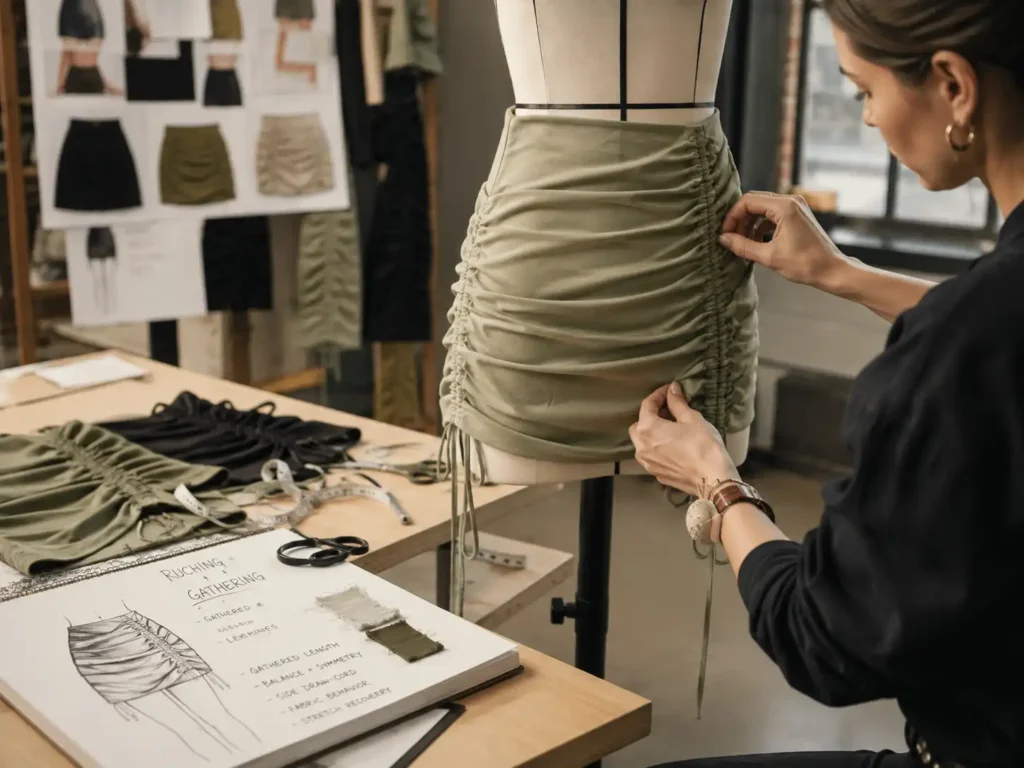
Ruching and Gathering

Slit Construction

Invisible Zipper Finish

Metal Zippers and Hardware
Metal zippers, logo plates, decorative chains, studs, or other hardware can strengthen a denim, utility, or street-style mini skirt, but weight and edge finish must suit the garment. Heavy hardware can pull light fabric out of shape, while rough plating can scratch skin or damage neighboring garments during packing. Development should confirm size, plating color, puller design, attachment method, reinforcement, and wash compatibility when denim washing is involved. QC checks security, surface condition, sharp edges, color consistency, and protective packing around exposed hardware.

Lining and Inner Coverage

Sequin and Embellishment Finish

Topstitching and Hem Finish
Pattern Development Turns Design Into Production
A mini skirt pattern must hold the intended waist position, hip line, length, flare or fitted shape, closure, and hem through fitting, grading, and bulk cutting.

From Reference to a Working Skirt Block
Development can begin from a tech pack, reference image, original sample, sketch, line sheet, or measurement chart, but the pattern cannot be built reliably from visual proportion alone. The first task is to identify the skirt category, intended waist level, body fit, fabric behavior, closure, lining, hem, and any design features such as pleats, slits, panels, ruching, or low-waist shaping. Pattern makers then translate those decisions into waist circumference, high-hip and full-hip shaping, front and back lengths, dart or panel distribution, side-seam position, hem sweep, and seam allowances suitable for sampling. Fabric choice is reviewed at the same stage because rigid denim, stretch jersey, satin, suiting, and lace-overlay construction need different ease and stabilization. The working pattern should allow the sample team to test the real silhouette rather than merely reproduce the outline of a reference photo. Notes about zipper, waistband, lining, pleat placement, or trim position are connected to the pattern so the first sample already reflects production logic.

Fit Correction Is Recorded in the Pattern
Sample feedback needs to change the pattern, not stay inside email or chat history. Common mini skirt revisions include waist gaping, tight hip, side-seam twisting, incorrect low-waist position, excessive or insufficient flare, skirt length that feels unsafe, uneven hem, slit placement, lining exposure, or zipper bulging. The pattern maker reviews fitting photos, garment measurements, marked detail images, fabric stretch, and written comments to identify the root cause. A tight hip may require ease adjustment rather than simply adding to the side seam; a skirt that rides up may involve stretch recovery, hip tension, or length balance; a gaping back waist may need contouring rather than a smaller overall waist. Approved corrections are transferred into the updated pattern and measurement chart, with construction notes adjusted when the solution affects waistband, zipper, lining, pleats, or trims. The revised sample then verifies whether the change solved the original issue without creating a new one elsewhere.

Size Grading Must Preserve the Intended Proportion
Jinfeng Apparel can develop size ranges for US, UK, EU, and AU markets, including alpha sizing and extended ranges based on the brand’s own size standard. Mini skirt grading deserves particular care because waist, hip, and length do not always grow at the same visual rate. A low-waist mini needs the dropped waist line to remain proportionate as hip circumference increases. A bodycon mini needs controlled ease across sizes so smaller sizes are not excessively tight and larger sizes do not lose shape. Pleated styles need pleat distribution and waistband measurement to remain aligned after grading. The final grade rule should be checked against the approved base-size sample and brand size chart before bulk cutting. Key measurement points can include waist, high hip or full hip where specified, center-front length, center-back length, side length, waistband height, slit height, and lining length. Final pattern files, size charts, and grading rules become part of the production reference for bulk QC and future repeat orders.
Sampling Establishes the Production Standard
Sampling is used to validate fabric, proportion, workmanship, and manufacturing feasibility before a mini skirt is released into a bulk production schedule.

Requirement Review Before Cutting a Sample
A useful sample starts with enough information to make clear manufacturing decisions. Jinfeng Apparel reviews available development files such as tech packs, reference images, original samples, sketches, line sheets, fabric swatches, trim references, label files, size charts, target quantity, and launch date. For a mini skirt, early review identifies waist position, silhouette, hip fit, finished length, fabric direction, closure, waistband, lining, hem, slit, pleat or ruching details, private-label needs, and any risk created by decoration or special trims. Material availability is checked because changing from an available fabric to custom dye, special lace, sequin, wash treatment, or custom hardware can affect both sample route and production planning. When key information is missing, the team defines which decisions must be confirmed before pattern work starts. The aim is to avoid a sample that looks visually close but cannot be quoted, graded, or repeated accurately for bulk.

First Sample Tests the Main Product Decisions
The first sample is used to test the direction, not to pretend every design will be perfect in one attempt.
A simple mini skirt can often reach a first-sample stage in about 7-10 days when fabric and trims are ready, while complex sequin, lace, mesh, heavily structured, or special-material styles may require about 15-25 days or a project-specific schedule. Timing also depends on fabric availability, trim development, pattern difficulty, and feedback speed. The first sample should verify silhouette, waist and hip fit, skirt length, waistband stability, zipper or closure, lining, hem, decoration placement, and overall workmanship. Measurements are compared with the development size chart, and photos or video can be used to support remote review before shipping. Any area that changes cost, MOQ, material sourcing, or construction is identified early so the program does not move forward on an assumption that later becomes expensive to reverse.

Sample Output Must Be Usable by Production
A finished sample is only valuable when the manufacturing information behind it can be transferred. Jinfeng Apparel records approved or revised information in pattern files, measurement charts, fabric references, trim records, sewing instructions, label placement, packing requirements, and QC checkpoints as the style develops. Sample photos alone are not enough for a multi-style collection because production teams need clear measurements and construction standards. When the sample includes pleats, ruching, a special waist, sequin surface, lace overlay, metal hardware, or unusual lining, those details need written or visual instructions that explain placement and finishing. Before moving toward PP approval, the team also confirms whether any material or construction change has altered price, MOQ, sample timing, or the expected production schedule. The sampling stage therefore builds both the garment and the production file that follows it.
Sample Revision Solves the Cause, Not the Symptom
When a mini skirt sample misses the target, fit, fabric, workmanship, length, trims, and visual proportion are reviewed separately before the next sample is made.

Fit Feedback Is Diagnosed by Category
Mini skirt feedback often arrives as simple comments such as “too tight,” “too loose,” “too short,” or “does not sit right.” Those comments need to be converted into measurable causes.
Jinfeng Apparel reviews front, side, and back fitting images, garment measurements, waist placement, high-hip and hip tension, side-seam direction, center-front and center-back length, hem line, slit height, lining, and fabric stretch.
A skirt that feels too tight may need more hip ease, a different waistband shape, or a fabric with better stretch rather than a general size increase. A low-waist skirt that looks too low may need the drop position corrected without changing the overall hip fit. A bodycon skirt that rides upward may point to recovery, hip tension, or length balance. Feedback is prioritized so critical fit and safety issues are corrected before cosmetic details. The next pattern version records the approved change rather than leaving the solution dependent on verbal memory.

Fabric and Workmanship Changes Trigger Re-Review
Changing fabric during sampling can alter drape, stretch, recovery, opacity, shrinkage, seam appearance, and waistband behavior. A satin replacement may need different zipper handling and pressing.
A rigid denim replacement may require more ease than a stretch version. A new lace or mesh can change lining coverage and edge finishing. A heavier sequin base can affect seam thickness and comfort.
Jinfeng Apparel compares new material properties and reviews whether the pattern, lining, sewing method, trim specification, costing, MOQ, or production timing also need to change. Workmanship feedback follows the same logic.
Zipper bulging may require installation or seam adjustments; pleats may need revised depth; lining exposure may require different length or attachment; hem waviness may require another finish. A change is considered complete only when the revised construction is recorded and can be repeated by production.

Revision Records Protect Multi-Style Programs
Collections involving 10, 20, or more styles can become difficult to manage when revisions are scattered across messages. Each revision should record version, issue, cause, action, measurement change, pattern change, material change, trim change, cost impact, timing impact, and approval status where relevant. Jinfeng Apparel converts bulk-relevant revisions into updated pattern files, size charts, BOM information, fabric and trim records, sewing instructions, QC checkpoints, and revised sample requirements. A revised sample is usually needed when the pattern changes significantly, fabric changes, structure changes, or a complex workmanship issue has been re-engineered. Smaller corrections can still require a documented review before PP. Clear revision records also support repeat orders because the factory can refer to the final approved version rather than reconstructing decisions from previous correspondence. The result is a cleaner transition from development to PP approval and less ambiguity once materials are committed for bulk production.
PP Approval Connects Sample and Bulk Production
The PP stage locks the final production standard so fabric, construction, measurements, labels, packing, and QC move into bulk as one controlled set of instructions.

PP Sample Locks the Final Specification
The PP sample is the final production confirmation before bulk manufacturing begins. For a mini skirt, approval should cover fabric, color, waist and hip measurements, skirt length, waistband structure, zipper or closure, pleats or ruching, slit, lining, hem, trims, labels, hangtags, barcode information, and packing method where applicable. Final materials should be used whenever the approved bulk appearance depends on them. A PP sample is not the ideal stage for repeated redesign because late changes can affect material purchasing, cost, sewing method, size grading, production schedule, and packing preparation. Jinfeng Apparel reviews whether any final comment requires another pattern or construction update before the style is released. Once the PP standard is confirmed, it becomes the reference used by merchandising, pattern, production, QC, and finishing teams. Clear PP lock reduces the risk of different departments working from different versions of the style.

Production Handover Uses Files, Not Memory
After PP approval, the style moves into bulk through a handover package that connects the approved garment to operational instructions. Relevant records can include final pattern, size chart and grade rule, approved fabric reference, trim card, BOM details, sewing instruction, measurement points, label and hangtag placement, barcode or SKU requirements, packing instruction, and QC checklist. Mini skirts with pleats, decorative panels, sequin surfaces, special waistbands, or asymmetric details may also need marked photos or construction notes to show exact placement. The production line should understand what is fixed and which points require special inspection before sewing begins. Material arrival and trim readiness are checked against the approved specification. Handover also makes it easier to identify the source of a deviation during production because teams can compare the garment with a defined file and approved sample instead of arguing over an earlier development version.

Golden Sample Supports QC and Repeat Orders
A Golden sample can serve as the physical reference for workmanship, proportion, trim placement, finishing, label location, and packing standards after the production specification is locked. QC teams can compare bulk garments with the approved measurements and physical standard during in-line and final inspection. The value continues after shipment: repeat-order preparation is faster when the final pattern, fabric reference, trim record, measurement file, packing requirement, QC notes, and Golden sample standard remain available. A mini skirt that becomes a strong-selling SKU may return in another color, new fabric, or matching-set extension. The saved standard helps the team identify which elements can be reused and which changes require a new sample or PP review. Repeatability is built from records created during the first development cycle rather than from an assumption that the previous style can be reproduced from memory.
Bulk Production Follows Defined Control Gates
Production timing is built after PP approval, material readiness, order quantity, size and color breakdown, packing requirements, and QC scope are confirmed.
| Control Gate | What Must Be Ready | Main Mini Skirt Risk | Production Action |
| PP Lock | Final sample, measurements, construction, labels | Late changes entering bulk | Freeze approved specification before line release |
| Material Arrival | Shell, lining, zippers, trims, labels, packing | Missing components stop cutting or sewing | Verify arrival status and specification |
| Fabric Preparation | Relaxation, shade grouping, wash plan where required | Stretch change, shade variation, shrinkage | Prepare fabric according to material behavior |
| Cutting | Final pattern, size ratio, fabric direction | Length error, grain error, damaged panels | Check direction, quantity, defects, bundle identity |
| Sewing Start | Sewing instruction, trim card, PP reference | Waist, zipper, pleat or seam deviation | Brief production team and inspect early output |
| In-Line Inspection | Measurements and workmanship checkpoints | Batch errors spreading through the run | Correct deviations before volume increases |
| Finishing | Pressing, surface protection, final measurement | Satin marks, uneven hem, sequin damage | Inspect finishing against fabric requirements |
| Packing Release | Label, barcode, SKU, polybag, carton rules | Wrong SKU, mixed sizes, surface damage | Final packing QC before shipment release |
Production Capacity Backed by Womenswear Teams

Pattern and Sample Resources

Owned and Coordinated Factories

Sewing and Flexible Production

QC, Merchandising and Finishing
Mini Skirt QC Covers Fit and Finish
Quality control follows the approved pattern, measurements, fabric, construction, trim, and packing standard, with mini-skirt-specific checks built into production rather than left to final inspection alone.
| QC Point | What We Inspect | Typical Failure | Main Control Stage |
|---|---|---|---|
| Waist | Finished waist, waistband shape, closure alignment | Gaping, tightness, rolling | Sample, in-line, final |
| Hip | Hip measurement, ease, side-seam balance | Pulling, twisting, loose silhouette | Sample, in-line, final |
| Skirt Length | Front, back, side length where specified | Excessive shortness, inconsistent proportion | PP, cutting, final |
| Waistband | Width, interlining, elastic, seam flatness | Rolling, bubbling, uneven height | Sewing, pressing, final |
| Zipper / Closure | Length, color, smoothness, seam flatness | Bulging, catching, open-close failure | Incoming, sewing, final |
| Slit / Opening | Height, reinforcement, symmetry | Excess exposure, weak seam | Sewing, final |
| Hem | Finished width, balance, pressing | Wavy, uneven, twisted | Sewing, finishing, final |
| Lining | Coverage, color, length, attachment | Lining visible, pulling, poor opacity | Sewing, final |
| Surface | Shade, snags, holes, sequin or lace condition | Color difference, damage, decoration loss | Incoming, in-line, final |
| Packing | Labels, barcode, size, SKU, folding, protection | Mixed SKU, wrong label, surface damage | Packing QC |
Private Label Details Stay Controlled Through Packing

Woven, Size and Care Labels
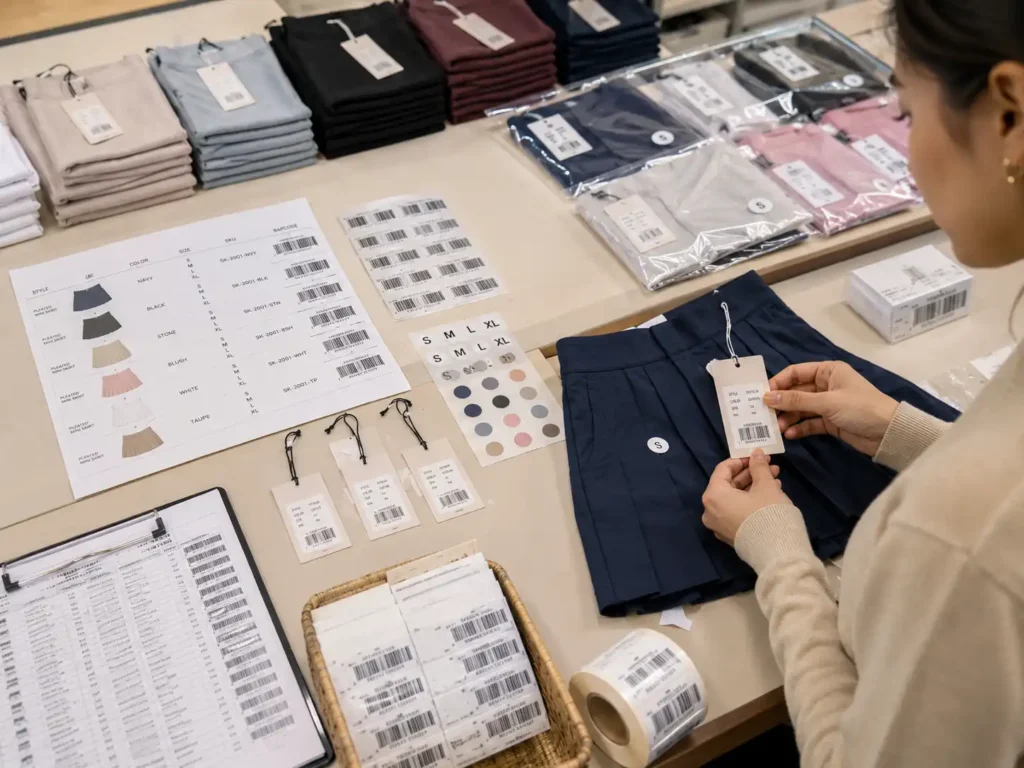
Hangtags, Barcodes and SKU Labels

Polybags, Folding and Cartons

NDA and Unreleased Design Protection
MOQ and Cost Follow the Product Specification

Base Garment Quantity

Fabric and Color Development

Trims and Workmanship
Invisible zippers, metal zippers, custom pullers, hardware, lace trims, rhinestones, sequins, specialty elastic, woven labels, hangtags, and decorative components can carry independent supplier requirements. Workmanship also affects cost: pleating, ruching, layered mesh, lace matching, sequin handling, lining, complex waist construction, and decorative hardware require different sewing and inspection time. Jinfeng Apparel evaluates trim specification and construction together so cost changes are connected to visible product decisions rather than appearing later as unexplained additions.

Packaging and Order Structure
Build a Mini Skirt Program Beyond One Style
Hero Style to Color Extension
Mini Skirt to Matching Set
Repeat Orders and New-Season Updates
US Mini Skirt Collection Program
A recent-order-scale example shows how a multi-style program can be managed when different fabrics, constructions, and launch requirements must share one development and QC framework.

Program Profile: 18 Styles, 36,000 Pieces
An anonymous US fast-fashion partywear program was structured around 18 mini-skirt and coordinated matching-set styles within an approximately 36,000-piece brand order. The assortment combined satin minis, fitted stretch skirts, sequin statement skirts, low-waist fashion styles, and coordinated skirt sets intended for seasonal online launches. The program required several color groups and size runs, so the development team could not treat each style as an isolated sample. Shared fabric families, common trim directions, brand label files, packing rules, and launch priorities were grouped before sampling. Hero styles were developed first so fit and construction decisions could inform related styles. The key commercial requirement was not simply producing a short skirt; the assortment needed consistent waist and hip proportions, controlled length, reliable closures, photo-ready finishing, and enough production discipline to move several styles through development without mixing versions. The project structure followed the current order pattern Jinfeng commonly manages for brand programs: roughly 10-30 styles and 20,000-80,000 total pieces per brand order, depending on assortment and season.

Main Risks: Fit, Surface and Style Version Control
The satin styles needed smooth seams, controlled shine direction, clean zipper installation, lining decisions, and pressing that did not mark the surface. Fitted stretch skirts needed stable recovery, balanced side seams, and length control so the garment did not ride upward during movement.
Sequin styles added risks around decoration loss, scratching, thick seam allowances, zipper paths, and packing abrasion. Low-waist styles needed careful drop placement and hip ease so the visual proportion remained consistent after grading. With 18 styles in development, revision control was another major issue: waist corrections, fabric substitutions, trim changes, revised lengths, and packing decisions had to be moved into updated pattern, size, BOM, sewing, and QC files rather than being left in separate conversations.
Samples were prioritized by risk. Complex decorative and fitted styles received more technical review before PP, while related color or set extensions followed once the base construction was confirmed.

Production Result: One Standard from PP to Packing
After fit, fabric, construction, and visual details were approved, final styles moved through PP lock and production handover.
Pattern files, measurement charts, fabric and trim references, sewing instructions, label placement, packing requirements, and QC points were aligned before line release. In-line inspection focused on waist, hip, length, side-seam balance, zipper function, decorative surface condition, and hem.
Satin finishing was checked for press marks and snags; sequin styles received additional surface and packing protection review. Private-label information and SKU packing were verified during finishing to prevent style, color, or size mix-ups.
The program format also created a repeat-order base: confirmed patterns, fabric directions, color references, trim records, and packing standards could be reused when strong styles returned in new colors or follow-up drops. The outcome was a collection managed as one controlled manufacturing program rather than 18 disconnected production jobs.
Send the Information Needed for Project Review
Product and Development Files
Quantity, Size and Launch Plan
Custom Mini Skirts Frequently Asked Questions
Jinfeng Apparel supports mini skirts across A-line, bodycon, pleated, low-waist, denim, satin, sequin, structured, and matching-set directions. Development is based on the brand’s design, reference, tech pack, original sample, or line sheet, with fabric, waistband, hip fit, skirt length, closure, lining, hem, and production feasibility reviewed before bulk.
The base MOQ starts from 200 pieces per style and color, depending on fabric availability, color development, trims, construction complexity, and production schedule. Special fabrics, custom dyeing, printing, denim washing, decorative trims, custom hardware, or private-label packaging can have separate supplier requirements that need confirmation before quotation.
A simple first sample can often take about 7-10 days when materials are ready. Complex sequin, lace, mesh, heavily structured, or special-material styles may take about 15-25 days or require a project-specific schedule. Fabric availability, trim development, pattern difficulty, and feedback speed all affect timing.
Yes. Jinfeng Apparel can begin from reference images, sketches, original sample photos, line sheets, or other design material. The team will still need to confirm product structure, fabric direction, measurements, waist and hip fit, skirt length, trims, lining, workmanship, quantity, and target market before an accurate production standard can be built.
Length is reviewed together with waist position, hip fit, front and back balance, fabric stretch, lining, and grading. Approved measurement points can include center-front, center-back, side length, slit height, and lining length. PP approval and bulk QC use the confirmed size chart and pattern rather than judging length visually.
Yes. Private-label support can include woven labels, size labels, care labels, hangtags, barcode stickers, SKU labels, polybags, cartons, and carton marks. Placement and packing are confirmed against the approved order files, with special attention to fitted, low-waist, sheer, or decorative styles where label position and packing protection affect the garment.
Not reliably. Fabric weight, stretch, recovery, drape, opacity, shrinkage, surface decoration, and seam behavior change the fit and construction. When a material changes, Jinfeng Apparel reviews whether waist and hip ease, lining, closure, waistband, hem, pattern, costing, or sampling need to be adjusted before bulk.
Fit feedback is classified and converted into pattern and measurement changes. The team reviews waist, hip, side seams, skirt length, waistband, slit, lining, fabric stretch, and movement. Major pattern, fabric, or construction changes normally move through a revised sample before PP approval, with updated records maintained for production.
Bulk production is released from the approved PP standard with final pattern, size chart, fabric and trim references, sewing instructions, label and packing requirements, and QC checkpoints. In-line and final inspection compare production garments with approved measurements and workmanship standards. Golden sample references can also support bulk QC and later repeat orders.
Yes. Repeat-order support can use retained pattern files, size charts, fabric references, color information, trim records, construction notes, packing requirements, QC points, and Golden sample standards. New colors, same-pattern fabric changes, and style updates are reviewed to determine which approvals can be reused and which need new sampling.

Start Your Custom Mini Skirt Program
Send Jinfeng Apparel the product information your team already has, and the development review can begin around the decisions that matter for a production-ready mini skirt: silhouette, waist placement, hip fit, skirt length, fabric, waistband, closure, lining, design details, size range, quantity, private-label requirements, and launch timing.
A tech pack is useful, but a clear reference image, original sample, sketch, line sheet, or existing fit sample can also provide a workable starting point when the missing specifications are identified during review.
For a faster project assessment, include:
- Reference image, tech pack, sketch, or original sample photos
- Target quantity by style and color
- Intended size range and target market
- Preferred fabric, color direction, and trims
- Existing fit comments or measurements, if available
- Label, hangtag, barcode, SKU, or packing requirements
- Target sample, PP, launch, or delivery window


