 Skip to content
Mixed-Decoration Dress Development
Complex decoration works only when fabric behavior, garment structure and surface work are developed as one system. Jinfeng Apparel supports fashion brands with mixed-decoration dress development from feasibility review and material direction to pattern work, sampling, PP approval, bulk production, QC and private-label delivery.
- 2 dedicated sample rooms for development and revision work
- 7+ senior pattern makers supporting fit, placement and structure correction
- 20+ sample machinists handling complex dress prototypes and revisions
- Complex sequin, lace, mesh and structured samples are generally reviewed on a 15-25 day project basis after materials and workmanship are confirmed
Built for Brands Developing High-Impact Decorated Dresses
Partywear Programs
Occasionwear Collections
Product Development Teams
Multi-Style Brand Programs
What Mixed-Decoration Dress Development Really Involves
Mixed decoration is not the simple addition of several decorative elements. Every sequin, rhinestone, bead, lace placement, embroidery area or decorative trim changes the way a dress behaves during pattern development, sewing, fitting, pressing, packing and wear. Development begins by deciding which visual ideas can work together on the selected base fabric and garment structure.
Decoration Must Follow the Garment Structure
A decorative concept can look balanced on a flat sketch and fail once it crosses a bust dart, side seam, zipper, elastic zone or cut-out edge. Placement needs enough seam clearance for sewing and enough visual continuity after the garment is assembled. Dense decoration around the neckline or bust may also change drape, weight distribution and fit. Jinfeng reviews the silhouette first, then checks how decoration interacts with body-shaping areas, seams, closures, lining and movement zones.
For fitted dresses, decoration density around the bust, waist and hip needs special attention because added weight or rigid trim can reduce stretch or distort the original pattern. For looser occasion dresses, the same decoration may affect drape, hem balance or surface movement instead. Development decisions therefore depend on both the artwork and the finished wearing effect.
Multiple Techniques Create Process Conflicts
Embroidery, sequin work, rhinestone application, lace placement, hand beading and placement print do not always follow the same production route. Heat, needle penetration, pressing pressure, seam handling and repeated stretching can damage work completed too early. A workable sequence has to protect previous operations while keeping later sewing and finishing possible.
Jinfeng evaluates whether decorative work should be completed before assembly, after partial assembly or close to final finishing. The answer depends on fabric stability, artwork location, access for sewing, pressing temperature, lining construction, zipper position and risk of abrasion. A dress becomes production-ready only when the decoration route can be repeated consistently, not merely demonstrated once on a sample.
Sample Approval Must Become a Bulk Standard
A strong sample is only useful when the approved result can be converted into repeatable production instructions. Mixed-decoration styles require more records than a standard dress: final pattern version, size chart, fabric reference, trim reference, placement notes, workmanship sequence, lining method, decoration density, sewing instruction, QC points and packing protection.
Approved changes are recorded before PP approval so production teams do not rely on memory or visual guesswork. The goal is to preserve the intended appearance while giving cutting, sewing, finishing and QC teams clear standards to follow across every size and production batch.

Dress Categories Suited to Mixed Decoration

Party Mini Dresses

Going-Out Dresses

Holiday Dresses

Cocktail Dresses

Evening Dresses

Occasion Dresses
Mixed-Decoration Combinations We Can Evaluate

Sequin + Rhinestone

Sequin + Hand Beading

Lace + Rhinestone

Mesh + Rhinestone

Sequin + Embroidery

Placement Print + Decoration
Fabric and Decoration Compatibility Matrix
Base fabric determines how much weight, needle work, heat, stretch loss and lining support a decorated dress can accept. Material selection should be approved before decoration density and placement are locked.
| Base Fabric | Suitable Decoration Direction | Main Risk | Development Focus |
| Mesh / Power Mesh | Rhinestones, localized sequins, lace placement | Tearing, stretch loss, transparency change | Tension zones, backing, lining, recovery |
| Satin / Stretch Satin | Rhinestone accents, lace, embroidery, local sequin work | Snagging, shine marks, puckering, color shift | Surface protection, needle choice, pressing, seam clearance |
| Lace | Rhinestones, bead details, edge decoration | Motif damage, unstable attachment, lining mismatch | Motif alignment, backing, edge finish, lining color |
| Tulle / Organza | Light beads, embroidery, localized sparkle | Puncture, stiffness, distortion | Decoration weight, seam support, layer control |
| Sequin Fabric | Rhinestone accents, local bead details | Excess weight, missing sequins, thick seams | Surface balance, attachment security, lining, packing |
| Jersey / Stretch Knit | Lightweight local decoration | Restricted stretch, distortion, seam tension | Stretch recovery, placement size, reinforcement |
| Velvet | Rhinestone or bead focal details | Pile marks, pressure damage, color appearance | Pile direction, attachment, pressing and packing |
| Crepe / Structured Woven | Embroidery, lace, trim, localized stones | Puckering, stiffness, seam distortion | Stabilization, artwork scale, seam integration |
Feasibility Review Before the First Sample
A mixed-decoration concept should be reviewed before pattern and sample work begin. Early review reduces the risk of building a visually attractive sample around a fabric, trim or process combination that cannot be reproduced efficiently in bulk.

Design Input Review
Jinfeng can begin from a tech pack, reference image, original sample, sketch or line sheet. The first review identifies silhouette, construction, target body effect, key decoration zones and areas where decorative work may interfere with seams, closures, stretch or lining. Incomplete information does not prevent an initial review, but final sample planning becomes more accurate when fabric direction, quantity plan, size range and target delivery window are provided together.
For complex styles, the development team compares the visual goal with garment reality. A dense rhinestone area on stretch mesh, for example, needs different support from the same artwork placed on satin. A beaded neckline can affect garment balance and skin comfort. A sequin panel crossing a zipper can create thickness and function problems. Those points are identified before expensive materials or manual work are committed.
Material and Trim Feasibility
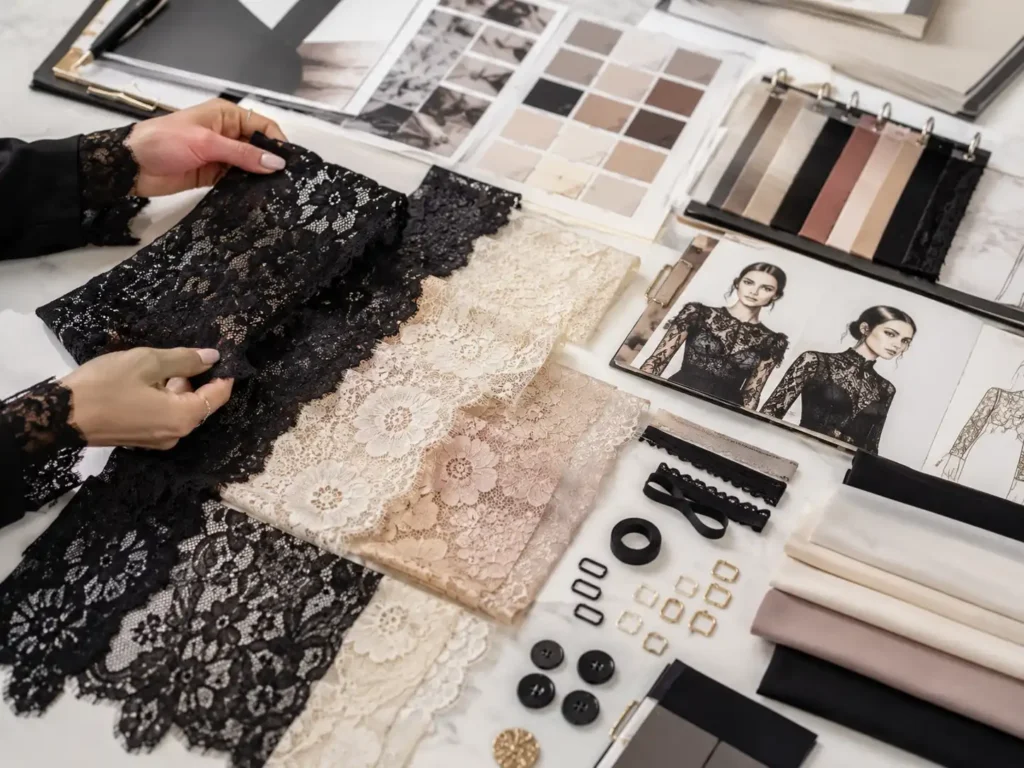
Fabric composition, weight, stretch, recovery, drape, transparency and surface sensitivity are checked against the decoration method.
Jinfeng also reviews rhinestone trim, bead chain, sequins, lace trims, lining, zipper, boning or bra-cup requirements where relevant.
Special trims can carry their own MOQ, lead time and color limitations, so material feasibility and commercial feasibility are reviewed together.
Alternative materials may be proposed when the first option creates unnecessary cost, unstable bulk supply or poor wear performance. The goal is not to simplify every design; the goal is to preserve the intended visual effect with a construction and material route that can be repeated reliably.

Production-Risk Review
Before sampling, Jinfeng identifies risks related to seam thickness, needle damage, skin scratch, decoration loss, fabric distortion, pressing marks, lining exposure, zipper interference and packing pressure.
High-risk points are converted into sample checkpoints rather than left for final inspection.
Complex sequin, lace, mesh and structured samples are generally handled on a 15-25 day project basis after material direction and workmanship are confirmed.
Special trims, custom colors, custom fabrics or additional handwork can change the timeline, so timing is confirmed against the actual development plan rather than promised as a fixed number.
Base Fabric, Lining and Structural Support
Surface decoration can change weight, stiffness, stretch and body coverage. Fabric and lining decisions therefore need to be developed with the decorative plan, especially on fitted, transparent or structured dresses.

Base Fabric Stability
Mesh, power mesh, satin, stretch satin, lace, jersey, tulle, organza, velvet and sequin fabric behave differently under decoration. Stretch fabrics need enough recovery after stones, beads or dense stitching are added. Delicate woven surfaces need protection from puncture, snagging and pressing marks. Sheer fabrics may need backing or lining in selected areas to maintain coverage and attachment stability.
A base fabric that looks correct in an unembellished swatch can change once decoration is added. Added weight can pull a neckline forward, distort a side seam or reduce drape. Sample development checks the decorated fabric in the actual garment structure rather than judging material in isolation.
Lining and Skin-Contact Control
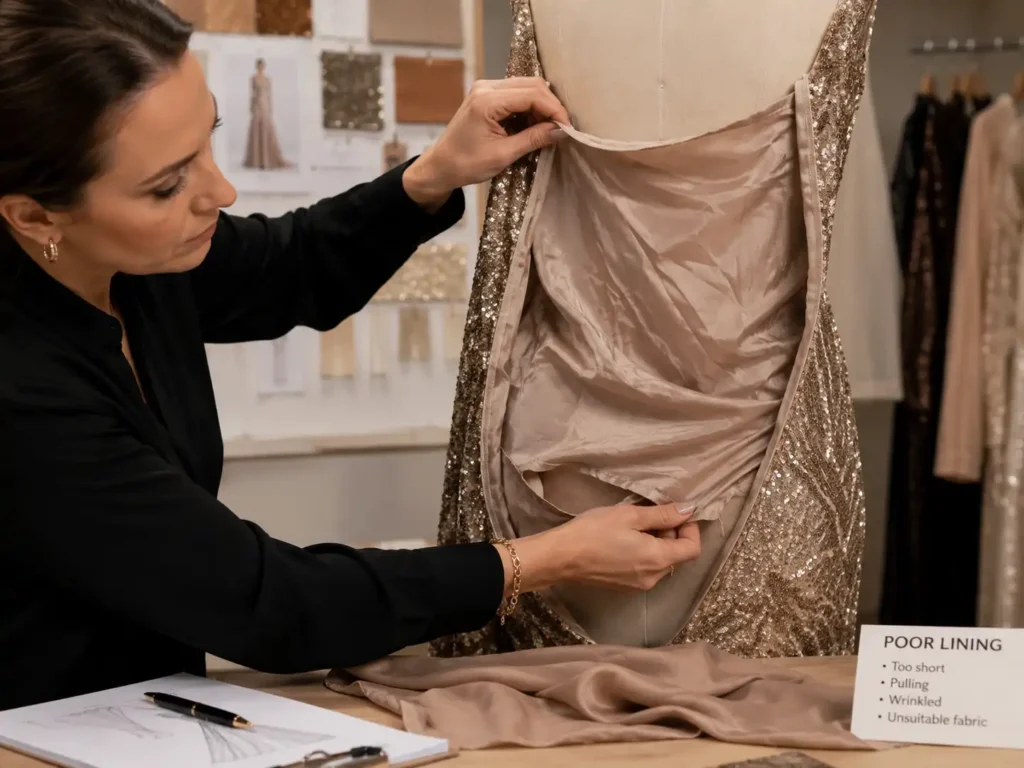
Lining affects opacity, comfort, structure and the way decoration feels against the body. Soft lining may be needed under sequins or beadwork to reduce scratching. Stretch lining can support fitted mesh while preserving movement. Lining color also influences the visual depth of lace and transparent fabrics, so color approval should be handled with the shell fabric and decoration rather than at the end of development.
Coverage length matters as much as material choice. A short lining under a heavily decorated skirt can create a visible transition. A tight lining can change the fit of an otherwise correct outer layer. Attachment points are reviewed so lining does not pull against decorated panels or interfere with zippers and slits.

Internal Support Where Needed
Some mixed-decoration dresses need structural support beyond normal lining. Bra cups, boning, anti-slip tape, elastic or interlining can help maintain bust shape, neckline stability or waist definition when surface work adds weight. Internal support is selected according to silhouette and wearing purpose, not added automatically.
Support must also stay compatible with decoration placement. Rhinestones or dense embroidery over a rigid internal seam can create uncomfortable pressure. Heavy decorative work near the bust or shoulder may require stronger balance through straps, seam support or inner construction. Sample fitting is used to verify the combined effect before PP approval.
Decoration Placement Is a Pattern Decision
Placement artwork must work on a three-dimensional garment, across different sizes, seams and movement zones. Jinfeng develops decoration placement together with pattern and fit rather than treating it as a separate finishing step.
Protect Seams, Zippers and Stress Zones
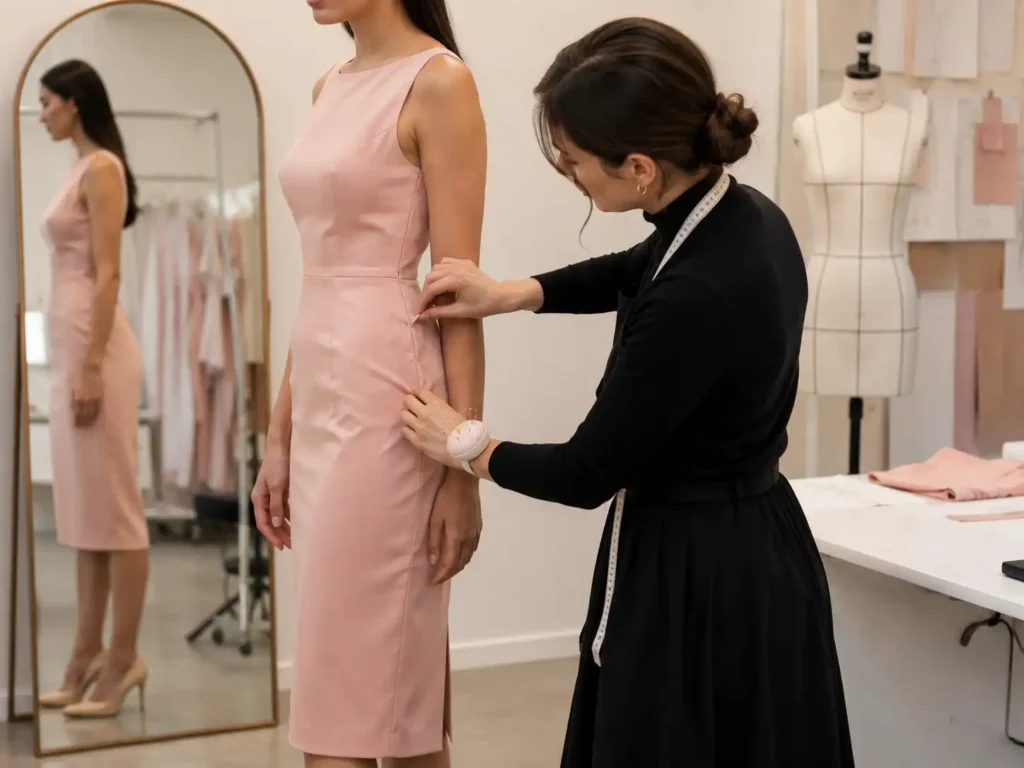
Decoration should not block seam allowances, zipper teeth, hook positions, edge finishing or areas that need repeated stretching. Dense stones or beadwork placed directly across side seams can create bulk and discomfort. Sequins near invisible zippers can prevent smooth closure. Heavy trim close to straps can change shoulder balance.
Jinfeng reviews neckline, bust, waist, hip, side seam, zipper, cut-out, slit and hem zones before final placement is approved. Clearance rules are based on the selected attachment method and construction. Local reinforcement can be added when the visual concept requires decoration close to a stress area.

Balance Visual Density Across the Body
Decoration density changes how the silhouette reads. Heavy sparkle around the bust can visually increase volume; dense decoration at the hip can alter proportion; a concentrated waist motif can sharpen shape but may also reduce stretch. Product development therefore considers both visual effect and fit behavior.
Asymmetrical designs need clear reference points so placement remains intentional after grading. Symmetrical designs need reliable center lines and left-right checks. Jinfeng uses pattern and sample references to keep decoration aligned with garment shape rather than only with flat artwork dimensions.

Build Placement for Size Grading
A placement that fits a sample size may not sit correctly on larger or smaller sizes. Artwork can require controlled repositioning around bust points, waistlines, necklines or hem levels as the pattern changes. Simple proportional scaling is not always enough, especially with border motifs, cut-outs or decoration designed around fixed seam positions.
The approved sample establishes visual intent, while grading rules define where critical motifs should remain relative to body and construction landmarks. Size charts, final patterns, placement notes and QC reference points are aligned before bulk release so decoration does not drift across the size range.
Workmanship Sequence Must Protect Every Decoration Layer
Mixed decoration can fail when the right techniques are completed in the wrong order. Jinfeng plans workmanship around access, heat, needle work, stretching, pressing and final surface protection.

Pre-Assembly Decorative Work
Embroidery, placement print or selected sequin operations may need to be completed on panels before full garment assembly when flat access improves accuracy. Early work allows cleaner artwork registration, but panel decoration must leave enough room for seam allowances, darts, zippers and later shaping. Cutting direction and pattern version must already be controlled before decorative panels are processed.
Pre-assembly work is especially sensitive when pattern revisions are still likely. A major fit change can move seams and invalidate artwork placement. For complex styles, decoration-heavy panels should not be fully committed until the pattern direction is stable enough to protect material and handwork investment.

Mid-Assembly Placement and Reinforcement
Some decorations are easier to attach after major seams establish garment shape but before lining or final closure hides access. Local reinforcement, trim anchoring or decorative straps may be handled at this stage. The sequence must preserve access for secure stitching while avoiding visible construction marks on the finished surface.
If rhinestone chains, bead details or lace trims cross multiple panels, alignment checkpoints are built into the sewing route. Production instructions define where work begins, where it ends and how continuity should look after seams are joined.

Final Decoration, Pressing and Protection
Late-stage decoration can protect delicate components from sewing abrasion, but finishing becomes more difficult if stones, beads or sequins cannot tolerate pressure or heat. Pressing standards therefore need to be defined around decorated areas. Protective layers, low-pressure handling or restricted ironing zones may be required depending on material.
Final inspection checks attachment, missing components, sharp edges, surface damage and placement before packing. Packing method is then selected to prevent decoration from pressing into neighboring panels or scratching the fabric during transport.
Pattern and Fit Control Under Decorative Weight
A decorated dress still has to fit correctly, move comfortably and maintain the intended proportion. Pattern development considers the effect of added weight, reduced stretch and local stiffness before bulk grading is approved.

Bust, Waist and Hip Balance
Body-conscious dresses are particularly sensitive to decoration. Heavy or rigid work across stretch zones can pull the garment away from the body, flatten shaping or create drag lines. Jinfeng reviews bust, waist and hip measurements together with decorated sample behavior, not only the base pattern.
Fit comments can lead to pattern correction, decoration repositioning or a change in fabric/lining combination. Revised measurements are recorded before another sample or PP stage is made. The objective is to correct the source of the problem rather than compensate with surface decoration or pressing.

Neckline, Strap and Armhole Stability
Decorative weight near the neckline or shoulder can change strap tension and neckline position. Strap length, armhole shape, bust coverage and anti-slip support may need adjustment when sequins, rhinestones or beadwork are concentrated in the upper body.
Fit review uses front, side and back views to check whether the dress sits securely while standing and moving. Decorative areas close to skin are checked for scratch risk and pressure. Any pattern correction that changes placement is transferred into updated artwork notes before the next sample is approved.

Hem, Slit and Movement Control
Heavy decoration near the hem can change drape and walking movement. Long dresses may pull unevenly if decoration density is not balanced. Slit openings can become stiff or abrasive when trim sits too close to the edge. Jinfeng reviews hem balance, slit height, lining length and decorated edge handling as one fit-and-construction decision.
For stretch styles, movement checks also look for decoration pulling away from the base fabric or restricting recovery. Production approval requires the garment to maintain appearance not only on a hanger, but through normal wearing movement.
Mixed-Decoration Sampling From Review to PP Approval
Project Review
Material Direction
First Sample
Fit and Decoration Review
Revised Sample
PP Sample
Development Capacity for Complex Dress Programs
2 Sample Rooms
7+ Senior Pattern Makers
20+ Sample Machinists
Cost Drivers and Design-for-Manufacturing Options
Mixed-decoration cost is shaped by much more than the visible trim. Fabric, density, handwork, pattern complexity, sewing access, lining, wastage, QC and packing all influence the final production model. Jinfeng reviews cost without weakening the intended brand-level appearance.
| Cost Driver | Why It Changes Cost | Development Option |
|---|---|---|
| Decoration density | More materials, handwork and inspection time | Concentrate detail in high-visibility zones |
| Hand beading | High manual labor and slower throughput | Use focused beading instead of full-surface work |
| Rhinestone coverage | Material cost, attachment time, reinforcement | Use focal placement or trim structures |
| Sequin surface area | Cutting loss, seam clearing, needle risk, QC | Combine sequin panels with cleaner base-fabric areas |
| Lace placement | Motif matching, cutting loss, edge finishing | Use controlled motif zones or lace trim |
| Complex lining | More pattern pieces, sewing and fitting work | Select support only where coverage or comfort requires it |
| Multiple decoration processes | Extra handling and sequence control | Remove redundant effects while preserving focal details |
| Special trims / colors | Supplier MOQ and lead-time exposure | Select stable alternatives early in sampling |
| Revision rounds | Repeated pattern, material and handwork cost | Lock critical decisions before full decorative commitment |
| Protective packing | Extra material and handling | Define fold and protection method during PP stage |
From Approved Sample to Repeatable Bulk Production
Sample approval must be converted into production documents, material references and QC checkpoints. Jinfeng uses a controlled handover so bulk teams work from approved standards rather than interpretation.

Final Pattern and Measurement Lock
Approved fit comments are transferred into the final pattern and size chart before production. Bust, waist, hip, dress length, strap length, neckline, armhole, slit and other relevant measurements become bulk reference points. Decoration placement notes are updated if pattern changes shift visual landmarks.
Size grading is reviewed against both fit and decoration position. A motif designed around a waistline or neckline cannot simply drift as sizes change. Critical placement references are tied to pattern landmarks and QC points so the finished appearance stays intentional across the size range.

BOM, Trim and Decoration Handover
Bulk handover includes shell fabric, lining, zipper, support components, decoration trims, labels and packaging requirements. Approved fabric and trim references help prevent substitution errors. Decoration details record material type, color, placement, attachment method and protection requirements where needed.
For multi-style programs, structured records reduce confusion between similar trims or colorways. The same discipline supports later repeat orders because pattern, BOM, color, trim and packing references can be retrieved instead of rebuilt from memory.

Sewing Instructions and QC Checkpoints
Production instructions translate the PP sample into repeatable sewing and finishing actions. Seam allowance, stitch density, zipper position, lining method, decoration clearance, pressing restrictions and key inspection points are communicated before bulk sewing starts.
Inline checks are used to catch repeated errors before they spread across large quantities. Missing decoration, placement drift, zipper interference, seam thickness, lining problems or scratch risk should be corrected during production, not discovered after the full order is complete.
Production Allocation for Complex Decorated Dresses
Complex Fabric Units
Occasionwear Units
Flexible Program Allocation
Decoration-Specific Quality Control From Material to Packing
Quality control for mixed-decoration dresses must follow the risk created by each material and process. Jinfeng checks decoration together with fit, sewing, lining, closures and packing so a visually strong garment remains wearable and repeatable in bulk.

Incoming Material and Trim Control
Incoming checks review fabric color, hand feel, weight, surface defects and the condition of lace, mesh, sequins and decorative trims. Sequin materials are checked for missing or loose surface elements; mesh is checked for snags and holes; satin and other sensitive surfaces are checked for color difference and damage. Trim specification, color and appearance are compared with approved references before production begins.
Decoration components also need enough supply consistency for the planned order. Material changes during production can create visible differences in shine, size, color or attachment behavior. Approved substitutions are therefore reviewed before use rather than introduced silently on the line.

Cutting and Sewing Checks
Cutting QC confirms pattern version, fabric direction, stretch direction, panel quantity and size bundling. For placement-driven designs, cut panels must stay aligned with artwork and motif references. Sewing QC checks seam quality, seam allowance, symmetry, zipper flatness, strap position, lining attachment and decoration clearance around construction zones.
Decorated styles receive additional attention around seam thickness, needle damage and skin-contact edges. Dense sequin or stone areas should not block closures or create bulky seams. Lace and mesh need clean handling so attachment work does not create holes or distortion.
Decoration Security and Appearance
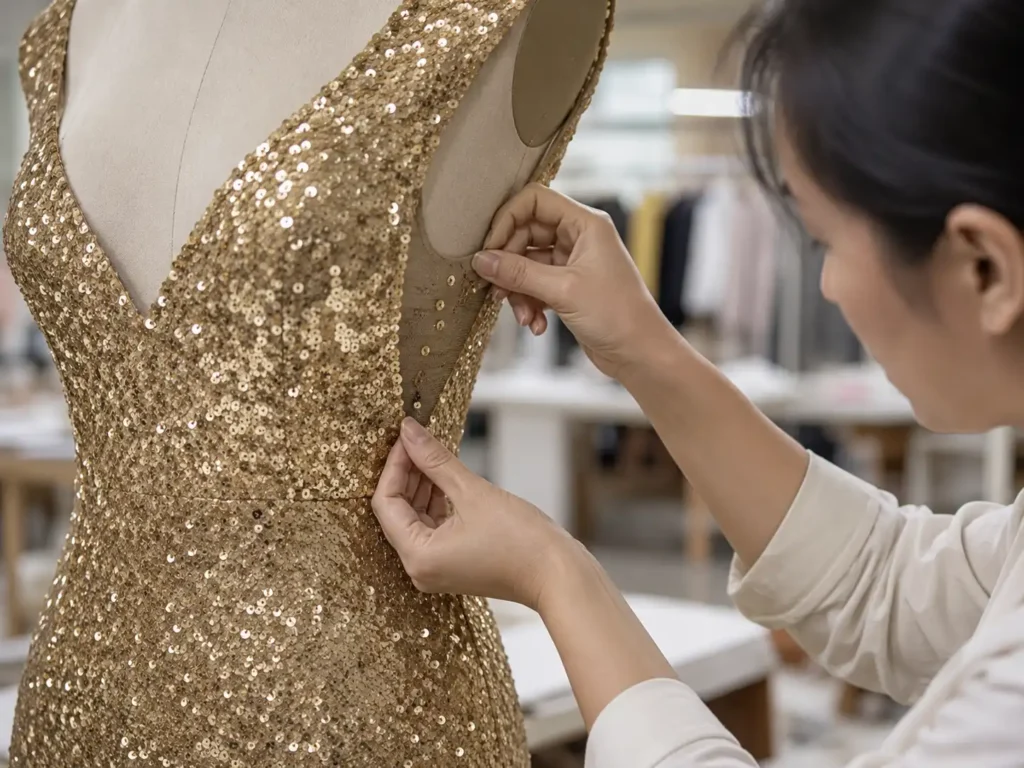
Inline and garment inspection checks missing sequins, loose stones, loose beads, placement drift, left-right imbalance, visible glue or stitch damage where relevant, and surface inconsistency. Focal decoration is compared against approved placement references rather than judged only by general appearance.
Wear-related checks include scratch risk around armholes, neckline, side seams and slits. Stretch styles are reviewed for recovery after decoration. Heavy areas are checked for pulling or sagging. The objective is a stable garment, not only a clean flat-lay presentation.

Final Garment and Packing QC
Finished garments are reviewed for measurements, fit effect, pressing, color difference, stains, holes, zipper function, label position and overall appearance. Packing QC verifies hangtags, barcodes, size stickers, polybags, folding method, carton marks and packing ratio.
Decorated surfaces need protective folding and pressure control. Sequins, rhinestones and raised trims should not be crushed, rubbed or pressed into neighboring panels during transit. Packing standards are confirmed before bulk packing begins so protection is part of production control, not an afterthought.
Packing Protection for Raised and Reflective Decoration
Anti-Scratch Layering
Controlled Folding
Pressure Management
Label and SKU Accuracy
Mixed-Decoration Development Checklist Before Sampling
Style Reference
Tech Pack
Base Fabric Direction
Decoration Plan
Size Range
Quantity Plan
Commercial Target
Private Label Details
Mixed-Decoration Dress Development Frequently Asked Questions
It is the coordinated development of a dress using two or more decorative techniques while controlling fabric, pattern, placement, lining, workmanship sequence, sampling, fit, QC and bulk repeatability. The goal is a production-ready garment, not a one-off decorated sample.
Project review can cover combinations involving sequins, hand beading, rhinestone application, embroidery, lace placement, decorative trims and placement print where the selected fabric, construction and material availability support the design.
Yes, when fabric strength, decoration weight, placement, attachment security, seam clearance and skin contact are suitable. Dense combinations may need lining, reinforcement or reduced coverage in high-stress areas.
Fabric is evaluated by composition, weight, stretch, recovery, drape, transparency, surface sensitivity, lining requirement, decoration method, MOQ, cost and bulk risk. The final choice should support both the visual concept and repeated production.
Placement is tied to pattern landmarks such as neckline, bust, waist, seams, zippers and hem. Size grading may require controlled repositioning rather than simple proportional scaling. Final pattern, placement notes and QC references are aligned before bulk production.
Complex sequin, lace, mesh and structured dress samples are generally handled on a 15-25 day project basis after material and workmanship direction are confirmed. Special trims, custom colors, additional handwork or major revisions can extend the schedule.
Yes. Special trims, custom fabrics, handwork, decoration density, multiple processes, inspection time and packing can affect MOQ or unit price. Jinfeng’s standard MOQ starts from 200 pcs per style/color, while special materials may carry supplier-based requirements.
PP approval locks fabric, color, trims, measurements, construction, decoration placement, labels, packing and key QC points. Final pattern, size chart, BOM, material references, sewing instructions and inspection checkpoints are transferred to production.
QC covers incoming materials, cutting, sewing, inline production, finished garments and packing. Decoration-specific checks include missing or loose components, placement, symmetry, attachment security, skin scratch risk, seam interference, surface damage and packing protection.
Send a reference image or tech pack, base-fabric direction, decoration artwork or trim reference, size range, quantity per style/color, color plan, target delivery window and private-label requirements. Jinfeng can then assess sample route, material risk and production feasibility.

Send Your Mixed-Decoration Dress Project for Review
A useful project review starts with enough information to evaluate the garment as a complete product, not as separate fabric and decoration requests. Send your reference image, tech pack, original sample photos or line sheet together with the planned decoration direction. Include expected quantity per style/color, size range, fabric preference, color plan, private-label requirements and target delivery window where available.
Jinfeng will review the style around silhouette, base fabric, lining, decoration weight, placement, seam and zipper interaction, workmanship sequence, sample complexity, MOQ fit, cost drivers, bulk-production risk and decoration-specific QC. Complex styles can then move into material confirmation, pattern development, first sample, revision and PP approval with clearer technical priorities.
For multi-style programs, include a style list so development priority can be arranged around launch needs and complexity. Organized input makes it easier to compare materials, control revision versions and prepare production standards before bulk release.
- Reference image, sketch or tech pack
- Decoration artwork or trim reference
- Fabric and lining preference
- Quantity per style/color
- Size range and fit notes
- Color plan
- Label and packing requirements
- Target delivery window


