 Skip to content
Tulle Dress Quality Control Checklist: What Should You Inspect Before Bulk Production?

Your trusted Women’s Apparel Manufacturer from China

Tulle dresses can look simple on a hanger, yet they are among the easiest fashion garments to get visibly wrong in bulk. A tiny hole can become obvious once light passes through several layers. A lining that is slightly too short can turn a graceful skirt into an awkward one. A few millimeters of imbalance at the waist may become a noticeably crooked hem after the skirt hangs under its own weight. These problems are rarely caused by one dramatic mistake; they usually come from several small controls being missed at different stages.
A reliable tulle dress quality control checklist should cover approved fabric and color, mesh damage, layer count, cutting direction, gathering, lining, seams, closures, measurements, fit, hem balance, embellishments, labels, packing, and final inspection. QC should begin before cutting and continue through sewing, finishing, packing, and pre-shipment inspection so defects are corrected before they multiply across the order.
Imagine two dresses from the same purchase order hanging side by side. They carry the same style number, size, and color, yet one skirt looks fuller, the second lining ends higher, and one side of the hem drops lower when the garment is worn. Both may technically be “finished,” but they are not the same product. The real purpose of tulle dress QC is to make the approved sample repeatable, not merely to make finished garments look acceptable one by one.
What Should a Tulle Dress QC Checklist Cover?
A tulle dress QC checklist should follow the garment from pre-production approval to shipment. It should verify the approved sample, tulle, lining, trims, size chart, layer construction, cutting, sewing, fit, finishing, labels, packing, and final inspection. The most useful checklist states what must be checked, when it must be checked, what reference is used, and what happens when a result falls outside the approved standard.
Pre-Production Approval
The strongest quality control starts before the first bulk panel is cut. Once the wrong tulle, lining shade, layer arrangement, or sewing method enters the production line, inspection becomes a repair exercise rather than a prevention system. The production team should therefore work from a complete approval package that combines the physical approved sample with the latest tech pack, pattern, BOM, size chart, color approval, sewing instructions, trim details, and packing requirements.
Tulle requires several approvals that deserve more attention than they would on a simple opaque woven dress. Layer count should be written clearly rather than left to visual interpretation. If three outer layers have different lengths, each length should be defined. If fullness comes from a particular gathering ratio, tier width, or combination of soft and firmer tulle, that structure needs a production reference. Comments such as “make the skirt slightly fuller” or “keep it airy” are useful during design discussion, but they are too subjective for repeatable bulk production.
Color also needs to be approved as a complete system. A pale tulle placed over a warm beige lining can look very different from the same tulle over a cool pink lining. For ivory, champagne, blush, nude, powder blue, and other subtle shades, the final layered appearance matters more than the color of one isolated swatch. A well-controlled approval stage records the exact fabric and lining combination that created the accepted sample.
QC by Production Stage
Tulle quality is easier to control when defects are caught at the earliest stage where they can be identified. A damaged roll should be stopped before cutting, an incorrect layer count should be corrected before the waistband is closed, and a drifting waist measurement should be found while garments are still moving through sewing. Final inspection is important, but it should confirm that earlier controls worked rather than reveal the first sign of a repeated production problem.
Production stage | Main inspection points | Release decision |
Incoming material | Color, mesh condition, hand feel, weight reference, lining, trims | Material is accepted, segregated, or rejected before cutting |
Cutting | Pattern version, direction, size bundle, panel quantity, layer identification | Correct panels move to sewing |
Sewing | Seam quality, gathering, layer attachment, zipper, lining | Defects are corrected before repetition |
In-line QC | Measurements, symmetry, volume, workmanship | Process is adjusted while production is active |
Finished garment | Fit, hem balance, color, closures, appearance | Garment is passed, repaired, or held |
Packing QC | Labels, barcode, size sticker, folding, carton ratio | Packed units match order requirements |
Final inspection | Sampling, measurements, defects, cartons, shipment records | Shipment is released, reworked, or reinspected |
This stage-by-stage approach matters because tulle is difficult to repair once several layers have been assembled. Replacing an inner layer may require opening the waist seam, removing adjoining layers, rebuilding gathering, and checking hem balance again. Catching the same damaged panel during incoming or cutting inspection costs far less time and produces a cleaner result. The same logic applies to wrong lining, mixed shade lots, missing layers, and incorrect size bundles.
Approved Sample and Production Standard
The approved sample should remain the main visual benchmark for silhouette, volume, transparency, lining relationship, gathering density, trim placement, and overall balance. It is especially useful with tulle because many important qualities are visual rather than purely dimensional. Two skirts can have the same waist measurement and nominal layer count yet look different if the gathering is distributed unevenly or the tulle stiffness changes between sample and bulk.
At the same time, the sample should never replace written specifications. A production team cannot reliably reproduce hundreds or thousands of garments from appearance alone. The latest size chart, measurement tolerance, BOM, pattern, sewing instructions, color approval, layer details, and packing specification should sit beside the physical sample. When a sample revision changes lining length, tulle quality, neckline position, or skirt volume, the written documents need to change as well so the approved correction reaches cutting, sewing, QC, and packing.
A useful comparison during pilot or early bulk production is to hang several garments next to the approved sample rather than checking them one at a time. Differences in fullness, transparency, color depth, and hem balance become much easier to see. This simple comparison often reveals drift before measurements alone do, particularly on prom, formal, homecoming, and occasion styles where the skirt is a major part of the visual value.
Which Tulle Fabric Defects Should You Check?
Tulle fabric should be checked for holes, broken mesh, pulled yarns, snags, distorted openings, shade variation, transparency, hand feel, stiffness, width, and consistency between rolls. Inspectors should also judge the fabric after layering, because several transparent layers can amplify small color or opacity differences that are difficult to notice when one layer is examined by itself.
Holes, Snags, and Mesh Damage
Tulle has an open mesh structure, so damage behaves differently from a flaw in a compact woven fabric. One broken intersection can spread under tension, and a pulled yarn can distort neighboring openings without producing an obvious hole at first glance. Inspection should therefore look beyond large tears and include stretched mesh, snag lines, irregular openings, damaged selvedges, crushed areas, and local distortion caused by handling or transportation.
The easiest way to inspect light tulle is against a contrasting darker background under even lighting, while dark tulle is easier to examine against a light surface. The fabric should lie naturally rather than being stretched tight, because tension can temporarily make distorted mesh look more regular. Long rolls should be checked at more than one point, including near roll transitions, and clearly marked defects should be kept outside visible cutting areas whenever the approved material standard allows that type of utilization.
Defect position affects severity. A small irregularity hidden inside a seam allowance may have little visual effect, while the same flaw in the center-front outer layer of a pale prom dress can be immediately noticeable. Neckline overlays, sleeves, upper skirt layers, and front panels generally deserve stricter visual judgment because the wearer and camera see them first. Embroidered, beaded, or appliquéd tulle should also be reinspected after decoration because needles, heat, adhesives, and trim edges can create damage after the original fabric inspection has already passed.
Weight, Transparency, and Hand Feel
Tulle used in fashion dresses varies widely in weight and structure. Within Jinfeng Apparel’s working fabric reference, common tulle qualities are approximately 15-80 gsm, covering very light soft tulle through firmer qualities used for more visible volume. Weight alone does not define quality, but a change in weight, yarn character, or stiffness can alter skirt fullness, hand feel, transparency, sewing behavior, and the amount of fabric needed to reproduce the approved silhouette.
Tulle property | Practical production reference | What can change if it drifts |
Fabric weight | Common working range about 15-80 gsm, depending on style | Volume, drape, handling, cost, transparency |
Transparency | Compare single layer and approved multi-layer build | Coverage and finished color depth |
Hand feel | Match approved softness or firmness | Comfort at waist, armhole, neckline, and skin-contact areas |
Mesh structure | Openings should remain visually consistent | Surface appearance and snag resistance |
Stiffness | Compare hanging silhouette with approved sample | Skirt may collapse or become overly rigid |
Layered shade | Evaluate with actual layer count and lining | Pale colors may become darker, warmer, or cooler |
Lining interaction | Review on dress form or fit model | Coverage, color, and movement may change |
Transparency should never be judged only from a fabric card. One layer can appear almost invisible, while three or four layers create substantial visual coverage, especially where fabric is gathered around the waist. The same principle applies to color. A soft blush can become deeper after layering, and a slightly different lining tone can change the entire garment. For this reason, fabric approval is safest when the actual tulle, layer count, lining, and construction are evaluated together during sampling.
Hand feel also changes once fabric is concentrated. A tulle that feels comfortable when held flat may become scratchy where several gathered layers meet at the waist or where raw edges touch the underarm. Inspectors should therefore distinguish decorative areas from skin-contact areas. A firmer tulle may be excellent for supporting an A-line or fit-and-flare silhouette but uncomfortable at the neckline unless the construction includes a softer binding, lining, or protective finishing method.
Color and Layered Shade
Tulle color control is more complicated than comparing one roll with one color swatch because transparency makes the final shade a combination of several materials. The eye sees the tulle, the layers underneath it, the lining, and the density of gathering at the same time. A small roll-to-roll variation that seems acceptable on a single layer can become much more obvious once three or four layers are stacked on a finished skirt.
Color inspection should compare each production roll with the approved standard, then compare rolls with one another and finally check the layered construction over the approved lining. Finished garments from the same colorway should also be viewed side by side. This is particularly important for white, ivory, champagne, nude, blush, dusty pink, pale blue, and other shades where slight warm or cool shifts are easy to see in photography and event lighting.
Batch traceability helps prevent one garment from containing visibly different tulle lots. If multiple rolls are required for a large order, the cutting room should keep shade information attached to bundles rather than allowing visually different rolls to be mixed casually. Thread, zipper tape, elastic, binding, appliqué, and lining should also be reviewed against the finished layered garment, not just the bare tulle. A trim can match the lining perfectly and still appear too dark or too warm when viewed through several transparent layers.
How Should Cutting and Layering Be Controlled?
Tulle cutting and layering should be controlled through stable fabric handling, correct pattern versions, accurate size bundling, defined layer quantities, consistent gathering, and clear length references. Lightweight tulle moves easily, so small cutting or bundling errors can become visible differences in volume, symmetry, and hem balance after several layers are assembled into the same garment.
Cutting Stability
Tulle should not be handled like stable suiting or denim. Lightweight mesh can shift across the cutting table, and excessive spreading tension can change panel dimensions before cutting even starts. If the fabric is pulled tight during spreading and then relaxes afterward, a panel that appeared correct on the table may shorten, twist, or lose symmetry. The risk becomes more noticeable on long skirt pieces because small distortion near the waist can create larger differences at the hem.
Before bulk cutting, the team should confirm the current pattern version, size, panel quantity, fabric direction, stretch direction when relevant, layer identification, and all placement marks. Multi-size orders need disciplined bundling because transparent panels can be difficult to distinguish once tickets are removed or mixed. Soft tulle should be supported when moved rather than dragged across the table, and sharp edges, rough surfaces, or crowded handling areas should be avoided because they can create snags before sewing begins.
Early cut-panel inspection is particularly valuable. Checking the first bundles before the full lay is processed can reveal a wrong pattern revision, missing notch, reversed asymmetric panel, incorrect tier length, or stretch-direction mistake while the amount of affected fabric is still limited. Cutting accuracy creates the correct starting point, but the team should remember that final hem balance may still change after gathering, attachment, hanging, and steaming, so cutting inspection and finished-garment inspection solve different problems.

Layer Count and Volume
Layer count needs to be treated as a specification, not an artistic impression. “Three layers of soft tulle plus lining” is repeatable; “make the skirt full” is not. Fullness can come from additional layers, wider panels, denser gathering, a firmer tulle, a structural underskirt, or a combination of these methods. Each choice changes material consumption, sewing time, waist bulk, movement, transparency, and the final silhouette.
Inspectors should confirm how many layers are used, where each layer begins, the length of each layer, how gathering is distributed, and whether front, back, left, and right remain visually balanced. A common production error occurs when the correct number of layers is present but the fullness is unevenly distributed. Extra gathering may accumulate at one side seam or near the center back, causing the skirt to look twisted even though the material quantity is technically correct.
Size-to-size volume also deserves attention. As the waistband circumference increases, the same skirt width produces a lower gathering density. If skirt panels are graded without considering visual fullness, larger sizes may look flatter than the approved base size. The reverse can happen if width is increased too aggressively, creating unnecessary weight and bulk. Comparing several sizes side by side on forms or fit models is often more informative than relying only on flat measurements.
Hem and Layer Balance
Layered tulle gives the eye several horizontal lines to compare, making uneven hems especially noticeable. The garment should be allowed to hang naturally before hem assessment because pulling individual layers straight by hand can hide the real balance. Inspectors should compare front and back, left and right, outer and inner layers, and the relationship between tulle and lining rather than checking only the lowest visible edge.
When a hem looks uneven, the root cause should be identified before trimming. The problem may come from inaccurate cutting, uneven gathering, a tilted waist seam, lining tension, incorrect layer attachment, or different relaxation behavior between panels. Simply cutting off the lowest point can make one garment look level temporarily while leaving the production method unchanged, which means the same defect will continue to appear in later pieces.
Floor-length gowns magnify small alignment errors because of their long vertical distance. The bodice and waist should sit correctly before the skirt length is judged, and any train or intentional back drop should be compared with the approved sample. Mini and knee-length styles create a different challenge: because the overall garment is shorter, a relatively small difference between layers can become proportionally more obvious. Short lining must also remain consistent enough to provide the intended coverage when the wearer sits and moves.
How Do You Inspect Tulle Dress Sewing and Construction?
Tulle dress sewing should be inspected for secure seams, even stitch formation, clean layer attachment, stable gathering, smooth lining, functional closures, and controlled embellishment. The construction must hold several lightweight layers without puckering, twisting, tearing, or creating bulky visible joins. Because tulle is sheer, internal workmanship can affect the outside appearance more directly than it does on many opaque fabrics.
Seam Quality
A seam can be technically closed and still look poor on tulle. Uneven seam allowances, heavy thread tension, trapped layers, bulky joins, or twisted stitching can remain visible through the garment and change the way the skirt hangs. Sewing QC should therefore consider both strength and appearance. Open seams, skipped stitches, broken stitches, loose threads, puckering, inconsistent seam width, incorrect layer attachment, and excessive thickness at gathered joins are all reasons to stop and correct the process.
The load carried by a seam should influence how it is inspected. A floating decorative overlay may carry very little tension, while a waist seam can support several gathered layers and experience repeated pulling when the wearer sits or moves. Shoulder joins, waist seams, zipper areas, fitted bodices, and strap attachment points generally need greater stability than decorative edges. The approved construction method should define how these areas are sewn and reinforced rather than leaving operators to choose different solutions from garment to garment.
Gathered seams deserve additional attention because too much bulk can create a ridge under a smooth waistband or fitted bodice. Even when the seam is strong, a thick concentration of tulle can distort the waistline and make one side of the skirt sit differently from the other. In-line inspectors should compare gathering distribution and seam thickness early so the production team can adjust handling before hundreds of pieces reach finishing.
Lining Control
For many tulle dresses, lining is part of the design rather than an invisible supporting component. It determines coverage, comfort, color depth, movement, and the visual relationship between body and outer layers. A beautifully sewn skirt can still fail if the lining rides upward, twists, pulls against the tulle, extends below an intended sheer section, or creates a noticeably different shade from the approved sample.
The lining should be checked for correct material, shade, front and back length, side-seam alignment, neckline and armhole finish, slit position when applicable, and smooth attachment to the outer garment. It should move without dragging the tulle or restricting the wearer. Light-colored and nude-lined designs should be reviewed under strong, even light because transparency issues are easier to see before packing than during a quick inspection under normal workshop lighting.
Movement testing is especially useful. A lining can look correct while the garment is hanging but climb several centimeters during walking because of static, friction, insufficient ease, or poor attachment. Once it moves upward, the dress may become more transparent than intended and the outer tulle may collapse around the body differently. For mini dresses, seated coverage matters; for long gowns, inspectors should watch whether the lining catches the feet, twists around the legs, or creates drag that changes the outer hem.
Zippers and Embellishments
Zippers, hooks, appliqués, beads, rhinestones, embroidery, and sequins interact directly with delicate tulle, so inspection should consider both the accessory and the fabric around it. A zipper that functions perfectly is still a quality problem if loose mesh repeatedly enters the slider. Each zipper should open and close smoothly while inspectors watch for trapped tulle, rippling along the seam, misaligned top edges, and excessive tension around the opening.
Decorative work needs similar attention. Placement should match the approved design, left and right sides should remain balanced when symmetry is intended, and attachment should be secure without distorting the mesh. Heavy appliqués or dense beading can pull lightweight tulle downward, while hard sequins and rhinestone settings can snag adjacent layers during wear or packing. Skin-contact areas around the neckline, armhole, waist, and side seam should also be checked for sharp or scratchy edges.
Packing risk should already be considered at this stage. Raised decoration, metal components, and stiff embellishments can damage nearby tulle if the garment is folded tightly without protection. A good construction review therefore asks not only whether the decoration looks attractive on the inspection table, but also whether it remains secure and safe when the dress is zipped, worn, moved, folded, packed, transported, and unpacked again.
Which Fit and Measurement Checks Matter Most?
Tulle dress fit inspection should combine technical measurements with on-body evaluation. Bust, waist, hip, bodice length, straps, armholes, skirt length, lining length, and other approved points should remain within the client’s confirmed tolerance, while fit review should verify coverage, balance, movement, and silhouette. Measurements alone cannot show whether layered tulle hangs evenly or preserves the intended volume across different sizes.
Measurement Control
Measurement points should be defined in the approved size chart, and every inspector should use the same method. Soft garments can produce inconsistent readings if operators pull the fabric differently, choose different reference points, or measure layers under different tension. The measurement specification should therefore make clear where the garment is placed, which layer is being measured, and whether the measurement is taken relaxed or under a defined condition.
Common tulle dress points include bust, waist, hip for fitted styles, shoulder, armhole, neckline width or depth, strap length, bodice length, waist position, center-front length, center-back length, lining length, outer tulle length, slit height, and skirt sweep where required. Not every design needs every point, but each controlled point should have a commercial reason. A fitted waist affects comfort and appearance more directly than a free outer-skirt sweep, so the same numerical tolerance should not automatically be used everywhere.
Measurement checks should happen during production rather than only after completion. If waist or bodice measurements begin drifting in the first sewing batches, the team can review seam allowance, operator method, fabric behavior, and pattern use before the issue spreads. Stretch-tulle combinations need additional caution because a garment can meet a flat measurement while fitting differently if bulk fabric stretch, recovery, or lining tension differs from the approved sample.
On-Body Fit
Fit testing reveals problems that a tape measure cannot. The dress should be viewed from the front, side, and back, then checked during simple movements such as walking, turning, sitting, and raising the arms. The goal is not to create a runway fitting session; it is to see whether the garment behaves the way the approved style was intended to behave under normal wear.
Short tulle dresses need close attention to bust coverage, armhole coverage, waist position, strap stability, mini length, lining position, and skirt lift during movement. A style can pass standing measurements yet become too revealing when the wearer sits. Long formal dresses shift the focus toward bodice support, waist balance, front and back length, walking clearance, train position, lining movement, and slit height. A skirt that appears level on a hanger can swing to one side if gathering or layer attachment is uneven.
The waistline deserves particular attention because it controls the visual relationship between bodice and skirt. A slightly tilted waist can make one side of the skirt appear longer and can change the wearer’s proportions even when the outer panels were cut correctly. This is one reason experienced fit reviews look at the garment as a complete silhouette rather than treating measurements, construction, and tulle volume as separate topics.

Size-to-Size Consistency
Grading a tulle dress is not simply a matter of increasing bust, waist, and hip measurements by a fixed amount. The important question is whether every size still looks like the same style. Waist circumference, bodice proportions, skirt width, gathering density, layer spacing, lining coverage, and vertical placement all interact, so a mathematically correct grade can still create a visibly different silhouette.
Several sizes should be compared side by side whenever the order covers a broad range. Inspectors should look at waist position, bodice-to-skirt proportion, relative fullness, gathering density, tier height, strap position, lining coverage, outer-layer length, and overall balance. This is especially important for prom, homecoming, bridesmaid, graduation, and occasion collections where the same style may be photographed, merchandised, and reviewed across many sizes.
A larger waist naturally spreads the same amount of skirt fabric over a greater circumference, which can make larger sizes look flatter if skirt width is not adjusted thoughtfully. The opposite problem occurs when panel width is increased too aggressively, creating unnecessary bulk and weight. Vertical grading also matters: a lining length that provides safe coverage in the base size may not create the same proportional coverage in a larger size. The goal is not geometric sameness; it is visual and functional consistency when the garment is worn.
How Is Final Tulle Dress Inspection Done Before Shipment?
Final tulle dress inspection should verify finished appearance, measurements, workmanship, tulle condition, layer count, color, lining, closures, labels, packing, and carton information against approved standards. Defects should be classified consistently, documented clearly, and corrected before shipment. A client-approved AQL or other sampling plan can support final inspection, but it should confirm process control rather than replace it.
Finished Garment Inspection
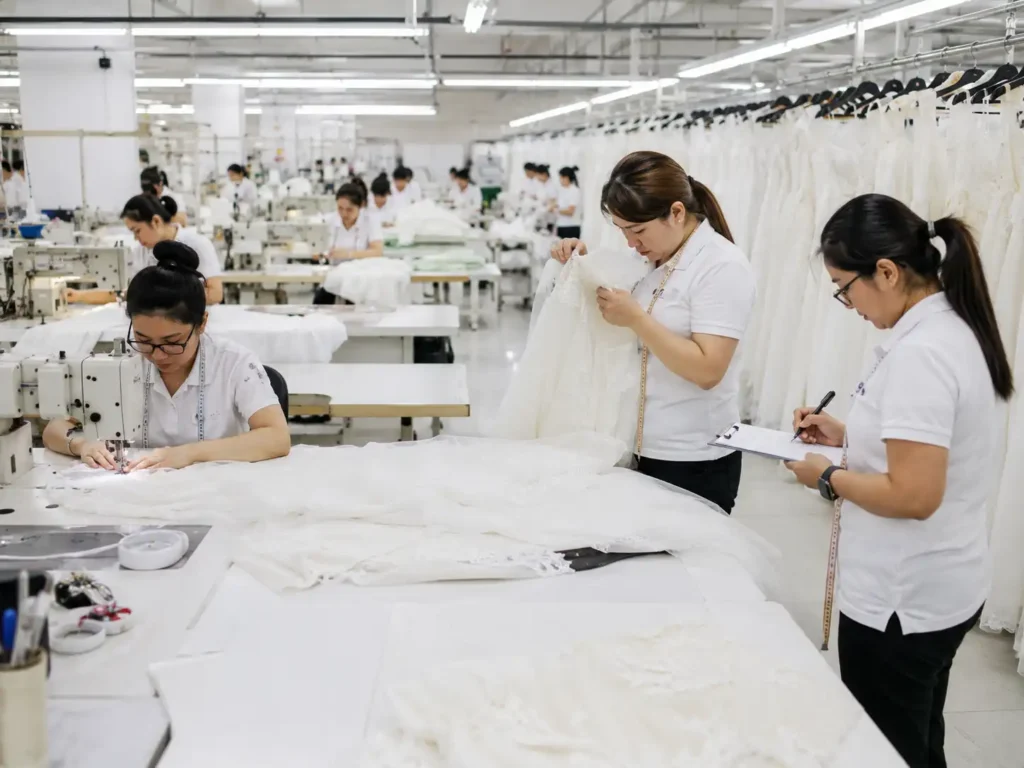
Final inspection should begin with the whole garment rather than immediately searching for tiny defects. Hang the dress naturally, compare the silhouette with the approved sample, and look at volume, color, waist balance, front-back relationship, lining, and hem. Once the overall appearance is acceptable, move closer to examine holes, snags, stains, loose threads, seam quality, layer quantity, gathering, closures, trims, decorations, labels, and measurements.
Tulle layers should be gently separated during inspection because damage, foreign material, or a folded layer can remain hidden inside a gathered skirt. The garment should also be moved. Lift and release the skirt, rotate it, open and close the zipper, and check whether layers return naturally or catch on appliqués, sequins, hooks, or internal seams. Many tulle problems are movement problems rather than defects that remain obvious when the dress is perfectly arranged on a hanger.
Inspectors should distinguish isolated faults from repeated patterns. One removable thread end may be a local finishing issue. Several garments with the same uneven hem, wrong lining length, missing layer, or shade difference indicate a process problem that may affect a much larger portion of the order. When repeated defects appear, expanding the inspection and investigating the root cause is usually more valuable than repairing only the pieces already sampled.
Defect Classification and AQL
Final garment inspection commonly separates defects into critical, major, and minor categories, but the acceptance limits should follow the confirmed client standard rather than a single number used for every order. Product risk, lot size, sales channel, garment complexity, and brand expectations all influence the sampling plan. A heavily embellished formal dress may require different attention from a simpler tulle skirt even when both use the same basic inspection framework.
Defect category | Tulle dress examples | Typical commercial effect |
Critical | Serious safety issue or severe labeling/compliance error | Garment or shipment cannot be accepted without correction |
Major | Large visible hole, broken zipper, wrong size/color, missing layer, severe measurement deviation | Likely affects sale, wear, appearance, or customer acceptance |
Minor | Small removable thread, slight acceptable finishing mark, limited cosmetic issue | Low effect on function and overall appearance |
AQL sampling can be useful for large lots because it provides a structured method for selecting and evaluating finished units. The important point is that the sampling level and acceptance limits should be agreed for the order. Inspectors should not casually assume that one commonly used AQL value applies to every brand, market, or style. Photographic defect standards are helpful because terms such as “small hole,” “slight shade difference,” or “acceptable unevenness” can be interpreted differently by different people.
AQL also should not become a substitute for in-line control. If production inspection has already found repeated missing layers or serious measurement drift, waiting for random final sampling adds little value. Correct the process while garments are still being made, then use final inspection to verify that the correction was effective. Final sampling is strongest when it sits at the end of a controlled production chain, not when it is expected to rescue an uncontrolled one.
Packing and Shipment Records
Packing is the last stage where a good tulle dress can still be damaged. Excessive compression can flatten volume, hard embellishments can press into nearby layers, and sharp trims can snag the mesh while the garment moves inside the package. Packing method should therefore reflect the product. A simple soft skirt may tolerate standard folding, while a structured prom dress with layered tulle and raised decoration may need tissue, protective separation, or a different fold sequence.
Packing QC should verify the correct garment, size label, care label, hangtag, barcode, SKU, polybag, folding method, color-size ratio, carton mark, and carton contents. Retail and ecommerce orders may also have warehouse-specific label positions or packing instructions that need to be checked before cartons are closed. A perfectly made dress with a wrong barcode or size sticker can still become an expensive receiving or fulfillment problem after arrival.
Final quality records should connect the shipment back to the approved production standard. Measurement reports, defect photographs, inspection findings, repair or corrective-action records, packing verification, carton details, and final inspection status are valuable not only for the current shipment but also for repeat orders. When the same style returns in another color or season, reliable records help the team reproduce the approved tulle, lining, layer arrangement, measurements, construction, and packing without rebuilding the product standard from memory.
Conclusion
Tulle dresses rarely fail because of one spectacular production error. More often, the final problem is the result of small differences accumulating: a slightly firmer roll, uneven gathering, one missing layer, a lining that moves upward, a waist seam that tilts, or a hem trimmed before the garment has settled. The most dependable quality system catches these details at the stage where they begin rather than asking a final inspector to repair the consequences.
For fashion teams developing prom, formal, graduation, homecoming, occasion, bridesmaid, or layered dress collections, the most productive supplier conversation is therefore not simply “Can you make this?” It is a discussion about which tulle creates the intended volume, how the layers are defined, how color changes over lining, which measurements are critical, how the silhouette is protected across sizes, and how the approved sample becomes a repeatable bulk standard. When those decisions are documented and checked consistently, tulle becomes far more predictable in production.
Jinfeng Apparel approaches tulle as one of several fabric systems that require product-specific handling rather than treating every dress with the same generic QC routine. For a custom tulle project, sharing the tech pack, reference sample, intended silhouette, fabric direction, size range, lining requirement, and target use before bulk production gives the development team a better chance to identify layer, fit, transparency, and construction risks while they are still inexpensive to solve.
Share This Article :

Jerry Lee
Categories

Latest blogs
Table of Contents
Here, developing your OEM/ODM private label clothing collection is no longer a challenge—it’s an excellent opportunity to bring your creative vision to life.

