 Skip to content
What Are the Types of Sequin Fabric and Which Is Best for Dresses?

Your trusted Women’s Apparel Manufacturer from China

A sequin dress can look straightforward from a distance: a bright surface, a clean silhouette, and thousands of small reflective pieces catching the light. In development, however, two fabrics that look almost identical in a photograph can behave completely differently. One may stretch comfortably around the body while another barely moves. One may drape easily over a lining, while another becomes unexpectedly heavy once it is used across a full-length skirt. The difference usually starts with the fabric beneath the sequins and continues through the sequin size, density, attachment method, surface finish, and direction.
Sequin fabric is best classified by its backing, stretch, sequin construction, coverage, and finish. Common dressmaking types include sequin mesh, stretch sequin, sequin velvet, sequin lace, embroidered sequin, reversible sequin, sequin tulle, and sequin knit. The best choice depends on the dress silhouette, required stretch, weight, transparency, lining, skin comfort, seam construction, and the visual effect the design is intended to create.
That is the practical reason a beautiful swatch can still produce a disappointing garment. A 20 cm sample does not show how a fabric behaves over the hip of a bodycon dress, across the curved seams of a corset bodice, or through the full length of an evening gown. The useful question is not simply which sequin fabric looks best on the table. It is what the material will do after it has been cut, sewn, stretched, lined, worn, photographed, packed, and repeated in bulk production.
What Is Sequin Fabric?
Sequin fabric is a textile base decorated with reflective discs or shaped embellishments that are sewn or embroidered onto its surface. Its performance depends as much on the backing as on the sequins. Mesh, tulle, knit, velvet, lace, and woven grounds can produce very different levels of stretch, transparency, weight, drape, comfort, and sewing difficulty in a finished dress.
Sequin fabric is better understood as a construction system than as one fiber category. At minimum, it combines a base fabric, a decorative sequin layer, and an attachment method. The base carries much of the structural load; the sequins create reflection, color, texture, and movement; the stitching or embroidery keeps the decorative layer connected while the material is handled, cut, sewn, fitted, and worn. Changing any one of those components can change how the finished dress behaves.
For development teams, this distinction matters because the word “sequin” says very little about performance. A silver sequin on stretch mesh may suit a fitted mini, while a silver sequin densely embroidered on stable tulle may behave more like an overlay for occasionwear. Both can appear almost identical in a small online image, but they may require different patterns, linings, closures, seam treatments, and production methods.
What Is Sequin Fabric Made Of?
The backing is normally the first specification worth checking. Fine mesh creates transparency and can range from soft and elastic to stable and firm. Knit or elastane-containing bases can provide movement for body-conscious shapes. Velvet adds pile, depth, and usually more body. Lace introduces motifs that may need intentional placement. Tulle tends to create a lighter and more delicate sheer effect, while a stable woven backing usually gives more predictable shape with less stretch.
Sequin size changes the surface just as strongly. Small sequins around 3-5 mm are common in many fashion-fabric ranges and can form a relatively continuous field of sparkle. Larger discs become individual visual elements and may move more independently. Size alone does not determine weight, because density, overlap, sequin thickness, thread, and backing construction all contribute. A densely overlapped small-sequin fabric may be heavier and more difficult to sew than a loosely scattered design using larger discs.
How Are Sequins Attached?
Sequins may be arranged in parallel rows, overlapping fields, scattered layouts, floral embroidery, geometric motifs, borders, gradients, or engineered placement patterns. In some fabrics, each sequin is held relatively independently. In others, a continuous embroidery thread secures a sequence of pieces, so cutting through one thread can loosen several neighboring sequins. This difference may not be obvious until the first sample is cut and seam allowances are prepared.
Attachment method directly affects sewing. Dense or large sequins can sit under the needle path, creating bulky seams or increasing the chance of needle damage. Production teams may need to clear selected sequins from seam allowances, secure loose thread ends, sew the seam, and then restore individual sequins where the finished garment would otherwise show a visible gap. A simple two-panel shift and a multi-panel corset dress can therefore require very different labor even when both use the same fabric article.
Is Sequin Fabric Stretchy?
Some sequin fabrics stretch substantially, while others are almost stable. Useful elasticity normally comes from the backing rather than from the sequins themselves. Stretch mesh, knitted polyester/elastane fabrics, and certain jersey-like bases can work well for fitted garments, but a supplier description such as “stretch sequin” should still be verified on the actual decorated material because embroidery tension and dense coverage can reduce the movement of the original base.
Stretch and recovery should be evaluated separately. A fabric may extend easily and still fail to return close to its original dimensions, which can create bagging at the seat, hip, waist, neckline, or elbow. A practical development check is to mark a measured section, stretch it to the level expected in wear, hold it briefly, release it, and compare the recovered measurement. The sequin field should also be observed under extension because gaps can open and reveal considerably more backing than the fabric shows while relaxed.
Is Sequin Fabric Heavy?
Sequin fabric ranges from lightweight scattered tulle to dense embellished constructions that become substantial in a full garment. Fabric mass is influenced by the backing, sequin size, sequin thickness, coverage, embroidery thread, overlap, and lining. A small commercial stretch-sequin article may sit around the mid-200 g/m2 range, but this is only an example of how specifications can look; there is no single standard weight for the category, and individual supplier data should always be checked.
Weight becomes especially important when it interacts with stretch and garment length. A fabric that performs well in a mini dress may pull downward when extended into a maxi because several additional square meters of material continuously load the shoulder, waist, and side seams. Long samples should therefore be allowed to hang before final approval, and key garment lengths should be rechecked after several hours or overnight. A 20 cm swatch cannot reproduce the vertical load of an embellished floor-length dress.
What Are the Main Types of Sequin Fabric?
The main dressmaking categories include sequin mesh, stretch sequin, sequin velvet, sequin lace, embroidered sequin, reversible sequin, sequin tulle, and sequin knit. These names are not mutually exclusive: one article can be a stretch mesh with 3 mm metallic embroidered sequins. The useful distinction is how each construction behaves in stretch, opacity, weight, drape, lining, cutting, and sewing.

The naming system can be confusing because suppliers often describe different dimensions at the same time. “Mesh” refers to the backing, “reversible” refers to the way the sequin moves, “holographic” describes a surface effect, and “5 mm” describes size. When a sourcing team understands this overlap, it becomes much easier to compare apparently similar fabrics without assuming that every product carrying the same sales name will behave in the same way.
The practical approach is to treat the type name as the beginning of the specification rather than the conclusion. A dress developer should still check usable width, actual stretch direction, recovery, weight, transparency, pattern repeat, surface direction, and the way the material feels against skin. Those properties decide whether the textile works in the garment long after the catalog name has been forgotten.
Fabric Type | Common Backing | Typical Stretch Potential | Transparency | Common Dress Use |
Sequin mesh | Mesh or net | Low to high | Medium to high | Party dresses, eveningwear, overlays |
Stretch sequin | Stretch mesh or knit | Medium to high | Low to medium | Bodycon, mini, club styles |
Sequin velvet | Velvet | Low to medium | Low | Party, evening, cooler-season styles |
Sequin lace | Lace | Low to medium | Medium to high | Occasion dresses, overlays, panels |
Embroidered sequin | Mesh, tulle, or woven base | Depends on base | Depends on base | Evening and statement dresses |
Reversible sequin | Knit or mesh | Low to medium | Usually low | Interactive and statement styles |
Sequin tulle | Fine tulle | Low to medium | High | Sheer sleeves, yokes, gown overlays |
Sequin knit | Knitted base | Medium to high | Low to medium | Fitted dresses, skirts, tops |
Sequin Mesh and Tulle
Sequin mesh is one of the most versatile constructions used in dresses because its open ground can support both dense and scattered decoration. It can be used as a complete shell over a lining, as a transparent sleeve, as a yoke, or as an embellished panel. Some mesh bases provide useful elasticity; others remain stable. Transparency can also change under tension, so a fabric that appears adequately covered while lying flat may reveal significantly more backing when stretched across the bust or hip.
Sequin tulle tends to create a finer, lighter visual effect and is particularly useful for sheer overlays, sleeves, upper bodices, and gown layers. Very fine tulle, however, should not be assumed to carry heavy decoration without consequences. Dense embellishment can concentrate stress around seams or narrow sections. The commercial labels “mesh” and “tulle” are not always used consistently, so actual hole size, softness, stretch, weight, embroidery density, and resistance to distortion should be checked on the physical material rather than inferred from the product name.
Stretch Sequin and Sequin Knit
Stretch sequin fabric is commonly selected for bodycon dresses, fitted minis, clubwear, fitted skirts, and other silhouettes that need the outer shell to move with the wearer. The base may be stretch mesh, knitted polyester, jersey, or a blend containing elastane. The useful questions are how far the finished embellished fabric stretches, whether it recovers cleanly, and what happens to the sequin spacing when the surface is under the amount of tension expected in the finished garment.
Knitted does not automatically mean highly elastic, and four-way stretch in a supplier description does not guarantee that every direction is equally useful. Dense embroidery can limit the base, while a heavy sequin layer can contribute to vertical growth. Long fitted dresses deserve particular attention because additional weight can pull on the knit structure over time. The proposed lining should be tested at the same time, since a highly elastic shell paired with a low-stretch lining can create restricted movement, twisting, or unexpected load at seams.
Velvet, Lace, and Embroidered Sequin
Sequin velvet combines reflective embellishment with a pile surface that adds depth and a richer hand. It can work particularly well for party dresses, winter occasionwear, fitted minis, and evening styles. The pile introduces direction, however, and the sequin motif may add a second directional requirement. If pattern pieces need to face the same way to maintain consistent shade and reflection, marker efficiency can fall and material consumption can rise compared with a non-directional fabric.
Sequin lace and embroidered sequin fabrics are more dependent on motif placement. A floral repeat may need to be centered at the neckline, balanced across left and right bodice panels, or aligned around a waist seam. When visual placement matters, the marker cannot be optimized only for maximum fabric utilization. This makes repeat size and usable width important costing inputs. Embroidered sequin is especially useful when the textile itself is expected to carry much of the design detail, allowing a relatively simple garment silhouette to look complex without adding many construction seams.
Reversible Sequin
Reversible, flip, or mermaid sequin fabric uses sequins that show another color or surface when brushed in the opposite direction. The effect is interactive and visually strong, but it introduces directionality that needs to be controlled throughout cutting and sewing. If two adjacent panels are cut in opposite orientations, the finished garment can respond differently to touch or reflect light in inconsistent ways even when both pieces came from the same roll.
These fabrics can also feel bulkier because the sequins need enough freedom to turn. Underarms, necklines, narrow straps, cuffs, and tight seam intersections should be tested carefully during sampling. Reversible sequin is most useful when the interactive effect is central to the product concept. When the design simply needs a uniform field of sparkle, a fixed flat-sequin fabric can often provide a cleaner route with fewer directional constraints and less seam preparation.
How Are Sequin Fabrics Classified?
Sequin fabrics are best classified through several overlapping specifications: backing, sequin size and shape, surface finish, coverage, motif, and direction. “Mesh,” “3 mm,” “holographic,” and “reversible” describe different properties rather than competing categories. A useful fabric description combines several of these details so design, sourcing, pattern, costing, and production teams are discussing the same material.
A vague description such as “silver sequin fabric” can refer to dozens of constructions with different behavior. A much more useful specification might read: silver 3 mm flat metallic sequins, densely embroidered on black two-way stretch mesh, one-way surface direction, approximately 135 cm usable width. That description immediately tells a pattern maker, sample room, and costing team far more about likely stretch, opacity, marker restrictions, seam preparation, and lining needs.
This level of detail also makes substitutions safer. When an original fabric becomes unavailable, teams can identify which characteristics are essential and which can change. If the most important requirements are stretch recovery, black backing, small flat sequins, and a dense surface, an alternative can be evaluated against those points rather than chosen only because it looks similar in a supplier photograph.
Backing and Structure
Backing should usually be recorded first because it controls much of the garment’s mechanical behavior. Mesh and tulle emphasize openness and transparency, knitted structures can provide elasticity, velvet adds pile and body, lace contributes decorative structure, and a stable woven ground generally gives more controlled shape. The same 5 mm sequin can therefore perform differently on stretch mesh and on firm tulle even when color, shape, and finish are identical.
Width also matters because fabric consumption is calculated from the usable cutting area rather than the nominal roll description. Many fashion fabrics are sold somewhere around the 125-150 cm width range, but embellished articles can be narrower, and embroidered borders may reduce the practical width further. When a border, damaged edge, or unembroidered margin cannot be used, the costing team should work from measured usable width rather than the number printed in the supplier listing.
Size, Shape, and Finish
Small sequins around 3 mm and 5 mm are common in dressmaking ranges because they create a relatively fine, continuous surface, while larger sequins become more graphic and individually visible. Size should be recorded rather than described only as “small” or “large,” especially when bulk fabric will be purchased after a sample is approved. A one- or two-millimeter difference can noticeably change surface scale when thousands of pieces cover the garment.
Shape and finish then add another layer. Round, oval, square, rectangular, floral, cupped, elongated, and irregular pieces reflect light differently and can create very different hand feel. Metallic, matte, iridescent, holographic, transparent, and pearlescent finishes also photograph differently. For ecommerce-focused collections, the sample should be viewed under natural light and direct studio-style lighting because a highly reflective surface can create bright hotspots that make garment shape harder to read in photography.
Coverage and Placement
Coverage can range from scattered decoration to dense all-over fields and overlapping surfaces. Dense coverage often produces stronger visual impact and greater opacity, but it may also increase weight, restrict stretch, slow seam preparation, and raise the amount of hand repair required after cutting. Scattered coverage leaves more of the backing visible, making backing color, transparency, and texture a larger part of the design rather than merely a support layer.
Motif placement introduces an additional decision. A floral or geometric design may need to be centered at the front bodice, balanced around a neckline, or placed deliberately at the hem. If placement is important, fabric consumption should be estimated with the actual repeat in mind. A repeat of 30 cm, for example, can force a pattern piece to move significantly from its most efficient marker position. The approved standard should also define whether exact placement or approximate visual balance is required across sizes.
Direction and Repeat
Directional sequin fabric must be cut consistently. Reversible sequins are the obvious example, but velvet-backed sequins, cascading embroidery, ombre layouts, and one-way motifs can create the same issue. Rotating a pattern piece by 180 degrees may improve marker utilization on paper while producing a visible shade or reflection difference in the garment. A one-way cutting rule should therefore be established before material consumption is finalized.
Repeat adds another restriction. When the visual motif needs to cross a seam or remain centered, the cutting team may need extra length to achieve alignment. This is particularly relevant for long panels, paired bodice pieces, and symmetrical designs. Recording repeat length and repeat width in centimeters gives the marker team usable information and allows costing to reflect the real fabric requirement rather than an idealized non-patterned calculation.
Specification | What to Record | Practical Effect |
Backing | Mesh, tulle, knit, velvet, lace, woven | Stretch, drape, opacity, stability |
Usable width | Measured width in cm | Garment consumption and marker efficiency |
Weight | g/m2 from supplier or measured sample | Garment load, drape, lining needs |
Sequin size | For example 3 mm, 5 mm, 10 mm | Surface scale and seam handling |
Coverage | Scattered, motif, dense, overlapping | Weight, opacity, cost, stretch restriction |
Stretch | Direction plus measured extension/recovery | Pattern and fit suitability |
Direction | One-way or non-directional | Cutting orientation and consumption |
Repeat | Length and width in cm | Motif placement and marker planning |
Which Sequin Fabric Is Best for Dresses?
There is no single best sequin fabric for every dress. Stretch sequin usually suits bodycon and fitted minis; embroidered mesh and tulle work well for occasionwear and overlays; velvet gives a richer, more substantial surface; lace adds motif detail; and stable embellished fabrics can suit structured shapes. The correct choice balances appearance with stretch, recovery, weight, transparency, lining, seam construction, and comfort.
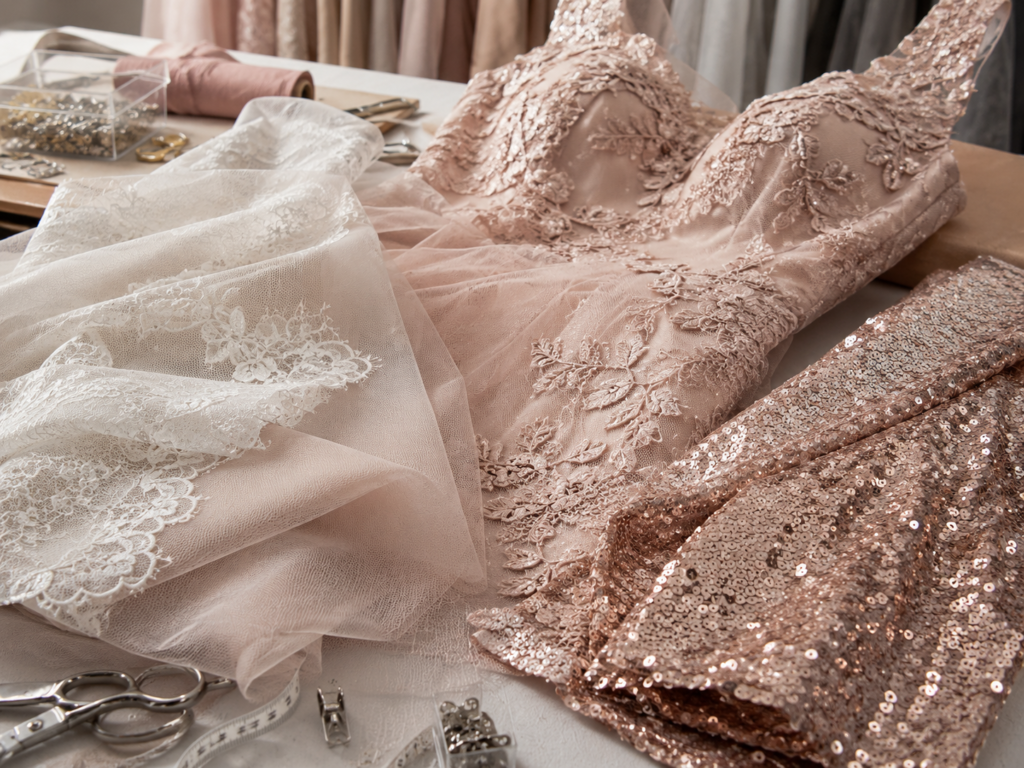
The most reliable selection process starts with silhouette rather than sparkle. A fitted pull-on dress requires a different fabric response from a corset dress with an invisible zipper. A floor-length gown places far more vertical load on the textile than a mini. A sheer design depends on the relationship between the outer fabric and the lining, while a structured bodice needs the decorative layer to cooperate with boning, cups, seam shaping, and internal support.
That is why the same sequin article can be excellent for one style and unsuitable for another. Using one fabric across a collection can simplify sourcing, but consolidation should not override garment performance. The material needs to support the intended fit, movement, and construction in every style where it is used, not merely match the collection color palette.
Dress Style | Practical Fabric Direction | Priority Check | Common Development Risk |
Bodycon dress | Stretch knit or stretch mesh sequin | Recovery under body tension | Bagging and backing exposure |
Party mini | Stretch or dense all-over sequin | Skin comfort and hem behavior | Underarm or thigh scratching |
Evening gown | Embroidered mesh or tulle | Weight, drape, hanging growth | Skirt distortion over time |
Corset dress | Stable decorative sequin layer | Seam and internal-structure compatibility | Bulk around panel seams |
Sheer dress | Mesh, tulle, or lace sequin | Transparency over chosen lining | Uneven coverage in stretched areas |
Statement dress | Reversible or large-format sequin | Surface direction | Inconsistent cutting orientation |
Bodycon and Mini Dresses
Bodycon dresses normally benefit from a sequin construction with useful crosswise stretch and reliable recovery. Stretch knit or stretch mesh is often a practical starting point, but the sample should be evaluated at the bust, hip, seat, and waist because those areas may place very different amounts of tension on the surface. A fabric that looks densely covered while relaxed may reveal significant backing once the pattern applies negative ease.
Mini dresses introduce concentrated skin contact at the hem and high movement around the hip. The lining should be long enough to prevent abrasive sequin edges from repeatedly touching the thighs, while still remaining hidden during walking and sitting. A sitting test is essential for fitted minis: the shell may ride upward, the lining may pull against the body, and the sequin field may open more at the seat than it does when the wearer is standing. A visually successful sample should still feel stable after repeated movement.
Party and Evening Dresses
Party dresses allow a broader range of materials because the category includes fitted minis, loose shifts, one-shoulder styles, draped shapes, and structured bodices. Stretch sequin is useful when mobility dominates, dense all-over sequins create immediate impact, and embroidered mesh can produce a more refined surface by allowing motifs and open areas to work together. Underarm comfort deserves particular attention because the wearer may spend hours moving in the garment rather than standing still for a photograph.
Evening gowns add the issue of scale. A swatch that feels only moderately heavy can create a substantial load when several meters are used from shoulder to floor. Long samples should be hung overnight and remeasured, especially when the backing stretches. Designers should also review motif placement across the length of the garment. A large floral repeat that looks elegant on a sample panel can appear awkward if a major motif is cut through the waist or placed differently on paired bodice sections.
Corset and Structured Dresses
Corset dresses need the sequin layer to cooperate with the internal structure rather than provide the support itself. Cups, boning, interfacing, lining, and shaped seams create the architecture; the embellished fabric supplies the visible surface. Stable sequin mesh or controlled embroidered fabric often works well over these components, while stretch sequin can be used selectively when the design intentionally needs movement in particular areas.
Panel count has a direct production effect. A corset bodice may contain six, eight, or more shaped seams, and dense sequins around each seam increase bulk and sewing difficulty. Clearing embellishment from seam allowances can produce a flatter result but adds preparation and repair work. The choice of fabric should therefore be reviewed together with the pattern. A slightly less dense surface can sometimes produce a noticeably cleaner finished corset because the seam structure remains sharp rather than becoming buried under hard overlapping sequins.
Sheer and Lined Dresses
Mesh, tulle, and lace-backed sequins are natural choices when transparency is part of the design. The key decision is not simply whether to add lining, but where coverage is required and where the design should remain deliberately sheer. Bust, lower torso, and hip areas may need controlled opacity, while sleeves, shoulders, side panels, or upper chest can remain transparent. These zones should be defined in the pattern or technical package rather than left to interpretation at the sewing stage.
Lining compatibility matters just as much as color. A highly elastic outer shell paired with a stable lining can restrict movement, while a very soft lining may fail to stabilize a heavy embellished shell. Skin comfort should be checked at necklines, underarms, straps, side seams, cuffs, and hems, where cut sequin edges are most likely to touch the body. In sequin dress development, lining, sequin loss, skin scratching, and needle breakage are practical production concerns that should be evaluated during sampling rather than left until final inspection.
How Do You Judge Sequin Fabric Quality?
Good sequin fabric should have secure embellishment, consistent coverage, an appropriate backing, predictable stretch and recovery, acceptable skin comfort, and stable appearance across the approved lot. Quality is not simply the amount of sparkle. A fabric can look impressive on a hanger and still perform poorly if sequins loosen, the backing distorts, the surface scratches, motifs vary, or bulk color differs from the approved sample.
A useful quality review happens in more than one state. The fabric should be examined flat, stretched where appropriate, cut at the edge, sewn into a sample, and worn. A material that passes a visual roll check can still create problems once a needle crosses the sequin field or once the wearer repeatedly moves an arm against a trimmed edge. Decorative textiles require a quality standard that reflects the finished garment rather than the untouched roll alone.
It is equally important to distinguish normal handling sensitivity from unacceptable instability. Sequin fabrics are not expected to behave exactly like plain jersey, but the amount of shedding, distortion, roughness, or variation should be predictable enough for the intended price point and use. If a material demands extensive hand repair after ordinary sewing, that labor needs to be recognized before bulk approval rather than discovered after hundreds of pieces have been cut.
Sequin Security
Start by bending, rubbing, and gently manipulating the sample. A small amount of sequin loss at freshly cut edges can occur, particularly where an embroidery thread has been severed, but widespread or progressive shedding suggests that the attachment system needs closer review. Inspect the reverse side as well as the face to see how the threads travel and whether one cut can release a longer chain of neighboring embellishments.
The finished sample is a better test than the untouched swatch. Check it again after cutting, sewing, fitting, pressing, and normal handling. Missing pieces around seam allowances, zippers, darts, or hems often reveal whether the construction method is compatible with the material. For premium or highly visible styles, it can be useful to retain matching loose sequins or trim for controlled repair. The aim is not to eliminate every possibility of loss, but to make the finishing and repair process predictable enough for repeated production.
Skin Comfort
Scratchiness usually comes from sequin edges, folded seam allowances, and high-contact zones rather than the center of the decorated surface. Testing comfort by touching the face of the fabric with a hand is therefore not enough. The sample should be worn and moved in, with attention to underarms, neckline edges, shoulder straps, cuffs, side seams, waist seams, and short hems where repeated contact can make a small rough point become uncomfortable.
Solutions depend on the garment. Lining, facing, binding, clearing sequins from seam allowances, changing the seam position, or adjusting the armhole can all help. A full lining does not automatically solve every issue because exposed sequins may still extend beyond the lining at a neckline or hem. Comfort should be signed off during fitting, especially for occasionwear that may be worn for several hours. A garment that becomes irritating after twenty minutes can create return risk even when the visual finish is excellent.
Stretch and Coverage
For stretch sequin, quality includes what the surface looks like under tension. A fabric may appear almost opaque when relaxed but reveal large areas of backing when extended by 15-20 percent. Whether that is acceptable depends on the design, but it should be seen deliberately during development. The same test can reveal uneven embroidery tension if one area opens much more than another at the same level of extension.
Recovery should then be observed after repeated stretching. If the backing remains wavy or the sequin spacing does not return close to its starting arrangement, a fitted garment may bag after wear. This is especially important in styles using negative ease because the textile spends much of its life under load rather than lying flat. Quality approval should therefore represent the condition in which the fabric will actually be worn, not just the condition in which it is displayed on the supplier roll.
Color and Bulk Consistency
Reflective surfaces can create apparent color differences even when the underlying material is from the same lot. Sequin coating, angle, surface direction, backing shade, and lighting all influence what the eye sees. When comparing bulk fabric with an approved reference, place both samples in the same orientation and view them under consistent light before deciding that a color mismatch is present. Rotating one piece can sometimes make an apparent difference disappear because reflection, not pigment, created the contrast.
Bulk inspection should also check motif repeat, sequin density, missing embroidery, border width, and recurring faults across the roll. Directional articles should be compared with the surface facing the same way. Incoming inspection before cutting is particularly valuable because defects in embellished textiles can create extensive rework after sewing. For production planning, the approved swatch and approved garment sample should remain available as physical references so the bulk material is compared with the actual standard used during development.
How Do You Choose Sequin Fabric for Production?
Choose sequin fabric by working backward from the finished dress. Confirm silhouette, stretch, recovery, weight, transparency, lining, direction, motif placement, seam construction, usable width, cost, and supplier availability before bulk approval. A reliable sequence is fabric screening, swatch review, sample development, fit and wear evaluation, revision, approved reference, bulk-fabric confirmation, incoming inspection, and only then cutting.
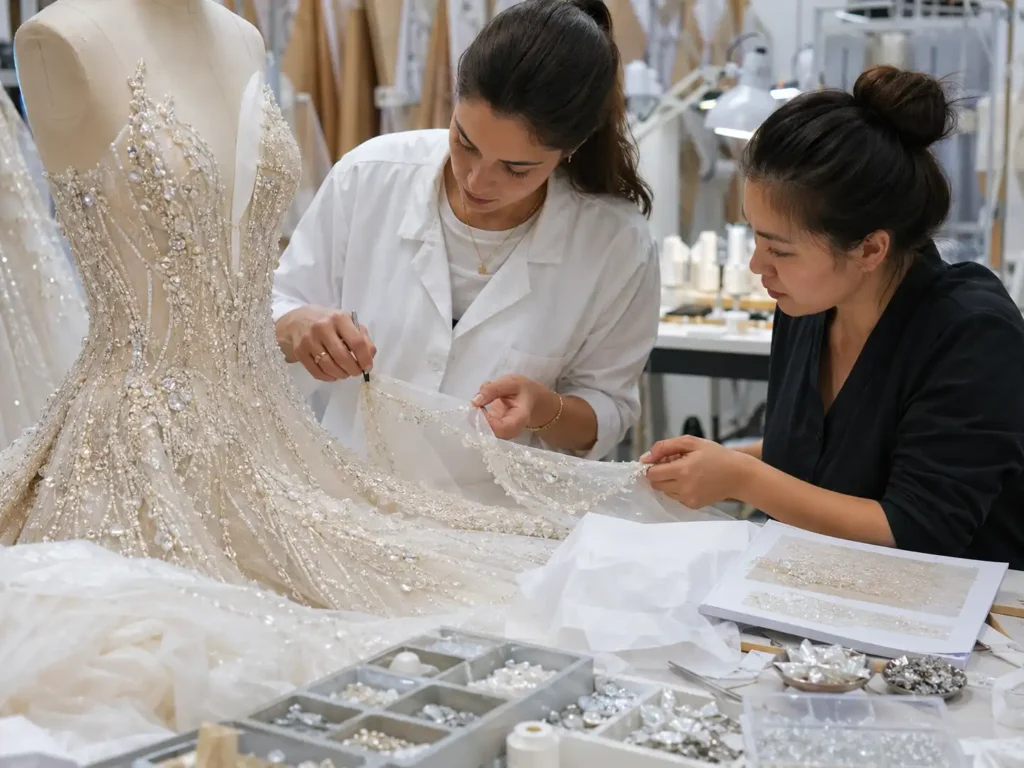
A spectacular textile can still be the wrong production choice if it requires one-way cutting that the costing did not allow, if the motif repeat creates excessive waste, if the lining cannot follow its stretch, or if the supplier quantity is too high for the planned color breakdown. The fabric decision becomes commercially reliable only when design intent and production constraints are considered together rather than handled by separate teams in sequence.
For custom development, the strongest starting information is a technical package or clear reference that shows the intended silhouette, garment length, color plan, lining concept, target quantity, and preferred sequin effect. This lets the sourcing and development teams compare fabrics based on actual garment requirements. It also makes alternative sourcing much easier if the first-choice article is unavailable, because the replacement can be judged against defined performance characteristics instead of visual similarity alone.
Match Fabric to the Pattern
Begin by listing what the pattern needs the material to do. A bodycon dress may require strong crosswise stretch and recovery. A slip-style silhouette may prioritize drape. A corset requires a decorative shell that works over rigid internal structure. A maxi introduces greater vertical load than a mini, while an embroidered evening dress may depend on motif placement more than elasticity. This short performance brief is more useful than asking suppliers simply for “high quality sequin fabric.”
A practical brief can include required stretch direction, opacity, softness or structure, surface density, lining plan, garment length, major seam positions, motif placement, visual finish, and target cost level. This also protects the design when substitutions are needed. If a silver stretch mesh becomes unavailable, the development team can search for another article with similar recovery, usable width, density, backing color, and hand rather than accepting the first silver fabric that appears similar on screen.
Plan Cutting and Sewing
Directional surfaces should be identified before marker planning. If all pieces must face the same direction, the marker loses some of the flexibility available with a plain non-directional fabric and consumption may increase. Motif repeat can add another layer of loss when flowers, borders, or geometric elements must be centered or matched. These effects are easiest to control when the cutting team receives clear grain, surface-direction, and placement notes with the approved pattern.
Sewing method should also be established in the sample. Dense or hard sequins directly under the needle can increase needle breakage and produce bulky seam allowances. Depending on the fabric, operators may need to remove selected sequins from the seam path, secure the attachment thread, sew the seam, and restore visible pieces afterward. This is particularly important in corset bodices and fitted dresses with many shaped seams. A method that is not defined until bulk sewing begins can quickly create inconsistent workmanship across lines or operators.
Control Cost and MOQ
Sequin dress cost includes much more than the per-meter fabric price. Real costing can involve usable width, garment consumption, one-way cutting loss, motif positioning, lining, slower cutting, seam clearing, additional sewing time, hand replacement, finishing, inspection, rework, and packaging protection. Two fabrics with similar supplier prices can therefore produce very different garment costs once their handling requirements are included.
Raw-material MOQ can also differ from garment MOQ. Jinfeng Apparel’s standard production MOQ starts from 200 pieces per style/color, while special sequin fabrics, custom colors, certified materials, or specially developed textiles may carry higher supplier-based requirements. For multi-color collections, fabric availability should be checked before every colorway is commercially confirmed. A stock black article may be workable at normal production quantities, while a custom champagne or holographic finish may require a larger fabric commitment that changes the economics of the planned order.
Confirm Before Bulk
Bulk production should not begin from an informal statement such as “make it the same as the sample.” The final fabric record should identify the article, color, backing, usable width, sequin size where relevant, stretch direction, surface direction, lining, and critical motif requirements. The approved garment should establish construction details such as seam treatment, neckline finish, zipper installation, lining length, hem method, placement standard, and acceptable interior appearance.
Before cutting, compare bulk rolls with the approved reference for color, finish, width, stretch, density, direction, missing embellishment, and repeating faults. A practical sequence is fabric selection, swatch approval, first sample, fit review, revised sample, approved reference, bulk-fabric approval, incoming inspection, cutting, inline quality control, and final inspection. For a manufacturer managing sequin dresses across sampling and repeat production, this sequence is more valuable than simply finding a visually attractive fabric because it turns a successful sample into a repeatable product.
Conclusion
Understanding the types of sequin fabric is useful only when the classification helps a real garment decision. Mesh, tulle, knit, velvet, lace, embroidered, reversible, and stretch constructions each bring a different combination of movement, transparency, weight, texture, and production difficulty. Sequin size, finish, density, motif, and direction then modify that behavior further. The best material is therefore not the one with the most sparkle or the highest price; it is the one that produces the intended silhouette with manageable sewing, comfortable wear, and repeatable bulk quality.
For brands developing custom sequin dresses, the strongest process is to confirm the garment requirement before locking the material. A tech pack, reference image, target silhouette, color plan, quantity, lining concept, and preferred visual effect allow a manufacturer to evaluate whether a proposed fabric actually works for the pattern. Jinfeng Apparel’s documented development model covers fabric sourcing, pattern development, sampling, bulk production, quality control, private-label packaging, and repeat-order support, which is especially useful for sequin products where material behavior and construction cannot be separated cleanly.
A sequin swatch can win attention in seconds, but a successful sequin dress has to do much more. It needs to look convincing under light, move with the body, stay comfortable at the edges, survive the sewing process, and remain consistent when the order moves from one approved sample to hundreds of finished garments. That is where material knowledge becomes production value: the sparkle is visible, but the decisions underneath it are what make the product work.
Share This Article :

Jerry Lee
Categories

Latest blogs
Table of Contents
Here, developing your OEM/ODM private label clothing collection is no longer a challenge—it’s an excellent opportunity to bring your creative vision to life.

