 Skip to content
Lace Overlay vs Lace Panel: What Is the Difference and Which Is Better for Dresses?

Your trusted Women’s Apparel Manufacturer from China

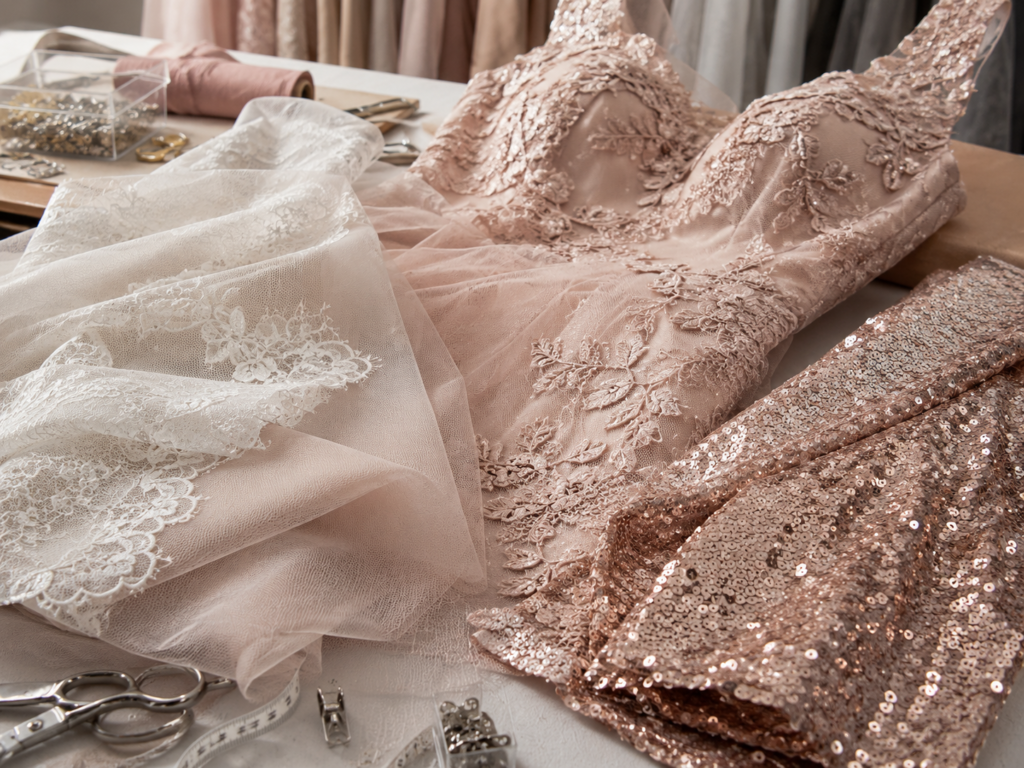
A lace dress can look deceptively simple in a campaign image. The surface may show one continuous floral pattern, a narrow sheer waist detail, or an elegant lace back, yet the construction underneath can be completely different. One style may use lace as a full overlay over satin or lining, while another may insert lace as a separate panel between opaque sections. The difference affects far more than appearance: it changes pattern development, stretch behavior, lining decisions, motif placement, seam construction, fabric consumption, fit, and the way quality must be controlled from sample to bulk production.
A lace overlay places lace over another fabric or lining so the two layers create one visual surface, while a lace panel uses lace as a defined section or insert within the garment. Overlay usually gives broader visual continuity; panel construction gives more control over contrast, transparency, body placement, and seam architecture. Neither option is automatically better. The right choice depends on the silhouette, lace structure, lining, fit, motif, and intended visual effect.
The interesting part begins when a reference photo reaches the sample room. A flower that looked perfectly placed on screen may land awkwardly across the bust, a nude lining may become too obvious under studio lighting, or a narrow side panel may pull differently from the stretch fabric beside it. Those problems rarely come from lace being a “difficult fabric” in a general sense. They usually come from choosing a construction without first deciding what role the lace needs to perform in the finished dress.
What Is the Difference Between Lace Overlay and Lace Panel?
A lace overlay is primarily a layering method: lace covers another fabric or garment section. A lace panel is primarily a sectional construction method: lace forms a defined part of the garment. Overlay affects surface appearance and layer interaction, while panels affect seam placement, body segmentation, transparency, pattern structure, and the way different materials are joined.
| Construction Point | Lace Overlay | Lace Panel |
| Main construction idea | Lace sits over a base layer | Lace forms a defined garment section |
| Typical coverage | Medium to large areas | Localized areas |
| Base fabric beneath lace | Usually present | May or may not be present |
| Pattern relationship | Often follows the underlying pattern piece | Often developed as its own pattern piece |
| Transparency control | Mainly controlled by base fabric or lining | Can be sheer, lined, or backed with mesh |
| Seam emphasis | Often visually minimized | Panel seams may become design features |
| Common locations | Full bodice, skirt, sleeve, yoke | Side waist, neckline, back, underbust, hem |
| Main production concern | Layer alignment and motif continuity | Seam accuracy and panel symmetry |
Overlay Is a Layering Decision
The clearest way to understand a lace overlay is to think in layers rather than in garment sections. In many overlay constructions, another material underneath provides most of the opacity, support, stretch control, or drape, while the lace changes the surface appearance. A fitted cocktail dress, for example, may use a stretch lining or woven base to establish the shape, with lace placed over the same bodice area. From the outside, the wearer mainly sees lace; from the inside, the garment behaves more like a coordinated two-layer system. That matters around darts, princess seams, zippers, waist seams, neckline edges, and hems because the two fabrics must move and sew together without bubbling or twisting. Overlay construction is especially useful when broad lace coverage is desired without making the entire garment transparent. It also gives designers a powerful color tool: black lace over black creates a dense tonal surface, while the same lace over nude lining makes every open part of the motif much more visible.
Panels Are a Placement Decision
A lace panel has a clearer boundary because it occupies a specific part of the garment rather than simply covering a larger underlying area. Designers commonly place panels at the side waist, center front, back neckline, underbust, hip, sleeve, or lower skirt. Because a structural panel connects directly to neighboring pattern pieces, it can affect fit much more than a decorative surface layer. If a stable lace panel is inserted into a highly elastic bodycon dress, that one section can become less flexible than the rest of the garment, even when the finished measurements look correct on a flat table. Panels can also be used for visual shaping. A narrow lace waist insert can make the middle of the body feel lighter, curved side panels can visually refine the hip line, and a sheer lace back can create a dramatic rear view without changing the front. Good panel design therefore combines aesthetic placement with pattern logic, because the seam itself becomes part of the silhouette.
The Same Dress Can Use Both
Overlay and panel construction are not competing techniques that must be chosen exclusively. A single dress can use both, which is one reason product photography often creates confusion. Consider an occasion dress with a bodice covered in lace over nude lining. That upper section is an overlay because the supporting layer remains underneath. The same dress might include a narrow unlined lace section between the bodice and skirt, making the waist area a panel. Both sections use lace, but they perform different jobs. The distinction becomes especially important when a style is developed from a reference image. A sheer-looking side area might be lace replacing the main fabric, lace over skin-tone mesh, or lace over a closely matched lining. Those three solutions can look similar in a photograph while behaving very differently in fitting and production. Before pattern cutting begins, the development team should clearly understand four boundaries: where the lace begins and ends, where the base fabric begins and ends, where the lining begins and ends, and where structural seams are located.
Visual Similarity Can Hide Technical Differences
Two lace dresses can appear almost identical online while requiring very different cutting, sewing, and quality-control methods. One may use a continuous lace overlay across an entire bodice so the base fabric carries most of the structure. Another may use several separate lace panels joined between satin sections, creating more material transitions and more opportunities for seam-related fit changes. Looking at the inside construction usually reveals the difference more quickly than studying the exterior. If the main fabric continues beneath the lace, the treatment generally functions as an overlay. If lace replaces the main fabric inside a defined pattern section, it functions more like a panel. For brands working from digital inspiration, that technical interpretation matters. Asking a factory simply to “make it like the photo” leaves too much unresolved. A reliable development process should define what the wearer sees, what sits underneath, what carries the fit, and how the construction should remain stable across multiple sizes.
How Does Each Lace Construction Work?
Overlay construction begins by coordinating lace with an underlying layer, while panel construction begins by integrating lace into separate garment sections. The choice affects cutting, motif direction, seam allowance, stretch control, lining, joining methods, edge finishing, zipper installation, pressing, and how consistently the approved sample can be reproduced in bulk production.

Overlay Cutting and Attachment
A lace overlay often follows the general shape of the pattern piece underneath, but it should not automatically be cut exactly like the base material without further review. Large floral motifs, scalloped borders, directional repeats, or unstable lace structures can all require adjustments before cutting. Alignment is the first major concern. If a dominant flower needs to sit symmetrically around the neckline, the cutting position cannot be determined only by marker efficiency; the pattern may need to shift so the motif lands correctly. Once cut, the lace must remain stable relative to the base layer during assembly. Depending on the design, the layers may be secured inside seam allowances, basted temporarily, joined at selected points, or allowed limited independent movement. A fitted bodice generally needs more control than a soft skirt. Too much fixing can make delicate lace look stiff, while too little can allow the outer layer to creep during sewing and create bubbles, twisted seams, or inconsistent motif positions. The attachment method should therefore follow the lace, base fabric, silhouette, and desired surface effect rather than a single standard rule.
Panel Pattern Development
A lace panel normally needs to be treated as a real pattern component, not as decoration added after the main pattern is finished. Its seam lengths must match neighboring pieces, its notches and balance points must be accurate, and its stretch direction should be evaluated before the sample is cut. The issue becomes especially important in fitted garments. Imagine a stretch jersey dress with a relatively stable lace panel at each side waist. If the pattern is developed as though all materials behave the same way, the lace can restrict the body in exactly the area where the wearer expects flexibility. The reverse problem also occurs: an elastic lace panel joined to stable satin may grow along the seam, creating waves or twisting that pressing cannot permanently solve. Panel shape also changes the visual result. A vertical side panel can lengthen the body visually, while a curved waist panel can emphasize shaping. The pattern maker is therefore managing both fit and design. The seam line is not simply a place where two fabrics meet; it is one of the strongest visual and mechanical lines in the garment.
Seams Change the Final Appearance
Lace makes seam placement unusually visible because motifs can be interrupted in ways that attract the eye more strongly than the stitch line itself. A large flower cut abruptly at center front or the waist can make a technically well-sewn dress feel poorly planned. Overlay construction can create additional thickness because lace, base fabric, lining, zipper tape, and seam allowances may all meet in the same area. Around a center-back zipper or waist seam, that stack of layers can cause ridges, rippling, or a hard edge if bulk is not reduced thoughtfully. Panels create a different challenge because the seam forms a transition between materials that may have different thickness, stretch, and surface friction. Uneven feeding can make the softer or more elastic side grow during sewing, leaving a wavy line. Good seam planning therefore begins before sample assembly. Motif location, layer count, pressing behavior, seam bulk, and material compatibility should be reviewed while the pattern is still being developed rather than treated as finishing problems at the end.
Edges and Borders Need Separate Planning
Many dress laces include scalloped or engineered borders, and those borders can become part of the garment rather than being cut away as waste. A scalloped edge may form the finished neckline, sleeve opening, back edge, or hem, giving the design a softer and more refined finish than a conventional turned edge. When the border is important, pattern length and placement often need to be adjusted so the scallop falls exactly where intended. Overlay dresses can use this effectively because the outer lace can extend slightly beyond the lining or base layer, creating a delicate edge without exposing raw supporting fabric. Panels can also use scallops, but the relationship with adjacent seams gives the pattern maker less freedom. Cutting border lace carelessly can remove one of the fabric’s most valuable visual features and can increase consumption because pieces cannot always be nested tightly. Before bulk production, the approved sample should clearly show which decorative borders must remain intact, where they finish, and how much positional variation is acceptable from garment to garment.
Which Design Effect Does Each Option Create?
Lace overlay creates a broader, more continuous textured surface, while lace panels create focused contrast, transparency, or visual segmentation. Overlay usually feels more integrated with the garment, whereas panels draw attention to specific body areas. The better option depends on whether the design needs continuity, shaping, exposure, contrast, or a clearly defined decorative focal point.
Coverage and Surface Continuity
Overlay works particularly well when lace should dominate a large visual area. An entire bodice, complete skirt, sleeve, yoke, or almost a full dress can be covered in lace while another layer underneath provides opacity, support, or drape. The result normally reads as one continuous surface, which is useful for cocktail dresses, occasionwear, evening styles, and wedding-guest dresses where texture is intended to be a major part of the look. Large coverage does create additional production responsibilities. Motif direction should remain consistent from left to right, and prominent floral elements should not drift unexpectedly between front and back. If the design uses a centered motif, cutting teams need to treat that position as a visual specification rather than a casual preference. Panels create a different rhythm because they interrupt the garment instead of covering it. Satin with lace only at the waist, sides, or back allows both materials to be read separately. The decision is therefore partly about hierarchy: should lace become the main surface, or should it work as a deliberate accent inside another fabric story?
Transparency and Body Coverage
Panels provide especially precise control over where transparency appears. A designer can expose the upper back, side waist, neckline, or underbust while keeping neighboring sections opaque. The panel may be left unlined, backed with nude mesh, or lined only in selected areas depending on the required balance between exposure and support. Overlay construction creates transparency in a different way because another layer normally sits underneath. The effect then depends heavily on the contrast between lace and backing. Black lace over black lining can read as dense and formal, while the same lace over beige or skin-tone lining makes every open space more visible. Apparel lace commonly spans a broad range of roughly 60-250 gsm, but weight alone does not predict transparency because motif density and open area matter just as much. A heavier lace with large openings may reveal more skin than a lighter but closely constructed lace. Bust coverage, lining length, side exposure, and back transparency should therefore be approved on the complete sample under realistic lighting rather than judged from a small fabric swatch.
Contrast and Body Shaping
A lace panel can do much more than add decoration because its position changes how the body is visually read. Dark side panels next to a lighter center body can create a narrowing effect, a curved waist section can make the waistline feel more defined, and a narrow vertical insert can lengthen the visual line of the torso. A sheer panel between opaque sections can also create negative space without using a completely open cutout. Overlay has less obvious segmentation because the base generally continues underneath, so its strength lies more in depth, richness, and surface complexity. Tonal combinations such as navy lace over navy satin or ivory lace over similar lining create subtle texture, while contrasting combinations make the motif more graphic without necessarily breaking the silhouette into separate blocks. Neither approach is automatically more premium. A costly lace can look confused if too many competing seams cut through the motif, while a simpler lace can look highly considered when its placement reinforces neckline shape, waist position, and overall proportion.
Bodices, Skirts, and Cutouts
Bodices often suit overlay construction because a supporting layer can manage bust coverage, stability, and structure while lace remains visually dominant. This is particularly useful in corset-inspired, fitted occasion, and cocktail dresses where darts, cups, boning channels, princess seams, or lining already exist underneath. Skirts offer more flexibility. A full lace overlay over satin or lining creates continuous movement and a soft layered surface, whereas lace godets or inserted panels can add flare, transparency, or directional contrast without covering the whole skirt. Cutout designs naturally lean toward panel thinking because the designer is defining a precise area of exposure at the waist, back, neckline, or side body. Lace may replace the main fabric or sit over nude mesh to create controlled transparency. Sleeves follow the same logic: a fully separate lace sleeve acts as a lace pattern section, while a woven sleeve covered with lace functions as an overlay. The useful question is not simply where lace can be added, but whether it is meant to act as surface, structure, coverage, contrast, or transparency.
How Do Fabric, Lining, and Fit Affect the Choice?
Lace type, lining, and fabric compatibility can change the construction decision completely. Weight, density, stretch, recovery, drape, motif scale, and edge structure determine whether an overlay lies smoothly or a panel remains stable. The strongest construction is the one that lets the lace, base fabric, neighboring material, and lining behave as a compatible system.
Material Factor | What to Check | Overlay Risk | Panel Risk |
Lace weight | Common fashion range may be about 60-250 gsm | Heavy lace can drag or stiffen the base | Heavy panel can distort neighboring fabric |
Stretch | Direction, extension, recovery | Lace and base may stretch differently | Panel can restrict or over-expand one area |
Transparency | Density and open areas | Depends strongly on lining color | May expose more body than intended |
Drape | Soft, medium, structured | Dense lace can suppress base-fabric drape | Soft panel may collapse beside firm fabric |
Motif size | Small repeat vs large motif | Large motifs need broad alignment | Large motifs need precise panel placement |
Scalloped border | Usable position and direction | Can create finished neckline or hem | Can restrict panel dimensions |
Lining | Color, stretch, thickness, length | Controls the entire surface appearance | Controls local coverage and stability |
Lace Type Changes the Construction
Lace is not one predictable material category. Polyester, nylon, cotton, and spandex-based laces can behave very differently, and even two polyester laces can vary greatly in density, softness, stretch, recovery, surface thickness, and dimensional stability. Lightweight soft lace often works well as an overlay because it can follow the drape of an underlying fabric without overpowering it. Dense embroidered lace can create a richer surface but may add noticeable thickness where several seam allowances meet. Stretch lace can be very effective in fitted dresses because it follows the body more comfortably than rigid lace, yet its stretch direction must correspond with the garment. A lace that stretches strongly across the width but hardly at all vertically should not be rotated simply to improve motif placement without first checking the fit consequences. Rigid lace panels can look excellent in structured dresses but may be unsuitable inside highly elastic silhouettes unless the pattern compensates for reduced movement. A swatch can show color and texture, but only a constructed sample reveals how the lace will behave with the actual supporting materials.
Lining Is Part of the Design
Lining should not be treated as an invisible technical afterthought in a lace garment because it often determines the final visual effect almost as strongly as the lace itself. A tonal lining reduces contrast and makes the garment read as denser and more textural. A nude lining increases motif visibility because the open areas appear closer to skin, while a deliberately contrasting lining can turn subtle floral lace into a graphic surface. Lining length can also become a design tool. A full-length lace skirt may be lined only to mid-thigh so the lower portion remains sheer, a lace sleeve may be left unlined while the bodice uses the same fabric over an opaque base, and a back panel may use skin-tone mesh instead of ordinary lining to preserve transparency while adding stability. Color approval should therefore be done with the lace physically placed over the proposed backing. Weight and stretch matter too: a stiff lining can flatten delicate lace movement, while a weak or overly elastic lining may not provide enough support for a structured silhouette.
Stretch Compatibility Controls Fit
Fit problems often appear when two attractive materials are combined without checking how they stretch and recover together. If stretch lace is used over a base with much lower elasticity, the completed garment will usually be limited by the less elastic layer, so the wearer does not receive the stretch suggested by the lace swatch. Panel construction can expose the difference even more clearly. A stable lace side panel inside a stretch jersey dress may behave like a rigid strip around the waist or hip. The flat garment measurements can still match the specification, yet the dress may feel tighter because tension is distributed differently around the body. The opposite situation also occurs when a soft elastic panel is joined to stable woven fabric. The lace can stretch while sewing and create waves that return after pressing. For fitted silhouettes, material compatibility should therefore be checked through movement as well as static measurement. Sitting, walking, raising the arms, bending, and turning often reveal tension problems that remain invisible on a hanger.
Motifs Affect Cutting Yield
Large floral, medallion, or geometric motifs can turn lace cutting into a placement exercise rather than a straightforward marker-efficiency exercise. If a dominant flower must sit at the center neckline, the front pattern may need to move away from the most economical position. If left and right bodice pieces need mirrored motifs, additional fabric may be required because the pieces cannot always be nested closely. Scalloped borders create another constraint because a border intended for the hem or neckline has to stay aligned with the fabric edge. Overlay construction often demands continuity across a larger surface, while panels tend to concentrate attention at symmetrical positions and seam boundaries. A small center-front insert can therefore require more precise motif placement than a much larger all-over skirt. Before costing, it is useful to identify the areas where motif position is visually critical, such as center front, left-right bust zones, back neckline, waistline, and prominent hem borders. Without that distinction, fabric consumption can be underestimated or bulk cutting can produce obvious garment-to-garment variation.
Which Is More Complex to Sample and Produce?
Neither method is consistently more difficult. Overlays can require more fabric, broader motif alignment, and careful layer control, while panels can require more seams, material transitions, and precise symmetry. Complexity depends on lace structure, garment fit, motif repeat, scalloped edges, lining, number of pattern pieces, sewing operations, and the consistency expected in bulk production.
Fabric Use and Cost
A full or large-area overlay will often consume more lace than a narrow panel simply because it covers more of the garment, but that does not automatically make it the more expensive option. A small panel cut from costly engineered lace can have poor material yield if only a limited part of the repeat is usable. Large floral repeats and scalloped borders can also reduce cutting efficiency because the pattern pieces cannot be placed wherever free space appears on the marker. Labor matters just as much as meterage. Panel construction introduces joining seams, and every additional boundary may require alignment, stabilization, trimming, pressing, lining transitions, or careful handling of open lace edges. Overlay construction may reduce visible material transitions but can add preparation work because the layers must be positioned accurately and prevented from shifting around the neckline, bust, waist, zipper, and side seams. A realistic cost review should separate lace price, usable width, cutting loss, motif-placement requirements, lining consumption, sewing operations, finishing, and inspection instead of treating “overlay” or “panel” as a fixed price category.
Motif Matching Can Drive Difficulty
Motif matching can turn a relatively simple silhouette into a demanding production style. Large floral motifs are particularly unforgiving at the center front because even a modest shift can make the entire bodice appear off-center. Symmetrical left and right areas also attract immediate comparison from the eye. Overlay garments may require consistent motif flow across a broader area, especially when separate front, side, and back pieces should still read as one continuous surface. Panels concentrate the problem at boundaries. A side panel on the left should normally correspond visually with the one on the right, a center-front insert may require a motif precisely aligned with the garment center, and a waist panel can look unfinished when large flowers are chopped randomly at both seam lines. The practical production solution is to identify critical matching zones during sample approval. Not every motif on the entire dress needs exact duplication, but important focal areas should have a clear reference so cutting teams know where consistency matters and where controlled natural variation is acceptable.
Sampling Must Test More Than Appearance
A lace sample should be evaluated on the body rather than only on a hanger or flat table. For an overlay, the review should include layer shifting, bubbling, drape, transparency, motif position, neckline behavior, zipper flatness, seam bulk, lining color, bust coverage, and whether the lace distorts during movement. Panel styles bring additional fit questions because width, shape, stretch compatibility, symmetry, seam smoothness, and transparency need to be checked against neighboring materials. A side panel that looks correct when the sample is flat can rotate or narrow once worn. Common lace-sample corrections include overly transparent bust areas, lining colors that weaken the motif, hard edges that irritate the skin, uneven pattern placement, misaligned waist motifs, asymmetric side panels, incomplete scalloped hems, or wavy seams. Important revisions should be transferred into the pattern, measurement chart, fabric and trim records, sewing instructions, and inspection points. Jinfeng Apparel uses this type of development logic when converting sample feedback into production-ready information rather than leaving important changes only in informal messages.

QC Must Follow the Construction
Quality control needs to begin before a finished garment exists because many lace problems cannot be repaired after final assembly. Incoming lace should be checked for holes, color differences, motif consistency, damaged edges, and obvious batch variation before cutting. During cutting, direction, placement, and left-right symmetry become the main concerns. Sewing inspection then shifts toward puckering, layer movement, panel distortion, uneven feeding, seam quality, edge finish, and whether the lining remains properly hidden. Final inspection still matters, but it should confirm the controls already applied earlier rather than discover major construction mistakes for the first time. Lace is especially sensitive to handling because open structures can snag and contrasting linings make holes or irregular seams highly visible. Pressing also requires care because excessive pressure can flatten dimensional motifs or leave seam impressions. For repeat production, keeping the approved sample, pattern, lace reference, lining reference, motif-position notes, and inspection criteria can greatly reduce the risk of a later run drifting away from the original standard.
Production Stage | Overlay Checks | Panel Checks |
Incoming fabric | Lace quality, color, motif consistency, holes, batch differences | Same checks plus compatibility with adjoining fabric |
Cutting | Motif direction, overlay alignment, scalloped placement | Panel shape, left-right symmetry, motif position |
Sewing | Layer shifting, bubbling, seam bulk | Wavy seams, unequal feeding, panel distortion |
In-line fitting | Bust coverage, neckline, waist, drape | Panel width, body position, stretch restriction |
Finished garment | Motif continuity, exposed lining, damaged lace | Seam smoothness, panel symmetry, transparency |
Pressing | Flattening or distortion of lace texture | Seam marks and panel deformation |
Packing | Snagging, crushing, folding damage | Lace-edge protection and garment shape |
How Do You Choose Between Lace Overlay and Lace Panel?
Choose according to what the lace must do. Overlay works best when lace should create a continuous surface over a supporting layer. Panels work best when lace needs a defined location, sheer area, contrast, or shaping function. The decision should consider fit, stretch, lining, motif placement, seams, comfort, cost, and whether the construction can be repeated consistently across sizes and bulk production.
Fitted Dresses Need Material Compatibility
For bodycon, corset, fitted cocktail, and other close-to-body silhouettes, the most reliable construction is usually the one that keeps stretch and support predictable. Overlay can work well when the underlying fabric provides most of the fit and the lace mainly provides texture. The outer lace still needs enough compatible movement to avoid splitting, bubbling, or restricting the base. Panels can create powerful shaping effects, but they become part of the fit architecture. A curved side lace panel may visually narrow the waist while also changing the actual stretch distribution in that area. Its position must remain intentional through grading; simply enlarging every dimension proportionally can allow the panel to drift away from the desired body line in larger sizes. Corset-inspired styles need even more care because lace may cross cups, boning channels, princess seams, or structured lining. A motif that appears centered on a flat pattern can shift once bust volume is formed. Front, side, and back fitting photographs are therefore valuable when reviewing waistline, hip curve, bust coverage, neckline stability, panel position, and zipper behavior.
Occasion Dresses Need the Right Balance
Occasionwear often benefits from overlays because the lace can dominate visually while another fabric provides comfort, opacity, and structure. Wedding-guest dresses, cocktail dresses, evening styles, and party dresses can use tonal or contrasting underlayers to create very different results from the same outer lace. Panels are often stronger when the design needs selective transparency rather than all-over texture. A lace back, side waist, neckline insert, or underbust section can create a noticeable focal point without making the entire garment sheer. The decision should also reflect the wearing situation and sales channel. A dress intended for more formal events may need greater coverage than a club or party style, and a style sold primarily online should be reviewed under bright front lighting because lace can appear significantly more transparent in studio photography than under ordinary sample-room lighting. Comfort is equally important. Open or embroidered lace positioned directly against the underarm, neckline, waist, or bust can feel rough depending on yarn and edge finish, so a visually successful sample still needs a realistic wear test.
Sheer Designs Need Clear Boundaries
Sheer lace appears effortless when the underlying boundaries have been planned carefully. The design team needs to decide which areas should genuinely reveal skin, which should only appear sheer, and which must remain fully covered. Lace over nude mesh can simulate exposure while providing more stability, while lace over skin-tone lining gives stronger coverage but may preserve a similar visual impression from a distance. Panel construction is often easier to control when transparency should exist in one specific location because the exposed area has a clear pattern boundary. Overlay is more suitable when the sheer-looking effect needs to continue across a larger section while still using a supporting layer underneath. Lining boundaries deserve special attention because an awkward horizontal stopping point can become more noticeable than the lace itself. Bust, hip, and side-body areas should also be checked on a fit model because stretch around curves can open the lace more than expected. A well-resolved sheer dress looks intentional from the front, side, and back rather than depending on one flattering product photograph.
Production Approval Should Be Specific
Before bulk production, the technical package should make the lace construction difficult to misunderstand. It should state whether each lace area is an overlay, panel, insert, or unlined section; where the base fabric and lining continue; the approved lace and lining colors; stretch direction; motif orientation; symmetry expectations; scalloped-edge placement; key transparent zones; seam construction; and any focal motifs that need to remain consistent. The final approved sample should also settle fit, bust coverage, neckline, waist position, panel shape, zipper behavior, edge comfort, lining length, and seam appearance. A practical sequence moves from reference design to construction interpretation, fabric and lace approval, pattern development, first sample, fitting, revision, pre-production approval, and controlled bulk production. The most expensive lace mistake is rarely choosing the wrong terminology. It is allowing an unresolved construction detail to reach bulk cutting, where a problem that could have been corrected on one sample may suddenly affect an entire production run.
Conclusion
Lace overlay and lace panel are best understood as different tools rather than competing levels of quality. Overlay is strongest when lace needs to behave as a continuous surface over a supporting material, giving the designer broad texture, color depth, and controlled opacity. Panels are strongest when lace needs a deliberate position, boundary, contrast, or transparency function inside the garment structure. Once stretch, lining, motif placement, seam construction, fit, comfort, sampling, cost, and repeatability are considered together, the choice becomes much clearer. For brands developing lace dresses, the most useful conversation with a manufacturing partner starts before the first sample is cut. Sharing the intended silhouette, reference images, lace character, lining concept, size range, key coverage areas, and production expectations allows the technical team to resolve construction decisions early. That is usually where a beautiful lace idea stops being only a visual reference and becomes a dress that can be sampled, fitted, produced, inspected, and reordered with confidence.
Share This Article :

Jerry Lee
Categories

Latest blogs

Table of Contents
Here, developing your OEM/ODM private label clothing collection is no longer a challenge—it’s an excellent opportunity to bring your creative vision to life.

