Skip to content
Peplum Dress Development
Develop Peplum Silhouettes from Design Concept to Production-Ready Garments
Peplum dresses rely on more than adding volume around the waist. Waist placement, flare distribution, fabric body, bodice fit and skirt proportion must work together before a design can move confidently into production.
- 2 sample rooms supporting structured women’s dress development
- 7+ senior pattern makers for pattern construction and fit correction
- 20+ sample machinists supporting first samples, revisions and PP samples
- 10–15 days is a common first-sample reference for regular dresses; more structured or complex styles may require 15–25 days
- MOQ starts from 200 pieces per style/color, subject to fabric, trims and project requirements
- Development can begin from a tech pack, reference image, sketch, original sample or line sheet
Development Capacity Built Around Fashion Dress Programs
2 Sample Rooms
7+ Pattern Makers
20+ Sample Machinists
6 Owned Factories
10+ Production Partners
15+ QC Inspectors
Built for Established Fashion Development Teams
Product Development Teams
Sourcing and Buying Teams
Established Fashion Brands
Seasonal dress collections often include several silhouette families, fabric groups and launch priorities.
A peplum style may sit alongside bodycon, occasion, corset, satin, lace or mesh designs in the same program. Jinfeng supports multi-style, multi-color and multi-size development while maintaining separate pattern, sample, BOM and approval records for each style.
Peplum Dress Directions We Can Develop

Structured Peplum
- Waist seam stability
- Controlled flare projection
- Interfacing requirement
- Side-profile balance
- Zipper-area structure
- Clean pressing and edge shape

Soft Draped Peplum
- Drape direction
- Peplum depth
- Front-to-side volume
- Back fullness
- Hem behavior
- Waist-seam bulk

Asymmetric Peplum
Asymmetric designs place greater pressure on pattern balance. One side may intentionally fall lower or extend farther, but the garment still needs a stable visual center and controlled interaction with the skirt. Key development areas include:
- Left-right pattern relationship
- High-low placement
- Side seam transition
- Grain direction
- Hem finishing
- Visual weight distribution
The goal is intentional asymmetry rather than a garment that simply appears uneven.

Pleated Peplum
- Knife or box pleat direction
- Pleat spacing
- Stitch-down length
- Waistline bulk
- Side-seam continuity
- Pressing behavior

Gathered Peplum
- Gathering amount
- Elastic or fixed waist construction
- Distribution marks
- Front/back balance
- Seam thickness
- Lining compatibility

Corset Peplum Dress
Corset-inspired bodices place the peplum directly next to a highly fitted upper body. Cup shape, boning, waist compression, zipper stability and peplum flare therefore influence one another. Development can involve:
- Bust and cup position
- Boning channels
- Waist shaping
- Lining structure
- Peplum attachment
- Zipper reinforcement
- Balance between fitted bodice and lower volume
A visually strong first sample still needs fit and movement review before final pattern approval.
Engineering the Peplum Silhouette and Body Proportion
A successful peplum creates a controlled relationship between torso, waist, hip and skirt. Small changes in waist placement or flare can alter the entire silhouette, which is why development needs to evaluate the garment as a three-dimensional shape rather than treating the peplum as an isolated decorative panel.
Waist Position Sets the Entire Silhouette
The attachment line establishes where the peplum begins and therefore influences how long the torso appears, where the narrowest visual point sits and how the garment transitions toward the hip.
A seam positioned too high may shorten the bodice and move volume toward the rib area. A seam positioned too low may bring the widest part of the peplum closer to the natural hip, creating more visual weight than intended.
During development, Jinfeng reviews several factors together:
- Bodice length:The front and back bodice must reach the intended waist position without pulling.
- Natural versus designed waist:Some concepts use a true natural waist while others intentionally raise or lower the seam.
- Bust-to-waist balance:Changes in bust shaping can alter where the waist seam sits when worn.
- Back length:A front waist that appears correct can still tilt if the back balance is wrong.
- Skirt connection:Peplum placement must make visual sense with the skirt rise, shape and length.
Flare Must Be Distributed, Not Merely Added
Peplum fullness can be created through circular spread, panels, pleats, gathers or combinations of these techniques. The important question is not simply how much fabric is added, but where the volume appears around the body.
Equal flare around the full circumference is not always visually successful. A fashion concept may need more projection at the side, reduced volume at center front or controlled fullness toward the back.
Pattern review can consider:
- Front volume:Too much fullness may make the abdomen area visually heavy.
- Side projection:Side flare strongly controls the recognizable peplum profile.
- Back volume:Back fullness may need adjustment around the zipper and seat.
- Panel seams:Multi-panel construction allows more local control over flare.
- Bias behavior:Curved sections can stretch or drop differently after hanging.
- Hem circumference:Large circumferences increase movement but also material usage and finishing work.
First-sample review should therefore look at the dress from multiple angles rather than approving the front view alone.
Peplum Depth Must Work with the Skirt
A 16 cm peplum and a 24 cm peplum do not simply represent two lengths of the same design. Depth changes where the edge ends relative to the high hip, full hip and skirt shape.
Mini dresses usually need careful proportion control because the peplum occupies a larger percentage of the total visible garment length. Midi dresses can accommodate more variation, while fitted pencil or bodycon skirts require particular attention to where the peplum ends against the hip.
Development considers:
- Peplum depth relative to bodice length
- Hip coverage
- Mini, midi or maxi proportion
- Pencil versus A-line skirt shape
- Side and back profile
- Movement while sitting and walking
A final proportion should be locked only after the selected fabric and real fit have been reviewed together.

Fabric Behavior Changes the Peplum More Than Expected
A pattern can be technically accurate and still produce the wrong silhouette when fabric body, drape or stretch differs from the development assumption. Jinfeng evaluates fabric not only for appearance and handfeel but also for how it supports, collapses, stretches or amplifies peplum volume.
| Fabric Direction | Expected Peplum Effect | Main Development Considerations |
|---|---|---|
| Structured Woven | Defined, architectural flare | Body, crease recovery, interfacing, seam thickness |
| Crepe | Controlled shape with moderate movement | Weight, grain direction, waist-seam bulk, drape |
| Satin | Fluid to semi-structured polished silhouette | Shine direction, snagging, pressing, seam visibility |
| Ponte / Stable Knit | Smooth fitted transition with resilience | Stretch, recovery, waist tension, seam growth |
| Chiffon | Light, floating peplum | Layering, transparency, narrow finishing, volume control |
| Organza | Strong volume with low weight | Excess stiffness, seam visibility, edge finishing |
| Lace | Decorative peplum with motif interest | Motif placement, joining, lining, edge treatment |
| Mesh | Light transparent structure | Stretch, support, lining coverage, seam stabilization |
Drape Controls Fall
Soft fabrics move downward more readily and can reduce the visual width of a peplum. Pattern volume may need to increase when a design requires visible movement without becoming flat.
Body Controls Projection
Firmer materials can hold a pronounced side profile with less pattern spread. Excess body, however, may produce a costume-like effect or make the waist seam difficult to press cleanly.
Stretch Changes Fit Interaction
Stretch fabrics influence the bodice, waist and hip differently from stable woven fabrics. Recovery, seam construction and the relationship between fitted sections and peplum volume should be reviewed together.
Surface Matters
Satin, sequins, lace and other visually sensitive surfaces can make small construction irregularities more visible. Shine direction, motif placement, seam thickness and pressing deserve attention before bulk production.
Pattern Development Behind a Controlled Peplum Shape
Peplum pattern development connects design intention with repeatable garment geometry. The pattern must control how the bodice reaches the waist, where added volume begins, how the flare travels around the body and how the peplum joins the skirt without creating twisting, excess bulk or unintended distortion.
Build the Bodice Before Adding Volume
A peplum cannot correct an unstable bodice. Bust shaping, torso length, waist suppression and center-front or center-back balance need to establish a stable foundation before the peplum seam is finalized.
Pattern makers review the supplied size chart or brand block and compare it with the intended silhouette. Depending on the style, attention may include darts, princess seams, side seams, neckline depth, armhole shape, cups, boning, straps or internal lining.
Key checks include:
- Bust circumference and shaping
- Front and back waist length
- Side seam position
- Waist circumference
- Shoulder or strap balance
- Closure allowance
- Lining relationship
Once the upper body sits correctly, the peplum attachment line can be developed with much greater control.
Build Volume According to Design Direction
Different pattern methods create different peplum behavior. Circular pieces tend to produce continuous flare, panelled patterns can distribute volume more precisely, pleats create controlled directional fullness and gathered structures give a softer appearance.
Pattern decisions can include:
- Number of panels
- Slash-and-spread amount
- Front versus back flare
- Grain orientation
- Pleat or gathering positions
- Seam locations
- Peplum depth
- Hem circumference
For asymmetric designs, both visual balance and construction stability matter. A dramatic side extension may require different support or grain treatment from the shorter side.
Connect Bodice, Peplum and Skirt as One System
Three components meet around the waist: the upper bodice, peplum layer and main skirt. Their seam lengths, thicknesses and grain behavior must align.
Development review pays attention to:
- Waist-seam matching
- Side-seam continuity
- Center-front alignment
- Center-back and zipper intersection
- Lining connection
- Skirt ease
- Seam allowance
- Bulk created by multiple layers
A zipper crossing a layered waist area can become wavy or protrude if seam thickness and support are not controlled. A peplum may also pull upward if the skirt underneath restricts the hip.
Final pattern approval therefore depends on the complete garment rather than the peplum pattern alone.

Fit Development from Waistline to Full Garment Balance
Torso and Waist Fit
Bust shape, front length, back length and waist suppression determine whether the peplum seam sits level around the body. Fit feedback should identify where tension or excess fabric begins rather than simply reporting that the waist feels wrong.
Key review areas:
- Bust placement
- Front waist length
- Back waist length
- Waist circumference
- Side-seam balance
- Closure stability
- Neckline or strap relationship
Hip and Movement Balance
Peplum volume occupies space over the high hip while the skirt underneath may remain fitted. Insufficient hip ease can pull the skirt upward and change the position of the peplum.
Review includes:
- High-hip ease
- Full-hip ease
- Peplum edge position
- Side-profile projection
- Sitting comfort
- Walkingmovement
- Skirt recovery after movement
Size and Grade Control
Grading a peplum is not always a matter of increasing every dimension by the same percentage. The brand may want a consistent visual flare across a wider size range rather than progressively increasing volume too aggressively.
Grade review may address:
- Waist circumference
- Bodice length
- Peplum depth
- Panel width
- Flare amount
- Hip ease
- Hem circumference
- Placement of pleats or gathers
Construction Details That Define the Finished Peplum

Waist Seam Construction

Zipper Intersection
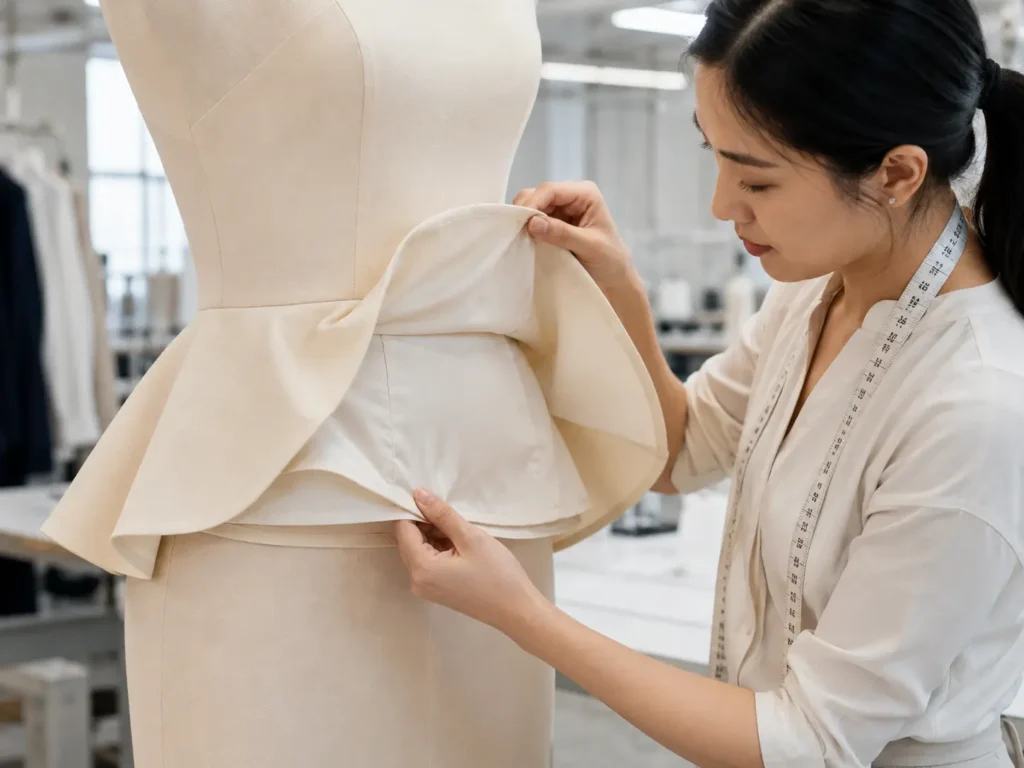
A center-back or side zipper may cross the peplum attachment seam. Uneven thickness can create a bump, twist or wavy zipper line.
The sample stage is used to verify zipper type, seam stabilization, allowance control and how the peplum edge meets the closure.
Lining Support
Lining can improve comfort, opacity and internal finish, but it also changes how the garment hangs.
A lining that is too tight may pull the outer fabric, while a heavy lining can reduce movement. Coverage and attachment should suit the outer fabric and peplum construction.

Structural Support

Pleat and Gather Control

Edge and Hem Finishing
Peplum Dress Sampling from First Review to Approval
Requirement Review
Fabric and Trim Direction
Pattern Development
First Sample
- Silhouette
- Fabric behavior
- Waist placement
- Bust and hip fit
- Peplum flare
- Construction feasibility
- Lining
- Zipper behavior
- Overall proportion
Revised and Fit Sample
Comments are separated into pattern, measurement, material, trim and workmanship issues. Revised samples are made when the changes materially affect fit, appearance or production standards.
For regular dresses, a first-sample reference is commonly around 10–15 days after required materials and development information are ready. More complex structured designs may require approximately 15–25 days, while revised samples are commonly evaluated on a 7–15 day reference depending on the changes involved.
PP and Golden Sample
The PP sample becomes the final pre-production confirmation.
Approved fabric, measurements, construction, trims, labeling and packing requirements should be aligned before bulk production.
A Golden sample then provides a physical reference for production, quality control, repeat orders and later comparison.
Solving Peplum Problems Through Controlled Sample Revision
Strong development work becomes most visible when the first physical sample reveals a problem. Jinfeng does not treat comments as isolated sewing requests. Fit images, measurements and construction observations are reviewed to identify whether the root cause comes from the pattern, fabric, trim, sewing method or interaction between several factors.
When the Peplum Sits Too High or Too Low
A waistline problem may come from more than the seam position itself. Front-body length, bust shaping, back length and skirt tension can all move the attachment line when the dress is worn.
Revision review may involve:
- Comparing front, side and back fit photos
- Measuring the actual seam position
- Checking whether the seam remains level
- Reviewing bodice length
- Correcting pattern balance
- Updating measurement references
When the Peplum Looks Too Flat or Too Wide
A flat peplum can result from insufficient pattern spread, fabric that drapes more heavily than expected or volume concentrated in the wrong area. An excessively wide peplum may come from the opposite combination.
The correction may involve:
- Increasing or reducing flare
- Redistributing volume
- Changing panel shape
- Adjusting peplum depth
- Testing another fabric
- Revising reinforcement
- Modifying pleat or gather amounts
When the Zipper, Side Seam or Hem Distorts
Peplum designs create additional seam intersections around the waist. A zipper may become wavy, side seams may rotate or the hem may appear uneven after the garment hangs.
Revision work can check:
- Layer thickness around the closure
- Zipper installation
- Seam stabilization
- Grain direction
- Side-seam alignment
- Hanging behavior
- Pressing technique
- Hem balance
Once approved, corrections are not left only in sample comments. Relevant changes need to enter the updated pattern, size chart, BOM, sewing instruction and QC checklist so production teams work from the final standard.
Lock Development Standards Before Bulk Production Starts
The transition from sample approval to production is where many fashion programs lose consistency. Jinfeng transfers approved development decisions into controlled production references so pattern, materials, measurements, workmanship, labeling and packing are no longer dependent on informal communication.
| Development Item | Production Standard Before Bulk |
| Peplum Silhouette | Approved shape and volume reference |
| Final Pattern | Corrected and approved pattern version |
| Size Chart | Confirmed measurements and tolerances |
| Grade Rule | Approved size-development logic |
| Fabric | Approved composition, weight, color and reference |
| Trims | Approved zipper, lining and required components |
| Construction | Sewing instructions and critical workmanship points |
| PP Sample | Final pre-production approval |
| Golden Sample | Physical production and QC reference |
| QC Checklist | Defined measurement and appearance checks |
| Labels | Approved placement and artwork |
| Packing | Confirmed folding, polybag, SKU and carton requirements |
Manage Multi-Style Peplum Collections Without Losing Control
Group by Development Logic
- Fabric sourcing
- Pattern assignment
- Sample preparation
- Trim development
- Revision priority
- Cost review
Prioritize Commercial Styles
- Launch date
- Fabric readiness
- Pattern complexity
- Photo-sample needs
- Revision status
- PP approval timing
Track Each Style Separately
Each style should retain its own development record even when several garments share fabrics or trims.
Jinfeng can manage multi-style programs through separate style numbers, sample versions, BOM records, patterns, size charts, QC requirements, packing instructions and production orders.
Approved changes remain traceable rather than being mixed across the collection.
Move Approved Peplum Styles into Controlled Bulk Production
Production Handover
Final pattern files, approved size charts, BOM information, fabric references, trims, sewing instructions and QC checkpoints are prepared for production.
A peplum-specific handover may highlight:
- Waist attachment position
- Pattern notches
- Peplum panel sequence
- Pleat or gathering marks
- Zipper intersection
- Lining construction
- Critical measurements
The production team works from approved information rather than an earlier development version.
Line Execution
Jinfeng operates 18+ sewing lines and 6+ flexible production lines across its women’s fashion production system. Production allocation can consider garment construction, fabric characteristics, order quantity and delivery planning.
Key production controls include:
- Fabric batch management
- Cutting accuracy
- Pattern version control
- Sewing instruction
- In-line checking
- Garment measurements
- Pressing
- Final finishing
Final Production Review
Finished garments are checked against approved measurements and visual references before packing.
Peplum projects deserve additional attention because slight variation around the waist can noticeably change the silhouette. Production review therefore combines measurement control with visual comparison against the approved reference.

Quality Control Focused on Peplum Construction Risks
Waistline Position
Inspectors check whether the peplum attachment sits consistently according to the approved measurements and pattern. Relevant checks can include:
- Front waist position
- Side waist position
- Back waist position
- Levelness around the body
- Seam matching
Flare Symmetry
Symmetrical designs need controlled left-right shape. Pattern placement, sewing accuracy and pressing can all affect the apparent volume. QC compares:
- Left and right projection
- Panel orientation
- Pleat direction
- Gather amount
- Hem balance
Volume Distribution
A peplum can meet measurements but still appear different if fullness shifts during sewing. Critical areas include:
- Center front
- Side body
- Center back
- Pleat placement
- Gather distribution
- Side seam transition
Zipper and Seam Stability
Layered waist construction can place pressure on the closure and adjacent seams. Inspection looks for:
- Zipper waviness
- Bulging
- Twisting
- Seam puckering
- Layer misalignment
- Uneven pressing
The closure should function cleanly without changing the intended waist shape.
Measurement Control
- Bust
- Waist
- Hip
- Bodice length
- Total dress length
- Peplum depth
- Relevant placement measurements
Final Appearance
Peplum dresses receive visual review after finishing and pressing because shape can change during final handling. Inspection considers:
- Silhouette
- Symmetry
- Fabric surface
- Pressing
- Lining exposure
- Loose threads
- Label placement
- Packing condition
MOQ, Sampling Time and Development Cost Planning
MOQ Planning
Jinfeng Apparel’s standard starting MOQ is 200 pieces per style/color.
A style developed in two colors is therefore normally planned around the MOQ for each color rather than combining multiple colors into one 200-piece total. Fabric mills, custom trims, special dyeing, printing or packaging may carry separate supplier minimums.
For larger multi-style programs, quantity planning can be reviewed by style, color, fabric group and expected launch sequence.
Sample Timing
Reference timing depends on style complexity and material readiness:
- Simple first sample: 7–10 days
- Regular dress first sample: 10–15 days
- Medium-complex dress: 12–18 days
- Complex structured, lace, mesh or sequin style: commonly 15–25 days
- Special fabric or custom trims: material-supplier timeline applies
- Revised sample: commonly 7–15 days
- PP sample: commonly 7–15 daysafter final materials are ready
Cost Drivers
Peplum cost is affected by more than base fabric price.
Important factors include:
- Fabric consumption
- Peplum circumference and depth
- Lining
- Interfacing or internal support
- Pattern complexity
- Number of panels
- Pleats or gathering
- Zipper and trims
- Sewing time
- Pressing
- Sample revisions
- QC requirements
- Label and packing specifications

A Multi-Style Peplum Development Program in Practice
The following anonymized program illustrates how a larger fashion collection can move from mixed development references into coordinated sampling and production. Commercial numbers are representative of the order scale Jinfeng regularly manages, while brand-identifying design information remains confidential.

Development Brief and Initial Risks
A fashion label planned an 18-style dress program containing structured peplum, draped peplum, corset-peplum and occasion silhouettes. The overall bulk plan was approximately 48,000 garments, distributed across multiple colors and size ranges.
Inputs included a combination of tech packs, reference images, size charts and selected fabric directions. Several styles were visually strong on the original concept boards but still required technical clarification before sampling.
Early review identified several issues:
- Two structured peplum designs used fabric directions that could create excessive stiffness.
- One asymmetric design placed too much visual volume around the side hip.
- Several styles lacked a clearly defined peplum depth measurement.
- A corset-peplum style placed a zipper through a thick layered waist intersection.
- Pleat placement on two styles was visually indicated but not fully dimensioned.
- Different products required different lining and support approaches.
The development team separated the styles by construction and fabric family instead of pushing all 18 through an identical workflow.

Sample Revision and Production Standard
First samples were evaluated for waist placement, flare, fabric behavior, bodice fit, zipper stability and overall dress proportion.
Selected revisions included:
- Reducing side flare on one asymmetric peplum while retaining back movement
- Moving a waist seam slightly to improve torso proportion
- Revising panel spread on a structured style
- Changing internal support where the peplum projected too rigidly
- Adjusting pleat placement so fullness remained balanced between sizes
- Correcting zipper-area seam bulk on a fitted style
Comments were converted into revised patterns and measurement references rather than being kept only in emails or chat messages.
The development sequence continued through revised samples and PP confirmation. By the production stage, approved styles had defined pattern versions, size charts, fabric references, trims, sewing instructions and QC checkpoints.

Bulk Execution Across 48,000 Pieces
Bulk production was divided according to construction, fabric and schedule rather than treating all 18 styles as one undifferentiated order.
Production controls focused on:
- Correct pattern version by style
- Fabric batch consistency
- Peplum placement
- Pleat or gather control
- Waist-seam levelness
- Zipper flatness
- Garment
measurements - Final silhouette against approved references
- SKU and packing accuracy
The value of development work became visible at bulk stage: critical silhouette decisions had already been resolved before production, reducing the need for production teams to interpret design intent independently.
For a multi-style program, the goal is not merely producing 48,000 garments. The goal is ensuring every style carries its own approved development logic into production while the entire collection moves within one coordinated schedule.
Peplum Dress Development Frequently Asked Questions

Start Your Peplum Dress Development with Jinfeng
A productive development review begins with enough information to understand the intended silhouette and the commercial plan behind it. Send your peplum dress reference image, sketch, tech pack or existing sample together with the expected fabric direction, size range, colors and quantity. If the design includes pleats, gathers, corsetry, lining, special closures, lace, mesh, satin or other important details, include those requirements so the development team can evaluate pattern, material and sampling risks before production planning.
For a more accurate project review, provide:
- Product reference, sketch or tech pack
- Existing sample, if available
- Size chart and target size range
- Preferred fabric or fabric swatch
- Color plan
- Quantity per style/color
- Peplum shape or proportion requirements
- Lining and trim requirements
- Private-label requirements
- Packaging instructions
- Target price, when available
- Planned launch date
- Testing or inspection requirements
- Shipping destination