 Skip to content
Types of Lace Used in Dresses: Which Lace Is Best for Each Style?

Your trusted Women’s Apparel Manufacturer from China

Lace can make two dresses cut from almost the same silhouette look completely different. One may feel light, romantic and almost weightless, while another appears graphic, sculpted and highly formal. The difference is not simply the floral pattern. Ground construction, yarn, motif density, weight, stretch, transparency, border design and finishing all influence how lace behaves after it is placed over lining, shaped around the body and sewn through multiple seams. That is why a lace that looks beautiful in a supplier photo can still be the wrong material for the dress being developed.
The main types of lace used in dresses include Chantilly, Guipure, Alençon, embroidered, Raschel, stretch, eyelash, corded and 3D lace. The best option depends on the silhouette, desired transparency, weight, motif scale, stretch and lining. Fine net laces suit soft overlays, dense lace adds visual structure, stretch lace supports fitted shapes, and dimensional lace creates stronger decorative impact.
The useful question is therefore not simply, “Which lace looks best?” It is, “What will this lace do after it is cut around a bust, matched across a waist seam, stretched over a hip, lined, pressed, packed and reproduced across many garments?” A flower positioned a few centimeters off center can change the whole front view. A lining with the wrong stretch can fight the shell. A beautiful scalloped edge can disappear if the pattern was planned too late. Those are the details that turn lace selection from decoration into real dress development.
What Are the Main Types of Lace Used in Dresses?
The main dress laces include Chantilly, Guipure, Alençon, embroidered, Raschel, stretch, eyelash, corded and 3D lace. These names do not all follow one technical classification system: some describe traditional lace families, others describe construction, elasticity or decoration. For dress development, the most useful approach is to compare how each lace looks, feels, stretches, drapes and behaves in sewing.
Chantilly, Guipure and Alençon
Chantilly lace is usually recognized by delicate motifs carried on a fine net ground. It tends to look light, intricate and relatively transparent, making it useful for sleeves, upper bodice overlays, softer skirts and dresses where the lace is expected to float over a separate lining. The important point is that “delicate” does not automatically mean fragile or premium. Yarn quality, finishing, ground stability and motif definition still need to be checked on the actual fabric rather than assumed from the name.
Guipure lace behaves differently because the motifs are commonly linked to one another without the same obvious fine net background. The open spaces can make it look airy, yet the yarn concentration inside the connected motifs often gives the fabric more body and a firmer hand. This makes Guipure useful for cocktail dresses, structured minis and midis where the lace itself needs to create a stronger graphic surface. Alençon lace is commonly associated with motifs on a net ground that are emphasized by raised outlines, giving formal dresses more visual depth. In practice, all three families can vary considerably between mills, so the supplier name should be treated as a starting point rather than a full fabric specification.
Embroidered and Raschel Lace
Embroidered lace is an especially broad commercial category because the visual effect depends on both the supporting ground and the embroidery applied over it. A fine embroidery on lightweight tulle can feel almost weightless, while dense embroidery on a firmer mesh may add noticeable body to the garment. The stiffness can also vary within the same piece of fabric: the open ground may flex easily, but large embroidered flowers can resist folding. That local change in stiffness matters around darts, princess seams, armholes and fitted waist areas.
Raschel lace is produced through machine-knitting technology and is widely used in commercial womenswear because it can be engineered in many motif scales, densities and hand feels. It should not be dismissed as a single “basic” category. A well-made Raschel lace can provide clean motif definition, stable repeat and efficient production, while another construction may be too soft, too open or too unstable for the intended garment. The useful evaluation is practical: does the ground distort, is the repeat consistent, does the lace hold its shape after handling, and can bulk fabric reproduce the same appearance as the approved sample? Those questions matter more than the category name alone.
Stretch, Eyelash and Corded Lace
Stretch lace is often the most practical choice for bodycon and closely fitted silhouettes because it can follow body movement instead of forcing the pattern to create all the mobility through seams and ease. However, “stretch” is not a complete specification. The fabric should be checked in both principal directions, and recovery should be observed after repeated extension. A lace that stretches easily but returns slowly can cause a neckline, waist or hip area to relax after wear, even if the first fitting looks correct.
Eyelash lace is recognized by fine fringe-like edges that create a soft, slightly undone finish around necklines, sleeves, hems or lingerie-inspired panels. Those decorative edges need protection during cutting because they can be accidentally trapped inside seam allowances or trimmed inconsistently. Corded lace uses raised cord-like outlines to emphasize the motifs, producing stronger definition under event lighting and photography. The extra thickness can become a problem where cords stack at darts, waist seams or zipper areas, so the placement of dense motifs should be reviewed during sampling rather than left for sewing operators to solve individually.
3D and Decorative Lace
Three-dimensional lace adds raised petals, appliqués, layered embroidery or other surface elements that sit above the supporting ground. This creates immediate visual impact on occasion dresses, statement minis and formal gowns, but it also changes the way the fabric must be handled. A large flower placed over a zipper can prevent the zipper from lying flat, while a dimensional motif at the underarm may feel uncomfortable or become crushed during wear. The decorative surface therefore needs to be mapped against the actual pattern pieces, not simply admired on a fabric hanger.
Additional embellishment such as beads, sequins, stones or metallic threads can increase the weight of the lace and alter its drape. It can also introduce more quality checkpoints, including attachment security, snagging, pressing sensitivity and packing protection. The best decorative lace is not necessarily the most elaborate option. For a commercial dress collection, a slightly simpler surface that can be cut, sewn, inspected and repeated consistently may produce a stronger finished product than an extremely complicated lace requiring constant hand correction.
Lace Type | Typical Structure | Typical Stretch | Visual Character | Common Dress Use |
Chantilly | Fine net ground with delicate motifs | Low | Light, refined, transparent | Evening dresses, sleeves, overlays |
Guipure | Connected motifs with little visible net | Low | Graphic, structured, open | Cocktail, mini, midi, occasion dresses |
Alençon | Motifs on net with raised outlines | Low | Dimensional, formal | Occasion and formal dresses |
Embroidered | Embroidery over mesh or tulle | Low to moderate | Variable from light to dense | Party, evening, statement dresses |
Raschel | Machine-knitted lace | Variable | Variable from fine to stable | Commercial fashion dresses |
Stretch Lace | Elastic lace construction | Moderate to high | Flexible, body-following | Bodycon, fitted mini and midi dresses |
Eyelash Lace | Fine fringe-like decorative edge | Variable | Soft, lingerie-inspired | Slip styles, sleeves, neckline details |
Corded Lace | Raised cord outlining motifs | Usually low | Defined, textured | Evening and occasion dresses |
3D Lace | Raised flowers or appliqué motifs | Usually low | Bold, dimensional | Statement dresses and formal styles |
How Do Lace Types Differ?
Lace types differ in ground construction, fiber content, motif scale, weight, transparency, stretch, recovery, border design and surface dimension. These variables determine how the fabric drapes, whether it needs lining, how it should be patterned and how difficult it is to sew consistently. Two laces with similar floral designs can behave very differently once they are cut into real garment panels.
Ground and Motif Structure
The ground is the background structure supporting the decorative motifs, and it has a major influence on how a lace behaves. A fine net ground usually increases transparency and visual lightness, but it can also make seam allowances, lining edges and internal construction more visible. When the ground is very delicate, the fabric may distort if it is stretched during spreading or sewing. A stable embroidered mesh behaves differently because the base can carry more stitching without losing shape, although dense embroidery can create localized stiffness around large motifs.
Motif scale is equally important. Small, closely repeated motifs are generally easier to place across different sizes because pattern edges interrupt fewer large visual elements. Large florals create stronger impact, but they demand more deliberate placement at the center front, bust, waist and hem. Directional motifs add another layer of control because turning pattern pieces to save fabric may cause flowers or leaves to face the wrong direction. In commercial production, useful width is therefore more important than nominal fabric width. Borders, direction, damaged areas and matching requirements can reduce how much of the roll can actually be used, and that directly affects material consumption.
Weight and Drape
In Jinfeng Apparel’s internal fabric reference system, common lace used for fashion dresses is generally considered within an approximate 60-250 gsm working range, depending on composition, density and construction. That broad span helps explain why two dresses both described as “lace dresses” can feel completely different on the body. A fine, open lace may contribute little weight and move easily over a lining, while a dense embroidered or corded lace can add enough body to influence the silhouette itself.
Weight should never be judged without drape. A relatively light lace can still feel stiff if embroidery tightly locks the ground, while a heavier open construction may fall more naturally because yarn is distributed in larger motifs with more empty space between them. This difference becomes obvious in skirts: one lace may collapse softly over the hips while another stands away from the body. Local stiffness matters in fitted bodices as well. Thick embroidery crossing a bust dart or princess seam can create ridges that were not visible in the flat swatch. Handling a larger fabric piece and making a real sample remain the most reliable ways to understand how the material will behave.
Transparency and Lining
Transparency is one of the defining features of lace, but the finished level of coverage comes from the combination of shell, motif density and lining. A highly open black lace over black lining can appear relatively restrained because the two layers visually merge. Put the same lace over nude lining and the floral pattern becomes much more pronounced. A contrast lining can create an even stronger graphic effect, turning the lining into part of the design rather than a hidden support layer.
The lining also changes function. If the lace stretches but the lining does not, the finished dress may feel restrictive despite the flexible outer shell. When both layers stretch but recover at different rates, the garment can ripple, twist or relax after movement. Coverage should also be reviewed on the body, especially around the bust and upper thigh, because open areas may fall differently after the pattern is graded into multiple sizes. For this reason, lining color, opacity, weight and stretch should be approved together with the lace. Treating the lining as a late sourcing decision is one of the simplest ways to turn a good lace choice into a disappointing garment.
Fiber, Stretch and Recovery
Polyester, nylon, cotton and spandex-containing lace are all common in dress development, but fiber content by itself does not define quality. A well-finished polyester lace can look cleaner and feel more suitable for the garment than a poorly constructed lace made with a more expensive fiber. Cotton content can create a matte, natural character, yet the final hand still depends on yarn size, finishing and motif density. Nylon is often useful in fine grounds, while spandex or elastane introduces functional stretch where the dress requires closer fit and movement.
Stretch should be measured in the direction the pattern will actually use it. Some laces extend mainly across the width, while others have meaningful movement in both directions. Motif orientation and stretch direction do not always align, which can create difficult pattern-placement choices. Recovery deserves equal attention because a fabric that does not return cleanly may grow at the neckline, waist or seat. For fitted dresses, the lace and lining should be tested together under repeated movement. Once the two layers are sewn into one garment, their combined behavior matters more than either fabric’s performance when tested separately.

Which Lace Works for Each Dress Style?
The best lace depends on the dress silhouette and wearing occasion. Fine net lace suits soft overlays and refined formal looks, dense or corded lace gives cocktail and occasion dresses stronger definition, stretch lace works well for close-fitting shapes, and open lightweight lace can suit selected resort styles. Motif scale, lining, comfort, elasticity and seam placement should be evaluated together before final fabric approval.
Occasion and Evening Dresses
Occasion and evening dresses allow lace to play several roles. It can become the entire outer shell, a transparent upper layer, a sleeve fabric, a bodice feature or a localized decorative panel. Fine Chantilly-style lace works well when the design needs softness and controlled transparency without making the garment look heavy. Corded, Alençon-style and dense embroidered laces create stronger visual definition, particularly under event lighting and ecommerce photography, where raised motifs remain visible from more than a few steps away.
The fabric still needs to match the internal structure of the dress. A heavily embroidered lace placed over boning, cups, underlining and a dense lining can make a fitted bodice heavier and stiffer than expected. A lighter lace may produce a better result when the pattern already provides strong support. Large motifs should also be checked around the bust, neckline and waist because formal dresses are visually unforgiving when placement feels accidental. In practice, the best occasion lace is one that creates enough surface impact while still allowing the pattern, lining and internal structure to do their jobs without competing against one another.
Bodycon and Fitted Dresses
Bodycon dresses place more demand on lace because the shell has to follow the body through standing, sitting and movement. Stretch lace is usually the most straightforward option when the lace itself forms a major part of the fitted shell. It can support controlled negative ease, but only when extension and recovery are stable. A lace that stretches generously and then returns slowly may fit perfectly for the first few minutes yet become loose around the waist, neckline or seat after several hours of wear.
The lining must work with the shell. If a four-way stretch lining is combined with lace that moves mainly across the width, the garment may twist or pull unevenly. A very firm lining can also cancel much of the lace’s functional stretch. Rigid lace is still possible in fitted dresses, but the pattern usually needs more shaped seams, darts, panels or an underlying stretch base. Large dense motifs should be checked around the hip and bust because they can create localized pressure and reduce flexibility. A body fitting tells much more than a hanger: the lace must be evaluated in the same layer combination and direction intended for production.
Mini, Midi and Maxi Dresses
Dress length changes how motif scale is perceived. On a mini dress, a large repeat may show only one or two dominant flowers across the entire garment, which makes placement extremely noticeable. If the largest motif falls unevenly across the bust or is cut awkwardly at the hem, the problem can dominate the design. Smaller or medium motifs often give short dresses more placement flexibility, although bold Guipure can work well when the graphic scale is deliberate.
Midi dresses provide more vertical space for larger motifs and decorative borders. A scalloped edge can become a strong hem feature when it is planned from the beginning, but preserving that edge changes the cutting layout and can increase fabric use. Maxi dresses introduce another issue: total garment weight. A lace that feels only moderately heavy as a swatch can become noticeably heavier when used across a floor-length skirt, especially after lining is added. The shell and lining should also be checked together in movement. A fluid lining under a stiff lace can create two different drape behaviors, while a heavy lining can flatten a delicate shell and reduce the lightness that made the lace attractive in the first place.
Resort and Summer Dresses
Resort and summer dresses often benefit from open, visually light lace, but the most transparent or lightweight fabric is not automatically the most comfortable. Some open constructions have firm yarns or rough decorative edges that become irritating around armholes, shoulder straps and waist seams. A lace can feel acceptable in a small hand test yet become uncomfortable after several hours of repeated skin contact, especially in warm conditions when friction increases.
Partial lining can help preserve the light appearance of a summer dress. A bodice may need full coverage while sleeves, lower skirt panels or selected cutout areas remain sheer. Softer machine-made lace, cotton-containing constructions and open Guipure can all work depending on the intended style. Packing should also be considered because resort collections are often folded for ecommerce or retail distribution. Highly dimensional flowers, fragile fringe and loose appliqués can be compressed in transit. The strongest material choice balances visual openness, skin comfort, lining strategy and enough structural stability to survive normal production, packing and wear.
Dress Style | Useful Lace Direction | Key Property | Common Development Risk |
Evening Dress | Chantilly, corded, embroidered | Drape and visual depth | Excess weight or bulky seams |
Cocktail Dress | Guipure, corded, embroidered | Structure and motif definition | Poor motif balance |
Bodycon Dress | Stretch lace | Stretch and recovery | Bagging or restricted movement |
Mini Dress | Small-to-medium motifs | Placement and proportion | Large motifs cut awkwardly |
Midi Dress | Guipure, embroidered, border lace | Border and repeat | Higher cutting loss |
Maxi Dress | Lightweight or medium lace | Drape and total garment weight | Shell and lining moving differently |
Resort Dress | Open, soft lace | Comfort and breathability | Rough edges or excessive transparency |
Lingerie-Inspired Dress | Eyelash, fine stretch lace | Softness and edge appearance | Delicate edge damage |
How Do You Choose Lace for a Dress?
Choose lace by evaluating it as part of the finished garment, not as an isolated swatch. Review the silhouette, transparency, stretch, recovery, motif scale, border, hand feel, lining, color and usable width together. A suitable lace should create the intended appearance on the body while remaining practical to pattern, sew, fit, inspect and reproduce across the required size and color range.
Lining and Coverage
Lining is one of the most influential decisions in a lace dress because it changes both the appearance and the way the garment functions. The first question is coverage: exactly where should the wearer see skin, and where should opacity be controlled? Sleeves, upper chest panels or lower skirt sections may be intentionally sheer, while the bust, waist and hip usually require more deliberate coverage. These areas should be reviewed on a complete sample rather than decided from a flat fabric board.
Color comes next. Tonal lining gives a quieter effect because the lace and base visually blend, while nude lining emphasizes the motif and can create an illusion effect. Contrast lining makes the lace even more graphic. Weight and stretch must then be checked together. A heavy lining can flatten a fine lace, while a rigid lining can remove the advantage of a stretch shell. Large floral openings around the bust are especially sensitive because placement changes as sizes are graded. The safest approach is to approve lace and lining as a pair under normal indoor light and stronger photography-style lighting, with the garment fitted on the body.
Stretch and Pattern
Stretch lace changes the assumptions behind pattern development. A block designed for a stable woven fabric normally contains more wearing ease than a bodycon block developed for elastic materials. Replacing the original fabric without changing the pattern can therefore produce a garment that feels loose, even when the measurements look correct on paper. The reverse is more severe: cutting a pattern developed for stretch lace in rigid Guipure can make the dress substantially tighter and restrict movement at the bust, waist and hip.
Before pattern work begins, the fabric should be checked in both main directions to determine useful extension and motif orientation. Recovery should influence how much negative ease is used, because a fabric that does not return reliably can grow after repeated movement. Fit testing should include sitting, walking, raising the arms and normal hip movement rather than only standing measurements. Pattern teams should also identify where dense motifs cross shaping seams. A dart through heavy embroidery may be bulky, while an open ground can be easier to shape but more visibly reveal the seam. The fabric and pattern have to be developed together, not sequentially.
Motif Scale and Placement
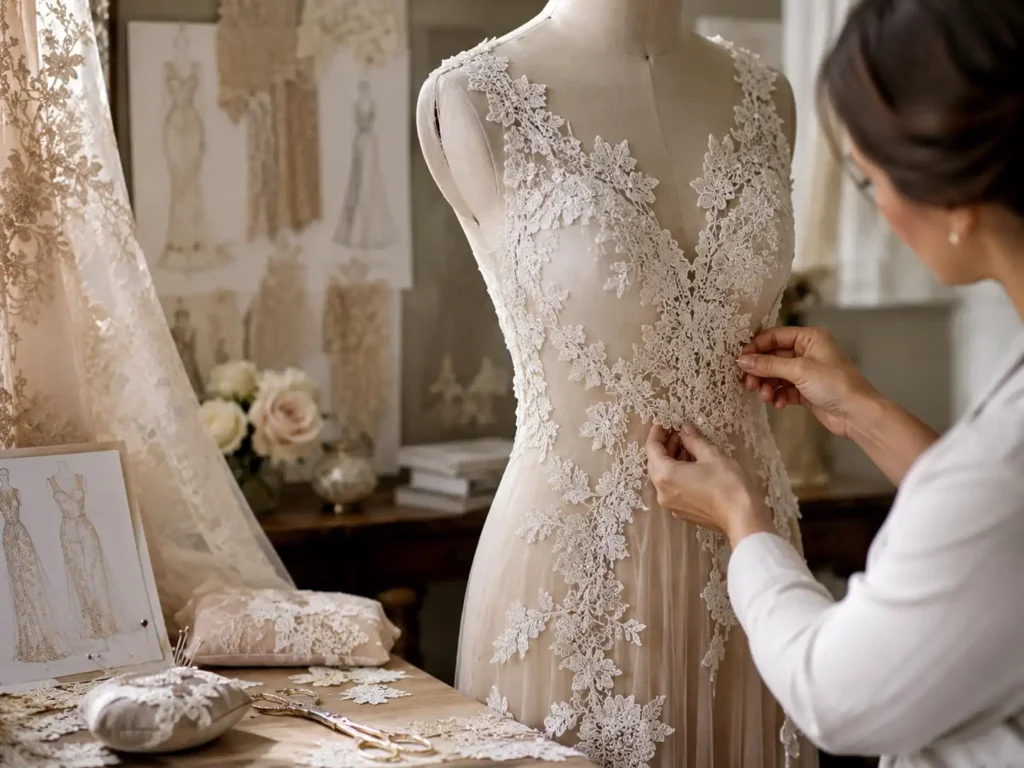
Motif placement can make an inexpensive lace dress look considered, while poor placement can make an expensive lace look careless. The center front is usually the first reference point because the eye immediately notices when a dominant flower sits slightly off center. The bust is another sensitive area, especially with large floral motifs and open spaces that can create unintended emphasis. Waist seams also deserve attention because an abrupt break in the repeat can make the bodice and skirt feel disconnected.
The hem should be planned early when the fabric has a decorative scalloped border. Preserving the border may require pattern pieces to follow the edge rather than the most efficient cutting arrangement, which can raise material consumption. During size grading, identical motif placement is not always realistic, but the same visual logic should remain: balanced center front, suitable bust coverage, coherent left-right symmetry and consistent border treatment. These priorities should be recorded on the approved sample or production instruction. Without that reference, different cutters may make reasonable but inconsistent placement decisions, producing visible variation within the same bulk order.
Color and Hand Feel
Lace color should be approved in combination with its lining because the open structure allows the base color to influence the final appearance. Ivory lace can read warmer over cream and cooler over pale beige. Black lace appears much denser over black lining than over nude, even though the shell is exactly the same. Under strong studio lighting, contrast between shell and lining may appear greater than it does under ordinary indoor light, which matters for garments intended to be photographed for ecommerce.
Hand feel is equally practical. A lace that feels slightly firm between the fingers can become irritating when the edge repeatedly touches the underarm, inner elbow, neckline or waist. Corded motifs, dense embroidery and decorative borders are common sources of localized friction. If the fabric is otherwise suitable, construction can sometimes solve the issue through a soft facing, binding, lining extension or revised seam location. However, comfort should be tested before bulk approval rather than assumed. A lace dress can look excellent in photographs and still generate fit complaints or returns if the areas touching skin are not comfortable during normal movement.
How Do You Sew and Finish Lace?
Lace should be sewn according to its motif, ground stability, thickness and edge design. Important controls include direction, symmetry, seam placement, border preservation, reinforcement and damage prevention. Fine lace needs careful handling to avoid stretching or holes, while dense, corded or 3D lace may require local trimming, motif repositioning or appliqué work to prevent bulky joins and keep the finished dress visually clean.
Motif Matching
Motif matching begins at pattern placement, long before the sewing machine. For a symmetrical front bodice, the center line should establish the visual balance. Large flowers, medallions or leaves need to sit intentionally rather than drifting left or right. Paired sleeves and bodice panels should also feel related. This does not mean every floral element must be perfectly mirrored, but the overall distribution should look controlled rather than accidental.
Side seams are more complex because perfect matching can consume considerably more fabric, especially when the repeat is large. The better approach is to define priority zones. A fitted formal dress may prioritize the center front, bust and waist while accepting natural variation at less visible side areas. A simple straight dress made from bold Guipure may justify more side-seam continuity because the motif is the main design feature. These decisions should be settled on the approved sample and turned into cutting instructions. If the production note only says “match lace,” every cutter may interpret that requirement differently, leading to inconsistent garments even when all of them are technically well sewn.
Seams and Borders
Not every lace seam should be handled like a normal woven seam. Fine, relatively flat lace may accept conventional construction, while dense embroidered or corded areas can become bulky when two heavy motifs meet inside the seam allowance. Before sewing, it is useful to map where thick motifs cross side seams, waist seams, darts and zippers. In selected designs, some decorative material can be carefully removed from the seam allowance while preserving the visible motif, reducing thickness without changing the front appearance.
Borders require similar planning. If a scalloped edge is intended to form the hem, sleeve edge or neckline, the pattern must be positioned around that border from the beginning. This reduces marker flexibility and may increase fabric use, but cutting the border off and trying to recreate the effect later usually weakens the design. Stability also matters because some open lace structures distort or unravel once cut. Edge finishing should therefore protect both appearance and durability. Skin-contact areas deserve special review; an attractive border can still be unsuitable at an armhole or neckline if its yarn or cord repeatedly scratches the wearer.
Appliqués and Decorative Details
Lace appliqués give designers more freedom because individual motifs can be placed independently of the base fabric repeat. A flower can be moved away from a zipper, centered more precisely over a bodice or used to disguise a seam. This is particularly useful on structured evening dresses and corset-inspired silhouettes, where the internal pattern lines may otherwise interrupt the decorative surface. The trade-off is additional manual work and more operations that need clear placement references.
Three-dimensional flowers, beadwork, sequins and stones introduce even more variables. A heavy appliqué can pull a fine mesh base out of shape, while a rigid decorative piece at the underarm can affect comfort. Decoration that crosses a zipper can prevent smooth opening, and raised elements may flatten under direct pressing. Attachment security should therefore be checked before bulk production rather than only at final inspection. For dimensional surfaces, pressing methods often need to change, with more work from the reverse side or around the raised elements instead of directly over them. The decorative effect is successful only when it survives construction, wear and packing without losing the intended shape.
Damage Prevention
Fine lace can be damaged at almost every stage of production, so prevention is more efficient than repair. Incoming rolls should be checked for holes, snags, broken ground yarns and obvious embroidery defects before the fabric reaches the cutting table. Defective zones can then be marked and avoided rather than discovered after they become part of a finished bodice. During spreading, operators should avoid unnecessary tension because stretching the ground can shift motif position and make paired pieces appear different even when they were cut from the same marker.
The sewing floor introduces new risks. Open lace can catch on rough table edges, exposed zipper teeth, hooks or damaged machine surfaces. Fine grounds can be affected by unsuitable needles or excessive thread tension, while dense embroidery can cause skipped stitches or needle deflection. Pressing should also reflect the fiber and decoration: too much heat or pressure can distort synthetic grounds, flatten 3D flowers or damage surface trims. A hole identified before cutting costs a small amount of fabric; the same hole found after sewing, pressing and packing can require dismantling or rejecting an entire garment.
What Should Be Checked Before Bulk Production?
Before bulk production, confirm the exact lace, color, lining, stretch, motif direction, usable width, border, pattern placement and approved sample. Production should then control shade, motif consistency, holes, symmetry, seam matching, edge finishing, lining exposure and measurements. Lace dresses are most reliable when fabric approval, pattern approval, workmanship approval and packing requirements are treated as one connected system.
Fabric and Sample Approval
The first approval should be the actual fabric, not only a reference photograph or supplier screenshot. A useful lace swatch needs to be large enough to show the complete motif repeat, open areas, border and ground structure. Very small cuttings can hide exactly the features that later affect a full bodice. The lace should also be reviewed over the intended lining so that transparency, color contrast and hand feel are considered together before sample sewing begins.
The first garment sample answers a different set of questions. Does the lace drape correctly on the body? Is the motif scale suitable for the silhouette? Does the lining show too strongly? Are edges comfortable? Are flowers falling awkwardly across the bust or waist? When revisions are needed, they should become updated production information rather than remaining as informal chat comments. Pattern changes belong in the pattern, lining changes should update the material reference, and placement changes should be recorded in cutting instructions. A structured sequence of first sample, revised or fit sample, pre-production approval and sealed final reference gives the production team something concrete to reproduce instead of asking them to remember how the earlier development discussion ended.
Bulk Fabric Consistency
Bulk lace should be compared with the approved development material before cutting starts because sample yardage and production yardage may come from different lots. Shade, hand feel, embroidery density, motif definition and even usable width can vary between batches. When several rolls are required for one color, visually different shades should not be mixed inside the same garment. A difference that seems minor on separate rolls can become obvious when two panels sit directly beside each other.
Repeat and direction should also be checked. A production lot can look nearly identical from a distance yet behave differently if the motif repeat, border width or base tension has changed. Material consumption calculations depend on usable fabric, not simply the nominal roll width, so borders, directional patterns and defective areas should be included in the real yield calculation. Special lace may also carry supplier-specific minimum quantities or dye-lot limitations that are separate from the garment order itself. For repeat programs, keeping a sealed fabric reference, supplier code, color record and approved garment can reduce uncertainty when the style is reordered months later.
Cutting and Sewing Control
Cutting is the point where many lace decisions become irreversible. Before bulk cutting, operators should know the required motif direction, stretch direction, center-front position, border use and priority matching areas. Paired pieces should be checked for symmetry where the design requires it, especially on front bodices, sleeves and visible side panels. If the instruction is vague, different cutters can make different but individually reasonable decisions, creating inconsistency across the order.
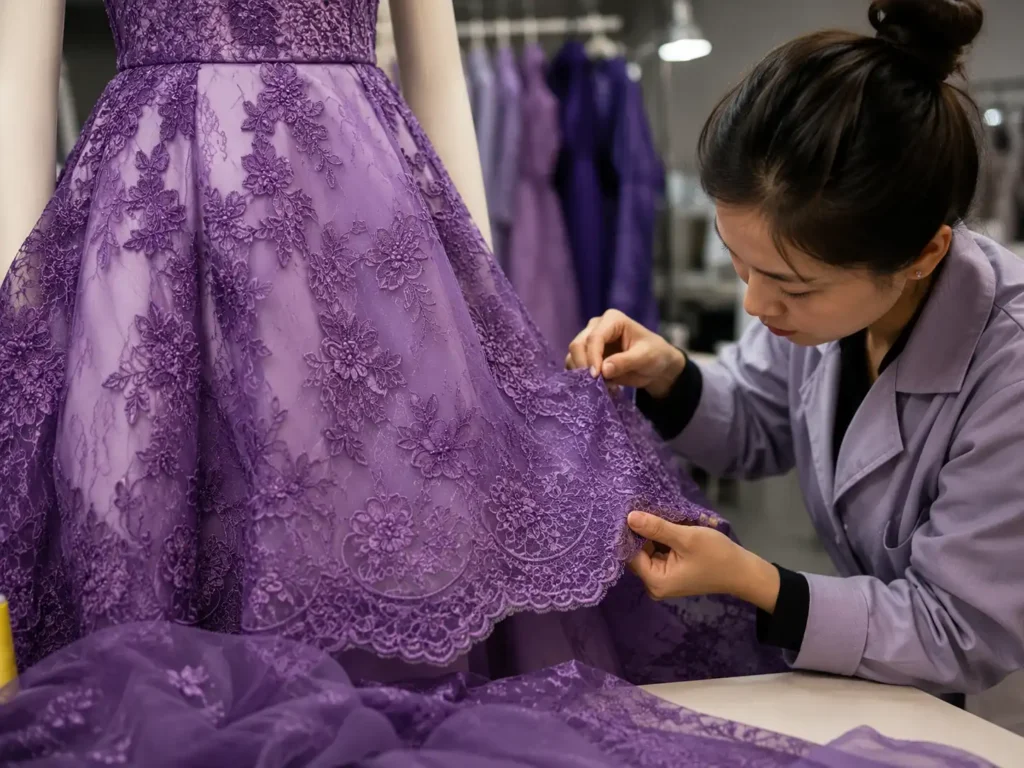
During sewing, inspection shifts toward ground stability, seam quality and damage. Early production pieces should be checked for bulky motif intersections, exposed lining, distorted mesh, broken yarns and uneven joins. If a dense flower crosses a waist seam or zipper line and causes thickness, it is much better to adjust the method during the first pieces than after hundreds of garments have been assembled. Bust coverage also belongs in this stage because a placement problem usually begins with cutting rather than sewing. In-line inspection catches issues while they are still relatively inexpensive to correct, whereas final inspection often discovers the same problem after too much work has already been added to the garment.
Final QC and Packing
Final quality control for lace dresses combines normal garment checks with fabric-specific visual inspection. Measurements, seam quality and general workmanship still matter, but inspectors should also examine motif direction, position, left-right balance, holes, damaged edges, lining exposure, hem treatment and shade consistency. The garment should be compared against the approved reference so that the standard is based on an actual sample rather than a general instruction such as “make it neat.”
Packing deserves equal attention because lace can be damaged after sewing is complete. Fine grounds should not be pressed directly against sharp metal trims or exposed zipper components. Dimensional flowers and appliqués should not be compressed more than necessary, and beaded or sequined lace may require protective separation depending on the design. Folding position can also matter when raised motifs sit at the fold for long periods during transport. The key question before release is whether the factory can reproduce the approved sample repeatedly without relying on individual operators to make important visual decisions from memory. A clear reference, practical checkpoints and early inspection are what make that consistency possible.
Production Stage | What to Confirm | Main Risk Controlled |
Lace Approval | Motif, shade, hand feel, stretch, usable width | Wrong material enters development |
Lining Approval | Color, opacity, weight, stretch | Incorrect transparency or fit |
Sample Fitting | Coverage, drape, comfort, motif position | Fabric looks good flat but fails on body |
PP Approval | Final lace, pattern, lining, workmanship | Sample-to-bulk inconsistency |
Bulk Fabric Inspection | Shade, holes, repeat, width | Roll-to-roll variation |
Cutting | Direction, symmetry, border, motif placement | Irreversible placement errors |
Sewing Inspection | Seams, joins, damage, lining exposure | Defects repeated through production |
Final QC | Measurements, holes, symmetry, color, edges | Defective finished garments |
Packing | Folding, surface protection, decoration | Snagging or crushed surface details |
Conclusion
The best lace for a dress is not automatically the finest, most expensive or most decorative fabric. It is the lace that supports the intended silhouette, creates the right level of transparency, works with the pattern and lining, feels comfortable on the body and can be reproduced consistently in production. Chantilly can create softness, Guipure can add graphic structure, stretch lace can support body-following styles, and 3D lace can deliver strong visual impact, but every one of those choices comes with its own construction and quality implications.
For a custom lace dress project, the most useful development package includes more than a reference image. A clear tech pack or sketch, target silhouette, preferred lace direction, lining expectation, size range and intended visual effect allow fabric sourcing, pattern development and sampling to work as one connected process. When these decisions are made early, problems such as unintended transparency, poor motif placement, incorrect stretch, bulky seams and sample-to-bulk variation are easier to prevent. The result is not simply a prettier lace dress; it is a garment that can move from design concept to approved sample and then into repeatable production with far fewer surprises.
Share This Article :

Jerry Lee
Categories

Latest blogs
Table of Contents
Here, developing your OEM/ODM private label clothing collection is no longer a challenge—it’s an excellent opportunity to bring your creative vision to life.

