 Skip to content
GRS Fabric Sourcing Support
GRS Fabric Sourcing Support for Global Womenswear Brands
Build recycled-material collections around fabric performance, verified supplier scope, production feasibility, and reliable garment execution. Jinfeng Apparel connects GRS-related fabric sourcing with pattern development, sample approval, bulk production, quality control, branded packing, and export delivery.
- Since 2008 in custom womenswear development and manufacturing
- 6 owned women’s fashion factories for category-based production allocation
- 2 sample rooms supported by 7+ senior pattern makers and 20+ sample machinists
- 15+ QC inspectors covering material, cutting, sewing, garment, and packing checks
A fabric certificate alone does not create a successful garment. Weight, stretch, recovery, drape, opacity, surface finish, color consistency, trim compatibility, and production handling still determine the final result. Each project begins with a material brief and moves forward only after the sourcing route, sampling plan, commercial conditions, and documentation expectations are clear.
Built for Structured Womenswear Sourcing Programs
Global Fashion Brands
Sourcing Teams
Sustainability Teams
Product Development Teams
Private Label Programs
Buying and Vendor Offices
Common Risks in GRS Fabric Sourcing
Unclear Certificate Scope
Fabric-Design Mismatch
Fabric MOQ Misalignment
Color and Batch Variation
Weak Bulk Continuity
Disconnected Supply Teams
Our GRS Fabric Sourcing Support Process
The service follows a controlled path from material requirement to production-ready garment standard. Each stage produces a clearer decision: which fabric route is feasible, what must be verified, how the material affects the garment, and what information must move into bulk production.

Define the Material Requirement
Development starts with the product rather than a generic request for “GRS fabric.” The review covers garment category, target composition, recycled-content target, construction, fabric weight, usable width, stretch direction, recovery, drape, shine, transparency, hand feel, color plan, quantity, launch date, target price, testing needs, and documentation expectations.
A satin slip dress, structured office dress, mesh bodycon style, resort maxi, and stretch jumpsuit require different material behavior. Clear specifications prevent the sourcing team from collecting attractive but commercially unsuitable swatches.

Identify the Sourcing Route
The project may follow one of four routes: stock certified fabric, stock greige with custom dyeing, an existing certified base with custom printing or finishing, or a custom-developed material.
Each route carries different MOQ, price, timing, testing, and documentation conditions.
Jinfeng compares available routes against garment quantity and launch timing.
A stock option may support a faster photo sample, while a custom-developed option may offer stronger brand differentiation but require a longer commitment and higher material minimum.

Screen Suppliers and Scope
Potential suppliers are reviewed by legal entity, certified site, product category, material composition, listed processes, certificate validity, and ability to support transaction documentation for the intended order.
The review also identifies whether the proposed source is a mill, processor, trader, or integrated supplier.
A certificate screenshot is not treated as final proof.
Current documents and order-specific confirmation are requested before the material is positioned as an approved sourcing option.

Compare Swatches and Commercial Terms
Selected swatches are compared by appearance, touch, construction, performance, price, available colors, custom-color conditions, material MOQ, lead time, continuity, and suitability for bulk garments. Jinfeng presents alternatives in a way that supports a product decision rather than a fabric-only decision.
Where two options look similar, the comparison can include likely fabric consumption, pattern impact, lining needs, seam behavior, pressing sensitivity, and expected risk during mass production.

Validate Through Garment Sampling
Fabric approval is not complete until the material has been assessed in the intended garment. Pattern makers review stretch, drape, thickness, transparency, seam stability, neckline behavior, zipper installation, lining interaction, and pressing response. The first sample establishes whether the material direction is commercially usable.
Fit comments and fabric comments are recorded separately. A pattern problem should not be mistaken for a material problem, and a material limitation should not be hidden through repeated pattern changes.
Transfer the Approved Standard
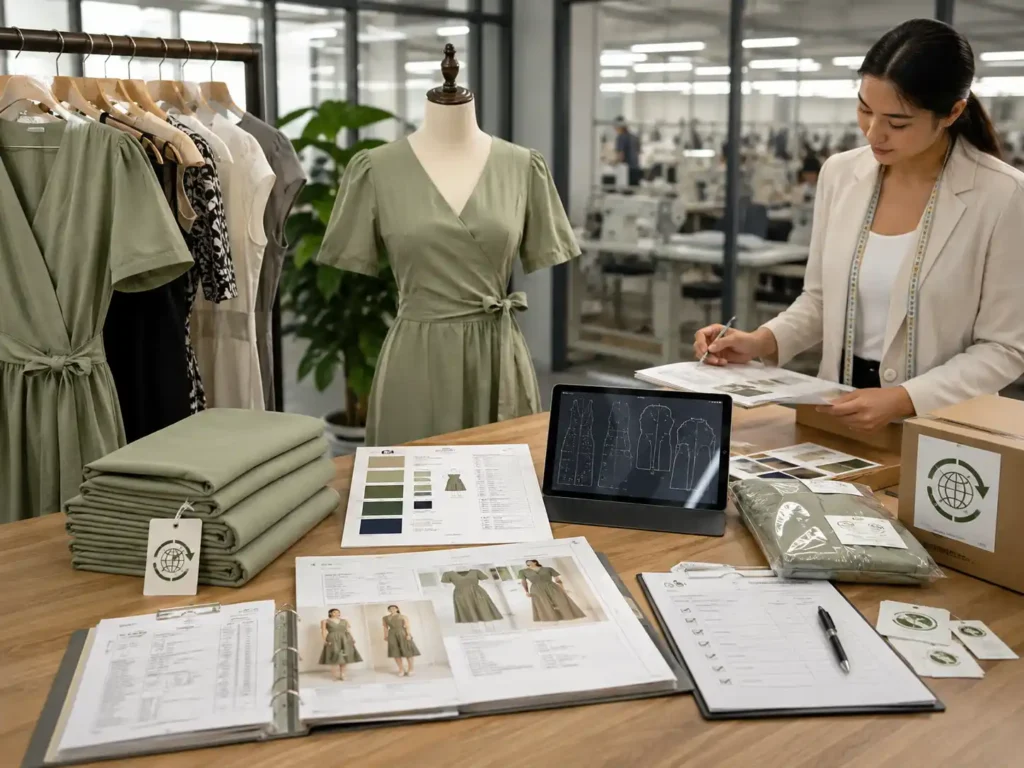
After sample approval, the final material reference moves into the BOM, color record, size chart, pattern file, sewing instruction, QC checklist, packing requirement, and production plan.
Bulk controls are based on the approved reference rather than a supplier description alone.
The handover also records which documentation is expected, who provides it, when it should be available, and which claims still require external confirmation.
GRS Documentation Without Ambiguous Claims
Global Recycled Standard
Scope Certificate
Transaction Certificate
Project Claim Review
How We Screen GRS Fabric Suppliers

Legal Entity Match

Certified Site Match

Product Scope Match

Process Scope Match

Validity and Status

Transaction Readiness
GRS Fabric Directions for Womenswear Collections
The matrix below connects common recycled-material directions with garment applications and the controls required before approval. Availability, certification scope, colors, MOQ, and testing remain project-specific.
| Fabric Direction | Suitable Womenswear | Key Development Checks | Main Bulk Risks |
|---|---|---|---|
| Recycled polyester satin | Slip dresses, occasion dresses, midi and maxi styles | Shine direction, drape, snagging, opacity, lining, zipper flatness | Shade variation, press marks, surface pulls, inconsistent luster |
| Recycled chiffon woven | Resort dresses, layered maxis, sleeves, ruffles | Weight, transparency, drape, print direction, lining balance | Skew, seam puckering, color variation, hem distortion |
| Recycled polyester mesh | Bodycon dresses, cut-out styles, overlays, sleeves | Stretch, recovery, transparency, skin feel, lining support | Holes, seam growth, edge curling, shade difference |
| Recycled jersey knit | Casual dresses, tops, sets, travel styles | GSM, recovery, pilling, shrinkage, twisting, hand feel | Side-seam twist, length growth, pilling, size instability |
| Recycled ponte knit | Structured bodycon, office dresses, fitted sets | Compression, recovery, thickness, seam tension, pressing | Permanent crease, seam impression, inconsistent recovery |
| Recycled nylon stretch | Active dresses, swim-inspired styles, fitted tops | Four-way stretch, opacity, recovery, chlorine or wash needs | Color migration, shine variation, elastic fatigue |
| Recycled cotton blend | Casual tops, jersey dresses, lounge sets | Fiber blend, softness, shrinkage, pilling, colorfastness | Batch hand-feel variation, shrinkage, surface fuzzing |
| Recycled suiting woven | Office dresses, tailored sets, skirts, jumpsuits | Structure, drape, crease recovery, abrasion, lining choice | Pressing shine, seam slippage, color-lot variation |
Matching GRS Fabrics to Womenswear Categories
Material decisions become meaningful only when connected to the garment. Jinfeng develops dresses, skirts, jumpsuits, matching sets, tops, and private-label womenswear with category-specific fit, construction, and QC controls.
Party and Occasion Dresses
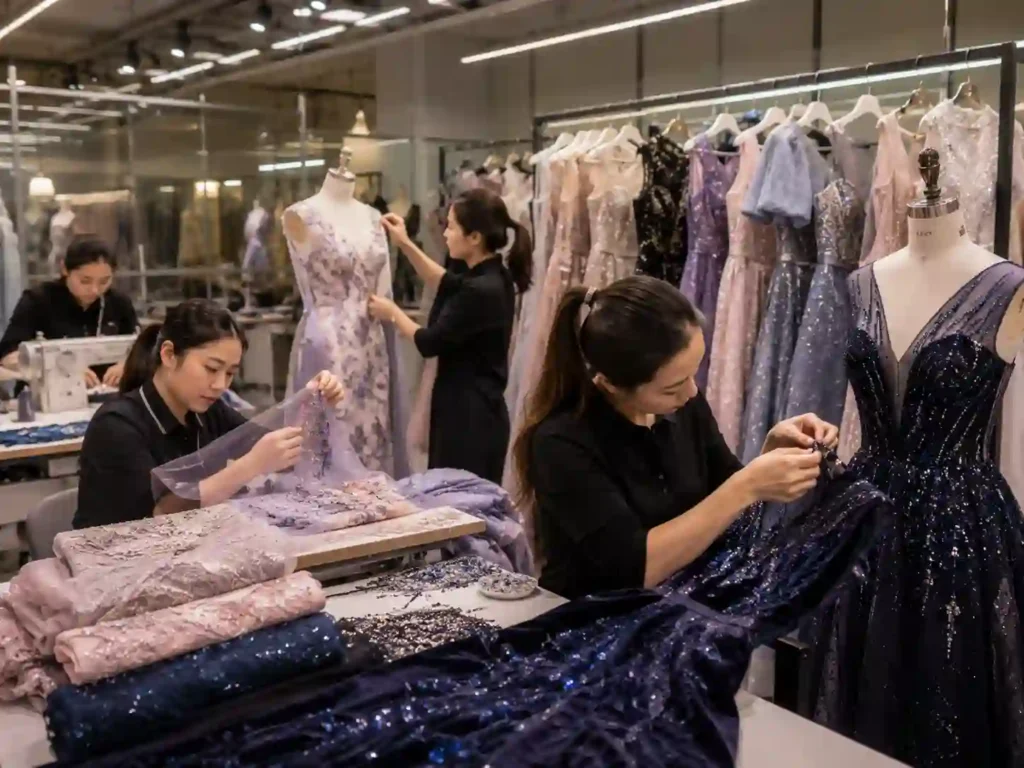
Party and occasion styles depend heavily on visual performance. Recycled satin, mesh, chiffon, lace-associated bases, and sequined recycled-polyester constructions may be evaluated according to shine, drape, opacity, color depth, movement, and camera response. Pattern makers also review bust coverage, waist position, slit height, neckline stability, zipper flatness, and lining balance.
Satin requires careful cutting direction and pressing control. Mesh requires recovery and edge stability. Chiffon requires seam and hem control. Decorative fabrics may require soft lining and anti-scratch handling. Material approval is therefore tied to sample appearance and wearability, not certificate status alone.
Bodycon and Mesh Styles
Bodycon dresses and fitted mesh products need controlled stretch across bust, waist, hip, hem, neckline, and cut-out areas.
Fabric elongation must be balanced with recovery; high stretch without recovery can produce sagging, seam growth, and inconsistent sizing.
Power mesh or supportive lining may be added where the outer material does not provide enough stability.
Fit review covers side-seam twisting, riding up, transparency under tension, bust support, strap load, and post-wash dimension. Grading rules may need adjustment when a recycled alternative behaves differently from the original fabric.
Resort and Vacation Dresses
Resort programs often combine light woven fabrics, printed surfaces, long hems, ruffles, loose sleeves, and travel-friendly packing.
Recycled chiffon, lightweight recycled polyester woven, recycled viscose blends where available, and selected recycled-cotton blends can support the category when drape, transparency, print stability, and wrinkle behavior meet the intended use.
For printed collections, fabric direction, repeat size, shade consistency, placement, and strike-off approval must align with style grouping.
Packing tests help protect long garments and reduce heavy creasing before photography or retail presentation.
Jumpsuits and Matching Sets
Jumpsuits require coordinated control across upper-body fit, waist position, rise, inseam, movement, closure, and fabric recovery. Matching sets add color consistency, upper-and-lower proportion, size-ratio planning, and paired-SKU packing. A recycled fabric with unstable recovery can create different fit results between a top and skirt or between a bodice and trouser section.
Jinfeng reviews fabric direction, usable width, shrinkage, layout, and grading before bulk. Multi-style programs are grouped by fabric family so that approved lots, colors, and handling instructions remain consistent.
Office-to-Evening Collections
Office-to-evening products need structure without excessive stiffness, comfort through long wear, and a surface that maintains a premium appearance. Recycled ponte, crepe-like recycled polyester, selected suiting, and blended woven fabrics can support dresses, skirts, sets, and tailored jumpsuits.
Development checks include crease recovery, pilling, abrasion, seam slippage, lining friction, pressing shine, and sitting comfort. The final option should preserve clean lines while remaining suitable for production volume and repeat orders.
Prepare a Complete Fabric Sourcing Brief
Product and Structure
Material Target
Color and Finish
Quantity Plan
Timeline and Delivery
Compliance and Documents
Swatch Review and Fabric Performance Testing
Swatch evaluation combines appearance, measurable performance, garment construction, and commercial risk. Jinfeng separates visual approval from technical approval so a promising material does not enter sampling with hidden limitations.
Visual and Hand-Feel Review
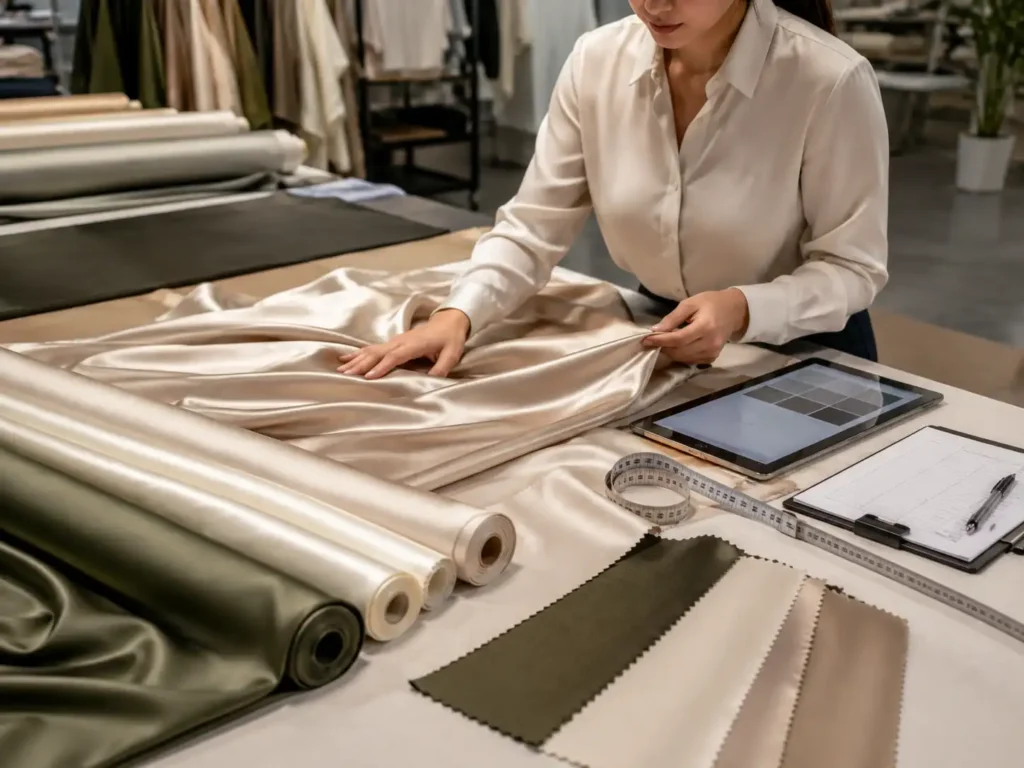
The first review compares color, luster, texture, drape, softness, structure, transparency, and surface uniformity. Materials are viewed flat, hanging, gathered, stretched, folded, and under direct light where relevant. Satin and metallic surfaces are checked for directional shine; mesh is checked under tension; chiffon is checked against lining options.
Videos can document movement, stretch, recovery, and light response when teams cannot review swatches in person. Visual review narrows the list but does not replace measurable testing.
Construction Compatibility
Fabric behavior is assessed against seams, darts, gathers, ruffles, pleats, zippers, hems, binding, elastic, boning, cups, linings, and decorative trims.
Thin material may pucker around an invisible zipper; heavy trim may distort mesh; stretch fabric may require adjusted seam tension; a slippery satin may need revised cutting and handling instructions.
Construction risks identified before sampling save more time than repeated revisions after the garment is assembled.
Dimensional Stability
Shrinkage, growth, recovery, skew, and twisting affect pattern accuracy and size consistency.
Knits may require relaxation before cutting.
Stretch materials may need recovery checks after repeated extension. Wovens may show width or grain variation between lots.
Test results are translated into pattern allowance, cutting direction, garment measurement tolerance, and care-label recommendations where applicable.
Color and Surface Durability
Colorfastness, rubbing, wash response, pilling, snagging, abrasion, coating stability, print adhesion, and surface damage are reviewed according to product use. Occasion satin and sequined surfaces may require protective packing; active or travel garments may require stronger wash and abrasion performance.
Where brand, retailer, or market rules require formal results, testing can be coordinated with the supplier or an approved third-party laboratory by project.
Sample-Level Confirmation
A garment sample reveals interactions that a swatch cannot show: bust and hip tension, neckline collapse, zipper waviness, lining drag, hem balance, opacity in motion, pressing response, and size growth during wear.
Material approval is finalized alongside sample feedback and documented revisions.

From Fabric Selection to Approved Garment Sample

Fabric Shortlist

Pattern Impact Review

First Sample

Fit and Fabric Review

Revised and PP Samples

Golden Sample Record
MOQ, Cost, and Lead-Time Planning
Commercial planning should separate garment production conditions from fabric supplier conditions. Jinfeng’s regular garment MOQ starts from 200 pieces per style and color, while fabric MOQ can rise through custom yarn, custom weaving, dyeing, printing, coating, special finishing, certification scope, or supplier batch requirements.
| Sourcing Route | Typical Commercial Driver | Main Cost Components | Timing Considerations |
|---|---|---|---|
| Stock certified fabric | Available color, lot quantity, remaining inventory | Fabric price, swatches, freight, wastage | Faster when stock and documents are current |
| Stock base with custom dyeing | Dyehouse color MOQ and greige availability | Lab dip, dyeing, shade control, testing, wastage | Lab-dip rounds and dyeing schedule add time |
| Certified base with custom print | Print method, color count, repeat, print MOQ | Strike-off, screens or digital setup, printing, wastage | Artwork, strike-off, approval, and printing lead time |
| Custom-developed fabric | Yarn, knitting or weaving MOQ, finishing requirement | Development, yarn, weaving or knitting, dyeing, finishing | Longest route; several supplier stages require approval |
| Multi-style shared fabric | Combined fabric consumption across styles | Shared lot, color management, cutting efficiency | Strong option when 10-30 styles use grouped materials |
| Special performance fabric | Test method, coating, lamination, or functional finish | Finish, testing, lower efficiency, protective packing | Processing scope and final documentation need early review |
Bulk Production Controls for GRS Fabric Garments
Approved material must remain controlled through receiving, cutting, sewing, finishing, packing, and final inspection. Jinfeng’s quality system includes 15+ QC inspectors and covers incoming material, cutting, sewing, in-line, garment, pressing, packing, AQL, inspection coordination, and repeat-order review.
Incoming Material Control
Received fabric is checked against the approved reference for supplier, article, color, lot, width, weight, hand feel, stretch, recovery, surface finish, visible defects, and available accompanying information.
Rolls are identified by lot so shade or performance differences can be isolated before cutting.
Critical materials such as satin, mesh, jersey, printed fabric, coated fabric, and linings receive category-specific checks.
A mismatch discovered before cutting can be contained; the same mismatch discovered after sewing can affect an entire production batch.
Relaxing and Cutting Control
Knitted and stretch fabrics may require controlled relaxation before marker planning and cutting. Grain direction, stretch direction, print direction, pile, shine direction, and left-right symmetry are confirmed before bulk cutting. Layers, cutting height, notch accuracy, and bundle identification are adjusted according to the material.
Satin is protected from pulls and directional luster errors. Mesh is protected from holes and distortion. Printed fabrics are reviewed for repeat and placement. Multi-size bundles remain identified through sewing.
Sewing and In-Line Control
Line setup follows the approved PP sample, sewing instruction, and fabric behavior.
QC checks seam tension, stitch length, puckering, seam growth, zipper installation, lining balance, edge finishing, support structure, trim attachment, and measurement at risk points.
Problems are corrected during production rather than waiting for final inspection. In-line findings are linked to the responsible operation and reviewed across the remaining quantity.
Garment and Pressing Control
Finished garments are checked for measurements, symmetry, fit-critical construction, color consistency, surface damage, transparency, drape, stretch recovery, closures, trims, lining, hem balance, and overall appearance. Pressing temperature and pressure are adapted to the material to avoid shine, flattening, marks, distortion, or coating damage.
Photo-sensitive occasion products receive additional visual review under suitable lighting. Stretch garments receive measurement and recovery checks after handling.
Packing and Final Inspection
Packing checks include brand label, size label, care label, fiber-content information, hangtag, barcode, SKU label, polybag, size-ratio packing, carton mark, carton quantity, and shipping documents. Delicate satin, sequined, coated, or embellished garments receive protective packing where required.
Final inspection can include AQL-based review and coordination with a nominated third-party inspector. Bulk records are retained for repeat-order comparison and quality follow-up.
Private Label, Documentation, and Delivery Support
Fiber Content Labels
Care Label Coordination
Brand and Size Labels
Barcode and SKU Packing
Shipping Documentation
Certificate Coordination
Clear Support Boundaries Build Stronger Programs
Jinfeng Can Support
- Jinfeng can review product and material requirements, identify sourcing directions, coordinate swatches, compare commercial options, assess garment suitability, develop patterns and samples, manage fabric-related production controls, organize private-label packing, prepare shipment documents, protect confidential files, and retain approved references for repeat orders.
- The production system includes 6 owned women’s fashion factories, 10+ long-term satellite production partners, 18+ sewing lines, 6+ flexible production lines, 2 sample rooms, 7+ senior pattern makers, 20+ sample machinists, 15+ QC inspectors, and 12+ merchandisers. Production allocation depends on style structure, material, workmanship, quantity, timing, and QC needs.
Verified by Project
- Supplier certificate validity, exact fabric scope, approved processing stages, recycled-content percentage, transaction-document availability, consumer-facing claim eligibility, testing requirements, custom-color MOQ, custom-development conditions, and final certified chain must be verified for the actual project.
- No promise is made that every recycled fabric is always available, every color can follow garment MOQ, every shipment automatically receives a transaction document, or every final garment qualifies for a public GRS claim. Clear verification protects the brand, supplier, and long-term program.
Womenswear Program Examples

US Occasionwear Collection
An established US occasionwear label developed an 18-style collection totaling approximately 36,000 garments. The range included recycled-polyester satin midi dresses, lined chiffon maxis, stretch mesh bodycon styles, and matching evening sets across several color groups.
The main sourcing challenge involved finding materials that supported the required shine, drape, opacity, recovery, and cross-fabric color direction without separating fabric decisions from garment fit. Jinfeng grouped styles by material family, compared stock and custom-dyed options, reviewed swatches against linings and trims, and prioritized six photo-critical styles for early sampling.
Sample comments covered neckline stability, zipper flatness, bust coverage, mesh recovery, lining length, and satin press marks. Approved changes were transferred into the patterns, BOMs, sewing instructions, and QC checklists. Bulk fabric was controlled by lot, with additional visual inspection for shade, surface pulls, and luster direction before cutting.
The program moved through first sample, revised sample, PP sample, and Golden Sample stages, followed by phased bulk delivery aligned with the brand’s campaign calendar.

European Resortwear Program
A European resortwear brand planned 24 styles and approximately 58,000 garments across printed maxis, lightweight dresses, coordinated sets, skirts, and jumpsuits.
The collection used several recycled-polyester woven directions, lightweight mesh details, and selected recycled-content blends.
The main difficulty was balancing light hand feel with opacity, print clarity, wrinkle behavior, repeat alignment, and bulk timing. Jinfeng organized the program into print groups, solid-color groups, and shared-lining groups. Strike-offs and fabric swatches were reviewed alongside sample silhouettes so print scale and fabric drape could be approved together.
Pattern work focused on hem balance, ruffle volume, waist placement, jumpsuit rise, lining coverage, and movement.
Bulk controls included print direction, shade grouping, panel placement, seam puckering, hem distortion, and anti-crease packing for long garments.
Production was divided into planned phases, allowing campaign styles to move first while later styles completed final print and sample approval.

North American Active-Fashion Drop
A North American fashion group developed a 12-style active-fashion drop totaling approximately 24,000 garments.
Products included fitted dresses, tennis-inspired styles, stretch tops, skirts, and coordinated sets using recycled nylon stretch, recycled polyester jersey, and supportive mesh.
The material challenge centered on four-way stretch, recovery, opacity, compression, pilling, side-seam stability, and consistent fit across sizes.
Jinfeng reviewed fabric extension and recovery, adjusted negative ease by material family, and separated outer-fabric and lining behavior during fitting.
Sample review covered bust-waist-hip proportion, armhole shape, skirt ride-up, seam growth, waistband recovery, and opacity under movement.
Bulk production used relaxation controls, stretch-direction checks, measurement checkpoints, seam-tension review, and final recovery inspection.
Approved material, pattern, color, packing, and QC records were retained for reorder evaluation and future color extensions.
GRS Fabric Sourcing Frequently Asked Questions
It is a project-based service connecting recycled-material requirements with supplier screening, swatch review, garment suitability, sampling, bulk control, private-label packing, and documentation coordination. The goal is not merely to find fabric carrying recycled claims, but to identify material that can meet the collection’s appearance, fit, quantity, timing, and verification needs.
Jinfeng does not make a blanket certification claim for every factory, process, fabric, or garment. Relevant supplier certificates, processing scope, transaction documentation, and final claim eligibility are reviewed by project. Current verified documents should be checked before any public statement or order commitment.
Yes, sourcing directions can be reviewed for satin, chiffon, mesh, jersey, ponte, stretch nylon, suiting, selected blends, and other women’s fashion materials. Availability, colors, composition, recycled content, certificate scope, MOQ, price, and lead time depend on the specific source and project.
The review covers legal entity, certified facility, product scope, material category, listed processes, certificate validity, and transaction readiness. A certificate screenshot alone is not treated as proof for a specific fabric or shipment.
A Scope Certificate describes an organization’s approved site, products, materials, and processes within a validity period. A Transaction Certificate relates to a specific certified transaction. Holding an SC does not automatically prove that every fabric or shipment is certified.
Jinfeng’s regular garment MOQ starts from 200 pieces per style and color. Fabric mills may require separate minimums for stock lots, custom dyeing, custom printing, special yarns, custom weaving, finishing, or certified batches. Shared fabrics across 10-30 styles can sometimes improve commercial alignment.
Yes. Available swatches, color cards, videos, or sample yardage can be coordinated before garment sampling. The review should cover appearance, hand feel, weight, width, stretch, recovery, drape, transparency, surface quality, price, MOQ, timing, and available documents.
It can. A recycled alternative may differ in stretch, recovery, weight, drape, shrinkage, thickness, or surface finish. Pattern and sample review determine whether measurements, negative ease, lining, seams, support, or pressing methods need adjustment.
Custom dyeing and printing can be evaluated according to base-fabric availability, color MOQ, lab-dip or strike-off requirements, print method, artwork, supplier schedule, testing, and certificate scope. Approval time should be planned before the garment sample deadline.
No automatic promise can be made. TC availability depends on the certified supply chain, actual organizations, approved products and processes, transaction details, upstream records, and certification-body requirements. The document path should be confirmed before order placement.

Start Your GRS Fabric Sourcing Review
A useful evaluation requires enough information to connect material requirements with garment development and bulk production. Send a tech pack, reference sample, line sheet, or product brief together with the collection plan.
Jinfeng will review the product structure, possible fabric routes, sourcing risks, sample needs, commercial conditions, production fit, QC priorities, and documentation points before recommending a development path.
Please include:
- Product category and style count
- Reference images, tech packs, or original samples
- Preferred fiber composition and recycled-content target
- Fabric weight, width, stretch, hand feel, shine, or transparency needs
- Color plan, print files, and trim direction
- Quantity by style and color
- Size range and fit requirements
- Photo-sample, PP, bulk, and launch dates
- Testing, certificate, retailer, or transaction-document requirements
- Packing, barcode, SKU, shipping, and destination information


