 Skip to content
One Shoulder Top Manufacturer for Fashion Labels
Custom one shoulder tops developed around asymmetric fit, fabric behavior, retail presentation and repeatable bulk production for established fashion labels.
- 4 fit zones reviewed before pattern approval: shoulder anchor, neckline angle, bust coverage and exposed-side armhole depth.
- 3 core approval stages for production readiness: first fit sample, revised sample and PP sample confirmation.
- 8 one-shoulder QC checkpoints carried from approved sample into cutting, sewing, finishing and packing.
- MOQ starts from 200 pcs per style/color, with fabric, trim, color and packaging requirements evaluated before quotation.
Jinfeng Apparel supports one shoulder tops from reference images, original samples, sketches, line sheets or complete tech packs. Pattern development, fabric and trim sourcing, sample correction, bulk production, private-label packing and export coordination are managed through a structured womenswear production system in Guangdong, China.
Development Capacity Behind Every One Shoulder Top
Since 2008
Long-term womenswear development experience supports pattern interpretation, fabric selection, sample correction and production planning for fashion-led collections rather than isolated cut-and-sew execution.
6 Owned Factories
10+ Production Partners
2 Sample Rooms
7+ Pattern Makers
20+ Sample Machinists
Built for Fashion Labels With Structured Production Plans
Brand-Led Development
Multi-Style Collections
Retail-Ready Delivery
One Shoulder Structures Are Not Interchangeable

One Shoulder

Off Shoulder

Cold Shoulder

Asymmetric Neckline
Where One Shoulder Top Development Commonly Fails
Neckline Slippage
Uneven Shoulder Pull
Bust Coverage Loss
Armhole Exposure
Recovery Breakdown
Grading Distortion
One Shoulder Top Styles for Fashion Collections

Fitted Jersey Top

Rib Knit Crop

Ruched Side Top

Draped Woven Blouse

Mesh Layered Top

Satin Occasion Top

One Shoulder Bodysuit

Single Sleeve Top
Build One Shoulder Tops Into Stronger Collections

Going-Out Collection

Resort Collection

Occasion Collection
Match Fabric Performance to One Shoulder Structure
Fabric choice controls how the neckline holds, how the covered shoulder carries tension and how the exposed side behaves during movement. Visual preference alone is not enough; weight, stretch direction, recovery, opacity, drape and sewing response must support the intended silhouette.
| Fabric | Best Use | Weight / Stretch | Manufacturing Control |
|---|---|---|---|
| Stretch Jersey | Fitted, ruched and double-layer tops | 160-320 gsm; medium-high stretch | Confirm recovery, negative ease, edge stability and side-seam rotation. Relax fabric before cutting. |
| Rib Knit | Cropped, casual and fitted silhouettes | 180-360 gsm; directional stretch | Control rib direction, neckline band tension, hem stretch and shade variation. |
| Ponte | Structured fitted tops and matching sets | 220-380 gsm; moderate stretch | Manage bulk at seams, shoulder pressure, pressing and neckline thickness. |
| Power Mesh | Layered, body-contoured and support panels | 100-250 gsm; high stretch | Check opacity, recovery, seam strength, layer alignment and exposed-edge comfort. |
| Fine Mesh | Sheer party tops and decorative layers | 40-120 gsm; low-high stretch by base | Prevent snagging, holes, seam tunneling and uneven layer tension. |
| Stretch Satin | Fitted occasion tops and draped styles | 120-260 gsm; low-medium stretch | Control shine, snagging, seam puckering, recovery and pressing temperature. |
| Crepe | Draped blouses and clean woven styles | 120-260 gsm; usually low stretch | Plan closures, grain, pleat placement, shrinkage and seam appearance. |
| Lace | Occasion, layered and statement tops | 70-220 gsm; varies by construction | Review motif placement, lining, edge finish, color matching and damaged areas. |
Engineering Stable Fit Across an Asymmetric Neckline
One-shoulder fit is a tension system. Shoulder placement, neckline geometry, bust shape, armhole depth and fabric recovery must support one another. Correcting only the most visible symptom rarely produces a stable result.

Shoulder Anchor and Neckline Angle
The covered shoulder acts as the main anchor, but the strongest position is not automatically the highest or widest point. Pattern review compares shoulder width, slope, neck base, arm movement and the intended diagonal line. An anchor placed too far outward can slide; one placed too far inward can pull the neckline toward the neck and distort the opposite armhole. The neckline length is measured along the finished sewing line, not only along the raw edge. Binding, facing, elastic or a double-layer finish changes the effective tension. During the first fitting, the garment is observed from front, side and back while the wearer lifts both arms, turns the torso and sits. Comments are converted into precise pattern actions such as moving the shoulder point, shortening the neckline, changing the edge finish or redistributing ease. A revised sample confirms whether the correction works without creating a new pressure point.

Bust Coverage and Exposed-Side Support
The diagonal neckline crosses the upper bust at an angle, making conventional neckline-depth measurements insufficient. Pattern makers compare the bust point, exposed-side edge, front armhole, side seam and lining contour as a connected shape. Coverage must remain aligned with the intended styling and undergarment plan during movement. For fitted jersey or mesh, double layers and controlled negative ease can provide support; for woven satin or crepe, darts, princess shaping, internal tape, lining and a concealed opening may carry the structure. A lower armhole can look visually lighter but may reveal too much during movement, while a higher armhole can cut into the body and pull the neckline. Fit comments should state exact edge movements and measurements instead of broad instructions such as “more coverage.”

Tension Distribution and Recovery
Asymmetric garments often twist when one edge is stabilized and the opposite body area remains too loose. Tension is assessed across neckline, covered shoulder, exposed-side armhole, under-bust area and hem. Stretch fabrics are checked in both directions because a material can have strong width stretch but limited vertical recovery. Edge binding must recover without gathering the shell, and internal elastic must support the neckline without creating visible indentation. Woven designs may require a closure to avoid forcing the garment over the shoulders. Repeated dressing tests reveal relaxation that a single fitting cannot show. When recovery is insufficient, possible actions include changing fabric, increasing layer support, revising neckline length, changing elastic quality or adjusting the pattern ease. The selected solution must remain manufacturable at bulk scale.

Movement and Wear Testing
Static mannequin review is useful for visual balance but cannot replace a live fitting. Wear testing includes raising the arms, reaching forward, turning, walking, sitting and returning to a neutral position. The neckline should recover without continuous adjustment, the shoulder anchor should remain seated and the exposed-side edge should not migrate. Sleeve versions are also checked for elbow bend, cuff pressure and rotation. Comments are recorded by location and action: for example, “neckline drops 12 mm after arm lift” is more useful than “feels loose.” The pattern, elastic specification or sewing method is then revised. A final PP sample should match the approved fit, fabric and trim package before bulk production begins.
Design Details That Define One Shoulder Tops

Draped Neckline

Side Ruching

Single Long Sleeve
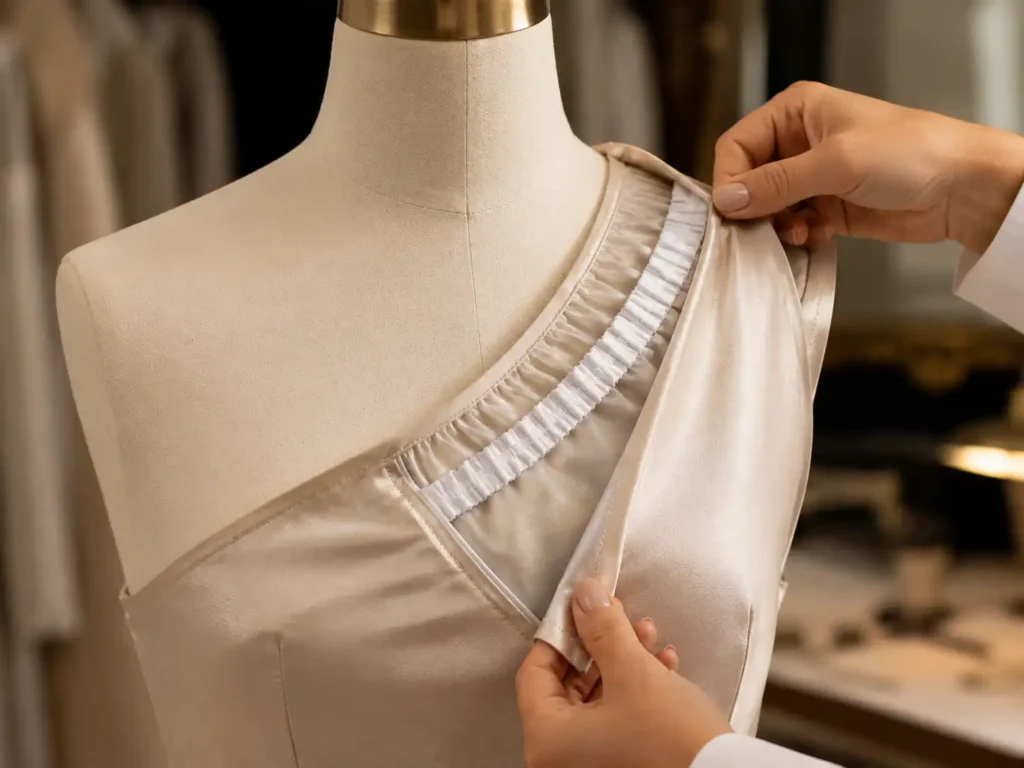
Internal Elastic
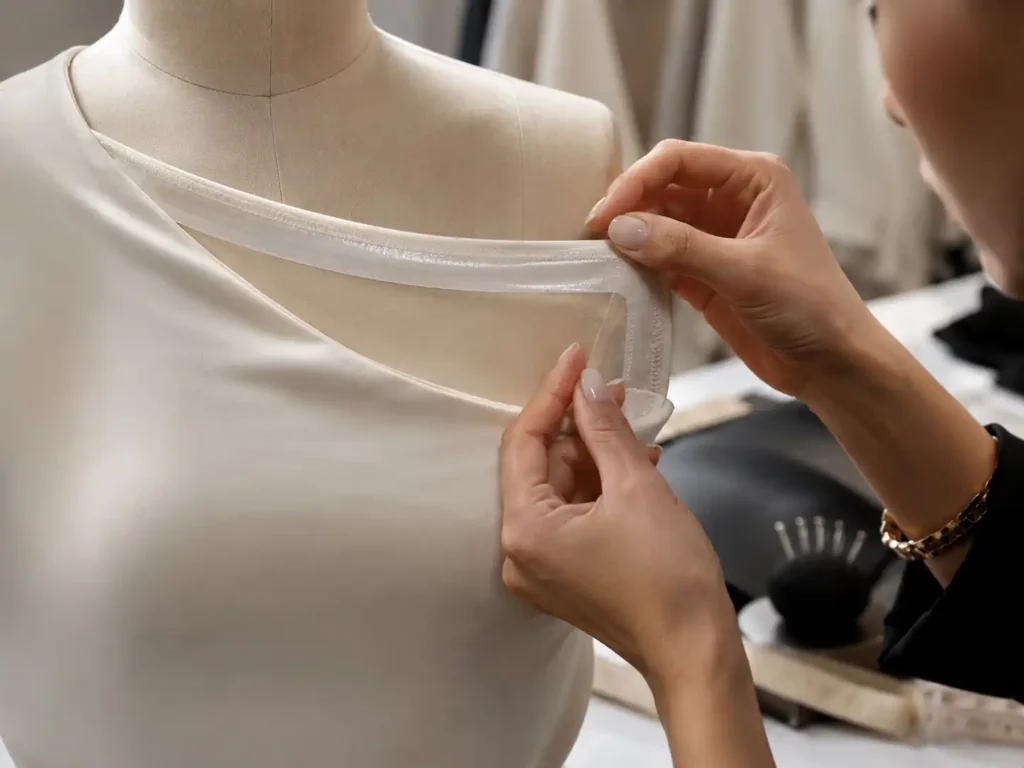
Anti-Slip Support

Double-Layer Front

Side Zipper

Decorative Trims
Grading One Shoulder Tops Across the Size Range
A strong base-size sample is only the starting point. Asymmetric grading protects the visual line and coverage while shoulder width, bust growth, armhole depth and body length change at different rates.

Anchor Point by Size
The shoulder anchor cannot move by the same amount as the bust or body width. Grading rules consider neck width, shoulder slope and intended coverage. A small size may need a tighter anchor without narrowing the neckline excessively, while larger sizes may need extra shoulder support without shifting the design line too far outward. Pattern overlays are reviewed before cutting a size set.

Neckline Angle Control
Keeping the exact same diagonal angle across all sizes can reduce bust coverage in larger sizes or raise the neckline too far in smaller sizes. The target visual line is preserved through controlled point movement rather than uniform scaling. Key neckline points, finished length and exposed-side height are measured against the approved grading plan.

Bust and Armhole Growth
Bust circumference, front length and armhole depth interact strongly in one-shoulder styles. Extra bust room should not simply be added at the exposed side because the neckline may open. Growth is distributed through side seams, darts, princess lines, stretch allowance or panel shaping. Armhole depth is checked with the intended undergarment and movement requirement.

Size-Set Verification
For production programs, representative sizes are sampled or measured according to the agreed size range and risk level. Key points include bust, waist, hem, shoulder position, neckline length, exposed-side edge, armhole depth, sleeve length and body length. Results are recorded against the size chart before final bulk grading is released.
From Style Reference to Approved Production Sample
Project Review
Fabric Direction
Pattern Development
First Sample
Revision Record
PP Approval
Manage Ten to Thirty Styles Without Losing Control
Group by Fabric
Rank Hero Styles
Track Approval Status
Separate Risk Levels
Lock Shared Components
Plan Bulk Allocation

Transfer Approved Samples Into Repeatable Bulk Standards
The handover from sample room to production determines whether the approved fit survives at scale. Final files, materials and workmanship references are assembled before cutting begins.
- Final Pattern and Grading File: The approved pattern includes the corrected neckline, shoulder anchor, exposed-side armhole, body shape, sleeve or opening and hem. Grading rules and size-chart references are released together so bulk cutting does not rely on an outdated base pattern. Pattern version control matters when several sample rounds have changed different areas.
- Fabric and Trim Reference: Bulk fabric is matched to the approved quality, weight, stretch, hand feel, color and finish. Trim cards can include elastic, zipper, hook-and-eye, tape, lining, thread, labels and packaging components. Substitute materials require review because even a small elastic or lining change can alter fit and construction.
- Sewing Standard and First Pieces: Construction instructions identify stitch type, seam allowance, edge finish, gathering ratio, elastic length, closure method, label position and pressing approach. First production pieces are checked against the PP sample before line output increases. Early correction is less disruptive than sorting a completed order.
- QC and Packing Handover: Measurement points, tolerance, visual checkpoints, trim requirements, pressing rules, label placement, barcode data, packing ratio and carton marks are transferred into production and finishing checks. Production, merchandising, QC and packing teams work from the same approved information rather than separate message threads.
Workmanship Standards for Clean One Shoulder Tops

Stable Neckline Finish

Flat Shoulder Seams

Smooth Side Seams

Clean Layer Alignment

Secure Closures

Controlled Pressing
Quality Control Focused on Asymmetric Construction
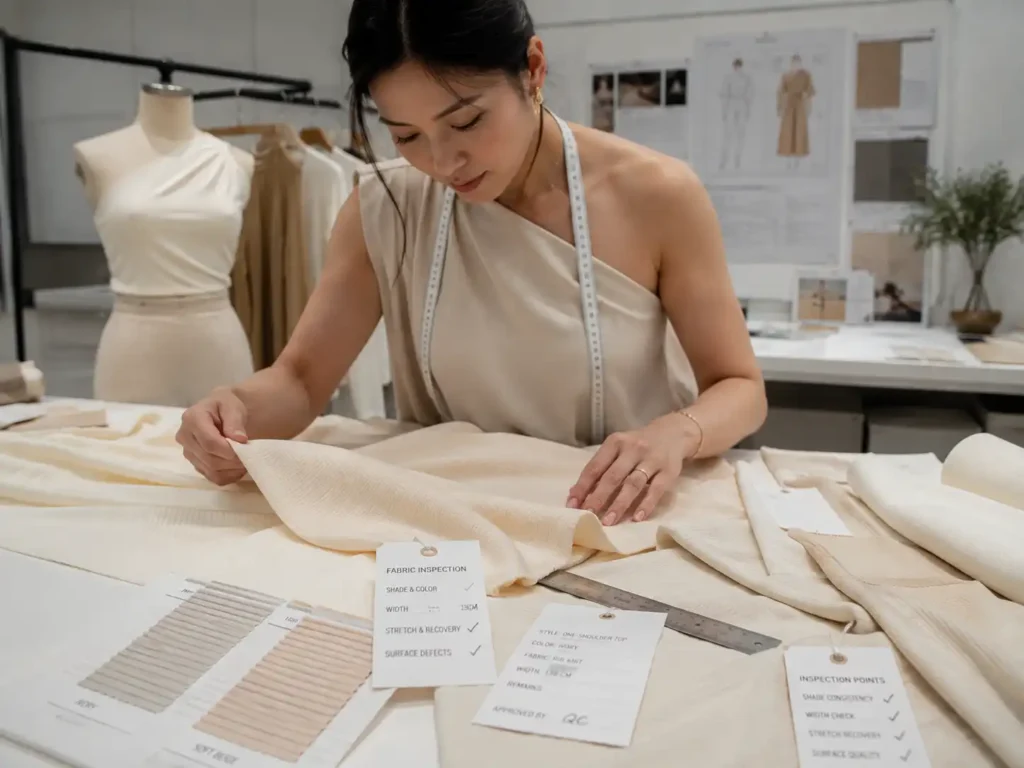
Fabric Inspection

Cutting Direction

Neckline Angle

Bust and Armhole

Elastic Recovery

Measurement Control

Visual Workmanship

Packing Accuracy
Private Label, Compliance Support and Design Protection
Retail-Ready Packing
NDA and Design Protection
Material and Audit Support
MOQ, Quotation and Production Planning
MOQ starts from 200 pcs per style/color. Final feasibility and quotation depend on fabric source, color development, trims, construction, size ratio, packaging, quality requirements and production schedule. A lower quantity does not automatically create a shorter timeline when materials or approvals are not ready.
| Project Input | MOQ Effect | Cost Effect | Planning Effect |
|---|---|---|---|
| Stock fabric and standard color | Usually supports the base MOQ when supplier stock is confirmed | More stable material costing | Faster planning after sample and PP approval |
| Custom dye or custom weave | Fabric mill minimums may raise garment MOQ | Adds development and dyeing cost | Requires lab dip, approval and bulk fabric time |
| Custom print | Print base and color count affect minimums | Adds artwork, screen or digital setup | Needs strike-off or print sample approval |
| Special mesh, lace or sequins | Supplier stock and motif availability govern MOQ | Lining, placement and handling add cost | Sourcing and testing can extend development |
| Special trims or closures | Trim supplier minimum may apply | Mold, plating or custom color may add cost | Approval and production follow trim supplier timing |
| Multiple colorways | MOQ is evaluated per style/color | Smaller color splits reduce cost efficiency | More approvals and shade control are needed |
| Complex construction and packing | Garment MOQ may remain 200, subject to materials | More sewing, QC and packing labor | Longer sample review and production preparation |
One Shoulder Top Manufacturing Frequently Asked Questions
The base MOQ starts from 200 pcs per style/color. Fabric stock, custom color, custom print, special mesh or lace, trims and packaging can carry separate supplier minimums. Quantity is evaluated per style and per color rather than by combining unrelated styles into one total.
Yes. Reference images, sketches, line sheets, original sample photos and complete tech packs can all start the review. More accurate assessment becomes possible when quantity, fabric direction, size range, target market, labels, packaging and delivery goals are included.
Yes. Jinfeng supports jersey, rib knit, ponte, mesh, power mesh, stretch satin, crepe, lace and other suitable womenswear fabrics. Pattern, closure, edge finish and support method are selected according to stretch, recovery, drape, opacity and construction.
Stability is managed through the shoulder anchor, neckline length, fabric recovery, pattern ease, internal elastic, tape, lining or double-layer construction. Live fitting and movement checks are used because mannequin appearance alone cannot confirm recovery during wear.
Simple styles can often be sampled in 7-10 days. Ordinary womenswear styles generally require 10-15 days, while complex structures can need 15-25 days. Special fabrics, custom trims and delayed approvals follow the relevant supplier and review timing.
Yes. Brand-specific size charts can be used. Grading reviews shoulder anchor, neckline angle, bust growth, exposed-side armhole, side seam, sleeve, body length and elastic length rather than applying uniform enlargement to the full pattern.
Yes. Programs with 10-30 styles can be grouped by fabric, construction, launch priority, trim package and production route. A style tracker can record sample status, revision, fabric approval, PP status, quantity and required delivery window.
Yes. Woven labels, size labels, care labels, hangtags, barcode stickers, SKU labels, polybags, stickers, cartons, carton marks and warehouse labels can be supported according to confirmed artwork and packing instructions.
Yes. NDA-based cooperation can protect tech packs, original samples, patterns, unpublished designs, labels, packaging files, prices and order information. Brand identity and unreleased styles are not disclosed without authorization.
Send the style reference or tech pack, target quantity per style/color, fabric preference, color plan, size range, construction details, private-label requirements, quality standards and target delivery window. The team can then review feasibility, sampling, MOQ and cost drivers.

Start Your One Shoulder Top Development
Send Kelly the style information available now, whether it is a complete tech pack, a line sheet, an original sample reference or a group of concept images. Jinfeng Apparel will review the asymmetric structure, fabric direction, trim requirements, sample route, MOQ fit, private-label needs and production planning before issuing a formal next step.
Clear source files help the pattern and merchandising teams identify risk earlier and reduce unnecessary revisions later.
- Reference image, sketch, tech pack or original sample photos
- Target quantity for each style and color
- Preferred fabric, weight, stretch or hand-feel direction
- Color plan and brand-specific size range
- Main label, care label, hangtag, barcode and packaging requirements
- Target launch, delivery destination and nominated forwarder details when available
- Quality, testing, compliance or warehouse receiving requirements


