Skip to content

A garment can travel through fibre production, fabric making, dyeing, cutting, sewing, packing, retail, customer use, resale, repair, and textile sorting while much of its useful history remains scattered across technical packs, spreadsheets, test reports, supplier emails, and factory records. The care label may show fibre content and washing symbols, but it rarely explains which material version entered bulk production, what changed after sampling, or which evidence supports a product claim.
A Digital Product Passport for fashion is a structured digital record connected to a physical garment through a persistent identifier and a readable data carrier. It can provide verified product, material, manufacturing, compliance, care, repair, and end-of-life information to authorised users. The passport is the maintained data record; a QR code is only one possible access point.
That distinction matters because two dresses can carry nearly identical QR labels while offering completely different value. One code may open a short-lived campaign page, while the other resolves to the correct style, colour, production version, composition, care instructions, responsible economic operator, and supporting information. The small printed square is the visible part. The difficult work begins earlier, when design, sourcing, production, quality control, and data ownership must agree on what the garment actually is.

What Is a Fashion DPP?
A fashion Digital Product Passport is a structured product record linked to a garment through a persistent identifier and data carrier. It can hold or connect product, material, manufacturing, compliance, care, repair, and end-of-life information. The applicable product rules determine which fields are required, who may access them, and whether the passport applies at model, batch, or item level.
A Product Record, Not a Sales Page
A normal ecommerce page is designed mainly to present and sell a product. It may contain photographs, colours, size options, styling suggestions, and a brief material description, but it can change when the collection is refreshed or disappear when the style is discontinued. A DPP is intended to remain connected to the product and support information needs that continue after the first retail transaction.
Take a black satin occasion dress as an example. The sales page may describe a fitted waist and adjustable straps, while the product record may need to distinguish shell and lining composition, identify the exact style-colour version, connect the garment to the responsible economic operator, and provide care or end-of-life information. If a later batch uses a different lining, the record must represent that change instead of repeating the first sample’s data.
The Working Architecture
A functioning passport depends on four connected parts: a defined physical product, a persistent identifier, a readable carrier, and a maintained digital record. Supporting evidence sits behind those parts and gives the information credibility. When the identifier changes between the design team, factory, and warehouse, or when the carrier opens a temporary campaign page, the digital record no longer matches the garment reliably.
The EU ESPR framework expects passport information to be electronically accessible, interoperable, machine-readable, and protected against inappropriate changes. The textile-specific rules will determine the exact fields, carrier placement, data availability period, and passport granularity. A company therefore needs a durable information architecture, not merely a QR-code generator or a beautifully designed consumer landing page.
| DPP element | Fashion example | Common failure |
| Physical product | One model, production batch, or individual garment | Materially different versions share one record |
| Unique identifier | Style, SKU, GTIN, batch code, or serialised ID | Identifiers differ between design, factory, and warehouse |
| Data carrier | QR code, barcode, NFC, RFID, or another approved carrier | The code opens only a short-lived marketing page |
| Digital record | Composition, responsible parties, care, compliance, and lifecycle data | Information reflects the sample rather than bulk production |
| Supporting evidence | BOMs, specifications, reports, and approvals | Published claims cannot be traced to source records |
Different Users, Different Views
A shopper, retailer, repairer, recycler, customs officer, and market-surveillance authority do not need the same view. Customers may want composition, care, repair, and responsible-business information. Retailers may need product variants and compliance references. Repair and sorting operators may need component details, while authorities may need identifiers and restricted technical documentation that should not appear on the public consumer screen.
Controlled transparency is especially important in fashion because technical packs, original patterns, unpublished designs, supplier prices, and component sources can be commercially sensitive. Good governance defines which data is public, which data is shared only with approved partners, which information is reserved for authorities, and who may create, approve, correct, or withdraw each record. Personal customer data should remain outside the passport unless a lawful and explicit purpose exists.

Why Does Fashion Need DPPs?
Fashion needs DPPs because essential garment information is often fragmented, inconsistent, and difficult to verify once production changes begin. A persistent digital record can strengthen traceability, support better-substantiated product claims, and provide care, repair, resale, sorting, and recycling information that conventional labels cannot hold. It also exposes weaknesses in BOM control, supplier evidence, and product-version management.
Traceability Gaps in Real Orders
Fashion traceability often looks stronger in a policy statement than it does during a live order. A company may know the name of its garment factory but still struggle to connect the shipped dress to the exact shell fabric, lining, zipper, elastic, labels, and approved component versions used in bulk. The largest gaps usually appear when materials, facilities, or construction details change after the first sample.
A designer may approve one fabric for fit while purchasing later confirms a commercially workable replacement. The change may be agreed through email or a messaging application, yet the technical pack, care-label draft, compliance folder, and product description may continue to show the earlier material. Preparing a passport forces the business to define product identity, ownership, approval, evidence, and update rules instead of reconstructing the decision months later.
| Production event | Data risk | Possible commercial effect |
| Bulk fabric replaces sample fabric | Composition and care remain unchanged | Incorrect labels, claims, or customer information |
| Lining changes by colourway | All colours retain one generic BOM | The record does not match the garment |
| Factory allocation changes | The old facility remains in the system | Production-location data becomes inaccurate |
| Trim substitution is approved informally | Component records are not revised | Repair and component information becomes unreliable |
| Repeat order uses a new material lot | Previous evidence is reused automatically | Batch-level claims may be unsupported |
| SKU mapping differs by system | The record links to the wrong variant | Customers or authorities see incorrect data |
Useful Information After the Sale
Most apparel data loses practical value after the product leaves the retailer. The customer keeps a small care label, while repair businesses, resale platforms, sorters, and recyclers may receive little reliable information about the garment’s construction or materials. A digital record can preserve relevant information without trying to print every field inside a dress or on a removable paper hangtag.
The EU strategy for sustainable and circular textiles links DPPs with products that last longer and are easier to repair and recycle. Useful information may include clearer care guidance, replaceable closure details, material composition, or sorting instructions. A passport will not make a mixed-material sequin dress automatically recyclable, but it can describe the product’s complexity accurately instead of reducing the entire garment to one broad fibre name.
Claims Need Evidence
Environmental statements become harder to control as collections, suppliers, colourways, and repeat orders multiply. A claim such as ‘made with recycled materials’ remains incomplete unless the business can identify the relevant component, explain the calculation, define the affected batches, and connect the statement to current supplier evidence. The most credible passports will publish fewer, clearer claims rather than large collections of vague assertions.
The ESPR allows future product rules to address durability, repairability, substances of concern, environmental performance, and appropriate end-of-life handling. The detailed textile fields are still under development, so every proposed data point should not be presented as final law. The practical lesson is immediate: each published statement needs a source, responsible reviewer, approval date, relevant product version, and defined update trigger.
What a Passport Cannot Fix
A passport records and communicates information; it does not automatically improve fabric durability, pattern efficiency, sewing quality, fit consistency, working conditions, inventory planning, or recyclability. A poor-quality garment can still carry a polished digital interface, and incorrect supplier information can still enter an advanced system. Technology can protect a record after entry, but it cannot prove that the original statement matched the material delivered.
DPP readiness is therefore tied to ordinary product-development discipline. Fabric confirmation, sample approval, pre-production checks, laboratory testing where relevant, inline inspection, final measurement, label verification, and packing checks remain necessary. The digital record should be the controlled output of those activities. It should never become a substitute for physical quality control, competent technical review, or accurate communication between the brand and its suppliers.

Which DPP Rules Apply?
The ESPR establishes the EU framework for Digital Product Passports, but it does not yet impose one final universal apparel passport on every garment. Textiles and apparel are a priority product group, with 2027 identified as an indicative target for adopting product rules. Final scope, fields, access rights, passport level, transition periods, and application dates require textile-specific legislation.
ESPR Sets the Framework
Regulation (EU) 2024/1781, commonly called the ESPR, is in force and creates the framework through which product-specific ecodesign and information requirements can be adopted. It does not prescribe one identical passport for every product category. Delegated acts define what applies to a particular group, including data points, identifiers, carrier placement, passport granularity, access rights, and the period for which information must remain available.
The framework already establishes practical principles. A passport is linked through a data carrier to a persistent unique product identifier. Information should be accessible electronically, interoperable, and protected against inappropriate alteration. The DPP Registry is designed as a central indexing service storing identifiers and registration data rather than every detailed product record, while full information remains in the decentralised passport environment.
Apparel Timing
The Ecodesign for Sustainable Products and Energy Labelling Working Plan 2025-2030 lists textiles and apparel as a priority product group and gives 2027 as the indicative year for adopting the relevant measure. That is a planning target for the delegated act, not an automatic deadline requiring every garment to carry a complete passport on 1 January 2027.
Preparatory studies, consultation, technical analysis, and impact assessment come before adoption. The final act then identifies covered products, data requirements, transition arrangements, and application dates. The ESPR normally provides at least 18 months before a delegated act applies unless a justified exception is made. A 2026 Joint Research Centre study explores possible textile-apparel DPP content, but it supports rule development rather than functioning as the final mandatory dataset.
| Regulatory stage | What it means for fashion companies |
| ESPR framework in force | The legal mechanism and core DPP principles already exist |
| Textiles in the 2025-2030 working plan | Apparel is a confirmed priority product group |
| Preparatory studies and consultation | Scope, impacts, methods, and candidate data points are assessed |
| Textile delegated act adopted | Detailed apparel obligations become legally defined |
| Transition period | Brands, importers, retailers, and suppliers prepare systems and records |
| Application date | Covered products placed on the EU market follow the final rules |
Who Carries Responsibility
Responsibility depends on how the garment is placed on the EU market and on the duties assigned by the final rules. A non-EU factory is not automatically the operator responsible for the consumer-facing passport simply because it sewed the product. A brand, importer, retailer, authorised representative, or another economic operator may carry the formal obligation under a particular supply and market structure.
The responsible organisation still depends on upstream information. Fabric mills may hold composition evidence, trim suppliers may provide component data, and garment factories may need to confirm the final BOM, production site, approved substitutions, care-label details, packing identifiers, and quality records. Supplier contracts and onboarding procedures should define fields, evidence formats, update deadlines, retention periods, confidentiality levels, and responsibility for corrections.
What Is Still Open
As of July 2026, textile-specific questions remain open, including exact apparel scope, mandatory data fields, verification methods, public and restricted access layers, carrier placement, passport granularity, and application dates. The JRC has published a methodology for defining DPP data requirements and a detailed textile-apparel study, showing that the data model is being developed rather than copied from a generic software template.
Companies can still prepare sensible foundations now: stable product identifiers, final composition, controlled material versions, responsible-party information, manufacturing records, care data, and evidence sources. A practical plan separates established ESPR principles, likely preparation fields, and final textile-specific obligations. That approach improves data discipline immediately while preserving flexibility to adapt when the delegated act is published.
What Data Is Included?
A fashion DPP may include product identity, responsible-party details, materials, components, production information, compliance documentation, care guidance, repair information, and end-of-life data. The final mandatory apparel dataset is not fixed. Companies should build verified and version-controlled product records while separating confirmed legal fields from proposed, voluntary, conditional, confidential, or role-restricted information.
Identity Comes First
Product identity is the anchor for every other field. Accurate composition has little value when it is connected to the wrong style, colour, batch, size, or production version. Fashion companies often use overlapping references such as design style numbers, factory order codes, retailer SKUs, warehouse barcodes, GTINs, and internal colour or size identifiers. These references need a reconciled master structure rather than informal cross-checking.
A controlled product master commonly includes style code, product name, category, season, colour reference, size range, SKU structure, responsible business, and production version. Colourways may share a pattern while using different dyes, linings, prints, or decorative components. Larger size ranges may also use wider elastic or stronger support parts. The passport structure should distinguish variants whenever required information changes.
Materials and Components
A useful material record separates the garment into components. A description such as ‘100% polyester’ may cover only the shell while omitting lining, power mesh, elastic, zipper tape, sequins, embroidery, thread, labels, and other elements. The public display may not list every part, but the underlying BOM should identify components that affect composition, claims, care, repair, or end-of-life handling.
Fabric names also require technical translation. Satin, chiffon, lace, mesh, crepe, jersey, and velvet describe appearance or construction rather than complete fibre content. Material records should connect supplier article number, composition, weight, usable width, colour reference, approval status, and relevant production orders. Certified, recycled, or organic claims must be checked against supplier, batch, colour, certificate scope, validity, and the material actually used in bulk.
Manufacturing and Compliance
Manufacturing information may include production facilities, process stages, order references, component sources, and records supporting product claims or compliance. The final disclosure level will depend on textile rules and access rights. Internally, the finished garment should still be connected to the approved production source, even when commercial details remain restricted from consumers or general supply-chain partners.
Compliance files may include declarations, test reports, chemical information, material specifications, care assessments, and documentation required under other applicable laws. Care data needs equal control. A lined satin dress with boning and cups may need different instructions from an unlined slip dress even when both use a similar shell fibre. The final wording should follow the approved bulk product rather than an earlier sample.
Access and Confidentiality
A practical passport uses access layers. Public information may include identity, composition, care, repair guidance, and responsible-business details. Approved partners may receive more detailed component or supply-chain data, while authorities may access restricted declarations or technical documentation. The final textile rules will define mandatory information and the actors entitled to view or update it.
Fashion companies must also protect technical packs, original patterns, supplier prices, unpublished launch plans, client-specific packaging, and proprietary construction methods. Reliable DPP data is not the same as publishing everything. It is controlled transparency: correct information, supported by appropriate evidence, available to the correct audience for the required period, with clear ownership and a documented process for corrections.

How Does a Fashion DPP Work?
A fashion DPP works by linking a garment, its packaging, or accompanying documentation to a persistent product identifier through a machine-readable carrier. Scanning the carrier retrieves a structured record from connected systems. Product-specific rules determine the accepted carrier, placement, passport granularity, required fields, user access, update rights, and the period for which the information remains available.
The Carrier and Identifier
The carrier is the visible or scannable part of the passport. QR codes attract attention because ordinary smartphones can read them, but the ESPR framework is not limited to one technology. Barcodes, two-dimensional symbols, NFC, RFID, or other identification methods may be used where product rules and standards allow them. The carrier opens the record; it is not the complete passport itself.
Placement affects usefulness. A code printed only on a paper hangtag may work before sale but disappear immediately afterward. A code in a care label may remain with the garment, although it must survive relevant washing, pressing, abrasion, and folding. The identifier should also remain persistent when a brand changes its website, software platform, or service provider, which requires redirects, data ownership, export, backup, and migration planning.
Model, Batch, or Item
Passport granularity describes how closely the record matches the physical product. A model-level passport can cover units sharing the same required information. A batch-level passport can distinguish production period, facility, fabric lot, or component source. An item-level passport gives each garment its own identity and can support authentication, repair history, rental, resale, or take-back services, although it creates more identifiers and operational work. The ESPR allows delegated acts to select the appropriate level. One style number may not always be sufficient because a printed colourway can use a different shell composition, a repeat order can move to another factory, or a zipper can be replaced with an approved substitute. A scalable structure can link item data to batch and model records rather than duplicating every stable field.
Systems Behind the Passport
The complete record rarely comes from one platform. Product identity may sit in PLM, purchasing and order data in ERP, consumer content in PIM, testing in a compliance system, supplier information in sourcing tools, and production details in factory records. The passport layer connects and presents the required information; it does not automatically replace every existing business system.
A typical flow moves from design approval to BOM confirmation, purchasing, pre-production approval, production, quality control, packing, and passport publication. Each handoff can create errors. A revised BOM may not reach the care-label team, a barcode may be printed incorrectly, or an approved substitution may never enter the compliance record. Interoperable, machine-readable data matters more than fashionable technology labels. Blockchain is not required to make incorrect source data true.
Updates and Continuity
Fashion products change frequently as materials become unavailable, suppliers replace components, labels are corrected, and repeat orders move between production units. The workflow must define whether a change requires a new identifier, a new batch, or a revised record. It should preserve what changed, when the change occurred, who approved it, which quantities were affected, and which data fields required review. Continuity extends beyond the original sale and beyond one software subscription. A passport that stops working two seasons after launch cannot support repair, resale, market surveillance, or lifecycle traceability. The ESPR framework and registry arrangements point toward persistent availability, so service contracts should address data ownership, structured export, backups, migration, redirects, and termination instead of assuming that one vendor will remain in place forever.

How Should Brands Prepare?
Brands should prepare by auditing product data, assigning ownership, controlling material and construction changes, and testing a limited collection before committing to a large DPP platform. The priority is not printing QR codes. It is creating a dependable connection between the final garment, approved BOM, supplier evidence, production version, care information, responsible parties, and retained records.
Start with a Data Audit
A useful pilot begins with a manageable group containing enough variation to reveal real problems. A five-style dress capsule might include a lined woven dress, a stretch bodycon style, a lace occasion dress, a matching set, and a garment with decorative trims. This produces a realistic mix of materials, construction, suppliers, care requirements, and change points without attempting to map the entire catalogue at once.
The audit compares what the business believes it knows with what it can prove. Composition may exist in the ecommerce system but not match the bulk specification. A factory name may identify a sourcing office rather than the production site. A recycled-content claim may lack evidence connected to the purchased colour and batch. Internal readiness measures should locate these gaps rather than become unverified marketing statistics.
| Audit area | What to check | Useful internal measure |
| Product identity | Style, colour, size, SKU, barcode, and version alignment | Share with one reconciled master record |
| BOM control | Shell, lining, trims, and approved production version | Share of bulk orders with a final approved BOM |
| Material evidence | Composition, specifications, and claim support | Share of material fields linked to evidence |
| Factory data | Actual production site and order or batch reference | Share traceable to the correct facility |
| Care information | Instructions match bulk materials and construction | Share reviewed after final material approval |
| Change records | Substitutions, approvals, quantities, and affected fields | Share captured outside informal messages |
| Data ownership | Named owner and update rule for each field | Share with accountable ownership |
| Exportability | Structured data can move between systems | Share available outside static PDFs |
Fix Change Control
Most passport errors begin before the DPP platform, when the physical product changes but the information does not. Every material or construction change should identify the affected style, colour, size range, order, and batch. The request should explain the reason, list fields that may change, identify required approvals, and update the BOM, care wording, compliance file, costing, and passport data together.
Fast-fashion schedules create frequent pressure points. Fabric may be replaced because a mill misses the launch date, lining may change to solve transparency, zipper length may be revised after fitting, or a repeat order may move to another production line. A final pre-production checkpoint should confirm pattern, measurement chart, BOM, bulk materials, trims, labels, care wording, barcodes, and packaging before cutting begins.
Test One Collection
A pilot should reproduce the complete process rather than produce a few attractive demonstration pages. For each product, define passport level, carrier placement, public and restricted fields, evidence sources, approval routes, and update responsibilities. Test the mobile customer view, but also test data extraction, correction, version control, access permissions, backup, export, migration, and the connection between ecommerce variants and passport records.
The physical carrier also needs testing. A code intended for a care label should remain readable after relevant washing, pressing, and handling, while placement should not irritate the wearer or damage a delicate garment. Include one planned change during the pilot, such as replacing a lining or moving a batch, to see whether the process can manage real development rather than only display static information.
Set Supplier Responsibilities
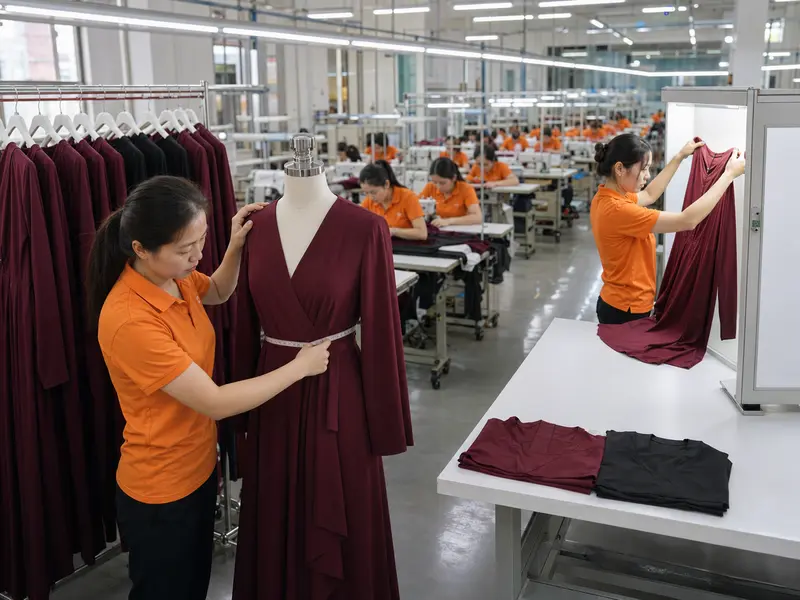
Reliable passports cannot be built when supplier data is treated as an informal request sent just before shipment. Required fields, source documents, formats, deadlines, confidentiality levels, and retention periods should be agreed during onboarding and development. A clothing manufacturer may need to confirm the final production BOM, facility, material references, approved substitutions, care-label details, quality status, SKU mapping, and packing identifiers.
Jinfeng Apparel supports custom womenswear development from reference images, samples, or technical packs through fabric and trim sourcing, pattern development, sample revision, bulk production, quality control, private-label packing, and export coordination. Its documented system includes 2 sample rooms, 7+ senior pattern makers, 20+ sample machinists, 15+ QC inspectors, and retained pattern, measurement, fabric, trim, and packing records for repeat orders. These capabilities support orderly data collection, while final legal compliance remains with the relevant economic operator and professional compliance team.