Skip to content

A dress may look simple on a product page, yet dozens of technical decisions sit behind its final appearance. The neckline must hold its shape, the waist must sit where the designer intended, the fabric must drape correctly, the lining must not twist, and every size must preserve the approved silhouette. Labels, care instructions, barcodes, packing ratios and warehouse requirements must also match the brand’s operating system. A private label dress manufacturer connects those decisions and turns a concept into a product that can be sampled, approved, produced and reordered.
A private label dress manufacturer develops or produces dresses that another company sells under its own brand. The manufacturer may handle pattern making, fabric sourcing, sampling, size grading, bulk sewing, quality control, labels, packaging and export coordination, while the brand controls product positioning, customer-facing identity and final approvals.
The phrase private label is often used loosely. One supplier may only replace the neck label on an existing catalogue style, while another may create a new pattern from a tech pack, correct the fit through several samples, source brand-specific materials and deliver a retail-ready collection. Those services involve very different levels of control, investment and product ownership. Many costly production problems begin before the first piece of fabric is cut, because the brand and factory never defined what had to be developed, approved, documented and reproduced. The following guide explains the model in practical terms so a fashion team can evaluate a supplier before a promising sample becomes a difficult bulk order.
What Private Label Means
Private label manufacturing separates the consumer-facing brand from the production company. The customer sees the fashion label on the garment, website and packaging, while the manufacturer works behind the scenes to engineer and produce the product. In its simplest form, private labeling may mean adding a brand label and hangtag to an existing dress. In a more developed arrangement, the factory creates a new pattern, sources a specific fabric, corrects the fit through sampling and manufactures the approved style for the client.
That difference matters because two suppliers may use the same marketing term while offering very different levels of control. A catalogue supplier may allow changes to color, label and packaging but keep the silhouette and construction unchanged. A development-led manufacturer may adjust measurements, internal support, seam placement, lining, trims and finishing so the garment reflects a particular brand standard.
A buyer should confirm what private label includes before paying for development:
- Whether a new pattern will be created or an existing block will be reused.
- Whether fit, measurements, fabric, trims and construction can be customized.
- Whether the same or a similar style may be offered to other clients.
- Whether labels, care information, barcodes and branded packaging are included.
- Whether approved patterns and technical records will be retained for reorders.
The answers reveal whether the brand is buying a lightly modified garment or building a controlled commercial product. That distinction affects development cost, exclusivity, lead time and the ability to repeat the style later.
Custom or Ready-Made?
Private label dresses can be selected from a ready-developed range, modified from an existing base style or created as fully custom products. Each route can be commercially sensible when it matches the brand’s priorities.
A ready-developed style is useful when speed matters more than exclusivity. The brand may change the color, label and packaging while the original silhouette remains largely unchanged. This reduces pattern and sample work, but similar garments may appear in other stores. A modified style sits in the middle: the factory might change the neckline, sleeve, length, fabric or fit while keeping the underlying pattern foundation.
A fully customized private label dress normally starts from a tech pack, physical sample, sketch, line sheet or clearly defined reference. It may require original pattern development, brand-specific measurements, custom fabrics or colors, special internal construction, dedicated trims, size grading and pre-production approval.
The more customized the product becomes, the more important written approvals and version control become. A custom garment is not defined only by how different it looks. It is defined by whether the design, measurements, material references, construction and packaging are documented well enough to be produced consistently across sizes and future orders.
Brand and Design Ownership
The client normally owns its name, logo, label artwork, packaging design and customer-facing product identity. Ownership of the garment pattern, print artwork, technical files and manufacturer-developed design details should be clarified separately.
A practical agreement should state who supplied the original concept, who created the production pattern, whether development fees include pattern ownership, whether the style is exclusive and whether the factory may display the sample. It should also explain how unpublished files are stored, who can access them and what happens to the records after production.
An NDA can provide a legal framework, but daily operating behavior matters just as much. A responsible manufacturer controls access to unreleased samples, technical files, private label artwork, order quantities, pricing and launch schedules. When satellite factories or specialist suppliers are involved, confidentiality procedures should extend through the complete production chain.
Jinfeng Apparel supports NDA-based cooperation and protects client tech packs, samples, patterns, trims, private label details and unpublished designs throughout development and production. The practical value is not simply secrecy; it is giving the brand confidence to share enough information for accurate development without losing control of its future collection.
Who Uses This Model?
Private label dress manufacturing is widely used by established ecommerce brands, occasionwear labels, boutique chains, fashion retailers, sourcing companies, regional distributors and brand groups managing several collections. These companies want product control without operating their own cutting, sewing, finishing and quality systems.
The model is especially valuable when a business needs its own fit and size system, coordinated seasonal collections, custom labels, retail packaging, reliable reorders and access to specialized production for satin, mesh, lace, sequins, corsetry or stretch garments.
Mature brands also use external manufacturers because factory ownership creates permanent commitments in labor, equipment, maintenance, compliance, material purchasing and capacity planning. Outsourcing production allows the brand to focus on merchandising, marketing, sales and customer data while using the manufacturer’s technical and operational infrastructure.
The strongest relationships usually begin when the brand already understands its customer, price level, sales channel and product direction. A factory can solve technical and production problems, but it cannot replace a missing commercial strategy. Clear brand decisions allow the manufacturer to make better fabric, construction, cost and scheduling recommendations.
How Does Private Label Dress Manufacturing Work?
Private label dress manufacturing usually follows a controlled sequence: product brief, feasibility review, costing, material sourcing, pattern development, sampling, fit approval, pre-production confirmation, bulk manufacturing, inspection, branded packing and shipment. Each stage should create a clear approval before the next begins.
Product Brief and Feasibility
A project begins with enough information for the manufacturer to understand what the brand wants to make and whether the idea is technically and commercially realistic. The strongest starting point is a complete tech pack, but development can also begin from a physical sample, front and back sketches, reference photographs, a line sheet, a moodboard, a size chart or a fabric swatch.
The brand should also state the expected quantity, number of colors, size range, target market, planned sales season, quality level, target price range and required delivery window. These commercial details affect technical choices. A premium occasionwear dress may justify internal support, layered lining and delicate finishing that would not fit a lower retail price.
A professional review considers more than whether the dress can technically be sewn. The factory should assess whether the chosen material can hold the silhouette, whether the design can be graded across the intended size range, whether trims are available, whether the construction is stable in bulk and whether the deadline allows enough time for approvals.
A quick quotation based on one image may look efficient, but it often hides assumptions about fabric, lining, seam construction, quantities and packaging. A more reliable quotation explains what has been included and which variables could still change the price.
Fabrics, Patterns and Samples
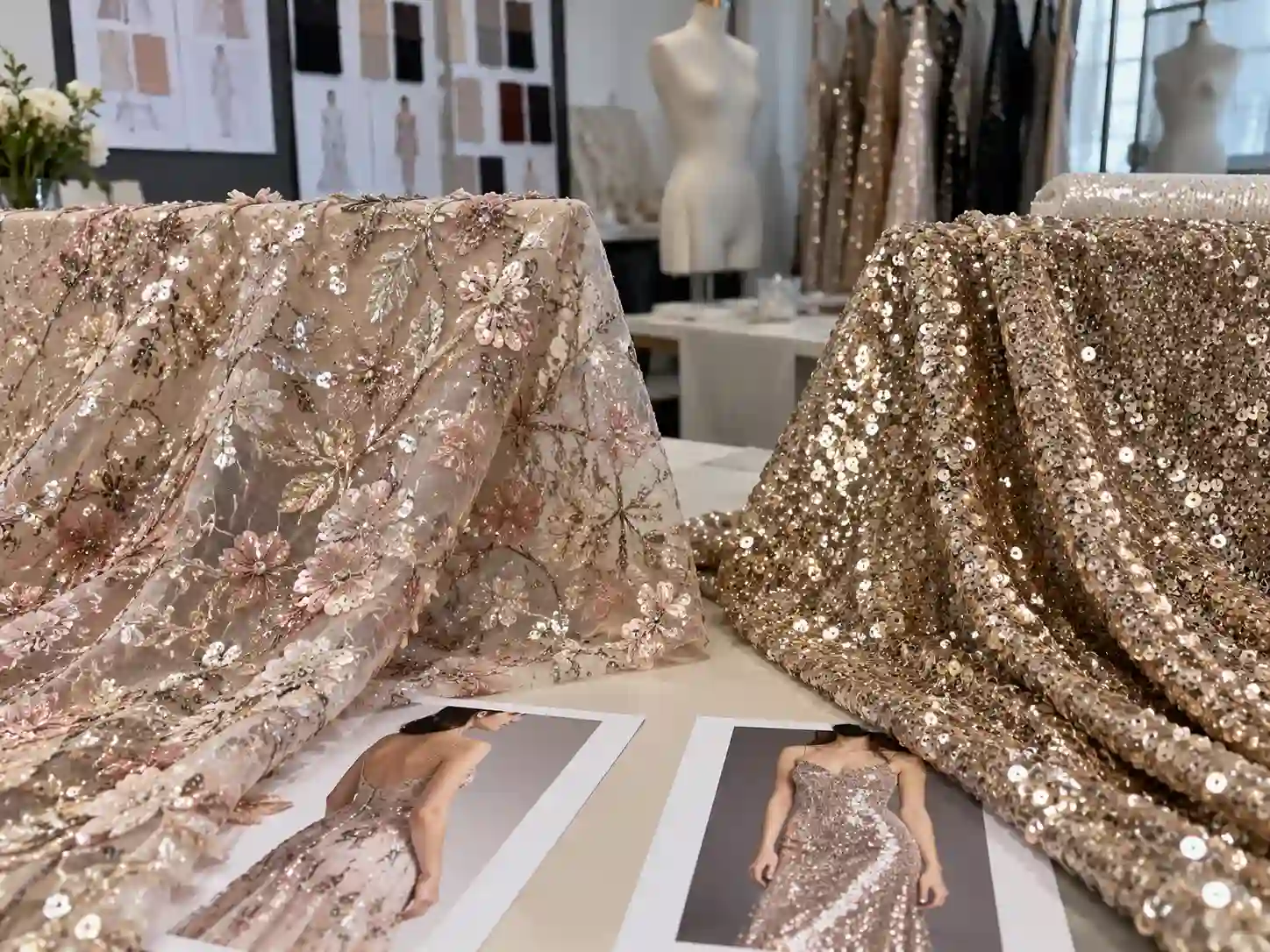
Fabric, pattern and construction must work together. A bodycon dress made in high-recovery ponte behaves differently from the same pattern cut in lightweight jersey. A non-stretch satin corset dress requires different ease and internal support from a stretch satin version. A soft mesh may drape beautifully but need reinforcement around a zipper or gathered neckline.
Material review should cover composition, practical weight, usable width, stretch direction, recovery, shrinkage, drape, transparency, surface finish, color consistency, bulk availability and supplier minimums. When an exact material is not available, the replacement should be evaluated for how it changes fit, sewing method, cost and lead time.
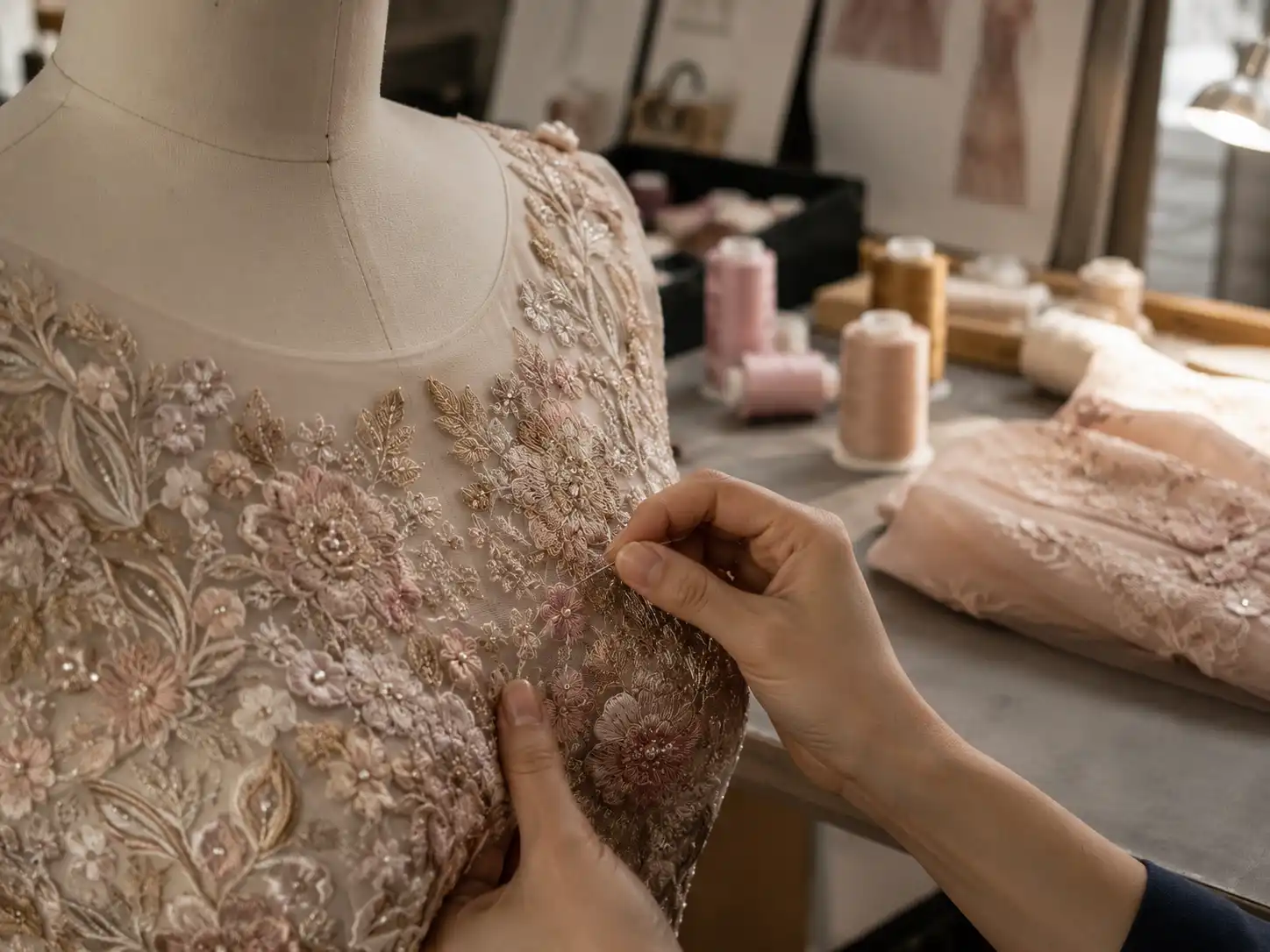
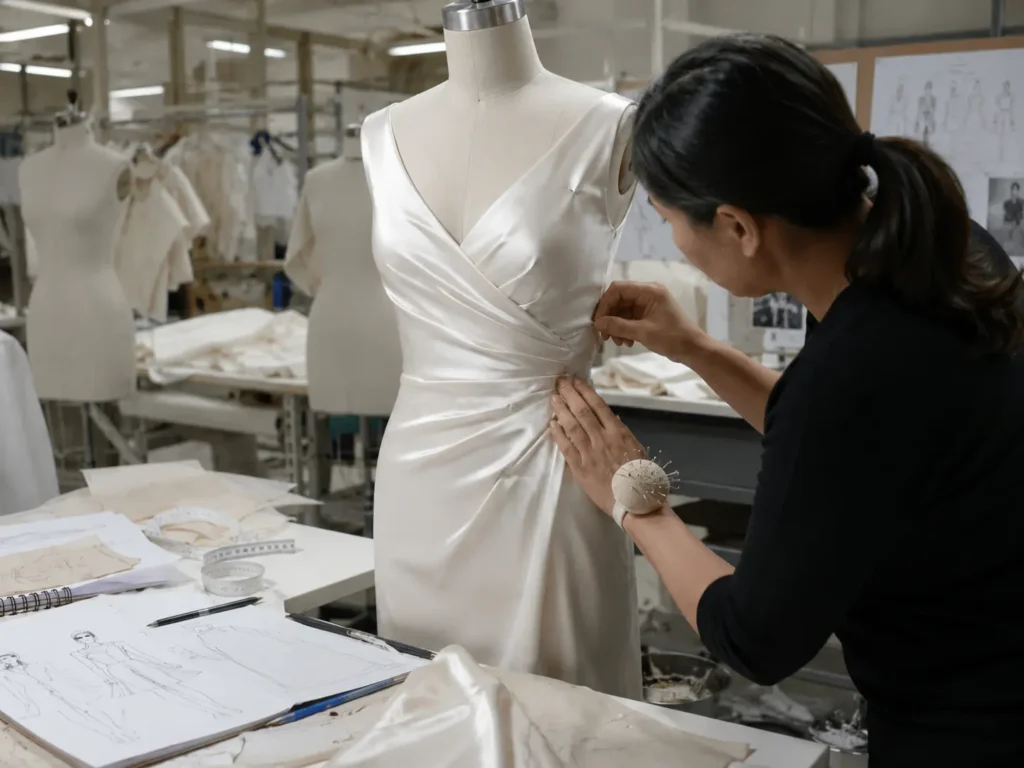
Pattern development converts the design into production pieces and controls the relationship among bust, waist, hip, neckline, shoulder, armhole, strap length, skirt balance and overall length. The first sample is not expected to answer every question perfectly. Its purpose is to reveal what must be corrected before bulk production.
Sample comments should be measurable. ‘Make the waist tighter’ leaves room for interpretation; ‘reduce the waist circumference by 2 cm while keeping both side seams vertical’ gives the pattern maker a usable instruction. Corsetry, asymmetrical draping, sequins, lace placement, bias cutting and multiple fabric layers often require additional sample rounds because one adjustment can affect several parts of the garment.
From PP Sample to Bulk
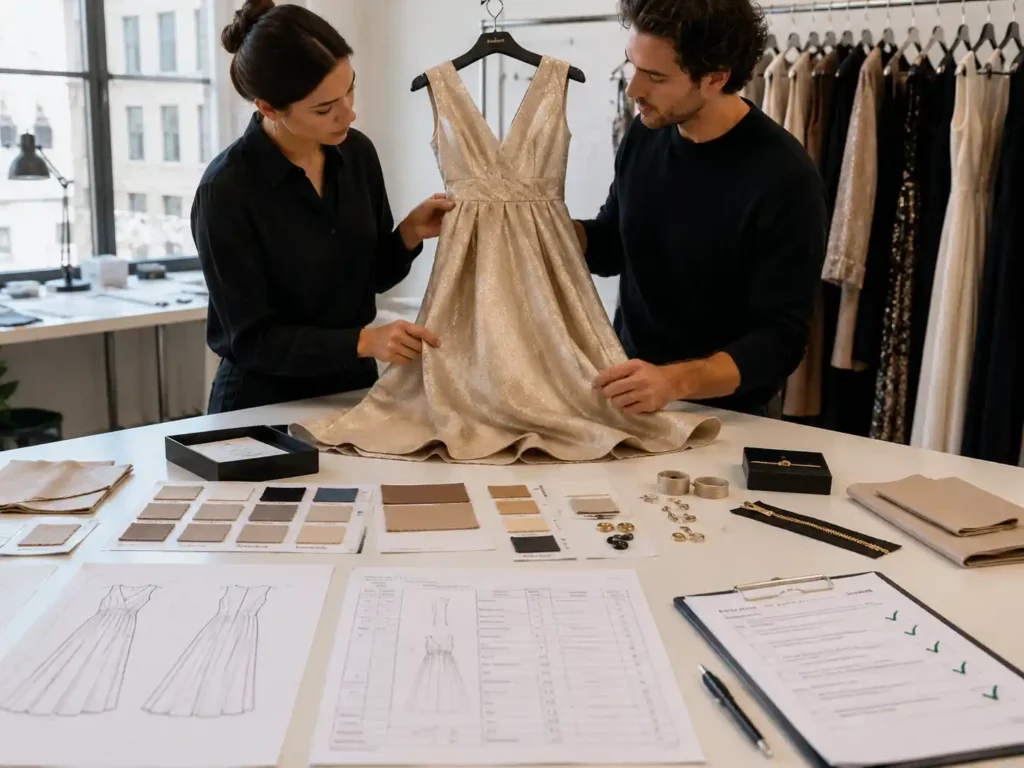
Bulk production should begin only after the brand has approved a version that the factory can reproduce. The pre-production sample, commonly called the PP sample, should reflect the intended bulk fabric, trims, measurements, construction, labels and key finishing details. It becomes the working reference for production and quality control.
| Production Stage | Main Output | Brand Approval | Risk if Skipped |
| Product review | Feasibility notes and development scope | Style and specifications confirmed | Construction may be misunderstood or the target may be unrealistic |
| Material approval | Fabric, lining and trim references | Color, hand feel and performance approved | Bulk material may differ from the expected look or fit |
| Fit sample | First wearable prototype | Fit and proportion comments | Pattern errors move into later stages |
| Revised sample | Corrected measurements and construction | Design and fit confirmation | Conflicting sample versions remain active |
| PP sample | Bulk-ready reference | Written production authorization | The factory lacks a final standard |
| Bulk production | Cut, sewn and finished garments | In-line and final quality review | Defects are discovered after most units are complete |
| Packing | Labeled and SKU-matched goods | Packing and carton verification | Warehouse, retail or barcode errors delay receiving |
Once fabric is cut, even a small change can affect hundreds or thousands of units. Moving a zipper, altering a neckline curve or increasing garment length after cutting may require replacement material, rework or a revised schedule.
The safest workflow uses one approved technical file, one approved measurement chart and one clearly identified sample version. Instructions scattered across email, messaging apps and unmarked photographs create unnecessary risk, especially when several people from the brand and factory are involved.
Packing and Delivery
Packing is part of the product rather than an administrative task added after sewing. A finished dress may require a brand label, size label, care and composition label, hangtag, barcode, SKU sticker, color-size identification, individual polybag, protective insert, folding method, carton assortment and warehouse receiving label.
Every data point must match the garment inside the package. A correctly sewn black medium dress can still create a return or inventory error when the polybag carries a small-size barcode. Retailers, ecommerce warehouses and third-party logistics providers may also have different rules for mixed cartons, carton labels and barcode formats.
Packing instructions should be finalized before goods reach the packing department. Late label artwork, missing barcode files or unresolved carton ratios can delay shipment even when every garment has been completed.
A capable manufacturer coordinates branded packaging with the production plan, checks SKU accuracy before sealing cartons and retains the packing standard for reorders. This reduces receiving errors and helps the brand keep the customer experience consistent across sales channels.
Which Services Does a Private Label Manufacturer Provide?
A full-service private label manufacturer may support design interpretation, pattern making, fabric and trim sourcing, sample development, size grading, bulk sewing, inspections, branded labels, retail packaging and export coordination. Brands should confirm which services are internal, outsourced or charged separately.
Product Development
Product development is where a creative idea becomes a garment that can be priced, sampled, graded and manufactured repeatedly. Depending on the project, the manufacturer may provide construction analysis, pattern making, fit correction, fabric recommendations, trim selection, sample sewing, size grading, cost engineering and production-risk assessment.
Good development work does not mean accepting every visual detail without question. Experienced technicians identify where a concept may create fit, quality or production problems. A very low neckline may need hidden support. Heavy ruching can distort side seams when the fabric is too light. A long bias-cut satin skirt may continue to drop after hanging, which affects the final hem. Boning placed too close to a zipper can create stiffness or visible pressure marks.
The manufacturer’s job is not to redesign the product according to personal preference. It is to explain the trade-offs among appearance, cost, comfort and repeatability so the brand can choose deliberately. A heavier lining may improve coverage but reduce fluid movement; softer elastic may improve comfort but provide less support; a custom trim may strengthen brand identity but increase minimums and lead time.
Useful development comments connect the visual goal to production reality before the sample is treated as final. This prevents the brand from discovering avoidable limitations after bulk fabric has been booked or cut.
Fabric and Trim Sourcing
Many private label manufacturers source materials through established supplier networks. This can reduce coordination work, but the approval process should remain transparent. The brand should know what is being offered rather than receiving a photograph labeled only as ‘similar fabric.’
A useful fabric submission identifies composition, practical weight, width, stretch, recovery, surface finish, transparency, shrinkage considerations, color method, available quantity, reorder potential and lead time. Trims deserve the same discipline. Zippers, cups, boning, elastic, lace, rhinestones, sliders and hardware can affect appearance, comfort and sewing efficiency.
| Component | Practical Approval Points | Common Dress Risk |
| Stretch fabric | Direction, recovery, weight and shrinkage | Loose fit, twisting or inconsistent sizing |
| Satin | Weight, shine, snagging and seam behavior | Puckering, pulls and press marks |
| Mesh | Transparency, stretch, softness and edge stability | Seam waviness, tearing or discomfort |
| Lace | Motif, repeat, edge and placement | Mismatched panels and excessive material waste |
| Zipper | Length, tape color, puller and movement | Wavy center back or difficult closure |
| Cups and boning | Shape, firmness, grading and placement | Poor bust support or visible internal structure |
| Labels | Size, fold, material, colorfastness and placement | Irritation, fading or incorrect identification |
| Packaging | Dimensions, barcode, warning text and SKU data | Receiving errors or garment compression |
When the exact material is unavailable, the factory should explain how a substitute changes drape, fit, cost or schedule. A visually similar fabric is not always technically equivalent, and a small material change can require a pattern or construction adjustment.
Labels, Packaging and QC
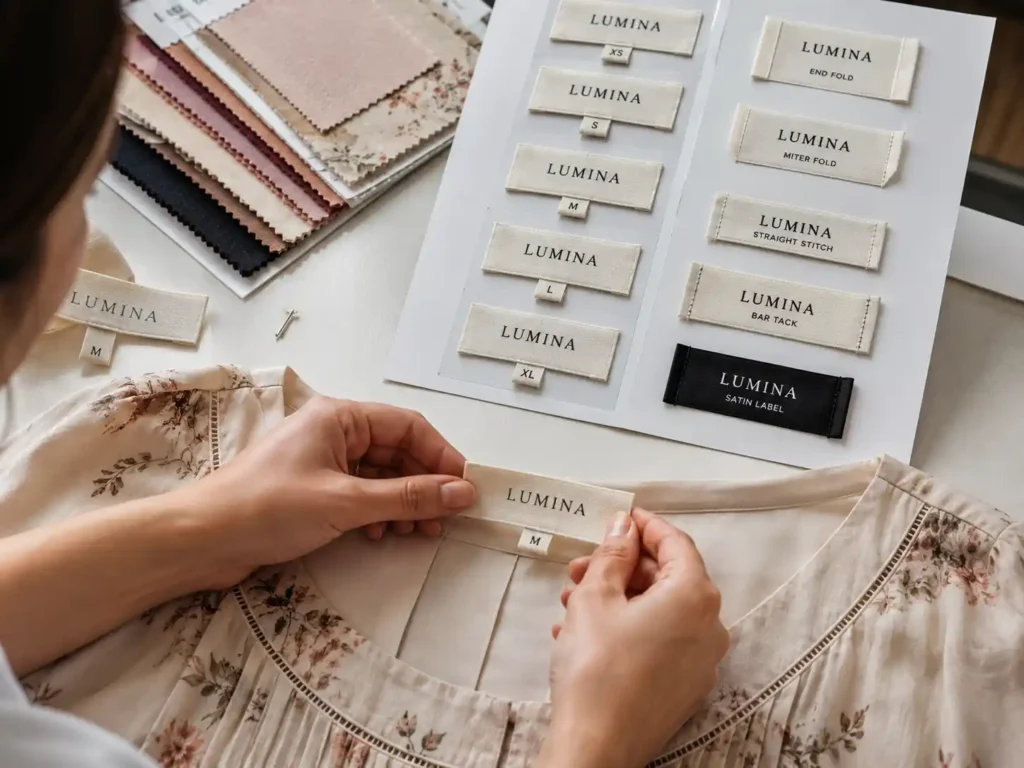
Private label service normally covers permanent garment branding and removable retail materials. Permanent components may include woven, printed, satin or heat-transfer main labels, size tabs and care labels. Retail materials may include hangtags, barcode stickers, SKU labels, branded polybags, cartons and warehouse marks.
Label development should be coordinated early because artwork, folding method, material, size, placement and supplier minimums all affect production. A missing care-label file can hold up packing even after the dresses are complete. Barcode and SKU data should be checked against the actual color and size before cartons are sealed.
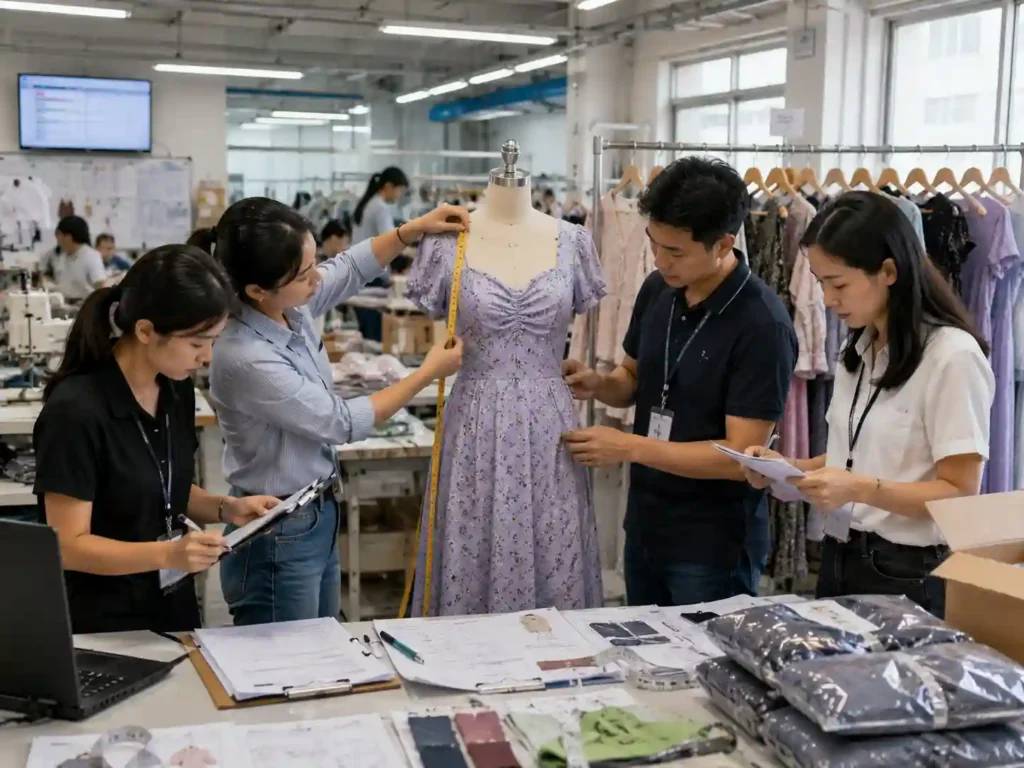
Quality control should run alongside production instead of appearing only at final inspection. A practical sequence includes incoming material review, fabric shade and defect checking, cutting verification, first-piece approval, in-line sewing checks, measurement inspection, finished appearance review, pressing checks, label verification, packaging checks and pre-shipment release.
The checklist must reflect the specific style. Bodycon dresses require attention to stretch recovery and measurement stability. Satin needs protection from seam puckering, pulls and press marks. Mesh requires checks for holes, transparency and neckline distortion. Corset dresses need balanced cups, boning, top-edge support and zipper installation. A generic final checklist alone will not control these category-specific risks.
Reorders and Seasonal Support
A long-term manufacturer should be able to restart an approved product without rebuilding the project from memory. Useful retained records include the approved pattern, graded size set, measurement chart, fabric reference, color standard, trim specifications, construction file, label artwork, packaging guide and previous inspection comments.
A reorder still requires review. Fabric dye lots can change, a trim may be discontinued and the original sewing line may not be available. The new batch should be compared with the approved historical standard before cutting begins.
Seasonal support is more complex than repeating one style. A collection may involve ten, twenty or more products moving through development at the same time, each with different sample status, material deadlines and launch priorities. The manufacturer must separate urgent photo samples from bulk approvals, coordinate shared fabrics and maintain a consistent fit standard across the range.
Jinfeng Apparel supports seasonal collection development, repeat orders and multi-batch production by retaining pattern, measurement, fabric, trim and packing records. For the brand, the practical benefit is lower communication cost, faster restart of approved styles and better continuity between seasons.
How Is Private Label Different From Other Models?
Private label describes a product sold under the client’s brand, while white label, OEM and ODM describe different ways the product is selected, designed or developed. The terms can overlap, so buyers should focus on who creates the design, how much customization is allowed and whether the product is exclusive.
Private Label vs White Label
White label products are usually developed in advance and offered to several businesses under different brand names. Customization is often limited to color, label, tag or packaging. Private label can also begin with an existing style, but it more often implies a product prepared for one client through fit, material, construction or branding changes.
The market does not use these terms consistently. A supplier may advertise private label services while offering only catalogue garments. Another may use the same term for fully custom cut-and-sew development. Practical questions are more useful than the label itself: Can other clients buy the same style? Is a new pattern created? Can the fit be changed? Is exclusivity available?
White label can be faster and simpler because the product has already been developed. It is suitable when assortment speed matters more than differentiation. Custom private label provides more control, but the brand must invest more time in specifications, material approvals, samples and production decisions.
Neither model is automatically superior. The right choice depends on whether the brand’s competitive value comes from selection and speed or from signature fit, construction and product identity.
Private Label vs OEM
OEM stands for original equipment manufacturing. In apparel, the client normally provides the design and technical requirements, while the factory develops samples and manufactures according to those instructions. An OEM project often begins with a complete tech pack, approved measurements, defined materials, construction details, label artwork and packaging requirements.
Private label and OEM are not opposites. A dress made from the client’s original specification is an OEM product; when it is delivered under the client’s branding, it is also private label.
OEM gives the brand high product control, but it also demands accurate information and timely decisions. A detailed tech pack does not remove the need for factory review. Measurements can conflict, construction notes can be incomplete and the specified fabric may not support the intended shape.
OEM is generally suitable for brands with internal designers, technical developers or established fit standards. The manufacturer adds value by identifying production risks, refining the pattern and maintaining the approved standard through bulk production.
Private Label vs ODM
ODM stands for original design manufacturing. The manufacturer contributes more directly to product creation. The brand may provide a moodboard, target customer, reference images, retail price and collection direction, while the factory helps develop the shape, fabric, pattern, construction and sample.
ODM can be useful when the brand understands its market but does not have a complete technical development team. It can shorten the path from trend direction to a manufacturable product, especially when the factory already understands the relevant dress category and material behavior.
The brand should still clarify whether the proposed design is exclusive, whether it has been offered elsewhere, who owns the final pattern, what can be changed, whether the product can be reordered and which development costs are included.
ODM reduces internal development work, but it does not remove the client’s responsibility for fit, material, product identity and final approval. The factory can propose solutions; the brand must decide whether those solutions match its customer and commercial strategy.
Choosing the Right Model
The appropriate model depends on the level of differentiation, control, speed and internal technical capacity the brand needs.
| Manufacturing Model | Typical Starting Point | Customization | Usual Exclusivity | Best Suited To |
| White label | Existing factory product | Low | Low unless negotiated | Rapid assortment expansion |
| Basic private label | Existing or adapted product | Low to medium | Varies | Branded products with limited development |
| ODM private label | Brand direction plus factory development | Medium to high | Contract dependent | Brands needing design and technical support |
| OEM private label | Client tech pack or approved sample | High | Usually higher | Brands with established product specifications |
| Fully custom cut-and-sew | New pattern and construction | Very high | Can be contractually protected | Original collections and signature fits |
More customization gives the brand greater control, but it also creates more decisions and approval points. A retailer adding a simple seasonal dress may benefit from an adapted base style. A label built around a signature corset fit will require original development and stronger pattern control.
The terminology on a supplier’s homepage matters less than the written scope in the quotation and development agreement. Those documents should state what is being created, what can be changed, who approves each stage, what records will be retained and what degree of exclusivity applies.
What Do Brands Need Before Production?
Before production, a brand should define the design, measurements, material direction, colors, quantity, size range, labels, packaging, target market, quality expectations and delivery schedule. A complete tech pack is ideal, but clear samples or references can also start development when missing details are documented before bulk approval.
Design Files and Tech Packs
A tech pack gives the manufacturer a controlled source of product information. A practical dress tech pack usually includes front and back drawings, a measurement chart, points of measurement, base size, fabric and lining requirements, trim details, seam and stitch instructions, construction notes, label placement, colors and packaging requirements.
The brand should identify which details are fixed and which can be adjusted. A designer may insist on a particular neckline and length while allowing the factory to recommend a commercially available satin. Another project may require an exact nominated fabric but permit internal construction changes. Clear priorities help the factory offer useful solutions without changing what defines the product.
A tech pack is not always required for the first conversation. Development can begin from a physical sample, sketch or reference image. However, the project still needs a final technical record before bulk production.
A weak tech pack can be as risky as no tech pack. Common problems include conflicting measurements, missing views, outdated comments and construction copied from another garment. The manufacturer should review the document and raise questions before sampling rather than silently follow obvious inconsistencies.
MOQ and Material Minimums
MOQ is the lowest practical quantity at which the factory and material suppliers can produce the order under the specified conditions. It may apply per style, color, fabric, print, trim, label or packaging item.
A sewing factory may accept a garment quantity that is lower than the fabric mill’s minimum for custom dyeing. A zipper supplier may have a separate threshold, and custom printed packaging may have another. This is why the headline factory MOQ does not tell the complete story.
Brands should ask whether the MOQ is per style or per color, whether several styles can share one fabric, whether different colors have separate material minimums, whether packaging can be retained for reorders and whether highly fragmented size ratios affect efficiency.
Jinfeng Apparel’s MOQ starts from 200 pieces per style and color. The final minimum can change with fabric availability, custom dyeing, weaving, printing, specialized trims, construction complexity, packaging and production scheduling.
| Project Input | Minimum Information to Provide | Why It Matters |
| Style | Tech pack, sample, sketch or clear references | Defines the development and construction scope |
| Quantity | Units per style and color | Controls material buying and line planning |
| Size range | Sizes plus expected ratio | Affects grading, cutting and packing |
| Fabric | Composition, look, stretch and target weight | Controls fit, cost and production method |
| Color | Pantone reference, swatch or approved standard | Reduces shade misunderstanding |
| Labels | Artwork, dimensions and placement | Allows supplier MOQ and lead-time review |
| Packaging | Polybag, barcode, SKU and carton rules | Prevents late packing delays |
| Delivery | Required ship date and destination | Supports realistic sourcing and production planning |
Cost and Lead-Time Inputs
A dress quotation is built from the complete product rather than sewing labor alone. Major inputs include fabric price and consumption, lining, trims, pattern development, sample work, cutting complexity, sewing time, handwork, pressing, inspection, labels, packaging, quantity, color-size breakdown and delivery terms.
A simple satin slip dress and a structured corset dress may use a similar amount of outer fabric, but their labor, support materials and inspection requirements are very different. The number of colors also matters because each color can create separate fabric purchases, cutting plans and quality references.
Lead time is cumulative. It may include fabric sourcing, custom color development, trim production, pattern making, sample sewing, courier time, fit review, sample revisions, PP approval, bulk material booking, cutting, sewing, inspection, packing and shipment booking.
Brand-side delays are part of the calendar. A sample waiting ten days for consolidated comments has already used ten days of the launch schedule. A reliable quotation should therefore state the assumptions behind the price and timeline. When fabric, construction or quantities are still open, the early figure should be treated as an estimate rather than a final production commitment.
Fit and PP Samples
A fit sample checks how the design works on the target body. The PP sample confirms what the factory is authorized to reproduce in bulk. These are different approval moments, even when the same physical sample eventually satisfies both purposes.
Fit review should examine bust, waist and hip measurements, ease, neckline stability, shoulder and strap position, armhole shape, side-seam balance, waist placement, skirt movement, hem balance, zipper behavior, lining length and transparency. The sample should be viewed from the front, side and back, and fitted styles should be tested while sitting, walking and raising the arms where appropriate.
Comments should be consolidated into one revision document. When a designer, buyer and fit technician send separate instructions, the factory may receive conflicting priorities. Clear change ownership avoids the common situation in which one person approves a detail that another person later rejects.
The PP sample should use approved or bulk-representative materials and include the final construction, measurements and important branding details. Any change after PP approval should be documented with its effect on price, material usage and schedule. Complex dresses may require additional rounds, while a well-documented repeat style can often move faster.
How Do You Choose the Right Manufacturer?
Choose a private label dress manufacturer by evaluating relevant product expertise, development capability, material knowledge, sample accuracy, production organization, quality controls, confidentiality and repeat-order systems. Factory size alone is not enough; the supplier must manage the specific fabrics, construction risks, quantities and delivery standards required by the collection.
Category Expertise
Dress manufacturing is not one uniform skill. A factory experienced in casual cotton styles may not be the right partner for satin corset dresses, sequin occasionwear or stretch bodycon products. Each category creates different risks and requires different technical control.
Bodycon dresses depend on stretch direction, recovery and measurement stability. Satin requires careful cutting, handling and pressing to prevent pulls, puckering and shine marks. Mesh needs control of transparency, tearing and seam waviness. Lace requires motif placement and edge finishing. Sequins need secure attachment and checks for skin irritation.
Corset and structured dresses need particular attention to cup position, boning direction, waist shaping, top-edge stability, zipper installation, internal seam bulk and lining support. Maxi and bias-cut styles create different concerns around hanging, grain direction and hem balance.
Ask the manufacturer to explain how it handles the most difficult feature in the proposed style. A detailed technical response is more meaningful than a large gallery of unrelated garments. Jinfeng Apparel focuses on custom dresses, partywear, occasionwear, bodycon, mesh, satin, lace, sequin and corset styles, with production allocation based on product and fabric requirements.
Capacity and Quality Evidence
Capacity should be assessed through organization and accountability, not only through a claimed monthly number. A suitable supplier should explain where patterns are developed, who manages samples, how styles are assigned, how peak-season capacity is handled, who controls partner factories, when inspections occur and who releases goods for shipment.
Jinfeng Apparel has focused on women’s fashion manufacturing since 2008 and operates six owned women’s fashion factories with more than ten long-term satellite production partners. Work is matched according to garment category, fabric, complexity, quantity and schedule while technical requirements, quality standards and delivery remain centrally coordinated.
Using more than one production unit is not automatically a weakness. Many established apparel suppliers use specialized factories or long-term capacity partners. The critical issue is whether the main supplier controls the approved pattern, material references, workmanship standard, inspections and final shipment.
Useful quality evidence can include material approval records, measurement reports, in-line inspection forms, defect classifications, approved sample references, packing checklists, pre-shipment reports and corrective-action records. A supplier that only says ‘we always provide good quality’ has provided little evidence. A supplier that can explain where defects are found, recorded and corrected is easier to evaluate.
Confidentiality and Supplier Control
Sensitive product information should be protected before it is shared widely. Brands should ask how the manufacturer handles tech packs, original samples, patterns, print artwork, label files, packaging designs, unreleased photographs, quantities, pricing and launch schedules.
An NDA is useful, but operational behavior reveals whether confidentiality is taken seriously. Ask who can access the files, whether supporting factories receive complete or limited information, how samples are stored and whether staff may photograph unreleased products.
A manufacturer’s behavior toward other clients is a useful signal. A supplier that casually displays another brand’s unreleased collection may eventually treat your products the same way. Confidentiality should continue after shipment because archived patterns and label files are often retained for reorders.
Supplier control also includes responsibility for partners. When a project is allocated to another production unit, the primary manufacturer should remain accountable for technical communication, materials, workmanship, inspection and delivery rather than passing problems between companies.
Questions Before Ordering
Before placing an order, ask questions that reveal how the manufacturer works rather than collecting general sales claims.
- Which dress categories do you manufacture regularly?
- Can you develop from a tech pack, physical sample, sketch or reference image?
- Who creates and corrects the production pattern?
- How are fabrics, trims, colors and bulk substitutions approved?
- Is MOQ calculated per style, per color or per material?
- Which sample stages are required before bulk cutting?
- How are measurement tolerances and fit comments recorded?
- Which inspections occur during sewing, finishing and packing?
- Can you follow barcode, SKU, carton and warehouse instructions?
- Can you sign an NDA and protect unreleased products?
- Which records are retained for reorders and seasonal collections?
- Who remains responsible when production is allocated to a partner factory?
A good manufacturer will also ask questions. Silence is not always efficiency. When a supplier quotes a complex dress without asking about material, lining, construction, quantities, sizing or packaging, important assumptions are probably being made.
The most productive first inquiry includes the style files or references, estimated quantity by color, size range, target market, fabric direction, packaging needs and required shipment window. That gives the factory enough information to review feasibility and prepare a quotation based on the actual product rather than a generic headline price.
Build a Private Label Dress Program That Can Scale
Private label dress manufacturing works best when creative direction and production discipline support each other. The brand defines the customer, product identity, commercial targets and approval priorities. The manufacturer translates those decisions into patterns, materials, samples, production files, quality controls and retail-ready delivery.
The strongest supplier is not necessarily the one that gives the fastest first price. It is the one that understands the product category, identifies risk before cutting, keeps approvals controlled and can reproduce an accepted standard across sizes, colors, reorders and seasonal collections.
Jinfeng Apparel is a Guangdong-based custom women’s fashion manufacturer serving global fashion brands and mid-to-large apparel clients with OEM, ODM and private label development. Since 2008, the company has supported dress development, fabric and trim sourcing, pattern work, sampling, bulk production, quality control, branded packaging and export coordination through six owned women’s fashion factories and more than ten long-term production partners. The standard MOQ starts from 200 pieces per style and color, subject to fabric, trim, construction and packaging requirements.
For a project-specific review, send your tech pack, reference images, original sample or line sheet together with the estimated quantity by color, size range, target market, fabric direction, packaging requirements and required delivery window. The team can review structure, sampling needs, material options, MOQ conditions and production risks before preparing a quotation.