Skip to content

A dress collection can look impressive in a line sheet and still perform poorly once it reaches the market. One season may contain too many similar bodycon dresses; another may have strong campaign pieces but no dependable styles that customers can wear repeatedly. In many cases, the problem is not weak design. It is an unbalanced product structure that spreads attention, budget, and production capacity across the wrong mix of products.
A balanced dress collection combines proven commercial styles with selective fashion pieces, covers the occasions and silhouettes the target customer actually buys, and distributes colors, sizes, prices, and quantities according to evidence. It should feel visually coherent while offering meaningful choice, protecting inventory depth, and remaining realistic for sampling, production, quality control, and repeat orders.
Balance does not mean giving every category the same number of styles. It means assigning each dress a clear commercial role. Some products attract attention, some generate volume, some support a higher price point, and some test a new direction without exposing the whole range to unnecessary risk. Imagine launching 24 dresses, only to discover that 14 are short, fitted party styles in similar colors. The range is large, yet the customer still feels there is not enough choice. That is the difference between having many products and building a genuinely balanced collection.
What Makes a Dress Collection Balanced?
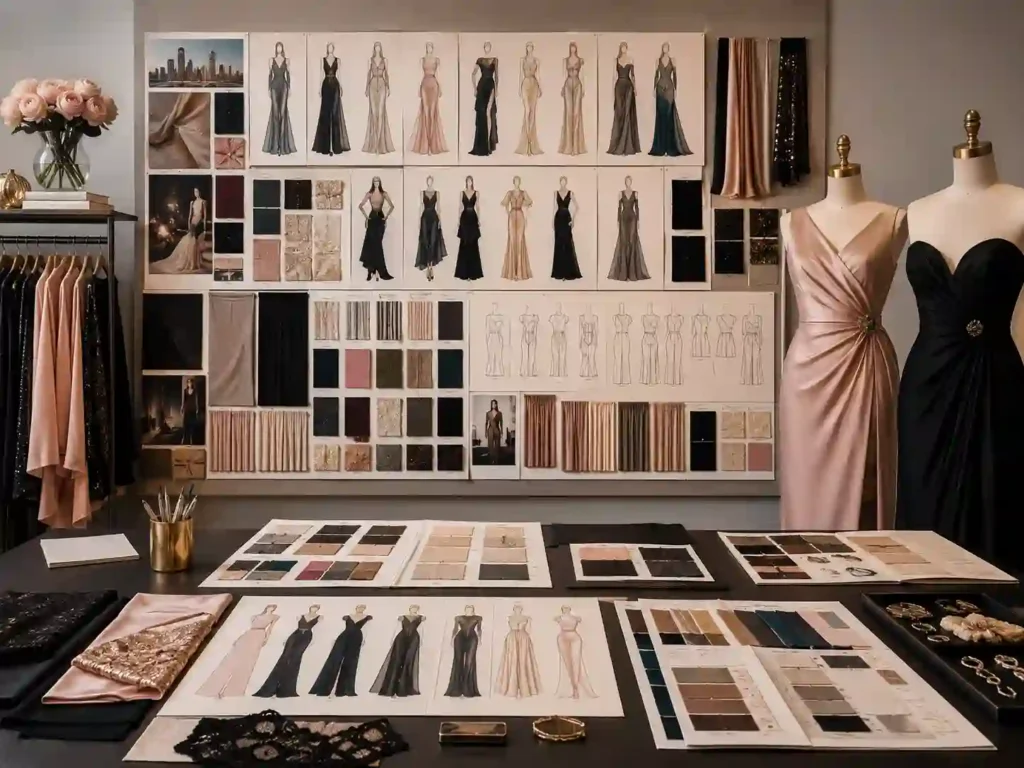
A balanced dress collection gives customers meaningful choice without filling the range with near-duplicate products. It combines reliable commercial styles, seasonal fashion, statement pieces, and controlled tests while maintaining a clear brand identity. Balance should be judged across occasion, silhouette, length, fabric, color, price, fit, and inventory risk—not by giving every category the same number of styles.
Collection Purpose
Every collection needs a clear job. A partywear launch, a resort capsule, a wedding-guest range, and a year-round ecommerce collection should not be built in the same way. Without a defined purpose, teams tend to approve styles one by one and only notice missing categories, duplicated fits, or price gaps after sampling has already consumed time and budget.
A useful collection brief should identify the target customer, primary wearing occasions, launch window, selling channel, expected retail price range, and the products likely to carry the greatest commercial weight. “Fashionable dresses for women” is too broad. “Contemporary occasion dresses for women buying for weddings, dinners, birthdays, and seasonal events” is far more useful because it immediately influences length, coverage, fabric, construction, and price architecture.
A style can be attractive and still be wrong for the range. A heavy velvet corset dress may be commercially sensible for a winter event collection but difficult to justify in a lightweight summer resort program. Purpose gives the team permission to reject attractive ideas that do not serve the season, customer, channel, or delivery calendar.
Product Roles
Not every dress should perform the same commercial function. Some styles provide stable conversion, some create seasonal urgency, some lift the visual value of the campaign, and some allow the brand to test a new proportion, fabric, or construction with controlled exposure.
| Product Role | Illustrative Share | Main Purpose | Typical Examples |
| Core commercial styles | 35–45% | Stable conversion and repeat-order potential | Slip midi, ruched mini, clean A-line |
| Seasonal fashion styles | 25–35% | Newness and seasonal relevance | Halter maxi, printed resort dress |
| Statement styles | 10–20% | Campaign impact and brand recognition | Corset gown, embellished mesh dress |
| Controlled tests | 10–15% | Measure demand for new ideas | New waistline, fabric, or proportion |
These percentages are planning references rather than fixed rules. A specialist occasionwear label may carry more statement products, while a high-volume ecommerce brand may need a larger core. The important step is assigning each design a role before approving color count, quantity, and marketing investment. When every style is treated as equally important, brands often overbuy exciting pieces and underbuy dependable products.
Visual and Commercial Balance
Visual consistency matters, but it is not the same as commercial balance. Twelve dresses may share the same fitted shape, narrow straps, and short length. Different colors and trims can make the line sheet look varied, yet the customer still sees twelve versions of a similar product.
Review the range from several angles: how many styles serve the same occasion, how many share a similar fit, how many sit at the same price point, and how many depend on the same fabric appearance or short-lived trend. Also check whether the collection offers practical differences in coverage, sleeve options, movement, and repeat-wear potential.
A balanced range normally carries a recognizable design language without forcing every product into the same silhouette. The brand can repeat a signature neckline, waist treatment, or fabric story while varying length, volume, fit, and occasion. Commercial balance also requires enough products near the brand’s main selling price. If the range is dominated by labor-intensive premium designs, it may look impressive while missing the price zone where most customers actually convert.
Warning Signs
An unbalanced range usually reveals itself before sales begin. More than one-third of the collection may serve nearly the same occasion, several products may differ only by a trim change, or untested styles may carry too many colors. Other warning signs include no clear opening price, limited coverage options, weak repeat-order candidates, and an excessive concentration of complex fabrics or trims.
- Several styles compete for the same customer, occasion, and retail price.
- Campaign pieces outnumber dependable volume products.
- Color growth is faster than real customer demand.
- The range lacks sleeve, length, or fit variation.
- Too many styles require custom lace, boning, handwork, or special dyeing.
- The development calendar has no room for fit corrections or PP approval.
The most useful final review asks whether every style passes four tests: customer relevance, brand fit, financial logic, and production feasibility. A design that succeeds in only one area may still belong in the range, but it should normally receive a more controlled quantity rather than the same commitment as a proven core product.

Who Is the Collection Built For?
A dress collection should be built for a clearly defined customer, not a vague idea of women who enjoy fashion. The team must understand where she wears dresses, how much she spends, which fits make her feel confident, and why she returns products. Customer behavior, sales channel, climate, and market timing should influence the range before personal design preferences take over.
Customer Profile
Age and location are useful, but they do not explain enough. Two women of the same age may have completely different lifestyles, budgets, fit expectations, and reasons for purchasing a dress. A practical customer profile should include primary occasions, preferred lengths, comfort with fitted or revealing styles, sleeve and coverage preferences, expected garment quality, common fit concerns, and typical retail spending.
Consider two customers shopping for a weekend event. One wants a fitted mini dress that photographs well and feels highly fashion-led. The other wants a midi dress with bra coverage, movement, and a more forgiving waist. Both may be in the same age group, but they require different products, fabrics, and fit solutions.
The collection does not need to serve everyone. Broad targeting often weakens the line because no group feels fully understood. A more practical method is to define one primary customer, one secondary customer, and a limited group of overlapping needs. Repeated comments about bust support, sleeve tightness, waist placement, skirt length, or transparency should be treated as product-development data rather than isolated customer-service complaints.
Occasion and Lifestyle
Customers usually buy dresses for a reason: a wedding, birthday, holiday, graduation, dinner, work event, or weekend away. Understanding these situations makes assortment planning more useful than simply classifying products by neckline or fabric.
Review each occasion by frequency, urgency, and expected spend. Everyday dresses may be purchased more often but at a lower average price. Formal event dresses may sell less frequently but support stronger fabrics, internal structure, and higher retail pricing. A highly specific party dress can deliver strong visual impact but limited repeat use, while a versatile satin midi may work for dinners, wedding events, holidays, and seasonal celebrations.
Lifestyle also affects construction. Customers who travel may prefer fabrics that pack easily and recover from creasing. Customers attending long events may care about movement, breathability, lining, strap security, and the ability to sit comfortably. The image may win the click, but fit, comfort, quality, and occasion relevance usually determine whether the customer keeps the garment.
Market and Channel
A collection should change according to where and how it will be sold. Ecommerce can support broader assortment because products do not compete for physical rail space, but every additional SKU requires photography, product descriptions, size information, stock management, customer support, and return processing. A large online range can become expensive to manage even without a store.
Boutiques and wholesale showrooms need clearer visual differences. Buyers have limited space and may reject styles that appear too similar. Each dress must earn its position through a distinct silhouette, occasion, price, or fabric story. Regional factors also matter. Warm-climate markets may support lightweight maxis, resort dresses, open backs, and breathable fabrics for longer periods, while cooler markets may require transitional colors, sleeves, layering potential, and denser materials.
Timing can be as important as design. A wedding-guest dress delivered after the main event season loses much of its commercial value. Work backward from the selling window and allow realistic time for fabric booking, sampling, fit correction, production, inspection, and shipping.
Useful Customer Data
Sales data should guide planning, but it must be interpreted carefully. A strong seller does not automatically prove that every visible feature should be repeated. The product may have benefited from the best photography, a timely launch, a strong price, or unusually complete size availability.
- Sell-through by style, color, and size.
- Full-price sales before discounting.
- Product-page traffic and conversion.
- Return rates and specific return reasons.
- Customer search terms and wait-list requests.
- Review comments and customer-service questions.
- Social saves, shares, and repeat-order requests.
- Wholesale feedback and stockout timing.
Break results into product attributes. High traffic with low conversion suggests a different problem from low traffic. The product may attract attention but fail on price, fit confidence, fabric description, or missing sizes. Strong sales with high returns can indicate desirable design but weak execution. Brands with limited history can still learn through controlled quantities, pre-launch content, customer interviews, and careful competitor observation. The aim is not perfect prediction; it is reducing the cost of being wrong.

Which Dress Categories Should Be Included?
The right categories are the ones that serve real customer occasions while creating meaningful differences across length, silhouette, fit, and use. Mini, midi, and maxi dresses should not be included simply to complete a checklist. Each category needs a clear reason for being in the range and must support the brand’s customer, climate, channel, and price structure.
Length Mix
Mini, midi, and maxi dresses affect more than hem position. Each length changes fit, fabric consumption, customer confidence, grading, packing, and selling occasion. The correct mix should follow customer demand rather than an arbitrary one-third split.
| Dress Length | Strong Applications | Main Development Concerns | Typical Commercial Role |
| Mini | Party, club, birthday, vacation | Coverage, body length, riding up, grading | High visual impact |
| Midi | Wedding guest, dinner, office, brunch | Calf position, movement, proportion | Broad occasion coverage |
| Maxi | Resort, formal, evening, holiday | Total length, drape, fabric use, packing | Premium or destination-led |
Mini dresses often perform well in party, club, birthday, and warm-weather categories. Their apparent simplicity can be misleading: a few centimeters in body length, waist position, or hem opening can determine whether the wearer feels secure. Midi dresses usually offer the widest commercial reach, but the exact hem placement and movement must be controlled. Maxi dresses support resort, evening, and formal positioning, yet they require tighter control of total length, fabric consumption, lining, drape, and size grading.
Occasion Coverage
A well-planned collection covers a focused group of occasions rather than every possible use. Common categories include casual daywear, work, brunch, dinner, resort, birthday, party, club, wedding guest, graduation, cocktail, and formal events. A practical range may prioritize three primary occasions, support two secondary occasions, and test one new area.
One dress can serve several occasions, but it still needs a clear primary story. A fitted satin midi may suit weddings, dinners, and birthdays, yet its photography, naming, and styling should identify the strongest use first. Clear positioning helps customers understand why the product belongs in their wardrobe and helps internal teams decide which styles are truly different.
Avoid building the whole range around rare or highly specific events unless there is evidence of demand. Emotionally important occasions can support premium products, but they may also create narrow selling windows and higher customer expectations. The collection needs enough versatility to keep selling after the peak event period.
Silhouette Families
Silhouette variation should be obvious when the collection is viewed from a distance. Changing only a neckline, trim, or color does not always create a genuinely different product. Grouping styles into practical families makes repetition easier to see.
- Fitted: bodycon, corset, fitted slip.
- Waist-defined: A-line, fit-and-flare, skater.
- Relaxed: shift, babydoll, loose slip.
- Draped: wrap, cowl, ruched.
- Structured: panelled, tailored, boned.
- Volume-led: tiered, ruffled, full-skirted.
- Asymmetric: one-shoulder, uneven hem, directional drape.
Visual focus should also move around the body. One dress may emphasize the neckline, another the waist, another the back, and another the movement of the skirt. Every silhouette introduces technical consequences. Corset dresses need support and balance; bias-cut slips require grain control; ruched dresses need consistent tension; full skirts need stable waist seams. Design variety must therefore be matched with appropriate sampling and production time.
Category Gaps
Range gaps are easier to identify when the line is reviewed as a matrix rather than as individual sketches. Check whether the collection contains an easy-to-understand commercial product, a clear entry point, a premium or image-building style, more than one coverage level, more than one fit type, and at least one strong repeat-order candidate.
Also look for accidental concentration. A line may contain five party dresses but no product suitable for an outdoor event, daytime occasion, or customer who wants sleeve coverage. Category balance should not weaken the brand identity. A clubwear label does not need conservative office dresses merely to appear complete; it may create balance through different lengths, support levels, stretch, coverage, and evening occasions within its own market.
The purpose is not to create the largest assortment. It is to remove unnecessary duplication and fill commercially important gaps so that every style has a reason to exist.
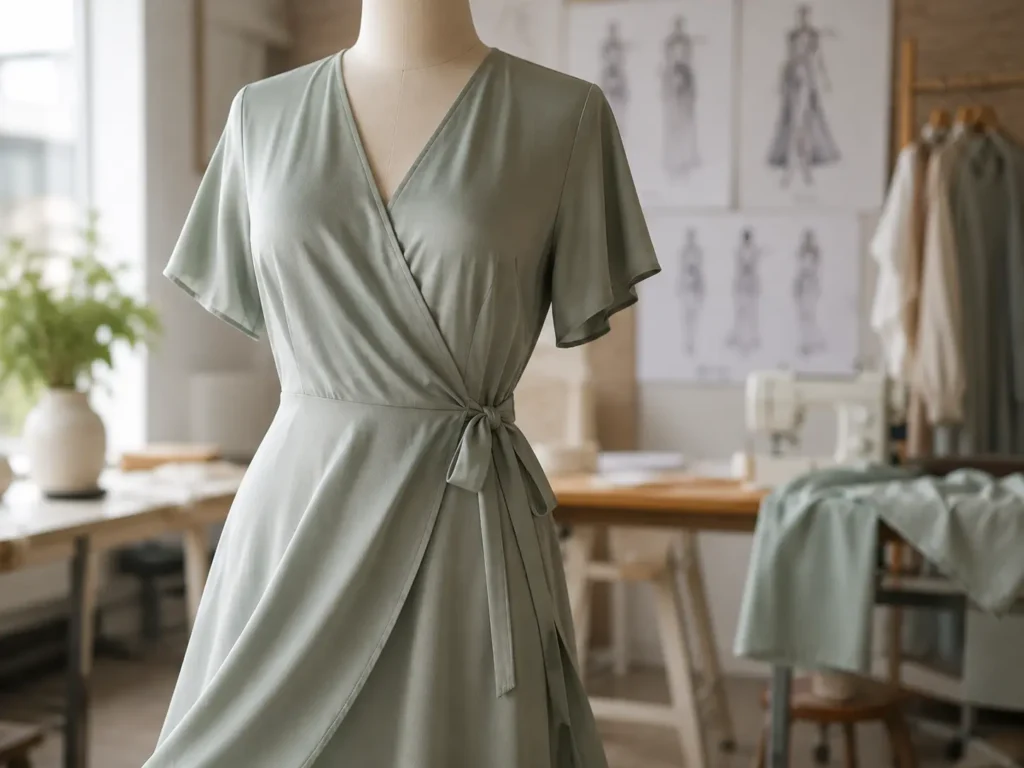
How Should Colors, Fabrics, and Prices Be Balanced?
Colors, fabrics, and prices should be planned together because each decision affects demand, cost, production complexity, and inventory. A strong range uses a controlled color hierarchy, materials that support the intended silhouettes, and clear price steps customers can understand. Adding more options is not always an improvement; too many colors or difficult fabrics can divide quantities and weaken availability.
Color Architecture
Choose colors as a collection system, not one style at a time. A practical palette often combines dependable commercial shades, seasonal colors, and a limited number of accents or prints. An illustrative planning split is 45–55% proven neutrals and brand colors, 25–35% seasonal shades, and 10–20% accents, prints, or experiments. This refers to collection emphasis rather than unit quantity.
Color should be reviewed against fabric, occasion, and photography. The same shade can look very different on satin, mesh, jersey, and chiffon because surface reflection, transparency, and texture change the result. Linings, zippers, elastics, thread, and trims also need compatible shades.
Adding one color seems minor, but it creates a new style-color combination across every size. Ten styles in four colors produce 40 style-color groups before size allocation. That increases fabric booking, cutting separation, stock tracking, quality checks, and reorder complexity. Proven silhouettes can usually support more colors; new shapes are safer in fewer commercial shades until fit and demand are understood.
Fabric Behavior
Fabric determines how a design behaves on the body and in production. A silhouette should not be fully approved before the material direction is understood. The table below shows why visually similar fabrics can create very different development risks.
| Fabric | Suitable Dress Types | Important Specifications | Common Production Risks |
| Satin | Slip, occasion, evening | Weight, shine, snag resistance, drape | Puckering, seam impression, shade variation |
| Chiffon | Maxi, layered, resort | Transparency, weight, shrinkage | Fraying, uneven hems, lining issues |
| Mesh | Party, fitted, panelled | Stretch direction, recovery, opacity | Distortion, holes, visible seam tension |
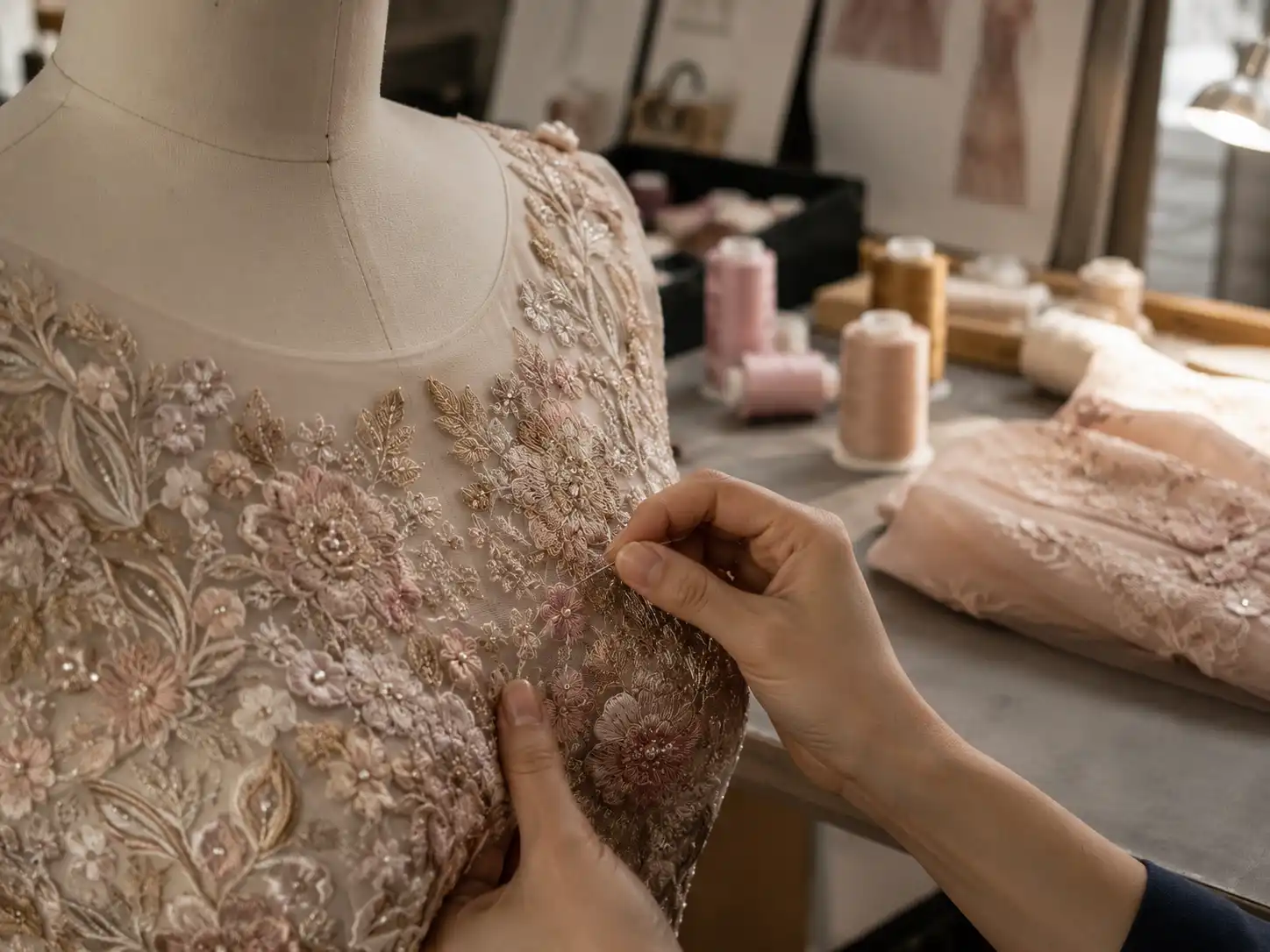
| Lace | Occasion, corset, formal | Motif size, repeat, edge finish | Misalignment and high cutting waste |
| Jersey | Bodycon, casual, draped | GSM, stretch, recovery, shrinkage | Twisting, growth, unstable measurements |
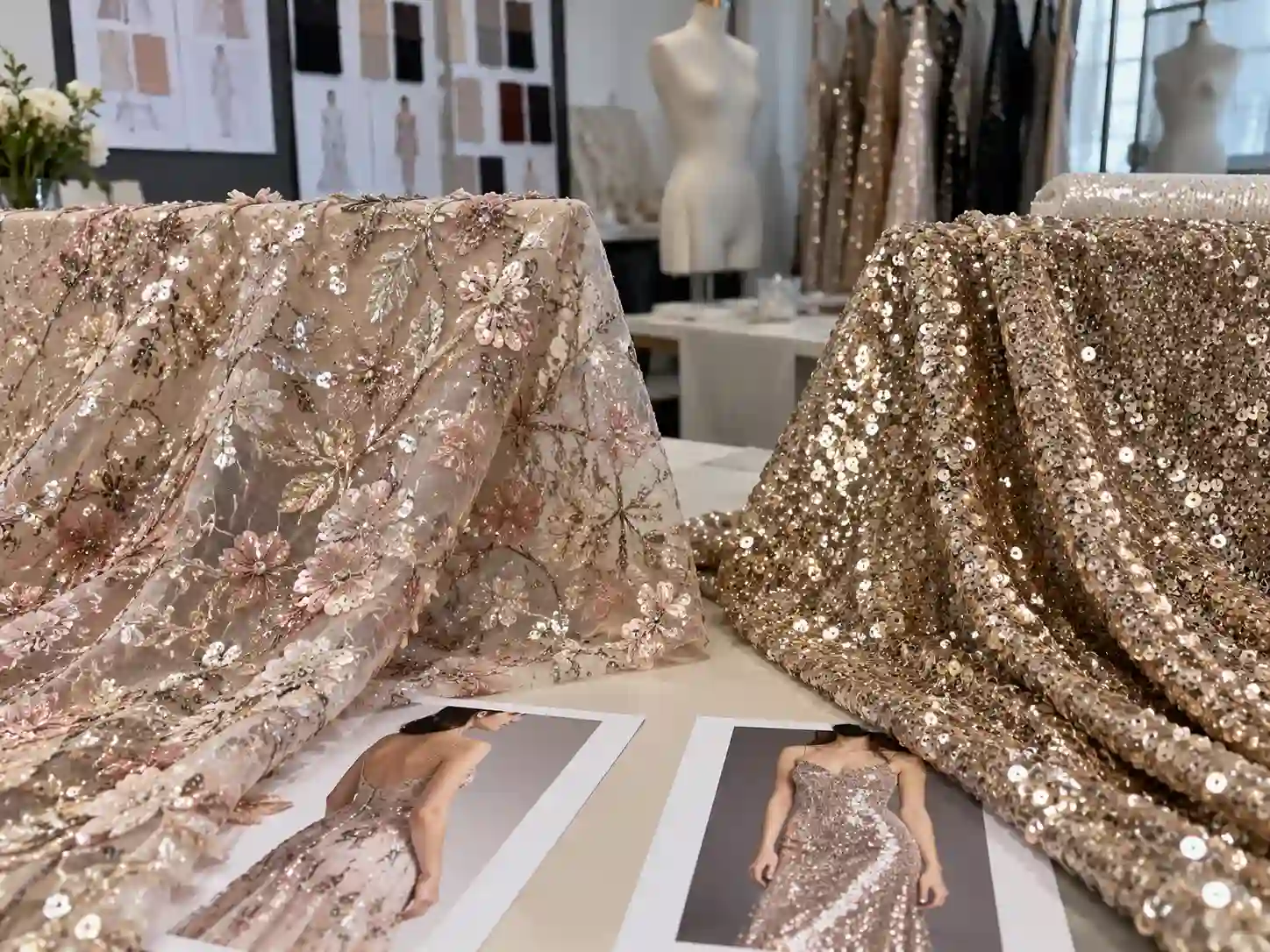
| Sequin fabric | Party, statement, evening | Sequin density, base fabric, weight | Abrasion, needle damage, difficult seams |
Before bulk approval, review weight, width, stretch, recovery, opacity, shrinkage, colorfastness, seam performance, pressing response, and care requirements. A fabric may look attractive as a swatch and still fail on the garment. Lightweight satin can collapse around a structured bodice; dense sequins may overload delicate straps; soft jersey may not recover well enough for a close-fitting shape. The whole collection should also balance matte, fluid, textured, structured, transparent, and reflective surfaces.
Price Structure
Customers should be able to understand why one dress costs more than another. A practical range may include an entry tier with cleaner construction, a core tier at the brand’s main selling price, a premium tier with stronger fabric or internal structure, and a statement tier with limited or labor-intensive work.
The largest portion of the range usually belongs near the price where the brand converts most consistently. Entry products help new customers, while premium styles raise perceived value. Cost must be planned during development. Fabric consumption, lining, cups, boning, zippers, lace placement, sequins, ruching, pleating, cutting waste, sewing time, pressing, quality checks, and packaging all affect the final quotation.
When a style exceeds target cost, protect the feature customers value most. Simplify hidden construction, consolidate colors, select a more stable alternative fabric, revise trim placement, or reduce unnecessary seams before removing the element that makes the design desirable.
Material and Cost Risk
A balanced collection should not depend too heavily on difficult materials. Custom-dyed fabrics, exclusive prints, unusual hardware, special lace, and hand-applied decoration can add value, but they also increase lead time, minimum commitments, approval stages, and reorder risk.
Review how many styles rely on supplier-specific fabrics, custom colors, special trims, high cutting waste, long testing cycles, or difficult sewing operations. If half the collection depends on one specialist material, a quality problem or late delivery can affect the whole launch. Technical risk should be distributed across the assortment.
Fabric continuity matters as much as initial appearance. A dress may become a bestseller, but a repeat order becomes difficult if the material was seasonal, discontinued, or custom-made below the supplier’s normal minimum. Core products should use more stable materials where possible, while limited fabrics can support controlled statement pieces. Cost balance does not mean making every garment inexpensive; it means investing where customers can see and value the difference.
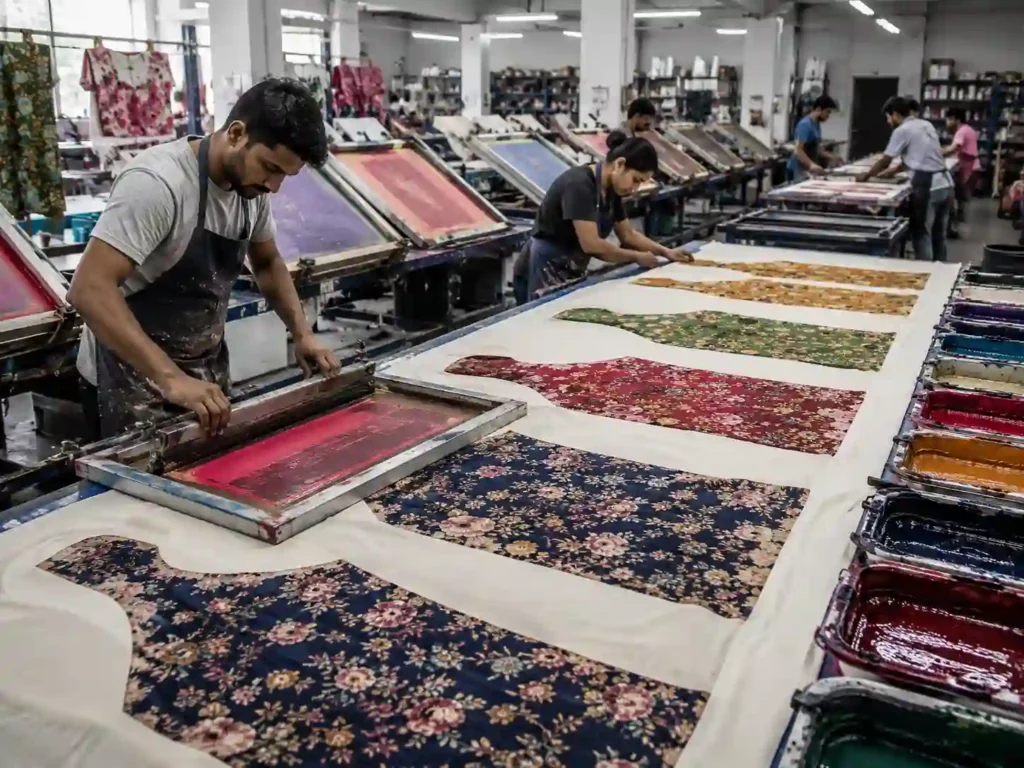
How Many Styles, Colors, and Sizes Are Needed?
The correct number depends on budget, demand, MOQ, selling channel, and the team’s ability to manage complexity. More SKUs do not automatically create more useful choice. The range should be broad enough to cover distinct customer needs, while production depth should concentrate on the styles, colors, and sizes most likely to sell or be reordered.
Range Breadth
Start by counting meaningful differences rather than total designs. Range breadth should cover distinct occasions, silhouettes, lengths, fits, fabrics, and price points. An 18-style collection might contain six core commercial dresses, four occasion-led styles, three seasonal or resort styles, two premium statement products, and three controlled trend tests. The exact structure depends on the brand, but the exercise reveals whether the collection is carrying too much duplication.
Create a grid showing each style’s occasion, length, silhouette, fabric, price, and commercial role. Six sketches may look different yet occupy the same product space if they are all short, fitted, sleeveless party dresses at the same price. Removing repetition often improves customer choice because the remaining products become easier to understand, photograph, stock, and reorder.
Every new style also creates hidden workload: specification, pattern development, sampling, fitting, costing, grading, photography, product content, quality criteria, and stock management. Add a design only when it contributes a commercially distinct option.
Color and SKU Growth
SKU growth is often underestimated during design meetings. The basic calculation is styles multiplied by colors multiplied by sizes. Production commitment also depends on the minimum quantity required for each style-color combination.
| Planning Element | Example |
| Number of styles | 12 |
| Colors per style | 2 |
| Sizes per color | 6 |
| Total SKUs | 144 |
| Factory MOQ per style/color | 200 units |
| Total initial production | 4,800 units |
Increasing from two colors to three raises the example from 4,800 to 7,200 units—a 50% increase in production commitment without adding a new silhouette. A color is not merely a creative option; it creates additional fabric requirements, cutting groups, size allocation, inspection, and inventory exposure.
New silhouettes usually benefit from fewer initial colors. Proven products can support broader color development because fit, conversion, and reorder behavior are better understood. Before adding a color, ask whether it reaches a new customer, season, occasion, or styling need. If the difference is small, deeper stock in the stronger shade may be more useful.
Size Ratios
A complete size range is not enough; quantity must be distributed according to real demand. An illustrative ratio for six sizes could be XS:S:M:L:XL:XXL = 1:2:3:3:2:1. For 240 units, that produces 20, 40, 60, 60, 40, and 20 pieces. This is only an example. Historical sales, market, silhouette, and fabric behavior should determine the actual curve.
Different styles may need different ratios. A fitted mini dress and a relaxed wrap dress may not sell through the same size distribution. Stretch garments can behave differently from rigid woven products because customers may choose a size based on compression, comfort, or coverage.
Review stockouts by size, not only total style sales. A product may appear to be a strong seller because key middle sizes sold out early, while less requested sizes remain. Grading quality also matters: adding sizes without checking strap length, neckline depth, sleeve width, waist position, hip ease, and total length can produce inconsistent fit across the range.
Depth and Reorders
Production depth should follow commercial confidence. Deeper quantities are normally more suitable for products with strong historical demand, broad occasion coverage, stable fabric availability, reliable fit, clear price positioning, and low return risk. More controlled quantities are appropriate for new silhouettes, experimental colors, unusual fabrics, narrow occasions, and complex statement pieces.
Reorder feasibility changes the initial buying decision. When fabric is regularly available and production can restart efficiently, the brand may carry a more conservative first order. When the material is custom-dyed, seasonal, or supplier-limited, a repeat order may require a larger quantity or longer lead time.
For Jinfeng Apparel projects, the standard MOQ starts from 200 pieces per style/color and depends on fabric availability, color development, trims, construction complexity, packaging requirements, and production scheduling. Planning style-color combinations before sampling helps prevent a collection from expanding beyond a realistic budget or production structure.
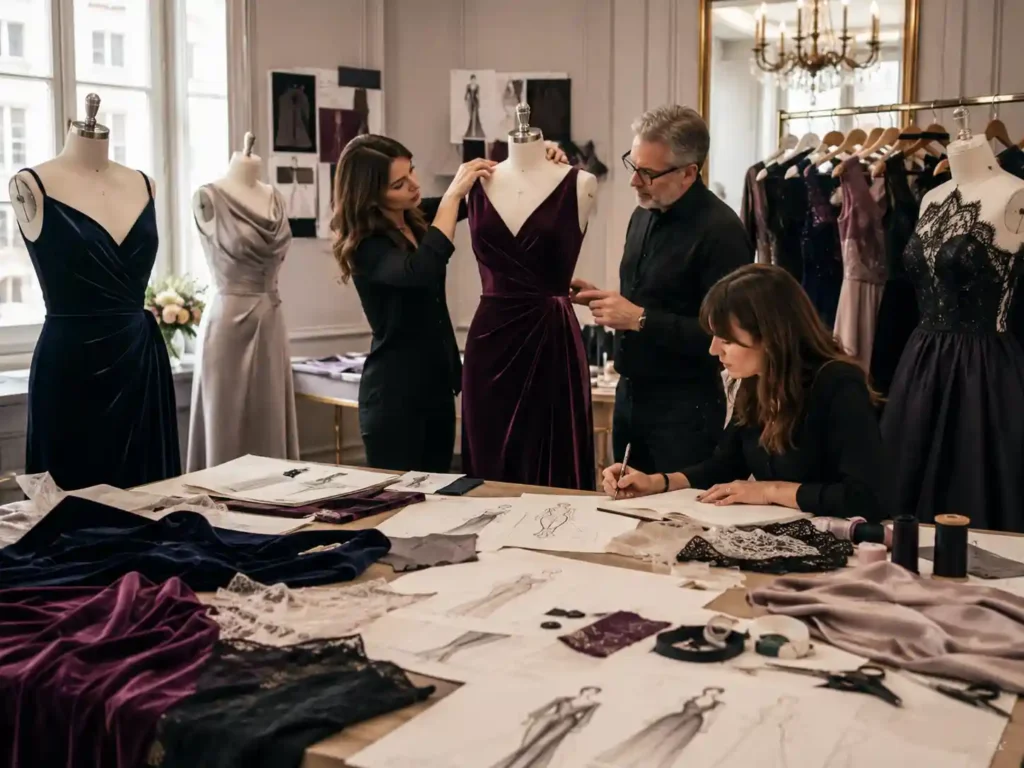
How Do You Test, Produce, and Refine the Collection?
A collection becomes commercially reliable when designs are translated into clear specifications, approved samples, repeatable production standards, and post-launch learning. Before bulk production, confirm fit, fabric, construction, color, grading, trims, packaging, and quality criteria. After launch, sales, stockouts, returns, and customer feedback should directly influence the next range.
Sampling Inputs
Sampling becomes slower and less accurate when key decisions are missing. A reference image can start development, but it does not define every measurement, seam, internal support, or material requirement. A useful package includes front and back technical views, base-size measurements, points of measurement, fabric composition and weight, stretch direction, lining, color references, seam details, closures, cups, boning, artwork, labels, packaging, target quantity, market, cost range, and delivery date.
When a full tech pack is not available, development can still begin from a sample garment, sketch, line sheet, size chart, moodboard, or detailed reference image. Every assumption should be documented and confirmed so that later changes are clearly separated from initial interpretation.
Sampling should test more than appearance. The garment needs to be evaluated while walking, sitting, raising the arms, and moving naturally. Strap security, zipper operation, neckline coverage, lining movement, transparency, seam tension, and recovery after wear all matter. A beautiful sample that only works while the model stands still is not commercially ready.
Sample Stages
Different samples answer different questions. A practical sequence may include a first sample for design interpretation, a fit sample for measurement and balance, a revised sample for corrections, a photo or salesman sample for presentation, a size-set sample for grading, a pre-production sample for bulk approval, and a sealed reference sample for production and inspection.
The first sample should not be mistaken for the bulk standard. It may use substitute fabric, temporary trims, incomplete grading, or hand-corrected construction. Fit review should check neckline position, bust shape, waist level, side-seam balance, armhole comfort, skirt movement, zipper behavior, and total length—not merely whether the garment closes.
Complex corset, draped, lace, mesh, sequin, cut-out, and mixed-stretch designs usually need more development time than a clean woven shape. Revision time should be included in the launch calendar. Skipping one correction round can transfer a small unresolved issue into hundreds or thousands of garments.
Production Control
Bulk production should start only when the approved standard is clear. The factory needs a confirmed sample, final measurements, grading rules, fabric and trim specifications, color references, labels, packaging details, and inspection criteria. A controlled sequence normally includes incoming material inspection, fabric preparation, cutting control, bundle identification, sewing-line setup, initial production review, inline measurement checks, finished-garment inspection, pressing, packing verification, and final sampling inspection.
Quality problems often come from variation rather than total failure. One garment may look correct; the challenge is maintaining the same fit, seam quality, shade, trim position, and pressing result across every size and color. Multi-style collections also require careful separation because similar linings, zippers, labels, or shades can be mixed when storage and bundle control are weak.
Jinfeng Apparel operates 6 owned women’s fashion factories and works with 10+ long-term satellite production partners. Its documented system includes 18+ sewing lines, 6+ flexible production lines, 2 sample rooms, 7+ senior pattern makers, 20+ sample machinists, 15+ QC inspectors, and regular monthly capacity above 100,000 pieces. These resources are allocated according to product type, fabric, complexity, quantity, and delivery plan rather than treating every dress as the same production job.
Quality and Refinement
Inspection results should be recorded in a form that improves future products. A simple pass or fail decision is not enough. Track recurring issues such as bust variance, waist position, strap length, neckline gaping, side-seam twisting, uneven hems, zipper waviness, lining visibility, shade differences, sequin loss, lace mismatch, pressing marks, and packaging creases.
Customer returns add another layer of fit data. “Too small” is not precise enough; the problem may be the bust, upper arm, waist, hip, thigh, or total length. Product reviews and customer-service messages should be converted into measurable development questions. Fit consistency is especially important for repeat purchasing because a customer who trusts one dress is more likely to buy another.
After launch, review full-price sales, conversion, stockouts, return reasons, color performance, size demand, markdowns, and requests for new colors. Separate design problems from execution problems. A slow seller may have launched late or lacked key sizes. A high-return product may have strong demand but inaccurate fit information. Keep pattern, measurement, fabric, color, trim, workmanship, packaging, and inspection records so successful products can be repeated or extended without restarting from zero.
Build the Range Before You Build the Inventory

A balanced dress collection is not created by adding more sketches. It is built by making deliberate choices about customer, occasion, silhouette, length, fabric, color, price, size, quantity, and production risk. The strongest ranges give customers meaningful variety while keeping enough focus to protect fit consistency, inventory depth, delivery timing, and repeat-order potential.
Jinfeng Apparel is a Guangdong-based custom women’s fashion manufacturer supporting global brands and mid-to-large apparel clients with OEM, ODM, private-label, and custom dress production. Since 2008, the company has supported pattern development, fabric and trim sourcing, sampling, bulk production, quality control, private-label packaging, export coordination, seasonal collections, and repeat orders. The standard MOQ starts from 200 pieces per style/color, subject to materials, construction, and project requirements.